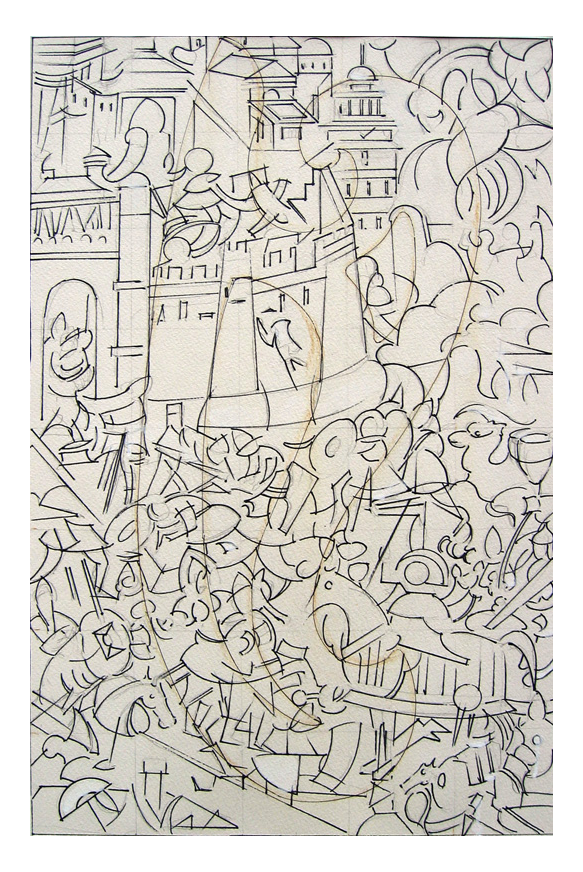
Ricardo F. Morín Untitled, 2005 Charcoal and black Sharpie pen 24 × 18 inches
Developers, governments, and those affected by artificial intelligence assign different significance to the same technical achievement. A developer seeking commercial advantage may treat an advance as grounds for ownership. A government concerned with strategic predominance may treat it as an instrument of national power. Those exposed to its consequences may judge it through its effects upon employment, education, communication, or public judgment. Each perspective depends upon relations that the achievement alone does not disclose.
These relations participate in development itself. Investors influence which problems receive attention. Owners determine who may use a capability and under what conditions. Governments establish permissions, restrictions, and incentives. The technology available to a user embodies decisions whose purposes need not be evident in its operation.
An answer appears on a screen. Its fluency may lead the user to accept it as sufficient for understanding. Yet the answer alone does not disclose how developers trained the system, which sources informed its response, what restrictions govern its output, or how developers organize its presentation to invite confidence. The user may find the answer useful without knowing all these conditions. That usefulness does not establish the adequacy of the answer.
Mediation names this dependence: understanding rests upon relations that attention to its immediate object does not necessarily reveal. The answer occupies the user’s attention. The conditions supporting its production, presentation, and acceptance remain only partially visible.
The public accounts of artificial intelligence exhibit a comparable dependence. Commercial accounts identify innovation through investment, demand, and return. Strategic accounts identify technological capacity through advantage over competitors. Security accounts identify uses through the dangers they introduce or prevent. Each account directs attention toward relations relevant to its purpose. Each leaves questions that its governing purpose cannot adequately answer.
These accounts also inform decisions. An institution that measures achievement through commercial return has grounds to favor applications for which customers will pay. A government that measures achievement through strategic advantage has grounds to favor capabilities that strengthen its position. The criteria through which an institution recognizes value therefore bear upon the purposes it authorizes and the resources it assigns. What remains outside those criteria may lack an effective claim upon its decisions.
Those who determine the terms of recognition can influence which needs count as reasons for action. Their authority does not follow from the completeness of their account. It may rest upon ownership, financial resources, statutory powers, or control over infrastructure. An account can govern development and can still leave much of its social significance unexamined.
The United States’ 2025 AI Action Plan explicitly frames development as a race for global dominance, and links technological leadership with economic and military advantage. The United Nations’ Global Digital Compact places international governance within a commitment to public benefit and inclusive participation. The former sets out actions for federal agencies; the latter records commitments among participating states. The purposes expressed in these documents operate through different institutional means. Their coexistence supplies no common authority for deciding between them when their demands conflict. [1]
Commercial success establishes that a product attracts expenditure. It does not establish how its benefits and burdens are distributed. National predominance establishes an advantage relative to other powers. It does not establish that the advantage improves the circumstances of those subject to its consequences. Protection against malicious use addresses a necessary concern. Authorized uses may also diminish the ability of people to understand, question, or influence decisions affecting them.
The capacities under development nevertheless permit achievements of substantial human value. Researchers can incorporate particular capabilities into successive stages of inquiry, and use them to examine complex relations, formulate hypotheses, and assist the design of inventions. Particular applications may support advances in medicine, materials, or other fields concerned with human welfare. The value of an achievement depends upon what it enables people to do and upon the consequences of its use. Commercial ownership or strategic sponsorship does not exhaust that value.
The same capacity to assist inquiry introduces uncertainty when institutions delegate decisions and actions to systems. Developers and users may permit a system to select means, initiate operations, or act upon other systems with limited intervention. Its effects then depend upon the scope of that permission, the conditions governing its operation, and the ability of those responsible to inspect or interrupt its actions.
Agency in these circumstances need not resemble human intention to exert power over human affairs. A system can influence conduct through recommendations that institutions routinely accept, classifications upon which access depends, or operations carried out under delegated authority. Uncertainty concerns how its actions will interact with circumstances its designers and users cannot fully anticipate, and how effectively human beings can retain control over those interactions.
The system may also influence the relations through which people understand and authorize its use. If an institution relies upon it to identify priorities, assess evidence, or evaluate performance, its outputs inform decisions about subsequent delegation. Authority initially granted by human beings can therefore support operations that shape the grounds upon which further authority is granted. The institution’s reliance upon the system extends beyond the performance of a task to the judgment of what tasks deserve performance and under whose direction.
Incremental benefit and uncertainty about agency can coexist within the same arrangement. An invention may improve human welfare, and may increase reliance upon systems that those affected cannot readily examine or contest. That reliance may rest upon cost, infrastructure, contractual restrictions, or the absence of practicable alternatives. Limited understanding can impede scrutiny of the arrangement without constituting its sole cause. The achievement retains its value. That value supplies no sufficient account of the reliance established through its use.
The betterment of society consequently depends upon more than the intentions of those directing development. If those institutions retain exclusive authority to define improvement, their criteria govern which consequences receive recognition. A gain in productivity may accompany diminished security of employment. Greater access to information may accompany greater reliance upon a small number of providers. Expanded capabilities may leave those affected with fewer means of challenging their application.
Who receives the benefit, who bears the burden, and who possesses authority to decide are distinct questions. An assessment confined to aggregate improvement can conceal the differences upon which its judgment rests.
The global reach of artificial intelligence extends those differences across societies. Worldwide availability does not establish worldwide participation in determining its purposes. A community may receive a system without the resources to adapt it to its language, examine its limitations, or challenge its terms of use. Providers extend access while they retain control over the conditions of participation. The technology serves a wider population without a corresponding distribution of authority over its development.
Nor does an appeal to the common good settle whose purposes should govern. Judgments about the common good depend upon whose circumstances receive attention, which consequences carry weight, and what forms of reliance people are prepared to accept. Institutions may affirm universal benefit while excluding affected communities from those judgments.
Technical competence, financial resources, political authority, security, and social need each sustain claims upon development. None supplies a sufficient account of the whole. Their unequal institutional power bears upon which claims govern, which remain negotiable, and which lack any effective means of expression.
Where institutions treat one criterion as sufficient, their judgments substitute a partial measure for the relations supporting it. Commercial actors identify expansion with progress. Governments identify predominance with protection. Security authorities identify the prevention of prohibited uses with safety. Providers identify availability with participation. Each identification leaves dependencies outside the account through which the undertaking is justified.
The answer on the screen offers the user something immediately available for judgment. Its usefulness may be real. Its fluency does not disclose who determined its conditions, what authority supports its use, or how reliance upon it influences subsequent judgment. The emerging capacities of artificial intelligence extend the consequences of those relations. Those who delegate authority to systems require knowledge of the conditions governing the systems and powers to withhold, limit, or revoke that delegation. Those affected without participating in the delegation stand in a different relation: their ability to contest its consequences depends upon access to the grounds of decisions and institutional means of holding the delegating authorities answerable.
Suprematism functions as the universal grammar of repressive justification. Suprematism is less a doctrine than a habit of explanation: the manner in which domination comes to sound necessary, privilege comes to appear orderly, and exclusion comes to be described as preservation. Its forms vary—race, religion, nation, civilization, party, historical destiny—but its logic remains constant: some are presumed fit to decide, others to comply.
This habit is not confined to any one society or system. It appears wherever hierarchy can be narrated as natural or deserved, and wherever authority is spared the burden of explanation. What distinguishes societies is not their immunity to suprematism, but the degree to which it is restrained. Progress does not consist in its disappearance, but in limiting the circumstances under which supremacy can excuse itself.
When that restraint weakens, advantage acquires moral cover, grievance hardens into entitlement, and authority reorganizes itself around exception rather than obligation. Suprematism then ceases to be merely a social tendency and becomes a principle of coherence—one that prepares the ground for repression not by force, but by familiarity.
Suprematism is rarely named at the moment it takes hold. It enters social life quietly, through habit rather than declaration, and through permission rather than force. Most people encounter it not as a belief, but as a pattern: who is trusted without question, whose mistakes are forgiven, whose grievances are taken seriously, and whose presence is treated as a complication. Long before it becomes political, suprematism arranges everyday expectations.
At its core, suprematism is the assumption that order depends on hierarchy—that some are naturally entitled to decide, while others must adapt. This assumption has appeared in every form of organized society. It attaches itself easily to existing distinctions, but does not depend on any of them. Its content changes. Its function does not. Wherever it takes root, it relieves power of the burden of explanation and replaces justification with inheritance.
Historically, efforts to restrain such arrangements have rarely depended upon the actions of those most affected by them alone. Groups subjected to discrimination often possess the least access to the institutions capable of altering laws, customs, and public attitudes. As a result, challenges to entrenched hierarchies have frequently depended upon the participation of individuals and institutions situated within the very structures being contested. The durability of supremacy lies not only in the injuries it imposes, but also in its capacity to limit the means through which those injuries can be redressed.
No society outgrows this impulse. What matters is whether it is constrained. Where restraint holds, authority remains conditional, rules survive inconvenience, and grievance does not harden into entitlement. Where it weakens, dominance reappears under new names, and inequality begins to feel practical rather than dangerous.
Suprematism becomes most persuasive in moments of strain. Economic uncertainty, cultural change, and political fragmentation make procedural life feel slow and fragile. In such moments, hierarchy offers clarity. It promises stability without negotiation and coherence without equality. What it conceals is the cost of that promise: the quiet replacement of shared obligation with selective privilege. These conditions do not create suprematism; they reveal how readily it adapts to the language through which societies interpret threat.
In contemporary American politics, strands of conservatism increasingly function not as custodians of institutional continuity but as vehicles through which suprematist reasoning finds renewed expression. The language of preservation — tradition, order, cultural defense — often serves to frame hierarchy as necessity rather than preference. Within segments of the Republican Party, populist rhetoric recasts political disagreement as a struggle between an authentic people and forces portrayed as alien or corrupt. This framing does not merely mobilize support; it reorganizes legitimacy itself, narrowing the field of acceptable plurality while presenting exclusion as protection.
Historically, populism has not always culminated in authoritarian forms, yet its grammar lends itself to them when grievance becomes the organizing principle of political identity. Suprematism thrives precisely in such moments, because it does not require explicit doctrine; it operates through the normalization of unequal standing and through narratives that portray dominance as restoration. What appears as resistance to change thus becomes a mechanism by which hierarchy is reaffirmed under the guise of necessity and allows power to concentrate while it retains the appearance of democratic expression.
Because the premise concerns order rather than identity, it travels easily across contexts. In one place it is spoken plainly; in another it is implied through custom or history. Everywhere it functions by the same means: by presenting inequality as inheritance rather than choice, and by treating dominance as continuity rather than imposition. Its strength lies not in what it claims, but in how little it needs to explain.
What has been accepted socially soon reorganizes authority. Once unequal power is experienced as stabilizing, its concentration no longer appears alarming. Decisions migrate upward with little resistance, justified less by argument than by temperament, experience, or presumed fitness. Exception enters quietly, not as a rupture but as an adjustment, a temporary deviation said to protect what remains intact. Law continues to exist, but its role shifts. It no longer governs in advance. It follows explaining afterward what authority has already decided.
When this reorganization occurs, authority begins to act directly rather than procedurally. Executive power is justified as the fulfillment of popular expectation and treated as license to bypass legislative and judicial mediation. Enforcement expands inward, organized around targets rather than warrants, and selection shifts from proven violation to presumed risk. At the same time, electoral administration is recast as a security problem, with authority drawn upward from the states on the claim that existing safeguards cannot be trusted. In both cases, an asserted threat is used to replace prior limits with command, to concentrate power, and to present the change as necessity rather than choice.
As this pattern settles, restraint becomes uneven. Rules remain visible, but their force depends increasingly on who invokes them and against whom. Obligation is emphasized downward, while discretion accumulates upward. What was once justified as exception begins to feel ordinary, even prudent. The expectation that authority must submit itself to procedure weakens, replaced by a belief that outcomes matter more than the means by which they are reached. Constitutional life does not disappear; it thins. It survives as language and form, while its discipline is quietly set aside.
Suprematism does not announce itself as cruelty or ambition. It presents itself as common sense. It appears whenever power no longer feels obliged to explain itself, and whenever inequality is treated as a condition of order rather than a failure of it. Societies do not collapse because they lack ideals, but because they grow accustomed to exemption. When supremacy is permitted to justify itself—by history, identity, urgency, or fear—law becomes selective, authority becomes personal, and procedure becomes a formality observed only when convenient. The disorder that follows is not chaos, but a disciplined imbalance in which restraint is asked of some and entitlement is granted to others. This is how constitutional life ends: not in rupture, but in acceptance.
Ricardo F. Morín Persian Three 19” × 29” Graphite, sanguine and Sumi ink on watercolor paper 2003
The present crisis does not begin with soldiers in the streets or laws being openly suspended. It begins earlier, in our thoughts and conversations, as words change their meaning. Before courts are bypassed or elections are challenged, the language used to describe legality begins to shift. Words once tied to injury become tools of accusation. Authority moves first by changing how things are said, long before procedures are changed.
The shift is often noticed first not in statutes, but in how accusations are repeated on television, in hearings, and in everyday conversation, long before any ruling is issued.
A person opens an official notice declaring that a “violation” has occurred, yet the document contains no description of the act, no evidence to examine, and no process by which the finding might be contested. What is presented is not an allegation awaiting review, but a conclusion that now governs what actions are permitted next.
In earlier constitutional systems, a violation referred to a specific act. Evidence had to be gathered. Law had to be applied. A process had to be followed. Today, a violation is increasingly declared rather than demonstrated. The word no longer signals a legal test. It signals that judgment has already been made. What once required adjudication can become an instrument of command.
A rule can then be enforced before the disputed premise on which it rests has been adjudicated. The affected party may retain a right of review, but review occurs after the language of violation, necessity, security, or compliance has already supplied a reason for action.
Language and procedure meet at that point. A disputed condition is named as though established; governmental action proceeds upon the name; review follows.
This logic became visible on January 6, 2021. An election certified through legal procedures was declared illegitimate by assertion. A lawful transfer of power was described as theft. Defeat was renamed a violation. What followed was not confusion. It was narrative replacing legal process.
The legal aftermath did not produce a single institutional resolution. The federal prosecution concerning efforts to overturn the 2020 election was dismissed in November 2024 after Donald Trump’s reelection, pursuant to the Department of Justice’s longstanding position concerning prosecution of a sitting President. On January 20, 2025, presidential clemency commuted the sentences of fourteen people convicted of offenses related to January 6, granted full pardons to the other individuals convicted of such offenses, and directed the Attorney General to seek dismissal with prejudice of pending indictments arising from January 6. The Georgia election-interference prosecution against Trump was dismissed in November 2025.
Different proceedings ended through different constitutional and procedural mechanisms. None produced a final adjudication of the federal election-interference charges against the returning President.
The sequence also appears in administrative government.
In 2026, the Department of Homeland Security made full receipt of specified counterterrorism grants conditional upon changes to state and local election administration, with 20 percent of an award subject to withholding for noncompliance. Six cities and counties challenged those conditions. On September 28, a federal court held that the Federal Emergency Management Agency lacked congressional authority to impose them and vacated the election-related requirements.
The judgment demonstrates that constitutional restraint had not disappeared. Judicial review remained capable of making restraint effective. The disputed condition nevertheless existed as an administrative command before judicial review determined whether the agency possessed authority to impose it.
The constitutional difficulty lies in that interval. Governmental action and its prospective consequences can precede the institutional judgment that determines the lawful limits of the authority asserted.
The same sequence appears in less formal civic encounters. A courthouse remains open. Hearings are scheduled. Filings are accepted. Yet a consequential determination may already govern the person who seeks review. Procedure remains available, but it begins after the disputed condition has acquired practical effect.
Beyond the United States, a related distinction separates power from sovereign authority. Military or diplomatic power may alter the circumstances in which another State decides. It does not itself determine the sovereign competence by which that decision becomes lawful.
Earlier claims about acquiring Greenland treated territorial control as an object of strategic necessity. On September 22, 2026, the United States, Denmark, and Greenland signed an agreement that instead proceeds through the existing defense relationship. It would permit new American facilities at Narsarsuaq and Mestersvig, expansion of Pituffik Space Base, and broader American military access while leaving Greenland within the Danish realm and affirming its right to self-determination. The agreement remains subject to parliamentary approval in Greenland and Denmark.
Pressure did not itself transfer sovereignty. The arrangement that followed requires agreement and constitutional process.
On September 1, Venezuela’s National Assembly approved an oil agreement between Venezuela and the United States involving 17 fields and approximately one-fifth of the country’s oil reserves. Some opposition legislators abstained because they had not been able to examine the written terms of the agreement. The legislative act is part of the constitutional record; it cannot simply be disregarded. It also does not answer a different question: what constitutional competence the Venezuelan institutions presently exercising power possess to create rights intended to endure far beyond the present government. American recognition can determine whom the United States treats as Venezuela’s government. It cannot answer that Venezuelan constitutional question.
Across these cases, law has not disappeared. Courts adjudicate. Legislatures enact. Agreements remain subject to constitutional process. The difficulty appears in two related forms: power may act before review determines its lawful limits, and power may alter the circumstances in which another sovereign must exercise its own authority.
Language gives the first condition institutional force and can accompany the second. A disputed premise described as a violation, necessity, security requirement, or act of compliance can begin to govern conduct before the institutions charged with determining its legal consequences have completed that determination.
What emerges is power that remains procedurally recognizable as lawful while the limits of its authority remain subject to determination. Procedure survives. The sequence changes.
The danger lies in what language permits power to present as already decided. When accusation becomes violation, necessity becomes authority, and compliance becomes evidence of legality, judgment begins after its vocabulary has been supplied by power.
The first freedom is judgment.
Freedom survives only where judgment remains possible. Judgment survives only where language has not yet been taken over by power.
Ricardo F. Morín September 30, 2026 Bala Cynwyd, Pennsylvania
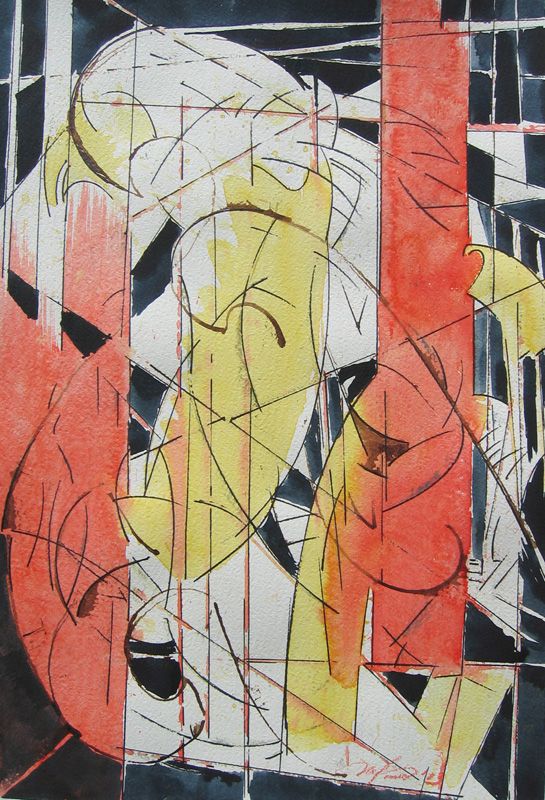
Ricardo F. Morín Templates III 14” x 20” Watercolor and ink on paper 2003
People often discover that what they say or do does not remain where they placed it. A remark made in passing is repeated elsewhere. A decision taken for one purpose is later cited for another. Words meant to clarify are reused to justify actions the speaker never anticipated. Once expressed, what has been authored moves beyond the situation in which it was produced and enters contexts the author does not control.
What is written, declared, or enacted does not retain its meaning by remaining tied to intention. Readers, listeners, colleagues, and institutions receive what has been authored through their own expectations, needs, and circumstances. As situations change, the same words or actions are taken up differently. Meaning migrates not because authors relinquish care, but because interpretation unfolds wherever what has been authored circulates.
As interpretation accumulates, the link between origin and significance loosens. What an author sought to express does not vanish, yet it no longer governs how the expression will be understood or used. Each act of reception introduces new relations, drawing on conventions and pressures that exceed the author’s horizon. Over time, layers of meaning form that cannot be reduced to a single originating moment without loss.
Under these conditions, authority persists without control. Authored material continues to shape understanding and guide action even as the author’s capacity to direct its meaning diminishes. Texts, decisions, and gestures acquire standing not because their origin remains present, but because their effects endure within systems that rely on them. Authority attaches to circulation and use rather than to command.
When authorship is mistaken for sovereignty over meaning, confusion follows. Attempts to fix interpretation by appealing to origin fail to account for the fact that meaning arises through use rather than preservation. Efforts to reclaim control often generate conflict instead of clarity, as different contexts assert incompatible claims on what has been authored. What collapses in such moments is not meaning itself, but the assumption that meaning can be governed from a single point.
Authorship therefore functions as an unavoidable condition rather than a position of mastery. To author is to introduce words or actions into a field where interpretation proceeds independently of intent. What remains with the author is not ownership of meaning, but exposure to its unfolding. Authorship binds the author to consequences that continue to develop as what has been authored acquires significance beyond its initial articulation.
Authorship persists not as sovereignty over meaning, but as exposure to the ongoing movement of significance as what is authored circulates beyond its origin.
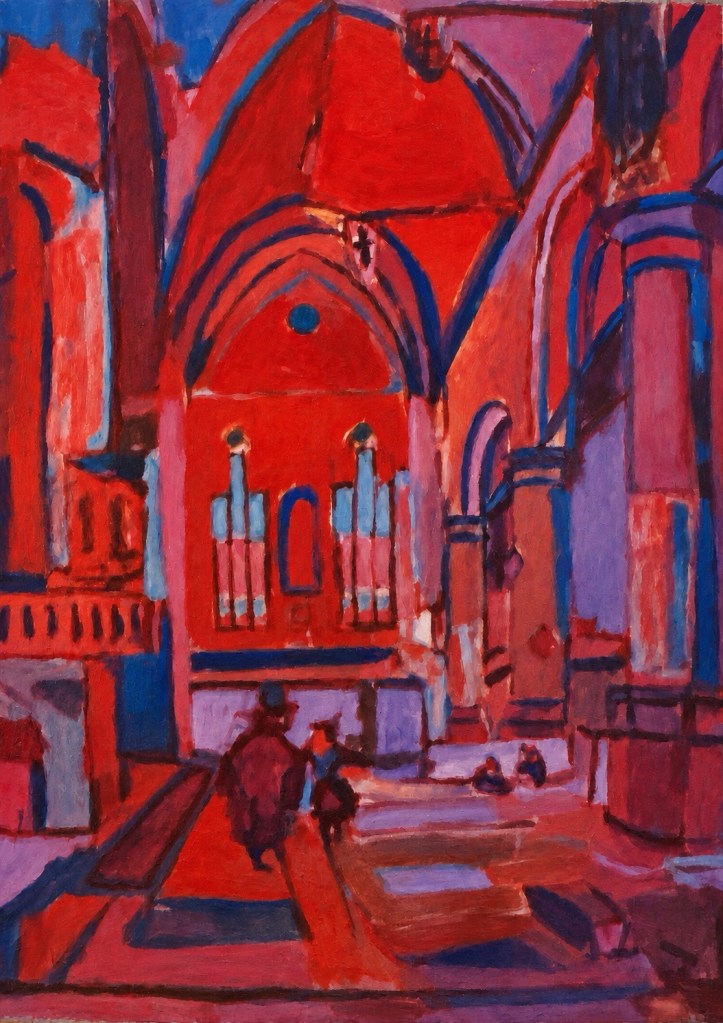
Ricardo F. Morín Interpretation after Gothic Church Interior, Dutch School, 17th century. Acrylic on board Approximately 12 × 18 inches 1978
The mind can conceive explanations that exceed what it can establish. The difficulty begins when it grants those explanations an authority that the available reasons do not justify. A conviction then acquires the standing of knowledge without satisfying the conditions that would warrant that recognition.
Theology, astrology, and science do not justify their claims in the same way. Theological arguments may appeal to revelation, tradition, religious experience, or philosophical reasoning. Astrological predictions assert relationships between celestial patterns and human affairs that require empirical support. Scientific explanations acquire credibility through evidence, testing, and comparison with alternatives, while remaining subject to correction. These differences matter: openness to examination does not make all claims equally credible, and the inability to disprove a claim does not establish its truth.
The fact that the mind conceives an explanation does not establish that its object is imaginary. The question is what warrants accepting it and what could require its revision. When every possible outcome is interpreted as confirmation, experience ceases to distinguish between the belief and its alternatives. If no outcome can count against it, its apparent agreement with everything that happens cannot by itself establish its validity.
Astrology illustrates how this problem can affect agency. An accepted prediction may influence decisions, discourage attempts, and narrow the possibilities a person is willing to pursue. When those choices help produce the anticipated outcome, the person may attribute it to destiny, overlooking the contribution of the expectation itself. The prediction need not come true to impose a limitation: a belief about what must happen can restrict what a person attempts to make happen.
Reflection requires the discipline of keeping conclusions open to examination and revising them when the evidence warrants it. That discipline extends to convictions that provide comfort, coherence, or direction. It requires neither perpetual indecision nor equal doubt about everything, but confidence proportionate to justification.
The endurance of an assertion does not by itself establish its truth, and its openness to revision does not mean that it must eventually prove false. The mind compromises its capacity for discernment when it ceases to examine the convictions that guide its decisions.
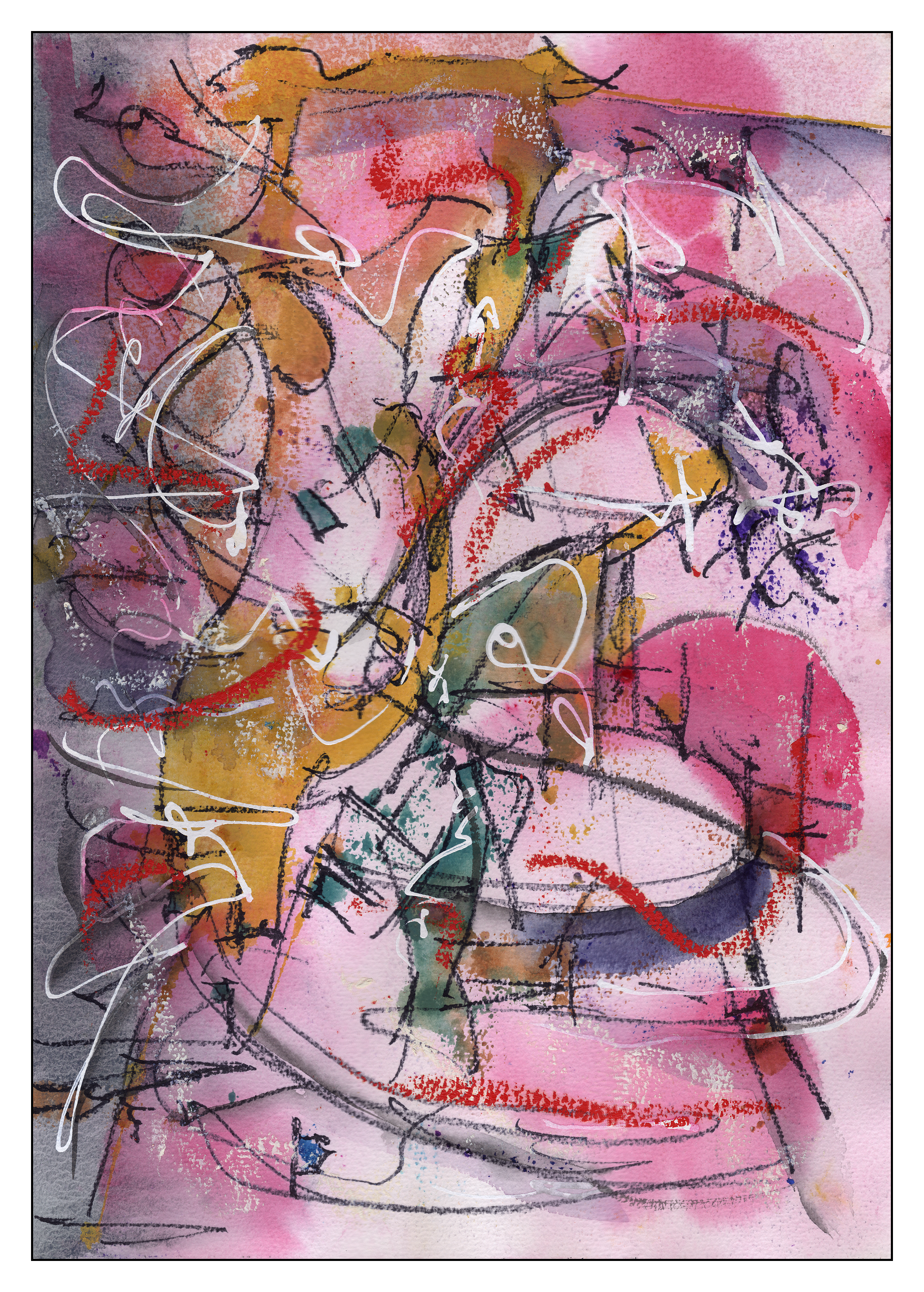
Ricardo F. Morín Infinity Strata 14″ x 20″ Watercolors, charcoal, dyes, oil and white-out on paper 2005
People learn about the past through what others tell them. Parents recount earlier times, teachers explain events in sequence, officials issue statements, and communities preserve stories that explain what happened and why it mattered. These accounts do not present the past in full. They select certain events, connect them to one another, and give them weight, while leaving other events aside. Over time, these explanations become familiar ways of understanding where things came from.
As circumstances change, people return to these same accounts to make sense of new situations. Without discovering new facts, speakers may emphasize different events, draw new connections, or describe the same outcomes in a different light. An episode once mentioned briefly may later be treated as decisive. An outcome once described as accidental may later be explained as necessary. What changes is not what occurred, but how people organize and invoke it.
The people who recount the past do so from their own positions. Each account reflects what its speaker can see, remember, and explain. No one holds the entire picture. Authority does not arise because any single account is complete or neutral. Authority arises when multiple accounts begin to overlap. When different people, speaking from different positions, refer to the same events in similar ways, their accounts reinforce one another. What gains standing is not a privileged viewpoint, but a pattern of references that becomes easier to repeat, teach, and rely upon.
Because of this, continuity is not discovered in the past; it is assembled after the fact. People draw lines between events that were not experienced as connected at the time. Periods receive names, turning points are identified, and beginnings are assigned only after later developments make such arrangements appear sensible. The coherence that history presents reflects how events are organized in retrospect, not how they were lived as they unfolded.
Historical authority does not grow from adding more facts alone. It grows from stabilizing a way of arranging those facts. Once a particular ordering becomes familiar, it serves as a reference point. Other explanations are not dismissed because they lack information, but because they do not fit the prevailing way of connecting events. Authority attaches to the arrangement that holds together, not to the archive itself.
As the principles used to organize the past shift, authority shifts quietly with them. The same dates, names, and events remain visible, yet their relationships and implications change. Because the surface details persist, the deeper reorganization often goes unnoticed. What changes is not the record, but the logic through which the record is made intelligible.
History therefore does not offer a fixed account of what occurred. It offers a way of making sense of what occurred that holds long enough to guide understanding and action in the present. That coherence remains contingent on the conditions that sustain it. When those conditions change, historical accounts do not disappear; they reorganize. Authority persists not because the past has been settled, but because a particular ordering continues to function.
History acquires authority not by fixing the past, but by stabilizing an arrangement of events that can endure long enough to orient judgment, even as the principles that produce that arrangement continue to change.
Ricardo F. Morín Furrows That Do Not Hold 14 x 20 inches Water color, dyes, oil sticks, white-out pen, and charcoal pencil 2008
Author’s Note
This essay appears in English under the title Furrows That Do Not Hold, which does not translate the original Spanish title but restates the condition it describes. The choice is not stylistic. It reflects the limits of how English prose carries figurative density without altering diagnostic function.
In English, a literal rendering of the image tends to register as proverb, allegory, or parable. Such a register introduces interpretive expectations the essay does not intend to activate. To preserve an observational and unsentimental tone, the English title names the condition in operational terms rather than reproducing the image.
In Spanish, the essay appears under the title Arar el mar sin cosechaalguna.In that linguistic context, the image can sustain historical gravity—including biblical cadence—without becoming moral instruction or rhetorical emblem. The phrase names a condition directly: real labor, a medium that does not retain marks, and the structural absence of yield.
This asymmetry is not incidental. It reflects the problem the essay examines: the limits of transmission across contexts. Meaning does not pass intact between generations any more than it does between languages. What can be preserved is not form, but function, when conditions permit reception.
Ricardo F. Morín
Oakland Park, Fl
Dec. 19, 2025
I.
Work continues. It is visible, organized, and often diligent. Tasks are performed, systems maintained, language refined, and processes repeated. The difficulty is not the absence of effort, nor even its misdirection, but the absence of accumulation—understood here as the condition that allows externally generated knowledge to be received, retained, and re-entered as orientation rather than reenacted as effort. What is done does not remain available for re-entry; the work does not carry forward.
This condition is easily mistaken for exhaustion or indifference. It is neither. The signs of engagement are everywhere. Activity increases. Responsiveness improves. Output multiplies. What disappears is continuity.
In such environments, motion replaces inheritance. The value of action lies in its execution rather than in what it leaves behind. Work proceeds as if each instance were sufficient unto itself. The past is not rejected; it is simply not retained in a form that can be re-entered.
II.
Experience is not a substance that can be passed intact from one holder to another. It is formed under pressure: through duration, consequence, and constraint. When detached from those conditions, it arrives flattened. What once clarified limits now appears as commentary. What once compelled adjustment now reads as preference.
Attempts to transmit experience as instruction often fail because they precede necessity. The recipient encounters the lesson without the conditions that gave it force. The knowledge arrives before the situation that would make it intelligible. What is offered in advance of need appears optional, even when it is exact.
This failure is not cognitive. It is temporal. Experience cannot be received on demand because it does not function as information (it cannot be accumulated in advance of necessity). It functions as orientation, and orientation requires circumstance.
III.
Autonomy is essential to judgment. Without it, action collapses into obedience. Yet autonomy becomes obstructive when it refuses inheritance. Agency hardens into the assumption that value must be self-generated in order to be legitimate. What comes from elsewhere is treated with suspicion, not because it lacks relevance, but because accepting it appears to compromise independence.
Under this posture, reception is mistaken for dependence—the refusal of accumulation as orientation from elsewhere. Learning from prior experience feels like concession rather than orientation. The capacity to receive is replaced by the obligation to originate. Knowledge must appear new in order to count.
The result is not freedom, but isolation from accumulated sense. Experience remains available, but unreadable. It circulates as language without uptake, gesture without consequence.
IV.
Where transmission falters, novelty becomes proof of validity. What appears new is granted authority by contrast alone. The question of whether a condition has already been encountered is displaced by the pressure to demonstrate originality.
Reinvention follows not because prior solutions failed, but because their success left no visible trace (no accumulated precedent). What worked quietly does not announce itself as precedent. The wheel is reshaped to display initiative, not to improve function.
This is a categorical error. Effort persists, but the tool is mismatched to the medium. Methods designed for accumulation are applied where marks do not hold. Raking the sea fails not because nothing is done, but because the medium erases furrows as soon as they are made.
V.
In such conditions, motion substitutes for progress. Systems reward speed, output, and responsiveness. Pause appears as inefficiency. Return appears as delay. Depth is displaced by throughput.
Iteration is mistaken for understanding. Repetition becomes evidence of engagement. The absence of yield is attributed to insufficient effort rather than misalignment. The response is to intensify motion rather than to reconsider posture.
Progress is measured by displacement rather than retention (rather than accumulation). What matters is that something happens, not that it remains available for use. The future is constantly entered, but never furnished.
VI.
The sea persists. It does not resist effort, nor does it respond to insistence. It remains indifferent to force. Furrows disappear not in defiance, but in indifference. The labor is real; the absence of harvest is structural.
Exhaustion accumulates privately while systems remain unchanged. Each attempt begins again. What was learned is learned again. The cost is borne individually; the benefit does not carry forward.
This condition is not decline, decay, or loss of intelligence. It is not moral failure or generational fault. It is the predictable result of environments that reward autonomy without reception, novelty without continuity, and motion without accumulation.
Ricardo F. Morín Triangulation Series Nº59 12” x 15” Oil on linen 2009
* *
Knowledge enters common life through relations among persons. A proposition privately held may possess coherence, explanatory force, or evidentiary support, yet its public standing begins when the proposition becomes available to the examination of others. Agreement is only one possible response. Contradiction, revision, qualification, and the discovery of error also participate in the process through which a claim becomes intelligible beyond the judgment of the person who formed it. Validation, in this sense, does not mean approval. Validation refers to the exposure through which knowledge becomes subject to other judgments within a world no individual determines alone.
A claim, however, is never presented without the person who advances it. A response to the proposition consequently affects the claimant. Confirmation may establish credibility; correction may diminish it; and sustained attention may confer significance upon both the subject and the person addressing it. The validation of knowledge and the recognition of the knower remain distinguishable, but they do not remain separate. Each encounter with a claim contains the possibility that an examination of what is known will also become a judgment concerning the person who claims to know it.
Recognition is not an incidental intrusion into an otherwise impersonal activity. Language, instruction, and intellectual formation arise within relations through which individuals learn not only what may be known but whether their own perceptions merit expression. The need to be recognized accompanies the acquisition of knowledge because the person acquiring it also acquires a position from which to speak. Psychological vocabularies may identify intensified forms of reassurance seeking, contingent self-worth, or dependence upon approval, but the underlying condition precedes those definitions. The condition belongs neither to a diagnosis nor to a particular type of person. The condition is present wherever a human being submits a judgment to another consciousness and awaits a response whose meaning cannot be restricted to the judgment alone.
Repeated confirmation alters the relation between a claim and its source. A person whose judgments have proved reliable acquires credibility extending beyond the propositions already examined. Institutions formalize the extension of credibility through credentials, offices, publications, and titles; informal relations establish credibility through memory, reputation, and trust. Authority permits knowledge to circulate without requiring every proposition to be reconstructed from its foundations. The listener accepts that the speaker has previously undergone forms of examination whose repetition would be impracticable in every exchange. When the listener relies upon that prior credibility, the standing of the person may precede the standing of the claim. Confidence derived from particular judgments can therefore extend to the individual who produces them.
That extension of confidence may become more persuasive when extensive information, fluency across several vocabularies, and familiarity with multiple fields make intellectual breadth visible as a characteristic of the person. Such breadth may result from sustained study and may support comparisons among fields. Breadth alone does not disclose how knowledge from different fields has been organized. Information from several fields can coexist without mutual explanation; proficiency in those fields can coexist with uncertainty concerning the relations among the premises of those fields. The quantity and range of information may influence judgment apart from demonstrated organization. Accumulated knowledge may therefore be interpreted as comprehensive understanding.
That interpretation becomes more consequential when different fields are presented as a synthesis. Disciplines do not merely contain different information about a common reality. They establish objects through distinct methods, employ terms whose meanings depend upon particular histories, and recognize evidence according to standards that may not correspond. An explanation of human conduct, for example, may move from a neurological description to an ethical conclusion and from that conclusion to a theory of social order. Each transition may be intelligible, yet the evidence supporting the neurological description does not by itself establish the ethical conclusion, and the ethical conclusion does not by itself establish the theory of social order. Continuity of vocabulary may make the sequence appear complete before the relations have been demonstrated. The relation among fields may be demonstrated, remain provisional, or contain contradictions that no common vocabulary resolves. Describing the conjunction of the fields as synthesis does not reveal the status of that relation. The term synthesis indicates that coherence is being claimed, although the source of that coherence may still require examination.
Where the relations among fields remain incompletely demonstrated, acceptance of their asserted unity may depend partly upon confidence in the person presenting the synthesis. The range of the person’s knowledge, the fluency of the presentation, and the authority accumulated through previous exchanges can support acceptance of connections that the propositions themselves do not establish. Although this dependence does not demonstrate that the connections are mistaken, it discloses a change in the basis of coherence. The claim submitted for validation then concerns not only the relations among ideas but also the capacity of the person to comprehend those ideas as a totality.
Once acceptance depends partly upon the presenter, the passions of the knower may also affect the authority attributed to the synthesis. Acquiring information may alter how a person understands ambition, fear, attachment, resentment, and the desire for recognition without extinguishing any of them. A person may describe the operation of a passion while remaining subject to it; the capacity to identify a limitation does not confer command over its effects. Intellectual vocabularies may also make a passion more difficult to perceive: the desire for authority may be interpreted as service, the need for recognition as intellectual responsibility, and attachment to a conclusion as fidelity to truth. No clinical condition is required for these interpretations. They may arise from the influence of the knower’s motives upon the acquisition and presentation of knowledge.
Relational consequences arise when another person responds not only to what has been said but also to the authority attributed to the speaker. Agreement may confirm a proposition while also sustaining an identity organized around competence. Disagreement may concern a limited inference but be received as a withdrawal of confidence from a larger intellectual structure. The interlocutor then occupies more than one position: examiner of the claim, witness to the knower, and participant in the preservation or alteration of an established authority. These functions may coexist without becoming visible to either participant. The exchange continues to concern knowledge, but the response may also confirm or weaken the authority attributed to the claimant.
Unresolved relations among fields may also affect the understanding of a recipient. Confidence in the presenter may influence how the recipient evaluates those relations: a conjunction may be accepted as an established synthesis even when the recipient lacks the means to examine whether the constituent conclusions are compatible. The resulting confusion need not be recognized as confusion. The language supplied by the authority may give the conclusions internal consistency, and those conclusions may therefore be reproduced through subsequent explanations, instruction, or advice. The consequence does not depend upon deception. A person may sincerely transmit a coherence whose unresolved premises remain inaccessible to the recipient and perhaps insufficiently visible to the person who asserted it.
Recognition, however, is not sought only through the presentation of competence. A person may also disclose a limitation within a relation. An admission of imperfection may function as a request for reassurance or assistance, but the admission may also disclose a limitation without requesting either response. In the latter case, the speaker may neither deny the limitation nor experience the admission as an injury to self-worth. Fellowship may characterize an exchange in which the admission establishes trust between the speaker and the interlocutor. Both participants may then recognize vulnerability without interpreting the disclosure as a request for correction.
The interlocutor cannot determine the intended function of a disclosure from its content alone. An ordinary exchange may demonstrate this uncertainty. During a familiar conversation, a person may remark without distress that a notebook compensates for an unreliable memory. A companion may interpret the remark as self-denigration and respond by rejecting a judgment that the speaker had not experienced as injurious. An admission offered as trust may be heard as self-devaluation; an acknowledgment of limitation may be received as evidence of a distorted judgment requiring correction. A response may proceed from concern and still address a need that the speaker did not express. Through the disclosure, the speaker may establish trust, while the interlocutor may protect the speaker from a judgment considered harmful. Neither intention necessarily excludes regard for the other. The corrective response may convert disclosed vulnerability into an occasion for instruction.
The presentation of knowledge and the admission of limitation may perform different functions, yet both disclose the dependence of meaning upon response. A claim submitted for examination may be received as a demand for recognition of the claimant. A disclosure offered in fellowship may be received as a request for correction. In each instance, the interlocutor assigns a function to what has been communicated and thereby affects how the speaker and the interlocutor understand the exchange. Neither participant can determine that function alone: the person who speaks cannot control its attribution, and the interlocutor cannot recover intention without interpretation. Validation, recognition, and correction therefore arise not as fixed categories but as possible effects of an exchange whose participants may understand its purpose differently.
The attribution of wisdom may combine assessments of knowledge, passion, recognition, and limitation within a single judgment. Wisdom may be associated with the possession of extensive knowledge, the ability to relate different fields, composure before adversity, command over passion, or recognition of human limitation. These qualities can appear together, but their conjunction is not assured. Accumulated knowledge can coexist with unexamined assumptions; intellectual range can leave contradictions unresolved; apparent composure can depend upon the confirmation supplied by others; and acknowledgment of limitation can itself become part of an identity requiring recognition. The attribution of wisdom consequently reveals not only an assessment of the person but also an expectation concerning what knowledge is presumed to have accomplished within that person.
No separation of knowledge from recognition resolves the condition, since knowledge becomes social through responses that inevitably affect the person who speaks. Nor does the acknowledgment of vulnerability determine whether another person will receive the admission as fellowship, reassurance, or an occasion for correction. Greater awareness of these distinctions may itself become another claim to discernment and another position from which the conduct of others is evaluated. The analysis therefore does not yield a procedure by which validation can be purified of personal need or relations protected from every misalignment. The attempt to prescribe such a procedure would repeat the movement under examination by converting the recognition of a limitation into a claim of mastery over it.
Knowledge becomes public through examination, but the person who presents it remains exposed to what examination may confer or withdraw. A disclosure of vulnerability remains subject to the same uncertainty because its reception may convert an admission into a judgment the disclosure did not contain. Validation, correction, and recognition become distinguishable only after a response has altered the meaning attributed to the claim or disclosure. The analysis of those effects remains subject to the same condition: its distinctions become available for examination and may acquire authority through the recognition of those who receive them. Human beings require others to discover what their claims can sustain, yet neither the claim nor its analysis determines what follows from the presence of others.
In a recent exit interview published by The New York Times, Ross Douthat interpreted several transformations in American politics and culture through a vocabulary whose principal terms appeared to require no explanation. “Conservatism,” “liberalism,” “the right,” and “the left” appeared as recognizable conditions, constituted in advance and available for comparison. Douthat’s familiarity with the institutions and political tendencies under examination conferred upon those terms the authority that their definitions did not provide.
The difficulty lies not in the substance of the convictions expressed by Douthat, but in the categories through which those convictions are recognized and classified before they are examined. The words through which the argument proceeds do not identify stable objects. Those words gather different histories, institutions, dispositions and political constituencies under names whose apparent familiarity conceals their instability. The speaker can then move among electoral conduct, religious belief, party organization, ethical judgment and cultural temperament without establishing the relation among those matters. The word remains constant while its referent changes.
This instability is not peculiar to one commentator. Conservatism and liberalism have become political names whose authority often exceeds their descriptive capacity. Both terms are invoked as though they designated two coherent conditions through which persons and societies might be classified. Yet neither condition exists independently of the judgments made in its name. No society conserves everything it receives, and no society releases every person from every restraint. The decisive question is therefore not whether an order conserves or liberates, but what it preserves, which restraints it maintains or removes, who makes those determinations and through which institutions they acquire force.
Conservatism is frequently associated with preservation, although preservation alone cannot define it. Every political order preserves laws, expectations, jurisdictions and forms of conduct. Revolutionary governments preserve their revolutions; liberal governments preserve constitutional rights; commercial societies preserve the legal conditions upon which exchange depends. Preservation becomes conservative only after an inheritance has been selected and invested with authority.
The act of selection cannot be avoided because inheritances conflict. The authority of the family may conflict with the demands of the market. Local autonomy may contradict national sovereignty. Religious continuity may conflict with constitutional equality. Private property may protect one inherited arrangement while permitting the destruction of another. A commercial system defended as conservative may dissolve communities, occupations and customs more rapidly than a public program undertaken in the name of reform. No appeal to tradition can resolve these conflicts until someone determines which tradition should prevail.
Conservatism may therefore be understood not as the passive preservation of what exists, but as a judgment concerning inherited forms: which forms should retain their authority, who may alter them and what losses would become irreparable if those forms disappeared. This judgment may contain prudence. Institutions often contain knowledge that no individual designed and that no single generation comprehends in full. The destruction of an institution may disclose its value only when the relations it sustained can no longer be recovered. But duration does not establish innocence. An institution may endure because it embodies accumulated experience, because it protects those who depend upon it or because its beneficiaries possess the power required to prevent its alteration. Time alone cannot distinguish among these possibilities.
The invocation of tradition can conceal this uncertainty when it presents a chosen inheritance as though the past itself had selected it. Tradition then appears to speak, command or resist. The persons and institutions responsible for the selection disappear from the sentence. What has been deliberately preserved assumes the appearance of natural continuity. Conservatism becomes deceptive when selection is represented as inheritance and political agency is transferred to the past.
Liberalism encounters a corresponding difficulty, although not an identical one. It is commonly associated with freedom, consent and emancipation from arbitrary power. Yet no political order can eliminate restraint as such. Rights require laws; laws require interpretation; interpretation requires institutions; institutions require the power to compel conduct. Freedom of contract depends upon courts capable of enforcing contracts. Freedom from discrimination depends upon restraints imposed on conduct that might otherwise be defended as private choice. The protection of individual autonomy requires collective determinations concerning the conditions that make autonomy possible.
Liberalism is therefore not the absence of restraint. It is a judgment concerning restraint: which exercises of power require justification, whose consent makes authority legitimate and what protections a person may claim against institutions, majorities and inherited arrangements. Like conservatism, liberalism does not discover its answers without adjudicating among competing goods. The liberty of an employer may restrict the security of a worker. The liberty of a proprietor may limit public access. The liberty of a market participant may depend upon circumstances that leave another person without any effective alternative. To call a relation voluntary does not establish that the conditions producing consent were freely chosen.
Liberalism can conceal these decisions when it presents liberation as the simple removal of interference. A restraint is abolished, but another distribution of authority follows from its abolition. Public regulation may recede while private power expands. An inherited prohibition may disappear while economic necessity acquires greater command over conduct. The language of choice records the moment of decision but may omit the circumstances that determined which choices were available. Liberalism becomes deceptive when a newly established arrangement is presented as the absence of arrangement and institutional agency disappears behind the autonomy of the individual.
The conception of the person presupposed by each tradition also requires examination. Conservative discourse often conceives the person as formed through family, custom, religion, place and historical continuity. Liberal discourse often conceives the person as capable of consent and entitled to protection from authorities that person did not choose. Neither conception is sufficient by itself. A person does not enter the world independently of every relation, yet no inherited relation possesses unlimited authority over the person whose formation it helped to shape. Formation does not extinguish judgment; autonomy does not eliminate dependence.
The opposition between conservatism and liberalism becomes misleading when these partial conceptions are presented as descriptions of two different kinds of people. The same person may depend upon inherited relations while resisting the authority exercised through them. The same institution may preserve a freedom acquired through reform. The same law may interrupt one continuity in order to protect another. Political life does not divide cleanly between those who inherit and those who choose, because choice is exercised within an inheritance and inheritance persists through successive acts of choice.
The historical relation between the two traditions likewise resists a fixed opposition. Liberalism developed through challenges to hereditary privilege, confessional authority and arbitrary government. Conservatism acquired much of its recognizable form through opposition to revolutionary attempts to reconstruct society according to abstract principles. Their histories intersect without becoming symmetrical. Liberal institutions eventually become inheritances defended by conservatives. Conservative defenses of limited government may employ liberal arguments concerning individual rights. Movements described as liberal may construct extensive administrative powers, while movements described as conservative may accept radical transformations when they proceed from markets, technology or executive power.
The contemporary use of these names in the United States compounds the confusion. “Conservative” and “liberal” may identify party coalitions whose members agree upon their electoral adversaries while disagreeing about religion, commerce, war, sexuality, federal power and constitutional interpretation. The names produce an appearance of internal coherence by placing incompatible commitments on opposite sides of a presumed division. Once the division has been accepted, every new controversy is interpreted through it. The categories do not proceed from the inquiry; they determine what the inquiry is permitted to recognize.
For this reason, fluent political commentary can appear more explanatory than it is. A speaker invokes conservatism, liberalism, the right or the left, then supplies examples already assigned to those categories. The examples appear to confirm the classification because the classification determined their relevance from the beginning. Historical proximity may strengthen the performance. Someone who has worked within influential institutions may present personal experience as evidence that the categories possess the coherence attributed to them. Experience may provide valuable testimony, but it cannot replace a criterion. To have observed a political tendency is not to have established what makes its disparate expressions a single tendency.
The problem becomes most visible when metaphor occupies the place where definition is required. “Pagan energy” and analogous constructions, such as Christian conscience, liberal exhaustion or conservative strength, gather impressions without determining their relations. They may refer to theology, temperament, aesthetics, political conduct or retrospective fantasy. Their imprecision permits them to circulate among these domains while retaining the resonance acquired in each. The result is an oratorical projection of insight: language announces that something has been discerned before specifying the object of discernment.
A diagnostic inquiry must interrupt this movement. Whenever conservatism is invoked, the inquiry must ask what is being conserved, who selected it for preservation and which competing inheritance is being displaced. Whenever liberalism is invoked, the inquiry must ask what restraint is being removed, what authority replaces it and which circumstances determine whether consent is effective. Whenever either tradition presents its judgment as a historical necessity, the inquiry must restore the agents omitted from the account.
“Tradition requires” and “progress demands” appear to proceed from opposing vocabularies, but they perform a comparable displacement. Both expressions convert decisions into imperatives without responsible agents. One assigns action to the accumulated past; the other assigns it to an anticipated future. In each case, identifiable persons and institutions act while history receives grammatical responsibility for their actions.
Conservatism and liberalism may retain meaning, but not as self-evident conditions. Both terms identify recurrent ways of adjudicating matters of inheritance, authority, restraint and change. Their value depends upon whether the judgments made through them remain open to examination. Their danger begins when the names are allowed to settle the questions they should compel us to ask.
Political vocabulary does more than describe an argument. It determines who may participate in it, which continuities become visible, which restraints appear legitimate and which decisions can be concealed as inevitabilities. The persistence of conservatism and liberalism may therefore tell us less about the permanence of two coherent doctrines than about the authority acquired by their names. Before deciding between the two traditions, we must recover the acts of selection that each conceals. Only then do the words cease to govern the inquiry and become answerable to it.
Life does not begin with power. It begins with dependence. Before a human being becomes capable of judgment, choice, consent, or resistance, existence already unfolds within relationships upon which survival depends. No one enters the world invested with autonomy. Every human life begins by being sustained through the action of another.
Dependence, however, is not sufficient to explain authority. Whoever possesses greater strength may preserve another’s life, abandon it, or destroy it. Physical superiority alone cannot explain the character of the relationship through which human life ordinarily comes to develop. If force alone governed the bond between the one who requires protection and the one capable of providing it, care would cease to be distinguishable from domination.
Care begins to reveal itself as something different from domination through an experience so ordinary that it seldom becomes an object of reflection. The child gradually discovers a world in which the guidance received is not experienced solely as a limitation imposed from without, but as guidance properly exercised by the person who provides it. Before authority becomes an object of understanding, it constitutes a lived experience. Its first appearance assumes not the form of command, but that of care.
Care makes possible a form of dependence that force could never produce: a dependence that does not extinguish future freedom, but prepares the conditions for its emergence. The guidance received becomes intelligible because it is exercised for the benefit of a life still in formation, rather than for the immediate satisfaction of the person possessing greater power.
Power and authority operate jointly in the development of civilized life. Power designates the capacity to act. Authority designates the acknowledged right to guide, direct, judge, or decide. Both may be present in the same person, but neither necessarily implies the existence of the other. Power may exist without authority, just as authority may endure even after power has considerably diminished.
Obedience does not resolve the problem either. Human beings obey for many different reasons. They obey because they fear punishment. They obey because custom has rendered the alternatives invisible. They obey because deception has concealed the true nature of what is being required of them. They obey because every form of resistance appears futile. None of these circumstances constitutes authority. They explain only submission.
Authority begins only where recognition becomes possible. The guidance offered by one who leads must possess a title that renders its recognition justifiable independently of force. A person who accepts the guidance of another does not merely yield before a more powerful will. The person recognizes that such guidance possesses a title extending beyond the mere fact that it can be imposed.
That recognition constitutes legitimacy. Legitimacy is not identical with effectiveness, popularity, success, antiquity, or duration. Nor does it arise from the mere assertion of the person claiming obedience. It designates the condition under which authority may be recognized as due, rather than merely acknowledged as existing.
Because legitimacy depends upon recognition rather than upon the possession of power, it is more fragile than power itself. Force may remain intact after legitimacy has already begun to disappear. Armies may continue to obey. Institutions may continue to function. Laws may continue to be enforced. Yet the basis of recognition has already changed: what was once acknowledged as due begins to be experienced only as imposed.
From that moment onward, human relationships begin to change without commotion. Guidance approaches coercion. Trust yields to calculation. Responsibility begins to be confused with control. Instruction approaches indoctrination. Judgment begins to be perceived as domination. Authority remains visible while the intelligibility that once made it recognizable gradually recedes. A son may continue to obey his father from habit long after he has ceased to trust his judgment. From the outside, the relationship between father and son may appear scarcely altered. The same words continue to be spoken. The same decisions continue to be obeyed. Yet what inwardly sustained the father’s authority has already begun to disappear.
The disappearance of legitimacy does not bring about the immediate collapse of social life. Human relationships begin to reorganize themselves through means that no longer rest upon recognition. Where recognition ceases to sustain authority, substitutes arise to take its place. Force attempts to compensate for what recognition no longer grants. Fear seeks to secure the obedience that trust has withdrawn. Custom prolongs practices that scarcely continue to rest upon recognition. Manipulation manufactures the appearance of consent after genuine recognition has ceased to exist.
None of those means, however, constitutes authority. Force obtains conduct, but not recognition. Fear silences resistance, but does not produce assent. Custom prolongs forms whose intelligibility has weakened. Manipulation imitates legitimacy because it can no longer produce it. All such means depend upon the absence of the recognition they seek to replace.
What makes it possible for one human being to recognize the authority of another without reducing that recognition to force, fear, custom, or manipulation? Every subsequent form of authority will receive its intelligibility from the answer given to that question.
The first manifestation of authority remains inseparable from care because life still depends upon the constant presence of another. As the child grows, however, dependence begins to change. Survival ceases to occupy the center of the relationship. Understanding gradually begins to take its place.
No experience reveals more clearly than language how survival ceases to occupy the center of dependence and understanding begins to assume its place. No child invents the language through which the world begins to become intelligible. Words are received before they are used. Meanings are recognized before they are examined. Grammar is obeyed long before it can be explained. Every act of speech therefore presupposes an inheritance that no individual has produced independently.
The transmission of that inheritance cannot be obtained by force. A child may be compelled to repeat a word, but repetition does not yet amount to understanding. Language becomes one’s own because correction eventually comes to be recognized as something distinct from imposition. The child does not merely reproduce sounds. The child learns that certain words name the world more faithfully than others. Correction therefore always refers to a reality that transcends the person who corrects.
The acquisition of language also changes the nature of authority. The dependence characteristic of early childhood ceases to constitute its principal foundation. Authority now begins to arise from shared participation in an order that precedes both teacher and pupil. The language existed before either of them. Neither may claim it as an exclusive possession. Both remain subject to the same structure that makes communication possible.
For that reason, the teaching of language can never be reduced to the exercise of command. Whoever corrects an expression ultimately answers to the language itself, and not merely to personal will. The legitimacy of correction does not arise from the speaker’s desire, but from the fidelity with which the transmitted word corresponds to the language held in common. Authority then ceases to rest principally upon the person who teaches and begins to rest upon the reality to which that person remains subordinate.
Authority may be recognized even after the personal dependence characteristic of the earliest years of life has disappeared. The child begins to discover that someone deserves to be heard, not because that person is stronger or continues to provide care, but because that person permits faithful access to a reality existing independently of them both. Recognition thus ceases to be directed exclusively toward the person and begins to be directed toward what that person makes accessible.
The redirection of recognition toward the reality transmitted, rather than exclusively toward the person transmitting it, profoundly alters human experience. Authority may now be examined without thereby being abolished. Correction itself may be corrected. The teacher may be mistaken. Neither the examination of authority, nor the correction of what has been taught, nor the teacher’s error destroys the legitimacy of teaching, because legitimacy no longer resides exclusively in the person who teaches, but in the fidelity with which that person transmits what transcends both teacher and pupil.
Civilization begins to be constructed upon this displacement of authority from the person who transmits toward the integrity of what is transmitted. Once authority becomes attributable to the integrity of what is transmitted rather than simply to the person transmitting it, every higher form of learning becomes possible. Education, scientific inquiry, moral life, judgment, and constitutional government will each reproduce, within its own sphere, the subordination of authority to an antecedent reality that governs its exercise and makes its recognition possible.
Language, however, does not yet constitute education. It provides only the possibility of communicating the understanding upon which education may act. Through language, understanding may be communicated. Education pursues a different purpose: the deliberate formation of the understanding.
A teacher corrects a mistaken line of reasoning. The pupil first recognizes the error in the answer before fully understanding the truth of the explanation received. Correction does not require obedience alone. It requires sufficient trust to accept that another person may guide the understanding toward a reality it cannot yet perceive. With education, authority undergoes a further transformation. The child no longer depends upon the adult solely in order to inhabit a shared language, but in order to gain access to bodies of knowledge that cannot be acquired through individual experience alone. Every generation receives a world whose complexity vastly exceeds the duration of any single human life. Education exists because no human being can always begin again from the beginning.
The authority of the educator cannot therefore derive from age, office, or membership in an institution. None of those circumstances confers, by itself, the right to guide another person’s intelligence. The teacher acquires legitimacy only by making accessible a form of knowledge whose validity does not proceed from the teacher. Where teaching turns the teacher into the true object of learning, education has already ceased to exist.
Intellectual formation therefore requires a discipline common to teacher and pupil. The teacher answers to the truth of what is taught. The pupil answers to the effort required to understand it. Neither governs the educational relationship unilaterally, because both appear before a body of knowledge that neither has created.
Education therefore differs radically from indoctrination. Indoctrination seeks adherence to the teacher or the preservation of a doctrine irrespective of whether that doctrine retains its intelligibility. Education pursues the opposite end. It seeks to enable the pupil to recognize the truth even when that recognition ultimately surpasses the understanding of the teacher. The success of teaching consists in rendering the authority of the teacher progressively less necessary.
Education thereby reveals one of the least noticed characteristics of legitimate authority. The more faithfully knowledge is transmitted, the less the pupil depends upon the person who served as mediator. Education does not perpetuate dependence. It prepares autonomy without destroying the legitimacy of the relationship through which that autonomy became possible.
Legitimate authority and domination reveal here with greater clarity the contrary directions toward which they move. Domination needs to perpetuate itself because it depends upon the continuing subordination of the person subjected to it. Legitimate authority, by contrast, works so that recognition may ultimately sustain itself. It does not fear the intellectual maturity of the pupil, because it never sought possession of the pupil, but formation.
When teaching attempts to prevent examination, discourages correction, or seeks indefinitely to prolong the pupil’s dependence, it begins to depart from the subordination to knowledge that justified its authority. Corruption begins when the teacher ceases to understand the self as subordinate to the knowledge transmitted and demands recognition solely by virtue of the continued possession of authority.
A new question arises from the displacement of educational legitimacy away from the person of the teacher and toward fidelity to knowledge. If the legitimacy of education depends upon fidelity to knowledge rather than exclusively upon the educator, what makes it possible for knowledge to possess authority without becoming another form of institutional power? That question leads naturally from education toward scientific inquiry.
A researcher devotes years to developing a hypothesis. The results of new experiments eventually contradict it. The researcher may ignore them in order to preserve personal prestige or publicly acknowledge that reality has disproved the conclusions. That decision reveals whether the researcher remains subordinate to the evidence obtained or instead employs the institutional authority of science to preserve personal standing. Scientific inquiry arises from the obligation to submit the researcher’s conclusions to evidence capable of disproving them. No proposition becomes true because it was formulated by a prestigious scholar, approved by a renowned institution, or accepted by the majority of specialists. The authority of science does not proceed from those who practice it. It proceeds from the discipline through which every assertion remains exposed to examination, replication, correction, or rejection by others. The scientist therefore appears under the same requirements imposed upon every conclusion.
For that reason, scientific authority possesses a singular character. The possibility of error does not weaken it; it constitutes one of the conditions that make its legitimacy possible. An inquiry remains scientifically legitimate because it permits the public correction of its own results. Error belongs to the ordinary life of science. What delegitimizes inquiry is not the fact of being mistaken, but the withdrawal of conclusions from the procedure through which they might be shown to be mistaken.
An erroneous conclusion does not destroy the authority of science so long as it remains exposed to demonstration and correction through the same procedures that justify the inquiry. Error assumes another character when examination is no longer possible, when institutional prestige replaces demonstration, or when assent is demanded independently of any further verification. At that moment the researcher ceases to mediate knowledge of reality and begins instead to mediate recognition of the self.
Scientific authority, consequently, never resides in the scientist. It resides in the continuing fidelity of inquiry to the reality it seeks to understand. The researcher retains authority only while remaining subject to that reality. From the moment the researcher seeks exemption from that subordination, legitimacy begins to withdraw, even though the institutional power of science may appear to remain intact.
The temptation disclosed within scientific inquiry does not belong exclusively to science. Every enduring institution eventually confronts the danger of confusing the preservation of its own authority with the preservation of the reality that originally justified its existence. Institutions seldom lose legitimacy merely by exercising authority. They begin to lose it when their principal concern ceases to be what was entrusted to them and becomes their own permanence. Fidelity then yields to self-preservation. Mediation becomes self-reference. Authority, which formerly allowed the reality justifying it to be seen with transparency, gradually begins to obscure it.
Scientific inquiry thus leads toward the problem of moral authority. If science receives legitimacy from its fidelity to truth, does a similar structure govern those forms of authority that cannot be demonstrated experimentally and yet remain indispensable to common life? That question introduces the problem of moral authority.
A person who exhorts others to tell the truth is discovered in a lie. The principle remains. The authority of the person who invoked it disappears. That ordinary experience introduces a question distinct from all the preceding ones. What permits one person legitimately to guide the conscience of another? Moral authority presents greater difficulties than scientific authority because the goods to which it refers cannot be reproduced experimentally or reduced to measurement.
The answer cannot be found in the intensity of conviction. Every society knows individuals who proclaim virtue while contradicting through their conduct the very principles they affirm. Neither eloquence, reputation, prestige, nor office confers moral authority by itself. Before a judgment concerning the good merits recognition, there must exist a correspondence between the life of the speaker and the principles invoked.
Integrity makes that correspondence visible. It does not guarantee that every judgment will be true. Nor does it transform anyone into a perfect example. It permits moral authority to become intelligible because the person who exhorts others remains equally subject to the norms whose observance is proposed. What human beings recognize is not perfection, but coherence.
Hypocrisy therefore possesses an incomparable power of dissolution. It does not destroy the moral principle invoked. It destroys the authority of the person claiming to speak in its name. A moral requirement may retain its full truth while a particular person loses the right to formulate it. The contradiction resides not in the principle, but in the rupture between the principle and the conduct of the person invoking it.
Here too, error must be carefully distinguished from corruption. A morally serious person may err, correct a judgment, or retrospectively discover the insufficiency of earlier conclusions. So long as that person remains subject to the principles acknowledged, legitimacy remains intact. Hypocrisy is not a moral error susceptible to correction, but the deliberate claim to an exemption from the norms imposed upon others. From that moment onward, the principle ceases to govern the person’s conduct, and the person begins to govern the principle.
The experience accumulated thus far reveals a constant. The father remains subordinate to the good of the child. The teacher remains subordinate to knowledge. The researcher remains subordinate to truth. Whoever speaks in the name of the good remains subordinate to the principles proposed. In none of these cases does authority arise from personal superiority. It arises from sustained fidelity to a reality antecedent and superior to the person exercising it.
When that subordination is reversed, corruption begins to manifest itself without any visible rupture. The good ceases to govern conduct. Truth ceases to govern inquiry. Knowledge ceases to govern teaching. Principles cease to govern conscience. What originally justified authority begins to be used to preserve authority itself. The person becomes the source of an authority previously received from the reality to which that person remained subordinate.
Two persons appear with incompatible claims. Both believe themselves to be right. Both appeal to justice. Neither can independently decide which of the two claims should prevail. There the need for judgment first appears. Moral life thus leads toward another and still more complex requirement. Where several persons advance mutually incompatible claims, the guidance of an individual conscience is no longer sufficient. It becomes necessary to discern between competing rights. The need to discern between competing rights gives rise to judgment.
Judgment introduces a mode of authority distinct from all those previously considered. The father guides the child. The teacher leads the pupil. The researcher investigates the truth. The person who lives according to principles seeks to order personal conduct and guide the conduct of others. The judge, by contrast, appears where two or more incompatible claims simultaneously demand recognition. Authority then ceases to stand before one person alone and takes its place between persons whose claims must be weighed according to justice.
The complexity of that function does not alter the structure of legitimacy. No judge acquires authority by occupying a bench, wearing a robe, or possessing the power necessary to enforce decisions. Such circumstances make the institutional exercise of judgment possible, but they do not explain why that judgment deserves to be recognized as due. Judicial authority becomes intelligible only when those appearing before it may recognize that the decision remains subject to justice rather than to the interests, preferences, or convenience of the person judging.
Impartiality, consequently, does not constitute a virtue added to the exercise of jurisdiction. It constitutes a requirement inherent in the act of judgment itself. The parties seek not merely a decision. They seek a decision whose authority proceeds from its conformity with a justice that neither judge nor litigants have created. Justice thereby occupies the place toward which judicial authority points without ever becoming the possession of the person exercising it.
For that reason, even the appearance of partiality may profoundly erode the legitimacy of judgment. When those who come before the courts begin to perceive that decisions respond principally to the interests of the judge, the institution, or an external power, authority begins to separate itself from justice. Judgments continue to be issued. Obedience may continue. The judicial machinery remains in operation. Yet recognition gradually ceases to be directed toward the justice of the decision and begins to be directed toward the force ensuring its enforcement.
Within judgment as well, error must be distinguished from the loss of legitimacy. Judges remain human beings whose understanding is necessarily limited. An erroneous judgment does not by itself destroy judicial authority so long as the legal order preserves public procedures capable of correcting it. Appeal, review, and reasoned dissent do not weaken justice. They manifest the continued subordination of the judicial function to it.
The corruption of judgment begins in an entirely different place. It begins when the person judging ceases to understand the self as a servant of justice and begins to understand justice as whatever confirms personal authority. The exercise of jurisdiction then ceases to disclose the law and begins instead to disclose the power of the judge. Fidelity once more yields to self-reference. Office occupies the place formerly belonging to justice.
The same reversal has already recurred under successive forms. Care degenerates when it transforms another life into an object of possession. Education degenerates when it replaces formation with indoctrination. Scientific inquiry degenerates when prestige replaces demonstration. Moral authority degenerates when principles are used to exempt from them the person invoking them. Judgment degenerates when justice ceases to constitute the end to which judicial authority remains subordinate.
The recurrence of the displacement through which authority occupies the place of what ought to govern it reveals that the inquiry has reached another threshold. The question is no longer the examination of particular instances of authority. What now appears is the common subordination of all legitimate authority to what precedes it and governs its exercise. The inquiry ceases to ask what makes a particular authority legitimate and begins to ask what makes the legitimacy of all authority possible.
Care, language, education, scientific inquiry, moral conscience, and judgment belong to widely different domains of human experience. Care belongs to the beginning of life. Language makes a common world possible. Education transmits knowledge. Scientific inquiry disciplines the search for truth. Moral conscience orders conduct. Judgment restores justice between conflicting claims. Despite their diversity, all these experiences remain united by a common structure.
In none of them does authority find its origin in the person who exercises it. The father does not constitute the good of the child. The speaker does not constitute the language. The teacher does not constitute knowledge. The researcher does not constitute truth. Conscience does not constitute moral principles. The judge does not constitute justice. Each receives legitimacy only while remaining faithful to what precedes the exercise of authority and continues to govern it.
Power and legitimacy thus reveal that they proceed from entirely different conditions. Power exists wherever someone possesses sufficient capacity to impose conduct. Legitimacy exists only where authority remains intelligible as the faithful mediation of a reality that does not belong to it. Power may assert itself through possession. Legitimacy can be sustained only through fidelity.
Legitimacy is therefore at once more fragile and more enduring than power. It is more fragile because recognition may disappear while institutions continue effectively to perform their functions. It is more enduring because the realities from which authority receives legitimacy remain beyond those who exercise it temporarily. Persons disappear. Institutions change. Truth, justice, knowledge, the good, and care continue to judge all those who claim to represent them.
The inquiry undertaken thus far has shown the conditions under which legitimacy arises. The examination must now turn toward the inverse movement. It becomes necessary to ask how authority begins to lose the very quality that originally rendered it worthy of recognition.
The corruption of authority does not begin with the abuse of power. Abuse merely makes visible a corruption already under way. The true deterioration appears at the moment when authority ceases to refer to the reality that legitimized it and begins to demand recognition for itself. What formerly remained transparent to truth, care, justice, or knowledge slowly begins to obscure them. The institution, office, person, or tradition occupies the place belonging to the care, knowledge, truth, justice, or common good that originally justified its authority.
The abandonment of the reality that legitimized authority, followed by the demand that authority itself be recognized, is seldom announced by spectacular ruptures. It almost always proceeds through imperceptible substitutions. Fidelity yields to preservation. Mediation becomes representation. Representation eventually identifies itself with what it claimed to represent. Little by little, the distance disappears between authority and the reality from which it received legitimacy. Authority begins to present itself as though it were the source of what it was merely called upon to preserve.
When authority begins to claim itself as the source of its own legitimacy, legitimacy begins gradually to dissolve even while external stability appears intact. Recognition ceases to be directed toward the good protected, the truth investigated, the justice administered, or the knowledge transmitted. It begins instead to be directed toward the prestige of office, the permanence of the institution, the continuity of a tradition, or the influence of particular persons. Trust is demanded because authority exists, rather than because authority remains faithful to what justified its existence.
The consequences reach every form of civilized life. Where authority loses the capacity to refer beyond itself, the substitutes encountered at the beginning of this inquiry inevitably reappear. Force attempts to replace lost recognition. Fear seeks to preserve obedience. Custom prolongs practices whose foundation has weakened. Manipulation manufactures the appearance of a legitimacy it can no longer produce.
Civilization does not therefore consist in the mere accumulation of institutions. It consists in a complex network of authorities whose legitimacy depends upon continuing fidelity to the realities that gave rise to them. The health of a civilization is not measured by the magnitude of the power it concentrates, but by the degree of transparency with which its authorities continue to refer to care, knowledge, truth, justice, and the common good.
Only at this point does political authority acquire its full meaning. Constitutional government does not constitute a problem separate from all that precedes it. Within the sphere of public life, it gathers together all the forms of legitimacy examined thus far. The question is no longer whether political power possesses a legitimacy peculiar to itself. It is whether the constitutional order remains subject to the same requirement of fidelity to a reality that precedes and transcends it.
Civilization preserves these forms of authority through institutions. No generation could transmit language, knowledge, justice, or political order by itself. Institutions extend the transmission of language, knowledge, justice, and political order through time.
An institution, however, never possesses legitimacy in itself. A school exists to educate. A university exists to cultivate knowledge. A court exists to administer justice. A research center exists to conduct inquiry. Constitutional government exists to order the political life of a community through law. None of these institutions constitutes the principle from which its authority derives. All remain subordinate to the reality entrusted to their care.
Institutions therefore combine a strength and a vulnerability that do not appear with equal intensity in personal relationships. Their permanence permits the preservation of achievements extending beyond the duration of any individual life. Yet that same permanence introduces a constant temptation. What endures eventually develops interests of its own. The preservation of what the institution was meant to protect gradually gives way to the preservation of the institution itself.
The subordination of an institutional mission to the preservation of the institution seldom begins through a deliberate act of corruption. Institutions initially seek to secure the conditions necessary for the continued fulfillment of their mission. That concern remains legitimate so long as it remains subordinate to the purpose that justified the institution’s existence. The problem appears when preservation ceases to serve the mission and the mission begins to serve preservation. Means occupy the place of ends. The continuity of the institution gradually occupies the place of fidelity to the purpose that justified its existence.
When institutional preservation begins to prevail over mission, the institution ceases to ask whether it continues to make present the reality entrusted to its care. Its principal concern becomes its own survival. A university may continue to inaugurate buildings, expand its programs, increase enrollment, and improve its position in the rankings while the formation of the understanding gradually ceases to occupy the center of academic life. Nothing appears to indicate an institutional crisis. Yet the purpose that justified the institution’s existence has begun to yield to the preservation of the institution itself. Truth, justice, knowledge, or the common good ceases to constitute the supreme criterion of institutional examination. The center of gravity shifts toward the preservation of the organization.
The loss of legitimacy rarely manifests itself immediately because institutional power ordinarily survives the weakening of legitimacy for a considerable period. Buildings remain open. Procedures continue to be applied. Offices remain occupied. Decisions continue to be produced. External forms remain recognizable while the foundation that rendered them intelligible begins to withdraw from public experience.
Institutional deterioration is therefore frequently attributed to secondary causes. Political hostility, economic difficulties, cultural change, or external pressure is blamed. All these factors may accelerate decline. None constitutes its origin. Decline begins when the institution ceases to measure itself by fidelity to the reality it was meant to preserve and begins instead to measure itself by the effectiveness with which it secures its own continuity.
To understand that decline begins when an institution privileges its continuity over the reality entrusted to its care is to clarify one of the most persistent confusions of public life. Criticism directed toward an institution is often mistaken for hostility toward it. Yet genuine institutional fidelity may require precisely such criticism when it seeks to restore the institution to the purpose that justified its origin.
Conversely, the most impassioned defense of an institution may contribute to its delegitimation when it seeks to preserve the institution independently of the good it was called upon to serve.
Recognition, consequently, does not necessarily follow permanence, nor does it inevitably accompany change. It follows fidelity. Institutions remain legitimate only so long as they continue to make present what originally conferred authority upon them.
Among all institutions, one bears a responsibility greater than the rest. Unlike the school, the court, or the laboratory, the constitutional order does not administer one particular sphere of human experience. It establishes the juridical framework within which all other authorities may legitimately exercise their respective functions. Constitutional legitimacy therefore constitutes the broadest expression of the same structure that has unfolded from the earliest relationships of care.
Constitutional authority does not constitute an exception to the preceding forms of legitimacy. On the contrary, it presupposes and gathers them within the organization of public life. What care accomplishes within the family, teaching within the formation of the understanding, inquiry within the knowledge of truth, moral conscience within conduct, and judgment within the administration of justice, the constitutional order must accomplish in relation to the political community as a whole.
Government therefore never acquires legitimacy merely by governing. To govern demonstrates the existence of power. Constitutional legitimacy raises a different question. The existence of a government does not answer that question. It merely makes the question impossible to evade.
The answer cannot depart from the structure already disclosed within every preceding form of authority. Just as the teacher does not constitute knowledge, the researcher does not constitute truth, and the judge does not constitute justice, government does not constitute the origin of the public authority it exercises. Political authority necessarily remains subordinate to a reality that precedes and transcends it.
That reality is not the government itself, the organs composing it, administrative continuity, the effectiveness of public policy, institutional permanence, international recognition, partisan support, or the practical necessity of maintaining order. All these circumstances may accompany the exercise of power. None is sufficient to confer legitimacy upon it.
Public authority remains legitimate only so long as it continues to be attributable to the political community from which it proceeds. A government may retain control over ministries, public administration, the armed forces, and international relations. None of those circumstances yet answers the decisive question. All describe who exercises power. None yet demonstrates to whom public authority is constitutionally attributable. Government is not the owner of public power. It exercises that power in the capacity of a derivative authority. The source of that authority always remains outside government itself.
That same subordination protects the constitutional order from one of the oldest temptations of politics. Every government tends spontaneously to identify the continuity of its own existence with the continuity of the political community it administers. Yet the two can never be identical. The political community remains. Governments pass away. Public power does not belong to those who temporarily exercise it.
When government begins to identify the continuity of its own existence with the continuity of the political community, the corruption through which authority occupies the place of the reality that ought to govern it reappears. Government gradually ceases to refer to the political community from which it receives legitimacy. It begins to claim recognition because it governs, because it administers, because it preserves order, because it has survived, or because no immediate alternative appears to exist. The source of legitimacy begins to yield its place to the exercise of power itself.
At that moment, constitutional attribution begins to be replaced by mere political effectiveness. Public recognition ceases to be directed toward the constitutional conditions from which authority arises and begins instead to be directed toward the continued possession of power. Administration replaces attribution. Continuity replaces legitimacy. Possession replaces title. Elections may continue to be held. Courts may continue to issue judgments. The budget may continue to be executed. Yet public discussion may already have ceased to inquire into the constitutional title of power and begun to concern itself solely with the administration of those exercising it. There the substitution begins to become visible.
The replacement of constitutional attribution by political effectiveness does not require the immediate collapse of the constitutional order. Constitutions may continue to be invoked. Institutions may continue to function. Elections may continue to be held. Governments may continue to administer the state. The visible forms of constitutionalism remain standing while the legitimacy that gave them meaning gradually withdraws from public consciousness.
The consequence extends beyond the political sphere. When public authority begins to claim recognition by virtue of its mere permanence, subordinate institutions eventually reproduce the same reversal. The subordination of authority to the good, knowledge, truth, justice, and the political community weakens throughout civilized life. The substitution of control for care, first perceived within relationships of dependence, ultimately reaches its broadest political expression when the permanent exercise of power occupies the place of constitutional attribution. Civilization then begins to reorganize its understanding of authority around power rather than legitimacy. The displacement seldom manifests itself simultaneously within every sphere. It may begin in the family, continue within the school, become visible in institutions, and eventually reach the political order. Wherever authority begins to justify itself through the permanence of the person exercising it rather than through the reality to which it remains subordinate, permanence occupies the place of legitimacy.
No civilization can sustain itself exclusively upon power. Power organizes conduct, secures obedience, protects borders, administers resources, and represses disorder. None of this explains, however, why authority continues to be recognized as due after fear disappears, circumstances change, or a greater force arises. Power governs conduct. Legitimacy governs recognition. Where recognition disappears, power must rely with increasing intensity upon the substitutes that legitimacy had rendered unnecessary.
The most profound danger confronting a civilization therefore seldom appears initially in the form of violence. It begins when attention ceases to be directed toward the realities that justified authority. Care is replaced by control. Knowledge by prestige. Truth by consensus. Justice by decision. Constitutional attribution by the administration of power. Little by little, attention ceases to be directed toward what conferred legitimacy and becomes fixed exclusively upon the person exercising authority.
None of this need assume a revolutionary appearance. Parents continue to raise their children. Teachers continue to teach. Researchers continue their work. Judges continue to issue decisions. Governments continue to govern. Outwardly, civilization appears to preserve the same physiognomy. Yet beneath those familiar forms, another source of recognition has been established, founded upon utility, influence, identity, necessity, or mere permanence, which begins to occupy the place formerly belonging to legitimacy.
When the substitution of legitimating reality by the authority that claimed to represent it becomes habitual, the nature of disagreement itself changes. Discussion ceases to ask whether authority remains faithful to the reality that legitimized it. It begins to ask only whether authority is effective, convenient, representative, or sufficiently powerful to impose itself. Inquiry into legitimacy slowly disappears from the public horizon. Power begins to explain itself.
From that moment onward, every authority bears an increasing burden. No institution can indefinitely replace through force what legitimacy alone can sustain. Fear is eventually exhausted. Custom loses force with the passing of generations. Manipulation ultimately reveals the will directing it. Even force encounters limits beyond which obedience ceases to produce recognition. Authority that has ceased to refer to a superior reality ultimately depends upon itself alone.
The decisive question has never consisted in determining whether civilization requires authority. No form of common life can exist without it. The true question is whether authority will continue to recognize the realities from which it derives legitimacy or whether it will ultimately replace them with itself. No generation is exempt from answering that question anew.
The abolition of legitimacy destroys more than governments or institutions. It destroys the very possibility that one human being might recognize the authority of another without being reduced to force, fear, custom, or manipulation. The loss does not belong exclusively to the political order. It reaches every relationship through which a common world may come into existence.
Legitimacy therefore does not constitute an incidental attribute of civilization or a quality reserved for constitutionalism. It constitutes the silent condition permitting human beings to inhabit a common world without having to explain every form of authority through domination. So long as that condition remains alive, authority will continue to be transparent to the reality that legitimizes it. When it disappears, civilization will not perish immediately. It will simply begin to forget why authority existed.