*
*
~
The war in Ukraine is often presented as a geopolitical confrontation between the West and Russia, but this interpretation can obscure a deeper reality: the rise of authoritarianism as a global force. Noam Chomsky, one of the most influential voices in the critique of U.S. foreign policy, has argued that U.S. hegemony is the primary factor driving the conflict. His approach, rooted in Cold War logic, has been essential for understanding global power dynamics. However, one must question whether this framework remains sufficient to analyze the coordinated expansion of authoritarian regimes in the world today.
The issue is no longer simply whether U.S. policy contributed to Russia’s aggression, but whether democracies can withstand the deliberate advance of governments seeking to consolidate power at any cost. What is at stake transcends Ukraine’s sovereignty: it is the survival of democracy in the world.
Chomsky argues that NATO’s expansion and U.S. financial dominance exacerbated tensions with Russia and limited diplomatic options. His vision proposes a world in which power is distributed between the United States, Europe, China, and Russia, which he believes would create a more stable and just balance. This perspective has been crucial in questioning the excesses of U.S. interventionism. In the present world, however, where authoritarianism is not only reacting to the West but also actively seeking to reshape the global order, is a framework based solely on containing U.S. hegemony sufficient?
The rise of authoritarian regimes is not merely a response to Western influence; it is a deliberate strategy to consolidate power. While Chomsky has emphasized the importance of distributing global power, it is crucial to analyze the nature of those who would fill this void. Russia and China are not simply seeking a multipolar stability; their actions reflect an attempt to exert absolute control, without democratic constraints. Chomsky’s critique helps us understand the roots of international conflicts, but it may need to be expanded to account for how these regimes are transforming the very structure of global politics.
One challenge in applying Chomsky’s traditional analysis to the present is that contemporary authoritarianism no longer aligns solely with past ideological divisions. It is no longer a struggle between socialism and capitalism, or left and right. Rather, these regimes share a common objective: dismantling democratic institutions to ensure their permanence in power.
Putin, for instance, invokes Soviet nostalgia while prohibiting any critical reassessment of Stalinism. China blends State capitalism with absolute political control. Hungary and India, once considered democracies aligned with the West, have adopted authoritarian models. Meanwhile, the U.S. far-right, which historically opposed communism, has begun to adopt the Kremlin’s narrative, portraying it as a defender against “globalist elites.”
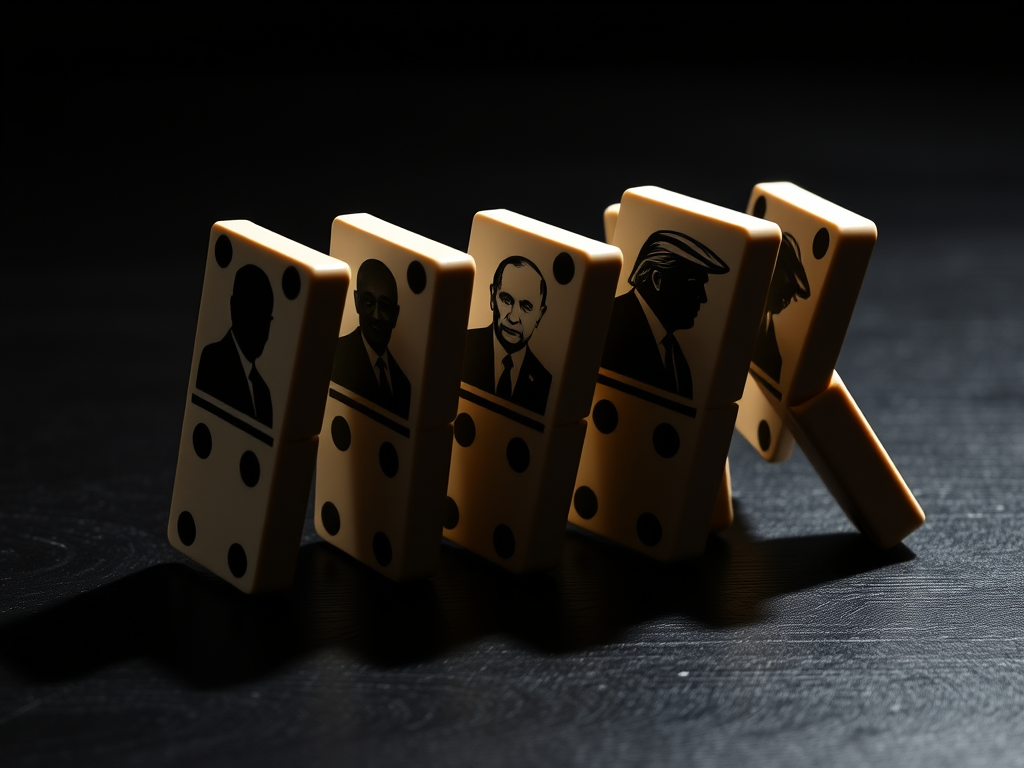
This ideological alignment makes modern authoritarianism more dangerous than ever. It not only transcends traditional power blocs but is also reinforced through strategic alliances, mutual support, and the erosion of democracies from within. This is perhaps most evident in the United States. The presidency of Trump revealed an unexpected vulnerability: the possibility that authoritarianism could thrive within the world’s most influential democracy. Here, the debate is no longer reduced to a question of isolationism or interventionism, but to the real risk of autocratic tactics being normalized in domestic politics.
The Trump administration sent contradictory signals regarding the Kremlin, weakening the principle of deterrence. Rather than establishing a clear stance against authoritarian expansion, its ambiguity allowed regimes like Putin’s to interpret the lack of firmness as an opportunity to act with impunity. Figures such as Marco Rubio have advocated for an unequivocal stance that would reinforce U.S. strategic credibility, while the inconsistency in the Trump administration’s foreign policy contributed to the perception that the West was divided and hesitant.
This weakening of democratic leadership has not occurred in a vacuum. The globalization of authoritarianism is a phenomenon in which autocratic regimes not only directly challenge democracies but also back one another to evade sanctions, subvert international pressure, and consolidate their internal rule. The invasion of Ukraine must be understood within this framework: it is not just a regional conflict or a reaction to NATO, but a calculated move within a broader strategy to weaken global democracy.
For decades, critics like Chomsky have been instrumental in highlighting the effects of U.S. dominance on global politics. His analysis has allowed us to understand how U.S. hegemony has influenced numerous conflicts. However, the evolution of authoritarianism raises questions that require expanding this perspective. The greatest threat to democracy is no longer exclusively U.S. power, but the consolidation of a global autocratic model advancing through coordinated strategies.
Blaming the U.S. for every geopolitical crisis may overlook a crucial shift: authoritarian regimes have moved from being a reaction to Washington’s influence to becoming an active strategy to replace the Western democratic model. Recognizing this shift does not absolve the U.S. of its failures in foreign policy, but it does demand an understanding that countering authoritarianism requires more than constant criticism of its hegemony. It requires recognizing that democracy faces a coordinated and unprecedented threat.
Chomsky’s vision of a multipolar world is, in theory, appealing. However, what would this imply in practice if the actors filling the void left by the U.S. are not interested in preserving democracy? The real challenge is not merely containing Putin’s territorial ambitions but preventing his model of governance—based on dismantling democratic institutions—from gaining traction in the West.
Chomsky remains one of the most incisive critics of U.S. foreign policy, and his work has been fundamental in understanding the effects of power on international relations. His analysis has shed light on the flaws of interventionism and the dynamics of global hegemony. The world, however, has changed, and so have the challenges facing democracies. Today, the crisis in Ukraine is no longer limited to a debate over NATO, U.S. intervention, or Western hypocrisy. It is part of a broader struggle between democracy and autocracy, a struggle that does not end at Ukraine’s borders but extends to the very political institutions of the West.
If we fail to recognize this shift, we risk not only losing Ukraine but also underestimating the scope of the threats facing democracies worldwide. Neutrality is no longer an option when the challenge is the survival of free societies. Beyond the mistakes of the West, the rise of authoritarianism demands a response that goes beyond constant criticism of U.S. hegemony and instead embraces the active defense of democratic values wherever they are under threat.
*
Ricardo Federico Morín Tortolero
February 28, 2025; Oakland Park, Florida
 Observations On Perception