Every constitution presupposes a constitutional subject more fundamental than the government it establishes. Before there can be presidents, legislatures, courts, or public officials, there must already exist the Nation from which public authority derives. Governments do not constitute the Nation. The Nation constitutes government through the lawful means prescribed by the constitutional order.
For that reason, constitutions concern themselves with more than the organization of power. They identify the source from which public authority may arise in law and prescribe the constitutional act through which that authority becomes publicly ascertainable, a function that preserves the Nation’s exclusive constitutional authority to constitute public authority. Authority is not created by those who exercise it. It is temporarily entrusted to them by the Nation acting under constitutional forms. Government therefore possesses neither an autonomous existence nor an independent title. Every public office derives from a constitutional act antecedent to itself.
The constitutional significance of an election resides precisely in that antecedent act. Elections do not merely record political preferences, produce governing majorities, or permit the peaceful succession of governments. Their constitutional purpose is to render the sovereign will of the Nation publicly ascertainable through a process whose transparency permits the lawful attribution of public authority. Transparency is therefore neither an administrative virtue nor a procedural safeguard. It is the constitutional condition through which the title to govern becomes publicly distinguishable from the mere possession of power.
Whenever that condition ceases to exist, the object of constitutional inquiry changes with it. The question no longer concerns the constitutional act through which authority became attributable to the Nation, but the government by which authority is presently exercised. Public offices may remain occupied. Legislatures may continue to enact laws. Courts may continue to pronounce judgment. Taxes may continue to be collected. International relations may proceed without interruption. Each describes the continued exercise of public authority. None identifies the constitutional act from which that authority became publicly attributable to the sovereign will of the Nation.
The displacement is easily overlooked because governments are visible whereas constitutional title is not. Political discussion therefore turns almost instinctively toward the recognition of governments, negotiated settlements, transitional authorities, constitutional reforms, sanctions, diplomatic initiatives, and international agreements. Each concerns the exercise, distribution, or succession of political power. None identifies the constitutional act through which the Nation confers title upon those who govern in its name. Without noticing it, the inquiry abandons the constitutional origin of authority and begins instead to examine the political administration of authority already being exercised.
The Venezuelan constitutional controversy illustrates that displacement with unusual clarity. International discussion has largely proceeded by asking which government should replace the existing one and under what political arrangements that transition should occur. Yet every proposal presupposes a condition that remains antecedent to them all. If the constitutional process through which the Nation makes its sovereign will publicly ascertainable has ceased to provide a transparent and verifiable attribution of public authority, no subsequent political arrangement identifies the constitutional source from which the proposed government derives its title.
The participation of foreign States introduces no exception to that condition. Diplomatic recognition, mediation, economic sanctions, military guarantees, political commitments, or negotiated agreements may influence the circumstances within which constitutional decisions are made. They may alter political outcomes, strengthen institutions, or hasten transitions. They remain external to the constitutional order through which the Nation alone confers public authority. A foreign State may recognize a government, encourage a constitutional settlement, or seek to influence political events. It does not participate in the constitutional act through which another Nation lawfully constitutes its own government, nor can it prescribe the juridical process by which that act acquires constitutional effect.
Every proposal for constitutional restoration therefore returns to the same antecedent condition from which it first departed. Before governments may be recognized, replaced, negotiated, or reconstituted, the Nation must first have made its sovereign will publicly ascertainable through the transparent constitutional process from which public authority derives its title.
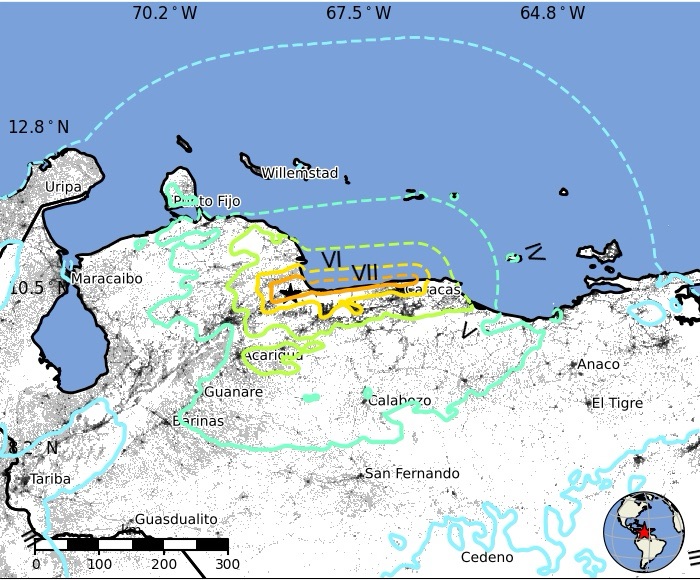
Figure 1. USGS ShakeMap depicting the distribution of ground-shaking intensity produced by the magnitude 7.5 earthquake of Wednesday, June 24, 2026, in north-central Venezuela. The map illustrates the geographical extent and relative intensity of the seismic event rather than structural damage. Courtesy of the U.S. Geological Survey (USGS). [1]
Ricardo F. Morín
July 3, 2026
Toronto, Canada
*
Scientific inquiry does not begin with certainty. It begins by identifying the boundaries of what is known, what remains unknown, and why the distinction matters. The absence of sufficient evidence neither confirms nor disproves a hypothesis; it defines the limits of present knowledge and establishes the necessity for further investigation. Nowhere is this principle more consequential than in environmental policy, where decisions made under conditions of uncertainty may shape the integrity of entire ecosystems for generations.
The first obligation of responsible governance is therefore not to defend a predetermined conclusion, but to ensure that the scientific conditions necessary to reach one exist. Where those conditions are absent, the appropriate response is neither affirmation nor dismissal, but verification.
Venezuela presents a circumstance that calls for independent scientific inquiry. The earthquakes of Wednesday, June 24, 2026, brought renewed attention to a question whose importance reaches far beyond those seismic events. They underscore the need to determine whether the scientific knowledge presently available is adequate to evaluate any interaction that may exist between intensive subsurface carbon extraction and the geological dynamics of one of the most tectonically complex regions in the Western Hemisphere. The country contains some of the world’s largest hydrocarbon reserves while also being traversed by active fault systems whose behavior demands continuous observation, precise measurement, and independent scientific verification.
Whether recent seismic activity bears any relationship to large-scale subsurface carbon extraction cannot presently be determined without transparent access to operational records, geological mapping, high-resolution seismic observations, and independent scientific analysis. The necessary evidence must first be established, verified, and subjected to rigorous scrutiny before any responsible conclusion—affirmative or negative—can be sustained.
This absence of verified knowledge is not a procedural inconvenience. It is itself an environmental concern. Carbon extraction necessarily alters the subsurface environment through drilling, reservoir depletion, fluid movement, pressure redistribution, and other engineering interventions. The degree to which those alterations interact with naturally stressed geological systems cannot be assumed. It must be measured. Where extensive extraction occurs within tectonically active regions, uncertainty becomes the principal reason for scientific investigation rather than an excuse to postpone it.
The question therefore extends well beyond the explanation of any individual seismic event. It concerns whether present scientific understanding adequately characterizes the cumulative interaction between industrial intervention and the geological systems upon which entire populations depend. Resolving that question requires continuous seismic monitoring, comprehensive geological characterization, transparent operational reporting, independent verification, and the willingness to revise conclusions as new evidence emerges.
The implications are not confined to Venezuela. They concern the broader governance of carbon extraction throughout the world. Every nation possessing significant hydrocarbon resources situated within geologically sensitive environments confronts the same responsibility: to ensure that economic activity proceeds within the limits established by demonstrable scientific understanding rather than by commercial urgency or geopolitical expediency.
Under conditions of institutional weakness, diminished regulatory independence, or limited transparency, this responsibility becomes even more critical. Scientific uncertainty should never become a refuge for either complacency or speculation. Instead, it imposes a higher standard of public accountability. The legitimacy of environmental regulation depends not upon confidence in predetermined outcomes, but upon confidence in the integrity of the investigative process itself.
This principle transcends the identity of any particular government, corporation, or foreign investor. Whether extraction is undertaken by domestic enterprises, multinational corporations, or state-owned entities, the obligation remains identical. Every operator should be subject to the same independent scientific oversight, the same environmental scrutiny, and the same public disclosure of information necessary to evaluate geological and ecological consequences. Responsible stewardship cannot depend upon the nationality of capital. It depends upon the universality of scientific standards.
When those standards are weakened or subordinated to political or economic priorities, the consequences extend far beyond the extraction site. The risks are borne by landscapes, watersheds, ecosystems, infrastructure, and communities whose stability depends upon geological conditions that cannot be negotiated once altered. Economic benefit may be immediate; environmental consequences may endure for generations.
The responsible extraction of carbon resources therefore demands more than technological capability or financial investment. It requires institutions capable of recognizing that uncertainty is not the absence of responsibility but its beginning. Scientific knowledge is not merely one consideration among many in environmental governance. It is the foundation upon which every legitimate regulatory decision must rest.
The Earth records every intervention with complete fidelity. Whether humanity possesses the wisdom to understand those records before they become irreversible consequences remains one of the defining environmental questions of our time.
To the Board of Governors of the Federal Reserve System—in recognition of the ongoing challenge of aligning institutional independence with public responsibility.
By Ricardo Morin
July 27, 2025
Abstract
This essay examines the conceptual validity of an independent treasury, free from executive control and governed by long-term, nonpartisan economic reasoning. It argues that the alignment of fiscal institutions with short-term political leadership creates structural risks that compromise transparency, sustainability, and public trust. By contrast, an autonomous treasury—operating within clear legal mandates and guided by professional expertise—can promote fiscal stability and integrity while preserving essential democratic oversight. The analysis rejects both executive subordination and technocratic absolutism, and proposes a balanced institutional model in which independence functions as a form of principled restraint. This concept, as developed in the essay, refers to the structured and lawful limitation of authority in pursuit of long-term public interest—discipline rooted not in detachment, but in ethics, transparency, and legality. This framework, abstracted from any specific national context, is intended to apply broadly to the theory and design of sound fiscal governance.
The Case for an Independent Treasury
The question of how a treasury should be structured—whether subordinated to political leadership or operating autonomously—raises fundamental concerns about institutional integrity, fiscal responsibility, and democratic accountability. While treasuries are often housed within executive power, there is a strong theoretical case for granting such institutions political independence. A treasury removed from direct control of governing administrations and guided instead by economic expertise, long-term reasoning, and publicly defined mandates can provide a more stable and ethically sound foundation for fiscal policy.
At the heart of this argument is the fact that fiscal decisions—such as setting tax levels, allocating public spending, and managing debt—extend far beyond the timeline of electoral cycles or political terms. When treasury operations are subject to short-term political priorities, fiscal policy risks being distorted by opportunism—through unsustainable tax cuts, politically timed spending increases, or the concealment of uncomfortable debt projections. These distortions undermine both the credibility of fiscal governance and the long-term stability that supports public trust and financial soundness.
A common set of distortions includes election-cycle spending surges that prioritize immediate electoral gains over lasting fiscal balance; strategic underreporting or reclassification of deficits to hide true fiscal conditions; and biased tax enforcement, where tax authorities selectively target or protect groups based on political motives. Such behaviors not only threaten fiscal sustainability but also weaken the treasury’s role as a neutral guardian of public resources.
Principled restraint is key to addressing these challenges. This concept refers to a structured commitment to ethical limits and responsible governance. It is a form of authority that binds itself willingly to the public interest, resisting both political capture and technocratic arrogance. Principled restraint is not the absence of power, but its disciplined and transparent exercise, grounded in law, deliberation, and long-term accountability. It affirms the treasury’s role as a steward of the public good across political transitions and economic cycles.
An autonomous treasury, governed by clear statutes and staffed by nonpartisan experts, can anchor fiscal management to long-term goals such as sustainability, fairness, and generational equity. Its purpose is not to replace democratic decision-making but to ensure that such decisions are carried out with consistency, impartiality, and professional skill. Just as some institutions responsible for macroeconomic stability are insulated from immediate political pressures, so too might a treasury—especially in functions like forecasting, revenue collection, and debt issuance.
The credibility of an independent treasury extends beyond its internal workings. Reliable and professionally managed fiscal behavior builds confidence among citizens, investors, and institutions. When financial governance is free from sudden reversals or partisan manipulation, it fosters trust and encourages long-term investment. Independence also helps prevent the politicization of fiscal enforcement, reducing the temptation to use taxation or regulations as tools of political favor or retaliation.
However, institutional independence is not without risks. Fiscal decisions are not merely technical; they are moral and distributive, touching on societal values, justice, and competing visions of the common good. Shielding these decisions entirely from democratic debate risks technocratic overreach, ideological rigidity, or disconnect from lived realities. Expertise alone cannot legitimize choices that affect livelihoods and social priorities.
The solution is not absolute independence but a careful balance between insulation and accountability. A treasury designed for long-term neutrality must be bound by clear mandates, subject to transparent review, and accountable through publicly visible processes. Its leadership should be appointed through pluralistic methods that reduce capture by any one faction, and its actions should undergo open reporting, independent audits, and legal oversight. Protected from arbitrary dismissal or short-term interference, it must still answer ultimately to the legal and ethical framework established by society through its representative institutions.
Moreover, any institutional design must include mechanisms for coordinated emergency response. No treasury, however independent, should be structurally paralyzed in times of acute crisis. Temporary protocols for collaboration with political authorities—limited by law and time—ensure that flexibility does not compromise integrity.
Ultimately, the case for an independent treasury rests not only on technical competence but on maintaining civic trust. When fiscal governance is shaped by rules rather than impulses, by analysis rather than improvisation, and by impartial stewardship rather than partisan interest, it becomes a stabilizing force in public life. The institutional form must embody a dual commitment: to professional expertise and democratic legitimacy. Independence, in this sense, is not isolation but principled restraint—a structured commitment to ethical limits and responsible governance. It is the disciplined and transparent use of power, grounded in law, public deliberation, and long-term accountability. This discipline protects the treasury’s role as steward of the public good across political changes and economic cycles.
Any society seeking to secure the long-term integrity of its public finances must confront the structural incentives shaping its treasury. If fiscal authority remains vulnerable to fleeting political agendas, sustainability will always be precarious. But if that authority drifts too far from public input, it risks losing the legitimacy it depends on. The challenge is to build institutions that are durable without becoming unresponsive, disciplined without becoming opaque, and independent without giving up accountability.
*
Annotated Bibliography
Blyth, Mark: Austerity: The History of a Dangerous Idea. New York: Oxford University Press, 2013 (Blyth explains how austerity, often framed as a technical necessity, has historically served as a political tool to restructure economic power. His analysis is crucial to understanding why an independent treasury should not be conceived as a default promoter of restrictive policy but as an institution committed to fiscal sustainability with social responsibility).
Brunner, Roger: “Independent Fiscal Authorities: A Comparative Analysis”. Public Finance Quarterly 21 (4): 482–505. Thousand Oaks: Sage Publications, 1993 (Brunner offers a comparative analysis of different models of independent fiscal authorities. His study provides an empirical foundation for evaluating how institutional independence can be balanced with effective mechanisms of democratic accountability).
Goodhart, Charles, and Dimitrios Tsomocos: The Challenge of Fiscal Independence. London: CEPR Press, 2021 (This volume examines the conceptual and practical challenges of separating fiscal policy from short-term political pressures. Its contribution is key to supporting the argument that fiscal independence must be grounded in clearly defined limits and democratic legitimacy to avoid self-referential technocracy).
Lledó, Victor, and Teresa Ter-Minassian: “Fiscal Councils and Independent Fiscal Institutions”. Washington; IMF Working Paper WP/22/47. International Monetary Fund, 2022 (This IMF paper provides a detailed overview of independent fiscal institutions across multiple jurisdictions. It emphasizes that the effectiveness of such institutions depends not only on their legal design but also on their integration into transparent democratic processes).
Ooms, Thomas: “Fiscal Policy and the Risk of Politicization”. Journal of Economic Perspectives 32 (3): 75–92. Nashville: American Economic Association, 2018 (Ooms argues that the politicization of fiscal policy leads to significant distortions in resource allocation. His article supports the idea that a structurally protected treasury can reduce the risk of decisions driven by partisan interests).
Stiglitz, Joseph E.: Economics of the Public Sector. New York: W. W. Norton, 2000 (This classic textbook offers a comprehensive framework on public sector economics. Stiglitz’s discussion of market failures and the role of institutions provides a solid theoretical foundation for justifying the careful design of a treasury with structural independence and public accountability).
Wehner, Joachim: Legislatures and the Budget Process: The Myth of Fiscal Control. New York: Palgrave Macmillan, 2010 (Wehner challenges the presumption that legislatures exercise effective control over public budgets. His work suggests that, given legislative weakness, strengthening the institutional role of the treasury may be necessary to ensure transparency and fiscal discipline).
The war in Ukraine is often presented as a geopolitical confrontation between the West and Russia, but this interpretation can obscure a deeper reality: the rise of authoritarianism as a global force. Noam Chomsky, one of the most influential voices in the critique of U.S. foreign policy, has argued that U.S. hegemony is the primary factor driving the conflict. His approach, rooted in Cold War logic, has been essential for understanding global power dynamics. However, one must question whether this framework remains sufficient to analyze the coordinated expansion of authoritarian regimes in the world today.
The issue is no longer simply whether U.S. policy contributed to Russia’s aggression, but whether democracies can withstand the deliberate advance of governments seeking to consolidate power at any cost. What is at stake transcends Ukraine’s sovereignty: it is the survival of democracy in the world.
Chomsky argues that NATO’s expansion and U.S. financial dominance exacerbated tensions with Russia and limited diplomatic options. His vision proposes a world in which power is distributed between the United States, Europe, China, and Russia, which he believes would create a more stable and just balance. This perspective has been crucial in questioning the excesses of U.S. interventionism. In the present world, however, where authoritarianism is not only reacting to the West but also actively seeking to reshape the global order, is a framework based solely on containing U.S. hegemony sufficient?
The rise of authoritarian regimes is not merely a response to Western influence; it is a deliberate strategy to consolidate power. While Chomsky has emphasized the importance of distributing global power, it is crucial to analyze the nature of those who would fill this void. Russia and China are not simply seeking a multipolar stability; their actions reflect an attempt to exert absolute control, without democratic constraints. Chomsky’s critique helps us understand the roots of international conflicts, but it may need to be expanded to account for how these regimes are transforming the very structure of global politics.
One challenge in applying Chomsky’s traditional analysis to the present is that contemporary authoritarianism no longer aligns solely with past ideological divisions. It is no longer a struggle between socialism and capitalism, or left and right. Rather, these regimes share a common objective: dismantling democratic institutions to ensure their permanence in power.
Putin, for instance, invokes Soviet nostalgia while prohibiting any critical reassessment of Stalinism. China blends State capitalism with absolute political control. Hungary and India, once considered democracies aligned with the West, have adopted authoritarian models. Meanwhile, the U.S. far-right, which historically opposed communism, has begun to adopt the Kremlin’s narrative, portraying it as a defender against “globalist elites.”
This ideological alignment makes modern authoritarianism more dangerous than ever. It not only transcends traditional power blocs but is also reinforced through strategic alliances, mutual support, and the erosion of democracies from within. This is perhaps most evident in the United States. The presidency of Trump revealed an unexpected vulnerability: the possibility that authoritarianism could thrive within the world’s most influential democracy. Here, the debate is no longer reduced to a question of isolationism or interventionism, but to the real risk of autocratic tactics being normalized in domestic politics.
The Trump administration sent contradictory signals regarding the Kremlin, weakening the principle of deterrence. Rather than establishing a clear stance against authoritarian expansion, its ambiguity allowed regimes like Putin’s to interpret the lack of firmness as an opportunity to act with impunity. Figures such as Marco Rubio have advocated for an unequivocal stance that would reinforce U.S. strategic credibility, while the inconsistency in the Trump administration’s foreign policy contributed to the perception that the West was divided and hesitant.
This weakening of democratic leadership has not occurred in a vacuum. The globalization of authoritarianism is a phenomenon in which autocratic regimes not only directly challenge democracies but also back one another to evade sanctions, subvert international pressure, and consolidate their internal rule. The invasion of Ukraine must be understood within this framework: it is not just a regional conflict or a reaction to NATO, but a calculated move within a broader strategy to weaken global democracy.
For decades, critics like Chomsky have been instrumental in highlighting the effects of U.S. dominance on global politics. His analysis has allowed us to understand how U.S. hegemony has influenced numerous conflicts. However, the evolution of authoritarianism raises questions that require expanding this perspective. The greatest threat to democracy is no longer exclusively U.S. power, but the consolidation of a global autocratic model advancing through coordinated strategies.
Blaming the U.S. for every geopolitical crisis may overlook a crucial shift: authoritarian regimes have moved from being a reaction to Washington’s influence to becoming an active strategy to replace the Western democratic model. Recognizing this shift does not absolve the U.S. of its failures in foreign policy, but it does demand an understanding that countering authoritarianism requires more than constant criticism of its hegemony. It requires recognizing that democracy faces a coordinated and unprecedented threat.
Chomsky’s vision of a multipolar world is, in theory, appealing. However, what would this imply in practice if the actors filling the void left by the U.S. are not interested in preserving democracy? The real challenge is not merely containing Putin’s territorial ambitions but preventing his model of governance—based on dismantling democratic institutions—from gaining traction in the West.
Chomsky remains one of the most incisive critics of U.S. foreign policy, and his work has been fundamental in understanding the effects of power on international relations. His analysis has shed light on the flaws of interventionism and the dynamics of global hegemony. The world, however, has changed, and so have the challenges facing democracies. Today, the crisis in Ukraine is no longer limited to a debate over NATO, U.S. intervention, or Western hypocrisy. It is part of a broader struggle between democracy and autocracy, a struggle that does not end at Ukraine’s borders but extends to the very political institutions of the West.
If we fail to recognize this shift, we risk not only losing Ukraine but also underestimating the scope of the threats facing democracies worldwide. Neutrality is no longer an option when the challenge is the survival of free societies. Beyond the mistakes of the West, the rise of authoritarianism demands a response that goes beyond constant criticism of U.S. hegemony and instead embraces the active defense of democratic values wherever they are under threat.