Posts Tagged ‘cadence’

“Intervals”

September 2, 2025

*

Design cover by Ricardo Morín
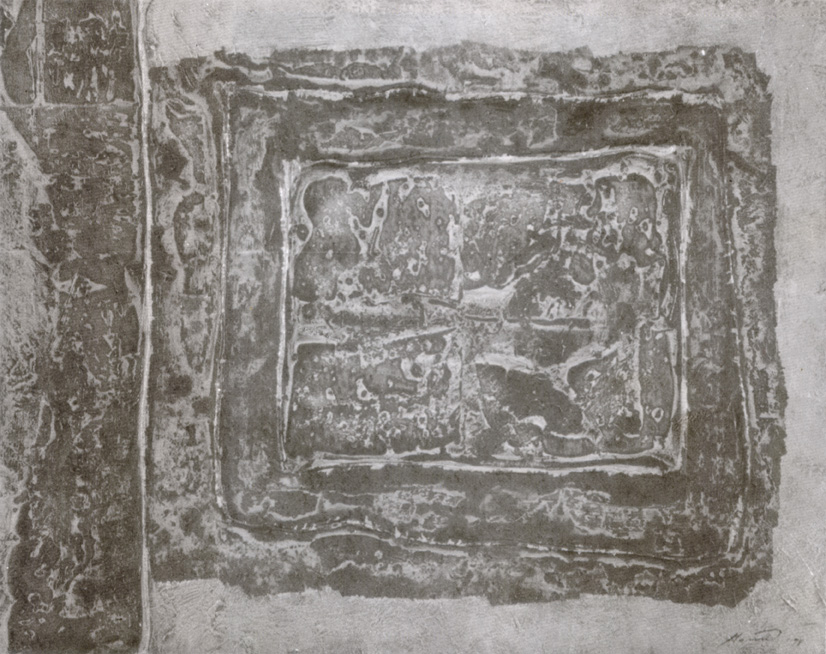
Aposento Nº 2
29″ x 36″
Oil on canvas
1994

Author’s Note

Intervals is written in a cadence held taut at the threshold of life and death.   It does not withhold itself, though its language remains stripped of explanation.   Ambivalence may be inescapable, but it is not the aim.   The anonymity of the speaker is deliberate, to keep attention on what is spoken rather than on who speaks.

Ricardo Morín, September 11, 2025. Bala Cynwyd, Pa.

Intervals

To heal himself, he would cover his body in mud and then rinse it away.    Crouched beneath the burning sun, he stared diagonally from a corner across the far end of the yard.   From the clothesline he hung a black umbrella, upside down.    Into it he cast the last handful of potions. From its collapse, heavy with weight, he hoped to avoid his own death.

He covered his books with a black sheet; blindly he pulled one out at a time and, after finding a sentence giving meaning to his thoughts, he put it back.   He waited for revelation.    His mother, now old, took another book out and searched for a better reply.

Exhausted and sleepless, he lay wrapped in a red blanket with his back to the mirror.    Drenched in tears, he felt undone.   Shivers traced his spine, as though his entrails were on fire.

He woke to the sound of running water.   His mother would scrub his garments until the fabric began to fray.    He had painted the walls white; the doors ceased to be brown.    An intruder leapt over the fence.   Then, with a surprising strength, he tore up the garden.

Nights followed without sleep.    He was unaware of sunken cheekbones; only his neighbors’ gaze could see him wasting away.     He managed to fly afar.     Though attentive to life, he found disappointment.

On arrival the hotel summoned an ambulance.    After a ten-hour flight, septic shock seized him; a nurse asked him to choose a destination.    Shivers returned.    He saw many dying, though it was not his turn.     Days later, his flesh returned to life.

With the memory of past ties, he departed again disappointed.    He crossed another distance and knew how fragile his solitude was.

You rescued him and he you.    A bridge was built out of longing.    Three years of passion did not mend the abyss; he took his life and you remained.

A Roman curate attended his mother’s cries, while he twisted her son’s.     Little did the curate know that it was by his own design.     He called for you, a new love, to come.    To love, to sustain the bond of the moment.


Epilogue

Intervals rests on our fearful perception of death, solitude, survival, and rupture (an interval is the rhythm of time and its ending is the emptying of what the consciousness of fear carries in it).    An interval seeks neither consolation nor resolution; it remains with what occurs, in the exposure where solitude and fracture reveal the fragility of existence.


“Questions That Hold Their Answers”

August 3, 2025

*


Ricardo Morin
Sonata Series
Each 30″x 22″= 60″h x 66″ overall
Watercolor on paper
2003

By Ricardo Morin

August 3, 2025

The Whittington chime, though rooted in the specific historical and ecclesiastical context of St. Mary-le-Bow in London, speaks in a language far broader than its origins. Every fifteen minutes, its melody punctuates the passage of time—not with dominance or insistence, but with a sequence of tones that seem to lean toward attentiveness rather than control. It does not call; it invites. Its fourfold phrasing unfolds with the day and carves it gently into intervals of awareness.

The hour does not ask to be heard.

It leans, it yields, it breathes.

In four phrases, time steps into its own shadow—

Not to rule, but to be received.

The first phrase is sparse and anticipatory. It announces nothing—yet it creates space for something to begin. The second phrase, slightly more confident, suggests that the shape of what’s coming may already be present in what has been. The third phrase swells with fullness, as though recognizing that something unspoken has come to form. And the fourth does not repeat or resolve—it releases. A soft culmination, an unforced closure. Nothing more is needed.

Four phrases like footprints.

Not forward, but inward.

The last does not complete the first—

It simply continues without demand.

Time is neither summoned nor announced—it is welcomed in silence. The melody performs a quiet orienting function. It makes no claims, prescribes no doctrine, and excludes no one. It requires attention, not belief. It passes through space and enters those who allow it, and in doing so, it reveals time not as a line to be followed, but as a vessel to be filled.

There is no message, only rhythm.

No doctrine, only form.

Not a path to walk,

But a shape to inhabit.

This surrender—this subtle willingness to listen—is not weakness, nor is it a form of passivity. It is a kind of interior readiness, a posture of faith in what does not insist upon itself. As one hears the chime at a distance—through open window, across an empty street, or at the center of a sleepless night—it becomes clear that regularity is not rigidity. It is a form of grounding, a pulse that reminds us of something more than measurement: the possibility that rhythm itself is a form of remembering.

Some things endure not because they hold us fast—

But because they return.

Each return is a soft petition:

Are you listening now?

To be transformed by time, the vessel must remain open. And openness is not emptiness in the deficient sense, but the fullness of a receptivity that listens before it responds. There are patterns here, but they do not bind. They unfold. Each phrase in the chime allows what came before to echo—faintly, without repetition—and then continues without imitation. It does not search for novelty, nor does it cling to what has passed.

It simply arrives.

An echo does not ask for an answer.

It waits until the shape of silence

Begins to sing it back.

In this way, the melody becomes an offering. And if there is meaning to be found in its intervals, it is not imposed from without. It is disclosed in the act of listening. Each person who hears it becomes part of its form, not by adding to it, but by receiving it. And in receiving, they are also shaped.

Some questions do not seek reply.

They seek a place to rest.

They carry their answers folded within—

Waiting only to be heard.

We often think of arrival as the end of something—as the completion of a search. But perhaps it is not the final step that matters most. Perhaps what matters is the quiet unfolding that prepares us to meet it. The chime does not deliver anything. It accompanies. It affirms that movement can be gentle, that order can serve grace, and that meaning is not attained, but awakened …

… —gently, without insistence.

It arrives, and we recognize it—

Not because we were waiting,

But because we were listening.

*