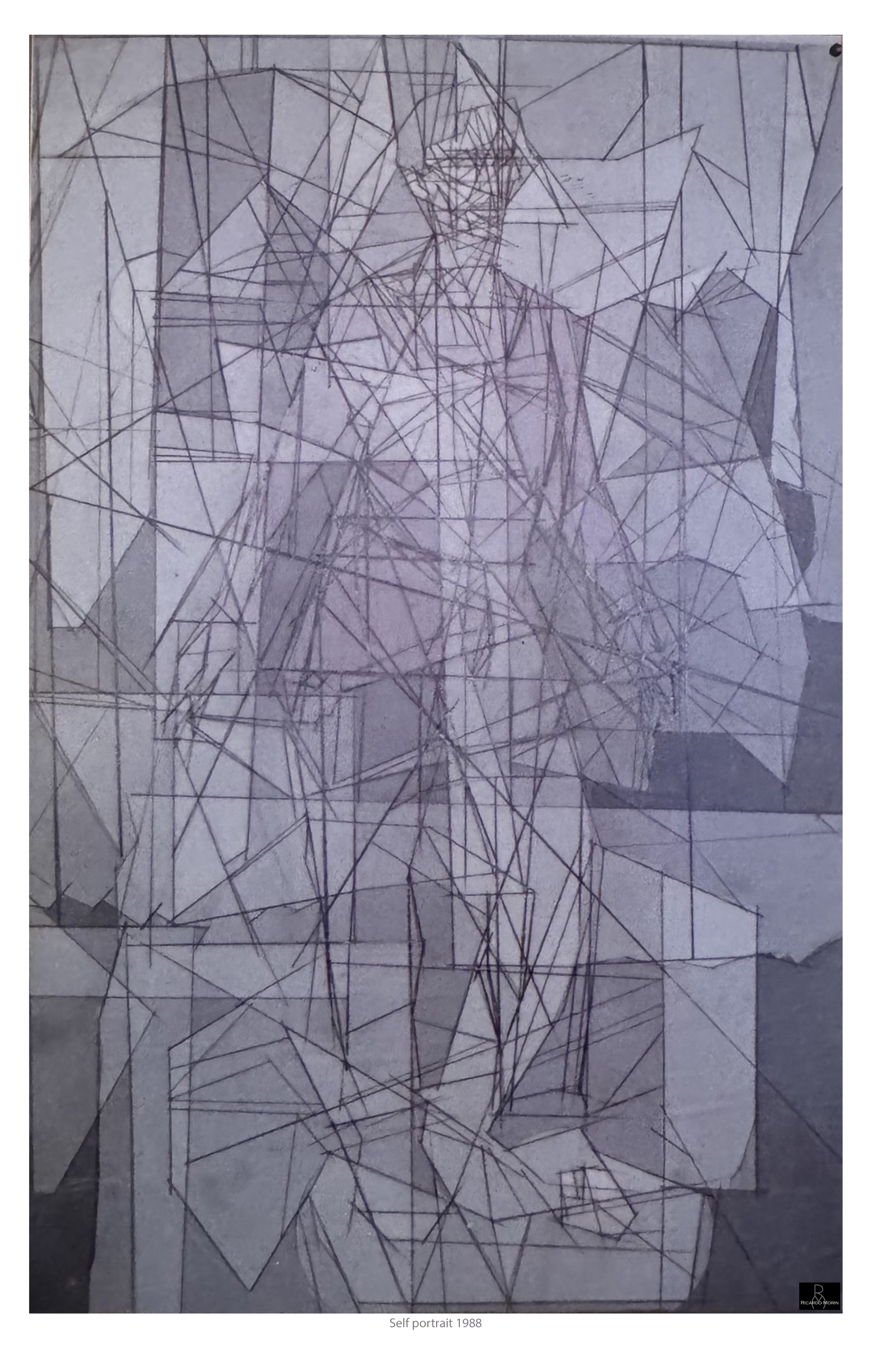
Self-Portrait, 1988.
Mixed media: collage, charcoal, and ink pen.
30 × 48 inches.
The traditions and rituals through which we identify ourselves should remain open to questioning, particularly when they concern guilt, repentance, and forgiveness. An inquiry into the meaning of fasting on Yom Kippur led me to ask how a practice of atonement relates to the conduct of daily life. The question can be asked of any such practice, within or outside a religion: does observing it deepen our attention to others, or can the observance take the place of that attention? Why should reflection occupy a separate place in a life whose every relationship already calls for awareness?
The difficulty begins when we treat living and examining how we live as separate activities. We act, withdraw, assess, and seek release from what we have done. Looking back is necessary because our understanding is incomplete and consequences often become apparent only later. But the limits of what we can know at any moment do not remove our responsibility to pay attention while acting. How we speak, decide, listen, or withhold a response already matters to other people. Reflection belongs within those acts, while we can still influence what happens, as well as afterwards, when we consider the consequences.
The observance that prompted this inquiry explicitly guards against allowing ritual to replace responsibility towards another person. Mishnah Yoma 8:9 (https://www.sefaria.org/Mishnah_Yoma.8.9) states that Yom Kippur does not atone for wrongs committed against another person until the wronged person has been appeased. The teaching requires us to address the person we have injured; observing the day alone cannot fulfil that obligation. The question of how reflection belongs within living nevertheless remains. Addressing an injury is a responsibility that follows wrongdoing. Attention to another person is already required within the relationship before any injury occurs.
A day devoted to repentance may renew an awareness that continues throughout the year. The distinction that concerns me is between reflecting from time to time and making reflection part of everything we do. An observance can support attention throughout daily life. Speaking, working, eating, and living with others already involve choices through which we acknowledge or disregard their circumstances. Where reflection is separated from daily conduct, sincerity in observing a ritual does not resolve the separation.
Questioning a ritual can be difficult because the practice may express commitments we hold deeply. A person may observe it out of religious conviction, loyalty to family customs, or a wish to be recognised as a member of a religious community. Belief in a teaching, loyalty to one’s family, and recognition by others are distinct considerations, even when they lead to the same observance. If questioning the practice feels like betraying one’s family or risking a community’s acceptance, defending the practice may take precedence over examining it. Careful examination can also express a serious commitment to understanding one’s faith. The reasons for valuing a ritual therefore need to be distinguished from the question of how observing it affects our conduct towards others.
Fasting may help someone concentrate by interrupting familiar habits. Even so, why should deprivation have a privileged role in making us more aware? Whatever attention a fast encourages must continue within daily life. When deprivation is understood as punishment, attention may shift from daily conduct to the intensity of one’s own suffering. My suffering does not, by itself, repair suffering I have caused. I may become absorbed in how much I can endure and pay less attention to the person affected by my conduct. The effort to become worthy again can then displace the work of understanding another person’s experience and making whatever repair is possible.
The preoccupation with recovering one’s own moral worth becomes especially restrictive when a wrong action is taken as proof of a defective human nature. Recognising our limitations can make us more receptive to correction. But a belief in our own defectiveness can keep us occupied with whether we are guilty, purified, forgiven, or restored. Our relation to others does not begin with an injury for which we must answer. When I listen to another person, I may discover how much my assumptions have left out. When we make a decision together, I need to consider the other person’s circumstances as well as my own. The other person’s reality precedes my judgment of how well I have responded to it. Responsibility develops within the relationship and includes answering for harm when harm occurs. A satisfactory judgment of myself does not bring my responsibility within the relationship to an end.
Confession can interrupt denial by acknowledging an injury we have concealed or refused to face. Naming the injury can make an honest conversation with the person affected possible. An apology may relieve the person who offers it while leaving the injured person’s loss or distrust unresolved. In admitting what I did, I show a willingness to answer for my conduct. The admission alone cannot establish that I have fulfilled my responsibility.
No one owes me forgiveness so that I may consider my moral account settled. Forgiveness may change a relationship profoundly, allowing affection or trust to become possible again. But forgiveness does not erase the consequences of what happened. Trust may need to be rebuilt, a loss may remain irreparable, and the injured person may still need to maintain boundaries within the relationship. My responsibility continues even if I am not forgiven. Nor can I demand that reconciliation take the form I desire.
To live consciously does not require us to sit in constant judgment of ourselves. Constant self-judgment would reproduce the self-absorption that can make penitence an obstacle to understanding others. Attention to others requires a willingness to notice, to listen, and to reconsider a judgment. Our intentions do not fully explain what our actions mean to someone else. Continuing attention means allowing what we learn from another person to influence how we proceed, even when that knowledge unsettles our understanding of ourselves. We will sometimes fail to pay attention. Recognising a failure can help us respond more adequately without turning the acknowledgment into a ceremony of self-condemnation.
The separation of reflection from daily conduct can arise within the most familiar relationships. We may presume that familiarity tells us what another person needs, or that good intentions spare us from reconsidering a decision. Confidence in our own understanding can then replace attention to a person whose needs or views may have changed. Confession, forgiveness, and observance belong within our relationships, but none can account for everything those relationships require of us. The daily acts of listening, choosing together, and responding to change have an ethical significance of their own, whether or not an injury ever occurs.
I cannot conceive of reflection as an interval after which one returns to living relieved of its demands. Reflection belongs to our participation in one another’s lives, through which we continually develop and revise our understanding. A ritual’s importance to our religious commitments or family customs does not settle the question of how observing it affects our conduct towards others. Another person’s reality remains before us after the words have been spoken and the appointed day has ended.