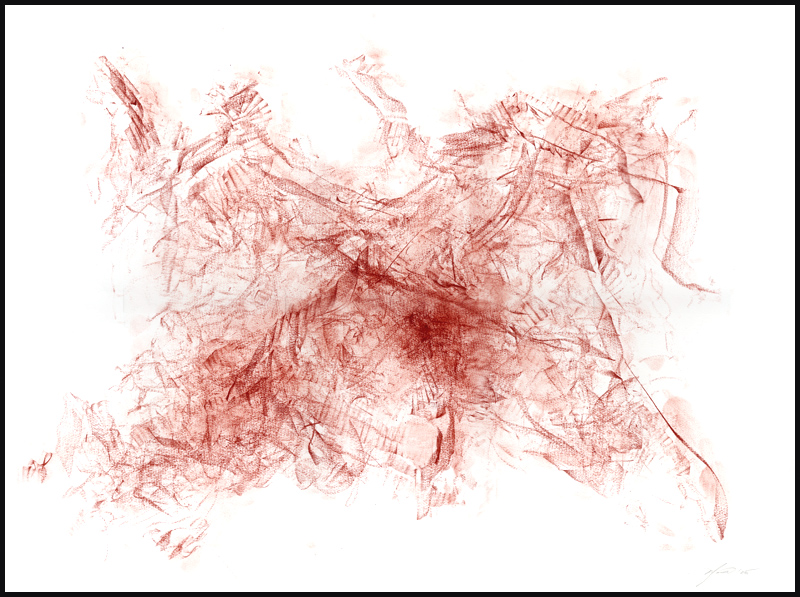
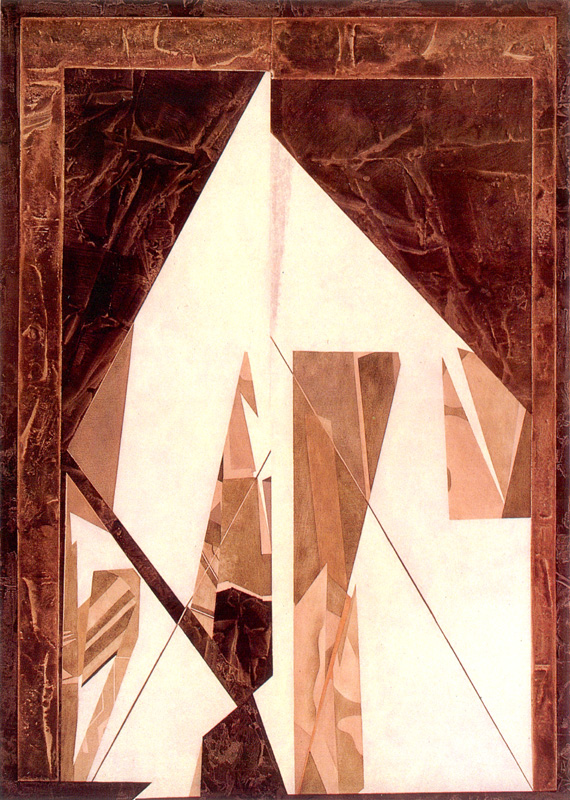
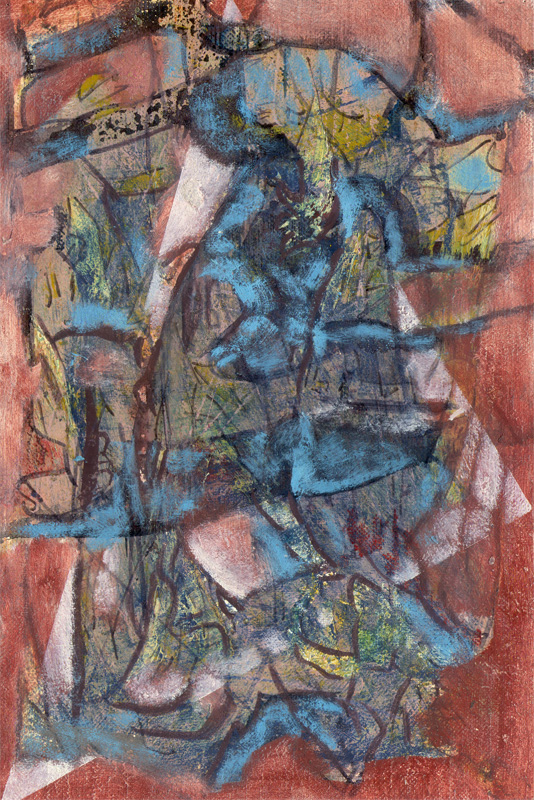
Ricardo F. Morín Infinity 3 30″x 22″ Sanguine on paper 2005
Two forms may be distinguished by their construction: an open curve, continuous along its course and capable of extension without closure, and a Möbius strip, formed by joining the ends of a band after a half-turn. The curve admits extension without return; the strip sustains a single continuous side through its return upon itself. Both are continuous. What differs is how continuity is held.
The open curve admits passage without requiring completion. It holds at each point without reference to return. The strip, received through its self-return, presents its course as already complete. Its coherence is apprehended through the relation that binds it to itself.
The curve may be followed without asking where it ends. A path along the strip’s interior may return indefinitely without meeting its single edge. The strip’s finite extent does not impose a final circuit. In both cases, continuity suffices.
The difference appears when attention shifts from what is given to how it is maintained. Along the curve, continuity is enacted in following. The path holds only insofar as no interruption occurs. The strip, received as a whole, appears to contain that continuity without requiring its course to be traced.
The strip’s return can thus sustain the invocation of infinity. An inexhaustible passage is received as already given within a finite form. The continuity that sustains this appearance remains implicit. The open curve offers no comparable assurance of completion. Its further extension must be followed, and its coherence depends on the unbroken relation along its course.
So long as the strip is received as given, the distinction holds. Infinity appears as already in place, and continuity remains absorbed within that appearance. The curve, by contrast, makes continuity operative without naming it.
The shift begins when what is given can no longer hold on its own. The strip’s apparent completeness no longer suffices. What appeared as a field without end must now be traced through the relation that sustains it.
The curve always depended on continuity, though it did not name it. Tracing the strip discloses the same dependence. What appeared as infinity is no longer primary. Its appearance depends on the continuity that had remained implicit.
The curve remains open, and the strip retains its return. Continuity is not confined to extension or return. It is what allows either to hold.
The appearance of infinity depends on continuity, but continuity does not require that appearance. It holds wherever relation is unbroken, including along a finite course.
Receiving accepts what appears without first requiring an explanation of what sustains it. Tracing follows the relations that sustain what appears and examines whether its coherence holds. Each entails a distinct discipline. Neither excludes the other.
The two modes remain distinct, yet not separate. The continuity that sustains the appearance in one is examined in the other. Their common ground does not make their requirements interchangeable.
In the invoking mode, virtue lies in receiving without imposing closure, in allowing what appears to remain unforced by premature explanation. The task is not to verify, but to receive without distortion.
In the diagnostic mode, virtue lies in sustaining relation without allowing coherence to be assumed. What appears must be traced, not to reduce it, but to prevent it from holding without what sustains it. Here the task is not merely to remain open, but to maintain relation.
Neither mode dispenses with the relation that sustains what appears. In receiving, that relation may remain implicit. In tracing, it must be maintained without substituting an imposed order for what was given.
The modes do not resolve into one another. Receptivity does not establish coherence, and tracing does not by itself prevent distortion. Passage between them requires attention to what each preserves and what each may alter.
Virtue does not belong to one mode alone. It appears wherever the proper condition of each is maintained without excess. In one, by not forcing completion. In the other, by not allowing what appears to hold without relation.
What differs is not what is given, but how it is held.
Ricardo F. Morin, October 6, 2026, Bala Cynwyd, Pennsylvania
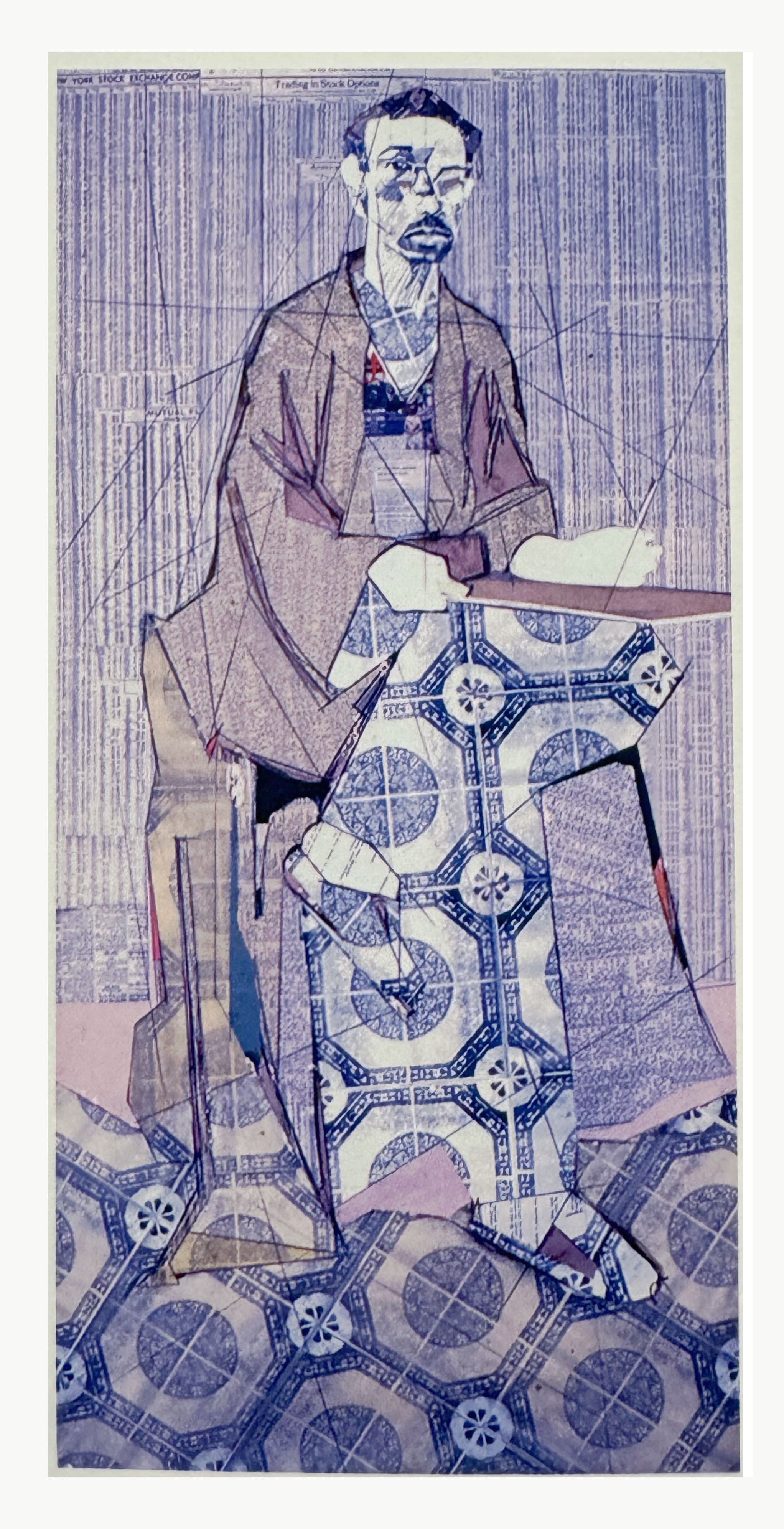
Ricardo F. Morín Self Portrait:Stock Market New York City 36” x 74” Collage with charcoal pencil 1987
He did not go into other artists’ studios unless invited. If he recognized something in the work, he said it.
At that time, education consisted in finding a means of expression that suited him. It was a way to refine what he saw and felt and to bring it into the work. The subject was his own, but it moved within the traditions of painting and other arts. What mattered was finding his voice as a painter, in the use of color and the depth it could sustain pictorially. On the surface, his gestures remained inscribed.
Within that, he would stand before the work and look, asking what it could contain or where it might resolve. If he recognized something, he stayed with it, not to explain or to correct it, but to register it mentally or to shift it within its structure. There would be a pause, and he would look again, as if something already present had just come into view.
Other artists entered his space with legitimate differences. They did not alter what took place between them.
One moment remains with him.
A graduate student was working on a piece, a structure rising like a tapering tower, bright, near red, perhaps fuchsia, with broken glass along its edges. It was not finished. It was evident that she was still working through it.
He stood beside her and said what came to him. It recalled what he had seen growing up: glass placed on top of walls, not as decoration, but to keep people out, to cut anyone who tried to enter.
She stopped, looked at the piece, then at him. Nothing more was said.
He left.
Later, he saw the piece again when she opened her show at an alternative gallery after graduating. There was a recording, a voice repeating that there is a violent world outside, and the piece and the voice remained together without resolution.
Their advisor in the art department told him that what he had said in her studio did not leave her and passed into the work.
He had not thought of it that way. He said it and moved on.
That is what remains with him, not recognition, but that something one sees can be taken up and continue elsewhere.
Around that time, his mentor said something to him in private. He told him not to take at face value what other faculty members said about his work, nor what he himself might say.
He heard it, and it did not leave him.
During that period, he traveled to Salzburg, Austria, for a seminar in stage design. He had not planned it. It just happened.
The work there required interpretation, and he found himself imposing his own way of seeing so that it would hold. It was not just something one looked at. It generated a mood that people entered and responded to.
He worked from what he saw, though it did not work as expected.
He continued with it.
After that, he entered a selective graduate program. It followed from what he had already started.
There, things took shape within a director’s limits of interpretation. He finished the program, but the way he had been working before did not continue in the same way.
Outside academia, he was received as an outsider; it did not extend beyond distrust. The work remained within that frame. He could see where the attention was directed; it did not include him, whatever he did. In New York City, visibility opened to the same names, not to him.
While he worked in stage design to support himself, he continued to produce paintings.
Opportunities did not present themselves for either.
He worked on what others would present, and it advanced without him.
The hours and the demands occupied the day and extended into the night, and when they ended, nothing was left for his own work. What had advanced before ceased to advance and it was no longer received in the same way. Expectations were in place, ways of doing things, and he saw them clearly enough to know where he stood.
Nothing came of that situation, but he persisted.
He kept working.
When he writes, he perceives what he has just thought and observes it once more without turning it into an answer.
At times, a thought comes with more weight than the rest. Where facts do not admit of equivalence and distinctions become inconvenient, they tend to be blurred; and where they are blurred, judgment loses its basis.
He leaves it there.
He asks whether anything is missing, not that something is missing, but whether.
Almost immediately, what he says begins to take form as an answer.
He stops.
Because that is not what he is asking.
He asked whether anything is missing, not what is missing, and left it there.
It occurs again. What he sees begins to take form as something he could think through.
He suspends that as well.
In the act of working, what he sees and thinks begins to take form as an answer. At times, what appears is not his, yet it comes as if it were. He sees it and does not complete it. It remains and returns without resolving. His attention does not leave him.
He remains within the situation as it presents itself.
There are relations in his life, some close, some not, and they arrive as they arrive. In those moments he responds, not because he decides to, but because the situation calls for it. He responds and confronts what derives from it.
He does not go beyond that act.
That stays there, not as something to return to, but as something that does not dissolve.
He sees himself acting and, at the same time, sees the movement that follows that action.
He does not resolve that movement.
He notices the inclination to fix a conclusion and does not follow it.
What appears presents itself with the weight of certainty for a moment and then recedes.
Ricardo Morin Landscape II: River Grass 18” x 24” Sepia on newsprint 2003
Ricardo F Morin
Dec. 6, 2025
Naples. Florida
*
Author’s Note
This diptych, “River Grass” and “Naples in the Morning,” brings together a reflection on continuity and a brief observation of everyday life. Two scenes—one sustained, the other fleeting—register how experience, silence, and attention shape presence. The first part, “River Grass,” does not present an argument, a confession, or a theory. It offers an observation shaped over time by proximity rather than distance. The focus is not on individual psychology or relational conflict, but on patterns that take form across generations and persist quietly within everyday life.
What follows avoids moral explanation and narrative resolution. It attends instead to continuity—how restraint, generosity, and presence may be transmitted not through instruction or memory, but through posture, habit, and orientation. The intention is to describe without adjudicating, and to clarify without assigning cause where cause cannot be cleanly isolated. What is traced here represents one possible orientation among many, shaped by inheritance but not exhaustive of its effects—an invitation not to mistake the channel for the ocean.
Orientation of “River Grass”
What follows attends to what persists when lives are shaped by continuity rather than interruption.
I. Inheritance
Not all inheritance arrives as memory. Some is conveyed without story, without date, without language. It enters through atmosphere rather than narrative—through cadence, restraint, posture, and a preference for continuity over display. In such cases, history is not recalled; it is carried.
This form of inheritance does not announce itself as trauma. It leaves no single scene to revisit, no episode that can be isolated and explained. Instead, it appears as a way of moving through the world: measured, attentive, resistant to excess. The past exerts influence not by instruction but by shaping what feels permissible, sustainable, or necessary.
Under these conditions, restraint is not experienced as loss. It functions as orientation. Accommodation does not signal submission but competence. Stability reflects not the absence of desire but the quiet placement of desire among other priorities. What is transmitted is not fear but caution—an ethic of endurance refined over time.
Because no event is foregrounded, little invites interpretation. The absence of visible distress encourages the assumption of ease. Life appears ordered, generous, and intact. Yet the inheritance remains active and structures conduct without requiring acknowledgment. It persists not as memory but as form.
Such inheritance often resists recognition precisely because it has succeeded. The past has not repeated itself. Continuity has been preserved. What remains is a posture oriented toward sustaining that continuity—a vigilance so normalized that it passes as temperament rather than history.
II. Restraint
Restraint, in this context, does not operate as inhibition or denial. It functions as a stabilizing orientation—an internal calibration shaped over time. Action is guided less by expression than by proportion and durability. What governs choice is not moral judgment but coherence.
Such restraint often coexists with clarity and decisiveness. Boundaries are maintained without conflict; decisions are made without excess emphasis. What is avoided is not agency but surplus. Expression is moderated not through fear of consequence, but through an internal sense of sufficiency.
Accommodation here is frequently misread. It does not arise from compliance or uncertainty, but from an assessment of impact. Space yielded to others reflects confidence in structure rather than retreat from position. Presence remains intact even when it is not foregrounded.
This orientation produces a stability that can appear effortless. Friction is minimized. Demands are rare. The absence of insistence is readily mistaken for ease or contentment. Yet the restraint at work is active, not passive—and continuously shapes what is articulated, deferred, or left unspoken.
Over time, restraint becomes difficult to distinguish from identity. It ceases to register as a choice among alternatives and hardens into posture. The question of expression recedes, replaced by an emphasis on responsibility, proportion, and non-disruption.
*
III. Generosity
Generosity shaped by inherited restraint rarely announces itself. It does not seek recognition or reciprocation, nor does it depend on visibility for validation. It appears instead as availability, as the quiet removal of obstacles, as the willingness to yield space without narrative or sacrifice.
In this form, giving is non-transactional. No balance is tracked; no return anticipated. What is offered is steadiness rather than favor. Support unfolds without appeal, often unnoticed, absorbed into ordinary conduct. The absence of demand is integral rather than incidental.
Because it imposes no weight, such generosity leaves little trace. Others encounter freedom without sensing its source. Autonomy is enabled without attribution. The one who gives remains present yet unmarked.
Over time, the habit of making room for others becomes more practiced than the habit of entering it. Attention turns outward and refines responsiveness while narrowing self-directed articulation. What persists is not loss, but redirection.
This configuration resists conventional readings of imbalance. No grievance emerges; no conflict announces asymmetry. Generosity remains intact, even exemplary. What shifts subtly is internal emphasis: presence exercised through allowance rather than assertion.
*
IV. Desire
Desire, within this orientation, is neither denied nor suppressed. It is repositioned. Its legitimacy is not questioned, but its urgency is diminished. What is set aside is not longing itself, but the expectation that longing must organize life.
Desire is acknowledged yet rarely centered. Expression is permitted elsewhere more readily than inwardly claimed. Attention gravitates toward what preserves stability rather than what intensifies experience. Satisfaction arises from coherence rather than culmination.
This produces no vacancy. Life remains engaged and responsive. What diminishes is insistence. Continuity comes to matter more than appetite; durability more than immediacy.
Because this arrangement is not framed as renunciation, it escapes notice. No moral language surrounds it. Nothing is named as sacrifice. Desire persists at a distance—observed, managed, deferred without struggle.
Over time, identity becomes shaped less by pursuit than by maintenance. Expression gives way to stewardship. Meaning accrues not through arrival, but through the avoidance of rupture.
*
V. Virtue
Patterns organized around restraint and continuity are often mistaken for moral attainment. Composure is read as wisdom; accommodation as maturity; silence as depth. Because no disturbance arises, the orientation escapes examination. What functions smoothly is presumed complete.
This misreading is reinforced by social frameworks that reward stability over inquiry. Absence of conflict is taken as evidence of balance. Generosity without demand is praised rather than interrogated. Its costs remain obscured precisely because they impose nothing on others.
Virtue, in this setting, becomes indistinguishable from habit. Adaptive orientation solidifies into character, and character into expectation. Reliability is affirmed repeatedly, deepening its hold.
The result is not deception but omission. The steadiness is genuine. What goes unrecognized is how fully such an arrangement organizes life around preservation rather than presence. The question of displacement remains unasked, not refused.
Misreading occurs through success. Relations endure. Structures hold. No obvious harm appears. And so the deeper configuration—quiet, durable, historically shaped—continues beneath the language of virtue.
*
VI. Continuity
At a certain threshold, continuity shifts from supporting means to governing end. Life becomes organized not around fulfillment, but around preservation. What matters most is that nothing essential is exposed to rupture, whether through excess demand or through untested assertion.
Fulfillment is not rejected, but subordinated. Satisfaction arises from duration rather than intensity. Time is oriented toward extension, not culmination. What is valued is the capacity to carry forward intact.
This proves effective. The past does not recur. Stability holds. Loss is contained rather than amplified. Inherited imperatives are honored not through recollection, but through conduct.
Yet when continuity occupies this position, the range of permissible movement narrows. Change must justify itself in advance. Desire must demonstrate durability before enactment. Expression yields to maintenance.
The future is approached as responsibility rather than as open terrain. Meaning accumulates through safeguarding what is essential rather than through the exploration of possibilities. Success becomes synonymous with the preservation of continuity.
*
VII. Presence
Presence, in its final form here, does not organize itself around position or priority. It functions laterally and sustains structure without becoming its focus. Life is held together through attentiveness rather than through claims to authority or justification. The course of life proceeds without pressure to arrive at an explanation that secures its coherence.
This mode of presence resists visibility. It does not seek recognition or assert precedence. Its efficacy lies in what remains intact rather than in what is achieved. Others move freely, often unaware of the support permitting such freedom.
To remain outside the center is not withdrawal. Engagement continues—measured, responsive, intact. What is avoided is domination, not participation. Influence is exercised through stability rather than direction.
The image implied by the title takes form. A river that advances without force, reshaping terrain through the sustained persistence of its course. Motion without spectacle. Endurance without inscription. The course is maintained by flowing around obstruction rather than confronting it.
What remains is continuity itself—quietly sustained, seldom noticed, and difficult to name.
*
“Naples in the Morning”
I sat across from my husband at a breakfast place in Naples, Florida. Diagonally behind him sat a young couple. The woman was small—almost childlike in scale—next to her husband, who stood well over six feet.
None of us had ordered yet. She carefully arranged her silverware and napkin, aligning them with deliberate precision, almost ritualistic. Her hair fell forward, parted to either side of her face like curtains drawn closed. When she lifted her chin, her facial features—Asian in appearance—came briefly into view. Despite her slightness, her posture suggested control rather than fragility.
When our glances crossed, she held my gaze longer than expected, nearly staring. She then lowered her head, hiding again behind her hair. Moments later, she lifted it once more and made the sign of the cross—forehead, chest, shoulder to shoulder—before turning fully back toward her husband. No words were exchanged.
When the food arrived, she resumed the same careful demeanor. She sliced her omelet into small, uniform squares, placed the knife down, and paused. Each piece was lifted individually, slowly, with unbroken repetition, as if rehearsed. The sequence carried the quality of performance. Though she remained oriented toward her husband, her torso shifted intermittently, angling slightly in my direction.
When they finished and moved toward the register, she rose first and walked ahead, chin lowered, hair once again masking her surroundings. He followed—tall, broad, moving through the room with visible ease. His stride was expansive, unguarded.
Ricardo Morin Sonata Series Each 30″x 22″= 60″h x 66″ overall Watercolor on paper 2003
The Whittington chime, though rooted in the specific historical and ecclesiastical context of St. Mary-le-Bow in London, speaks in a language far broader than its origins. Every fifteen minutes, its melody punctuates the passage of time—not with dominance or insistence, but with a sequence of tones that seem to lean toward attentiveness rather than control. It does not call; it invites. Its fourfold phrasing unfolds with the day and carves it gently into intervals of awareness.
The hour does not ask to be heard.
It leans, it yields, it breathes.
In four phrases, time steps into its own shadow—
Not to rule, but to be received.
The first phrase is sparse and anticipatory. It announces nothing—yet it creates space for something to begin. The second phrase, slightly more confident, suggests that the shape of what’s coming may already be present in what has been. The third phrase swells with fullness, as though recognizing that something unspoken has come to form. And the fourth does not repeat or resolve—it releases. A soft culmination, an unforced closure. Nothing more is needed.
Four phrases like footprints.
Not forward, but inward.
The last does not complete the first—
It simply continues without demand.
Time is neither summoned nor announced—it is welcomed in silence. The melody performs a quiet orienting function. It makes no claims, prescribes no doctrine, and excludes no one. It requires attention, not belief. It passes through space and enters those who allow it, and in doing so, it reveals time not as a line to be followed, but as a vessel to be filled.
There is no message, only rhythm.
No doctrine, only form.
Not a path to walk,
But a shape to inhabit.
This surrender—this subtle willingness to listen—is not weakness, nor is it a form of passivity. It is a kind of interior readiness, a posture of faith in what does not insist upon itself. As one hears the chime at a distance—through open window, across an empty street, or at the center of a sleepless night—it becomes clear that regularity is not rigidity. It is a form of grounding, a pulse that reminds us of something more than measurement: the possibility that rhythm itself is a form of remembering.
Some things endure not because they hold us fast—
But because they return.
Each return is a soft petition:
Are you listening now?
To be transformed by time, the vessel must remain open. And openness is not emptiness in the deficient sense, but the fullness of a receptivity that listens before it responds. There are patterns here, but they do not bind. They unfold. Each phrase in the chime allows what came before to echo—faintly, without repetition—and then continues without imitation. It does not search for novelty, nor does it cling to what has passed.
It simply arrives.
An echo does not ask for an answer.
It waits until the shape of silence
Begins to sing it back.
In this way, the melody becomes an offering. And if there is meaning to be found in its intervals, it is not imposed from without. It is disclosed in the act of listening. Each person who hears it becomes part of its form, not by adding to it, but by receiving it. And in receiving, they are also shaped.
Some questions do not seek reply.
They seek a place to rest.
They carry their answers folded within—
Waiting only to be heard.
We often think of arrival as the end of something—as the completion of a search. But perhaps it is not the final step that matters most. Perhaps what matters is the quiet unfolding that prepares us to meet it. The chime does not deliver anything. It accompanies. It affirms that movement can be gentle, that order can serve grace, and that meaning is not attained, but awakened …
What follows does not simplify or announce itself. It moves inward—through observation, thought, and the tension between clarity and disappearance. The soliloquy keeps to its own course: neither performing nor explaining, but sustaining an interior gaze. To read it is not to be guided, but to remain with it—where thinking becomes presence, and language measures what endures.
Soliloquy
Once upon a time, there lived within the writer a creative energy—its force and passion for self-expression—that sustained him. It was not summoned; it simply endured. So arresting was this presence that he could not discipline it into routine or mold it into a pattern for physical endurance. He could not pause it for walks or for any activity not already part of the act of creation itself. He resorted to standing while writing, walking while reading, sleeping while thinking.
His experience was never an affliction to be named or cured, but a life to be lived on its own terms—a creative testament to the fullness of being, not a clinical footnote to someone else’s definition. Choosing not to be defined by it honored both its agency and his lifelong work. It was a condition to be understood alone, even if shared in writing—yet never in search of validation.
Within the boundaries of personal insight, it revealed itself as a form of devotional absorption, one that brought dignity even in moments of physical strain and aging.
His refusal of validation was not an opposition to authority, but a denial that any external pressure should exist.
Some said there was nothing unique in anyone, that all expression merely reflected what had been learned. The writer did not disagree, yet he knew there was more to being than what one received—even from experience itself. Perhaps no one was unique, but each voice was distinct—formed from the sum total of an existence that could not be equated. From a random mixture, an ineffable summation, something emerged: something irreplaceable and irreproducible—not because it exceeded others, but because it belonged only to the one who bore it.
He feared madness—not as spectacle, but as the slow drift of meaning into isolation. The force within him was real, yet not entirely satisfying unless it discovered truth—truth that resonated not only within his own logic but in the logic of others. How else could one know oneself if intelligence remained solitary? Without echo, thought became a sealed chamber: intricate, yes, but airless. He did not seek certainty; he sought correspondence. It was not solitude he feared, but becoming untranslatable.
Life now appeared transient, precarious—timeless in sensation, yet embedded in time. It moved furtively—through failings, disappointments, and sudden moments of radiant clarity. Nothing could be reproduced. But he had come to accept that—not because it was lost, but because even memory altered what it held. What repeated was not the moment, but the act of noticing—the deepening of attention. And so he did not live to preserve what was, but to remain present as it changed. There was no going back, only going further—more attentively, more awake.
For him, inspiration didn’t strike—it settled. It arrived not with answers, but with permission to begin.
There was no ritual. No dramatic turning point. Only the canvas, the scent of oil, the shifting light across the floor. One day folding into the next, until the work became its own weather—sometimes clear, sometimes stormy, but always present.
He believed in attention, not mastery.
What moved him wasn’t how the painting was achieved at any given moment, but when deconstructed he had to reclaim it, not out of skill, but out of necessity—when the hand moved before thought, and something more honest than intention began to lead. And when it happened, it asked everything of him.
Any one watching—anyone but him—would have seen very little. A trace. A pause. A slight adjustment. But inside, something in him was listening—not to himself, but to the world, the material, the echo of a form not yet known.
He didn’t make work to be remembered, though he carried each piece like a child of his. He made it to stay alive. And when he encountered a finished painting years later, it stirred him physically. It wasn’t nostalgia. It was the smell of pigment, the sound of bristles, the grief of something nearly realized—lost, then found again.
Some days, the work moved with a kind of ease. Other days, it refused. He learned not to chase either.
He always began without knowing what he was after. A shade. A flicker of transparency. Astroke that unsettled the surface. Often the brush would stop midair, suspended while he waited for the next move to reveal itself. Sometimes nothing came. Those pieces sat untouched for weeks—a quiet unease in the corner of the room.
He lived alongside their silence.
The studio was never clean, but always ordered. Rags folded. Jars fogged with old turpentine. Walls bearing soft outlines of past canvases. The mess wasn’t careless. It was lived-in—not careless, just lived-in. Notes of Goethe’s pyramidal harmony hung besides mineral samples, sketches, color wheels, torn letters from art dealers. Not for revelation—but for proximity.
Not every piece held. Some failed completely. Others, losing urgency layer by layer, failed gradually, He kept those too—not as records, but as reminders. Where the hand had gone quiet. Where the work had ceased to ask. Yet they became platforms—spaces for later returns, for deeper entry.
His days had no fixed schedule, though a rhythm formed over the years—a long devotion, interrupted, resumed, endured.
Now, he arrived late morning from the City. The studio held the faint scent of wax and turpentine, laced with something older—dust, fabric, memory. He opened a window if weather allowed. Not for light but for air. For movement. For the slow turning of the fans like breath.
He made tea. Sometimes he played Bach, or a pianist, whose fingers pressed deeper into the keys than others. Other mornings: National Public Radio. A poet, a scientist, someone trying to say the impossible in ordinary words. He liked the trying more than the saying.
He painted standing—rarely seated. Some days he moved constantly between easel, sink, and mixing table. Other days he barely moved at all. Just watched.
Lunch was simple. Bread. Fruit. A little cheese. Sometimes eggs, lentils, soup across several days. He didn’t eat out much—not out principle, but because it broke the thread.
If tired, he would lie on the couch at the back wall. Twenty, thirty minutes. No more. And when he woke, the light had shifted again—slanted, softened, more forgiving. The canvas looked changed. As if it had waited for his absence.
Late afternoons were often the best. A second wind, free of pressure. There was a looseness in the air, born from knowing no one would knock or call. He spoke to the work then—not aloud, but inwardly. This tint? Too warm. This stroke? Too sure. Let it break. Let it breathe. Let it speak without saying.
Sometimes the medium resisted. A brush faltered. A gesture collapsed. He didn’t fight. He gave it space. If he stayed patient, it found its rhythm again.
Not everything reached completion. Some works remained open—not abandoned, simply finished enough. Others came suddenly, like music that plays without lifting the fingers.
By evening, he cleaned his tools. Never rushed. He wiped the palette. Rinsed the jars. Hung the rags to dry. It was a kind of thanks. Not to the painting. To the day.
Then lights out. Door closed. Nothing declared. Nothing completed. Yet something always moved forward.
Grief, too, remained. It lived in the room like dust—settled in corners, clinging to stretchers still bare, woven into old white sheets.
His sister’s illness came slowly, then all at once—while Adagio in G Minor played low across the studio. He painted through it. Not to escape, but because stopping would have undone him. In the silence between strokes, he could feel her breath weakening. Sometimes he imagined she could see the work from wherever she was. That each finished piece carried a word he hadn’t dared to say aloud. She would have understood. She always had.
Later, when his former lover died—alone, unexpectedly, in Berlin—he stopped painting altogether. The studio felt still in a way he couldn’t enter. Even the canvas turned away from him. When he returned, it was with a muted palette. Dry. Indifferent. The first brush stroke broke in two. He left it. And continued.
Desire, too, had quieted. Not vanished. Just softened. In youth it had been urgent, irrepressible. Now it hovered—an echo that came and went. He didn’t shame it or perform it. He lived beside it, the way one lives beside a field once burned, now slowly greening.
Grief didn’t interrupt the work. It deepened it. Not in theme—but in texture. Some of those paintings seemed familiar to others. But he knew what they held—the weight of holding steady while coming apart inside.
Even now, some colors recalled a bedside. A winter walk. The sound of someone no longer breathing. A flat grey. A blue once brilliant, now tempered between longing and restraint.
He wondered sometimes about that tension.
But when he painted, stillness returned.
Seventeen years ago, when chemotherapy ended, the days grew quieter.
There was no triumph. Just a slow return to rhythm—different now. The body had changed. So had the mind. He couldn’t paint for hours without fatigue. The gestures once fluid were heavier, more tentative.
He didn’t resist it.
The studio remained, but the center of gravity shifted. Where once he reached for a brush, now he reached for a pen. At first, just notes. Fragments. A way to hold the day together. Then came sentences. Paragraphs. Not about himself, not directly. About time. Memory. Presence. Writing became a solace. A way to shape what the body could no longer carry. A place to move, still, with care.
It wasn’t the end of painting. Just a pause. A migration. Writing required its own attention, its own patience. And he recognized in that a familiar devotion.
Sometimes, the canvas still called. It would rest untouched for weeks. Then one day, without announcement, he would begin again.
The two practices lived side by side. Some days the brush. Some days the page. No hierarchy. No regret. Only the quiet persistence of a life still unfolding.
There is no final piece. No last word.
He understands now: a life is not made of things finished, but of gestures continued—marks made in good faith, even when no one is watching. A sentence begun. A color mixed. A canvas turned to the wall—not in shame, but because it had said enough.
He no longer asks what comes next. That question no longer troubles him.
If anything remains, it will not be the name, or the archive, or even the objects themselves. It will be the integrity of attention—the way he returned, again and again, to meet the moment as it was.
Not to make something lasting. But to live, briefly, in truth.
*
Ricardo F Morin Tortolero
Bala Cynwyd, Pa., June 14, 2025
Editor:Billy Bussell Thompson
Author’s Note
This piece, like much of what I’ve made in recent years, exists because of those who have sustained me.
To David Lowenberger—whose love and steadfastness give my life its rhythm. Without him, continuity itself would falter.
To José Luis Montero, my first art teacher, whose presence early on became a compass I’ve never stopped following.
To my parents, whose quiet influence shaped my regard for form, devotion, and care.
And always, to my friend and editor, Billy Bussell Thompson, whose voice lives quietly in mine.
Writing, silence, and the art of understanding in stillness
*
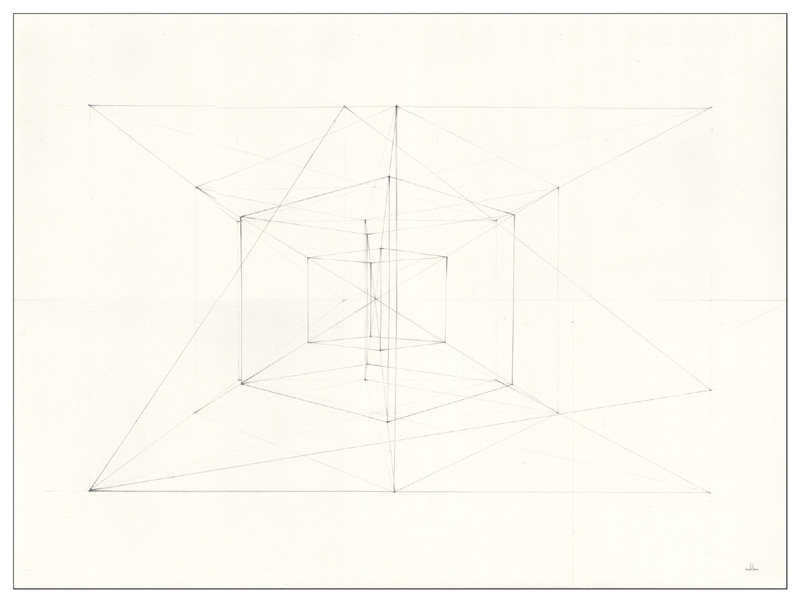
Ricardo Morín Triangulation 4 22″ x 30″ Graphite on paper 2006
To my sister Bonnie
*
Ricardo F. Morín
June 2025
Oakland Park, Florida
Author’s Note
This reflection was originally drafted before The Ethics of Perception, Part I, yet it belongs to the same inquiry into attention, understanding, and ethical relation.
There are moments when the truest form of intimacy is silence. At other times, it’s the quiet labor of reaching for the right word—however incomplete—that brings us closer. Expression, in this light, is not just a vehicle for communication, but an act of care.
To speak, to withhold, to write, to listen—each choice carries a particular weight. Intimacy lives in these gestures: not in grand declarations, but in the ethics of how we reveal ourselves—and how we receive what another dares to offer. What follows is not a theory, but a reflection on how intimacy appears in expression—and in its absence.
I. Prelude: in the pause between words
It’s hard to pinpoint the moment when something becomes intimate. It isn’t always a touch, or a glance, or even a confession. Sometimes, it’s just a pause—a shared pause—between one word and the next, when both people sense that something true is either about to be said or has just been said, without quite naming it.
Once, sitting face to face, I watched someone I cared for stare silently out the window. I said nothing either. There was no gesture, no disclosure, no clarifying words. And yet the silence didn’t feel empty—it felt full. In that stillness, something passed between us—not a message, not even an understanding, but a kind of permission:
To exist without explanation. To be present without having to perform.
That moment stayed with me not because it was dramatic, but because it was unplanned. I hadn’t expected it, and I couldn’t have recreated it. I only knew, afterward, that I had been in the presence of something rare: an intimacy that asked nothing more than to be.
And yet, not all intimacy is born in silence or in someone else’s presence. Some comes later, through writing—in that long interval between feeling and saying. Some is only possible thanks to the quiet distance that makes reflection possible.
II. What we mean when we say “intimate”
The word intimacy often evokes physical closeness: the realm of touch, proximity, lovers, secrets shared in the dark. But what if intimacy were less about closeness than about permission? The permission to be undefended. To move slowly. To be unclear—and still be trusted.
To be intimate with someone is not merely to be known, but to be seen— seen without the pressure to explain yourself quickly or justify what you feel. It’s an opening, and it’s also a risk: the risk of being misunderstood, and the deeper risk of being understood too well.
Some forms of intimacy unfold face to face. Others require distance. Some happen through dialogue. Others need a single voice, speaking on one’s own in a quiet room.
That’s where writing begins— not as performance, but as a long conversation, uninterrupted.
III. The varieties of intimacy
Intimacy shifts with context, with time, with the shape of the self we bring to another. It is not one thing— not just closeness, or tenderness, or vulnerability— but a set of ways we allow ourselves to be known, and sometimes, to know another.
There’s the intimacy of the body— perhaps the most visible and least understood. It belongs to touch, proximity, the instinctive draw toward another’s presence. But this form can deceive: physical closeness without emotional resonance is common— and easily faked. Yet when body and emotion align, there’s a wordless attunement: a hand resting on a shoulder for just the right amount of time; a breath falling into rhythm without intention.
Then there’s emotional intimacy: the slow courage to say what one feels— not just when it’s beautiful or convenient, but when it’s awkward, incomplete, or raw. This kind of intimacy isn’t given—it’s earned. It may take years, or a single night. Trust lives here—or breaks.
There’s also intellectual intimacy: what arises in conversation when ideas flow without anyone guarding their ground. It’s rare. Most social spaces reward speed, the need to shine, or the safety of politeness. But sometimes, with someone equally curious, thought expands in the presence of the other— not in agreement, but in response. There’s nothing to prove— only the pleasure of discovery. That’s intellectual intimacy. It creates a different kind of closeness— not of feeling, but of perception.
Stranger still is narrative intimacy— the kind that forms not between two people in the same room, but between the one who writes and the one who reads, separated by silence and time. It isn’t immediate— but it isn’t less real. A voice emerges from the page and seems to speak directly to you, as if it knew the contours of your mind. You feel understood—without being seen. You may never meet the person who wrote those words, but something in you shifts. You are no longer alone.
These are not rigid categories. They overlap, interrupt, evoke one another. One may deepen another. Physical presence can create emotional safety. Intellectual closeness can open into unexpected tenderness. And still, each has its own rhythm, its own grammar— and its own risks.
In that complexity, intimacy ceases to be a condition. It becomes a practice: something we learn, lose, revise, and sometimes write when no other form is possible.
IV. Writing as intimacy with oneself (and with another)
Writing, too, is a kind of intimacy— not only with others, but with oneself. Especially when it’s honest— when what’s written is not just clever or correct, but true. That kind of writing doesn’t flatter. It doesn’t argue. It reveals.
We write to bring something forth— not just for an audience, but to hear ourselves think, to see what we didn’t yet know we felt. In writing, we become witnesses to our own consciousness— both its lucidity and its evasions.
We follow a sentence not only for its logic, but for the feeling it carries. And when that feeling falters, we know we’ve lost the thread.
So we begin again, and again— trying not just to explain, but to say something that feels just.
In that sense, writing is an ethical act. It demands attention. It requires patience. It invites us to inhabit our own experience with precision— even when that experience is fragmented or unresolved.
And if we are lucky— if we are honest— something in that effort will reach someone else. Not to impress. Not to convince. But to accompany.
V. When intimacy fails or is refused
Sometimes you reach out—carefully, sincerely—and receive silence, indifference, or a response so misaligned it makes you feel naïve for having tried. Other times, the failure is subtler: a conversation that scatters just as something real begins to take shape—or a listener who hears your words, but not your meaning.
Those moments stay with us. Not because they’re dramatic, but because they remind us how precarious intimacy can be. It can’t be forced—just as humility can’t. Both require a quiet letting go—a willingness to offer something without knowing how it will be received. We can prepare the ground, make the gesture, risk the truth—but the rest depends on the other: their timing, their capacity, their willingness to meet us there.
There’s also the experience of being misunderstood—not just in fact, but in essence. You try to say something that matters, and the other person responds to what they think you said—or to a version of you that never was. It’s a blow— that mismatch between what you tried to share and what actually landed. The desire for intimacy becomes exposure without connection—a wound instead of a bridge.
Sometimes we avoid intimacy not because we don’t want it, but because we fear what it might cost. We’ve been made to feel clumsy—for caring too much, or for being too visible. Or we’ve shared something intimate, only to have it treated lightly—or analyzed without feeling. After that, we grow cautious. We speak less—or in fragments—or not at all.
It’s in the wake of such rejections—large or small—that writing ceases to be mere expression. It becomes repair. Writing allows us to recover what was lost in the moment— to name what never reached its destination, to finish the thought no one waited for, to say it again—this time without interruption, without assumptions, without fear.
And while writing cannot undo the failure of a shared moment, it can offer something else: coherence. A record. A form of truth that endures—even if it wasn’t heard.
In this way, writing becomes a quiet act of insistence—not against the world, but on behalf of the self. It’s a way of saying: What I tried to share still matters—even if it wasn’t received.
VI. The gesture that remains
In the end, intimacy is not a state but a gesture— repeated again and again— toward understanding, toward presence, toward a shared sense that may arrive… or may not.
Sometimes that gesture is a word spoken at the right moment. Sometimes it’s a silence held just long enough for the other to speak. And sometimes it’s the act of writing—solitary, patient, unfinished— offered not to a crowd, but to a single imagined reader who, one day, might need what you are now trying to say.
Writing, at its core, is a form of listening. Not only to others, but to the self that doesn’t rush, doesn’t perform, doesn’t need to persuade.
To the self that waits— that wants to be known not by what it manages to say in quick response, but by what it keeps trying to say with care.
That’s why I return to the page: not because it guarantees connection, but because it keeps the door open. Because in a world that demands speed, certainty, and charm, writing makes room for something slower and more faithful: the long, unfinished gesture of trying to reach someone— perhaps even oneself— with something resonant.
And when intimacy happens—on the page or in life— it’s never because we found the perfect words. It’s because someone stayed. Someone listened. Someone let the moment open—without rushing to close it.
That’s what I’m doing now: writing not to end something, but to leave it open— so that something of greater consequence might enter.