Posts Tagged ‘Loss’

“Intervals”

September 2, 2025

*

Design cover by Ricardo Morín
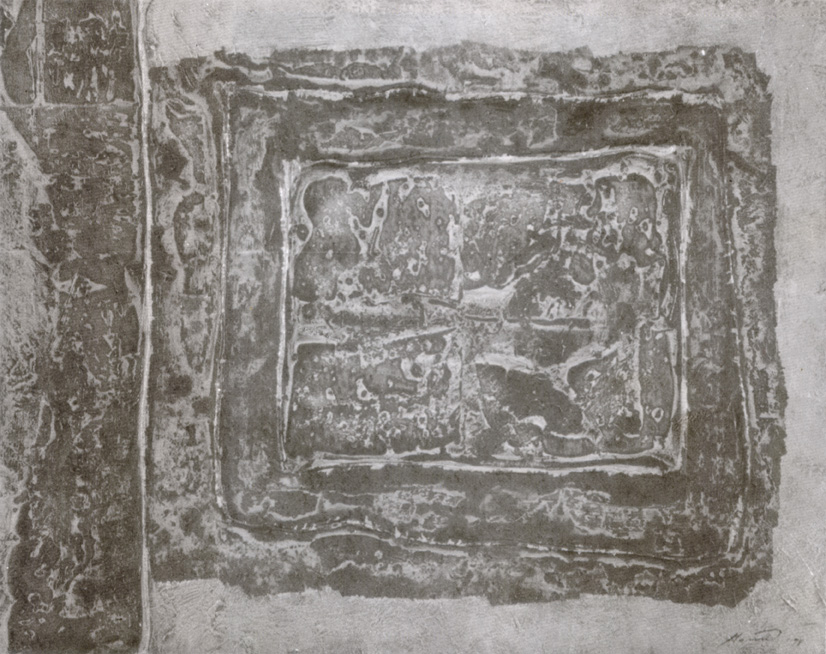
Aposento Nº 2
29″ x 36″
Oil on canvas
1994

Author’s Note

Intervals is written in a cadence held taut at the threshold of life and death.   It does not withhold itself, though its language remains stripped of explanation.   Ambivalence may be inescapable, but it is not the aim.   The anonymity of the speaker is deliberate, to keep attention on what is spoken rather than on who speaks.

Ricardo Morín, September 11, 2025. Bala Cynwyd, Pa.

Intervals

To heal himself, he would cover his body in mud and then rinse it away.    Crouched beneath the burning sun, he stared diagonally from a corner across the far end of the yard.   From the clothesline he hung a black umbrella, upside down.    Into it he cast the last handful of potions. From its collapse, heavy with weight, he hoped to avoid his own death.

He covered his books with a black sheet; blindly he pulled one out at a time and, after finding a sentence giving meaning to his thoughts, he put it back.   He waited for revelation.    His mother, now old, took another book out and searched for a better reply.

Exhausted and sleepless, he lay wrapped in a red blanket with his back to the mirror.    Drenched in tears, he felt undone.   Shivers traced his spine, as though his entrails were on fire.

He woke to the sound of running water.   His mother would scrub his garments until the fabric began to fray.    He had painted the walls white; the doors ceased to be brown.    An intruder leapt over the fence.   Then, with a surprising strength, he tore up the garden.

Nights followed without sleep.    He was unaware of sunken cheekbones; only his neighbors’ gaze could see him wasting away.     He managed to fly afar.     Though attentive to life, he found disappointment.

On arrival the hotel summoned an ambulance.    After a ten-hour flight, septic shock seized him; a nurse asked him to choose a destination.    Shivers returned.    He saw many dying, though it was not his turn.     Days later, his flesh returned to life.

With the memory of past ties, he departed again disappointed.    He crossed another distance and knew how fragile his solitude was.

You rescued him and he you.    A bridge was built out of longing.    Three years of passion did not mend the abyss; he took his life and you remained.

A Roman curate attended his mother’s cries, while he twisted her son’s.     Little did the curate know that it was by his own design.     He called for you, a new love, to come.    To love, to sustain the bond of the moment.


Epilogue

Intervals rests on our fearful perception of death, solitude, survival, and rupture (an interval is the rhythm of time and its ending is the emptying of what the consciousness of fear carries in it).    An interval seeks neither consolation nor resolution; it remains with what occurs, in the exposure where solitude and fracture reveal the fragility of existence.
“A Bond’s Trace”

June 3, 2025


Ricardo Morín
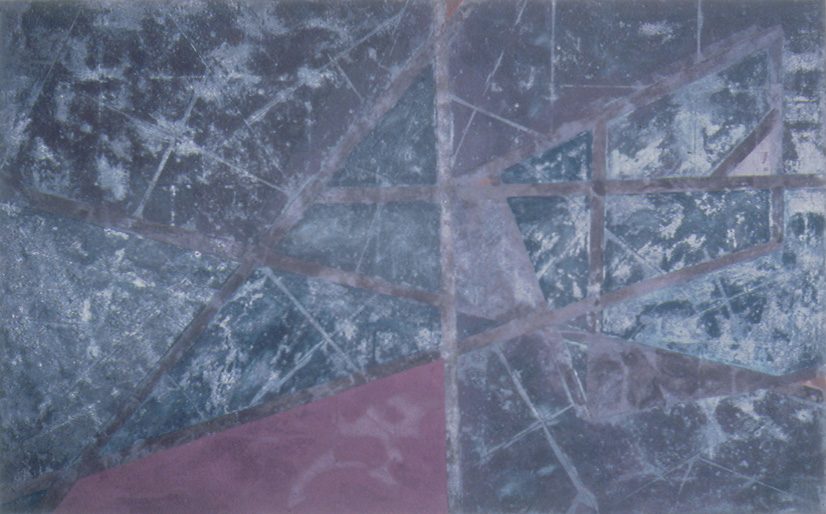
Buffalo Series, Nº 12
46" x 60"
Oil on canvas
1979
Ricardo Morín
Buffalo Series, Nº 12
46″ x 60″
Oil on canvas
1979

For those of us who have lost someone,

whose presence now rests in memory

and whose absence shapes who we are.

May this story preserve something of their enduring trace.


Julian tried to put into writing what he had dreamed.

He wondered:    could writing remain faithful to the one who watches, trembles, and longs to understand?

He dreamed he was offering his mother a bowl of viper’s broth.    The serpent’s head and torn fragments of its body were still writhing, as if unaware of their condition: alive, though undone. He held the bowl with both hands; it had been handed to him by an old woman seated at the far end of a wide, shallow circular pond.    The pond seemed to contain more than water—perhaps time, or memory, or fate.    Around him loomed shadows—blurred figures repeating the same ritual, or perhaps none at all.    He could not tell.

The path to his mother was arduous; the ground was slick with a substance he could not name.    The air was dense, weighted by an oppressive silence that made each step slow, burdensome.    The viper twisted in the broth, struggling to flee.   Even so, he kept the bowl steady.    He believed—in some quiet corner of himself—that if his mother drank, healing might be reached, or understanding, or peace for them both.

When he reached her, he knelt.    He spoke gently, urging her to drink while the broth was still warm.    “Hold the spoon carefully,” he whispered.    “Just small sips.”    But she turned her face away.    She would not drink.    Whether out of fear, pride, or rejection of what was offered, he did not know.    The viper shuddered, and his heart tightened in anguish.

He awoke unsettled, exhausted.    The dream still veiled his perception.    His breath was strained, shallow in the thick air of the room.    Why couldn’t he find calm?    What, exactly, kept him awake?

He wondered if it had been a premonition—a latent fear of his own decline.    Was the writhing snake a vision of his mind losing its serenity?    Were the slow gait, the unstable ground, the trembling hands a rehearsal of his own fading?    Or was it grief—that quiet interloper of the soul, forever hungry, never sated?

He only knew he had tried to help, to steady, to offer comfort that could not be received.    And in doing so, he faced not only the absence of his mother, but the shadow of his own dread—the question of who would walk beside him when his own farewell arrived.

But perhaps—he thought—there is something sacred in the attempt.    In the offering, even when refused.    In the slow advance—however uncertain it may be.


There, humility may dwell:

the kind that does not demand,

and yet disarms pain

by its presence—

too steady to be cast aside.

It meets no resistance—

only the quiet invitation to be welcomed.

Ricardo F. Morin Tortolero

Bala Cynwyd, Pa, June 2, 2025


“A Table Between Us”

February 16, 2025

*


~

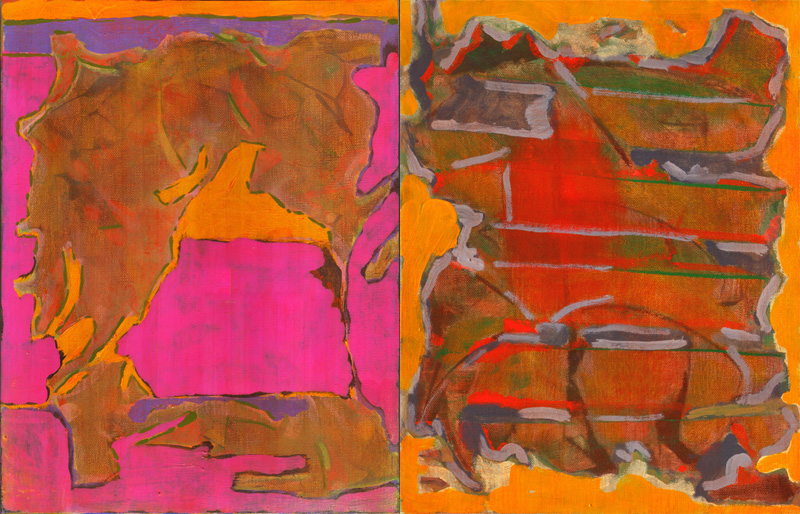
Silent Diptych
by Ricardo Morín
Medium: Oil On Linen
Size: 18 by 28 by 3/4 inches
Year: 2010

~


*

Prologue

Silent Diptych is not an illustration but a resonance—a meditation on silence, not as emptiness, but as a state of receptivity.     It is the space where judgment dissolves, where human connection lingers between words, where meaning is felt rather than spoken.     In its stillness, it holds what remains unresolved.     Some silences are quiet.     Others are filled with history.

RFMT

~


*

Our early dinner followed a matinee of “Parade”, a musical steeped in history, in indignity, in the weight of a life taken and a verdict that still hung unresolved.     At the table, we spoke of Leo Frank, the Jewish man lynched in Georgia a century ago–pardoned decades later but never absolved.     His true killer never pursued.

Three of us were Jewish.     They understood, in ways the rest of us could only acknowledge but never quite embody, the particular pain of being made a scapegoat.     The others sympathized but could not feel the same alienation—not in the marrow, not in the inherited way history imprints itself on some more than others.

It was a conversation of weight, but not of sorrow.     We spoke with the clarity that comes when facts are long settled but their reverberations remain.

Then came the interruption.

The woman at the next table turned to us with a question, her voice cutting easily through our discussion.

“Where are the girls?”

I glanced at my companions, the six of us settled comfortably into the familiarity of one another.

“What girls?” I asked, not unkindly.

She blinked, as if expecting the answer to be self-evident.

“We’re already married to each other,” I said.

She turned away without another word.

There was no need to dwell on it.     The moment was familiar.     A minor encounter, the sort that barely registered after years of knowing exactly how the world could tilt in response to our presence.

To shift the conversation, I said, “Freud might say that all relationships are attempts to resolve unfinished business with our parents.”

Someone smirked. A fork was set down.     A momentary silence, not of discomfort, but of consideration.

“Men with their fathers, women with their mothers,” I continued.

The responses were mixed.     Agreement.     Deflection.     A shift in tone.     Some spoke of failing to meet their fathers’ expectations.     Some spoke of hatred.     Some of detachment.     Some of nothing at all.

I mentioned my father.     His certainty that we, his children, would not know how to survive without him.     He meant economically, of course.     His generation had its own understanding of what it meant to endure.

“How many siblings do you have?” someone asked.

“Five,” I said.     “Including my younger sister, who just passed away.”    A pause.    She was angelic.”    “Sixty-nine.”        

There was sympathy, warm and immediate.    A moment held just long enough.

And then, as if on cue, the conversation shifted—easily, instinctively.     To theater.     To Tony Awards.     To the life and talent of voices long gone but forever recorded.

At the next table, the woman was laughing now, the moment between us already forgotten on her end.

And we, too, were laughing—at something lighter, something that did not ask to be examined too closely.

The moment stayed, unnoticed, but not forgotten.

~


*

Epilogue

Like the painting, the moment lingered—not demanding resolution, but waiting, quietly, to be understood.   The weight of history, the subtleties of belonging, the pauses in conversation where truth is felt but not spoken.   Silence, in the end, is never empty.   It is the space where everything remains.

~

Ricardo F. Morín Tortolero

February 16, 2025; Oakland Park, Florida


*