Posts Tagged ‘civic responsibility’

“Unmasking Disappointment: Series I”

January 7, 2026

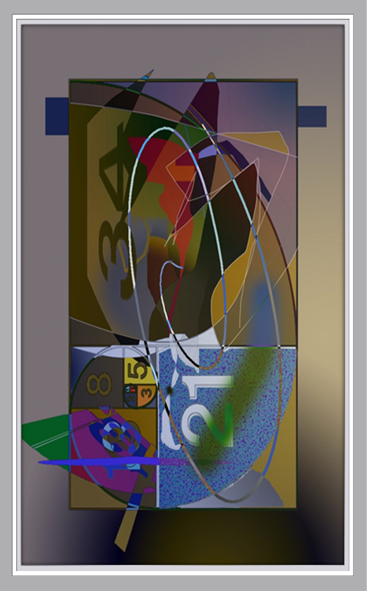
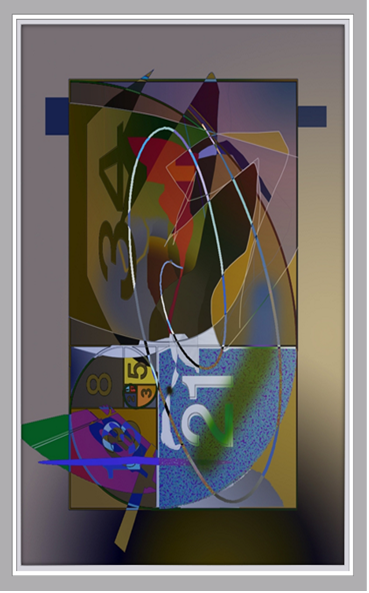
“Geometric Allegory,” digital painting 2023 by Ricardo Morin (American visual artist born in Venezuela–1954)

To my parents

Preface

Unmasking Disappointment” follows a line of inquiry present throughout my work:   the examination of identity, memory, and the relations that emerge when life unfolds across cultural boundaries.   Although I have lived outside Venezuela for more than five decades and became a naturalized citizen of the United States twenty-four years ago, my relationship to the country of my birth remains a persistent point of reference.   The distance between these conditions—belonging and removal—forms the backdrop against which this narrative takes shape.

This work belongs to a broader autobiographical project that gathers experiences, observations, and questions accumulated over time.   While personal in origin, it does not proceed as confession or memoir.   Its method is sequential rather than expressive:   individual exposure is situated within historical forces and political structures that have shaped Venezuelan life across generations.   The intention is not to reconcile these tensions, but to render them visible through recurrence, record, and consequence.

Series I” introduces the first thematic clusters of this inquiry.   The episodes assembled here do not advance a single thesis, nor do they aim at resolution.   They trace points of friction where private experience intersects with public power, and where political narratives exert pressure on ordinary life.   Across these encounters, patterns emerge—not as abstractions, but as conditions that alter how authority is exercised, how responsibility is displaced, and how agency is constrained.

The chapters that follow examine the pressures produced by systemic inequality and trace contemporary Venezuelan conditions back to their historical formation.   Autocratic rule and popular consent appear not as opposing forces, but as elements that increasingly entangle and weaken one another.   Within this entanglement, truth does not disappear; it becomes less evenly accessible and more readily displaced by narrative.

When public discourse is shaped by propaganda and misinformation, authoritarian structures gain resilience.   Recovering truth under such conditions does not resolve political conflict, but it clarifies the limits within which political life operates.   Agency emerges not as an ideal, but as a condition sustained—or undermined—through practice and consequence.

This work does not propose deterministic explanations or simple remedies.   It proceeds by accumulation, drawing attention to patterns that persist despite changing circumstances.   What it asks of the reader is not agreement, but attention:   to evidence, to sequence, and to the conditions under which political freedom may be meaningfully exercised.

Writing from Bala Cynwyd, Pennsylvania, and Fort Lauderdale, Florida, I remain aware of the distance between the environments in which this work is composed and the conditions it examines.   That distance does not confer authority; it imposes responsibility.

Ricardo Federico Morín
Bala Cynwyd, Pennsylvania, January 21, 2025


*

Table of Contents

  • Chapter I – A Written Language.
  • Chapter II – Our Recklessness.
  • Chapter III – Point of View.
  • Chapter IV – A Dialogue.
  • Chapter V – Abstract.
  • Chapter VI – Chronicles of Hugo Chávez (§§ I-XVII).
  • Chapter VII – The Allegorical Mode.
  • Chapter VIII – The Ideal Government and the Power of Virtue.
  • Chapter IX – The First Sign:   On Political and Social Resentment.
  • Chapter X – The Second Sign:   The Solid Pillar of Power:   The Military Forces.
  • Chapter XI – The Third Sign:  The Asymmetry of Political Parties.
  • Chapter XII – The Fourth Sign:  Autocracy (§§ 1-9):  Venezuela (§§ 10-23), The Asymmetry of Sanctions (§§ 24-32).
  • Chapter XIII – The Fifth Sign:  The Pawned Republic.
  • Chapter XIV – The First Issue:   Partisanship, Non-partisanship, and Antipartisanship.
  • Chapter XV – The Second Issue:   On Partial Truths and Repressive Anarchy.
  • Chapter XVI – The Third Issue:   The Clarion of Democracy.
  • Chapter XVII – The Fourth Issue:   On Human Rights.
  • Chapter XVIII – The Fifth Issue:  On the Nature of Violence.
  • Chapter XIX – The Ultimate Issue:   About the Deliverance of Injustice.
  • Acknowledgments.
  • Epilogue.
  • PostScript.
  • Appendix:   Author’s Note, Prefatory Note.     A). Venezuelan Constitutions [1811-1999], Branches, and Departments of Government.   B) Evolution of Political Parties: 1840-2024.    C) Laws Enacted by the Asamblea Nacional.  D) Clarificatory Note on Domestic Coercion, Foreign Presence, and Intervention.
  • Bibliography.

A Written Language

Stability is often sought where it cannot be secured.   Experience has shown this repeatedly.   Even careful intentions tend to draw one into uncertain terrain, where understanding lags behind consequence.   At the desk, as late-afternoon light reaches the page, writing assumes a practical function:   it becomes a means of ordering what would otherwise remain unsettled.   The act does not resolve vulnerability, but it records it.   Whether time alters such conditions remains uncertain; what can be done is to give them form.

What follows moves from the conditions of writing to the conditions it must confront.


*

Our Recklessness

~

Our painful struggle to deal with the politics of climate change is surely also a product of the strange standoff between science and political thinking.” — Hannah Arendt:   The Human Condition:   Being and Time [1958], Kindle Book, 159.

1

The COVID pandemic and the 2023 Canadian wildfires, among other recent events, have made visible conditions that were already in place.     These events did not introduce new vulnerabilities as much as they revealed the extent to which existing systems depend on economic incentives and political habits that privilege extraction over preservation.   During the period when smoke from the fires reached the northeastern United States, daylight in parts of Pennsylvania was visibly altered and registered the reach of events unfolding at a considerable distance.   Such occurrences do not stand apart from prevailing economic arrangements; they coincide with a model that treats natural conditions as commodities and absorbs their degradation as an external cost.

2

The fires in California in 2025, like those that spread across Canada in 2023, do not present themselves as isolated occurrences.   They form part of a sequence shaped by environmental neglect, political inertia, and sustained industrial expansion.   Conditions such as desertification, resource scarcity, and population displacement no longer appear solely as projected outcomes; they are increasingly registered as present circumstances.   Scientific assessments indicate that these patterns are likely to intensify in the absence of structural change. [1][2][3]   What is brought into view, over time, is not a singular failure but a system that continues to operate according to priorities that favor immediate yield over long-term continuity.

3

The question of balance does not arise solely as a technical problem.   It emerges within a moral and political field shaped by prevailing economic assumptions.   The treatment of nature—and more recently of artificial intelligence—as a commodity reflects a trajectory in which matters of shared survival are increasingly translated into market terms.    Under such conditions, considerations that once belonged to collective responsibility are recast as variables within systems of calculation.

4

Such patterns place increasing strain on conditions necessary for collective survival.   Responses to these conditions vary and range from indifference to urgency, though urgency does not invariably produce clarity.   What becomes apparent, across repeated instances, is a tendency for crisis to recur without sustained adjustment.   This recurrence parallels the political histories examined in the chapters that follow, where warning and consequence frequently fail to align.


Endnotes—Chapter II


*

Point of View

1

Conversations with my editor, Billy Bussell Thompson, have accompanied the development of this work over time.    His attention to research method and to the structure of argument has contributed to the clarification of its scope and direction.    These exchanges, often conducted at a distance and without ceremony, formed part of the process through which the present narrative took shape.    After an extended period of uncertainty regarding how to approach the subject of Hugo Chávez, the contours of Unmasking Disappointment gradually emerged.

2

Hugo Chávez entered national political life as a leader whose authority was exercised in opposition to political liberalism. [1]  While his public discourse emphasized alignment with the poor, the material benefits of power accumulated within a narrow circle. [2]  Over the course of his tenure, democratic institutions in Venezuela experienced progressive weakening, and governance assumed increasingly authoritarian forms.   These developments become more legible when situated within the historical record and examined through documented practice rather than rhetorical claim.

3

The events that followed Chávez’s rule are marked by disorder and unresolved consequence.   Their persistence draws attention to questions of historical accountability and collective responsibility that remain unsettled.   Examining the record of autocratic leadership—its ambitions as well as its failures—provides a means of approaching the problem of justice in Venezuela without presuming resolution.   Through this examination, enduring tensions come into view as conditions to be understood rather than conclusions to be reached.

~


Endnotes—Chapter III

  • [1]   The term caudillo originates in Spanish and has historically been used to describe a leader who exercises concentrated political and military authority.    In the Venezuelan context, the term carries particular resonance and refers to figures associated with the post-independence period of the nineteenth century.    Such leaders tended to consolidate power through a combination of personal authority, allegiance from armed factions, and the promise—whether substantive or rhetorical—of maintaining order under conditions of instability.    While some were regarded as defenders of local or national causes, others became associated with practices that facilitated authoritarian governance and weakened institutional structures.    The concept of the caudillo continues to function within Venezuelan political culture as a descriptive category applied to leadership forms that combine popular support with concentrated power.

Chapter IV

A Dialogue

A series of conversations between BBT and the author accompanied the examination of Venezuelan politics and history developed in this section.   These exchanges formed a transitional space in which reflection gave way to historical inquiry, allowing questions of interpretation, responsibility, and record to be addressed through dialogue rather than exposition.

1

—RFM:   “My writing has been concerned with the evolution of Venezuela’s political landscape, with particular attention to the emergence of authoritarian forms of rule.   The focus has been less on abstract doctrine than on how specific policies translated into everyday conditions for ordinary Venezuelans.”

2

—BBT:   “Examining how authoritarian leadership shapes political conditions is necessary, though the term itself is often contested and applied unevenly.   In Chávez’s case, the use of propaganda was not exceptional in form, but it was consistently employed as an instrument of governance.   How did official narratives during his tenure circulate, and what effects did they have on public perception over time?”

3

—RFM:  “Propaganda is not unique to Chávez; it functions as a recurring instrument across political systems.   In Venezuela, official media regularly attributed economic hardship to external interference rather than to domestic policy decisions.    At the same time, material conditions deteriorated, with shortages emerging from economic mismanagement and later compounded by external restrictions.   Opposition groups also circulated counter-narratives, which in turn elicited responses from the State.    These exchanges unfolded within a historical context shaped by civil conflict and Cold War alignments, and produced a fragmented informational environment.   Within that environment, responsibility for economic decline was frequently displaced, while public perception was managed through repetition rather than resolution.   The social and economic reforms invoked in justification did not, over time, yield the reductions in poverty and inequality that had been promised.”

4

—BBT:  “To render Venezuela’s political conditions with some accuracy, attention must be given to how ordinary citizens encountered these dynamics in daily life.     How were such conditions navigated in practice, particularly where political discourse intersected with immediate economic necessity?”

5

—RFM:  “The economic collapse that followed the decline of the oil-based model intensified poverty and placed sustained pressure on public services.   Examined in sequence, this period shows how colonial legacies and authoritarian practices converged in the formation of Chavismo.   Episodes such as the 1989 riots known as El Caracazo registered widespread disaffection with established parties and democratic institutions.   Under such conditions, the demands of securing basic necessities frequently outweighed engagement with abstract political principles.”

6

—BBT:   “Clarity in narrative depends in part on recognizing the assumptions that guide interpretation.   When these assumptions are made explicit and examined, the account becomes less directive and more accessible, allowing readers to follow the record without being steered toward a predetermined position.”

7

—RFM:  “No narrative proceeds without interpretation, including this one.   Writing provides a means of approaching Venezuela’s history—its colonial formation, episodes of authoritarian rule, and periods of political disruption—without foreclosing alternative readings.    A coherent account need not be exhaustive; it remains open insofar as it attends to implication and consequence rather than resolution.”

8

—BBT:  “The exchange itself underscores the importance of careful narration when approaching Venezuela’s political and social record.    Attending to multiple viewpoints does not resolve complexity, but it allows a more coherent account to emerge without reducing that history to a single explanatory frame.”

The exchange marked a transition from reflective inquiry to historical record.

~


Chapter V

Abstract

1

This section examines the sequence through which the political project articulated under Hugo Chávez assumed autocratic form.    Rather than attributing this outcome to a single cause, the inquiry proceeds by tracing how leadership decisions unfolded within a convergence of historical conditions, institutional arrangements, economic pressures, and geopolitical alignments.   The account does not begin from conclusion, but from record.

2
Attention remains on how authority was exercised and how its effects registered within Venezuelan society.    Historical circumstance, institutional design, and external influence are examined not to simplify the record, but to make visible the interdependencies through which power consolidated over time.    What emerges is not an explanatory thesis, but a configuration whose coherence can be assessed only through sustained attention to sequence and consequence.

~


“The Constitution Within”

August 10, 2025

*

Ricardo Morin
The Constitution Within
GCI
2025

*

Politics (from the Greek politikós, “of, by, or relating to citizens”) is the practice and theory of influencing people at the civic or individual level.

*

By Ricardo Morin

August 10, 2025.

~

From their earliest formulations, constitutional frameworks have been more than foundational legal agreements; they have stood as declarations of political philosophy, and defined how power should be organized, how it should be restrained, and to whom it must be answerable. Contemporary governance, to a large extent, continues those experiments, shaped over centuries of trial and adaptation. Yet these forms can endure in appearance while being emptied of substance. In more than a few States today, constitutions proclaim liberty while they narrow its scope, define rights in ways that exclude, and preserve the interests of a governing elite. Partisanship exploits the perceived limitations and vulnerabilities of others as grounds for exclusion; self-righteousness becomes a tool for domination, silences opposition, and suppresses dissent. The worth of a constitutional framework, therefore, is measured not only by its letter but by the ethical integrity of those who sustain it. Without ethics, politics loses its meaning; without civic virtue, the law ceases to serve peace and becomes an instrument of dominion.

The separation of powers, vigorously defended by Montesquieu, rests on the conviction that liberty survives when power is compelled to check power. This principle is distorted when institutions are subordinated to partisan or personal interests. In recent years, several States have formally preserved an independent judiciary while, in practice, subjected it to appointment processes controlled by the Executive or the ruling party. Such hollowing-out is not merely a technical failure; it reflects a political culture in which ambition, fear, or indifference among citizens permits the disfigurement of the very mechanisms designed to protect them. It also reveals how institutional strength and civic responsibility are bound together in ways that cannot be separated.

Historical constitutions continue to shape how political communities imagine authority. They bequeath principles that, at their best, offer adaptable frameworks for meeting new challenges without renouncing their essential core: that the legitimacy of a Government rests not on the strength of its rulers but on the solidity of the structures that limit them.

Yet these structures endure only when citizens reject duplicity and sectarianism. Divisions of ideology must not harden into exclusive loyalty to one’s own group at the expense of a shared civic framework. They endure only when citizens resist the idolatry of power, because authority loses its legitimacy once it is treated as sacred or unquestionable. And they endure only when citizens repudiate the cult of personality, in which a leader is raised above criticism through image-making, propaganda, and personal loyalty.

The durability of constitutional order, then, does not lie solely in written texts or institutional arrangements. It rests equally on the civic ethic of those who inhabit them. When ambition, fear, or indifference allow citizens to tolerate duplicity or surrender to sectarian loyalty, the limits on power become fragile. Conversely, when vigilance and responsibility prevail, constitutions retain their strength as both shield and compass—guarding against arbitrary rule while orienting political life toward justice and restraint.

True reform is not solely institutional but also internal: a revolution in the individual and collective sphere, in which each person accepts the responsibility to act with integrity, openness, and commitment to the common good, in harmony with oneself and with others. Only through the alignment of institutional structures with civic responsibility can any Constitution preserve its meaning and endure as a safeguard against arbitrary power.

*


Annotated Bibliography

~

  • Ginsburg, Tom, and Aziz Z. Huq.; How to Save a Constitutional Democracy. Chicago: University of Chicago Press, 2019. (Ginsburg and Aziz examine the legal and institutional pathways through which democracies weaken, from court-packing to the erosion of independent oversight. They draw on comparative examples from the United States, Hungary, and elsewhere to show how constitutional mechanisms can be used to consolidate power while preserving a façade of legality.)
  • Landau, David: “Abusive Constitutionalism.” UC Davis Law Review 47 (1), 2013: 189–260. (Landau develops the concept of “abusive constitutionalism” to describe how incumbents exploit constitutional change to entrench their rule. Uses Latin American and other global cases to illustrate how amendments and reinterpretations weaken checks and balances, alter electoral systems, and undermine judicial independence.)
  • Levitsky, Steven, and Way, Lucan A.: Competitive Authoritarianism: Hybrid Regimes after the Cold War. Cambridge: Cambridge University Press, 2010. (Levitsky and Way analyze regimes that preserve the formal institutions of democracy but manipulate them to ensure ruling-party dominance. They introduce the concept of “competitive authoritarianism” as a framework for understanding how constitutional norms are hollowed out while democratic forms are maintained.)
  • Levitsky, Steven, and Ziblatt, Daniel: How Democracies Die. New York: Crown, 2018. (Levitsky and Ziblatt argue that modern democracies often decline through the gradual decline of norms rather than coups. The book shows how leaders exploit constitutional ambiguities, stack courts, and weaponize law to suppress opposition, eroding both civic trust and institutional integrity.)

~


“The Wounds That Remain”

June 12, 2025

There are wounds that remain because we have not yet forged a moral consensus:

“…E pluribus unum”

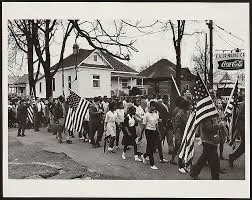
Participants carrying American flags in the Selma to Montgomery civil rights march, Alabama, 1965.
Photograph by Peter Pettus; gelatin silver print (reprint from 1999–2000).
Archival public domain image courtesy of the Library of Congress Prints & Photographs Division.
The image underscores a defining moment in our civic life:        when expressions of dissent are met not with dialogue but with the politicization of militarized force on behalf the executive’s brand.        It echoes a troubling pattern—where calls for justice and inclusion are conflated as partisan threats, and the defense of plurality is treated as provocation.
A stark visual of power confronting protest—where public dissent meets State’s militarization, June 2025.
Photo by Spencer Platt / Getty Images via NPR.


The image underscores a defining moment in our civic life:    when expressions of dissent are met not with dialogue but with the politicization of militarized force on behalf the executive’s brand.    It echoes a troubling pattern—where calls for justice and inclusion are conflated as partisan threats, and the defense of plurality is treated as provocation.


*

There is a deepening divide in our country—one intensified by the 2025 return of the Trump administration and the M.A.G.A. movement’s project to “reform” America by disrupting the constitutional principles that have long undergirded our democracy.    This movement has emboldened some to claim they are under siege—particularly by Black Americans—whom they accuse of harboring irrational hatred.    Yet this accusation ignores a deeper truth:    those who make it often refuse to confront their own complicity in the conditions that produce widespread suffering and rightful indignation.    They see themselves as blameless while dismissing the lived experience of others.

This dissonance reveals a persistent tribalism—a complex masked as patriotism, often directed at marginalized communities.    It demeans empathy and stifles accountability.

Dissent, however, is the lifeblood of democracy.    And while we may cherish this nation—its landscapes, its cultural richness, and its founding ideals—we must also confront the unfinished work of justice.    To celebrate the Constitution while ignoring the legacy of slavery, segregation, and systemic inequity is to cheapen both our history and our future.

Nowhere is this more evident than in our criminal justice system.    The need for reform is no longer a partisan position; it is a moral imperative.    Communities of color remain disproportionately targeted, criminalized, and subjected to violence under the guise of law and order.    Police departments across the country have repeatedly failed in their duty to protect those most vulnerable—those left behind by lack of opportunity, education, and support.    When these conditions are met not with compassion but with brutality, we witness the most abhorrent face of cruelty.

One may love this country profoundly, but such love must be active—committed to fairness, not nostalgia.    Justice and equality are not rewards for silence; they are the birthright of all who live here.

The Black Lives Matter movement is not a threat to American values; it is a call to fulfill them.    It is not hatred to protest injustice.    Hatred lies in silencing dissent, in trampling the rights of others while claiming moral high ground.    Time and again, those in power have distanced themselves from the oppressed, especially those stripped of political voice or voting rights.    This indifference persists until solidarity becomes unavoidable.

To relativize the murder of young Black men—or to remain silent—betrays a refusal to understand the long arc of racism in America.    Gestures of inclusion cannot substitute for truth.    Real justice requires not half-measures, but fullhearted resolve.

And now, that same machinery of suppression is turning with renewed force against immigrants, against LGBTQ Americans, and against the very principle of diversity.

—as demonstrated by the unnecessary militarization of one square mile Los Angeles in June 2025, where localized protests were amplified by the federal government as if they were a national insurrection—

The mobilization of troops to suppress peaceful protests—replacing law enforcement with military assault—, the criminalization of migrants seeking refuge, and the push to roll back gay rights—these are not isolated policies.    They are symptoms of the same moral aberration of the executive branch as a political brand:    the fear of plurality.

This fear has now targeted Diversity, Equity, and Inclusion (DEI) initiatives themselves.    These programs, born out of civil rights struggles and meant to remedy historical exclusion, have become scapegoats.    DEI is not a threat to merit; it is a framework for justice.    It is not a matter of political orthodoxy, but about ensuring access, visibility, and dignity for those long marginalized.    The opposition to DEI is not a neutral debate—it is a calculated attempt to suppress the very plurality that gives meaning to democracy.

—Often it reduces that plurality to a caricature.    In partisan circles, the term “woke” has been weaponized to dismiss any effort toward inclusion or redress as absurd, elitist, or dangerous.    What began as a call to remain alert to injustice has been twisted into a tool of mockery—less an argument than a reflex, deployed not to clarify but to silence.    Yet justice does not lose its urgency because it is ridiculed.

Banning DEI offices, defunding inclusion efforts, or labeling diversity work as ideological indoctrination reflects not strength, but fear.    Such actions undermine the foundational values of liberty and justice, replacing inclusive citizenship with enforced conformity.

The desire to reverse LGBTQ rights, to demonize racial justice movements, and to silence DEI are all parts of one piece. These are not isolated grievances; they are expressions of an intolerant worldview seeking dominance through exclusion—echoes of McCarthyism, the early 1950s campaign led by Senator Joseph McCarthy, whose televised accusations of communist infiltration turned suspicion into a weapon and captivated a fearful nation.    These are not the marks of a strong republic, but the signs of a fearful and weakened society.

And yet, the Republican majority in Congress—those enabling Trump and embracing the politics of M.A.G.A. disruption—has further deepened the moral deficit—cut taxes for billionaires and dismantled the nation’s social and political infrastructure.    They have fueled inflation through aggressive foreign tariffs and pursued a global posture that increases instability, all in service of enriching a narrow class of oligarchs at the expense of the common good.

To love this country is to reject that fear and the brittle cowardice that sustains it.    To love our nation is to defend and embrace its pluralism.    To love it is to confront its contradictions—not with cynicism, but with resolve.

We are not a perfect union, but we are still a union.    The path forward is not backward.    It begins where justice lives:    in the search for truth, in compassion, in courage.

~

PostScript

  • Project 2025 and the Machinery of Conformity

Among the clearest examples of how fear of plurality has been codified into political strategy is Project 2025—an ambitious blueprint for restructuring the U.S. federal government, advanced by The Heritage Foundation and now actively endorsed by the Trump administration.    Though its architects invoke the language of liberty and constitutional reform, its underlying goal is not democratic renewal but ideological consolidation.

Project 2025 does not merely aim to reduce government.    It seeks to dismantle the administrative State, eliminate civil service protections, and replace career public servants with partisan loyalists.    Under the guise of “draining the swamp,” it proposes a purge—not to restore constitutional balance, but to empower a narrow executive elite.    This is not conservatism in any meaningful sense.    It is executive authoritarianism draped in populist garb.

Even its rhetoric of “taking back the country” belies its intent:    not to restore pluralist democracy, but to impose uniformity—cultural, political, and moral.    DEI initiatives are to be dismantled, public education reshaped to reflect a singular ideology, and dissent within the government neutralized.    These are not reforms; they are instruments of control.

Such a project is not an aberration but a culmination:    the weaponization of nostalgia, grievance, and fear into policy.    And what it reveals is a deep contradiction—that those who most loudly invoke the Constitution now seek to rewrite it in practice, replacing the promise of We the People with the dominion of We alone.

This was not theoretical when we arrived in the Capitol Hill neighborhood earlier this week.    Outside the Heritage Foundation’s headquarters, we encountered a protest in full confrontation—two factions opposed, one defending reproductive rights, the other cloaking rage in the language of moral authority.    The louder of the two, a group of conservative mothers, shouted not in debate but in contempt—hurling not argument, but condemnation at the very idea of moral disagreement.

It was not a defense of life.    It was a campaign to control how others live.

What I witnessed outside the Heritage Foundation was no isolated outburst.    It was the local manifestation of the national project unfolding within.    The Foundation no longer merely comments on politics; it builds the scaffolding for an authoritarian turn already underway.    In synchrony with the Trump administration—whether openly acknowledged or not—Heritage is not offering policy recommendations.    It is designing a machinery of conformity.

This machinery does not tolerate pluralism.    It redefines dissent as insubordination, diversity as decadence, and governance as loyalty to a singular will.    It is not a restoration of constitutional order, but a calculated repudiation.

And what Project 2025 proposes is not mere administrative change.    It is a blueprint for ideological capture:    of language, of law, and of public life itself.    It replaces We the People with a command from above: Only us.

This is the wound that will not heal—unless we confront it.

  • On the Way to Union Station

As we were leaving Capitol Hill, heading toward Union Station to return home to Pennsylvania, the streets were marked by the symbols of looming celebration.    Barricades had gone up.    Military vehicles lined the avenues.   

Preparations were underway for a military parade featuring tanks, troops, and martial fanfare.    Officially, it was to mark the U.S. Army’s 250th anniversary.    But the timing—Saturday, June 14, Trump’s birthday—along with the pageantry and presidential framing, made it difficult to see the event as anything but an orchestrated spectacle.    The symbolism blurred the line between honoring military service and appropriating it for personal glorification.    It felt less like a birthday—and more like a coronation.

Crossing one of the barricaded intersections, a Black man in a sleek motorized wheelchair passed us on the right.    Without prompting, he looked at us—two men walking together—and said with calm finality, “Beware, Judgment Day is coming soon.”

We said nothing.    He kept rolling forward.

It was a quiet moment, but not a small one.    A judgment—clearly moral, likely biblical—delivered without confrontation, but not without intention.    It was an indictment, as casual as it was chilling.    Even someone visibly vulnerable had absorbed and echoed the nation’s reflex toward condemnation.    The extremes no longer live just in platforms and policies.    They are seeping into the pavement.

I turned to my husband and asked, “How long can all this hatred last?”

He didn’t look away. “We may not live to see the end,” he said. “But it will pass.”

*

Ricardo F. Morín

Capitol Hill, D.C., June 10, 2025