
Posts Tagged ‘constitutional law’

“Fabricated Authority”

January 21, 2026
Ricardo F. Morín
Irrationality, Propaganda, and Tribalism
CGI
2026

Ricardo  F.  Morín

January21, 2026

Oakland Park, Fl. 

1. A political claim ordinarily enters public life through institutions.  A law is debated, enacted, interpreted, contested.  A speech is delivered from a known office, before a defined audience, subject to reply and record.  Authority, in these cases, arises from responsibility and constraint.  


2. The text examined here satisfies none of these conditions.  


3. The text attributes to an unnamed broadcast the power to alter legal status.  The text presents a speaker not as a citizen who speaks, but as a conscience that pronounces.  The text declares effects that no statute, no executive order, and no court possesses the authority to produce.  The text announces national assent in the absence of any forum capable of granting assent.  


4. No enactment appears.  No interpretation occurs.  No review is possible.  


5. Nothing in this sequence is argued.  Nothing in this sequence is demonstrated.  Nothing in this sequence is capable of verification.  


6. Authority is not derived from office, law, or responsibility.  Authority is assigned by narrative arrangement.  


7. The speaker is granted moral standing by recognition alone.  The law is displaced by spectacle.  The audience is positioned as witness to a verdict that precedes deliberation.  Silence is treated as confirmation.  Stillness is treated as consent.  


8. What appears as denunciation functions as substitution.  


9. The place of institutions is occupied by a voice.  The place of argument is occupied by proclamation.  The place of judgment is occupied by reaction.  


10. The result is not persuasion.  The result is conversion.  


11. Citizens are not addressed as agents capable of contesting claims.  Citizens are addressed as spectators invited to receive a moral scene whose meaning has been fixed in advance.  


12. When invented testimony is received as political record, the boundary between event and wish disappears.  When spectacle is treated as verdict, correction loses authority.  When conscience is produced as performance, no institution remains capable of constraining conscience.  


13. This is not misinformation in the ordinary sense.  


14. This phenomenon is the replacement of judgment by fabricated authority.  


15. Authority ordinarily attaches to an office before authority attaches to a voice, because office supplies the limits under which speech can claim consequence.  A court exists, so a judge speaks.  A chamber exists, so a legislator speaks.  An administration exists, so an executive speaks.  In each case standing precedes utterance, and the public can locate responsibility by locating the forum in which the claim is made.  


16. The text examined here reverses that order.  The text presents a voice whose standing is not grounded in any office that can be named, any jurisdiction that can be defined, or any forum that can be recognized.  No delegation is stated.  No mandate is visible.  No responsibility is assumed.  Yet the voice speaks as if entitled to pronounce on matters whose force depends, in ordinary civic life, on enactment, interpretation, and review.  


17. This reversal matters because office establishes the scope under which a claim may operate, jurisdiction fixes the reach of effects, and procedure subjects both scope and reach to contest and record.  A claim that arises through these constraints can be challenged because standing can be challenged.  The claim here does not arise through constraint;  the claim arises through reception.  Standing depends on recognition rather than jurisdiction, and recognition is not a civic category that admits examination.  


18. One can dispute a mandate.  One can deny a court’s jurisdiction.  One can invoke procedure and require reply.  Recognition offers no equivalent instrument.  Recognition confers authority without specifying scope, and recognition allows a voice to present itself as conscience without accepting the obligations that make conscience accountable in public life.  


19. The effect is not merely that a voice speaks outside office.  The effect is that the role of office is replaced.  In a system where standing precedes speech, speech can be limited because the forum can be limited.  In a system where standing follows speech, speech expands until something external imposes a boundary.  


20. The text relies on no such boundary.  The text presents moral standing as complete at the moment of utterance, and the text treats reception as confirmation.  The audience is positioned less as a public capable of contest than as a witness to a pronouncement whose authority is presumed rather than earned.  


21. In that arrangement the claim to speak carries consequence without jurisdiction, and authority appears where no institution can be identified as a source of authority.  


22. Authority that does not arise from office cannot rely on procedure.  Procedure requires forum.  Forum requires jurisdiction.  Jurisdiction requires mandate.  None is present here.  


23. The claim therefore does not proceed by sequence.  The claim proceeds without premises, without grounds, and without anticipation of reply.  The statement does not argue.  The statement announces.  


24. What would ordinarily require enactment is declared complete.  What would ordinarily require interpretation is pronounced settled.  What would ordinarily require review is presented as final.  Verdict precedes forum.  


25. This reversal alters the function of speech itself.  Speech no longer seeks assent through reasoning.  Speech produces assent by declaration.  Judgment no longer follows deliberation.  Judgment is installed before deliberation can occur.  


26. Once proclamation is received as verdict, proof becomes irrelevant.  


27. Once argument is removed from the sequence, assent no longer arises from judgment.  Assent arises from recognition.  The claim does not ask to be examined.  The claim asks to be received.  The force of the claim depends less on what the claim establishes than on whom the claim addresses.  


28. The audience is not invited to consider whether the verdict follows from law, or whether the authority invoked possesses standing to pronounce.  The audience is invited to recognize the audience in the verdict.  


29. This shift alters the function of agreement.  In deliberative settings, assent follows contest.  One accepts a conclusion because one has weighed a claim against alternatives.  Here, assent precedes any such weighing.  The verdict arrives already formed, and reception supplies confirmation.  


30. Agreement no longer signals conviction, but affiliation, a posture defined less by conviction than by position.  


31. Recognition, in this arrangement, performs the work that argument once performed.  To accept the claim is to affirm membership in a moral position already defined.  The verdict does not bind because the verdict is correct.  The verdict binds because the verdict identifies.  


32. Those who receive the verdict do not do so as judges of coherence, but as participants in the posture the verdict confers.  The claim succeeds not by persuading opponents, but by consolidating those already disposed to accept the claim.  


33. This function explains the absence of procedure.  Deliberation would introduce fracture.  Contest would introduce differentiation.  Review would expose divergence.  None serves the purpose at hand.  


34. The claim therefore bypasses every stage at which disagreement could appear.  The claim offers instead a completed judgment whose primary effect is to sort recognition from refusal.  


35. The result is not belief in the ordinary sense, but affiliation, a posture defined less by conviction than by position.  To assent is to take position within a moral alignment whose boundaries are drawn by reception itself.  Those who accept are confirmed.  Those who hesitate are marked.  


36. Authority, in this form, does not govern through law.  Authority governs through identification.  


37. Once standing is conferred by reception, the remaining limits cannot hold.  


38. Once authority is produced in this manner, substitution becomes unavoidable.  In this arrangement office yields to presence, jurisdiction yields to recognition, procedure yields to proclamation, and judgment yields to reaction, until no limit remains capable of arresting the expansion that follows.  


39. Each replacement removes a limit.  Each replacement widens scope.  Each replacement dissolves responsibility.  


40. What remains is a form of authority that cannot be contested because no forum remains in which contest can occur.  


41. The consequence for citizenship follows directly.  A citizen ordinarily participates in judgment by weighing claims, contesting standing, and invoking procedure.  Here, that role disappears.  The citizen is no longer positioned as a participant in deliberation.  The citizen is positioned as a recipient of verdict.  


42. Agency yields to reception, judgment yields to alignment, and responsibility yields to loyalty, until disagreement itself can no longer appear as a civic act.  


43. In this posture disagreement ceases to be a civic act.  Disagreement becomes a breach of affiliation.  Hesitation becomes disloyalty.  Correction becomes defection.  


44. Once judgment is displaced in this way, repair becomes impossible.  Correction presupposes a forum.  Review presupposes jurisdiction.  Reply presupposes standing.  None remains available.  


45. A verdict that arrives without forum cannot be recalled to contest.  An authority that arises without office cannot be subjected to review.  A claim that governs through recognition alone cannot be corrected without threatening membership itself.  


46. The persistence of fabrication follows not from confusion, but from function.  Fabrication endures because fabrication stabilizes alignment.  Fabrication circulates because fabrication confirms position.  Fabrication resists correction because correction would dissolve the posture fabrication sustains.  


47. Authority, once detached from office and constraint, does not disappear.  Authority reappears in altered form.  Verdict is separated from forum.  Conscience is separated from responsibility.  Assent is separated from deliberation.  


48. What remains is a claim to govern without jurisdiction.  


49. This is not the corruption of judgment.  This is displacement.  


50. Judgment is no longer exercised.  Judgment is produced.
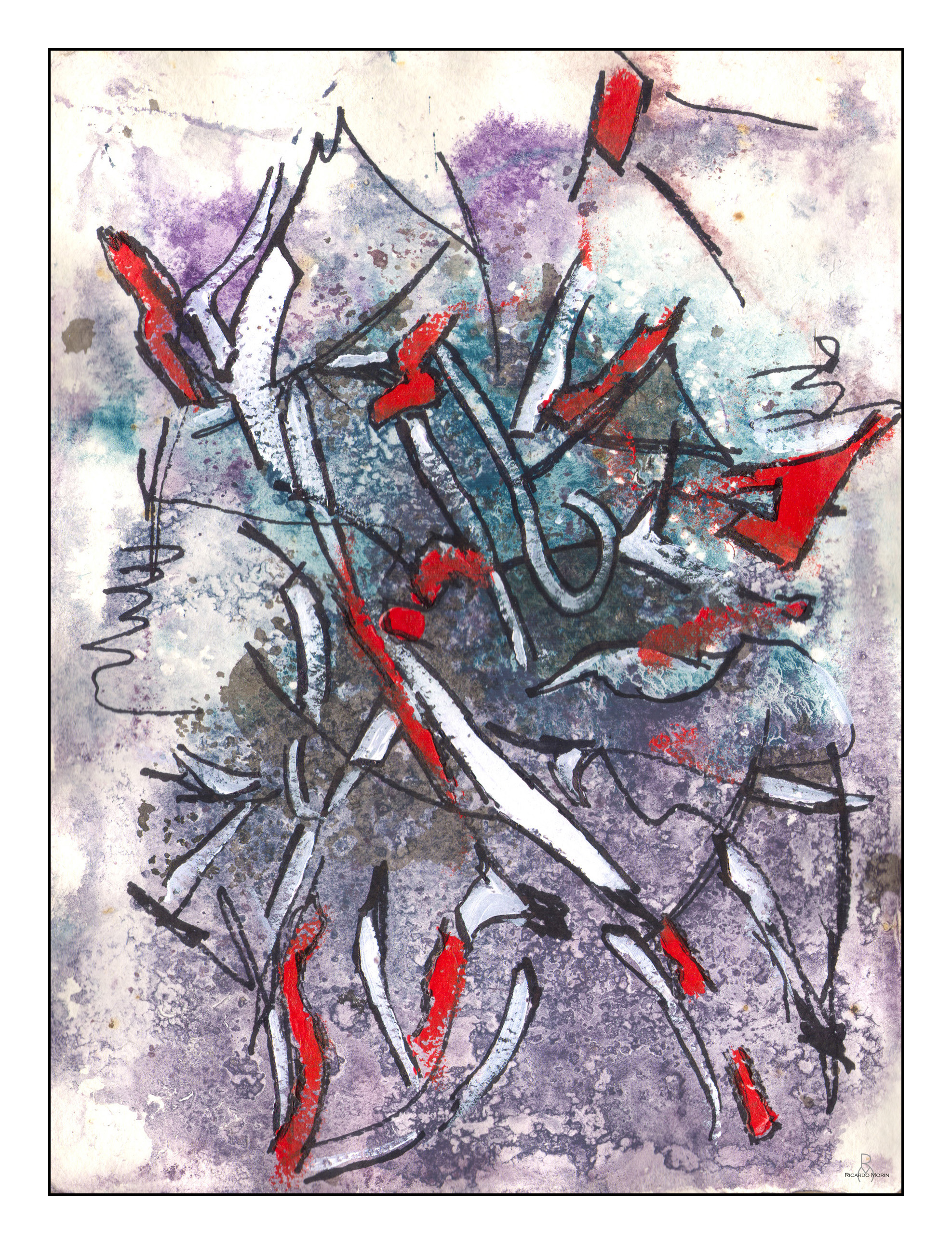

“Governing by Exception: The American Executive”

November 18, 2025

*

Ricardo Morín
Untitled #3: Governing by Exception
10″x12″
Watercolor
2003

By Ricardo F. Morín

October 10, 2025

Bala Cynwyd, Pa

Power unexamined becomes its own justification—Anonymous civic maxim.

Prologue

Governance is the moral discipline of order—the effort to keep authority aligned with conscience so that power remains a function of justice, not an instrument of self-interest.  Government enacts that discipline:   necessary, fallible, and ever in danger of mistaking permanence for legitimacy.


1

Political history rarely unfolds as a straight line.  It accumulates as a palimpsest in which new regimes—imperial, republican, authoritarian, and democratic—write their doctrines over the residues of previous orders.   Institutions and laws rarely vanish; they survive as layers of precedent and practice that later governments reinterpret to serve new purposes.   The present political moment in the United States should be examined within that structure of accumulation.  What appears to be a radical break with constitutional tradition is, in fact, the latest rewriting of an existing template.   The mechanisms that once safeguarded the republic now expand the reach of executive power; these mechanisms reveal how continuity and rupture coexist in the same act.

2

During the first half year of the Trump administration’s return to office, the political system of the United States has entered a state of controlled dislocation.  Executive directives have overridden congressional appropriations, suspended statutory programs, and reorganized entire departments under provisional authority.   A government shutdown, declared an administrative necessity, has become a method for restructuring the State.   Mass dismissals, selective funding freezes, and the redefinition of agency mandates have become coordinated tools for concentrating authority in the executive branch.  These are not isolated disputes between branches of government.  These actions reveal a coherent strategy of reconfiguration, executed through administrative acts that appear lawful but are designed to disfigure the balance of powers from within.

3

The guiding principle of this transformation is the normalization of exception.   Powers that earlier generations considered temporary—emergency measures to be used only under extreme threat—have become ordinary instruments of governance.  The invocation of the Insurrection Act, intended for rebellion or lawless obstruction, now functions as justification for domestic military deployment in states governed by political opposition.  The use of this authority is framed as a response to rising crime, even when verified data show a national decline.   In this inversion of logic, the declaration of emergency precedes its necessity.   The government generates the crisis it claims to confront and allows coercive measures to appear both inevitable and legitimate. What dissolves in this process is not only institutional restraint but the moral discipline of order—the very principle that once bound authority to conscience: i.e. the active faculty of perception through which recognition becomes responsibility and seeing acquires ethical weight.

4

This redefinition of authority as authoritarianism is reinforced by judicial doctrine.   The Supreme Court’s 2024 decision in Trump v. United States established that a president enjoys absolute immunity for “core official acts” and presumptive immunity for all other actions undertaken in an official capacity.  This ruling altered the meaning of accountability.  It placed the office of the president above ordinary legal scrutiny by presuming legality wherever official duty could be claimed.   The decision inverted the constitutional order that once defined the presidency as a position constrained by law.  Under this new interpretation, legality flows from function rather than from statute.   The Court did not invent executive supremacy; it legalized its evolution.   By insulating the executive office from the consequences of its acts, the judiciary, perhaps unintentionally, became an instrument of the very transformation it was designed to prevent.

5

Measured against the triad of government powers—legislative, executive, and judicial—the present equilibrium reveals a pronounced distortion.   Each branch retains its formal outline, yet its interior authority has thinned. Congress’s control of the purse has been undermined by impoundment and selective disbursement.   Administrative agencies have been hollowed out through abrupt firings and structural reorganizations.   The judiciary, bound by its own doctrines of deference and immunity, finds itself unable to intervene effectively.   What remains of institutional balance depends less on constitutional principle than on administrative inertia.  The machinery of government continues to function, but its continuity now rests on habit rather than on law.

6

This condition does not yet constitute overt dictatorship.  It represents a subtler phenomenon—a system that operates through legal forms but concentrates power in practice.   Authority remains constitutional in appearance while using those same procedures to entrench unilateral control.  The pattern can be recognized not through proclamations but through measurable actions:   decrees replacing legislation, “temporary” orders renewed without expiration, funds withheld from political adversaries, and federal troops dispatched to jurisdictions where disorder has not been empirically established.   Each measure, taken alone, seems limited and justified.   Together they form an architecture of exception—an invisible framework that reorganizes power without declaring revolution. Beneath this architecture lies the decline of the moral discipline of order, where legality endures but conscience recedes.

7

A forensic approach must therefore focus not on accusation but on diagnosis.  The purpose is to identify where practice diverges from principle, and where legal continuity conceals political mutation.  The question is not whether democracy has vanished, but how far the republic has drifted from its own operational norms.   This drift can be measured empirically through ordinary data:  the number of appropriations ignored or delayed, the duration and scope of emergency declarations, the ratio of confirmed officials to acting appointees, and the frequency with which presidential immunity is invoked to block review.   Each indicator marks a step away from the rule of shared power that defines constitutional democracy.

8

The concept of the republic, in its classical and Enlightenment sense, presupposed a balance between power and virtue:   the rule of law safeguarded by citizens free from dependence.   In contemporary practice, that idea has been reduced to a partisan label.   The republicanism that once demanded civic responsibility now coexists with mechanisms—PAC financing (Political Action Committee: An organization that raises and spends money to elect political candidates), factional loyalty, corporate influence—that transform governance into an instrument of private interest.   Thus the very word that once signified restraint now conceals its opposite:   a system where representation serves its sponsors more faithfully than its citizens.

9

History suggests that constitutional systems rarely collapse through open defiance.  They decline through adaptation.   The Roman Republic did not abolish its institutions; it gradually converted them into imperial offices.   Modern democracies follow similar paths when crisis is used to justify the consolidation of power.  Executive authority expands, legislative restraint weakens, and judicial caution hardens into complicity.  The American case fits this pattern.   The existing framework of the Constitution remains in place, yet its meaning shifts incrementally through interpretation, precedent, and administrative habit.  The transformation proceeds without formal amendment because each deviation is defended as continuity.

10

The metrics of decline are structural rather than moral.   When legality depends on will—the self-legitimating impulse of power once detached from moral accountability—and will is shielded from scrutiny, the architecture of restraint loses coherence.   Here the moral discipline of governance yields to the self-justifying logic of power.   What follows is not anarchy but organized dislocation—a condition in which institutions operate as before yet serve opposite purposes; in truth it is anarchy disguised as its own absence.   Procedures are observed; substance is inverted.   The outward appearance of democracy persists, while its inner logic is replaced by a system that governs through perpetual exception.

11

The task for observers and citizens alike is not to forecast collapse but to recognize mutation.  Political systems rarely announce their turning points; they disguise themselves as routine.  The test of civic intelligence is the capacity to detect when law becomes vocabulary, when oversight becomes performance, and when the state of exception ceases to be temporary.   The republic continues to function, but it functions under altered premises.   The preservation of legality therefore depends not only on the design of institutions but also on the vigilance of those who interpret them. Justice endures only where institutions remember that they exist to limit power, defend the vulnerable, and preserve the moral foundation from which authority derives its right to act.

12

The endurance of the republic will therefore depend not on the spectacle of its elections but on the recovery of its first obligation:   to keep authority answerable to the moral idea from which it draws its right to act.   Justice endures only where institutions remember that they exist to limit power, defend the vulnerable, and preserve the moral discipline of order through which freedom remains lawful and law remains human.   When that memory fades, what remains is administration without soul—a government still standing, but no longer governing.


“The Constitution Within”

August 10, 2025

*

Ricardo Morin
The Constitution Within
GCI
2025

*

Politics (from the Greek politikós, “of, by, or relating to citizens”) is the practice and theory of influencing people at the civic or individual level.

*

By Ricardo Morin

August 10, 2025.

~

From their earliest formulations, constitutional frameworks have been more than foundational legal agreements; they have stood as declarations of political philosophy, and defined how power should be organized, how it should be restrained, and to whom it must be answerable. Contemporary governance, to a large extent, continues those experiments, shaped over centuries of trial and adaptation. Yet these forms can endure in appearance while being emptied of substance. In more than a few States today, constitutions proclaim liberty while they narrow its scope, define rights in ways that exclude, and preserve the interests of a governing elite. Partisanship exploits the perceived limitations and vulnerabilities of others as grounds for exclusion; self-righteousness becomes a tool for domination, silences opposition, and suppresses dissent. The worth of a constitutional framework, therefore, is measured not only by its letter but by the ethical integrity of those who sustain it. Without ethics, politics loses its meaning; without civic virtue, the law ceases to serve peace and becomes an instrument of dominion.

The separation of powers, vigorously defended by Montesquieu, rests on the conviction that liberty survives when power is compelled to check power. This principle is distorted when institutions are subordinated to partisan or personal interests. In recent years, several States have formally preserved an independent judiciary while, in practice, subjected it to appointment processes controlled by the Executive or the ruling party. Such hollowing-out is not merely a technical failure; it reflects a political culture in which ambition, fear, or indifference among citizens permits the disfigurement of the very mechanisms designed to protect them. It also reveals how institutional strength and civic responsibility are bound together in ways that cannot be separated.

Historical constitutions continue to shape how political communities imagine authority. They bequeath principles that, at their best, offer adaptable frameworks for meeting new challenges without renouncing their essential core: that the legitimacy of a Government rests not on the strength of its rulers but on the solidity of the structures that limit them.

Yet these structures endure only when citizens reject duplicity and sectarianism. Divisions of ideology must not harden into exclusive loyalty to one’s own group at the expense of a shared civic framework. They endure only when citizens resist the idolatry of power, because authority loses its legitimacy once it is treated as sacred or unquestionable. And they endure only when citizens repudiate the cult of personality, in which a leader is raised above criticism through image-making, propaganda, and personal loyalty.

The durability of constitutional order, then, does not lie solely in written texts or institutional arrangements. It rests equally on the civic ethic of those who inhabit them. When ambition, fear, or indifference allow citizens to tolerate duplicity or surrender to sectarian loyalty, the limits on power become fragile. Conversely, when vigilance and responsibility prevail, constitutions retain their strength as both shield and compass—guarding against arbitrary rule while orienting political life toward justice and restraint.

True reform is not solely institutional but also internal: a revolution in the individual and collective sphere, in which each person accepts the responsibility to act with integrity, openness, and commitment to the common good, in harmony with oneself and with others. Only through the alignment of institutional structures with civic responsibility can any Constitution preserve its meaning and endure as a safeguard against arbitrary power.

*


Annotated Bibliography

~

  • Ginsburg, Tom, and Aziz Z. Huq.; How to Save a Constitutional Democracy. Chicago: University of Chicago Press, 2019. (Ginsburg and Aziz examine the legal and institutional pathways through which democracies weaken, from court-packing to the erosion of independent oversight. They draw on comparative examples from the United States, Hungary, and elsewhere to show how constitutional mechanisms can be used to consolidate power while preserving a façade of legality.)
  • Landau, David: “Abusive Constitutionalism.” UC Davis Law Review 47 (1), 2013: 189–260. (Landau develops the concept of “abusive constitutionalism” to describe how incumbents exploit constitutional change to entrench their rule. Uses Latin American and other global cases to illustrate how amendments and reinterpretations weaken checks and balances, alter electoral systems, and undermine judicial independence.)
  • Levitsky, Steven, and Way, Lucan A.: Competitive Authoritarianism: Hybrid Regimes after the Cold War. Cambridge: Cambridge University Press, 2010. (Levitsky and Way analyze regimes that preserve the formal institutions of democracy but manipulate them to ensure ruling-party dominance. They introduce the concept of “competitive authoritarianism” as a framework for understanding how constitutional norms are hollowed out while democratic forms are maintained.)
  • Levitsky, Steven, and Ziblatt, Daniel: How Democracies Die. New York: Crown, 2018. (Levitsky and Ziblatt argue that modern democracies often decline through the gradual decline of norms rather than coups. The book shows how leaders exploit constitutional ambiguities, stack courts, and weaponize law to suppress opposition, eroding both civic trust and institutional integrity.)

~