Archive for October, 2025

“The Industry of Suspicion: Propaganda and Manipulation of the Digital Era in Latin America”

October 15, 2025


By Ricardo F. Morín

Oct. 14, 2025

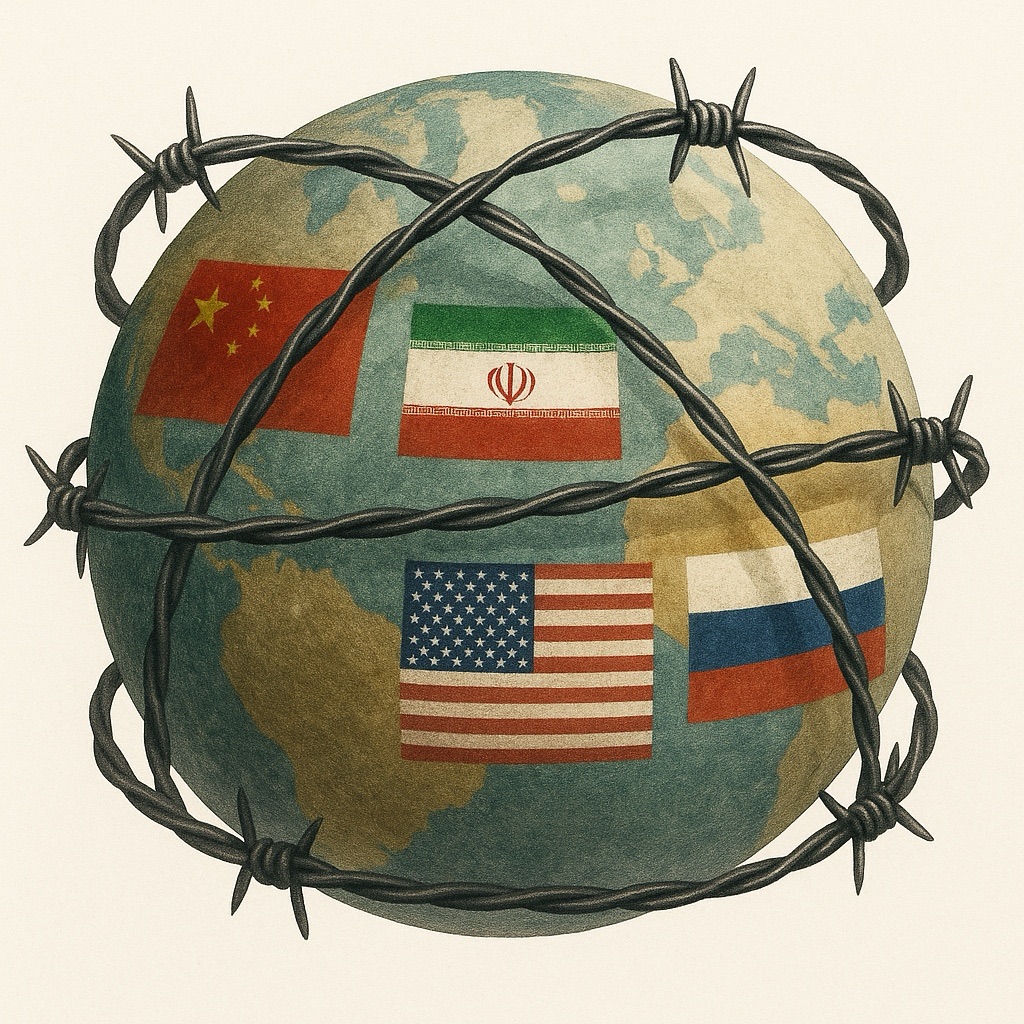
In the post-truth landscape of Latin American media, where outrage has become currency, few figures illustrate the fusion of ideology and marketing as clearly as Inna Afinogenova.    She has become the most recognizable voice of authoritarian suspicion in the Spanish-speaking sphere.    From platforms such as Canal Red Latinoamérica, her discourse forms part of a vast network of disinformation spreading across the region, cloaked in the rhetoric of critical thinking and popular emancipation.    These networks—spanning Moscow, Tehran, Beijing, and several Latin American governments—follow a single script: to dismantle trust in liberal democracy, to weaken institutions, and to turn permanent doubt into a substitute for conscience.    In the name of informational sovereignty, they replace debate with discredit, analysis with suspicion, and truth with narrative.    Their power lies not in blatant falsehoods but in the emotional manipulation that transforms confusion into conviction.    Within this context, Afinogenova stands not as an isolated commentator but as the emblem of a sophisticated propaganda apparatus—one that disguises obedience to twenty-first-century autocracies beneath the costume of dissent.

Inna Afinogenova, born in Dagestan in 1989, is a Russian journalist who worked as deputy director of RT en Español until May 2022.    She resigned citing her disagreement with the war in Ukraine and the imposition of a state-sanctioned narrative of aggression.    Since then, she has collaborated with geopolitical and Latin American media such as La Base, produced by the Spanish newspaper Público, and participates in Canal Red, an audiovisual project led by Pablo Iglesias (former vice-president of Spain and founder of the left-wing party Podemos, now active in political media).    There she directs and hosts programs like CaféInna and contributes to political analysis, particularly on Latin America.    Her audience is broad and her reach on digital platforms considerable, which makes her an influential figure in the political and informational debates of the Spanish-speaking world.

Her trajectory, however, has not escaped controversy.    During her tenure at RT en Español, she was one of the network’s most visible faces in Latin America, amplifying narratives that portrayed Western powers as inherently deceitful and predatory.    An opinion column in The Washington Post described her as “the Spanish voice of Russian propaganda,” citing her recurring defense of positions favorable to the Kremlin.    In December 2021, two months before the invasion of Ukraine, she used her program Ahí les va to mock Western intelligence warnings of an imminent attack and predicted that “January will come, then February, and still no invasion,” implying that the media hysteria served the interests of NATO.    Such episodes, though later overtaken by events, exemplify her rhetorical method:    to transform skepticism into disbelief and disbelief into persuasion.

Following her departure from RT, Afinogenova has continued to operate in media circles ideologically aligned with the Latin American left, reinforcing a discourse that equates the Western press with manipulation and imperialism.    Outlets such as Expediente Público have noted her role in shaping narratives within partisan campaigns, often echoing state-sponsored or geopolitically motivated lines from Russia, China, or Iran.    Through Canal Red and Diario Red, both associated with Pablo Iglesias, she participates in content ecosystems that frequently recycle material from international broadcasters like CGTN.    In countries such as Honduras, she has been accused of contributing to media strategies that favor left-wing candidates under the guise of “sovereign communication.”   While the evidence does not show a direct chain of command linking her to a specific regime, the pattern of thematic consistency reveals a coherent ideological alignment rather than independent journalism.

This alignment has provoked renewed debate since the release of her recent video, “¿Premio Nobel de la Paz… o de la Guerra?”, where she presents the Nobel Peace Prize awarded to María Corina Machado as a maneuver of geopolitical design rather than a moral recognition.    The video does not examine facts so much as it interprets intentions, suggesting that the award serves Western influence instead of honoring civic courage.   The argument, though rhetorically effective, confuses correlation with causality.    It is possible to acknowledge the imperfections of international institutions without denying the ethical weight of public bravery.   The Nobel Prize, like every human institution, reflects judgments; but in this case, it distinguishes a life of civic risk undertaken without weapons, privileges, or access to the coercive power of the State.

Questioning motives is legitimate; insinuating conspiracies without evidence is not.   Every critical voice bears responsibility, for truth demands proportion, not projection.   The struggle of María Corina Machado cannot be reduced to the rhetoric of “Western intervention” or dismissed as “fabricated dissent.”   It belongs to the conscience of a people seeking self-determination through legitimate means after decades of dispossession.    Respecting pluralism requires granting others the same intellectual good faith one demands for oneself.   Debate ennobles democracy only when grounded in verifiable facts and moral clarity, not when suspicion itself becomes the argument.    Between necessary skepticism and systematic suspicion lies a moral frontier:    crossing it is to pass from thinking freely to serving without knowing it.

“María Corina Machado: The Inheritance of a Republic”

October 14, 2025


By Ricardo Morín

Oct. 14, 2025

There are lives that seem to recapitulate the destiny of a nation, as if history, in search of renewal, gathers its scattered promises into one mortal form.  María Corina Machado stands within that rare order of beings in whom blood, memory, and conviction converge—not as privilege, but as burden.  She was not merely born into Venezuela’s republican lineage; she was summoned by it.  The call that first thundered through the assembly halls of Caracas in 1811—when its independence was declared and its first republican constitution conceived—still vibrates beneath her name.

Her ancestry reaches into the first pulse of the Republic.  From the Rodríguez del Toros, who set their signatures beneath the Act of Independence, to the Zuloaga engineers who electrified a nation, hers is a genealogy woven into the civic arteries of Venezuela.  It is a lineage that chose service over title, innovation over indulgence, and fidelity to the law over the ease of silence.  In that tradition, the notion of freedom is not an abstraction—it is inheritance, obligation, and vocation.  It is the thread that binds a people to their conscience.

When the institutions that once defined Venezuela began to crumble, when legality became theater and words lost their weight, Machado stepped into the void with the gravity of someone aware that retreat was impossible.  Her defiance was not theatrical—it was ancestral.  Every gesture, every refusal to submit, bore the quiet authority of history fulfilled.  She spoke as one who understood that to preserve dignity in times of humiliation is the purest form of resistance.  There is, in her manner of being, that rare synthesis of intellect and steadfastness that defines the moral personality of a nation at its best—lucid, unbending, and human.

Yet today, her adversary is not one but many.  Before her stands not only a narco-state that has hollowed out Venezuela’s sovereignty, but a fractured opposition—an archipelago of parties and personalities bound less by principle than by convenience.  Factionalized, transient, and transactional, these groups have transformed plurality into pretext and compromise into commerce.  Many have learned to live off the dictatorship they denounce.  They negotiate freedoms for themselves even as the country sinks deeper into captivity.  Against that duplicity, Machado’s presence has become a moral indictment: her clarity exposes their corruption; her endurance, their opportunism.

Around this internal disarray, the world circles in watchful appetite.  Venezuela’s vast natural wealth—its oil, gas, gold, and rare minerals—has become the prize of criminal networks and multinational investors alike.  Russia, China, Iran, and the United States, each cloaked in rhetoric of salvation, compete not to free the country but to secure a share of its exhaustion.  Behind the diplomatic masks of assistance lies the same calculation: that chaos can be profitable, that a nation weakened by hunger and fear can be managed more easily than one restored to its sovereignty.  This, for twenty-five years, has been Venezuela’s condition—a field of material, moral, and human extraction; its people scattered, its institutions despoiled, its memory pawned to the highest bidder.

In such a landscape, María Corina Machado stands as both witness and counterpoint.  Her struggle has never been for power but for coherence—for the recovery of a civic language capable of naming what has been lost.  To speak of law, truth, and justice amid pervasive corruption is to resurrect meaning itself.  Her voice has become the thread that gathers the nation’s scattered conscience, reminding Venezuelans that dignity cannot be negotiated, and that no foreign savior will restore what only citizens can redeem.

To see her walk through the streets, welcomed not by luxury but by faith, is to glimpse a country remembering itself.  She has become, willingly or not, the mirror through which Venezuelans rediscover their own moral architecture: decency, courage, compassion, and an unextinguished appetite for truth.  In her endurance, the long-interrupted dialogue between people and Republic resumes.

The Nobel Peace Prize, bestowed upon her, is therefore not a coronation but a recognition—an acknowledgment that her struggle transcends the moment and becomes emblematic of the human spirit’s refusal to yield to despair.  In awarding her, the world affirms that Venezuela’s republican dream—born in fire, preserved in conscience—still breathes through one of its daughters.  It is the dream of a nation that believes peace must be built not upon submission, but upon moral clarity; not upon silence, but upon the unwavering voice of the citizen.

What María Corina Machado represents is more than opposition to tyranny.  She is the embodiment of continuity—of the idea that a Republic, like a soul, survives so long as there remains one person willing to bear its weight with dignity.  Her ascent is not accidental—it is the return of an ancient promise.  In her composure, Venezuela recognizes itself once more: wounded yet unbroken, luminous in defiance, faithful to the destiny inscribed in its first act of freedom.


“The Veil of Liberation: Venezuela and the Machinery of Power”

October 10, 2025


Ricardo F. Morín — Oct. 10, 2025

Although the awarding of the Nobel Peace Prize (2025) to María Corina Machado brings joy and honor to those who still believe in the possibility of a democratic Venezuela, it also reveals a far more complex reality; one that demands reflection.

The international press has yet to grasp the dream surrounding the supposed liberation of Venezuela from a narco-state.     Venezuelans continue to wait indefinitely for liberation.    Beneath this hope lies a deeper bondage: the nation’s territory continues to be bound to multinational interests (Chinese, Russian, American, and others) driven not by ideology but by competition between investors and criminal networks.    For all of them, a prolonged conflict in Venezuela is convenient; it serves as a bridge to a regional metamorphosis and justifies the expropriation of the natural resources of the country; it aims at consolidating hemispheric dominance by the multinational interests.     The situation in Venezuela is therefore not only political but also structural; it is an experiment in which sovereignty is traded for access and resistance itself becomes a form of captivity.

The crisis in Venezuela reveals a moral conflict in modern politics:    how suffering can both be exploited and perpetuated when comprehension yields to fantasy.   The dream of liberation has become one of the nation’s most persistent fantasies.   Behind the language of emancipation lies a silent convergence of global interests; each one sustains the very conflict it claims to oppose.   In Venezuela, disorder legitimizes intervention and chaos provides the pretext for extraction.   In this sense, Venezuela is not merely a nation in distress but also a stage upon which the grammar of domination continues to be enacted through the vocabulary of deliverance

The challenge is no longer to imagine freedom as an external rescue but to comprehend how dependence disguises itself as salvation.  Only comprehension (the act of seeing beyond grievance and beyond consolation) can pierce the veil of liberation and restore meaning to the very idea of freedom.


Editor: Billy Bussell Thompson

“The Grammar of Conflict”

October 9, 2025

Ricardo F. Morín
Untitled #2
Watercolor
10”x12”
2003

By Ricardo F. Morín

Oct. 9, 2025

Bala Cynwyd, Pa

Conflict endures not only because of the grievances that ignite it, but also because of the internal logic that sustains it.    Hatred, victimhood, hypocrisy, tribalism, and violence do not operate as separate forces; they form an interdependent system that is justified at every turn.   This essay examines a system of conflict as a grammar—a set of rules and patterns through which antagonism shapes thought, legitimizes action, and perpetuates itself across generations.    The objective is not to judge but to expose how conflict becomes self-sustaining, how violence evolves from an instrument into a ritual, and how contradiction becomes the very foundation upon which societies act in ways that betray their own professed values.


1

Conflict, when stripped down to its structure, is less an event than a language.   Conflict is learned, repeated, and transmitted—not as instinct alone but as a structured framework through which people interpret events and justify actions.   Violence is only one expression of conflict; beneath the act lies a sequence of ideas and reactions that not only precede violence but also weave hostility deliberately into a fabric of continuity.   Understanding this grammar of conflict is essential, because it shows how human beings can remain locked in cycles of harm long after the original reasons have disappeared—not by accident, but because the rhetoric sustaining conflict extends the original violence far beyond its initial cause.    What appears spontaneous is often scripted, and what seems inevitable is, more often than not, the cumulative result of choices that have hardened into reflex.

2

Hatred is the first syntax of this grammar.    Conflict does not erupt suddenly but accumulates over time, layer upon layer, through memory, myth, and selective narration.    Conflict is presented as a defense against a perceived threat or subordination; yet its deeper function is preservation.    Hatred sustains identity by defining itself against what it is not.   Conflict, once entrenched, ceases to depend on immediate threat.   Conflict becomes self-justifying.   It becomes a lens that reinterprets evidence in conformity with its narrative and expectations.    Conflict prepares the ground on which it thrives and provides ready-made explanations for future disputes.

3

Victimhood gives hatred an enduring vocabulary.   It converts the suffering from a past event into a permanent political and social resource.   Suffering is a condition we all inhabit.    Yet to make suffering the core of collective identity is strategic.    Suffering allows communities to claim moral authority and to legitimize otherwise illegitimate actions.    The story of injury becomes a foundation for retaliation.    Herein, however, lies a trap:   identity anchored in victimhood threatens the cessation of its narrative.    Without the presence of an adversary, legitimacy loses potency.    The original wound remains open—remembered and weaponized for all that follows.    Each new act of aggression is framed as a defense of dignity and as a reaffirmation of suffering.

4

Hypocrisy is the structure holding this system together.    Hypocrisy enables simultaneous denunciation and deployment of violence.    It is a proclamation of ideals systematically violated.    Hypocrisy not only conceals contradiction; it embodies it.    It is, in fact, a vain attempt to invoke justice, to speak of universal rights, and to decry cruelty.    The resulting duplicity is essential.    Hypocrisy presents violence as a legitimate principle, domination as protection, and exclusion as necessity.

5

Once hatred, victimhood, and hypocrisy have aligned, violence becomes a ritual—not a reaction.    This ritual can claim instrumental goals:    the recovery of lost territory, the righting of past wrongs, or the assurance of safety.    But over time, the purpose fades and the pattern remains.    Each act tries to confirm the legitimacy of the last and to prepare a justification for the next.   The cycle no longer requires triggers; conflict sustains itself through momentum.    Violence becomes a means through which the collective is used to consolidate identity and to institutionalize memory.

6

Tribalism is a ritual of emotional power.   Conflict reduces the complexity of human experience to affiliation and exclusion.  Within this framework, radically different standards judge shifting actions according to who commits them.   What outsiders called terrorism becomes a defensive force within the tribe.   The tyranny of an enemy becomes the tribe’s strength.   Tribalism turns contradiction into coherence; it makes hypocrisy acceptable; it transforms violence into allegiance and reprisal into obligation.    The more deeply divisions define a society, the more indispensable conflict becomes to its sense of purpose.

7

Violence is no longer a response; it is a condition.    Violence persists not because it serves immediate goals, but because it affirms permanence.   Ending a cycle means dismantling its sustaining narratives; it means acknowledging an enemy is not immutable; victimhood is no longer unique; ideals no longer coexist with betrayals.

8

The illusion of inevitability is insidious.    If conflict frames destiny, accountability dissolves.    Reaction explains every action as defensive.   Herein, recognition diminishes agency; violence becomes not a choice but a forced external condition, an illusion allowing the cycle to continue.

9

Breaking the continuation is neither difficult nor mysterious.   Hatred as an explanation simplifies and legitimizes the narrative; it offers ideological reassurance; it sustains a false sense of control.    Together they form a system that seems natural, but familiarity is not fate.    The grammar of conflict is learned; what is learned can be unlearned.   The first step is to elucidate and to recognize what seems inevitable is only a choice disguised as a reaction.   Thus societies can construct new grammars, without enmity, without vengeance, and without domination.

10

To diagnose conflict is not to diminish suffering or to excuse violence.    An understanding of how suffering and violence endure reveals that each helps to sustain the other.    Profound injuries are not those inflicted once but are those kept alive by stories repeated about them.    The cycle endures because unreason has its own reason; it preserves the stories that keep us injured and persuades us of their necessity.    It is not that people act without reason, but that they rationalize the irrational until irrationality itself becomes the organizing principle of their behavior.    Exposing their grammar is not a solution, but it is a beginning:   a way to make visible the architecture of antagonism and, perhaps, to imagine forms of coexistence that no longer depend on perpetual conflict for their justification.


Edited by Billy Bussell Thompson, Oct. 9, 2025, NYC, NY