Posts Tagged ‘hatred’

“Who Feeds Hatred?”

April 15, 2026

Ricardo F. Morín
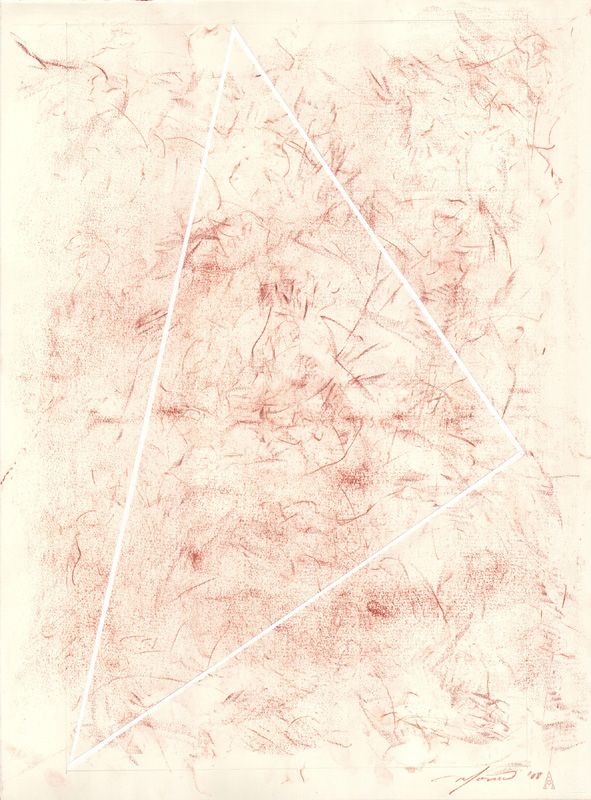
Triangulation II
22″ x 30″
Body color, sanguine, sepia, and white out on paper
2008


Societies rarely recognize when language begins to prepare the conditions for hatred.  Long before violence appears, speech has already changed how people see what is in front of them.  A group is no longer described by what it does, but by what it is made to stand for:  a “threat,” an “invasion,” a “corruption.”  Description yields to designation. 

In “Language, Judgment, and Freedom of Conscience:  On the Architecture of an Intellectual Position,” I examined how freedom of conscience depends on a steady link between what is seen, what is said, and how it is judged.  That link is not sustained by itself.  Seeing something does not ensure naming it precisely, and naming it does not ensure judging it clearly.  When that link breaks, language stops following experience and begins to direct it.  Words no longer come after what happens; they tell people in advance what they are supposed to see, think, or conclude.  In that shift, the ability to judge for oneself begins to weaken, long before courts are bypassed or rights are set aside.

 Once perception is shaped in advance, judgment no longer moves on its own.  Hostility no longer appears as a break but as something already contained in the way things are said.  A neighbor becomes “one of them.”  A disagreement becomes “an attack.”

Societies speak easily about hatred, yet rarely ask where it begins.  When violence becomes visible, the instinct is to find someone to blame.  The tyrant appears sufficient.  Yet this explanation soothes more than it explains.  It confines wrongdoing to individuals while leaving intact what made it possible:  repeated phrases, accepted labels, words no longer questioned.

A distinction is required.  To see clearly is not to hate.  To name brutality is not resentment but clarity.  To say “this act destroys a life” remains a description.  Hatred begins when the person is reduced to what must be removed.  Whoever speaks in that way adopts the same language he claims to reject.

Ideologies that organize hostility do not arise in isolation.  They differ in name but share a simple rule:  people define who they are by pushing others out.  Where this rule governs how people define themselves, human worth no longer serves as a shared measure.  Public life divides between those who belong and those who do not.  Nazism in Europe, Chavismo in Venezuela, the MAGA movement in the United States, and forms of theocracy show how entire populations come to speak of others as enemies and to treat that division as necessary for order or purity.

What appears in Trump is not new.  It is what no longer needs to disguise itself.

Once this way of speaking is taken up and repeated, it does not remain confined to leaders or doctrine.  It spreads.  Some repeat it because they believe it.  Others repeat it to avoid trouble, to fit in, or to protect themselves.  Language changes.  Words stop pointing to people and begin to assign them a place.  The adversary becomes a threat; the threat becomes someone to despise.  A person is no longer called by name but by a label:  “illegal,” “traitor,” “infidel,” “enemy.”

Another confusion follows.  In the name of understanding, some begin to describe those who defend such ideas as misunderstood or wounded.  This posture appears balanced, yet it shifts attention toward those who exercise power and away from those who live under it.

This confusion rests on a deeper habit of thought.  Violence is often explained by pointing to personal wounds or exclusion.  There is truth in this.  Yet when applied everywhere, it removes responsibility.  Everyone is vulnerable.  Not everyone participates in organized harm.  That requires decisions, repeated words, and people willing to act on them.

The difference between ethics and moralizing appears here.  Moralizing sorts people into good and bad.  Ethics looks at what allows certain actions to take place and spread.  It does not turn the adversary into a monster, but it does not excuse what is done.

Those who suffer the consequences rarely appear in these arguments.  They do not belong to factions or slogans.  They are those who must live with what others decide:  the family forced to move, the worker shut out, the person who learns to remain silent.

The question, then, cannot be answered by pointing to a tyrant.  Hatred is fed when people accept the lowering of language, treat humiliation as normal, and allow their judgment to be replaced by ready-made explanations.

At that point, hatred no longer appears exceptional.  It becomes a habit.  It repeats itself in ordinary speech:  “that is how things work,” “everyone does it,” “we have no choice,” “we were forced,” “it is for the nation.”  It appears in the language of order and protection:  “to restore order,” “for your safety,” and in the steady stirring of fear:  fear of losing place, fear of difference, fear of those seen as outsiders, even in societies shaped by mixture.

These expressions do not simply describe what is happening.  They shape how it is understood.  They make exclusion seem reasonable.  What once required justification begins to sound like common sense.

When this way of speaking settles in, hostility no longer needs to be defended.  It becomes expected, repeated, routine.  Responsibility does not vanish through denial; it fades through repetition:  through explanations that excuse and fears no one stops to question.

This is how hatred continues:  not only through those who declare it, but through those who repeat it, accept it, or let it pass without objection. 

The question remains. 

Who feeds hatred?

*

Ricardo F. Morín, March 16, 2026, Oakland Park, Florida.


“The Grammar of Conflict”

October 9, 2025

Ricardo F. Morín
Untitled #2
Watercolor
10”x12”
2003

By Ricardo F. Morín

Oct. 9, 2025

Bala Cynwyd, Pa

Conflict endures not only because of the grievances that ignite it, but also because of the internal logic that sustains it.    Hatred, victimhood, hypocrisy, tribalism, and violence do not operate as separate forces; they form an interdependent system that is justified at every turn.   This essay examines a system of conflict as a grammar—a set of rules and patterns through which antagonism shapes thought, legitimizes action, and perpetuates itself across generations.    The objective is not to judge but to expose how conflict becomes self-sustaining, how violence evolves from an instrument into a ritual, and how contradiction becomes the very foundation upon which societies act in ways that betray their own professed values.


1

Conflict, when stripped down to its structure, is less an event than a language.   Conflict is learned, repeated, and transmitted—not as instinct alone but as a structured framework through which people interpret events and justify actions.   Violence is only one expression of conflict; beneath the act lies a sequence of ideas and reactions that not only precede violence but also weave hostility deliberately into a fabric of continuity.   Understanding this grammar of conflict is essential, because it shows how human beings can remain locked in cycles of harm long after the original reasons have disappeared—not by accident, but because the rhetoric sustaining conflict extends the original violence far beyond its initial cause.    What appears spontaneous is often scripted, and what seems inevitable is, more often than not, the cumulative result of choices that have hardened into reflex.

2

Hatred is the first syntax of this grammar.    Conflict does not erupt suddenly but accumulates over time, layer upon layer, through memory, myth, and selective narration.    Conflict is presented as a defense against a perceived threat or subordination; yet its deeper function is preservation.    Hatred sustains identity by defining itself against what it is not.   Conflict, once entrenched, ceases to depend on immediate threat.   Conflict becomes self-justifying.   It becomes a lens that reinterprets evidence in conformity with its narrative and expectations.    Conflict prepares the ground on which it thrives and provides ready-made explanations for future disputes.

3

Victimhood gives hatred an enduring vocabulary.   It converts the suffering from a past event into a permanent political and social resource.   Suffering is a condition we all inhabit.    Yet to make suffering the core of collective identity is strategic.    Suffering allows communities to claim moral authority and to legitimize otherwise illegitimate actions.    The story of injury becomes a foundation for retaliation.    Herein, however, lies a trap:   identity anchored in victimhood threatens the cessation of its narrative.    Without the presence of an adversary, legitimacy loses potency.    The original wound remains open—remembered and weaponized for all that follows.    Each new act of aggression is framed as a defense of dignity and as a reaffirmation of suffering.

4

Hypocrisy is the structure holding this system together.    Hypocrisy enables simultaneous denunciation and deployment of violence.    It is a proclamation of ideals systematically violated.    Hypocrisy not only conceals contradiction; it embodies it.    It is, in fact, a vain attempt to invoke justice, to speak of universal rights, and to decry cruelty.    The resulting duplicity is essential.    Hypocrisy presents violence as a legitimate principle, domination as protection, and exclusion as necessity.

5

Once hatred, victimhood, and hypocrisy have aligned, violence becomes a ritual—not a reaction.    This ritual can claim instrumental goals:    the recovery of lost territory, the righting of past wrongs, or the assurance of safety.    But over time, the purpose fades and the pattern remains.    Each act tries to confirm the legitimacy of the last and to prepare a justification for the next.   The cycle no longer requires triggers; conflict sustains itself through momentum.    Violence becomes a means through which the collective is used to consolidate identity and to institutionalize memory.

6

Tribalism is a ritual of emotional power.   Conflict reduces the complexity of human experience to affiliation and exclusion.  Within this framework, radically different standards judge shifting actions according to who commits them.   What outsiders called terrorism becomes a defensive force within the tribe.   The tyranny of an enemy becomes the tribe’s strength.   Tribalism turns contradiction into coherence; it makes hypocrisy acceptable; it transforms violence into allegiance and reprisal into obligation.    The more deeply divisions define a society, the more indispensable conflict becomes to its sense of purpose.

7

Violence is no longer a response; it is a condition.    Violence persists not because it serves immediate goals, but because it affirms permanence.   Ending a cycle means dismantling its sustaining narratives; it means acknowledging an enemy is not immutable; victimhood is no longer unique; ideals no longer coexist with betrayals.

8

The illusion of inevitability is insidious.    If conflict frames destiny, accountability dissolves.    Reaction explains every action as defensive.   Herein, recognition diminishes agency; violence becomes not a choice but a forced external condition, an illusion allowing the cycle to continue.

9

Breaking the continuation is neither difficult nor mysterious.   Hatred as an explanation simplifies and legitimizes the narrative; it offers ideological reassurance; it sustains a false sense of control.    Together they form a system that seems natural, but familiarity is not fate.    The grammar of conflict is learned; what is learned can be unlearned.   The first step is to elucidate and to recognize what seems inevitable is only a choice disguised as a reaction.   Thus societies can construct new grammars, without enmity, without vengeance, and without domination.

10

To diagnose conflict is not to diminish suffering or to excuse violence.    An understanding of how suffering and violence endure reveals that each helps to sustain the other.    Profound injuries are not those inflicted once but are those kept alive by stories repeated about them.    The cycle endures because unreason has its own reason; it preserves the stories that keep us injured and persuades us of their necessity.    It is not that people act without reason, but that they rationalize the irrational until irrationality itself becomes the organizing principle of their behavior.    Exposing their grammar is not a solution, but it is a beginning:   a way to make visible the architecture of antagonism and, perhaps, to imagine forms of coexistence that no longer depend on perpetual conflict for their justification.


Edited by Billy Bussell Thompson, Oct. 9, 2025, NYC, NY