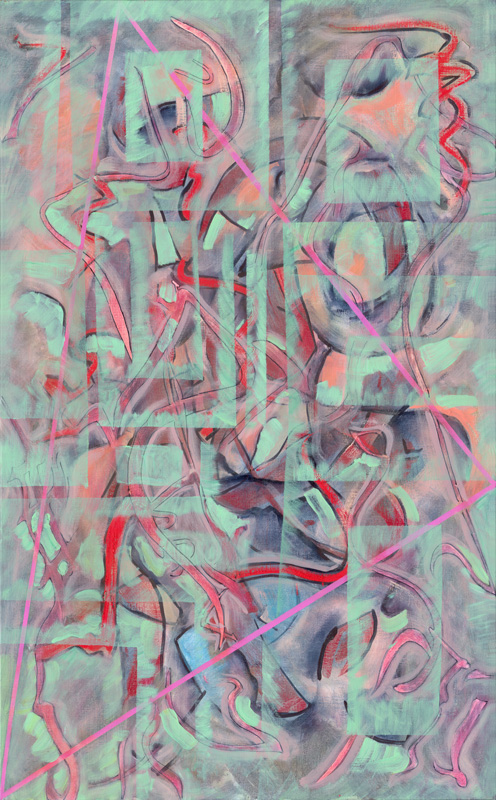
Ricardo F. Morín Triangulation Series Nº 7 37″ x 60″ x 2″ Oil on linen 2006
An elderly man stands beside a piece of luggage near the edge of a wide sidewalk at a public bus stop. A younger man notices him from a distance, and as he approaches, his attention remains fixed upon the older man rather than upon the bus stop itself. The older man perceives the stare as calculating, purposeful, and determined. There is room to pass. Instead, he changes course and strikes the older man with enough force to displace him from his position, then continues walking without explanation or apology. No dispute precedes the contact, and no serious injury follows.
The change of course makes the contact appear directed, though the encounter reveals little of what prompted it. Contempt, irritation, resentment, or the wish to impose upon someone may be imagined. None becomes certain merely because it would make the action intelligible. The younger man’s attention can be followed as far as the contact; his motive cannot be followed with the same assurance.
The older man was noticed before he was struck. Whatever the younger man perceived was sufficient to direct an approach, yet being noticed does not establish how much of a person has been acknowledged. Attention may be exact about where an act will arrive while remaining indifferent to the life upon which it intrudes.
Ordinarily, one passes a stranger without requiring an account of his presence. The man waiting beside his luggage need not explain where he is going or why he has stopped there. Almost nothing about him has to become known for the simple accommodation of passing without contact to occur.
Someone who would make that accommodation elsewhere may withhold it from a person expected to offer little resistance or to impose no consequence. Restraint weakens selectively, and another’s vulnerability can become an opportunity to act. Whether age or an expectation of impunity influenced the younger man’s choice remains unknown. Even if resentment were established, the question would remain why it found this particular recipient who is a total stranger.
The younger man had only to pass. Those charged with protecting a population face circumstances in which leaving the source of danger undisturbed may expose others to further injury. They may have to use force, and those awaiting their decision may have urgent reasons to demand it.
A government defending its territory, one invading another country, and one acting upon a danger it anticipates do not confront the same circumstances or bear the same responsibility. The suffering that follows cannot erase responsibility for how a war began. Neither can responsibility for its beginning settle every judgment concerning its subsequent conduct.
Those making the next decision must confront what remains dangerous, what has changed, and what another action could accomplish. People still exposed to attack may require defense long after the initial injury, while a brief operation may inflict harm for which no adequate ground ever existed. Neither the duration of a war nor the depth of the loss already suffered can settle what should happen next.
For those who have endured an attack, however, the first injury may remain more immediate than the changing circumstances through which a response proceeds. A danger recedes, an objective is reached, or further action creates risks absent at the beginning, while what happened continues to demand an answer. Asked what another strike would accomplish, a leader can return to the losses already sustained. The answer may be entirely sincere and still leave the question unanswered.
Grief may preserve a fidelity to the dead that no change in circumstances can satisfy. Political action nevertheless proceeds among the living. The demand that a loss receive an answer can persist after a particular response has ceased to serve the protection for which it was undertaken. At that point, reconsideration may be experienced as disloyalty even when the conditions of protection require it.
Those who receive the force may meanwhile become known chiefly through where they live or the people with whom they are associated. The person who directed an attack, the person who supported it, and the person who happened to live where it originated can be brought within the same field of action, though they do not bear the same responsibility. No one need deny that each has a history or a capacity to suffer. Those facts can be acknowledged and then set aside as having no bearing upon what is to be done.
The people exposed to an operation may be known to those directing it only through briefings, surveillance, casualty reports, and the observations passed through a chain of command. These can disclose what those deciding cannot see for themselves. Through a report, someone far from danger may learn what those enduring it have no means of bringing before him themselves. The distance between them can be reduced by the very procedures through which the decision is made.
Yet the reports may continue to arrive after the decision to proceed has ceased to admit reconsideration. Someone can register a loss accurately and still receive it only as something to be entered before the next authorization. The people affected remain visible in the record, while what becomes known about them is denied any bearing upon continuation. The information has arrived; the grounds of action have been protected from it.
Someone entrusted with the safety of others may knowingly cause harm while believing that refusing to act would cause more. The conflict may be real, and a clearer account of the consequences may not resolve it. But when those acting become certain that their responsibility supplies its own justification, the people who will bear the harm can appear only as a cost already accepted. Those who question the harm may then be treated as though they were opposing the protection itself.
An official may possess the authority to order an action and the means to carry it through, while those who will bear its consequences have little power to contest either. He can make the decision prevail without answering what he owes them. The question of justice remains, even when he acts with a sincere intention to protect others.
The older man was close enough to be deliberately approached. A distant population may be described in exhaustive detail. Neither proximity nor information establishes how another’s presence has entered a decision. Attention may narrow to what facilitates an act; an understanding of the suffering it will cause may also remain clear while the act proceeds. The failure can occur within attention itself.
A person may understand an injury, condemn its infliction, and nevertheless permit a comparable injury against someone placed outside the protection of that judgment. What is understood remains intact while its reach contracts. An account of the person’s fear, grievance, or conviction may make his conduct more intelligible without resolving how he accommodates what he condemns.
The younger man continues on his way without explaining himself. The absence of an explanation leaves a question about him; it does not make the force of the encounter disappear. What prompted him might become clearer if more were known, but he owed the older man the ordinary restraint that would have left him standing where he was.
The other remains someone whose life exceeds the terms under which he has been encountered. Grievance, threat, procedure, and necessity can each restrict what is permitted to matter about him. The person has not become fully known. The decision to act as though nothing further about him could matter may nevertheless already have been made.
Ricardo F. Morín October 6. 2026 Bala Cynwyd, Pennsylvania
Author’s Note: The conditions described here were examined earlier, through the structure of language rather than through particular encounters, in “The Grammar of Conflict”.
Life does not begin with power. It begins with dependence. Before a human being becomes capable of judgment, choice, consent, or resistance, existence already unfolds within relationships upon which survival depends. No one enters the world invested with autonomy. Every human life begins by being sustained through the action of another.
Dependence, however, is not sufficient to explain authority. Whoever possesses greater strength may preserve another’s life, abandon it, or destroy it. Physical superiority alone cannot explain the character of the relationship through which human life ordinarily comes to develop. If force alone governed the bond between the one who requires protection and the one capable of providing it, care would cease to be distinguishable from domination.
Care begins to reveal itself as something different from domination through an experience so ordinary that it seldom becomes an object of reflection. The child gradually discovers a world in which the guidance received is not experienced solely as a limitation imposed from without, but as guidance properly exercised by the person who provides it. Before authority becomes an object of understanding, it constitutes a lived experience. Its first appearance assumes not the form of command, but that of care.
Care makes possible a form of dependence that force could never produce: a dependence that does not extinguish future freedom, but prepares the conditions for its emergence. The guidance received becomes intelligible because it is exercised for the benefit of a life still in formation, rather than for the immediate satisfaction of the person possessing greater power.
Power and authority operate jointly in the development of civilized life. Power designates the capacity to act. Authority designates the acknowledged right to guide, direct, judge, or decide. Both may be present in the same person, but neither necessarily implies the existence of the other. Power may exist without authority, just as authority may endure even after power has considerably diminished.
Obedience does not resolve the problem either. Human beings obey for many different reasons. They obey because they fear punishment. They obey because custom has rendered the alternatives invisible. They obey because deception has concealed the true nature of what is being required of them. They obey because every form of resistance appears futile. None of these circumstances constitutes authority. They explain only submission.
Authority begins only where recognition becomes possible. The guidance offered by one who leads must possess a title that renders its recognition justifiable independently of force. A person who accepts the guidance of another does not merely yield before a more powerful will. The person recognizes that such guidance possesses a title extending beyond the mere fact that it can be imposed.
That recognition constitutes legitimacy. Legitimacy is not identical with effectiveness, popularity, success, antiquity, or duration. Nor does it arise from the mere assertion of the person claiming obedience. It designates the condition under which authority may be recognized as due, rather than merely acknowledged as existing.
Because legitimacy depends upon recognition rather than upon the possession of power, it is more fragile than power itself. Force may remain intact after legitimacy has already begun to disappear. Armies may continue to obey. Institutions may continue to function. Laws may continue to be enforced. Yet the basis of recognition has already changed: what was once acknowledged as due begins to be experienced only as imposed.
From that moment onward, human relationships begin to change without commotion. Guidance approaches coercion. Trust yields to calculation. Responsibility begins to be confused with control. Instruction approaches indoctrination. Judgment begins to be perceived as domination. Authority remains visible while the intelligibility that once made it recognizable gradually recedes. A son may continue to obey his father from habit long after he has ceased to trust his judgment. From the outside, the relationship between father and son may appear scarcely altered. The same words continue to be spoken. The same decisions continue to be obeyed. Yet what inwardly sustained the father’s authority has already begun to disappear.
The disappearance of legitimacy does not bring about the immediate collapse of social life. Human relationships begin to reorganize themselves through means that no longer rest upon recognition. Where recognition ceases to sustain authority, substitutes arise to take its place. Force attempts to compensate for what recognition no longer grants. Fear seeks to secure the obedience that trust has withdrawn. Custom prolongs practices that scarcely continue to rest upon recognition. Manipulation manufactures the appearance of consent after genuine recognition has ceased to exist.
None of those means, however, constitutes authority. Force obtains conduct, but not recognition. Fear silences resistance, but does not produce assent. Custom prolongs forms whose intelligibility has weakened. Manipulation imitates legitimacy because it can no longer produce it. All such means depend upon the absence of the recognition they seek to replace.
What makes it possible for one human being to recognize the authority of another without reducing that recognition to force, fear, custom, or manipulation? Every subsequent form of authority will receive its intelligibility from the answer given to that question.
The first manifestation of authority remains inseparable from care because life still depends upon the constant presence of another. As the child grows, however, dependence begins to change. Survival ceases to occupy the center of the relationship. Understanding gradually begins to take its place.
No experience reveals more clearly than language how survival ceases to occupy the center of dependence and understanding begins to assume its place. No child invents the language through which the world begins to become intelligible. Words are received before they are used. Meanings are recognized before they are examined. Grammar is obeyed long before it can be explained. Every act of speech therefore presupposes an inheritance that no individual has produced independently.
The transmission of that inheritance cannot be obtained by force. A child may be compelled to repeat a word, but repetition does not yet amount to understanding. Language becomes one’s own because correction eventually comes to be recognized as something distinct from imposition. The child does not merely reproduce sounds. The child learns that certain words name the world more faithfully than others. Correction therefore always refers to a reality that transcends the person who corrects.
The acquisition of language also changes the nature of authority. The dependence characteristic of early childhood ceases to constitute its principal foundation. Authority now begins to arise from shared participation in an order that precedes both teacher and pupil. The language existed before either of them. Neither may claim it as an exclusive possession. Both remain subject to the same structure that makes communication possible.
For that reason, the teaching of language can never be reduced to the exercise of command. Whoever corrects an expression ultimately answers to the language itself, and not merely to personal will. The legitimacy of correction does not arise from the speaker’s desire, but from the fidelity with which the transmitted word corresponds to the language held in common. Authority then ceases to rest principally upon the person who teaches and begins to rest upon the reality to which that person remains subordinate.
Authority may be recognized even after the personal dependence characteristic of the earliest years of life has disappeared. The child begins to discover that someone deserves to be heard, not because that person is stronger or continues to provide care, but because that person permits faithful access to a reality existing independently of them both. Recognition thus ceases to be directed exclusively toward the person and begins to be directed toward what that person makes accessible.
The redirection of recognition toward the reality transmitted, rather than exclusively toward the person transmitting it, profoundly alters human experience. Authority may now be examined without thereby being abolished. Correction itself may be corrected. The teacher may be mistaken. Neither the examination of authority, nor the correction of what has been taught, nor the teacher’s error destroys the legitimacy of teaching, because legitimacy no longer resides exclusively in the person who teaches, but in the fidelity with which that person transmits what transcends both teacher and pupil.
Civilization begins to be constructed upon this displacement of authority from the person who transmits toward the integrity of what is transmitted. Once authority becomes attributable to the integrity of what is transmitted rather than simply to the person transmitting it, every higher form of learning becomes possible. Education, scientific inquiry, moral life, judgment, and constitutional government will each reproduce, within its own sphere, the subordination of authority to an antecedent reality that governs its exercise and makes its recognition possible.
Language, however, does not yet constitute education. It provides only the possibility of communicating the understanding upon which education may act. Through language, understanding may be communicated. Education pursues a different purpose: the deliberate formation of the understanding.
A teacher corrects a mistaken line of reasoning. The pupil first recognizes the error in the answer before fully understanding the truth of the explanation received. Correction does not require obedience alone. It requires sufficient trust to accept that another person may guide the understanding toward a reality it cannot yet perceive. With education, authority undergoes a further transformation. The child no longer depends upon the adult solely in order to inhabit a shared language, but in order to gain access to bodies of knowledge that cannot be acquired through individual experience alone. Every generation receives a world whose complexity vastly exceeds the duration of any single human life. Education exists because no human being can always begin again from the beginning.
The authority of the educator cannot therefore derive from age, office, or membership in an institution. None of those circumstances confers, by itself, the right to guide another person’s intelligence. The teacher acquires legitimacy only by making accessible a form of knowledge whose validity does not proceed from the teacher. Where teaching turns the teacher into the true object of learning, education has already ceased to exist.
Intellectual formation therefore requires a discipline common to teacher and pupil. The teacher answers to the truth of what is taught. The pupil answers to the effort required to understand it. Neither governs the educational relationship unilaterally, because both appear before a body of knowledge that neither has created.
Education therefore differs radically from indoctrination. Indoctrination seeks adherence to the teacher or the preservation of a doctrine irrespective of whether that doctrine retains its intelligibility. Education pursues the opposite end. It seeks to enable the pupil to recognize the truth even when that recognition ultimately surpasses the understanding of the teacher. The success of teaching consists in rendering the authority of the teacher progressively less necessary.
Education thereby reveals one of the least noticed characteristics of legitimate authority. The more faithfully knowledge is transmitted, the less the pupil depends upon the person who served as mediator. Education does not perpetuate dependence. It prepares autonomy without destroying the legitimacy of the relationship through which that autonomy became possible.
Legitimate authority and domination reveal here with greater clarity the contrary directions toward which they move. Domination needs to perpetuate itself because it depends upon the continuing subordination of the person subjected to it. Legitimate authority, by contrast, works so that recognition may ultimately sustain itself. It does not fear the intellectual maturity of the pupil, because it never sought possession of the pupil, but formation.
When teaching attempts to prevent examination, discourages correction, or seeks indefinitely to prolong the pupil’s dependence, it begins to depart from the subordination to knowledge that justified its authority. Corruption begins when the teacher ceases to understand the self as subordinate to the knowledge transmitted and demands recognition solely by virtue of the continued possession of authority.
A new question arises from the displacement of educational legitimacy away from the person of the teacher and toward fidelity to knowledge. If the legitimacy of education depends upon fidelity to knowledge rather than exclusively upon the educator, what makes it possible for knowledge to possess authority without becoming another form of institutional power? That question leads naturally from education toward scientific inquiry.
A researcher devotes years to developing a hypothesis. The results of new experiments eventually contradict it. The researcher may ignore them in order to preserve personal prestige or publicly acknowledge that reality has disproved the conclusions. That decision reveals whether the researcher remains subordinate to the evidence obtained or instead employs the institutional authority of science to preserve personal standing. Scientific inquiry arises from the obligation to submit the researcher’s conclusions to evidence capable of disproving them. No proposition becomes true because it was formulated by a prestigious scholar, approved by a renowned institution, or accepted by the majority of specialists. The authority of science does not proceed from those who practice it. It proceeds from the discipline through which every assertion remains exposed to examination, replication, correction, or rejection by others. The scientist therefore appears under the same requirements imposed upon every conclusion.
For that reason, scientific authority possesses a singular character. The possibility of error does not weaken it; it constitutes one of the conditions that make its legitimacy possible. An inquiry remains scientifically legitimate because it permits the public correction of its own results. Error belongs to the ordinary life of science. What delegitimizes inquiry is not the fact of being mistaken, but the withdrawal of conclusions from the procedure through which they might be shown to be mistaken.
An erroneous conclusion does not destroy the authority of science so long as it remains exposed to demonstration and correction through the same procedures that justify the inquiry. Error assumes another character when examination is no longer possible, when institutional prestige replaces demonstration, or when assent is demanded independently of any further verification. At that moment the researcher ceases to mediate knowledge of reality and begins instead to mediate recognition of the self.
Scientific authority, consequently, never resides in the scientist. It resides in the continuing fidelity of inquiry to the reality it seeks to understand. The researcher retains authority only while remaining subject to that reality. From the moment the researcher seeks exemption from that subordination, legitimacy begins to withdraw, even though the institutional power of science may appear to remain intact.
The temptation disclosed within scientific inquiry does not belong exclusively to science. Every enduring institution eventually confronts the danger of confusing the preservation of its own authority with the preservation of the reality that originally justified its existence. Institutions seldom lose legitimacy merely by exercising authority. They begin to lose it when their principal concern ceases to be what was entrusted to them and becomes their own permanence. Fidelity then yields to self-preservation. Mediation becomes self-reference. Authority, which formerly allowed the reality justifying it to be seen with transparency, gradually begins to obscure it.
Scientific inquiry thus leads toward the problem of moral authority. If science receives legitimacy from its fidelity to truth, does a similar structure govern those forms of authority that cannot be demonstrated experimentally and yet remain indispensable to common life? That question introduces the problem of moral authority.
A person who exhorts others to tell the truth is discovered in a lie. The principle remains. The authority of the person who invoked it disappears. That ordinary experience introduces a question distinct from all the preceding ones. What permits one person legitimately to guide the conscience of another? Moral authority presents greater difficulties than scientific authority because the goods to which it refers cannot be reproduced experimentally or reduced to measurement.
The answer cannot be found in the intensity of conviction. Every society knows individuals who proclaim virtue while contradicting through their conduct the very principles they affirm. Neither eloquence, reputation, prestige, nor office confers moral authority by itself. Before a judgment concerning the good merits recognition, there must exist a correspondence between the life of the speaker and the principles invoked.
Integrity makes that correspondence visible. It does not guarantee that every judgment will be true. Nor does it transform anyone into a perfect example. It permits moral authority to become intelligible because the person who exhorts others remains equally subject to the norms whose observance is proposed. What human beings recognize is not perfection, but coherence.
Hypocrisy therefore possesses an incomparable power of dissolution. It does not destroy the moral principle invoked. It destroys the authority of the person claiming to speak in its name. A moral requirement may retain its full truth while a particular person loses the right to formulate it. The contradiction resides not in the principle, but in the rupture between the principle and the conduct of the person invoking it.
Here too, error must be carefully distinguished from corruption. A morally serious person may err, correct a judgment, or retrospectively discover the insufficiency of earlier conclusions. So long as that person remains subject to the principles acknowledged, legitimacy remains intact. Hypocrisy is not a moral error susceptible to correction, but the deliberate claim to an exemption from the norms imposed upon others. From that moment onward, the principle ceases to govern the person’s conduct, and the person begins to govern the principle.
The experience accumulated thus far reveals a constant. The father remains subordinate to the good of the child. The teacher remains subordinate to knowledge. The researcher remains subordinate to truth. Whoever speaks in the name of the good remains subordinate to the principles proposed. In none of these cases does authority arise from personal superiority. It arises from sustained fidelity to a reality antecedent and superior to the person exercising it.
When that subordination is reversed, corruption begins to manifest itself without any visible rupture. The good ceases to govern conduct. Truth ceases to govern inquiry. Knowledge ceases to govern teaching. Principles cease to govern conscience. What originally justified authority begins to be used to preserve authority itself. The person becomes the source of an authority previously received from the reality to which that person remained subordinate.
Two persons appear with incompatible claims. Both believe themselves to be right. Both appeal to justice. Neither can independently decide which of the two claims should prevail. There the need for judgment first appears. Moral life thus leads toward another and still more complex requirement. Where several persons advance mutually incompatible claims, the guidance of an individual conscience is no longer sufficient. It becomes necessary to discern between competing rights. The need to discern between competing rights gives rise to judgment.
Judgment introduces a mode of authority distinct from all those previously considered. The father guides the child. The teacher leads the pupil. The researcher investigates the truth. The person who lives according to principles seeks to order personal conduct and guide the conduct of others. The judge, by contrast, appears where two or more incompatible claims simultaneously demand recognition. Authority then ceases to stand before one person alone and takes its place between persons whose claims must be weighed according to justice.
The complexity of that function does not alter the structure of legitimacy. No judge acquires authority by occupying a bench, wearing a robe, or possessing the power necessary to enforce decisions. Such circumstances make the institutional exercise of judgment possible, but they do not explain why that judgment deserves to be recognized as due. Judicial authority becomes intelligible only when those appearing before it may recognize that the decision remains subject to justice rather than to the interests, preferences, or convenience of the person judging.
Impartiality, consequently, does not constitute a virtue added to the exercise of jurisdiction. It constitutes a requirement inherent in the act of judgment itself. The parties seek not merely a decision. They seek a decision whose authority proceeds from its conformity with a justice that neither judge nor litigants have created. Justice thereby occupies the place toward which judicial authority points without ever becoming the possession of the person exercising it.
For that reason, even the appearance of partiality may profoundly erode the legitimacy of judgment. When those who come before the courts begin to perceive that decisions respond principally to the interests of the judge, the institution, or an external power, authority begins to separate itself from justice. Judgments continue to be issued. Obedience may continue. The judicial machinery remains in operation. Yet recognition gradually ceases to be directed toward the justice of the decision and begins to be directed toward the force ensuring its enforcement.
Within judgment as well, error must be distinguished from the loss of legitimacy. Judges remain human beings whose understanding is necessarily limited. An erroneous judgment does not by itself destroy judicial authority so long as the legal order preserves public procedures capable of correcting it. Appeal, review, and reasoned dissent do not weaken justice. They manifest the continued subordination of the judicial function to it.
The corruption of judgment begins in an entirely different place. It begins when the person judging ceases to understand the self as a servant of justice and begins to understand justice as whatever confirms personal authority. The exercise of jurisdiction then ceases to disclose the law and begins instead to disclose the power of the judge. Fidelity once more yields to self-reference. Office occupies the place formerly belonging to justice.
The same reversal has already recurred under successive forms. Care degenerates when it transforms another life into an object of possession. Education degenerates when it replaces formation with indoctrination. Scientific inquiry degenerates when prestige replaces demonstration. Moral authority degenerates when principles are used to exempt from them the person invoking them. Judgment degenerates when justice ceases to constitute the end to which judicial authority remains subordinate.
The recurrence of the displacement through which authority occupies the place of what ought to govern it reveals that the inquiry has reached another threshold. The question is no longer the examination of particular instances of authority. What now appears is the common subordination of all legitimate authority to what precedes it and governs its exercise. The inquiry ceases to ask what makes a particular authority legitimate and begins to ask what makes the legitimacy of all authority possible.
Care, language, education, scientific inquiry, moral conscience, and judgment belong to widely different domains of human experience. Care belongs to the beginning of life. Language makes a common world possible. Education transmits knowledge. Scientific inquiry disciplines the search for truth. Moral conscience orders conduct. Judgment restores justice between conflicting claims. Despite their diversity, all these experiences remain united by a common structure.
In none of them does authority find its origin in the person who exercises it. The father does not constitute the good of the child. The speaker does not constitute the language. The teacher does not constitute knowledge. The researcher does not constitute truth. Conscience does not constitute moral principles. The judge does not constitute justice. Each receives legitimacy only while remaining faithful to what precedes the exercise of authority and continues to govern it.
Power and legitimacy thus reveal that they proceed from entirely different conditions. Power exists wherever someone possesses sufficient capacity to impose conduct. Legitimacy exists only where authority remains intelligible as the faithful mediation of a reality that does not belong to it. Power may assert itself through possession. Legitimacy can be sustained only through fidelity.
Legitimacy is therefore at once more fragile and more enduring than power. It is more fragile because recognition may disappear while institutions continue effectively to perform their functions. It is more enduring because the realities from which authority receives legitimacy remain beyond those who exercise it temporarily. Persons disappear. Institutions change. Truth, justice, knowledge, the good, and care continue to judge all those who claim to represent them.
The inquiry undertaken thus far has shown the conditions under which legitimacy arises. The examination must now turn toward the inverse movement. It becomes necessary to ask how authority begins to lose the very quality that originally rendered it worthy of recognition.
The corruption of authority does not begin with the abuse of power. Abuse merely makes visible a corruption already under way. The true deterioration appears at the moment when authority ceases to refer to the reality that legitimized it and begins to demand recognition for itself. What formerly remained transparent to truth, care, justice, or knowledge slowly begins to obscure them. The institution, office, person, or tradition occupies the place belonging to the care, knowledge, truth, justice, or common good that originally justified its authority.
The abandonment of the reality that legitimized authority, followed by the demand that authority itself be recognized, is seldom announced by spectacular ruptures. It almost always proceeds through imperceptible substitutions. Fidelity yields to preservation. Mediation becomes representation. Representation eventually identifies itself with what it claimed to represent. Little by little, the distance disappears between authority and the reality from which it received legitimacy. Authority begins to present itself as though it were the source of what it was merely called upon to preserve.
When authority begins to claim itself as the source of its own legitimacy, legitimacy begins gradually to dissolve even while external stability appears intact. Recognition ceases to be directed toward the good protected, the truth investigated, the justice administered, or the knowledge transmitted. It begins instead to be directed toward the prestige of office, the permanence of the institution, the continuity of a tradition, or the influence of particular persons. Trust is demanded because authority exists, rather than because authority remains faithful to what justified its existence.
The consequences reach every form of civilized life. Where authority loses the capacity to refer beyond itself, the substitutes encountered at the beginning of this inquiry inevitably reappear. Force attempts to replace lost recognition. Fear seeks to preserve obedience. Custom prolongs practices whose foundation has weakened. Manipulation manufactures the appearance of a legitimacy it can no longer produce.
Civilization does not therefore consist in the mere accumulation of institutions. It consists in a complex network of authorities whose legitimacy depends upon continuing fidelity to the realities that gave rise to them. The health of a civilization is not measured by the magnitude of the power it concentrates, but by the degree of transparency with which its authorities continue to refer to care, knowledge, truth, justice, and the common good.
Only at this point does political authority acquire its full meaning. Constitutional government does not constitute a problem separate from all that precedes it. Within the sphere of public life, it gathers together all the forms of legitimacy examined thus far. The question is no longer whether political power possesses a legitimacy peculiar to itself. It is whether the constitutional order remains subject to the same requirement of fidelity to a reality that precedes and transcends it.
Civilization preserves these forms of authority through institutions. No generation could transmit language, knowledge, justice, or political order by itself. Institutions extend the transmission of language, knowledge, justice, and political order through time.
An institution, however, never possesses legitimacy in itself. A school exists to educate. A university exists to cultivate knowledge. A court exists to administer justice. A research center exists to conduct inquiry. Constitutional government exists to order the political life of a community through law. None of these institutions constitutes the principle from which its authority derives. All remain subordinate to the reality entrusted to their care.
Institutions therefore combine a strength and a vulnerability that do not appear with equal intensity in personal relationships. Their permanence permits the preservation of achievements extending beyond the duration of any individual life. Yet that same permanence introduces a constant temptation. What endures eventually develops interests of its own. The preservation of what the institution was meant to protect gradually gives way to the preservation of the institution itself.
The subordination of an institutional mission to the preservation of the institution seldom begins through a deliberate act of corruption. Institutions initially seek to secure the conditions necessary for the continued fulfillment of their mission. That concern remains legitimate so long as it remains subordinate to the purpose that justified the institution’s existence. The problem appears when preservation ceases to serve the mission and the mission begins to serve preservation. Means occupy the place of ends. The continuity of the institution gradually occupies the place of fidelity to the purpose that justified its existence.
When institutional preservation begins to prevail over mission, the institution ceases to ask whether it continues to make present the reality entrusted to its care. Its principal concern becomes its own survival. A university may continue to inaugurate buildings, expand its programs, increase enrollment, and improve its position in the rankings while the formation of the understanding gradually ceases to occupy the center of academic life. Nothing appears to indicate an institutional crisis. Yet the purpose that justified the institution’s existence has begun to yield to the preservation of the institution itself. Truth, justice, knowledge, or the common good ceases to constitute the supreme criterion of institutional examination. The center of gravity shifts toward the preservation of the organization.
The loss of legitimacy rarely manifests itself immediately because institutional power ordinarily survives the weakening of legitimacy for a considerable period. Buildings remain open. Procedures continue to be applied. Offices remain occupied. Decisions continue to be produced. External forms remain recognizable while the foundation that rendered them intelligible begins to withdraw from public experience.
Institutional deterioration is therefore frequently attributed to secondary causes. Political hostility, economic difficulties, cultural change, or external pressure is blamed. All these factors may accelerate decline. None constitutes its origin. Decline begins when the institution ceases to measure itself by fidelity to the reality it was meant to preserve and begins instead to measure itself by the effectiveness with which it secures its own continuity.
To understand that decline begins when an institution privileges its continuity over the reality entrusted to its care is to clarify one of the most persistent confusions of public life. Criticism directed toward an institution is often mistaken for hostility toward it. Yet genuine institutional fidelity may require precisely such criticism when it seeks to restore the institution to the purpose that justified its origin.
Conversely, the most impassioned defense of an institution may contribute to its delegitimation when it seeks to preserve the institution independently of the good it was called upon to serve.
Recognition, consequently, does not necessarily follow permanence, nor does it inevitably accompany change. It follows fidelity. Institutions remain legitimate only so long as they continue to make present what originally conferred authority upon them.
Among all institutions, one bears a responsibility greater than the rest. Unlike the school, the court, or the laboratory, the constitutional order does not administer one particular sphere of human experience. It establishes the juridical framework within which all other authorities may legitimately exercise their respective functions. Constitutional legitimacy therefore constitutes the broadest expression of the same structure that has unfolded from the earliest relationships of care.
Constitutional authority does not constitute an exception to the preceding forms of legitimacy. On the contrary, it presupposes and gathers them within the organization of public life. What care accomplishes within the family, teaching within the formation of the understanding, inquiry within the knowledge of truth, moral conscience within conduct, and judgment within the administration of justice, the constitutional order must accomplish in relation to the political community as a whole.
Government therefore never acquires legitimacy merely by governing. To govern demonstrates the existence of power. Constitutional legitimacy raises a different question. The existence of a government does not answer that question. It merely makes the question impossible to evade.
The answer cannot depart from the structure already disclosed within every preceding form of authority. Just as the teacher does not constitute knowledge, the researcher does not constitute truth, and the judge does not constitute justice, government does not constitute the origin of the public authority it exercises. Political authority necessarily remains subordinate to a reality that precedes and transcends it.
That reality is not the government itself, the organs composing it, administrative continuity, the effectiveness of public policy, institutional permanence, international recognition, partisan support, or the practical necessity of maintaining order. All these circumstances may accompany the exercise of power. None is sufficient to confer legitimacy upon it.
Public authority remains legitimate only so long as it continues to be attributable to the political community from which it proceeds. A government may retain control over ministries, public administration, the armed forces, and international relations. None of those circumstances yet answers the decisive question. All describe who exercises power. None yet demonstrates to whom public authority is constitutionally attributable. Government is not the owner of public power. It exercises that power in the capacity of a derivative authority. The source of that authority always remains outside government itself.
That same subordination protects the constitutional order from one of the oldest temptations of politics. Every government tends spontaneously to identify the continuity of its own existence with the continuity of the political community it administers. Yet the two can never be identical. The political community remains. Governments pass away. Public power does not belong to those who temporarily exercise it.
When government begins to identify the continuity of its own existence with the continuity of the political community, the corruption through which authority occupies the place of the reality that ought to govern it reappears. Government gradually ceases to refer to the political community from which it receives legitimacy. It begins to claim recognition because it governs, because it administers, because it preserves order, because it has survived, or because no immediate alternative appears to exist. The source of legitimacy begins to yield its place to the exercise of power itself.
At that moment, constitutional attribution begins to be replaced by mere political effectiveness. Public recognition ceases to be directed toward the constitutional conditions from which authority arises and begins instead to be directed toward the continued possession of power. Administration replaces attribution. Continuity replaces legitimacy. Possession replaces title. Elections may continue to be held. Courts may continue to issue judgments. The budget may continue to be executed. Yet public discussion may already have ceased to inquire into the constitutional title of power and begun to concern itself solely with the administration of those exercising it. There the substitution begins to become visible.
The replacement of constitutional attribution by political effectiveness does not require the immediate collapse of the constitutional order. Constitutions may continue to be invoked. Institutions may continue to function. Elections may continue to be held. Governments may continue to administer the state. The visible forms of constitutionalism remain standing while the legitimacy that gave them meaning gradually withdraws from public consciousness.
The consequence extends beyond the political sphere. When public authority begins to claim recognition by virtue of its mere permanence, subordinate institutions eventually reproduce the same reversal. The subordination of authority to the good, knowledge, truth, justice, and the political community weakens throughout civilized life. The substitution of control for care, first perceived within relationships of dependence, ultimately reaches its broadest political expression when the permanent exercise of power occupies the place of constitutional attribution. Civilization then begins to reorganize its understanding of authority around power rather than legitimacy. The displacement seldom manifests itself simultaneously within every sphere. It may begin in the family, continue within the school, become visible in institutions, and eventually reach the political order. Wherever authority begins to justify itself through the permanence of the person exercising it rather than through the reality to which it remains subordinate, permanence occupies the place of legitimacy.
No civilization can sustain itself exclusively upon power. Power organizes conduct, secures obedience, protects borders, administers resources, and represses disorder. None of this explains, however, why authority continues to be recognized as due after fear disappears, circumstances change, or a greater force arises. Power governs conduct. Legitimacy governs recognition. Where recognition disappears, power must rely with increasing intensity upon the substitutes that legitimacy had rendered unnecessary.
The most profound danger confronting a civilization therefore seldom appears initially in the form of violence. It begins when attention ceases to be directed toward the realities that justified authority. Care is replaced by control. Knowledge by prestige. Truth by consensus. Justice by decision. Constitutional attribution by the administration of power. Little by little, attention ceases to be directed toward what conferred legitimacy and becomes fixed exclusively upon the person exercising authority.
None of this need assume a revolutionary appearance. Parents continue to raise their children. Teachers continue to teach. Researchers continue their work. Judges continue to issue decisions. Governments continue to govern. Outwardly, civilization appears to preserve the same physiognomy. Yet beneath those familiar forms, another source of recognition has been established, founded upon utility, influence, identity, necessity, or mere permanence, which begins to occupy the place formerly belonging to legitimacy.
When the substitution of legitimating reality by the authority that claimed to represent it becomes habitual, the nature of disagreement itself changes. Discussion ceases to ask whether authority remains faithful to the reality that legitimized it. It begins to ask only whether authority is effective, convenient, representative, or sufficiently powerful to impose itself. Inquiry into legitimacy slowly disappears from the public horizon. Power begins to explain itself.
From that moment onward, every authority bears an increasing burden. No institution can indefinitely replace through force what legitimacy alone can sustain. Fear is eventually exhausted. Custom loses force with the passing of generations. Manipulation ultimately reveals the will directing it. Even force encounters limits beyond which obedience ceases to produce recognition. Authority that has ceased to refer to a superior reality ultimately depends upon itself alone.
The decisive question has never consisted in determining whether civilization requires authority. No form of common life can exist without it. The true question is whether authority will continue to recognize the realities from which it derives legitimacy or whether it will ultimately replace them with itself. No generation is exempt from answering that question anew.
The abolition of legitimacy destroys more than governments or institutions. It destroys the very possibility that one human being might recognize the authority of another without being reduced to force, fear, custom, or manipulation. The loss does not belong exclusively to the political order. It reaches every relationship through which a common world may come into existence.
Legitimacy therefore does not constitute an incidental attribute of civilization or a quality reserved for constitutionalism. It constitutes the silent condition permitting human beings to inhabit a common world without having to explain every form of authority through domination. So long as that condition remains alive, authority will continue to be transparent to the reality that legitimizes it. When it disappears, civilization will not perish immediately. It will simply begin to forget why authority existed.
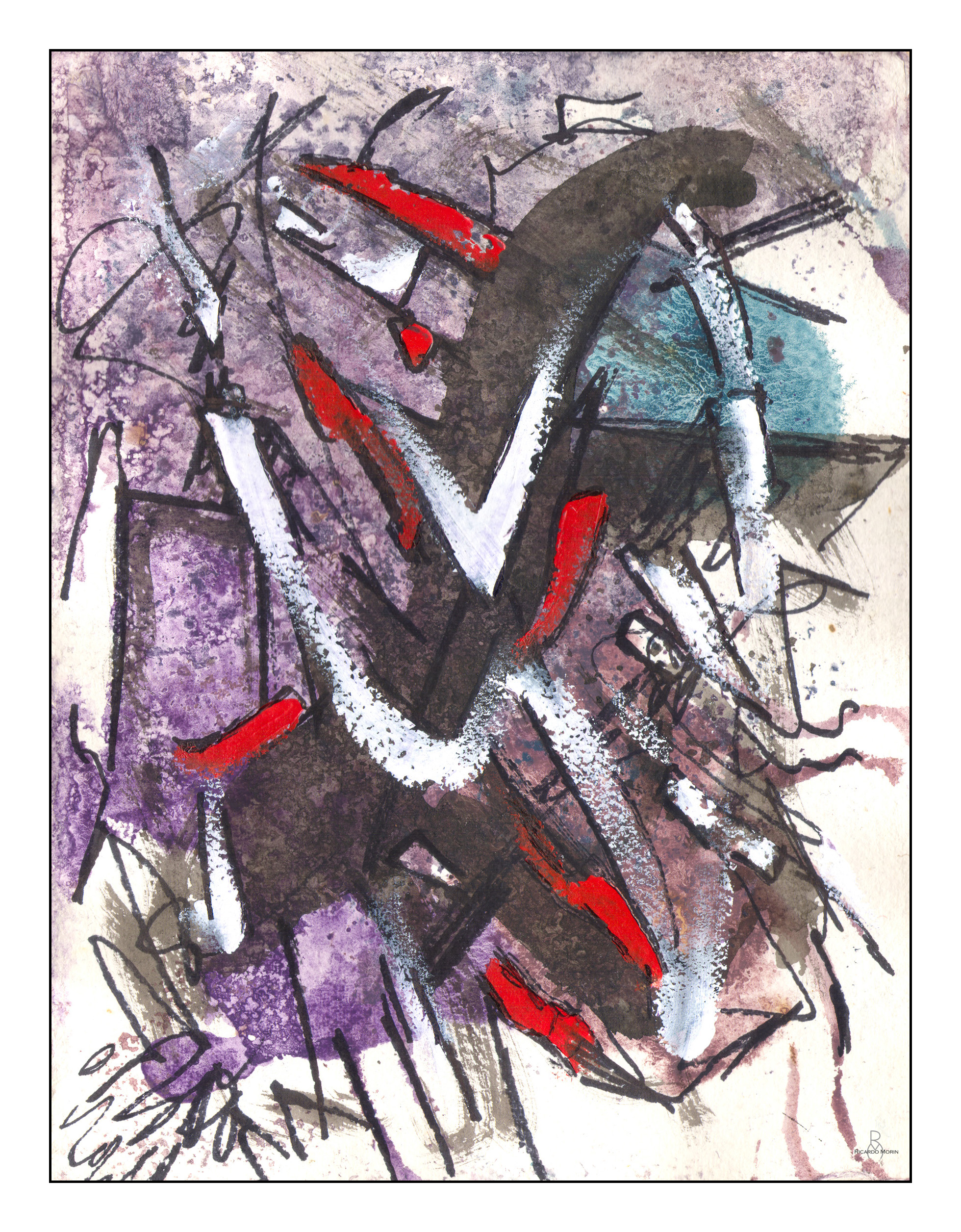
Ricardo Morin The Grammar of Punishment 10″x12″ Watercolor 2003
Ricardo F. Morín
November 2025
Bala Cynwyd, Pa
Billy Bussell Thompson, Editor
Author’s Note:
Societies respond to harm in two fundamentally distinct modes of action. One unfolds through the slow, cumulative patterns of behavior and belief that shape collective life; the other through the deliberate, codified interventions undertaken by institutions in the name of order. The Grammar of Conflict and The Grammar of Punishment are companion essays, each devoted to one of these modes of action.The Grammar of Conflict traces how hatred, victimhood, hypocrisy, tribalism, and violence intertwine into a self-perpetuating system—one that is sustained through repeated explanation at every turn and is endured not through necessity, but through the stories societies choose to tell. The Grammar of Punishment concerns the authority of the State, viz. a formal, structured exercise of power that imposes consequences within boundaries defined by lawful interpretation. The Grammar of Conflict traces how civic and political antagonism becomes habitual and self-justifying.The Grammar of Punishment addresses cases in which the State that exceeds its limits can turn injustice into a system of unreasoned laws. Taken together, the two essays offer complementary perspectives on the forces that perpetuate harm and on the deliberate choices that may interrupt its recurrence.
Abstract:
The Grammar of Punishment addresses the consequences a society imposes for wrongdoing and how the consequences shape the political order and the moral landscape. The essay treats punishment as a limited civic instrument and punishment as an entrenched practice. It describes conditions under which the same punitive act can either uphold shared rules or weaken these rules when the scope and purpose of the punishment exceed the original moral and civic justification for imposing them. The drift beyond that justification often occurs because punishment extends beyond accountability:when punishment becomes a vehicle for revenge, a demonstration of power, and a means of perpetuating the authority or moral narratives that allow it to continue long after the original violation has been addressed. This essay does not oppose punishment; it addresses conditions under which punishment displaces justice. At a time when punitive measures increasingly shape political discourse and public policy, understanding the internal logic of punishment is essential to preserving the boundary between justice and power.
The essay will trace how punishment evolves from a measured response to a specific wrongdoing into a self-perpetuating system of governing. It will show how institutions originally created to restore justice will come to assert authority, to sustain narratives of legitimacy, and to conceal the principles they were established to defend. The analysis will identify the conditions under which punishment remains credible (when the exercise of punitive authority is bounded by reason, procedure, scope, proportionality, time, and review) and the points at which punishment ceases to protect social order and begins instead to perpetuate harm. The essay, however, will neither dictate specific policies nor condemn the use of policies. Its purpose will be to clarify the roles attributed to punishment, the points at which those roles break down, and how continued reliance on punitive measures discloses deeper social choices about authority, responsibility, and the impulse to respond to injury—choices that reveal as much about a society’s values as about its fears.
1 Punishment is a public act that imposes a cost in response to a breach of law or shared norm. Punishment marks a boundary, declares a rule, and demonstrates its enforcement. This definition distinguishes punishment from prevention, restraint, accountability, and repair. Prevention concerns events that have not yet occurred. Restraint limits the capacity of an individual or group to cause harm. Accountability establishes facts and assigns responsibility. Repair addresses loss and attempts to restore what has been taken away. Punishment differs from these responses because punishment addresses a specific violation after the fact and imposes a consequence.
2 Any serious assessment of punishment must answer three questions:What is the purpose of punishment?To whom is punishment directed?And, what is the outcome of punishment? The first question concerns a reasoned intent as opposed to a vague one. The second question concerns the target and scope of the punitive act. The third question concerns its manifestation as opposed to the original intention of punishment. A punishment that claims deterrence yet produces recurrence, or resists compliance, errs not in degree but in comprehension of punishment as a tool. By ignoring cause, the application of punishment can mistake reaction for resolution and enact justice without insight—a cycle that corrects nothing because it understands nothing.
3 Four primary purposes of punishment are commonly recognized: boundary-setting, deterrence, incapacitation, and recognition. Boundary-setting defines the limits of acceptable behavior and affirms that rules retain meaning only when their violation entails consequence; those limits must be defined with clarity. Deterrence seeks to prevent future harm by making the cost of wrongdoing visible and measurable. Incapacitation protects society by restricting the offender’s ability to inflict further injury. Recognition satisfies the moral need to acknowledge that a wrong has occurred and that the community has responded to it. These aims are conceptually clear, yet their success depends on interpretation and application—each revealing whether the pursuit of order remains faithful to the idea of justice.
4
A penalty first intended to correct a specific wrongdoing can, over time, be turned by institutions into an instrument of government. This transformation begins when authorities broaden the reach of the penalty, apply it repeatedly as a mechanical demonstration, and treat its continuation as proof of the authority of the institutions and the legitimacy of the system. What begins as a targeted reaction applied to a specific violation is repeated, extended, and maintained beyond its original scope. Over time, the expectation of punitive action acquires a life of its own, and support for punishment becomes a marker of allegiance to the prevailing order. Actions that once aimed to correct behavior evolve into assertions of dominance, and dissent is recast as disloyalty. As this process deepens, penalties grow harsher, the circle of responsibility expands, and temporal limits dissolve. Punishment, once applied to resolve conflict, is continued under conditions that reproduce the same conflict. When a punitive measure must be repeated indefinitely merely to prove that a rule still holds, the measure is no longer reinforcing the rule; the measure itself becomes the rule. When punishment is applied habitually, its function changes—no longer of law but of power. Habit grants power a moral vocabulary that disguises its interest as principle. When law borrows the tone of justice itself, punishment is presented as restoration.
5
Once power begins to speak in the place of law, the line between what is and is not permitted may remain obscure, but the penalty for transgression is certain. Such obscurity transforms the law from a boundary of understanding into a field of intimidation. Power gains elasticity by refusing clarity; it rewards those who conform and isolates those who interpret too freely. In this inversion, the rule of law survives only in form but its grammar—definition, proportion, and foreseeability—has been erased.
6 Legitimacy is the foundation on which punishment stands. Without legitimacy, punishment no longer functions as justice and becomes an imposition of unchecked power—an exercise of power without lawful foundation. Legitimacy demands definition; tyranny thrives on ambiguity. For punishment to be legitimate, the rules it enforces must be established in advance, written in language that the public can understand, and open to examination and review through lawful procedures. To write rules in advance is to bind power to reason; it makes punishment a civic act—foreseeable, accountable, and shared—rather than the decision of whoever holds command. When these conditions are met, punishment serves a civic purpose, reinforces the rule of law, and secures its own legitimacy instead of weakening it.
7 Time limits are essential safeguards that prevent punishment from becoming a permanent condition. A consequence without a defined endpoint ceases to address a specific violation and becomes a permanent structure of power. When the duration of punishment is not limited by purpose, punishment no longer serves the law, but replaces it. This principle applies both within societies and among them: a sanction imposed on an individual, a community, or a State follows the same moral and structural logic. In foreign relations, punitive measures such as sanctions or embargoes function as instruments of discipline between States, and they risk the same transformation—from response to domination—when no path toward resolution is defined. The possibility of restoration—whether through legal standing, political recognition, or the end of hostilities—is not an act of leniency but a precondition for stability. Without a defined point of closure, the punished party has no reason to change course, and opposition becomes the only rational response. Durable orders, civic or international, therefore require an exit from punishment if they are to secure lasting peace.
8 Deterrence is often described as the most rational purpose of punishment, yet its logic frequently is invoked under conditions that include other motives. Under vague statutes, however, deterrence no longer warns; it confuses. Political authorities often invoke deterrence to justify harsher measures and claim that fear of consequence will prevent future harm. But fear imposes compliance without addressing underlying conditions that give rise to transgression. A punitive policy designed to frighten rather than to understand or correct those conditions becomes less an instrument of prevention and more a mechanism for asserting control. It teaches not respect for the rule of law but submission to power. When deterrence functions in this way, it ceases to serve justice and instead sustains the very instability it claims to prevent.
9
Uncertainty is an inherent condition of every system of punishment. Facts are often incomplete, motives are mixed, and consequences can rarely be predicted with precision. When the absence of reason is institutionalized under the pretext of uncertainty, the temptation arises to punish not for actions already committed but for those merely expected. Measures such as preventive detention or deportation are imposed not on verified conduct but on assumptions about future behavior. These actions, though defended as safeguards against possible harm, risk turning suspicion into verdict. This form of preemptive punishment blurs the distinction between justice and prevention, replacing evidence with prediction. As the reach of punishment extends beyond proven acts into the realm of conjecture, the obligation to justify its use must grow correspondingly heavier.
10 There are cases in which punishment is not only justified but necessary. Certain violations—treason, systemic corruption, sustained violence—break the foundation of shared order. Ignoring violations signals that common rules no longer carry consequence; this breakdown in enforcement creates the conditions for further harm. In such circumstances, punishment functions as an act of preservation: it re-establishes lawful boundaries and affirms that no person or group stands above the rules that govern collective life. Yet the legitimacy of this response depends on proportion and restraint. When punishment becomes the automatic answer to every offense, it ceases to serve justice and instead entrenches a culture of retribution. Punishment fulfills its purpose only when it is applied after reasoned explanation, fair procedure, and tangible repair have failed to resolve the violation; under those conditions, punishment restores the boundaries of order without extending harm beyond necessity.
11
Mercy functions as a limiting condition within systems of punishment rather than as a negation of justice. Where legal systems retain mechanisms for clemency, review, or proportional adjustment, punishment remains bounded by its original civic purpose. Systems that apply punishment without the possibility of mitigation or termination treat duration as authority and convert consequence into permanence. Under such conditions, punishment ceases to respond to a specific violation and instead establishes an enduring relation of domination.
The availability of mercy alters the operation of punishment by introducing temporal and proportional limits. These limits prevent punitive authority from extending beyond the circumstances that justified its initial application. When legal procedure excludes such limits, enforcement persists independently of the conduct that prompted it, and legality is reduced to repetition rather than judgment. Under such circumstance, punishment is administered as a continuous practice rather than as a reasoned response.
Systems that incorporate mercy preserve a distinction between law and command by allowing punishment to conclude once its stated purpose has been met. Where that distinction is maintained, punishment remains an instrument within the law rather than a substitute for it. Where it is not maintained, punishment operates without reference to restoration, and civic membership is replaced by continued exposure to sanction.
12
These principles are not abstractions but safeguards that keep the exercise of power subject to the law. When institutions apply punishment within those limits, the law retains its credibility because the consequences remain connected to reason. When institutions exceed those limits, punishment replaces the law as the source of authority, and conflict grows within the space that reason has abandoned. Under such circumstance, punishment no longer resolves the doing of wrong; it reproduces it. Justice survives only when the law speaks with a clarity that power cannot rewrite.
Ricardo F. Morín Untitled #2 Watercolor 10”x12” 2003
By Ricardo F. Morín
Oct. 9, 2025
Bala Cynwyd, Pa
*
Abstract
Conflict endures not only because of the grievances that ignite it, but also because of the internal logic that sustains it. Hatred, victimhood, hypocrisy, tribalism, and violence do not operate as separate forces; they form an interdependent system that is justified at every turn. This essay examines a system of conflict as a grammar—a set of rules and patterns through which antagonism shapes thought, legitimizes action, and perpetuates itself across generations. The objective is not to judge but to expose how conflict becomes self-sustaining, how violence evolves from an instrument into a ritual, and how contradiction becomes the very foundation upon which societies act in ways that betray their own professed values.
1
Conflict, when stripped down to its structure, is less an event than a language. Conflict is learned, repeated, and transmitted—not as instinct alone but as a structured framework through which people interpret events and justify actions. Violence is only one expression of conflict; beneath the act lies a sequence of ideas and reactions that not only precede violence but also weave hostility deliberately into a fabric of continuity. Understanding this grammar of conflict is essential, because it shows how human beings can remain locked in cycles of harm long after the original reasons have disappeared—not by accident, but because the rhetoric sustaining conflict extends the original violence far beyond its initial cause. What appears spontaneous is often scripted, and what seems inevitable is, more often than not, the cumulative result of choices that have hardened into reflex.
2
Hatred is the first syntax of this grammar. Conflict does not erupt suddenly but accumulates over time, layer upon layer, through memory, myth, and selective narration. Conflict is presented as a defense against a perceived threat or subordination; yet its deeper function is preservation. Hatred sustains identity by defining itself against what it is not. Conflict, once entrenched, ceases to depend on immediate threat. Conflict becomes self-justifying. It becomes a lens that reinterprets evidence in conformity with its narrative and expectations. Conflict prepares the ground on which it thrives and provides ready-made explanations for future disputes.
3
Victimhood gives hatred an enduring vocabulary. It converts the suffering from a past event into a permanent political and social resource. Suffering is a condition we all inhabit. Yet to make suffering the core of collective identity is strategic. Suffering allows communities to claim moral authority and to legitimize otherwise illegitimate actions. The story of injury becomes a foundation for retaliation. Herein, however, lies a trap: identity anchored in victimhood threatens the cessation of its narrative. Without the presence of an adversary, legitimacy loses potency. The original wound remains open—remembered and weaponized for all that follows. Each new act of aggression is framed as a defense of dignity and as a reaffirmation of suffering.
4
Hypocrisy is the structure holding this system together. Hypocrisy enables simultaneous denunciation and deployment of violence. It is a proclamation of ideals systematically violated. Hypocrisy not only conceals contradiction; it embodies it. It is, in fact, a vain attempt to invoke justice, to speak of universal rights, and to decry cruelty. The resulting duplicity is essential. Hypocrisy presents violence as a legitimate principle, domination as protection, and exclusion as necessity.
5
Once hatred, victimhood, and hypocrisy have aligned, violence becomes a ritual—not a reaction. This ritual can claim instrumental goals:the recovery of lost territory, the righting of past wrongs, or the assurance of safety. But over time, the purpose fades and the pattern remains. Each act tries to confirm the legitimacy of the last and to prepare a justification for the next. The cycle no longer requires triggers; conflict sustains itself through momentum. Violence becomes a means through which the collective is used to consolidate identity and to institutionalize memory.
6
Tribalism is a ritual of emotional power. Conflict reduces the complexity of human experience to affiliation and exclusion. Within this framework, radically different standards judge shifting actions according to who commits them. What outsiders called terrorism becomes a defensive force within the tribe. The tyranny of an enemy becomes the tribe’s strength. Tribalism turns contradiction into coherence; it makes hypocrisy acceptable; it transforms violence into allegiance and reprisal into obligation. The more deeply divisions define a society, the more indispensable conflict becomes to its sense of purpose.
7
Violence is no longer a response; it is a condition. Violence persists not because it serves immediate goals, but because it affirms permanence. Ending a cycle means dismantling its sustaining narratives; it means acknowledging an enemy is not immutable; victimhood is no longer unique; ideals no longer coexist with betrayals.
8
The illusion of inevitability is insidious. If conflict frames destiny, accountability dissolves. Reaction explains every action as defensive. Herein, recognition diminishes agency; violence becomes not a choice but a forced external condition, an illusion allowing the cycle to continue.
9
Breaking the continuation is neither difficult nor mysterious. Hatred as an explanation simplifies and legitimizes the narrative; it offers ideological reassurance; it sustains a false sense of control. Together they form a system that seems natural, but familiarity is not fate. The grammar of conflict is learned;what is learned can be unlearned. The first step is to elucidate and to recognize what seems inevitable is only a choice disguised as a reaction. Thus societies can construct new grammars, without enmity, without vengeance, and without domination.
10
To diagnose conflict is not to diminish suffering or to excuse violence. An understanding of how suffering and violence endure reveals that each helps to sustain the other. Profound injuries are not those inflicted once but are those kept alive by stories repeated about them. The cycle endures because unreason has its own reason; it preserves the stories that keep us injured and persuades us of their necessity. It is not that people act without reason, but that they rationalize the irrational until irrationality itself becomes the organizing principle of their behavior. Exposing their grammar is not a solution, but it is a beginning: a way to make visible the architecture of antagonism and, perhaps, to imagine forms of coexistence that no longer depend on perpetual conflict for their justification.
Edited by Billy Bussell Thompson, Oct. 9, 2025, NYC, NY
This story forms part of a narrative triptych alongside In Tenebris [2021] and In Darkness [2022], three pieces that explore the same murder trial through a different angle.
In Tenebris addresses the deliberation from within; In Darkness proposes an open-ended reimagining; Between Law and Conscience returns to the experience from a reflective distance—to examine what the justice system leaves out.
*
The trial took place seven years after the murder.
It was difficult to grasp how something so grave could have waited so long. No weapon had been recovered.The witnesses gave halting, conflicted testimony.The victim had been fourteen when he was shot. The defendant—who looked barely older than twenty at the time of trial—must have been about the same age back then. Both boys, really.What had unfolded in those missing years—before and after—was never addressed.
We were told the crime stemmed from a turf dispute between youth gangs. Not a premeditated act, but a flare of violence born in a world where survival, for some, is its own daily labor. Children—some no older than primary school age—trapped in loops of retaliation, where fear and poverty set the rhythm. None of that—none of what might explain how violence germinates where options vanish—was part of what we were allowed to consider.
There may have been earlier proceedings. Maybe the case began in juvenile court. Maybe there were appeals, delays, witnesses who refused to testify. Or maybe the file just sank, for a time, under the sheer weight of the judicial backlog. By the time we—the jury—entered, none of that background was available to us. Our task was to begin where the case file did: with the event. As if time had left no mark. As if the intervening seven years had not eroded memory or reshaped the young man who now sat before us.
The purpose, formally, was to determine guilt or innocence. But from the outset it felt like we were being asked to apply a blunt question to a situation that resisted such clean edges. This was not just about what had happened—but about what could not be said.
We were instructed to confine ourselves to the evidence. And we tried. But the questions kept tugging—quietly, steadily. How could we not see that this was a killing between teenagers? That it unfolded in a context already stacked against them? How could we not feel that something vital had been left out of the frame?
No one spoke of the defendant’s time in custody—how long he’d waited for trial, whether he’d been offered a plea, or had access to counsel early on. And that expression on his face—unreadable to some, unsettling to others—may have carried traces of confinement, of growing up inside a system that offers little room for grace. I couldn’t know. But I kept wondering.
Despite our best efforts to remain disciplined, the questions kept returning. What chances had that boy really had to escape the fate that claimed him? What might his life have looked like if different choices—his or others’—had been possible earlier? Was it fair, even legal, to weigh his guilt without considering the conditions that had shaped him?
But those thoughts were not admissible. They weren’t in the record. The judge’s instructions were clear: such context, however compelling, was irrelevant to the task before us. Justice, we were told, required a kind of tunnel vision—stripped of background, stripped of time.
So the proceedings followed their course: objections, testimony, forensic accounts, cross-examinations. The weapon was never found. Both the prosecution and the defense had their lapses—moments where arguments frayed or confidence gave way to fatigue. But what lingered wasn’t the strength or weakness of the case. It was the feeling that something essential remained unspoken, unreachable. That the full truth—if such a thing existed—had been sealed off long before we arrived.
Some jurors were ready to decide quickly. For them, the evidence presented was enough to convict. Others, myself included, were less sure—not out of sympathy, but because the case felt incomplete. I kept returning to a quiet unease: were we being asked to judge a person, or only the narrow outline the system permitted us to see?
During deliberations, the tension thickened. One juror said that the defendant’s withdrawn posture looked like guilt. Another saw in it exhaustion. I couldn’t say. But I kept asking myself—what does innocence look like after seven years in pretrial detention? What shape does presence take in someone who has lived under constant suspicion?
On one afternoon, before we adjourned for the day, the youngest among us—barely twenty—spoke up. His voice was low but certain:
“I grew up in a neighborhood too, where you were more likely to be stopped for how you looked than to be seen as someone worth protecting. I don’t know if he did it. But I do know what it feels like to be judged before you understand who you are.”
No one responded. But something in the room changed. The atmosphere softened. Our conversations grew less defensive, more reflective.
It took us nearly three weeks to reach a verdict. Not because the case was complex in a technical sense, but because we all—each of us—had to confront not only the facts but our own expectations of justice. Doubts lingered. The discussions were civil, even quiet, but weighted. It was as if the jury room had become something else—a kind of confessional, where what we revealed was not just about the case, but about ourselves.
I thought of my father, who used to say that justice must be blind, but never deaf. That one must listen for what’s withheld, not just what’s claimed. That memory stayed with me as we signed the verdict: not guilty.
There were quiet cheers from the defendant’s side. The victim’s mother wept. We, the jury, didn’t feel resolution—only the tremor of uncertainty. The judge thanked us for our service. We exited through a narrow corridor, shielded from the public, down a service elevator, then out.
I don’t know what became of him after that. Maybe he disappeared again into the margins of a city that had already marked him. Maybe he tried to begin again. I can’t know. But I do know this: that trial was not only about one act of violence. It was about the quiet violence of exclusion—of what the law, in its procedures, often refuses to see.
And it is that omission—silent, sanctioned, systematic—that places justice itself on the stand.