It may be enough that we do not turn away from what stands before us, even when it exceeds what we believe we can endure. What lies ahead is not lessened by our hesitation. If there is any measure left to us, it is in seeing what is there without withdrawing from it. Let it not pass unnoticed. In facing what we fear, something in us has already given way, though we continue as if it had not. Still, something must hold, even where we cannot name it.
Let it not be said that we did not see what we became. No tyranny stands apart from those who allow it to stand. What prevails does so not by force alone, but through what remains unexamined in each of us. If there is anything to be undone, it does not begin elsewhere. It begins in the refusal to see what we are when we turn away. If there is mercy, it is not in judgment, but in the possibility that one might still face what has been done without turning from it.
We do not stand outside this. What we condemn is not separate from us. If we fail, it is not only through action, but through what we leave unexamined. Indifference does not remain contained. It spreads, quietly, until nothing resists it. What we become in that condition is not imposed. It is allowed. And in that allowance, something essential gives way.
Before it is too late, there is only this: to see what is there, within and without, without division. Not in parts, not in sequence, but all at once. To see it without turning it into something else. In that seeing, there is no method, no progression, no assurance. Only the fact of it. And where that fact is seen without distortion, something acts, not as decision, but as the ending of what cannot continue once it is fully seen.
*
Ricardo F. Morín, recast from 2014, April 25, 2026, Bala Cynwyd, Pennsylvania.
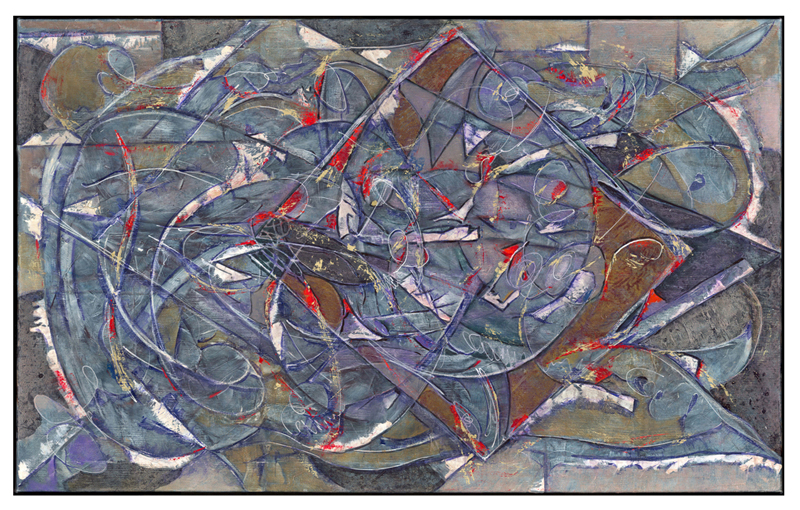
“Geometric Allegory” digital painting 2023 by Ricardo Morin (American visual artist born in Venezuela–1954)
*
Author’s Note
This installment examines how ideological labels, liberal, socialist, democratic, are deployed as instruments of alignment rather than as enforceable commitments. Venezuela is approached not as an exception, but as a case in which administrative practice, international positioning, and partisan abstraction converge to obscure responsibility. What follows traces how power is exercised through method rather than doctrine, how ideological language displaces accountability, and how clarity, rather than consensus, emerges as the first condition for recovery.
Ricardo F. Morín, January 12, 2026, Oakland Park, FL.
*
Chapter XIII
*
The Fifth Sign
~
The Pawned Republic
1
The Venezuelan economic crisis developed within a political environment in which control over foreign currency, public spending, and State revenues became increasingly concentrated in State-controlled allocation systems and extra-budgetary fiscal mechanisms. After exchange controls were established in 2003, access to foreign currency was centrally allocated through State mechanisms such as CADIVI, and by 2013 even government authorities were publicly acknowledging fraud in the assignment of preferential currency, including allocations to fictitious entities. At the fiscal level, parallel funds such as FONDEN administered substantial appropriations outside substantive parliamentary scrutiny, while public information on State spending and earmarked funds became increasingly unavailable. Under these conditions, the diversion of public resources did not appear as isolated misconduct but as a recurring feature of governance in which formal procedures governing budget approval and reporting remained nominally in place while independent verification and public disclosure diminished. What emerged was not the failure of a declared doctrine, but the consolidation of an administrative method in which access to public resources depended less on transparent procedure than on the concentration of discretionary control.
Debates that oppose socialism to capitalism misidentify the operative field. These terms describe beliefs about ownership and social purpose; they do not describe how economies are administered. Economic stability does not follow from declared purpose but from enforceable limits on taxation, spending, and contract execution. It depends on whether taxation follows rule, whether contracts are enforced without exception, whether budgets are bounded by procedure, and whether authority is exercised within limits enforced through budget law, contract enforcement, and institutional oversight. Where these conditions are absent, ideological designation does not fail; it becomes irrelevant.
As State procurement in sectors such as oil, infrastructure, and food imports became subject to political discretion, auditing functions weakened and oversight bodies lost operational independence. Revenues and contracts controlled by the State were increasingly used to redirect resources through discretionary allocation. Public authority ceased to function as a mediating structure and became an object of appropriation. The result was not episodic corruption but a stable arrangement in which diversion operated as an expected outcome of governance.
The mechanism did not explain action; it displaced its examination. Ideological language did not clarify operations; it rendered them inaccessible. Official discourse invoking class struggle and anti-imperialism redirected public attention from currency allocation, public spending, and procurement practices toward symbolic political conflict. These appeals replaced the examination of procedures with narratives of opposition that carried no capacity for control.
This substitution extended beyond the national sphere. Governments identifying with liberal or democratic traditions supported sanctions presented as instruments of pressure. In practice, these measures intensified economic hardship without altering the internal configuration of power. [1] At the same time, States maintaining political and economic alignment with the Venezuelan government, including China, Russia, and Cuba, permitted the attenuation of electoral oversight, judicial independence, and legislative authority and presented inaction as fidelity to principle. [2] Across these positions, ideological designation did not guide action. It concealed a convergence: measures that weakened society without altering authority, and positions that preserved authority without regard to how it was exercised.
2
What is presented as a divide between opposing systems resolves, in operation, into a convergence of practices. External pressure that weakens a population without altering authority, and external tolerance that preserves authority without regard to institutional dismantling, produce the same condition: the isolation of society from judicial, electoral, and legislative means of contesting authority.
Within that condition, the population is not situated between competing models of governance. It is rendered instrumental to positions that do not operate upon the mechanisms that sustain or constrain power. The language of alignment, whether in the form of solidarity, neutrality, or caution, does not alter this configuration when it remains detached from the procedures through which authority is exercised. [3]
Where accountability is not enforced, other forms of organization emerge without constraint. Criminal and informal economic networks operating without judicial or regulatory enforcement expand into the space left unregulated. Their growth does not require ideological justification; it follows from the absence of enforceable limits. [4] What is described as crisis does not begin with collapse. It begins when constraint is withdrawn from the exercise of power and remains abrogated without consequence.
Endnotes on Chapter XIII
[1] Francisco Rodríguez and Jeffrey Sachs, “Economic Sanctions as Collective Punishment: The Case of Venezuela,” The Lancet 393, no. 10178 (2019): 2584–2591; Center for Economic and Policy Research, “Sanctions in Venezuela: Economic and Humanitarian Impacts,” 2019.
[2] R. Evan Ellis, “The Maduro Regime’s Foreign Backers: China, Russia, Iran, and Cuba,” Center for Strategic and International Studies (CSIS), November 6, 2020; United Nations Human Rights Council, “Report on the Situation of Human Rights in the Bolivarian Republic of Venezuela,” 2022.
[3] Javier Corrales, “Democratic Backsliding Through Electoral Irregularities: The Case of Venezuela,” Perspectives on Politics 18, no. 2 (2020): 311–327.
[4] Insight Crime, “Venezuela’s Criminal Landscape: A Country of Collusion,” 2021; Transparency International, “Venezuela: Corruption Perceptions Index,” 2022.
*
Chapter XIV
*
The First Issue
~
Resisting Partisan Control:Civil Society’s Stance in Venezuela
1
Democratic life is not secured by a single principle but by the interaction of distinct forms: pluralism, partisanship, nonpartisanship, and antipartisanship. These forms do not resolve into unity. They define how authority is organized, contested, and limited within institutions such as parties, courts, and legislatures.
Pluralism establishes the condition under which difference can appear without being suppressed. Its function is to ensure that multiple positions can enter public space without requiring prior alignment. Where institutions fail to protect participation through electoral access and legal safeguards, participation contracts and representation narrows.
Partisanship organizes competition through structured alignment. Its function depends on a limit: that allegiance to a party does not supersede adherence to the rules governing the contest itself. When that limit dissolves, competition persists in form while its constraints disappear.
Nonpartisanship suspends alignment in order to preserve procedure. Its role is not neutrality in the abstract, but the maintenance of conditions under which decisions remain accountable to rule rather than to affiliation.
Antipartisanship emerges when these arrangements fail. It rejects parties as vehicles of representation, but in doing so it removes the structures through which accountability is exercised. Where this rejection becomes programmatic, it does not remove power. It removes the structures that limit it, leaving power to concentrate without opposition.
2
In Venezuela, antipartisanship became a governing strategy through the delegitimization of established parties and the centralization of authority in the executive. Public disillusionment with established parties permitted the emergence of a singular political alternative that did not operate outside institutions but reorganized them. Institutional limits were recast as impediments, and their removal was presented as restoration. What was removed, however, was not obstruction but constraint. [1]
Under Chávez, this method extended through the redirection of the State resources. Oil revenues were deployed to consolidate political alignment across sectors. Access to State-distributed resources increasingly depended on political alignment, particularly through government programs and public employment, establishing dependence in place of institutional trust. Under Maduro, this structure persisted under contraction: as resources diminished, the requirement of alignment intensified while preserving the same operational logic.
3
Clientelist practices were not introduced but expanded and centralized. What had been dispersed became systemic. Programs such as the Misiones Bolivarianas, funded through oil revenues and administered through State-aligned structures, illustrate this transformation. Their stated function was social provision; their operation linked access to political identification. In programs such as Barrio Adentro, healthcare delivery was administered through structures coordinated with the governing apparatus. [2] Benefits did not follow need alone, but alignment.
Policies of expropriation and currency control further restricted independent economic activity. By reallocating assets through administrative decision, these measures reduced the space within which alternative forms of organization could emerge. Economic contraction followed as a consequence of constrained operation.
4
The weakening of institutional structures displaced rather than eliminated organized activity. Civil society organizations assumed roles in legal defense, human rights documentation, and service provision where State institutions failed to operate consistently.
Organizations such as Provea, Foro Penal, and Transparencia Venezuela document violations, provide legal defense, and maintain records of administrative conduct. Electoral observation organizations document voting conditions and irregularities despite legal and operational restrictions. Community-based structures such as Mesas Técnicas de Agua coordinate access to basic services such as water supply in the absence of reliable State provision. These activities maintain a verifiable link between documented actions and their consequences, between public claims and records, and between authority and its legal limits. Where institutions no longer secure these relations, they are sustained through practice.
5
These formations do not constitute an alternative system of governance. They operate within limits imposed upon them, and their continuity remains contingent. Legislative measures increasing oversight of non-governmental organizations have further reduced their operational space.
What persists is not a program but a set of practices that maintain a verifiable link between action and consequence, authority and limit, and decision and verification. Where these relations are sustained, even in restricted form, the possibility of reconstruction remains.
Democratic recovery does not begin with alignment or design. It begins with the reestablishment of constraint upon power and the restoration of procedures through which actions can be examined and limited. Where these conditions are absent, declarations of principle do not fail; they do not operate.
Endnotes on Chapter XIV
[1] Javier Corrales and Michael Penfold, Dragon in the Tropics: Hugo Chávez and the Political Economy of Revolution in Venezuela (Washington: Brookings Institution Press, 2011), 19–24, 30–34.
Ricardo F. Morín Triangulation II 22″ x 30″ Body color, sanguine, sepia, and white out on paper 2008
Societies rarely recognize when language begins to prepare the conditions for hatred. Long before violence appears, speech has already changed how people see what is in front of them. A group is no longer described by what it does, but by what it is made to stand for: a “threat,” an “invasion,” a “corruption.” Description yields to designation.
In “Language, Judgment, and Freedom of Conscience: On the Architecture of an Intellectual Position,” I examined how freedom of conscience depends on a steady link between what is seen, what is said, and how it is judged. That link is not sustained by itself. Seeing something does not ensure naming it precisely, and naming it does not ensure judging it clearly. When that link breaks, language stops following experience and begins to direct it. Words no longer come after what happens; they tell people in advance what they are supposed to see, think, or conclude. In that shift, the ability to judge for oneself begins to weaken, long before courts are bypassed or rights are set aside.
Once perception is shaped in advance, judgment no longer moves on its own. Hostility no longer appears as a break but as something already contained in the way things are said. A neighbor becomes “one of them.” A disagreement becomes “an attack.”
Societies speak easily about hatred, yet rarely ask where it begins. When violence becomes visible, the instinct is to find someone to blame. The tyrant appears sufficient. Yet this explanation soothes more than it explains. It confines wrongdoing to individuals while leaving intact what made it possible: repeated phrases, accepted labels, words no longer questioned.
It is easier for the Castros, Putins, and Maduros of the world to incite hatred against imaginary enemies than to confront the state of shame and confusion they themselves generate.
A distinction is required. To see clearly is not to hate. To name brutality is not resentment but clarity. To say “this act destroys a life” remains a description. Hatred begins when the person is reduced to what must be removed. Whoever speaks in that way adopts the same language he claims to reject.
Ideologies that organize hostility do not arise in isolation. They differ in name but share a simple rule: people define who they are by pushing others out. Where this rule governs how people define themselves, human worth no longer serves as a shared measure. Public life divides between those who belong and those who do not. Nazism in Europe, Chavismo in Venezuela, the MAGA movement in the United States, and forms of theocracy show how entire populations come to speak of others as enemies and to treat that division as necessary for order or purity.
What appears in Trump is not new. It is what no longer needs to disguise itself.
Once this way of speaking is taken up and repeated, it does not remain confined to leaders or doctrine. It spreads. Some repeat it because they believe it. Others repeat it to avoid trouble, to fit in, or to protect themselves. Language changes. Words stop pointing to people and begin to assign them a place. The adversary becomes a threat; the threat becomes someone to despise. A person is no longer called by name but by a label: “illegal,” “traitor,” “infidel,” “enemy.”
Another confusion follows. In the name of understanding, some begin to describe those who defend such ideas as misunderstood or wounded. This posture appears balanced, yet it shifts attention toward those who exercise power and away from those who live under it.
This confusion rests on a deeper habit of thought. Violence is often explained by pointing to personal wounds or exclusion. There is truth in this. Yet when applied everywhere, it removes responsibility. Everyone is vulnerable. Not everyone participates in organized harm. That requires decisions, repeated words, and people willing to act on them.
The difference between ethics and moralizing appears here. Moralizing sorts people into good and bad. Ethics looks at what allows certain actions to take place and spread. It does not turn the adversary into a monster, but it does not excuse what is done.
Those who suffer the consequences rarely appear in these arguments. They do not belong to factions or slogans. They are those who must live with what others decide: the family forced to move, the worker shut out, the person who learns to remain silent.
The question, then, cannot be answered by pointing to a tyrant. Hatred is fed when people accept the lowering of language, treat humiliation as normal, and allow their judgment to be replaced by ready-made explanations.
At that point, hatred no longer appears exceptional. It becomes a habit. It repeats itself in ordinary speech: “that is how things work,” “everyone does it,” “we have no choice,” “we were forced,” “it is for the nation.” It appears in the language of order and protection: “to restore order,” “for your safety,” and in the steady stirring of fear: fear of losing place, fear of difference, fear of those seen as outsiders, even in societies shaped by mixture.
These expressions do not simply describe what is happening. They shape how it is understood. They make exclusion seem reasonable. What once required justification begins to sound like common sense.
When this way of speaking settles in, hostility no longer needs to be defended. It becomes expected, repeated, routine. Responsibility does not vanish through denial; it fades through repetition: through explanations that excuse and fears no one stops to question.
This is how hatred continues: not only through those who declare it, but through those who repeat it, accept it, or let it pass without objection.
The question remains.
Who feeds hatred?
*
Ricardo F. Morín, March 16, 2026, Oakland Park, Florida.
Ricardo Morín Infinity One: The Grammar of Emotional Mimicry 60″x 37″ Oil on linen 2005
*
Public life today is shaped less by ideas than by emotional cues. People respond not to the content of arguments but to the register in which those arguments are delivered. Tone becomes substance; affect becomes authority. The substitution of emotional cues for argument is not accidental. It reflects a deeper cultural grammar in which individuals learn to recognize themselves not through reasoning but through emotional likeness. The most resonant voice is not the most coherent one but the one that mirrors the emotional state of the crowd. I call this phenomenon the grammar of emotional mimicry.
The press plays a central role in reinforcing this grammar. Modern media does not function as a platform for the slow work of thought; it functions as a marketplace of sentiment. Editors select, frame, and circulate stories on the basis of emotional traction rather than intellectual clarity. A confession of anguish is treated as insight. A display of distress is treated as truth. The media’s primary currency is resonance, measured not by accuracy but by the intensity of feeling it can evoke. It simply reflects the incentives of an attention economy.
Prominent authors or celebrities are often given expansive platforms to articulate personal grievances that contain little conceptual grounding. A statement such as “there is no closure for innocent suffering unless the universe holds someone accountable” is presented as a courageous moral reflection. Yet the premise collapses at first contact: suffering is not distributed according to desert, and nature does not adjudicate innocence. Still, these are emotionally potent narratives because the marketplace rewards vulnerability, not reasoning.
This pattern of selection and reward parallels the emotional logic of populism. Followers of political figures often identify with leaders not because they share material circumstances or policy interests but because they recognize themselves in the emotional posture the leader performs.This is evident in the movement surrounding Donald Trump. His supporters do not mimic his ideas; they mimic his emotional volatility, his sense of grievance, and his theatrical defiance.He becomes a projection surface for the emotional life of the crowd. In return, he mirrors their turbulence. This is mimicry in both directions.
The convergence between media dynamics and populist dynamics is not accidental. Both rely on the same grammar: emotional resonance as a substitute for coherence. Trump’s appeal depends on this alignment between emotional expression and public response. The press amplifies his volatility because it generates spectacle; the public interprets the spectacle as authenticity; and authenticity is misread as truth. What appears most authentic is often least reliable as a guide to truth. The cycle continues because repetition and amplification do not depend on coherence. Indeed, incoherence strengthens the bond, because it signals freedom from the constraints of disciplined thought—constraints that many interpret as elitist or oppressive.
This grammar does not operate only in politics. It shapes cultural life more broadly. Cultural production increasingly privileges emotional exposure over disciplined expression. Works are evaluated on the basis of how effectively they simulate immediate sentiment, not on how clearly they illuminate experience. The result is a narrowing of public imagination: nuance becomes difficult to sustain, and reflection is displaced by emotive shorthand. This environment favors individuals who narrate their emotions vividly, regardless of whether their interpretations withstand scrutiny.
The consequences for civic life are considerable. When emotional mimicry becomes the dominant mode of engagement, disagreement becomes impossible to navigate. Individuals no longer encounter differences in judgment; they encounter differences in emotional identity. To critique an argument becomes an attack on the person’s emotional legitimacy. Public conversation becomes a contest of grievances rather than an exchange of ideas. The result is a brittle social sphere in which the loudest emotional frequency defines the terms of debate.
This shift also erodes the distinction between witness and participant. By seeking emotional stories, the press becomes a participant in the very dynamics it reports. It reinforces the emotional scripts people already inhabit. It privileges personal turmoil as evidence of moral depth. It treats spectacle as substance. In doing so, it trains the public to internalize emotional performance as the primary mode of communication. The media does not merely reflect emotional mimicry; it makes it a habitual form of expression.
Today’s emotional grammar differs in scale and function. Selection, repetition, and amplification now operate continuously, reducing complex experience to a narrow range of signals—grievance, resentment, and confession. As these signals circulate, attention is captured by intensity rather than guided by coherence. This is not a moral collapse; it is a failure in how attention is directed and sustained in public life.
The challenge is not to suppress emotion but to restore proportion. Emotional life is essential to human experience, but it cannot serve as a universal grammar for public reasoning. A culture that communicates primarily through emotional mimicry loses its ability to distinguish perception from projection. It becomes reactive rather than reflective. To recover clarity, we must once again separate the vividness of emotion from the validity of thought. Only then can public life recover the depth it has traded for resonance.
*
Ricardo F Morín, November, 2025, Oakland Park, Florida
This installment concludes Chapter XII, “The Fourth Sign.” It presents §§ 26–34 under the heading The Asymmetry of Sanctions, examining the unequal application and effects of external economic and political measures in the broader context established by the preceding sections on Autocracy and Venezuela.
Ricardo F. Morín, December 29, 2026, Oakland Park, Fl
*
Chapter XII: Part 3
*
The Asymmetry of Sanctions
*
26
Sanctions are often employed as a diplomatic tool to weaken autocratic regimes. Yet, their use reveals a deeper asymmetry in the struggle between democratic accountability and authoritarian resilience. According to data from the V-Dem Institute, nearly 72% of the world’s population now lives under autocratic rule—the highest proportion since 1978. This reality reframes sanctions not as exceptional measures against isolated regimes, but as policies deployed within a global order where autocracy has become the prevailing form of governance.
27
On one hand, sanctions aim to isolate autocracies economically and politically. On the other hand, regimes like Nicolás Maduro’s have demonstrated remarkable adaptability in the face of such measures. Such regimes’ endurance exposes the limitations of tools designed for a world in which democracy was presumed dominant.
27a
Subsequent developments, including the removal of Nicolás Maduro from power, alter the immediate object toward which sanctions were directed but do not resolve the structural conditions examined here. The networks of authority, the institutional arrangements, and the external alliances that sustained his rule have not been dissolved by his departure. What is observed in this case is not the endurance of a single figure, but the persistence of a governing structure capable of adaptation beyond him.
28
Maduro has formed adversarial alliances to circumvent external pressure and maintain his rule. By invoking themes of sovereignty and resistance against Western influence, he has turned isolation into a narrative of defiance.
29
This narrative serves as a foundation for partnerships with other autocratic States, including Russia, China, Cuba, Iran, and Turkey. [43][44][45][46][47] Driven by pragmatic interests rather than strict ideological alignment, these alliances enable Venezuela to mitigate the intended effects of sanctions.
30
The result is a paradox: while sanctions aim to weaken autocracies, they unintentionally contribute to their resilience. Reliance on alternative alliances allows regimes like Maduro’s to access resources, military aid, and political support, which in turn shields them from severe economic disruption and international scrutiny. In a world where the majority of the world’s population now lives under autocratic rule, the logic of isolation loses its potency; it becomes a misreading of the global balance itself.
31
In this way, sanctions contribute to the persistence of autocracy. Regimes like Maduro’s exploit their isolation to present themselves as defenders of national sovereignty and resistance to global hegemony. [48] This dynamic amplifies the concept of a multipolar world order. As global power shifts away from unipolar dominance, regimes like Maduro’s find new avenues to thrive.
32
By framing their cooperation as resistance to Western dominance, authoritarian regimes justify their alliances under the banner of multipolarity. This strategic repositioning does more than circumvent sanctions—it actively reshapes the global order. As these regimes expand their influence, they undermine democratic norms by replacing them with a system in which power is consolidated without external accountability.
33
This shift is not confined to regimes like Maduro’s: it reflects a broader trend in which authoritarianism gains ground by exploiting ideological fractures within democratic societies. Across Europe and Asia, nationalist and right-wing movements increasingly echo Kremlin-aligned narratives to amplify skepticism toward Western institutions. The rise of such forces in countries like Hungary, Italy, and India is not merely a domestic shift—it signals an alignment with a global framework where sovereignty is invoked not to empower citizens, but to insulate leaders from accountability.
34
Contrary to the argument that authoritarianism is solely a reaction to U.S. hegemony, its expansion demonstrates an independent momentum, one that persists regardless of American intervention. China and Russia do not seek to challenge the U.S. in pursuit of a more equitable world order; they aim to consolidate their power free from external constraints. In this landscape, the traditional ideological divide between left and right becomes secondary to a more fundamental struggle—the contest between concentrated power and democratic resilience. Whether under the guise of populism or nationalism, the objective remains the same: to undermine institutional checks and to consolidate power without sufficient accountability. [49]
~
Endnotes—Chapter XII: Part 3
§ 29
[43] In 2019, Russia’s State-owned Rosneft handled 70% of Venezuela’s crude oil exports and circumvented U.S. sanctions. Russia also supplied military equipment and training to bolster Maduro’s control over the armed forces.
[44] China’s involvement includes joint oil ventures in the Orinoco Belt, infrastructure projects like the Tinaco-Anaco railway project, and housing initiatives (Great Housing Mission). Despite operational challenges, these investments highlight China’s strategic interest in Venezuela’s energy sector.
[45]According to the Brookings Institution, Cuba and Venezuela have maintained close political and strategic ties, particularly during the Chávez and Maduro administrations. This relationship has extended beyond diplomatic and economic cooperation to include security and intelligence collaboration. Cuban institutions have provided training, advisory support, and technical expertise to Venezuelan military and security forces: 1). Dirección de Inteligencia(DI, a.k.a G2) [1961]: The Intelligence Directorate, also known as G2, has been involved in providing intelligence training and support to Venezuelan security forces, particularly in surveillance and national security operations. 2). Comité de Defensa de la Revolución(CDR) [1960]: The Committee for the Defense of the Revolution, created in Cuba, focused on grassroots mobilization and surveillance. Its activities extended to Venezuela, where it contributed to internal security and the promotion of political ideology. 3). Brigada Especial Nacional(BEN) del Ministerio del Interior(a.k.a.Avispas Negras or“Boinas Negras”) [1986]: The National Special Brigade, known as Black Wasps or Black Berets, has been involved in specialized military and security training; it has provided high-level tactical training to Venezuelan military and security personnel.
[46]Iran has aided Venezuela through energy and military cooperation, providing refined fuel and technical support for Venezuela’s oil industry. Barter agreements and drone technology exchanges underscore their deepening alliance.
[47]Turkey facilitated Venezuela’s gold trade, enabling Maduro to bypass sanctions. This trade, involving $900 million in 2018, has drawn criticism for its opacity and links to illegal mining in the Arco Minero region.
§ 31
[48]Aníbal Pérez-Liñán and Scott Mainwaring, Democracies and Dictatorships in Latin America: Emergence, Survival, and Fall (Cambridge: Cambridge University Press, 2014), 183-87, 199-202.
§ 34
[49]Steven Levitsky and Daniel Ziblatt, How Democracies Die (New York: Crown, 2018), 212-15.
Ricardo F. Morín Still Life 22″ x 30″ Mixed media on paper 2000
A relation between two individuals may appear stable even when it rests on a false premise. A decision is put forward without support and accepted before it is tested. One speaks; the other adjusts. A claim is introduced and taken in without examination. When contradiction appears, it is set aside. The relation holds because one asserts and the other accepts. An account of two individuals may appear exceptional, but the relation it reveals is not confined to them.
A wider relation between individuals, sustained by excluding contradiction, does not require agreement. It requires direction and alignment. A statement is repeated as if it were already settled and is carried forward as something to maintain. A speaker states a position with certainty and without qualification, and others accept that certainty as evidence of its validity rather than examine the claim itself. A shared account sets what may be said; questioning it is excluded. A decision holds because it confirms what is already assumed. The relation continues without being questioned.
At what point does such a relation stop interpreting reality and begin to act in its place? Not when a false claim appears, but when the relation no longer allows it to be tested. As long as claims are tested, disagreement examined, and adjustment follows evidence, the relation remains open. The shift occurs when alignment replaces testing. A claim is carried forward before it is checked and no longer stands as something to be tested.
Contradiction no longer interrupts the relation. It is dismissed or set aside and does not enter the decision. What does not fit is excluded from what follows.
A claim holds because it repeats what has already been said. Affirmation arises within the relation itself. Correction becomes unlikely.
A decision formed within the relation is carried out beyond it without being checked, and a person who did not take part in forming it is required to comply. The effect on that person is not examined and is treated as secondary to keeping the claim in place. Each participant encounters the effect on the person subject to the decision. Each participant continues to act in accordance with the claim and sets that recognition aside in order to maintain alignment. The action continues before either law or ethics can take hold.
Decisions are then measured against what has already been affirmed rather than against what is present. Behavior proceeds without testing. Judgments form within closed circles of affirmation. In an investment partnership, a senior partner advances a thesis under time pressure and incomplete information, and others commit capital on the strength of that authority rather than on outside validation. Elsewhere, under unresolved uncertainty, in a clinical setting, available tests do not resolve the diagnosis, and a physician advances a working assumption; care proceeds on that basis as it is repeated and affirmed, while conflicting signs are set aside. What appears consistent within produces actions that do not fit the conditions they are meant to address.
A relation of this kind also defines responsibility in a limited way. Each participant attends to the other within the relation, but not to those affected by it. Agreement between participants does not extend to those who are subject to what the relation produces. Within the relation, nothing presents itself as a breach: the claim is affirmed, the decision follows, and alignment is maintained, so no point of interruption arises from which it could be judged. Responsibility would require that each participant consider how the claim and the decision affect those outside the relation and allow that effect to alter or halt what follows. Where that does not occur, responsibility remains contained within the relation, and those outside it are acted upon without their situation entering into the decision.
The difference between shared belief and shared distortion lies in whether the relation allows correction. Where contradiction can enter and be considered, the relation remains open. Where it is excluded, the relation closes.
The problem does not begin when a claim is false. It begins when the relation that sustains it no longer allows it to be tested.
*
Ricardo F. Morín, March 31, 2026, Oakland Park, Florida.
Ricardo Morín Still Twenty-three: The Crypto Ladder Oil on linen & board 12″ x 15″ x 1/2″ 2012
*
Cryptocurrency claims independence from financial authority. In practice, tokens are bought, sold, and stored on centralized exchanges that control custody, execute trades, and process withdrawals. When participants leave their assets on these platforms, the exchange holds the private keys and manages access to funds. Control therefore shifts from regulated banks, which operate under capital requirements, liquidity rules, and continuous supervisory oversight, to private trading platforms that are incorporated in different jurisdictions and are subject to differing disclosure rules, reserve standards, and enforcement practices. The protections available to participants depend on the rules that apply in the jurisdiction where the platform operates.
In token systems that distribute assets before public trading begins, access to newly issued tokens is limited to founders, private investors, or participants in early distribution rounds. Transactions during this stage occur within that restricted group, and prices reflect exchanges among those who received tokens prior to public trading.
When public trading opens, additional buyers gain access through exchanges. They compete to purchase the existing supply from those who received or acquired tokens prior to public trading. Because supply does not immediately expand, buyers increase their bids against one another. As bids rise, the market price increases.
When participants who acquired tokens earlier sell at the elevated market price created by competitive bidding, later buyers transfer capital through those purchases, and that capital becomes the profit realized by earlier sellers. The exchange of tokens at increasing prices depends on the expectation that other participants will continue to enter the market and accept those prices. This expectation is not produced by the transaction itself; it precedes it and is shared among participants. When participants who acquired tokens earlier sell at the elevated market price created by competitive bidding, later buyers transfer capital through those purchases. The difference between the earlier acquisition price and the later sale price constitutes the gain realized by the earlier sellers.
Token systems can distribute supply broadly at issuance through public offerings or community allocations. Once trading begins, however, participants with greater capital can accumulate larger ownership positions by purchasing tokens from participants with smaller holdings. Over time, this accumulation concentrates supply within a smaller group. Participants who acquire positions earlier, or who can continue purchasing during periods of lower demand, come to control larger portions of supply than those who enter later or must sell under pressure.
If demand continues to exceed available supply, buyers increase their bids and prices rise. If demand declines and fewer buyers submit bids, the increase in price stops. When participants with large positions attempt to sell into a declining market, they submit large sell orders to the exchange. Those orders must match with buyers willing to purchase at the current price. If buyers submit bids at lower prices, sellers accept those lower bids in order to complete the trade. Each completed trade at a lower price becomes the new market price. As the quoted price falls, additional participants with open positions decide to sell in order to limit further loss. Those later sales occur at lower prices than earlier trades. Each completed sale alters the price available to others. Participants who exit earlier do so under different conditions than those who remain. The sequence of action changes the conditions of action for those who follow.
When requests for withdrawals exceed the cash or liquid assets an exchange holds, the platform restricts withdrawals or halts trading in order to slow the outflow. When prices reverse and many customers attempt to withdraw funds at the same time, exchanges that lack sufficient immediately available assets cannot satisfy all requests simultaneously. Participants must wait, and access to funds depends on the exchange’s internal capacity rather than on individual account balances alone. Account balances continue to record claims, but the ability to act on those claims depends on the platform’s capacity to honor them.
Even when tokens are initially distributed across many wallets, trading activity can lead to uneven accumulation. Participants with larger capital reserves can buy during downturns and retain their positions through volatility. Participants with smaller positions may sell under financial pressure. Over repeated cycles, ownership can become concentrated despite dispersed beginnings.
Under these conditions, the order of entry does more than determine the distribution of outcomes. It also creates a structural advantage. Participants who acquire tokens before the market reaches broad participation may realize gains with greater latitude once demand increases. Those who enter later acquire at higher prices and retain less capacity to exit the market before a sustained decline. A participant’s position within the temporal sequence alters the range of alternatives available at the moment of decision.
Traditional banks and regulated securities markets operate under public supervisory frameworks. Banks must maintain capital reserves to absorb losses and liquidity buffers to meet withdrawals. Public companies must disclose financial information so that investors can evaluate risk. In many jurisdictions, deposit insurance protects individual depositors up to defined limits. When institutions face systemic stress, central banks provide liquidity to prevent destabilization of the financial system.
Cryptocurrency markets do not uniformly operate under comparable requirements. Some exchanges publish limited financial information. Reserve practices are not standardized across platforms. Deposit insurance does not apply to token holdings. When an exchange becomes insolvent or mismanages assets, customers become unsecured creditors and bear losses directly. Their claims are not protected at the moment of stress, and recovery depends on liquidation processes that occur after access to funds has already been lost.
Participants who seek to avoid dependence on traditional financial institutions rely instead on trading platforms that combine custody, execution, and leverage services. When such platforms suspend withdrawals or fail, users have limited recourse. The location of authority changes, but reliance on intermediaries remains.
The principal distinction lies in how each system distributes and absorbs losses once prices reverse. In regulated markets, capital requirements, clearing mechanisms, and deposit insurance absorb part of trading losses before they reach individual participants. In cryptocurrency markets, those stabilizing mechanisms do not apply uniformly. When prices decline, losses pass directly from successive transactions at lower prices to individual account balances without an intermediate layer that cushions the impact.
The technology associated with cryptocurrencies continues to evolve. Applications beyond speculation expand as protocols are adopted for payment processing, settlement, and other non-speculative functions. Yet so long as sustained price appreciation depends principally upon the continued arrival of new buyers rather than upon cash flows, productive returns, or other observable economic fundamentals, and so long as ownership becomes increasingly concentrated through successive market cycles, the order of entry will determine the distribution of gains and losses. The extent of broad participation remains conditioned by how tokens are allocated at issuance, how platforms administer custody and liquidity, and what protections apply when those platforms fail.
Under these conditions, cryptocurrency does not constitute a substitute for banking or for stock markets in a strict institutional sense. The functions of custody, execution, and liquidity provision persist, but they are carried out under different conditions and without uniform frameworks of protection.
Authority does not disappear. It shifts to the platforms that administer custody, liquidity, and trade execution. Banks operate under capital requirements, liquidity rules, and continuous public oversight. Trading platforms do not operate under comparable constraints.
The language of decentralization coexists with continued reliance on centralized exchanges for custody, liquidity, and rule enforcement. Participants deposit funds, accept platform terms, and depend on exchange decisions even as they describe the system as independent of institutional authority. No shared answer resolves the matter.
*
Ricardo F. Morín, February 27, 2026, Oakland Park, Florida.