Ricardo F. Morín
May 17, 2026
Bala Cynwyd, Pennsylvania
*
He considers whether the biography and the career essay can cohabit sequentially within the same corpus.
They can. The sequence already contains its own direction. The career essay first: closer to the present tense of perception, moving by suspension, withholding biography deliberately. The reader encounters the intelligence before the circumstances surrounding it. The biography afterward. What had remained withheld becomes visible then: the cities, the illnesses, the rooms, the years of interruption and displacement.
Read in that order, the two texts produce something neither fully achieves alone. One reveals how a person sees. The other reveals what that person passed through while seeing it. The distance between them does not fracture the corpus. It creates proportion.
He considers whether three registers can coexist within the same body of work.
A corpus restricted to one register may already have accepted its own limits. Multiple registers practiced simultaneously suggest something else: not instability of method, but continuity of attention moving through different materials. The register changes according to what the material permits or resists. The underlying attention remains recognizable.
Across them, something is repeatedly brought near the edge of conclusion without fully entering it. Not because conclusion is feared, but because certain recognitions become less accurate once sealed too quickly. The distribution changes from text to text. The pressure of examination does not.
The difficulty is less internal than external. Readers and institutions prefer writers who can be situated immediately. A stable category simplifies reception. The corpus resists that instinct without opposing it directly. Some readers may find the variation generative. Others may experience uncertainty before it. That uncertainty may not be a defect in reception. It may be an accurate reflection of the work itself.
He considers publication outside of WordPress.
He does not intend to seek publication through commercial structures. WordPress has held the work for eighteen years. That continuity has been sufficient. The responsibility, if there is one, would consist only in maintaining a parallel digital corpus capable of surviving technical disappearance should the platform eventually fail. Perhaps a university library at some later point. Perhaps not.
No publishing houses. No agents. Few editors he would trust enough to permit entrance into the interior movement of the prose.
He considers how long WordPress itself may last.
WordPress.com is operated by a private company. Eighteen years of continuity is reassuring but not decisive. Many structures that once appeared permanent disappeared without ceremony. Libraries persist differently because preservation forms part of their institutional obligation rather than their market survival.
Yet the archive does not feel urgent. There may still be another fifteen years of work not yet written. The corpus at that point would be larger, more complete, more internally connected than it is now. Premature administration of a living practice can quietly interfere with the practice itself.
What matters at present is simpler than preservation. The work continues. The corpus develops. The next sentence remains unwritten.
He considers whether he should simply let the chips fall where they may.
The work exists. It accumulates gradually. What survives and what disappears has never belonged entirely to the author. Most of what human beings created vanished long ago: paintings, manuscripts, cities, names. What remains is shaped partly by quality, partly by accident, partly by whether another person cared enough to carry something forward beyond its own moment.
There may be a form of integrity in recognizing that limit without bitterness. A prose that refuses premature closure, a corpus resistant to category, a writer uninterested in agents, publishers, or literary positioning: all of these movements arise from related recognitions. The same attention that hesitates before sealing a conclusion in a sentence may hesitate before sealing one about permanence itself.
He considers whether it is worth anticipating the future condition of the corpus.
Probably not.
The work understood this long before the prose articulated it directly. The understanding did not arrive as philosophy. It emerged gradually through repetition: paintings delayed, illnesses prolonged, rooms abandoned, plans interrupted, canvases resting against walls for weeks while nothing visible advanced and yet something continued silently underneath perception itself.
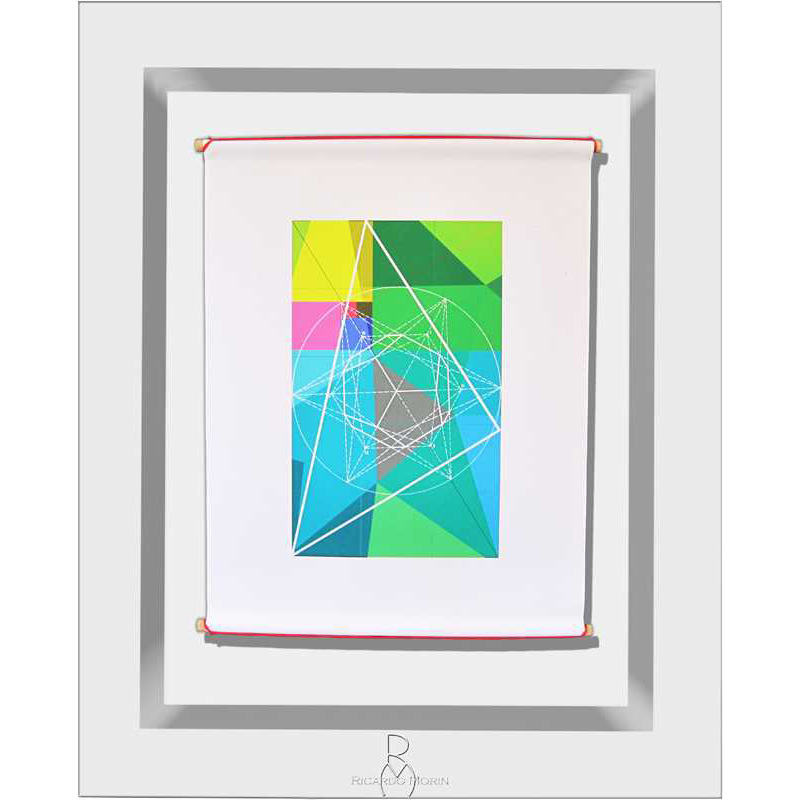
The pergaminos colgantes already contained that movement. So did Paradise. So did the long periods of stillness in Valencia. The recognition that anticipation easily becomes a form of inward noise did not arise from theory. It arose from observing how quickly projection interferes with attention.
To apply a different standard to the corpus itself, worrying over survival, categorization, institutional placement, would introduce an inconsistency the work has spent decades attempting to reduce.
The present moment contains the next essay. That is sufficiently difficult. Everything beyond it risks becoming administration of what does not yet exist.
He considers whether to share the corpus formally with an institution.
Perhaps not at all.
That possibility no longer produces anxiety. It follows naturally from the other refusals already present throughout the work: refusal of fixed category, refusal of literary positioning, refusal of premature conclusion, refusal of treating visibility as proof of value.
The archive may survive. Or disappear. Neither alters the necessity of the work while it is being written.
He considers ownership.
He never took much pride in possession. The loft in Tribeca was relinquished. The taller in Venezuela was relinquished. Professional identities were relinquished more than once. Each release altered perception afterward. Something became visible that possession itself had partially obscured.
A corpus may not differ greatly from that condition.
The essays exist. What happens to them afterward cannot entirely belong to him any more than the changing light across suspended canvases belonged to anyone who happened to stand before them. The work was never constructed as property. The pergaminos were not made as objects to dominate space. They emerged from stillness temporarily and returned to it afterward.
Complete relinquishment may not signify indifference. It may be the final extension of the same attention from which the work emerged.
He arrives somewhere that does not require a name.
Not grief exactly. Not resignation.
Tears of loss look backward toward what can no longer be recovered. Tears of acceptance belong to a different condition entirely: recognition without resistance, clarity without demand for alteration, awareness without the impulse to negotiate with reality so that it conforms to preference.
The work approached that same place gradually through many forms and many years: the stillness after noise, the empty canvas before the first mark, the pergamino hanging without frame or enclosure, the intervals where nothing appeared resolved and yet nothing required immediate resolution either.
Perhaps the work was never attempting permanence at all. Perhaps it was attempting something closer to lived energy moving through form for a brief interval before returning to stillness again.
That is not a small thing.
A conversation with oneself.
The question unresolved.
What remains is the writing.

