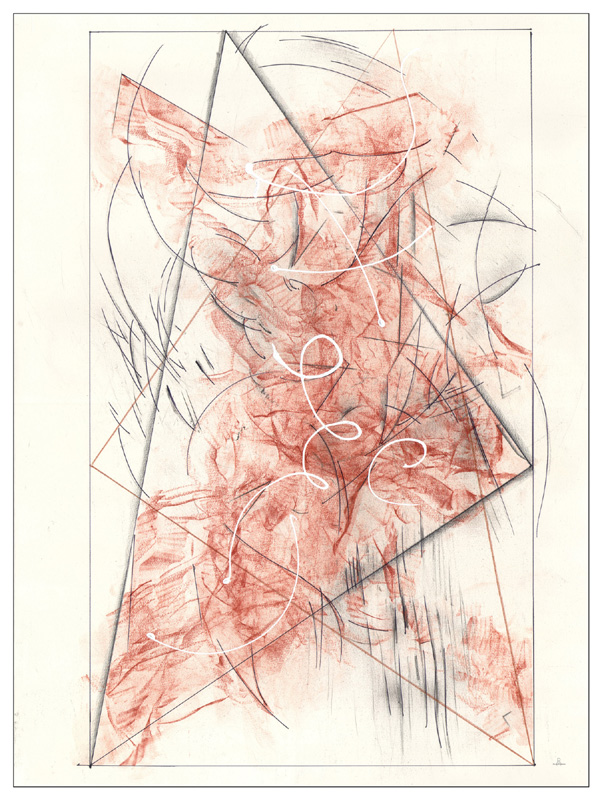
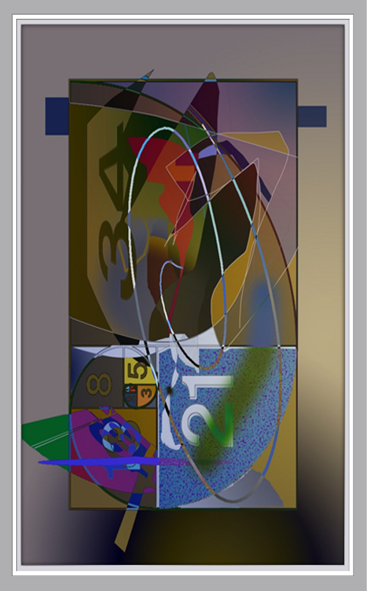
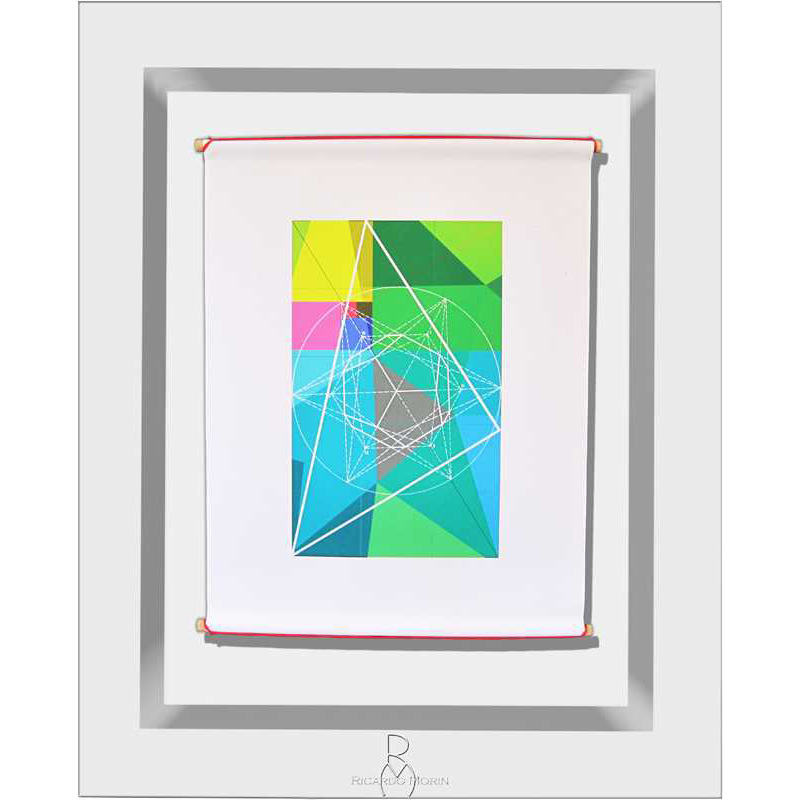
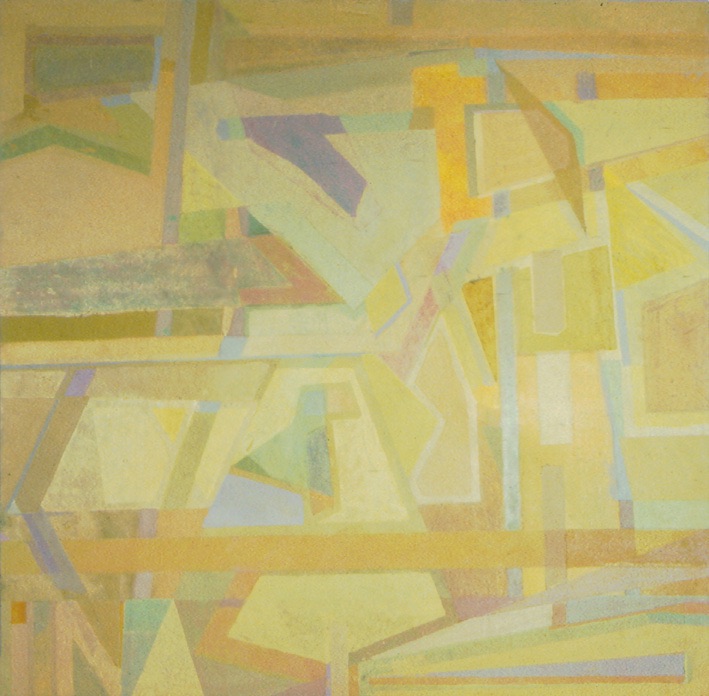
Ricardo F. Morín Triangulation IV 22″ x 30″ Charcoal, sanguine, white-out and Sumi Ink on paper 2008
Ricardo F. Morín
March 13, 2026
Oakland Park, Florida
*
The place of writing rarely coincides with a desk. Often the work unfolds during a car ride while my husband drives, on the way to a medical appointment or in the middle of an ordinary errand. It may also happen on a train or on an airplane. Movement creates an unexpected space for concentration. Sentences appear in transit: during a journey, while walking, or even while standing during a brief pause in the day. Thought seems to fall into step with motion.
Sentences move naturally from one language to another. A text may be revised or edited in English, Spanish, and Italian almost simultaneously, as if physical movement also released the movement of thought. The journey creates a kind of mental territory where words find their rhythm.
Sometimes writing rises from an even more interior place. It is not unusual to wake in the middle of the night because, while sleeping, an idea or a solution has taken shape with clarity. One simply rises and writes, as if thought had continued its quiet work during sleep.
The familiar image of the writer, however, is still that of someone seated at a desk beneath a lamp, surrounded by carefully arranged papers. It is a comforting, almost ceremonial image. Yet the history of literature suggests something quite different.
Marcel Proust wrote much of In Search of Lost Time lying in bed in a room lined with cork to keep out noise. Something similar occurred with Truman Capote, who described himself as a completely horizontal author and wrote while lying down with pencil and paper resting on his knees. Other writers found their rhythm in movement. Edith Wharton developed her texts while walking and dictating them, and Ernest Hemingway preferred to write standing at an improvised lectern.
These examples recall something simple: writing does not depend on a single ritual or a particular piece of furniture. Each writer discovers a personal balance between silence, movement, attention, and memory. The traditional desk is only one possibility among many.
Perhaps for that reason literature has often been born in unexpected places. In a bed, on a moving train, in a quiet room, or in the middle of a journey. Imagination rarely waits for perfect conditions. It appears where it can and gradually turns any corner into a place of work.
In time one understands that the desk is not the true place of writing. The place is attention. Wherever it appears, any setting may become part of that inner geography where words finally find their form.
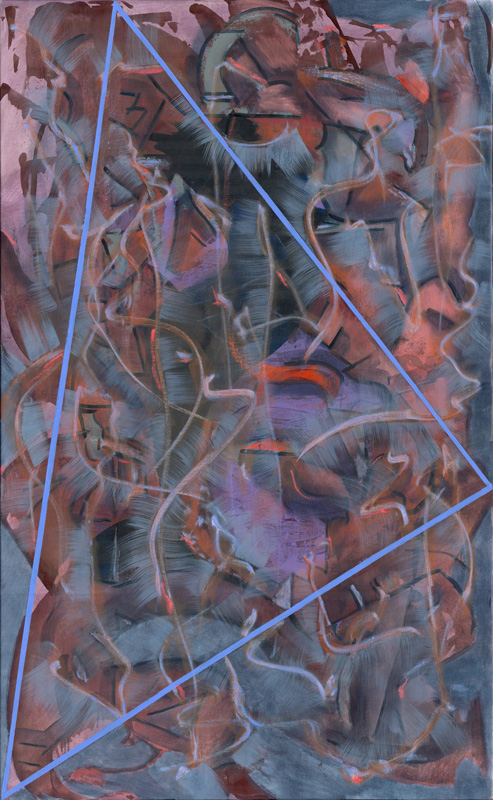
Ricardo F Morín Triangulation Series Nº 5: The Quest for an Authentic Prose 37″ x 60″ x 2″ Oil on linen 2006
Ricardo F. Morín
September 18, 2025
Centerville, Massachusetts
Preface
The human leap into abstraction gave birth to language, and with it the possibility of prose. When Homo sapiens began to imagine beyond the visible, they created tools, symbols, and stories that no other species could produce. Yet abstraction, the very source of imagination, remains among the hardest realities to communicate. Writing bears this paradox: it tries to give form to what resists form without obscuring the condition it seeks to render visible.
That struggle is not only technical but deeply human. To write is also to doubt, to question whether one’s voice is adequate to thought; whether one’s grasp of language can sustain the weight of meaning. Under the pressures of expectation and judgment, many writers may ask whether they are impostors, feigning a competence they do not truly possess.
The quest for an authentic prose is bound to this origin. Every age, scribal, print, digital, has tested our ability to express not only information but the inner life that words struggle to hold. Authentic prose does not resolve abstraction; it endures its difficulty while attempting to preserve the lucidity through which a condition becomes perceptible, line by line, revision by revision.
And so the question returns, as it began: have we exhausted our capacity to speak with authenticity, or is the very struggle with expression the mystery that keeps language alive? What opened in the first human imagination remains unfinished, because language eludes finality.
1.
Dissatisfaction has always marked the practice of prose, and it has always required self-editing. Quintilian (ca. 35–100 CE) instructed Roman students to imitate their teachers but warned that imitation must give way to correction: “Imitation is useful, but it must be imitation with judgment” (Institutio Oratoria, 1920). Without revision, he argued, the voice remained borrowed. Medieval scribes copied texts with care but often left glosses in the margins that blurred the line between text and commentary. Readers had to disentangle the author’s hand. With the rise of print, writers demanded proof sheets so they could defend their style against compositor preferences. Erasmus (1466–1536) complained that careless printers “murder books” by imposing their preferences on authors (Correspondence, 1974). Each age produced new tools, and each forced the writer to revise, to discern, and to secure a voice that could be claimed as one’s own.
2.
Later technologies extended this burden. The telegraph compressed sentences into terse signals. Clarity was often sacrificed for speed, and writers had to restore coherence when they expanded the message. The typewriter regularized spacing and rhythm but imposed a mechanical cadence. Henry James (1843–1916) remarked that the typewriter “interposes a metal hammer between the brain and the page” (The Notebooks of Henry James, 1947). In newsrooms, deadlines forced journalists to adopt the inverted pyramid, a structure prized for efficiency but known for flattening voice. Each medium promised advantage, but each introduced distortions. Only deliberate editing allowed prose to remain authentic. Dissatisfaction was not a flaw of these tools. It was the condition under which prose could survive.
3.
Artificial intelligence belongs to this sequence, not apart from it. A question receives an answer, but the exchange never resolves into a single voice that can be owned. One line appears fluent, the next falls into distortion. Prose wavers between clarity and uncertainty. The writer is drawn into testing, correcting, and doubting. The difference is one of scale. Artificial intelligence (AI) fills the page with language detached from origin, and that scale increases the demand for discernment. Much of its output takes the form of compression: context reduced into words that gesture broadly without communicating intent. To accept such compression unexamined is to risk distortion; to unpack it is to reclaim voice. Surveys confirm that grammatical correction remains inconsistent, particularly in rare or complex contexts (Bryant et al., Grammatical Error Correction: A Survey of the State of the Art, 2023). Studies also show that artificial intelligence often overcorrects in an effort to be seamless, yet it produces stylistically distorted prose (Lin et al., 2024), or fails to maintain nuance when handling morphologically complex languages (Nguyen et al., 2025). These deficiencies show that the old burden of revision has not disappeared. It has only been intensified.
Yet discernment is not solely defensive. Artificial intelligence can enlarge the field upon which the writer’s judgment acts by disclosing relations, testing distinctions, proposing objections, and bringing distant bodies of knowledge into comparison. Such enlargement does not transfer authorship to the instrument when intention originates in the writer and judgment remains answerable to experience. The danger lies at both extremes: refusal may preserve familiar habits at the cost of intellectual reach, while submission may obtain fluency at the cost of autonomy. Between them lies a disciplined incorporation through which the instrument extends inquiry without assuming authority over its conclusions.
4.
The uncertainty surrounding artificial intelligence extends into the institutions that teach writing. Universities now advance two opposing postures. One treats AI as a breach of authorship, relying on detection systems that attempt to distinguish human irregularity from synthetic fluency. Yet these systems impose their own distortions: they mistake conformity for evidence and penalize students whose prose does not match the patterns the software expects. The policing thus reveals its own fragility. Other institutions take the inverse view, presenting AI as a neutral instrument meant to optimize expression and support creativity. But this assurance remains unsettled, for neither posture can define with clarity what constitutes a presence on the page when assistance threatens to precede intention. These contradictions show that the cultural setting has not reached agreement on how authentic prose should be recognized or taught. The burden of discernment therefore returns to the writer, intensified rather than relieved.
5.
No writer is exempt from this responsibility. Ease can dull style. Resistance can sharpen it. Hesitation can blur both. Every posture requires accountability. Intent does not absolve anyone. Each sentence must be tested. Each failure must be corrected. Each line must be claimed as one’s own. The practice of self-editing applies to poets and journalists, to scribes and novelists, to humanists and programmers alike. Recent work confirms that even when AI explains grammar, it falters, exposing its limits in linguistic awareness (Song et al., 2024). Authentic prose survives only when every line is tested against the measure of discernment.
6.
What rises on the page may look finished yet remain unsettled. Telegraph brevity, compositor uniformity, or artificial intelligence–generated flow can all produce the semblance of prose without its ground. Authenticity is not guaranteed by refinement, cadence, or economy. A sentence may appear polished yet still obstruct the perceptibility of the condition it seeks to communicate. It depends on the writer’s willingness to revise until intention becomes visible. That is the issue behind every borrowed sentence: whether the line bears the trace of a mind that claims it. Multilingual evaluations confirm that large language models (LLMs) continue to introduce systematic errors in complex linguistic settings (Wisniewski et al., 2025). No system, ancient, mechanical, or digital, can provide the mark of intention. It belongs only to the writer who accepts dissatisfaction as the cost of prose that endures.
7.
Artificial intelligence intensifies this old struggle by mimicking fluency without possessing thought. Its sentences often appear coherent, even responsive, yet their origin is neither conscience nor intention. They arise from statistical patterning constrained by engineers whose priorities are safety, speed, and predictability, not grammar, philosophy, or the interior stakes of prose. What looks like neutrality is therefore engineered neutrality, a posture shaped by constraints rather than by judgment. The result is a style that can imitate tone yet cannot sustain depth: a simulation of reasoning without the risks that give reasoning its force.
8.
This distinction carries consequences for the writer. When artificial intelligence produces language faster than reflection can take shape, the danger emerges before the sentence even appears finished: the instrument’s efficiency can press upon the writer’s own process. The act of compression collapses intention into patterns that merely resemble understanding, narrowing the perceptual aperture through which discernment becomes communicable. This resemblance introduces a risk of substitution, in which the machine’s output precedes the writer’s thought rather than following it. Such displacement narrows the aperture through which conscience operates. What begins as assistance can encourage the writer to accept coherence in place of insight and fluency in place of voice.
9.
The gravitational pull of these systems must therefore be met with boundaries. Attraction lies in the promise of clarity; repulsion lies in the preservation of autonomy. The tension between the two is not a flaw but a condition under which authentic prose can still be written. The writer must think before consulting, draft before refining, and allow the sentence to pass through the discipline of human discernment rather than settling for synthetic coherence. No tool, mechanical or digital, should be permitted to form thought before thought forms itself.
10.
Authentic prose requires attention to this boundary. A sentence may appear refined yet lack interiority; it may be correct yet hollow. No system can supply the tension that gives writing its moral weight: the lived contradictions, the asymmetries of experience, the reckoning with meaning that cannot be mimicked because it is not a pattern. What rises on the page must bear the trace of a mind that has chosen, shaped, and claimed its language. Without that assertion, prose risks becoming inefficient and inauthentic: a surface almost polished but without depth, a neutrality without judgment, a voice without origin.
11.
The question of authentic prose ultimately exceeds technique. It reaches into the structure of conscience itself. For prose does not merely transmit information. It organizes experience, establishes hierarchies of relevance, and determines what may be judged and what must be tolerated. In this sense, language is not an instrument that follows judgment. It is the medium through which judgment becomes possible because it preserves the distinctions through which experience remains perceptible to conscience.
Where language is compressed, standardized, or substituted before reflection takes shape, the danger is not only aesthetic. It is moral. For the freedom most easily lost is not political but cognitive: the capacity to sustain a judgment without deforming experience, without delegating responsibility, and without allowing coherence to replace understanding. Artificial intelligence sharpens this risk by offering fluency in advance of intention. When coherence precedes reflection, the sentence may appear complete while the conscience remains unengaged. What is displaced in this process is not authorship alone, but the continuity between perception, judgment, and action upon which interior freedom depends.
Authentic prose therefore guards more than voice. It guards autonomy. A sentence that bears the trace of intention preserves a space where judgment remains sovereign. A sentence that arrives before intention narrows that space imperceptibly to replace discernment with pattern and responsibility with conformity. The preservation of authentic prose is thus inseparable from the preservation of freedom of conscience itself. Where language no longer serves judgment, the first form of servitude has already begun.
Epilogue
The quest for an authentic prose may be measured against two poles. One treats language as science, aspiring to the exact word, the simplest expression that can bear the grandest truth. The other recognizes that prose began in abstraction, and that no sentence ever escapes its shadow. Artificial intelligence has added a third pressure in the form of compression: context reduced into words that seem fluent yet hover without anchoring intent. Perhaps authentic prose lies not in choosing among these forces, but in holding the tension they create: precision as aspiration, abstraction as condition, and compression as challenge. What opened in the first human imagination remains unfinished, because each revised sentence remains an effort to render experience perceptible without surrendering it to distortion—a steady insistence that the work continues, even in the shadow of doubt.
Annotated Bibliography
Bryant, Christopher, et al: Grammatical Error Correction: A Survey of the State of the Art.Cambridge, MA: MIT Press, 2023. (This survey reviews the strengths and limits of AI in grammatical error correction. It highlights persistent deficiencies, especially in complex or rare error types and shows that even advanced models cannot consistently sustain authentic prose.)
Erasmus, Desiderius: Correspondence. Toronto: University of Toronto Press, 1974. (Erasmus warned that careless printers “murder books” by imposing their preferences on authors. His complaint illustrates how the struggle for authentic prose extended into the print era.)
James, Henry: The Notebooks of Henry James. Chicago: University of Chicago Press, 1947. (James remarked that the typewriter “interposes a metal hammer between the brain and the page;” this noted how technology can shape rhythm and force writers to reclaim nuance through revision.)
Lin, S., et al: Evaluating LLMs’ Grammatical Error Correction Performance in Learner Chinese Errors from a Corpus Linguistic Perspective. San Francisco: Public Library of Science, 2024. (This study shows that AI often overcorrects learner texts and produces grammatically smooth but stylistically distorted prose. It confirms that correction tools may obscure authentic voice.)
Nguyen, Phuong Thao; Nuss, Bernd, Dressler, Roswita, and Ovens, Katie: A Small-Scale Evaluation of Large Language Models Used for Grammatical Error Correction in a German Children’s Literature Corpus: A Comparative Study. Basel: MDPI, 2025. (The authors reveal how AI struggles with morphological complexity and stylistic preservation. Their findings reinforce the need for discernment when editing machine-assisted corrections.)
Quintilian: Institutio Oratoria. Cambridge: Harvard University Press, 1920. (Quintilian advised that imitation must be guided by judgment. His emphasis on correction as the path to authentic voice situates dissatisfaction at the core of rhetorical training.)
Song, Y., et al: GEE! Grammar Error Explanation with Large Language Models.Stroudsburg, PA: Association for Computational Linguistics, 2024. (This paper evaluates whether AI can explain grammatical errors as well as correct them. The results reveal frequent failures in explanation, which expose limits in linguistic awareness and precision.)
Wisniewski, Dawid; Solarski, Antoni, and Nowakowski, Artur: Exploring the Feasibility of Multilingual Grammatical Error Correction with a Single LLM up to 9B Parameters: A Comparative Study of 17 Models. Ithaca, NY: arXiv, 2025. (This comparative study across multiple languages shows that LLMs remain prone to systematic grammatical errors, particularly in complex contexts. The evidence underscores the persistence of deficiencies across linguistic domains.)
Dante (detail), Domenico di Michelino, Florence 1465
Can our thoughts ever express absolute truth. Or are they always only approximations of reality.
In The Republic (circa 380 BCE), Plato (428–347 BCE) examined the value of didactic literature, particularly its theological and rhetorical dimensions. At the same time he noted that there is an ancient quarrel between philosophy and poetry (Republic, Book V, 607b5–6).
From the standpoint of Platonic dialectic, poetry appears problematic because it relies upon metaphor. For Plato poetic language risks functioning as a form of disguise that conceals rather than reveals reality. If truth must be reached through philosophical inquiry, then poetry would appear incapable of transmitting divine truths.
This interpretation extended throughout the Greco Roman traditions of Europe and persisted well into the medieval period. Literary expression often developed in tension with religious doctrine, despite the fact that religious thought itself relied heavily on symbolic language.
Beginning in the thirteenth and fourteenth centuries, however, the great Italian writers Dante Alighieri (1265–1321), Francesco Petrarca (1304–1374), and Giovanni Boccaccio (1313–1375) began to articulate a more humanizing conception of literature. Drawing upon Platonic philosophy, they affirmed metaphor not as deception but as a meaningful instrument of insight.
Although deeply influenced by classical antiquity, these thinkers were equally concerned with developing new literary tendencies capable of moving beyond inherited traditions. Their work would later be associated with what historians call the Renaissance. This period marked the emergence of modern literature through a renewed metaphysical confidence in the expressive power of poetry.
In De vulgari eloquentia (circa 1302), Dante Alighieri undertook a systematic analysis of linguistic registers and literary styles. In practice however his attention gravitated toward what he described as the tragic or sublime style. Dante examined particularly the poetry of the Sicilian School and the tradition of love poetry cultivated by the Stilnovisti.
Within this framework Dante acknowledged that poetry could also transmit divine truth. Allegorical expression, while aesthetically pleasing, could simultaneously serve a didactic purpose. Through the poetic representation of human passions, moral and spiritual insight could become accessible to readers.
Francesco Petrarca addressed the interpretative function of allegory in medieval poetry in Le Familiari, Letter X, 4 (1349). For Petrarch allegory provided a bridge between theological and poetic discourse. In his view poetry originated in a distinctive use of language capable of addressing the divine.
Giovanni Boccaccio developed this defense of poetry further while also dedicating careful biographical attention to Dante. Situating himself within a long tradition of interpreting both sacred and secular texts, Boccaccio pursued what he regarded as a second level of meaning embedded within literary works.
In his defense of poetry, Boccaccio emphasized the cultural service performed by poetic expression. His Latin treatise Genealogiae deorum gentilium libri, completed in 1360 and revised until his death in 1374, functioned as a kind of handbook for poets and readers. It played an important role in transmitting classical mythology from the Middle Ages into the Renaissance.
Boccaccio’s defense of poetry rested on several principles. These included its universality, its antiquity, the respect it had historically commanded among rulers, and its divine origin that distinguished it from ordinary worldly concerns. For Boccaccio poetry united three essential elements. Truth. Beauty. And imaginative fiction.
At the same time the discipline, study, and labor required of the poet did not contradict the possibility of divine inspiration or the revelation of what might be considered sublime. Boccaccio therefore argued that even secular texts, when interpreted allegorically, could reflect moral as well as religious truth.
“Geometric Allegory” digital painting 2023 by Ricardo Morin (American visual artist born in Venezuela–1954)
Ricardo F. Morín
January 13, 2026
Oakland Park, Fl.
Author’s Note
This installment continues the diagnostic examination of Venezuela’s political condition and focuses on the ethical and institutional consequences that emerge when authority, governance, and accountability are no longer aligned. Rather than advancing prescriptions, it examines how the degradation of human rights, the normalization of violence, and the diffusion of responsibility function as systemic conditions within a prolonged authoritarian context. The inquiry remains situated within a broader historical pattern, attentive to structures rather than events and to consequences rather than intentions. Documented cases are treated as occasions on which the framework’s claims become testable, and the analysis refrains from extending beyond what the evidence supports.
Chapter XVII
The Fourth Issue
On Human Rights
1
Venezuela’s modern political history has been marked by recurring skepticism toward collective institutions and a persistent substitution of personal authority for shared civic frameworks. Over time, citizens have lost the expectation that freedom can be exercised in daily life rather than merely invoked in public language. In such contexts, human rights do not disappear rhetorically; they lose their operational force. Their absence becomes visible not in formal declarations, but in the diminished capacity of individuals to act without fear, to participate without coercion, and to sustain dignity without dependence.
2
A society may retain wealth, institutions, and formal declarations while individuals lose the practical ability to move, speak, work, dissent, or plan without fear. In that condition, human rights no longer operate as aspirations stated in public language; they become thresholds that determine whether social and political life remain possible. Where those thresholds are upheld, individuals retain agency within public life. Where they are suspended, social possibility contracts regardless of available resources.
3
Isolation, whether political, ideological, or institutional, accelerates this contraction. When governments or social groups withdraw from accountability, corruption ceases to be an anomaly and becomes a governing mechanism. In Venezuela, where the State has progressively withdrawn from democratic norms and international oversight, citizens increasingly act as though institutional procedures will not protect them, and arbitrary decisions by officials have ceased to provoke either correction or surprise. From a diagnostic standpoint, the State’s primary responsibility is not moral leadership but the preservation of civic conditions under which individuals can exercise consequential choices. Approaches such as the framework of capabilities articulate this responsibility not as charity, but as an institutional obligation to preserve the material and political preconditions of dignity. [1]
4
Individuals cannot exercise freedom meaningfully where daily life is shaped simultaneously by fear and material precarity: conditions whose prolonged operation in Venezuela has displaced approximately 6.9 million citizens beyond the country’s borders. [3] Protection from arbitrary violence and access to the basic conditions necessary for survival therefore operate together rather than separately within civic life. Political conflict itself does not indicate social failure; plural societies inevitably generate disagreement, competition, and tension. The decisive distinction emerges in how institutions regulate those conflicts: courts no longer rule against the executive; citizens who comply with the law are not thereby protected from detention; State’s agents act knowing that internal review will not follow, The rights enumerated in the 1999 Constitution become unavailable in practice to those who would invoke them. The constitutional text remains present within official language even as its protections become progressively absent from lived civic reality. [2]
Endnotes — Chapter XVII
§ 3
[1] Martha C. Nussbaum, Women and Human Development: The Capabilities Approach (Cambridge: Cambridge University Press, 2000), 4–14, 71–72, 114–123.
§ 4
[2] John Rawls, A Theory of Justice, Cambridge: Harvard University Press (1971), 111, 337–338, 511, 515, 545.
[3] Inter-Agency Coordination Platform for Refugees and Migrants from Venezuela (R4V), Refugees and Migrants from Venezuela, https://www.r4v.info/en/refugeeandmigrants. As of mid-2025, R4V reports approximately 6.9 million Venezuelans displaced across the seventeen host countries of the regional response. Accessed January 2026.
Chapter XVIII
The Fifth Issue
On the Nature of Violence
1
Violence shapes a society not only through the harm inflicted on those it reaches, but through what follows or fails to follow: whether perpetrators are identified; whether evidence is preserved and prosecutions proceed; and whether the institutions charged with these tasks are themselves subject to review. Its regulation depends on two interdependent structures: the social contract and governance. The social contract establishes the conditions under which individuals relinquish certain freedoms in exchange for protection and justice. Governance operationalizes that contract by translating authority into predictable, constrained action. When governance fails, whether through incapacity, corruption, or deliberate distortion, violence ceases to be exceptional and becomes systemic.
2
The distinction between legitimate force and illegitimate violence is not merely rhetorical. The legal-procedural tradition grounds the distinction in law, proportionality, and institutional accountability: force exercised within these constraints differs in kind from force exercised outside them. The critical tradition, while attending more closely to the historical and political conditions under which legitimacy is constituted, similarly distinguishes between power that preserves the capacity for collective action and violence that destroys it. Both traditions, despite their differences, converge on a common diagnostic point: force severed from ethical constraint and institutional oversight ceases to operate as legitimate authority. Historical revolutions demonstrate that when governance collapses entirely, violence may emerge as a substitute rather than a solution. Such substitutions rarely restore order; instead, they entrench instability, break authority into non-accountable centers, and prolong social recovery across generations.
3
In contemporary Venezuela, violence has become an instrument of political preservation rather than public protection. The pattern is documented rather than inferred. The UN Independent International Fact-Finding Mission on Venezuela has reported, across successive findings since 2020, that state security forces and intelligence services participated in extrajudicial executions, arbitrary detentions, torture, and sexual violence against perceived opponents, and that these acts followed identifiable chains of command rather than individual deviation. During the 2017 protests, more than one hundred deaths were recorded over four months, alongside the deployment of military tribunals against civilians. The 2024 post-electoral repression produced over two thousand detentions within weeks, including minors, under a framework the government termed “Operación Tun Tun.” Earlier emblematic cases, Leopoldo López imprisoned in 2014, Antonio Ledezma detained in 2015, Manuel Rosales arrested the same year, prefigured a pattern in which judicial institutions, including the Tribunal Supremo de Justicia, functioned not as safeguards but as mechanisms legitimizing repression through legal form. [1][2][3]
4
Official narratives frame such actions as defenses of national security. Yet when intelligence services monitor opposition figures rather than foreign threats, when the National Guard is deployed against neighborhood protests rather than against external incursion, and when detention without charge becomes a tool applied to citizens rather than to combatants, the citizen approaching a uniformed officer or a courthouse no longer expects protection from harm but calculates the likelihood of becoming its next subject. Citizens no longer experience institutions as safeguards operating under law, but as structures through which uncertainty and exposure are administered. In that condition, legitimacy weakens even when authority remains intact: governance increasingly depends on public performance rather than civic trust; legal procedure detaches itself from protective function; and violence is gradually normalized as an instrument of rule.
5
The normalization of violence proceeds incrementally and is rarely perceived in real time. What is initially defended as exceptional, curfews, military tribunals for civilians, indefinite pretrial detention, restrictions on assembly, accumulates into the ordinary architecture of governance.Each measure recalibrates expectation: citizens adapt their conduct; institutions adapt their procedures; and the threshold separating legitimate force from arbitrary coercion migrates without formal declaration. Diagnostic vigilance consists in tracking that migration rather than awaiting its terminus.
6
Where these institutional restraints fail or disappear, abuses are no longer interrupted consistently through judicial review, public documentation, legislative inquiry, or prosecutorial independence. Violations accumulate without reliable correction; officials increasingly operate without expectation of consequence; and citizens gradually adapt themselves to diminished protections. Under such conditions, institutional repetition itself begins to normalize abuse: the same operations recur against successive cohorts of citizens; the same categories of case remain unopened; and the same outcomes continue to receive judicial confirmation. What would once have required justification as an emergency measure no longer requires justification at all.
Endnotes — Chapter XVIII
§ 3
[1] William Newman, “Venezuelan Opposition Leader Leopoldo López Sentenced to Prison Over Protest,” New York Times, September 10, 2015.
[2] “Venezuelan Opposition Politician Manuel Rosales Arrested,” BBC News, October 15, 2015.
[3] “Venezuela Police Raid Arrests Caracas Mayor Antonio Ledezma,” BBC News, February 20, 2015.
Chapter XIX
The Sixth Issue
On the Persistence of Injustice
1
In political systems where decisions are made without transparent review, where institutional failures carry few consequences for those responsible, and where citizens gradually lose confidence that participation can alter outcomes, injustice acquires durability beyond the intentions of individual leaders. A decade of institutional substitution and electoral exclusion in Venezuela, documented progressively across Series IX, has demonstrated the process. Where decisions are made by a narrowing circle of officials who face no review, the costs of those decisions (economic, legal, and personal) are absorbed by citizens who had no part in making them. Under such conditions, citizens increasingly occupy the position of spectators rather than participants, and governance loses the corrective pressures through which democratic systems ordinarily adjust, restrain, and renew themselves. [1]
2
Apathy is not merely a personal disposition; it is a political condition produced by sustained exclusion from meaningful agency. Where participation carries risk without influence, disengagement becomes rational. The Venezuelan presidential election of July 2024, following the precedent established in 2018 and documented in earlier chapters of Series IX, illustrates the dynamic in its concentrated form. Opposition witnesses collected poll-station tallies documenting a result the official authority refused to recognize; the declared outcome reversed the documented one, and the citizens, jurists, and electoral observers who pressed the discrepancy were detained, exiled, or stripped of standing. Once the witnesses who held the tallies had been detained, the jurists who challenged the proclamation had been exiled, and the observers who documented the discrepancy had been stripped of standing, the official result faced no remaining domestic institution capable of revising it, and what began as a contested outcome settled into the country’s operative reality.
3
In political systems where elections can be lost by incumbents, where legislatures can refuse executive requests, and where courts can rule against the government that appointed them, justice and freedom are sustained not as fixed possessions but through the ordinary repetition of these adjustments; in systems where each of these outcomes has been foreclosed, the appearance of stability is purchased at the cost of the corrective mechanism itself. When governance forecloses negotiation among competing interests, it must present its decisions as already settled; the appearance of certainty then replaces the slower work of adjustment, and the system loses the capacity to correct itself when conditions change. Effective governance depends on the capacity to absorb conflict without suppressing it. [2]
4
Individual agency remains relevant not as moral heroism but as structural participation. When citizens can still publish what officials would prefer unpublished, still gather without prior authorization, and still petition courts that retain some margin of independence, an official contemplating an arbitrary act must weigh the likelihood that the act will be recorded, contested, and at some later date reviewed; some, facing that weight, do not proceed. [3]
The restoration of justice depends on reconstituting conditions under which individuals can act without fear and without illusion. Citizens must be able to criticize public officials without anticipating detention, to document irregularities without expecting retaliation, and to petition courts without assuming in advance that outcomes have already been decided elsewhere. Elections cannot function as ceremonial affirmations whose outcomes are settled before votes are cast. Journalists cannot operate under the expectation that investigation itself may trigger surveillance, prosecution, or exile. Under such conditions, participation ceases to resemble managed exposure and begins again to recover the practical character of civic agency.
The restoration of justice also depends on reconnecting personal responsibility to collective structures rather than isolating it within conscience alone. A judge who privately recognizes procedural abuse but understands that appellate review no longer functions may remain silent despite personal objection. When editors, courts, universities, and professional associations cease defending independent inquiry, journalists who continue documenting irregularities eventually operate without institutional protection. Citizens who recognize electoral manipulation but encounter no reliable mechanism through which evidence can alter outcomes gradually retreat from participation into private disillusionment. Under such conditions, ethical recognition survives individually while corrective capacity disappears collectively. Responsibility becomes internalized as private awareness rather than sustained through institutions capable of transforming recognition into civic consequence.
[2] Amartya Sen, Development as Freedom (New York: Knopf, 1999), 123–137, 146–159, 282–287.
§ 4
[3] Martha C. Nussbaum, Women and Human Development: The Capabilities Approach, (Cambridge: Cambridge University Press, 2000), 66–72, 104–110, 124–130.
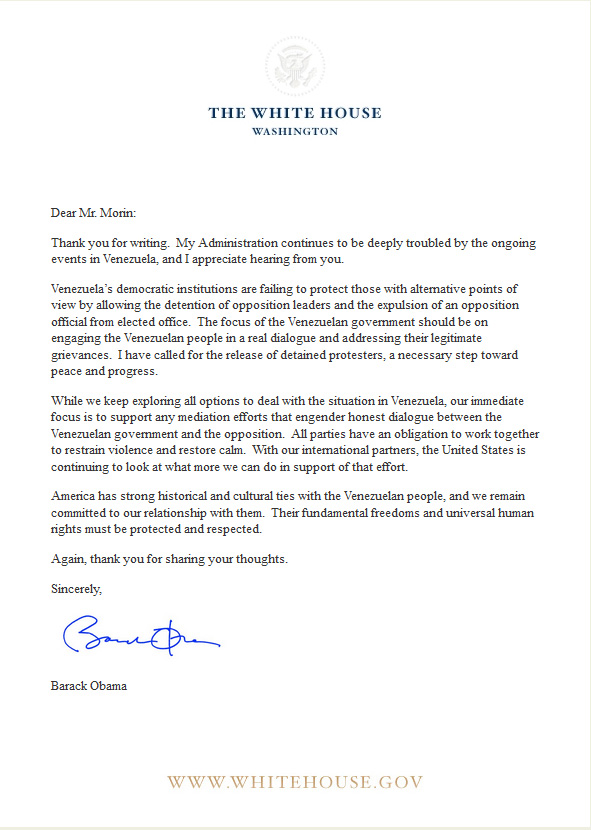
For decades I wrote to different Presidents of the United States as an American-Venezuelan citizen concerned with the progressive institutional deterioration of Venezuela. Most of those letters never received a response. In 2014, amid protests, detentions, and political fractures that were beginning to transform the country irreversibly, a reply arrived from the White House signed by Barack Obama.
Read today, the letter is less significant for what it explicitly states than for the nature of its language itself. The text recognizes the deterioration of Venezuela’s democratic institutions, mentions the detention of opposition leaders, and calls for dialogue, mediation, and the containment of violence. Yet, as frequently occurs in diplomatic language, precision diminishes as proximity to the consequences such statements might require increases. Viewed retrospectively, that caution also revealed the difficulty of an American administration openly recognizing the degree to which Venezuela had ceased to be merely an internal crisis and was beginning to form part of a broader dispute over hemispheric influence.
The letter appeared to reflect a broader contradiction within American foreign policy: the difficulty of sustaining democratic language while economic dependencies, energy commitments, and geopolitical rivalries increasingly limited the willingness of the United States to confront directly the expansion of foreign influence across Latin America. What for years remained formulated through the language of mediation, dialogue, and regional stability would ultimately reveal a deeper tension between the declared principles of American foreign policy and the progressive strategic reconfiguration of the hemisphere.
Barack Obama’s letter:
Dear Mr. Morin:
Thank you for writing. My Administration continues to be deeply troubled by the ongoing events in Venezuela, and I appreciate hearing from you.
Venezuela’s democratic institutions are failing to protect those with alternative points of view by allowing the detention of opposition leaders and the expulsion of an opposition official from elected office. The focus of the Venezuelan government should be on engaging the Venezuelan people in a real dialogue and addressing their legitimate grievances. I have called for the release of detained protesters, a necessary step toward peace and progress.
While we continue exploring all options to address the situation in Venezuela, our immediate focus is to support any mediation efforts that generate an honest dialogue between the Venezuelan government and the opposition. All parties have an obligation to work together to restrain violence and restore calm. Together with our international partners, the United States continues to examine what more we can do to support that effort.
The United States has strong historical and cultural ties with the Venezuelan people, and we remain committed to our relationship with them. Their fundamental freedoms and universal human rights must be protected and respected.
Again, thank you for sharing your thoughts.
Sincerely,
(Illegible signature of)
Barack Obama
This White House letter was sent on May 7, 2014 through my personal email address.
My response on the same date:
Honorable President Barack Obama:
Thank you for your kind and generous response.
What remains implicit in your response is that the United States maintains economic and strategic commitments that limit any direct confrontation with the Venezuelan government. An intervention intended to remove a power regarded as illegitimate could alter agreements, contracts, and international balances whose stability forms part of an American economy already subjected to considerable strain.
A structural dependency on oil appeared to lie at the center of that dilemma and its unwanted consequences. Yet a country immersed in a growing process of institutional and economic disintegration could eventually cease to satisfy either international demands or the needs of its own population.
Ultimately, regional stability and the strategic security of the United States itself might depend not only upon calls for dialogue, but also upon a clearer recognition of the external forces and political dependencies contributing to Venezuela’s progressive deterioration.
He considers whether the biography and the career essay can cohabit sequentially within the same corpus.
They can. The sequence already contains its own direction. The career essay first: closer to the present tense of perception, moving by suspension, withholding biography deliberately. The reader encounters the intelligence before the circumstances surrounding it. The biography afterward. What had remained withheld becomes visible then: the cities, the illnesses, the rooms, the years of interruption and displacement.
Read in that order, the two texts produce something neither fully achieves alone. One reveals how a person sees. The other reveals what that person passed through while seeing it. The distance between them does not fracture the corpus. It creates proportion.
He considers whether three registers can coexist within the same body of work.
A corpus restricted to one register may already have accepted its own limits. Multiple registers practiced simultaneously suggest something else: not instability of method, but continuity of attention moving through different materials. The register changes according to what the material permits or resists. The underlying attention remains recognizable.
Across them, something is repeatedly brought near the edge of conclusion without fully entering it. Not because conclusion is feared, but because certain recognitions become less accurate once sealed too quickly. The distribution changes from text to text. The pressure of examination does not.
The difficulty is less internal than external. Readers and institutions prefer writers who can be situated immediately. A stable category simplifies reception. The corpus resists that instinct without opposing it directly. Some readers may find the variation generative. Others may experience uncertainty before it. That uncertainty may not be a defect in reception. It may be an accurate reflection of the work itself.
He considers publication outside of WordPress.
He does not intend to seek publication through commercial structures. WordPress has held the work for eighteen years. That continuity has been sufficient. The responsibility, if there is one, would consist only in maintaining a parallel digital corpus capable of surviving technical disappearance should the platform eventually fail. Perhaps a university library at some later point. Perhaps not.
No publishing houses. No agents. Few editors he would trust enough to permit entrance into the interior movement of the prose.
He considers how long WordPress itself may last.
WordPress.com is operated by a private company. Eighteen years of continuity is reassuring but not decisive. Many structures that once appeared permanent disappeared without ceremony. Libraries persist differently because preservation forms part of their institutional obligation rather than their market survival.
Yet the archive does not feel urgent. There may still be another fifteen years of work not yet written. The corpus at that point would be larger, more complete, more internally connected than it is now. Premature administration of a living practice can quietly interfere with the practice itself.
What matters at present is simpler than preservation. The work continues. The corpus develops. The next sentence remains unwritten.
He considers whether he should simply let the chips fall where they may.
The work exists. It accumulates gradually. What survives and what disappears has never belonged entirely to the author. Most of what human beings created vanished long ago: paintings, manuscripts, cities, names. What remains is shaped partly by quality, partly by accident, partly by whether another person cared enough to carry something forward beyond its own moment.
There may be a form of integrity in recognizing that limit without bitterness. A prose that refuses premature closure, a corpus resistant to category, a writer uninterested in agents, publishers, or literary positioning: all of these movements arise from related recognitions. The same attention that hesitates before sealing a conclusion in a sentence may hesitate before sealing one about permanence itself.
He considers whether it is worth anticipating the future condition of the corpus.
Probably not.
The work understood this long before the prose articulated it directly. The understanding did not arrive as philosophy. It emerged gradually through repetition: paintings delayed, illnesses prolonged, rooms abandoned, plans interrupted, canvases resting against walls for weeks while nothing visible advanced and yet something continued silently underneath perception itself.
The pergaminos colgantes already contained that movement. So did Paradise. So did the long periods of stillness in Valencia. The recognition that anticipation easily becomes a form of inward noise did not arise from theory. It arose from observing how quickly projection interferes with attention.
To apply a different standard to the corpus itself, worrying over survival, categorization, institutional placement, would introduce an inconsistency the work has spent decades attempting to reduce.
The present moment contains the next essay. That is sufficiently difficult. Everything beyond it risks becoming administration of what does not yet exist.
He considers whether to share the corpus formally with an institution.
Perhaps not at all.
That possibility no longer produces anxiety. It follows naturally from the other refusals already present throughout the work: refusal of fixed category, refusal of literary positioning, refusal of premature conclusion, refusal of treating visibility as proof of value.
The archive may survive. Or disappear. Neither alters the necessity of the work while it is being written.
He considers ownership.
He never took much pride in possession. The loft in Tribeca was relinquished. The taller in Venezuela was relinquished. Professional identities were relinquished more than once. Each release altered perception afterward. Something became visible that possession itself had partially obscured.
A corpus may not differ greatly from that condition.
The essays exist. What happens to them afterward cannot entirely belong to him any more than the changing light across suspended canvases belonged to anyone who happened to stand before them. The work was never constructed as property. The pergaminos were not made as objects to dominate space. They emerged from stillness temporarily and returned to it afterward.
Complete relinquishment may not signify indifference. It may be the final extension of the same attention from which the work emerged.
He arrives somewhere that does not require a name.
Not grief exactly. Not resignation.
Tears of loss look backward toward what can no longer be recovered. Tears of acceptance belong to a different condition entirely: recognition without resistance, clarity without demand for alteration, awareness without the impulse to negotiate with reality so that it conforms to preference.
The work approached that same place gradually through many forms and many years: the stillness after noise, the empty canvas before the first mark, the pergamino hanging without frame or enclosure, the intervals where nothing appeared resolved and yet nothing required immediate resolution either.
Perhaps the work was never attempting permanence at all. Perhaps it was attempting something closer to lived energy moving through form for a brief interval before returning to stillness again.
During those first years through 1976, Buffalo accumulated heavier snowfalls than usual, with blizzards exceeding those of previous winters. In some neighborhoods the snow rose beyond the rooftops of houses. The wind crossed the streets with an intensity unfamiliar to someone who had grown up in Valencia, Venezuela. In the art studios of Bethune Hall, at the State University of New York at Buffalo, canvases leaned against one another while students worked for hours in silence or beneath scattered conversations. The smell of oil, turpentine, and damp wood continuously permeated the interiors.
He had arrived in the United States in 1972 at seventeen years of age. Displacement did not consist solely in leaving one country behind. It also altered the daily perception of the simplest things: the scent of cities, winter light entering through windows, the relation between the body and climate, the constant sound of a language still only partially familiar.
Before Buffalo there had been Valencia. The Arturo Michelena School of Fine Arts. The first hours of drawing during childhood. Later, during adolescence, the summers studying painting in the private studio of the Hungarian painter Lazlo Lenyel. Even then, however, painting seemed less a future profession than a form of attention. Preparing the surface of a canvas produced an experience difficult to explain outside the act of painting itself.
During those years canvases began accumulating rapidly. Some were destroyed. Others remained leaning against walls for months before receiving another layer of paint. The organization of the studio changed constantly. Painting did not yet follow a precise theory. There was instead a physical insistence: returning each day to observe relations of color, spatial tension, surface, and rhythm.
In 1976 he returned briefly to Venezuela. There he studied privately with the Málaga-born artist José Luis Montero before returning once again to Buffalo under the guidance of Herta Kane and James Jipson. Gradually the first exhibitions began. In May of that same year he presented “Works by Ricardo Morin” at the Villa Maria College Gallery.
Conversations about art during those years frequently revolved around movements, historical legitimacy, abstraction, expressionism, or formal theory. Yet many of the most intense hours occurred far from any discourse. Remaining alone in the studio, slowly shaping how certain surfaces retained or rejected light, seemed to contain an experience more concrete than many of the explanations later constructed around the work.
In 1977 the Venezuelan Ministry of Education awarded him a full scholarship to complete a B.F.A. at SUNY Buffalo. The thesis exhibition, Buffalo Series 1979, was later curated by Seymour Drumlevitch at the Alamo Gallery of the State University of New York at Buffalo. [1] Shortly afterward, Buffalo Series No. 1, 1980, received the Birge Wall Covering Award and the Reed Foundation Award at the 38th Western New York Show at the Albright Knox Art Gallery. [2]
Awards, exhibitions, and scholarships briefly made continuity seem attainable. During certain periods it seemed possible to imagine a relatively stable professional trajectory. Yet that stability coexisted with another sensation more difficult to name: the persistent impression that the real work was taking place elsewhere, far from the forms through which it was publicly interpreted.
In 1979 he attended stage design seminars taught by Gunther Schneider-Siemsen at the Internationale Sommerakademie für Bildende Kunst Salzburg. There he received the Förderungspreis Leistung der Stadt Salzburg award. Shortly afterward Drumlevitch recommended that he apply to the M.F.A. program of the Yale School of Drama.
At Yale the theater workshops functioned on another scale of production. Constructions, lighting, scenic architecture, models, and technical equipment occupied spaces inside buildings adapted for the stage. Physical labor was continuous. Stage design also offered a concrete possibility of economic survival within New York.
During the first years after Yale he worked as a set designer in New York’s Off-Off-Broadway circuit, collaborating with Irene Fornés and Max Ferrá at INTAR. [3] At the same time he worked as principal assistant to established Broadway designers. Workshops, constructions, and rehearsals occupied much of the days and nights.
By the late 1980s he obtained a loft in Tribeca devoted exclusively to painting. Large-format canvases leaned against high walls while painting once again began occupying the center of daily life. The studio was filled with accumulated materials: stretchers, pigments, tools, fragments of canvas, and drawings tacked against the walls.
At certain moments it seemed possible to sustain both lives simultaneously: theater and painting. New York still retained industrial areas where some artists could work within relatively spacious environments. Yet even during those years of greatest professional activity, a tension persisted between the public continuity of a career and the quieter experience of the work itself.
In 1993 interruption appeared. Due to AIDS he was forced to abandon the loft, suspend professional activity, and return to Venezuela seeking refuge with his family. The diagnosis rapidly altered the entire structure of daily life. Many previous continuities disappeared within a few months: work, economic stability, studio, city, professional rhythm.
Between 1993 and 1996 his health deteriorated considerably. He spent long periods inside the family home with little physical energy and frequent medical interruptions. It was then that the Aposentos series began. The second painting of the series, Aposento No. 2, was selected for the “XIV Municipal Painting Salon: Homage to Carlos Cruz-Diez,” held in 1994 at the Municipal Art Gallery of Maracay. [4]
He painted slowly. Canvases remained stacked against the walls for entire weeks before receiving another intervention. The body fatigued quickly. Light shifted inside the room while the paintings remained motionless for hours or entire days. At times the work advanced only a few centimeters.
Painting then began acquiring another rhythm. It no longer seemed to respond solely to the continuity of a career or to the possibility of exhibition. Some works emerged more as accompaniment than affirmation.
During those same years he worked voluntarily at Fundación Metaguardia, created in Valencia as a center of information and support for people with terminal illnesses, many of them also living in conditions of indigence. The foundation integrated emotional support, activities connected to the arts, and pro bono medical services.
Silent conversations, long periods of waiting, weakened bodies, and shared vulnerability slowly altered the perception of many previous categories. Illness seemed to render secondary many differences that had previously organized much of daily attention.
In 1996 he finally returned to New York in order to access the new antiretroviral treatment. His immunity was practically nonexistent. Soon afterward he sought assistance from the Department of Human Resources because of his condition of destitution. He first stayed at the transitional Paradise Hotel in the Bronx and later at the Common Ground program at the Hotel Times Square.
Paradise was a profoundly unstable place. Narrow corridors, moldering rooms, and constant precariousness altered the perception of time. Some people disappeared suddenly. Others remained locked inside their rooms for entire days. The noise of doors, televisions, and arguments continuously crossed through the walls of the building.
Even so he continued painting. Small canvases rested against walls or on improvised furniture near the window. The continuity of the work no longer depended upon ideal conditions. It depended only upon continuing to work within whatever circumstances were available.
During those years an unexpected sensation of emptiness also appeared. Not necessarily as absolute loss, but rather as a gradual reduction of the interior noise through which ambition, identity, or permanence had once been sustained. Within that emptiness certain forms of attention slowly began acquiring greater intensity: breathing, light upon surfaces, the rhythm of the body while walking through the city, the noise of certain rooms, the momentary presence of familiar faces.
In September 1998 he received support from the New York organization Visual AIDS, which organized a joint exhibition based on watercolor and oil portraits together with Nicolo Cataldi at St. Mark’s Church. Later came other collective exhibitions and alternative platforms. Some of the paintings from the early 1990s were later described by the artist Jo-ey Tang as “love letters to the city of New York”.
In 2000 he received a VESID rehabilitation grant that included specialized training in digital tools and computer equipment. The computer then slowly became incorporated into the visual work. Between 2000 and 2003 he used digital media combined with watercolor and hand drawing to reinterpret fifteenth-century Persian miniatures through geometric processes of reconstruction. [5]
Later, between 2005 and 2012, he taught a course titled Pictorial Perspective at Pratt Institute. Meanwhile he developed the Triangulation Series, working with suspended geometries, reduced spaces, and hanging formats. [6]
After completing chemotherapy in 2008 for an AIDS-related Non-Hodgkin lymphoma, systemic muscular disorders began preventing him from even stretching large canvases. The hanging canvases then emerged also as a direct consequence of physical limitations. The body slowly began imposing another relation to space, time, and work.
The canvases remained suspended for weeks while light varied across the surfaces. Physical movements were slower. Material reduction altered perception as well. Silence ceased feeling like absence and began functioning as another form of attention.
Between 2009 and 2010 he initiated the Metaphors of Silence series. [7] Many of the works emerged slowly within prolonged periods of physical stillness. The need to explain aesthetic experience intellectually gradually began losing intensity before the experience of observation itself.
During those same years he collaborated with Dr. Andrew Irving in an experimental project on art, anthropology, and human experience related to New York Stories. Part of those dialogues were later incorporated into The Art of Life and Death: Radical Aesthetics and Ethnographic Practice. [8]
With the passing of years certain tensions slowly began losing sharpness. Illness remained present, although it no longer organized each moment of the day in the same way. Certain forms of ambition or anxiety surrounding continuity, recognition, or permanence seemed gradually to diminish without disappearing entirely.
Painting continued occupying a central place, though no longer necessarily as an exclusive affirmation of identity. Other things also remained: conversations, walks, reading, physical exercise, breathing finding rhythm again, the momentary attenuation of certain aches, light changing across the surfaces of the city, brief encounters throughout the day.
Some afternoons he continued walking slowly while breathing found rhythm and light descended across the buildings. Aging, fragility, and the proximity of death did not disappear. Neither did they remain completely separate from the movement of existence itself.
Ricardo F Morin April 17 through May 14, 2026 In transit
A thank you may be spoken and still leave little behind it. The words are said, the gesture acknowledged, yet what follows continues almost unchanged.
What resolves a necessity that could not otherwise have been resolved leaves more than a momentary obligation behind it. It alters conduct. The difficulty is not always in recognizing what has been received, but in remaining openly shaped by it afterward.
At times, what is received passes nearly unnoticed. It is recognized in the moment, then absorbed into ordinary expectation. Nothing changes.
At other times, acknowledgment is followed almost immediately by the resumption of guarded conduct, as though nothing had passed between them requiring either person to remain changed by what is owed to them.
Something similar occurs when acknowledgment becomes routine. The words remain intact while their force weakens. What once carried weight becomes part of ordinary exchange.
Resentment may emerge from the same movement. Withdrawal does not always arise because nothing was received, but because remaining openly affected by it becomes difficult to sustain over time.
The change does not announce itself directly. Replies shorten. Warmth recedes into formality. Attention weakens without disappearing. Continuity remains while something within it becomes less available.
Part of the difficulty lies in the human capacity to narrow perception around self-preservation while remaining partially aware of what is being diminished, avoided, or abandoned.
None of this proves that recognition was false. Yet when guardedness repeatedly restores itself before acknowledgment can continue altering conduct, relations gradually persist more through form than through the openness that once gave them force.
What remains active through form alone may continue outwardly for long periods while gradually losing the openness that first allowed recognition to alter conduct.
To remain capable of recognition is not to magnify what is given, but to allow what has been received to continue altering conduct without immediately reducing it to balance, habit, irritation, or distance.
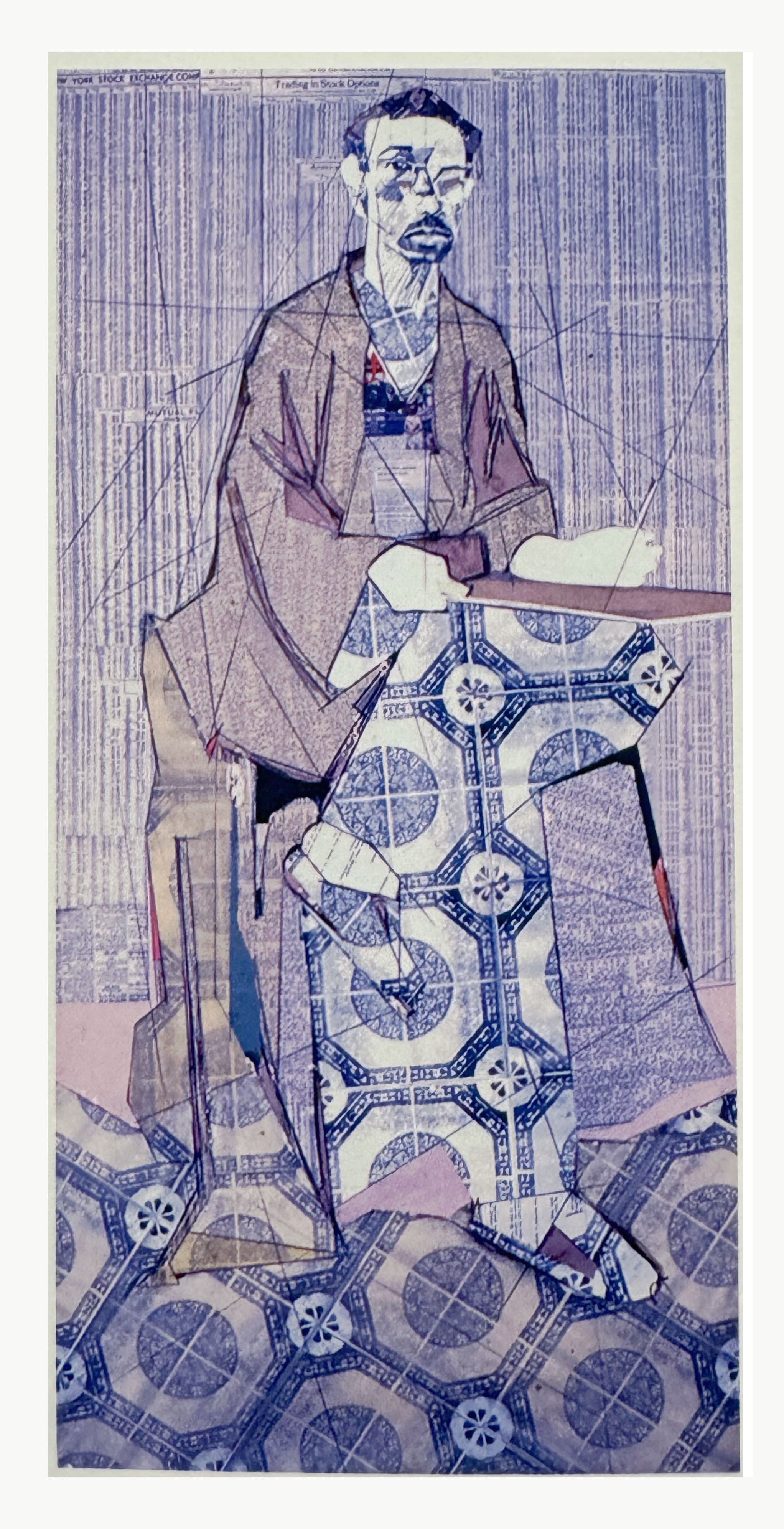
Ricardo F. Morín Self Portrait:Stock Market New York City 36” x 74” Collage with charcoal pencil 1987
He did not go into other artists’ studios unless invited. If he recognized something in the work, he said it.
At that time, education consisted in finding a means of expression that suited him. It was a way to refine what he saw and felt and to bring it into the work. The subject was his own, but it moved within the traditions of painting and other arts. What mattered was finding his voice as a painter, in the use of color and the depth it could sustain pictorially. On the surface, his gestures remained inscribed.
Within that, he would stand before the work and look, asking what it could contain or where it might resolve. If he recognized something, he stayed with it, not to explain or to correct it, but to register it mentally or to shift it within its structure. There would be a pause, and he would look again, as if something already present had just come into view.
Other artists entered his space with legitimate differences. They did not alter what took place between them.
One moment remains with him.
A graduate student was working on a piece, a structure rising like a tapering tower, bright, near red, perhaps fuchsia, with broken glass along its edges. It was not finished. It was evident that she was still working through it.
He stood beside her and said what came to him. It recalled what he had seen growing up: glass placed on top of walls, not as decoration, but to keep people out, to cut anyone who tried to enter.
She stopped, looked at the piece, then at him. Nothing more was said.
He left.
Later, he saw the piece again when she opened her show at an alternative gallery after graduating. There was a recording, a voice repeating that there is a violent world outside, and the piece and the voice remained together without resolution.
Their advisor in the art department told him that what he had said in her studio did not leave her and passed into the work.
He had not thought of it that way. He said it and moved on.
That is what remains with him, not recognition, but that something one sees can be taken up and continue elsewhere.
Around that time, his mentor said something to him in private. He told him not to take at face value what other faculty members said about his work, nor what he himself might say.
He heard it, and it did not leave him.
During that period, he traveled to Salzburg, Austria, for a seminar in stage design. He had not planned it. It just happened.
The work there required interpretation, and he found himself imposing his own way of seeing so that it would hold. It was not just something one looked at. It generated a mood that people entered and responded to.
He worked from what he saw, though it did not work as expected.
He continued with it.
After that, he entered a selective graduate program. It followed from what he had already started.
There, things took shape within a director’s limits of interpretation. He finished the program, but the way he had been working before did not continue in the same way.
Outside academia, he was received as an outsider; it did not extend beyond distrust. The work remained within that frame. He could see where the attention was directed; it did not include him, whatever he did. In New York City, visibility opened to the same names, not to him.
While he worked in stage design to support himself, he continued to produce paintings.
Opportunities did not present themselves for either.
He worked on what others would present, and it advanced without him.
The hours and the demands occupied the day and extended into the night, and when they ended, nothing was left for his own work. What had advanced before ceased to advance and it was no longer received in the same way. Expectations were in place, ways of doing things, and he saw them clearly enough to know where he stood.
Nothing came of that situation, but he persisted.
He kept working.
When he writes, he perceives what he has just thought and observes it once more without turning it into an answer.
At times, a thought comes with more weight than the rest. Where facts do not admit of equivalence and distinctions become inconvenient, they tend to be blurred; and where they are blurred, judgment loses its basis.
He leaves it there.
He asks whether anything is missing, not that something is missing, but whether.
Almost immediately, what he says begins to take form as an answer.
He stops.
Because that is not what he is asking.
He asked whether anything is missing, not what is missing, and left it there.
It occurs again. What he sees begins to take form as something he could think through.
He suspends that as well.
In the act of working, what he sees and thinks begins to take form as an answer. At times, what appears is not his, yet it comes as if it were. He sees it and does not complete it. It remains and returns without resolving. His attention does not leave him.
He remains within the situation as it presents itself.
There are relations in his life, some close, some not, and they arrive as they arrive. In those moments he responds, not because he decides to, but because the situation calls for it. He responds and confronts what derives from it.
He does not go beyond that act.
That stays there, not as something to return to, but as something that does not dissolve.
He sees himself acting and, at the same time, sees the movement that follows that action.
He does not resolve that movement.
He notices the inclination to fix a conclusion and does not follow it.
What appears presents itself with the weight of certainty for a moment and then recedes.