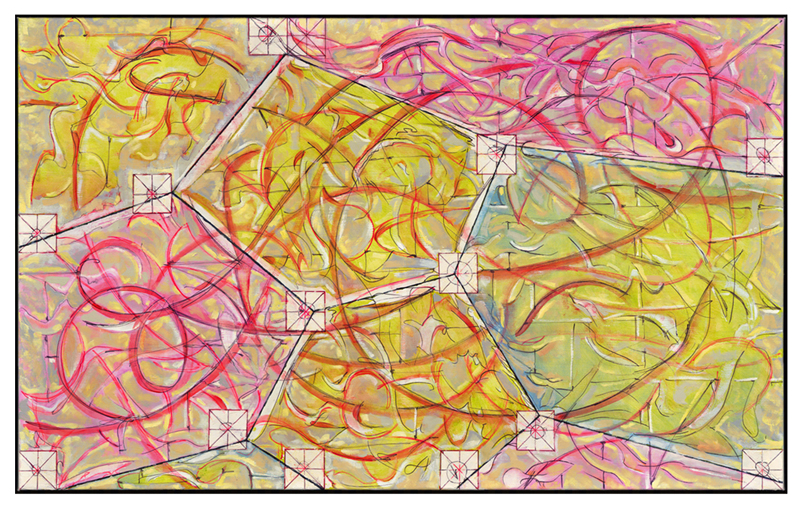
Dodecahedron
60″x 37″
Oil on linen
2005
Ricardo F. Morín
June 12, 2026
Bala Cynwyd, Pennsylvania
All living entities persist through relations. No organism exists in complete isolation from the conditions that sustain it. Life proceeds through continuous exchanges with surrounding environments and with other living systems. These exchanges need not be deliberate, conscious, or symbolic. They need only permit the registration of differences and the adjustment of behavior in response to them.
Communication emerges within this condition. It is not limited to speech, writing, or symbolic expression. More broadly, communication arises through correspondence, within which differences are registered and relations are established, maintained, or modified. Signals constitute one manifestation of such correspondence, but the forms through which correspondence occurs vary widely. Chemical gradients, electrical impulses, physical gestures, vocalizations, and symbolic systems all participate in communicative processes under different conditions.
Language occupies a distinct place within this broader field. Human language permits abstraction, symbolic reference, recursion, and the transmission of information beyond immediate circumstances. These capacities expand the range of what can be communicated. They do not, however, constitute the origin of communication itself. Rather, language represents a specialized manifestation of communicative processes that already operate throughout living systems.
The distinction is important because language often becomes identified with communication as such. Human beings naturally experience the world through linguistic categories and therefore tend to privilege language when considering the conditions of understanding. Yet much of what sustains relational life occurs without language. Organisms coordinate, adapt, compete, cooperate, and respond to changing conditions through forms of correspondence that precede symbolic representation.
Differences among communicative systems are differences of form, scope, and complexity. They do not necessarily imply absolute divisions between categories of existence. A signal that coordinates the movement of a colony, a vocal call that alerts a group to danger, and a sentence describing a future possibility all perform communicative functions despite substantial differences in structure. The means differ. The correspondences through which those differences are registered remain prior to the communicative forms that express them.
Observation permits the study of these processes but remains constrained by the capacities through which observation occurs. Instruments may extend perception, and conceptual frameworks may organize what is perceived, yet description remains distinct from the realities it attempts to describe. Every account reflects both the conditions observed and the limitations of the observer.
For this reason, communication is best approached descriptively rather than hierarchically. Human language possesses distinctive capacities, but those capacities do not require communication to begin with language nor to be exhausted by it. Language belongs within a broader communicative field that arises from forms of correspondence present throughout relational life.
The question is therefore not whether communication exists where language is absent. The more instructive question concerns the many forms through which relational life becomes possible before language appears. Attention to those forms reveals communication not as a uniquely human achievement but as a condition through which living systems participate in, respond to, and persist within the circumstances they inhabit.

