Posts Tagged ‘Hugo Chávez’

“Unmasking Disappointment: Series II”

January 21, 2026

*

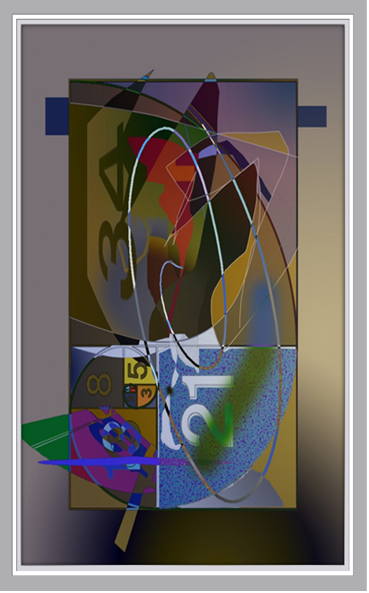
“Geometric Allegory” digital painting ©2023 by Ricardo Morin (American visual artist born in Venezuela–1954)

Ricardo F. Morín

Oakland Park, F.

December 12, 2025

Reflections from previous chapters eventually lead to a more historical inquiry, in which the following archive, Chronicles of Hugo Chávez, becomes another lens through which I approach the Venezuelan experience.


Chronicles of Hugo Chávez

1

Hugo Chávez, who spearheaded the Bolivarian Revolution, was born on July 28, 1954, in Sabaneta, Venezuela.   He died on March 5, 2013, at 4:25 p.m. VET (8:55 p.m. UTC) in Caracas, at the age of 58.   As the leader of the revolution, Chávez left a discernible imprint on Venezuela’s political history.   To reconstruct this history is to revisit a landscape whose consequences continue to shape Venezuelan life.

At the core of Chavismo lies a deliberate fusion of nationalism, centralized power, and military involvement in politics.   This fusion shaped his vision for a new Venezuela, one that would be fiercely independent and proudly socialist.

~
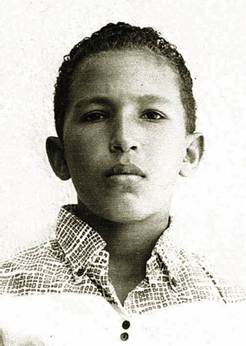
Hugo Chávez at age 11, sixth grade, 1965 (Photo: Reuters).

2

Hugo Chávez’s childhood was spent in a small town in Los Llanos, in the northwestern state of Barinas.   This region has a history of indigenous chiefdoms (i.e., “leaderships,” “dominions,” or “rules”) dating back to pre-Columbian times. [1]   Chávez was the second of six brothers, and his parents struggled to provide for the large family.   As a result, he and his older brother Adán were sent to live with their paternal grandmother, Rosa Inés, in the city of Barinas.   After her death, Chávez honored his grandmother’s memory with a poem; it concludes with a stanza that reveals the depth of their bond:

Entonces, /  abrirías tus brazos/  y me abrazarías/  cual tiempo de infante/   y me arrullarías/  con tu tierno canto/  y me llevarías/  por otros lugares/  a lanzar un grito/  que nunca se apague. [2]

[Author’s translation:   Then, /  you would open your arms /  and draw me in /  as if returned to childhood /  and you would steady me /  with your tender voice /  and you would carry me /  to other places /  to release a cry /  that would not be extinguished].

3

In his second year of high school, Chávez encountered two influential teachers, José Esteban Ruiz Guevara and Douglas Ignacio Bravo Mora, both of whom provided guidance outside the regular curriculum. [3][4]   They introduced Chávez to Marxism-Leninism as a theoretical framework, sparking his fascination with the Cuban Revolution and its principles—a turning point more visible in retrospect than it could have been in the moment.

4

At 17, Chávez enrolled in the Academia Militar de Venezuela at Fuerte Tiuna in Caracas, where he hoped to balance military training with his passion for baseball.  He dreamed of becoming a left-handed pitcher, but his abilities did not match his ambition.   Despite his initial lack of interest in military life, Chávez persisted in his training, graduating from the academy in 1975 near the bottom of his class.

5

Chávez’s military career began as a second lieutenant; he was tasked with capturing leftist guerrillas.   As he pursued them, he found himself identifying with their cause and believed they fought for a better life.   But by 1977, Chávez was prepared to abandon his military career and join the guerrillas.   Seeking guidance, he turned to his brother Adán, who persuaded him to remain in the military by insisting, “We need you there.” [5]   Chávez now felt a sense of purpose and understood his mission as a calling.   In 1982, he and his closest military associates formed the Bolivarian Revolutionary Movement-200:   they aimed to spread their interpretation of Marxism within the armed forces and ultimately hoped to stage a coup d’état. [6]

6

On February 4, 1992, Lieutenant Chávez and his military allies launched a revolt against the government of President Carlos Andrés Pérez.   Their rebellion, however, was swiftly quashed.   Surrounded and outnumbered, Chávez surrendered at the Cuartel de la Montaña, the military history museum in Caracas, near the presidential palace, on the condition that he be allowed to address his companions via television.   He urged them to lay down their arms and to avoid further bloodshed.   He proclaimed, « Compañeros, lamentablemente por ahora los objetivos que nos planteamos no fueron logrados . . . » [Author’s translation:   “Comrades, unfortunately, our objectives have not been achieved… yet,”].[7]   The broadcast marked the beginning of his political ascent.   His words resonated across the nation and sowed the seeds of his political future.

~
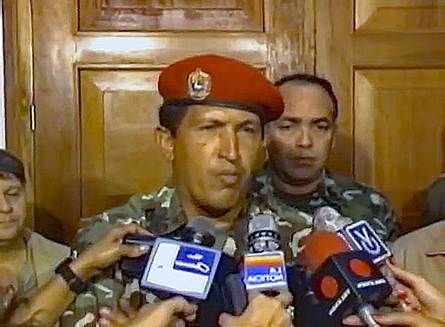
Chávez announces his arrest on national television and urges insurgent troops to surrender.

7

In 1994, newly elected President Rafael Caldera Rodríguez pardoned him. [8]   With this second chance, Chávez founded the Movimiento V República (MVR) in 1997 and rallied like-minded socialists to his cause. [9]   Through a campaign centered on populist appeals, he secured an electoral victory at age 44.

8

In his first year as President, Chávez enjoyed an 80% approval rating.   His policies sought to eradicate corruption in the government, to expand social programs for the poor, and to redistribute national wealth.   Jorge Olavarría de Tezanos Pinto, initially a supporter, emerged by the end of the elections as a prominent voice of the opposition.   Olavarría accused Chávez of undermining Venezuela’s democracy through his appointment of military officers to governmental positions. [10]   At the same time, Chávez was drafting a new constitution, which allowed him to place military officers in all branches of government.   The new constitution, ratified on December 15, 1999, paved the way for the “mega elections” of 2000, in which Chávez secured a term of six years.   Although his party failed to gain full control of the Asamblea Nacional (National Assembly), it passed laws by decree through the mechanism of the Leyes Habilitantes (Enabling Laws). [11][12]   Meanwhile, Chávez initiated reforms to reorganize the State‘s institutional structure, but the constitution’s requirements were not met.   The appointment of judges to the new Corte Suprema de Justicia [CSJ] was carried out without rigor and raised concerns about its legitimacy and competence.   Cecilia Sosa Gómez, the outgoing Corte Suprema de Justicia president, declared the rule of law “buried” and the court “self-dissolved.” [13][14]

9

Although some Venezuelans saw Chávez as a refreshing alternative to the country’s unstable democratic system, which had been dominated by three parties since 1958, many others expressed concern as the Partido Socialista Unido de Venezuela (PSUV) consolidated power and became the sole governing party. [15]   Legislative and executive powers were increasingly centralized, and the narrowing of judicial guarantees limited citizens’ participation in the democratic process.   Chávez’s close ties with Fidel Castro and his desire to model Venezuela after Cuba’s system—dubbed VeneCuba—raised alarm. [16]   He silenced independent radio broadcasters, and he antagonized the United States and other Western nations.  Instead, he strengthened ties with Iraq, Iran, and Libya.   Meanwhile, domestically, his approval rating had plummeted to 30%, and anti-Chávez demonstrations became a regular occurrence.

10

On April 11, 2002, a massive demonstration of more than a million people converged on the presidential palace to demand President Chávez’s resignation.   The protest turned violent when agents of the National Guard and masked paramilitaries opened fire on the demonstrators. [17]   The tragic event—the Puente Llaguno massacre—sparked a military uprising that led to Chávez’s arrest and to the installation of a transitional government under Pedro Francisco Carmona Estanga. [18]   Carmona’s leadership, however, was short-lived; he swiftly suspended the Constitution, dissolved the Asamblea Nacional and the Corte Suprema, and dismissed various officials.   Within forty-eight hours, the army withdrew its support for Carmona.   The vice president, Diosdado Cabello Rondón, was reinstated as president and promptly restored Chávez to power. [19]

11

The failed coup d’état enabled Chávez to purge his inner circle and to intensify his conflict with the opposition.   In December 2002, Venezuela’s opposition retaliated with a nationwide strike aimed at forcing Chávez’s resignation.   The strike targeted the state oil company Petróleos de Venezuela, S.A. (PDVSA), which generated roughly 80% of the country’s export revenues. [20]   Chávez responded by dismissing its 38,000 employees and replacing them with loyalists.   By February 2003, the strike had dissipated, and Chávez had once again secured control over the country’s oil revenues.

12

From 2003 to 2004, the opposition launched a referendum to oust Chávez as president, but soaring oil revenues, which financed social programs, bolstered Chávez’s support among lower-income sectors. [21]   By the end of 2004, his popularity had rebounded, and the referendum was soundly defeated.   In December 2005, the opposition boycotted the elections to the National Assembly and protested against the Consejo Nacional Electoral (National Electoral Council) (CNE). [22]   As anticipated in view of the opposition boycott, Chávez’s coalition capitalized on the absence of an effective opposition and strengthened its grip on the Assembly. [23]    By that point, legislative control rested almost entirely with Chávez’s coalition.    What followed was not a departure from this trajectory, but its extension through formal policy.

13

In December 2006, Chávez secured a third presidential term, a victory that expanded the scope of executive initiative.   He nationalized key industries—gold, electricity, telecommunications, gas, steel, mining, agriculture, and banking—along with numerous smaller entities. [24][25][26][27][28][29]   Chávez also introduced a package of constitutional amendments designed to expand the powers of the executive and to extend its control over the Banco Central de Venezuela (BCV).   In a controversial move, he unilaterally altered property rights and allowed the state to seize private real estate without judicial oversight.   Furthermore, he proposed becoming president for life.   In December 2007, however, the National Assembly narrowly rejected the package of sweeping reforms.

14

In February 2009, Chávez reintroduced his controversial proposals and succeeded in advancing them.   Following strategic counsel from Cuba, he escalated the crackdown on dissent. [30]   He ordered the arrest of elected opponents and shut down all private television stations.

15

In June 2011, Chávez announced that he would undergo surgery in Cuba to remove a tumor, a development that sparked confusion and concern throughout the country. [31]   As his health came under increasing scrutiny, more voters began to question his fitness for office.   Yet, in 2012, despite his fragile health, Chávez campaigned against Henrique Capriles and secured a surprise presidential victory. [32]

~
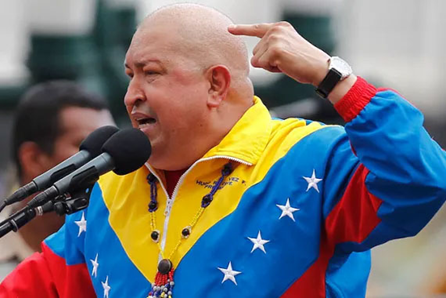
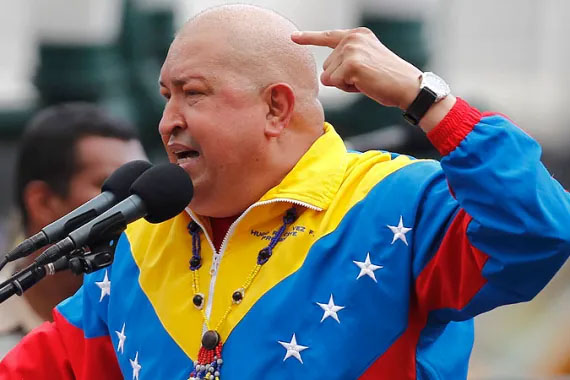
Chávez during the electoral campaign in February 2012.

16

In December 2012, Chávez underwent his fourth surgery in Cuba.   Before departing Venezuela, he announced his plan for transition and designated Vice President Nicolás Maduro as his successor, alongside a powerful troika that included Diosdado Cabello [military chief] and Rafael Darío Ramírez Carreño [administrator of PDVSA]. [33][34][35]   Following the surgery, Chávez was transferred on December 11 to the Hospital Militar Universitario Dr. Carlos Arvelo (attached to the Universidad Militar Bolivariana de Venezuela, or UMBV) in Caracas, where he remained incommunicado, further fueling speculation and rumors.   Some government officials dismissed reports of assassination, while others, including former Attorney General Luisa Ortega Díaz, claimed he had already died on December 28. [36]   Maduro’s cabinet vehemently refuted these allegations and insisted that no crime had been committed.   Amidst the uncertainty, Maduro asked the National Assembly to postpone the inauguration indefinitely.    This further intensified political tensions.

17

The National Assembly acquiesced to Maduro and voted to postpone the inauguration.   Chávez succumbed to his illness on March 5.   His body was embalmed in three separate stages without benefit of autopsy, which further fueled suspicions and conspiracy theories.   Thirty days later, Maduro entered office amid sustained political uncertainty. [37]   The implications of this transition extend beyond chronology; they shape the conditions examined in the chapters that follow in this series, which comprises 19 chapters, miscellaneous rubrics, and an appendix.

~


Endnotes:

§ 2

[1]   Charles S. Spencer and Elsa M. Redmond, Prehispanic Causeways and Regional Politics in the Llanos of Barinas, Venezuela (Cambridge: Cambridge University Press, 2017). Abstract: “…relacionados con la dinámica política de la organización cacical durante la fase Gaván Tardía.” Published in Latin American Antiquity, vol. 9, no. 2 (June 1998): 95-110. https://doi.org/10.2307/971989

[2]   Rosa Miriam Elizalde y Luis Báez, Chávez Nuestro, (La Habana: Casa Editora Abril, 2007), 367-369.    https://docs.google.com/file/d/0BzEKs4usYkReRVdWSG5LQkFYQ3c/edit?pli=1&resourcekey=0-yHaK7-YkA47nelVs-7JuBQ 

§ 3

[3]The Hugo Chávez Show,” PBS Front Line, November 19, 2008.    https://www.pbs.org/wgbh/pages/frontline/hugochavez/etc/ex2.html

[4]   L’Atelier des Archive, “Interview du révolutionnaire:   Douglas Bravo au Venezuela [circa 1960]” (Transcript:   “… conceptos injuriosos en contra de la revolución cubana …” [timestamp 1;11-14]), YouTube, October 14, 2016.   https://www.youtube.com/watch?v=1cx2D5VM8VM

§ 5

[5]   “Hugo Chavez Interview,”YouTube, transcript excerpt and time stamp unavailable:   Original quote in Spanish (translated by the author):  “. . . , if not, maybe I’ll leave the Army, no, you can’t leave, Adam told me so, no, we need you there, but who needs me?”   Retrieved October 12, 2023.

[6]   Dario Azzellini and Gregory Wilpert,Venezuela, MBR–200 and the Military Uprisings of 1992,”in The Wiley-Blackwell Encyclopedia of Revolution and Protest (Wiley 2009).    https://onlinelibrary.wiley.com/doi/epdf/10.1002/9781405198073.wbierp1525

§ 6

[7]   Declarations in a Nationwide Government-Mandated Broadcast,” BancoAgrícolaVe, YouTube, February 4, 1992.    https://www.youtube.com/watch?v=_QqaR1ZjldE

§ 7

[8]   Maxwell A. Cameron and Flavie Major, “Venezuela’s Hugo Chavez: Savior or Threat to Democracy?,” Latin American Research Review, vol. 36, no. 3, (2001):  255-266.    https://www.proquest.com/docview/218146430?sourcetype=Scholarly%20Journals

[9]   Gustavo Coronel, “Corruption, Mismanagement, and Abuse of Power in Hugo Chávez’s Venezuela,” Center for Global Liberty & Prosperity:    Development Policy Analysis, no. 2 (CATO Institute, November 27, 2006).   https://www.issuelab.org/resources/2539/2539.pdf.

§ 8

[10]   Jorge Olavarría Ante El Congreso Bicameral [July 5,1999],” YouTube.    https://youtu.be/_OkqNn8VF-Y?si=Cvuh4Vk391_0Pnut .   Accessed January 9, 2025.

[11]   Mario J. García-Serra, “The ‘Enabling Law’:    The Demise of the Separation of Powers in Hugo Chavez’s Venezuela,” University of Miami Inter-American Law Review, vol.32, no. 2, (Spring – Summer, 2001):   265-293.     https://www.jstor.org/stable/40176554

[12]   “Venezuela:   Chávez Allies Pack Supreme Court,” Human Rights Watch, December 13, 2004.    https://www.hrw.org/news/2004/12/13/venezuela-chavez-allies-pack-supreme-court

[13]   “Top Venezuelan judge resigns,” BBC News, August 25, 1999.   http://news.bbc.co.uk/2/hi/americas/429304.stm

[14]   “Suprema Injusticia:    ‘These are corrupt judges,” Organización Transparencia Venezuela.    https://supremainjusticia.org/cecilia-sosa-gomez-these-are-corrupt-judges/

§ 9

[15]   “United Socialist Party of Venezuela,” PSUV.   http://www.psuv.org.ve/

[16]   “Venezuela and Cuba, ‘VeneCuba,’ a single nation,” The Economist, February 11, 2010.   https://www.economist.com/the-americas/2010/02/11/venecuba-a-single-nation

§ 10

[17] “Photographs reveal the truth about Puente Llaguno massacre,” April 11, 2002, YouTube.    https://youtu.be/NvP7cL-7KL4?si=cUpMAv0myAWH5UWP

[18] “Pedro Carmona Estanga cuenta su verdad 21 años después,” El Nacional de Venezuela.     https://www.elnacional.com/opinion/pedro-carmona-estanga-cuenta-su-verdad-21-anos-despues/

[19] “Diosdado Cabello Rondón:Narcotics Rewards Program: Wanted,” U.S. Department of State.     https://www.state.gov/bureau-of-international-narcotics-and-law-enforcement-affairs/releases/2025/01/diosdado-cabello-rondon

§ 11

[20]   Marc Lifsher, “Venezuela Strike Paralyzes State Oil Monopoly PdVSA,” Wall Street Journal, December 6, 2002.    https://www.wsj.com/articles/SB1039101526679054593

§ 12

[21] “Socialism with Cheap Oil,” The Economist, December 30, 2008.    https://www.economist.com/the-americas/2008/12/30/socialism-with-cheap-oil

[22] “Venezuela: Increased Threats to Free Elections; New Electoral Body Puts Reforms at Risk,” Human Rights Watch, June 22, 2023 7:00AM.    https://www.hrw.org/news/2023/06/22/venezuela-increased-threats-free-elections

[23] Juan Forero, “Chávez Grip Tightens as Rivals Boycott Vote,” The New York Times, December 5, 2005.    https://www.nytimes.com/2005/12/05/world/americas/chavezs-grip-tightens-as-rivals-boycott-vote.html?referringSource=articleShare

§ 13

[24] Louise Egan, “Chavez to nationalize Venezuelan gold industry,” Reuters, August 17, 2011, 2:40 PM.   https://www.reuters.com/article/us-venezuela-gold/chavez-to-nationalize-venezuelan-gold-industry-idUSTRE77G53L20110817/

[25] Juan Forero, “Chavez Eyes Nationalized Electrical, Telcom Firms,” Reuters, January 9, 2007, 6:00 AM ET.    https://www.npr.org/2007/01/09/6759012/chavez-eyes-nationalized-electrical-telcom-firms

[26] James Suggett, “Venezuela Nationalizes Gas Plant and Steel Companies, Pledges Worker Control,” Venezuelanalysis, May 23, 2009.    https://venezuelanalysis.com/news/4464/

[27] David Brunnstrom, “Factbox: Venezuela’s nationalizations under Chavez,” Reuters, October 7, 2012, 10:51 PM.    https://www.reuters.com/article/us-venezuela-election-nationalizations/factbox-venezuelas-nationalizations-under-chavez-idUSBRE89701X20121008/

[28] Frank Jack Daniel–Analysis–, “Food, farms the new target for Venezuela’s Chavez,” Reuters, March 5, 2009, 6:06 PM EST.   https://www.reuters.com/article/us-venezuela-chavez-analysis-sb/food-farms-the-new-target-for-venezuelas-chavez-idUSTRE5246OO20090305/

[29] Daniel Cancel, “Chavez Says He Has No Problem Nationalizing Banks,” Bloomberg, November 29, 2009, 15:02 GMT-5.    https://www.bloomberg.com/news/articles/2009-11-29/chavez-says-he-has-no-problem-nationalizing-banks

§ 14

[30] Angus Berwick, “Special Report: How Cuba taught Venezuela to quash military dissent,” Reuters, August 22, 2019, 8:22 AM ET.    https://www.reuters.com/article/us-venezuela-cuba-military-specialreport/special-report-how-cuba-taught-venezuela-to-quash-military-dissent-idUSKCN1VC1BX/

§ 15

[31] Robert Zeliger, Passport: “Hugo Chavez’s medical mystery,” Foreign Policy, June 24, 2011, 10:20 PM.   https://foreignpolicy.com/2011/06/24/hugo-chavezs-medical-mystery/

[32] Juan Forero, “Hugo Chavez Beats Henrique Capriles,” The Washington Post, October 7, 2012.   https://www.washingtonpost.com/world/venezuelans-flood-polls-for-historic-election-to-decide-if-hugo-chavez-remains-in-power/2012/10/07/d77c461c-10c8-11e2-9a39-1f5a7f6fe945_story.html

§ 16

[33] Bryan Winter and Ana Flor, “Exclusive:   Brazil wants Venezuela election if Chavez dies – sources,” Reuters, January 14, 2013, 9:12 PM EST, updated 12 years ago.    https://www.reuters.com/article/cnews-us-venezuela-chavez-brazil-idCABRE90D12320130114/

[34] “Venezuela National Assembly chief: Diosdado Cabello,” BBC News, March 5, 2013.   https://www.bbc.com/news/world-latin-america-20750536

[35] “Rafael Darío Ramírez Carreño of Venezuela Chair of Fourth Committee,” United Nations, BIO/5031*-GA/SPD/630; 25 September 2017.   https://press.un.org/en/2017/bio5031.doc.htm

[36] Ludmila Vinogradoff, “La exfiscal Ortega confirma que Chávez murió dos meses antes de la fecha anunciada,” ABCInternacional, actualizado Julio 16, 2018, 12:44    https://www.abc.es/internacional/abci-confirman-chavez-murio-meses-antes-fecha-anunciada-201807132021_noticia.html?ref=https://www.google.com/

§ 17

[37] “Cuerpo de Chávez fue tratado tres veces para ser conservado: … intervenido con inyecciones de formol para que pudiera ser velado,” El Nacional De Venezuela – Gda, Enero 27, 2024, 05:50, actualizado Marzo 22, 2013, 20:51.   https://www.eltiempo.com/amp/archivo/documento/CMS-12708339

~
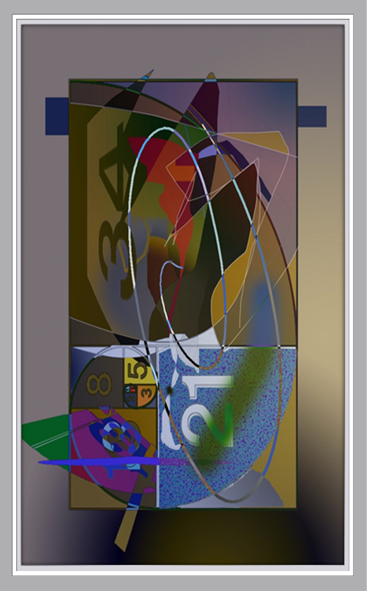
“Unmasking Disappointment: Series I”

January 7, 2026

“Geometric Allegory,” digital painting 2023 by Ricardo Morin (American visual artist born in Venezuela–1954)

To my parents

Preface

Unmasking Disappointment” follows a line of inquiry present throughout my work:   the examination of identity, memory, and the relations that emerge when life unfolds across cultural boundaries.   Although I have lived outside Venezuela for more than five decades and became a naturalized citizen of the United States twenty-four years ago, my relationship to the country of my birth remains a persistent point of reference.   The distance between these conditions—belonging and removal—forms the backdrop against which this narrative takes shape.

This work belongs to a broader autobiographical project that gathers experiences, observations, and questions accumulated over time.   While personal in origin, it does not proceed as confession or memoir.   Its method is sequential rather than expressive:   individual exposure is situated within historical forces and political structures that have shaped Venezuelan life across generations.   The intention is not to reconcile these tensions, but to render them visible through recurrence, record, and consequence.

Series I” introduces the first thematic clusters of this inquiry.   The episodes assembled here do not advance a single thesis, nor do they aim at resolution.   They trace points of friction where private experience intersects with public power, and where political narratives exert pressure on ordinary life.   Across these encounters, patterns emerge—not as abstractions, but as conditions that alter how authority is exercised, how responsibility is displaced, and how agency is constrained.

The chapters that follow examine the pressures produced by systemic inequality and trace contemporary Venezuelan conditions back to their historical formation.   Autocratic rule and popular consent appear not as opposing forces, but as elements that increasingly entangle and weaken one another.   Within this entanglement, truth does not disappear; it becomes less evenly accessible and more readily displaced by narrative.

When public discourse is shaped by propaganda and misinformation, authoritarian structures gain resilience.   Recovering truth under such conditions does not resolve political conflict, but it clarifies the limits within which political life operates.   Agency emerges not as an ideal, but as a condition sustained—or undermined—through practice and consequence.

This work does not propose deterministic explanations or simple remedies.   It proceeds by accumulation, drawing attention to patterns that persist despite changing circumstances.   What it asks of the reader is not agreement, but attention:   to evidence, to sequence, and to the conditions under which political freedom may be meaningfully exercised.

Writing from Bala Cynwyd, Pennsylvania, and Fort Lauderdale, Florida, I remain aware of the distance between the environments in which this work is composed and the conditions it examines.   That distance does not confer authority; it imposes responsibility.

Ricardo Federico Morín
Bala Cynwyd, Pennsylvania, January 21, 2025


*

Table of Contents

  • Chapter I – A Written Language.
  • Chapter II – Our Recklessness.
  • Chapter III – Point of View.
  • Chapter IV – A Dialogue.
  • Chapter V – Abstract.
  • Chapter VI – Chronicles of Hugo Chávez (§§ I-XVII).
  • Chapter VII – The Allegorical Mode.
  • Chapter VIII – The Ideal Government and the Power of Virtue.
  • Chapter IX – The First Sign:   On Political and Social Resentment.
  • Chapter X – The Second Sign:   The Solid Pillar of Power:   The Military Forces.
  • Chapter XI – The Third Sign:  The Asymmetry of Political Parties.
  • Chapter XII – The Fourth Sign:  Autocracy (§§ 1-9):  Venezuela (§§ 10-23), The Asymmetry of Sanctions (§§ 24-32).
  • Chapter XIII – The Fifth Sign:  The Pawned Republic.
  • Chapter XIV – The First Issue:   Partisanship, Non-partisanship, and Antipartisanship.
  • Chapter XV – The Second Issue:   On Partial Truths and Repressive Anarchy.
  • Chapter XVI – The Third Issue:   The Clarion of Democracy.
  • Chapter XVII – The Fourth Issue:   On Human Rights.
  • Chapter XVIII – The Fifth Issue:  On the Nature of Violence.
  • Chapter XIX – The Ultimate Issue:   About the Deliverance of Injustice.
  • Acknowledgments.
  • Epilogue.
  • PostScript.
  • Appendix:   Author’s Note, Prefatory Note.     A). Venezuelan Constitutions [1811-1999], Branches, and Departments of Government.   B) Evolution of Political Parties: 1840-2024.    C) Laws Enacted by the Asamblea Nacional.  D) Clarificatory Note on Domestic Coercion, Foreign Presence, and Intervention.
  • Bibliography.

A Written Language

Stability is often sought where it cannot be secured.   Experience has shown this repeatedly.   Even careful intentions tend to draw one into uncertain terrain, where understanding lags behind consequence.   At the desk, as late-afternoon light reaches the page, writing assumes a practical function:   it becomes a means of ordering what would otherwise remain unsettled.   The act does not resolve vulnerability, but it records it.   Whether time alters such conditions remains uncertain; what can be done is to give them form.

What follows moves from the conditions of writing to the conditions it must confront.


*

Our Recklessness

~

Our painful struggle to deal with the politics of climate change is surely also a product of the strange standoff between science and political thinking.” — Hannah Arendt:   The Human Condition:   Being and Time [1958], Kindle Book, 159.

1

The COVID pandemic and the 2023 Canadian wildfires, among other recent events, have made visible conditions that were already in place.     These events did not introduce new vulnerabilities as much as they revealed the extent to which existing systems depend on economic incentives and political habits that privilege extraction over preservation.   During the period when smoke from the fires reached the northeastern United States, daylight in parts of Pennsylvania was visibly altered and registered the reach of events unfolding at a considerable distance.   Such occurrences do not stand apart from prevailing economic arrangements; they coincide with a model that treats natural conditions as commodities and absorbs their degradation as an external cost.

2

The fires in California in 2025, like those that spread across Canada in 2023, do not present themselves as isolated occurrences.   They form part of a sequence shaped by environmental neglect, political inertia, and sustained industrial expansion.   Conditions such as desertification, resource scarcity, and population displacement no longer appear solely as projected outcomes; they are increasingly registered as present circumstances.   Scientific assessments indicate that these patterns are likely to intensify in the absence of structural change. [1][2][3]   What is brought into view, over time, is not a singular failure but a system that continues to operate according to priorities that favor immediate yield over long-term continuity.

3

The question of balance does not arise solely as a technical problem.   It emerges within a moral and political field shaped by prevailing economic assumptions.   The treatment of nature—and more recently of artificial intelligence—as a commodity reflects a trajectory in which matters of shared survival are increasingly translated into market terms.    Under such conditions, considerations that once belonged to collective responsibility are recast as variables within systems of calculation.

4

Such patterns place increasing strain on conditions necessary for collective survival.   Responses to these conditions vary and range from indifference to urgency, though urgency does not invariably produce clarity.   What becomes apparent, across repeated instances, is a tendency for crisis to recur without sustained adjustment.   This recurrence parallels the political histories examined in the chapters that follow, where warning and consequence frequently fail to align.


Endnotes—Chapter II


*

Point of View

1

Conversations with my editor, Billy Bussell Thompson, have accompanied the development of this work over time.    His attention to research method and to the structure of argument has contributed to the clarification of its scope and direction.    These exchanges, often conducted at a distance and without ceremony, formed part of the process through which the present narrative took shape.    After an extended period of uncertainty regarding how to approach the subject of Hugo Chávez, the contours of Unmasking Disappointment gradually emerged.

2

Hugo Chávez entered national political life as a leader whose authority was exercised in opposition to political liberalism. [1]  While his public discourse emphasized alignment with the poor, the material benefits of power accumulated within a narrow circle. [2]  Over the course of his tenure, democratic institutions in Venezuela experienced progressive weakening, and governance assumed increasingly authoritarian forms.   These developments become more legible when situated within the historical record and examined through documented practice rather than rhetorical claim.

3

The events that followed Chávez’s rule are marked by disorder and unresolved consequence.   Their persistence draws attention to questions of historical accountability and collective responsibility that remain unsettled.   Examining the record of autocratic leadership—its ambitions as well as its failures—provides a means of approaching the problem of justice in Venezuela without presuming resolution.   Through this examination, enduring tensions come into view as conditions to be understood rather than conclusions to be reached.

~


Endnotes—Chapter III

  • [1]   The term caudillo originates in Spanish and has historically been used to describe a leader who exercises concentrated political and military authority.    In the Venezuelan context, the term carries particular resonance and refers to figures associated with the post-independence period of the nineteenth century.    Such leaders tended to consolidate power through a combination of personal authority, allegiance from armed factions, and the promise—whether substantive or rhetorical—of maintaining order under conditions of instability.    While some were regarded as defenders of local or national causes, others became associated with practices that facilitated authoritarian governance and weakened institutional structures.    The concept of the caudillo continues to function within Venezuelan political culture as a descriptive category applied to leadership forms that combine popular support with concentrated power.

Chapter IV

A Dialogue

A series of conversations between BBT and the author accompanied the examination of Venezuelan politics and history developed in this section.   These exchanges formed a transitional space in which reflection gave way to historical inquiry, allowing questions of interpretation, responsibility, and record to be addressed through dialogue rather than exposition.

1

—RFM:   “My writing has been concerned with the evolution of Venezuela’s political landscape, with particular attention to the emergence of authoritarian forms of rule.   The focus has been less on abstract doctrine than on how specific policies translated into everyday conditions for ordinary Venezuelans.”

2

—BBT:   “Examining how authoritarian leadership shapes political conditions is necessary, though the term itself is often contested and applied unevenly.   In Chávez’s case, the use of propaganda was not exceptional in form, but it was consistently employed as an instrument of governance.   How did official narratives during his tenure circulate, and what effects did they have on public perception over time?”

3

—RFM:  “Propaganda is not unique to Chávez; it functions as a recurring instrument across political systems.   In Venezuela, official media regularly attributed economic hardship to external interference rather than to domestic policy decisions.    At the same time, material conditions deteriorated, with shortages emerging from economic mismanagement and later compounded by external restrictions.   Opposition groups also circulated counter-narratives, which in turn elicited responses from the State.    These exchanges unfolded within a historical context shaped by civil conflict and Cold War alignments, and produced a fragmented informational environment.   Within that environment, responsibility for economic decline was frequently displaced, while public perception was managed through repetition rather than resolution.   The social and economic reforms invoked in justification did not, over time, yield the reductions in poverty and inequality that had been promised.”

4

—BBT:  “To render Venezuela’s political conditions with some accuracy, attention must be given to how ordinary citizens encountered these dynamics in daily life.     How were such conditions navigated in practice, particularly where political discourse intersected with immediate economic necessity?”

5

—RFM:  “The economic collapse that followed the decline of the oil-based model intensified poverty and placed sustained pressure on public services.   Examined in sequence, this period shows how colonial legacies and authoritarian practices converged in the formation of Chavismo.   Episodes such as the 1989 riots known as El Caracazo registered widespread disaffection with established parties and democratic institutions.   Under such conditions, the demands of securing basic necessities frequently outweighed engagement with abstract political principles.”

6

—BBT:   “Clarity in narrative depends in part on recognizing the assumptions that guide interpretation.   When these assumptions are made explicit and examined, the account becomes less directive and more accessible, allowing readers to follow the record without being steered toward a predetermined position.”

7

—RFM:  “No narrative proceeds without interpretation, including this one.   Writing provides a means of approaching Venezuela’s history—its colonial formation, episodes of authoritarian rule, and periods of political disruption—without foreclosing alternative readings.    A coherent account need not be exhaustive; it remains open insofar as it attends to implication and consequence rather than resolution.”

8

—BBT:  “The exchange itself underscores the importance of careful narration when approaching Venezuela’s political and social record.    Attending to multiple viewpoints does not resolve complexity, but it allows a more coherent account to emerge without reducing that history to a single explanatory frame.”

The exchange marked a transition from reflective inquiry to historical record.

~


Chapter V

Abstract

1

This section examines the sequence through which the political project articulated under Hugo Chávez assumed autocratic form.    Rather than attributing this outcome to a single cause, the inquiry proceeds by tracing how leadership decisions unfolded within a convergence of historical conditions, institutional arrangements, economic pressures, and geopolitical alignments.   The account does not begin from conclusion, but from record.

2
Attention remains on how authority was exercised and how its effects registered within Venezuelan society.    Historical circumstance, institutional design, and external influence are examined not to simplify the record, but to make visible the interdependencies through which power consolidated over time.    What emerges is not an explanatory thesis, but a configuration whose coherence can be assessed only through sustained attention to sequence and consequence.

~


“The Intersection of Superstitious Beliefs in Venezuela”

February 8, 2025

*


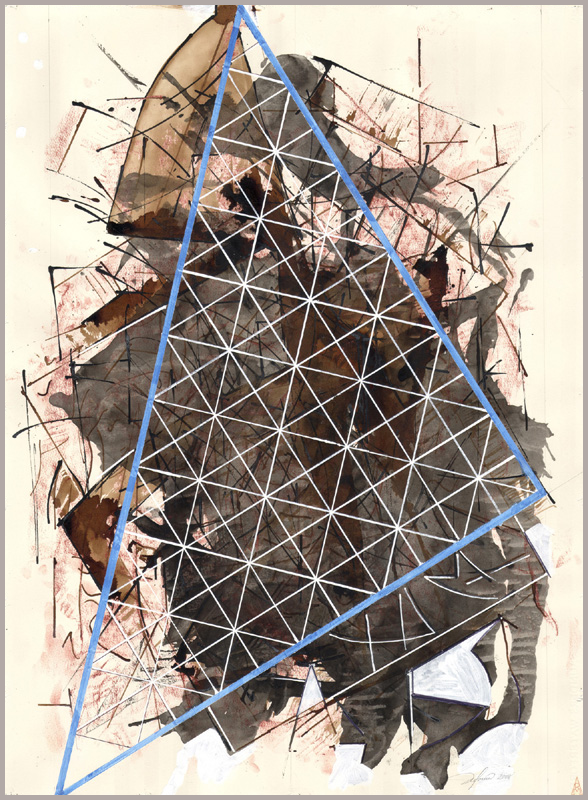
Triangulation 36
22″ x 30″
Body color, sanguine, sepia and Sumi ink on paper
2008

The Power of Myth and Storytelling

Storytelling has long been humanity’s way of making sense of the unknown—an enduring thread that weaves aspirations, fears, and triumphs into allegory.    Myths such as those of Jupiter reflect our longing for power, resilience, and the divine; they serve as echoes of the struggles that define us.    Whether in the trials of gods and heroes or the quiet ordeals of ordinary lives, these narratives offer a means to navigate the bewildering nature of existence.

Mystery drifts into the folds of nature and provokes the eternal human impulse to explain, to justify, to believe.    Superstition thrives where uncertainty prevails; it offers a semblance of control, a means to interpret the ungovernable.    But where does it lead?    Does superstition whisper in the ears of power, does it shape the visions of those who govern?    Even in nations where the media shields leadership from scrutiny, the allure of the esoteric persists, its expressions open yet its workings veiled, obscured by secrecy and the hush of conspiratorial dread.

As mythologies once shaped civilizations, superstition remains deeply woven into modern cultures.    It manifests in rites and rituals, in whispered incantations and quiet observances, in the gestures of those who seek certainty where reason falters.    And yet, for all its solace, does it propel or impede?    A society caught between superstition and rationality is one that stands at a threshold—as superstition lingers between the past and the demands of an evolving world.

Santería and Spiritism in Venezuela

Santería and Spiritism have taken root in Venezuela and their influence surges in times of crisis.    Santería, an Afro-Caribbean fusion of Catholic, Indigenous, and African traditions, finds expression in rituals meant to commune with spirits, to bridge the worlds of the living and the dead.    Spiritism, too, is tethered to the supernatural, a doctrine of spectral contact and whispered revelations.    The two converge and intertwine within the broader landscape of Venezuela’s spiritual consciousness.

The Religious Sect of María Lionza

At the heart of Venezuela’s esoteric traditions stands María Lionza, an enigmatic figure at the crossroads of Indigenous, African, and Catholic beliefs.    She is revered as a goddess of nature, love, and harmony, her presence invoked in ceremonies that summon the spirits of those who have passed—figures as varied as the doctor José Gregorio Hernández, pre-Columbian chieftains, military titans like Simón Bolívar, and even the late Hugo Chávez.

Among the sect’s most prominent mediums is Edward Guidice, who channels the spirit of Emeregildo, a figure believed to possess extraordinary healing abilities.    As Venezuela’s healthcare system falters, belief in supernatural intervention flourishes.    Where medicine is scarce, faith fills the void, and María Lionza’s presence looms ever larger in the search for solace.

Superstition and Modernization

Superstition and modernity exist in uneasy proximity—the former, a refuge from uncertainty; the latter, an unrelenting tide.    In Venezuela, these beliefs permeate not only the private sphere but also governance, health, and social order.    Esoteric and occult forces whisper through the corridors of power, amble in the choices of those who lead, and take root where institutions crumble.

Beyond superstition lies witchcraft—the deliberate act of bending unseen forces to one’s will.    It is a force feared, spoken of in hushed tones, its practitioners both sought and condemned.    Unlike passive belief, witchcraft asserts itself upon the world, shapes outcomes, and influences destinies.    It exists in the margins, yet its shadow stretches across every echelon of society.

As Venezuela contends with its trials, superstition remains a steadfast companion.    It soothes, it explains, it beckons.    Yet, between its comforts and constraints lies a question—does it fortify or does it fetter?    The answer, as always, remains in the spaces between faith and reason, between what is seen and what is merely believed.

Ricardo F Morin, February 8, 2025, Oakland Park, Fl.

Editor, Billy Bussell Thompson

New York City, February 14, 2025