Posts Tagged ‘introspection’

“A Memorandum on Knowing Oneself”

August 2, 2025

*


Ricardo Morin
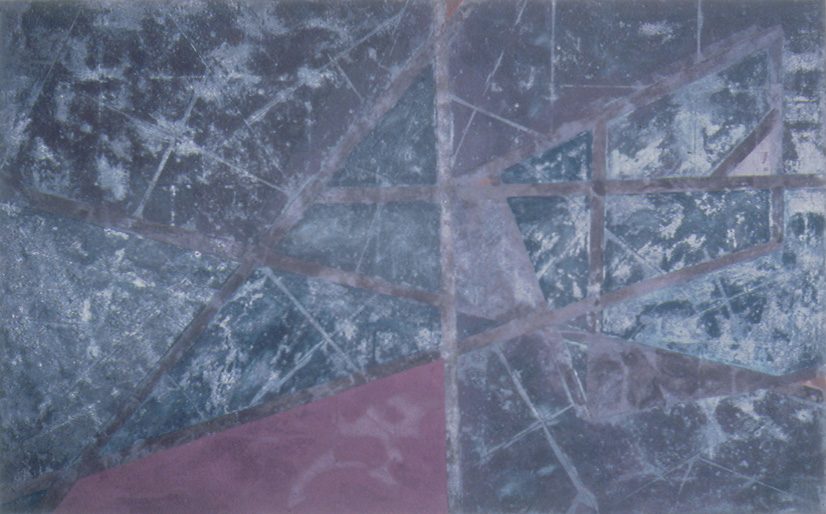
Triangulation 40

22″ x 30″
Body color, sanguine, sepia and Sumi ink on paper
2008


By Ricardo Morin

August 2, 2025

Bala Cynwyd, Pennsylvania

*

There are nights when sleep does not bring rest, but fire. Waking comes not from habit, but from the certainty that something must be understood. Not in a romantic sense of inspiration, but from the need to bring coherence to what is felt and remembered. Writing becomes a form of release: a counterweight to fatigue, an effort that both exhausts and restores.

Some days end in hollow silence, especially after confronting old wounds or noting the latent tensions in family history. What begins as scattered, even frantic thought gradually takes shape. A curve appears: from confusion to focus, and from focus to clarity. In that quiet progression, peace returns.

This rhythm is not chosen for comfort. It comes with broken sleep, exposed emotions, and an urgency born not of excess, but of necessity. Circumstances press in. When thought accelerates and the need to give it form becomes insistent, it is not excess but response.

Yet, nothing in this process happens in isolation. Even when no voices are named, no clarity arises without attunement with others—some near, some distant, some unknown. The work does not emerge from a single hand, but from a convergence of attentiveness, reflection, and exchange. Support comes not as authorship or possession, but as atmosphere, influence, and a presence that accompanies.

What is written here is not a record to own, nor a declaration to be remembered. It is a mark—a point of reference, placed not out of fear, but with lucidity. Whether revisited or left behind, it offers a place to return to if the journey darkens again. Nothing more is asked of it. Nothing less is owed.

*

“A Soliloquy”

July 6, 2025

*

Ricardo Morin
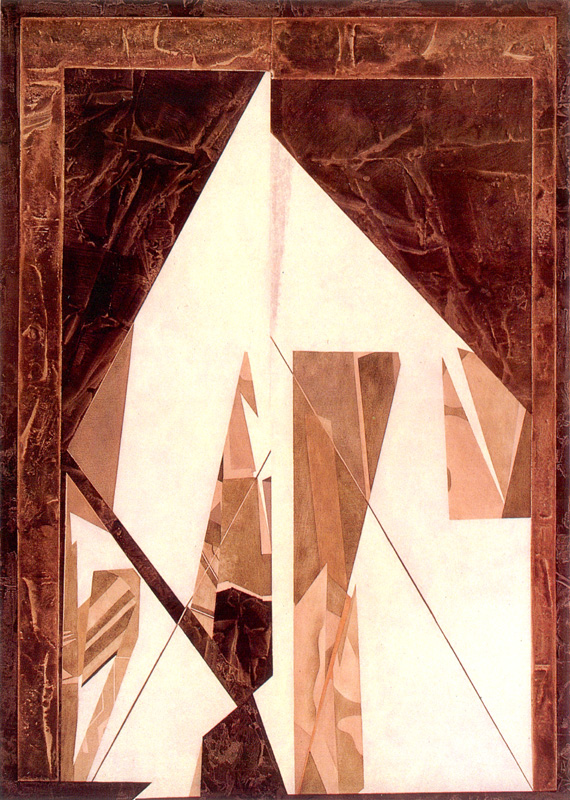
New York Series, No. 1
56″ x 84″
Oil on canvas
1992

Preface

What follows does not simplify or announce itself.  It moves inward—through observation, thought, and the tension between clarity and disappearance.  The soliloquy keeps to its own course:  neither performing nor explaining, but sustaining an interior gaze.  To read it is not to be guided, but to remain with it—where thinking becomes presence, and language measures what endures.


Soliloquy

Once upon a time, there lived within the writer a creative energy—its force and passion for self-expression—that sustained him. It was not summoned; it simply endured.  So arresting was this presence that he could not discipline it into routine or mold it into a pattern for physical endurance.  He could not pause it for walks or for any activity not already part of the act of creation itself.  He resorted to standing while writing, walking while reading, sleeping while thinking.

His experience was never an affliction to be named or cured, but a life to be lived on its own terms—a creative testament to the fullness of being, not a clinical footnote to someone else’s definition.  Choosing not to be defined by it honored both its agency and his lifelong work.  It was a condition to be understood alone, even if shared in writing—yet never in search of validation.

Within the boundaries of personal insight, it revealed itself as a form of devotional absorption, one that brought dignity even in moments of physical strain and aging.

His refusal of validation was not an opposition to authority, but a denial that any external pressure should exist.

Some said there was nothing unique in anyone, that all expression merely reflected what had been learned.  The writer did not disagree, yet he knew there was more to being than what one received—even from experience itself.  Perhaps no one was unique, but each voice was distinct—formed from the sum total of an existence that could not be equated. From a random mixture, an ineffable summation, something emerged:  something irreplaceable and irreproducible—not because it exceeded others, but because it belonged only to the one who bore it.

He feared madness—not as spectacle, but as the slow drift of meaning into isolation.  The force within him was real, yet not entirely satisfying unless it discovered truth—truth that resonated not only within his own logic but in the logic of others.  How else could one know oneself if intelligence remained solitary?  Without echo, thought became a sealed chamber:  intricate, yes, but airless.  He did not seek certainty; he sought correspondence.  It was not solitude he feared, but becoming untranslatable.

Life now appeared transient, precarious—timeless in sensation, yet embedded in time.  It moved furtively—through failings, disappointments, and sudden moments of radiant clarity.  Nothing could be reproduced.  But he had come to accept that—not because it was lost, but because even memory altered what it held.  What repeated was not the moment, but the act of noticing—the deepening of attention.   And so he did not live to preserve what was, but to remain present as it changed.  There was no going back, only going further—more attentively, more awake.

*

Ricardo F. Morin Tortolero

In transit on July 6, 2025


“A Bond’s Trace”

June 3, 2025


Ricardo Morín
Buffalo Series, Nº 12
46" x 60"
Oil on canvas
1979
Ricardo Morín
Buffalo Series, Nº 12
46″ x 60″
Oil on canvas
1979

For those of us who have lost someone,

whose presence now rests in memory

and whose absence shapes who we are.

May this story preserve something of their enduring trace.


Julian tried to put into writing what he had dreamed.

He wondered:    could writing remain faithful to the one who watches, trembles, and longs to understand?

He dreamed he was offering his mother a bowl of viper’s broth.    The serpent’s head and torn fragments of its body were still writhing, as if unaware of their condition: alive, though undone. He held the bowl with both hands; it had been handed to him by an old woman seated at the far end of a wide, shallow circular pond.    The pond seemed to contain more than water—perhaps time, or memory, or fate.    Around him loomed shadows—blurred figures repeating the same ritual, or perhaps none at all.    He could not tell.

The path to his mother was arduous; the ground was slick with a substance he could not name.    The air was dense, weighted by an oppressive silence that made each step slow, burdensome.    The viper twisted in the broth, struggling to flee.   Even so, he kept the bowl steady.    He believed—in some quiet corner of himself—that if his mother drank, healing might be reached, or understanding, or peace for them both.

When he reached her, he knelt.    He spoke gently, urging her to drink while the broth was still warm.    “Hold the spoon carefully,” he whispered.    “Just small sips.”    But she turned her face away.    She would not drink.    Whether out of fear, pride, or rejection of what was offered, he did not know.    The viper shuddered, and his heart tightened in anguish.

He awoke unsettled, exhausted.    The dream still veiled his perception.    His breath was strained, shallow in the thick air of the room.    Why couldn’t he find calm?    What, exactly, kept him awake?

He wondered if it had been a premonition—a latent fear of his own decline.    Was the writhing snake a vision of his mind losing its serenity?    Were the slow gait, the unstable ground, the trembling hands a rehearsal of his own fading?    Or was it grief—that quiet interloper of the soul, forever hungry, never sated?

He only knew he had tried to help, to steady, to offer comfort that could not be received.    And in doing so, he faced not only the absence of his mother, but the shadow of his own dread—the question of who would walk beside him when his own farewell arrived.

But perhaps—he thought—there is something sacred in the attempt.    In the offering, even when refused.    In the slow advance—however uncertain it may be.


There, humility may dwell:

the kind that does not demand,

and yet disarms pain

by its presence—

too steady to be cast aside.

It meets no resistance—

only the quiet invitation to be welcomed.

Ricardo F. Morin Tortolero

Bala Cynwyd, Pa, June 2, 2025


“The Limits of Suffering”

March 14, 2025

*

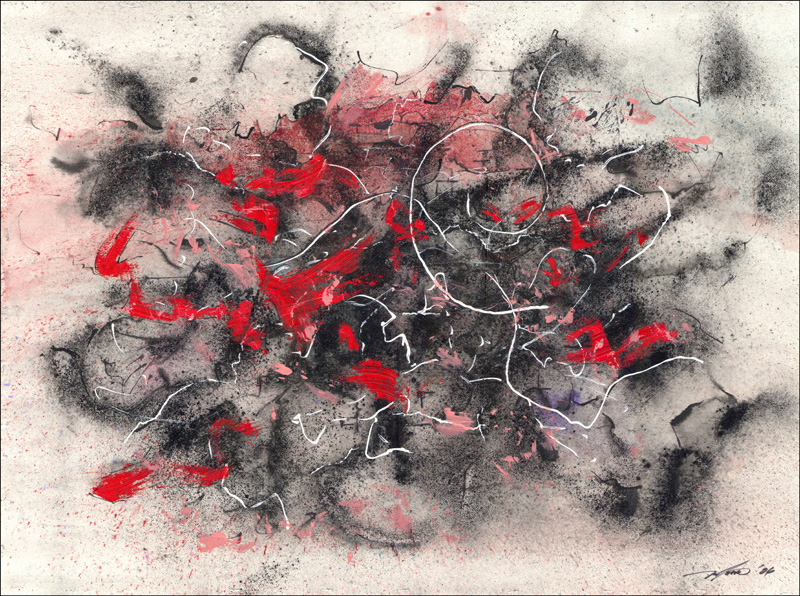
Untitled 012 by Ricardo Morín
22" x 30"
Watercolors, charcoal, oil, white-out and ink on paper
2006
Untitled 012 by Ricardo Morín
22″ x 30″
Watercolors, charcoal, oil, white-out and ink on paper
2006

There exists a threshold beyond which suffering ceases to be endurance and becomes something else—something raw, incommunicable.      It is not simply a matter of pain, nor even of despair, but of a silent depletion where the self finds itself at the precipice of its own dissolution.      Yet, how does one define this limit?

It is tempting to believe suffering has purpose, that it can be transmuted into wisdom or resilience.      This belief sustains us through its early stages.      We endure in the name of meaning, in the hope that suffering refines rather than annihilates.      But there comes a point where suffering becomes a force unto itself, severed from justification.      It no longer instructs, no longer dignifies—only persists.

The problem of suffering is not only how much one can bear, but how much one should reveal.      Silence often protects both the sufferer and the witness.      There are pains too intimate, too profound to translate into language without reducing them to spectacle.      To expose suffering in its entirety risks transforming it into something unrecognizable, stripping it of the dignity that private endurance affords.      Yet, concealment can create its own form of exile, a loneliness where pain festers unseen.

Some attempt to navigate this tension by offering fragments—enough to acknowledge suffering’s presence without inviting intrusion.      Others say nothing at all.      This is not cowardice but a final assertion of control, a refusal to be defined by pain.      To impose the expectation of disclosure upon those who suffer is to misunderstand the nature of their burden.      The gravity of suffering is not only in the experience itself but in the impossible task of making it understood.

We live under the illusion that the mind and body will hold, that endurance is limitless.      But suffering reminds us otherwise.      There is a breaking point, whether visible or silent, sudden or drawn out.     

It is not the same for everyone.      Some withstand more than others—not through superior strength, but through a different alchemy of circumstance, temperament, and sheer chance.      What remains constant is that all thresholds, eventually, are met. There is no single way to live with suffering.    Sometimes, what brings relief is not endurance, but the quiet act of self-recognition.    To speak, when one can.    To remain silent, when one must.    In the space between what cannot be said and what must be accepted, a simple truth may emerge: even uncertainty can sustain us, if we meet it with honesty.

And when that release is impossible, when suffering stretches beyond its own limits, only the silent acknowledgment of its presence remains—a weight that, sooner or later, must either be laid down or consume what is left.

Ricardo Federico Morín Tortolero

March 16, 20025; Oakland Park, Florida