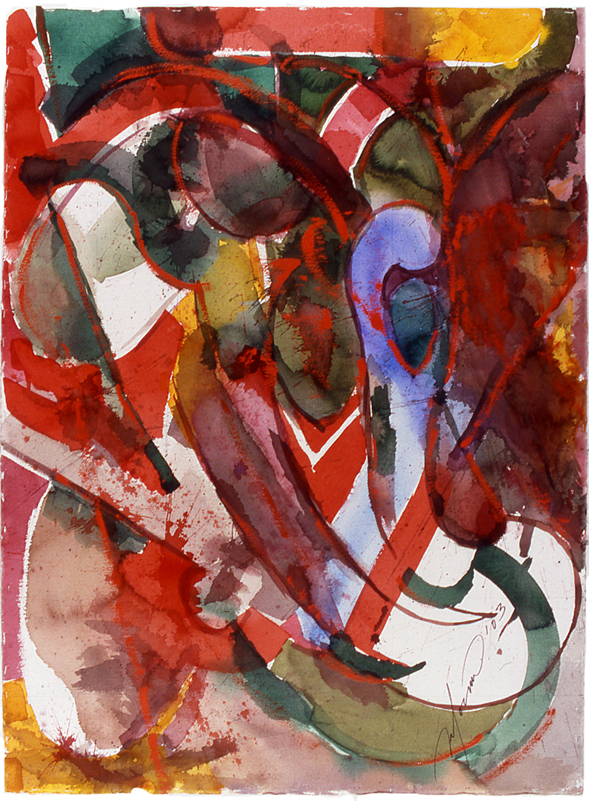
Ricardo F. Morín Templates II 40″h. x 30″w. Watercolor on paper 2003
People come to know who they are over time rather than all at once. A person recognizes themselves through earlier actions, remembered choices, and past commitments, even though the conditions under which those moments occurred no longer remain the same. What feels continuous is not encountered directly, but pieced together through recollection and interpretation as circumstances change. Because of this, uncertainty enters any effort to maintain a stable sense of self, not through confusion or deceit, but through the simple passage of time.
A person’s relation to themselves is therefore never fixed at its origin. It is mediated by memory, revision, and reassessment as life unfolds. What once made sense as a response to a particular moment must be understood again under different conditions. Identity does not remain secured by intention alone, because continuity can only be reconstructed after the fact rather than preserved intact.
Once identity must be reconstructed instead of taken as given, expectations of consistency begin to exert pressure. Past actions, statements, and commitments are treated as benchmarks against which the present self is measured, even when the circumstances that produced them no longer exist. Continuity is demanded where only relation is possible. What once functioned as a response to a specific situation is asked to stand as proof of an enduring self.
Because people encounter identity through memory and interpretation rather than direct access, identity becomes subject to demands for legibility. Others rely on familiar patterns of speech, behavior, and commitment to orient their expectations. When those patterns persist, continuity is assumed. When they shift, uncertainty arises. What cannot be readily recognized is often treated as absence rather than transformation.
Under these conditions, adjustment is frequently misread as violation. Changes made in response to altered circumstances are interpreted as departures from an assumed core rather than as necessary recalibrations. Earlier expressions of self are treated as binding commitments even when the conditions that produced them have changed. What is experienced internally as adaptation is therefore received externally as betrayal, not because trust has been broken, but because the expectation of fixity has remained in place.
After reconstruction is complete, identity offers no fixed origin. It offers only a coherence that must be maintained under changing conditions of recognition. Efforts to settle distress about identity fail when they ignore a simple fact: people change before others adjust their expectations. The difficulty does not arise from change itself, but from being required to remain readable according to standards that no longer apply.
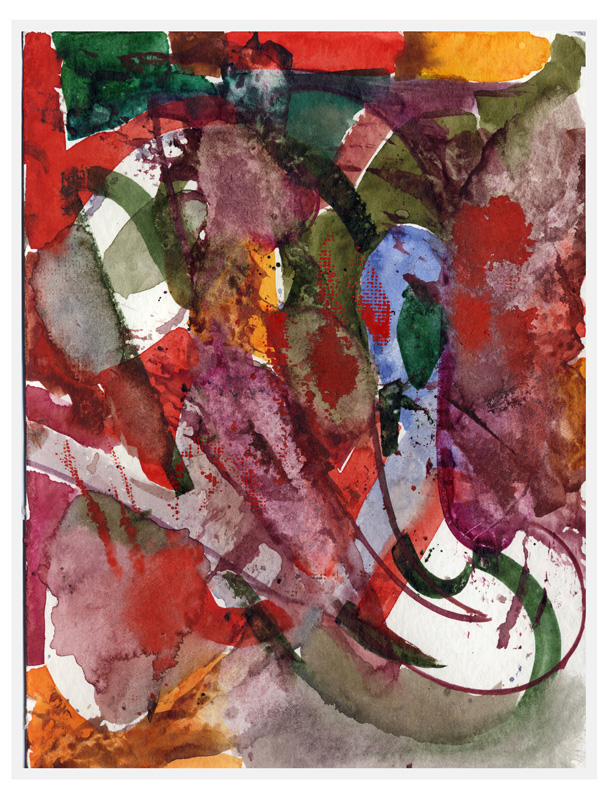
Ricardo F. Morín Templates 8” x 10” Watercolors on paper 2003
Ricardo F. Morín
January 31, 2026
Oakland Park, Fl.
People rely on memory because past experience cannot be returned to directly. What has already happened can only be approached again through recollection. Over time, memories are revisited under conditions that differ from those in which the original experience occurred. What once made sense in one moment must be made sense of again in another, and the standards used to judge it shift with present circumstances. As this happens, uncertainty enters the effort to rely on memory, not because people are careless, but because time alters the conditions under which understanding takes place.
In this respect, memory does not function differently from truth. Both remain exposed to time. What once appeared settled must be reconsidered as circumstances change, and neither memory nor truth remains fully governable by intention. What resists control is not honesty, but the displacement that time introduces between experience and its recall.
Memory as Justification
When direct access to experience is no longer possible, memory often takes its place as a source of explanation. People account for their decisions by referring to what they remember rather than to what can still be examined. Recollection is treated as evidence of continuity even when the conditions that produced it no longer exist. In this way, memory is asked to stabilize choices whose original context cannot be recovered.
As experiences recede further into the past, they are often invoked with greater confidence. This confidence does not arise because the memory has remained intact, but because distance shields it from challenge. What memory provides in such cases is not access to what happened, but a narrative sufficient to support judgment in the present.
Memory and Certainty
As experience becomes less accessible, certainty often increases rather than declines. Events that can no longer be tested against their original conditions become insulated from correction. Recollection hardens into conviction because comparison is no longer possible. Memory appears stable not because it is accurate, but because its sources cannot be revisited.
In this way, confidence attaches not to fidelity, but to distance. The past feels settled because it cannot be reentered. Certainty arises not from closeness to what occurred, but from the absence of any remaining means to contest what is remembered.
Memory and Repetition
As memories are repeated, they gain durability without preserving experience itself. Retelling does not restore original conditions; it refines what can be easily conveyed. Details that resist articulation fall away, while elements that can be narrated coherently are retained and reinforced. Through repetition, memory becomes less a trace of what occurred and more a stable account of what can be said.
What endures is not the experience itself, but a version shaped by its ability to be repeated without friction. After mediation is complete, the past yields no new facts, only new arrangements of what is already known.
We seldom think about gravity until something falls. A glass slips from a hand, rain descends through the air, our knees remind us that climbing stairs is not the same as coming down. Most of the time we simply accept weight as one of the conditions of being here. We stand because there is ground beneath us. We walk because our bodies remain attached to the surface of the Earth. We grow tired because carrying ourselves requires effort. Gravity seems so familiar that we hardly consider what it means.
We may know how to live within a condition without understanding what that condition reveals about us.
For centuries it was possible to imagine gravity as an attraction between bodies. A stone falls toward the Earth because the Earth pulls it downward. The image works well enough for ordinary purposes, and Newton gave that intuition mathematical power of extraordinary precision. Einstein did not simply improve the calculation.He altered the picture. In general relativity, gravity is expressed in the geometry of spacetime itself.Matter and energy affect that geometry, and a body in free fall follows the path determined by it.
When we stand motionless on the floor, we say that gravity is pressing us downward. But the pressure we actually feel comes from the floor pressing upward against us. If the floor disappeared and we began to fall freely, the sensation of weight would disappear as well, even though gravity had not gone away. What we call weight is the sensation produced when the floor prevents our body from following the path it would take in free fall.
We ask what time it is as though the question had a single answer.A call between London and Sydney gives the question different answers at the same moment.Morning in one place is already evening in another.We accept the discrepancy without difficulty because each clock names the hour from a different position on a rotating Earth.The clocks do not announce different realities.They reveal that even our most familiar account of time depends upon where we are.
Relativity carries that dependence further than ordinary experience suggests. The time accumulated by clocks depends not only upon the conventions by which we name the hour, but upon motion and gravity. Two perfectly accurate clocks separated by height do not accumulate exactly the same amount of time. A clock farther from the surface of the Earth runs imperceptibly faster than one below it. The difference within the height of a human body is extraordinarily small, yet it is real.
We do not feel it. Nothing in our nervous system announces that time accumulates at a slightly different rate near our head than near our feet. Our senses give us a practical world, not an exhaustive one.
The clock does more than organize appointments. Where we are enters into what we measure, first through the conventions of daily life and, at a deeper level, through the physical conditions in which the clock itself exists.
What suffices for living is not always enough for understanding.
We wake each morning within the apparent boundary of a body. We remember what happened yesterday. We anticipate what may happen tomorrow. We identify a continuous person who has survived changes of place, age, opinion, health, desire and circumstance. That continuity is indispensable. Without it we could scarcely conduct a life. But continuity does not mean immobility.
The body whose persistence we call ourselves is continually exchanging matter with its surroundings. We breathe, eat, excrete, shed cells, repair tissue, alter proteins, replace molecules and reorganize connections. The apparent solidity of the organism depends upon activity. What persists is not an untouched collection of material preserved from birth, but an organization maintained through change.
We distinguish the tree from the soil, rain, atmosphere and sunlight because the distinction is useful and because the tree possesses an organization unmistakably its own. Yet remove those exchanges and there is no tree. Its individuality does not require isolation. The boundary is real, but what it encloses remains dependent upon what crosses it.
We are no exception.
The elements in our bones, blood and nervous tissue did not begin with us. The carbon, calcium, oxygen, phosphorus and iron assembled into our bodies preceded every memory we possess. They entered a temporary organization capable of metabolism, sensation and thought. Eventually that organization will cease to maintain itself, and the materials that composed it will continue under other arrangements.
Nothing mystical needs to be added to this fact. Its difficulty comes from how directly it contradicts the scale at which we normally conduct our lives.
We naturally experience ourselves as centers. Vision opens from here. Pain occurs here. Memory gathers around this history. Desire points outward from this body. Every conscious life therefore begins from a perspective it cannot abandon. We cannot see without seeing from somewhere.
The mistake begins only when perspective becomes rank.
Because experience is centered upon us, we can begin to imagine that reality is centered upon us as well. What begins as an unavoidable condition of perception becomes an assumption about significance. Our plans acquire urgency because they are ours. Our losses appear uniquely intolerable because we undergo them. Our victories expand in importance because we remember the effort required to obtain them. The world gradually takes the form of a field across which we measure advantage, recognition, possession and control.
Much of human life must operate at this scale. We need homes, work, protection, institutions, agreements and some capacity to shape circumstances rather than merely submit to them. There is nothing inherently misguided in agency. The confusion occurs when the capacity to act becomes evidence of independence, or when the ability to control a portion of our circumstances is mistaken for mastery over the conditions that make control possible.
We may command a room, own a building, govern a company, direct an institution or exercise authority over millions of people, yet none of these distinctions alters the geometry in which our bodies exist. The most powerful person and the least visible pedestrian remain equally unable to suspend the passage of their own time. No title arrests metabolism. No possession negotiates with gravity. No reputation follows matter as an intrinsic property when the organization that sustained a person comes to an end.
This does not make human distinctions unreal. It places them.
A contract matters within human relations. An injustice matters to the person subjected to it. A work of art may alter perceptions long after the artist dies. A decision taken in an office can change a river, destroy a forest, preserve a neighborhood or determine whether strangers live under security or fear. Scale does not abolish consequence.
But consequence and cosmic importance are not the same thing.
We often seem caught between two unsatisfactory possibilities. Either we exaggerate ourselves until human desire becomes the measure of reality, or we look at the immensity of the universe and conclude that nothing we do can matter. Both responses preserve the same assumption. Both imagine that significance must be proportional to size or duration.
It need not be.
A brief event can alter everything that follows from it. A mutation occurs within a microscopic structure. A seed germinates in a crack. A sentence changes a judgment. A decision made in minutes affects people who were never present when it was made. Duration does not determine consequence any more than physical size determines complexity.
Our lives can therefore be transient without being negligible.
Much of human culture has been built around resistance to transience. We preserve names on buildings. We accumulate objects beyond use. We construct genealogies, monuments, archives and institutions. We seek recognition from people we do not know and sometimes from generations that will never meet us. Even power often carries beneath its practical advantages an obscure promise that importance might somehow protect us against disappearance.
Yet permanence is not what continuity means.
A wave continues through water without preserving the same water. A forest persists while individual trees germinate, mature, fall and decompose. A language survives because speakers who did not invent it alter it while using it. Continuity can depend upon transformation rather than resist it.
We usually speak of beginnings and endings as though they marked opposite conditions of reality. Something begins when a form appears and ends when that form can no longer sustain itself. The distinction remains real at the scale of the form, yet becomes less absolute when we ask what, precisely, has begun or ended. The wave subsides while the water continues in motion. The tree dies while its matter enters other exchanges. A body ceases to maintain the organization by which we recognized a person, while its materials continue under conditions the person no longer inhabits.
The same uncertainty widens with the scale. Roger Penrose has proposed, through conformal cyclic cosmology, that the remote future of one cosmic era may be conformally continuous with what appears as the beginning of another. Whether that proposal survives observation remains unresolved. Its relevance here lies less in asking us to accept a cyclic universe than in exposing how readily we treat beginning and ending as absolute properties of reality when they may also describe transitions between forms whose continuity exceeds the scale from which we observe them.
Every beginning we encounter already depends upon conditions that preceded it, and every ending alters the conditions that follow. A beginning can therefore be genuine without being an emergence from nothing, just as an ending can be final for a particular organization without becoming the disappearance of the reality from which that organization arose.
Continuity does not abolish beginning or ending. It places both within transformation.
We participate in such continuities everywhere, although our attention gravitates toward the individual form.
Birth gathers matter into an organization capable of sustaining a particular history. Death ends that organization. Between them something genuinely singular occurs. There is perception. There is memory. There is the astonishing capacity not merely to undergo events but to recognize relations among them.
Consciousness occurs within that same continuity.
We still do not possess an agreed physical account of how subjective experience arises. Penrose has also suggested that the problem may expose limits in our present understanding of quantum mechanics and perhaps connect consciousness with processes deeper than ordinary computation. Those proposals remain disputed.The more elementary point does not depend upon them:whatever consciousness ultimately proves to be, it does not occur outside nature.
Our thoughts are not spectators admitted into the universe from another realm.
They happen here.
The brain that distinguishes a star against surrounding darkness was assembled from the same physical world it observes. The eye that receives the light belongs to an organism formed on a planet orbiting one star among hundreds of billions in a galaxy that is itself one among an immense number of galaxies. The mathematical symbols with which we describe curvature, time and matter arise within nervous systems subject to the very conditions those symbols attempt to understand.
We are therefore in a peculiar position. We cannot step outside the universe to inspect it, yet within the universe a form has arisen capable of asking what the universe is.
This need not mean that the cosmos is conscious. The claim would exceed what we know. A more modest claim is already extraordinary enough: portions of matter can become organized in such a way that the resulting organism acquires sensation, memory, inference and the ability to examine its own conditions of existence.
For a while, matter can ask what matter is.
For a while, a temporal organism can investigate time.
For a while, beings held to the Earth by a geometry they cannot perceive directly can discover that geometry and revise an intuition that had seemed obvious.
Consciousness also allows consequences to be imagined before they occur.
A stone changes what it strikes. A river reshapes its banks. A storm destroys without intending destruction. We also alter what surrounds us, but sometimes we can foresee the alteration.
That difference is small in cosmic scale and enormous in human consequence.
The ability to anticipate does not guarantee wisdom. It also permits calculation, exploitation and forms of domination unavailable to creatures incapable of abstraction. We can organize resources on scales no individual could command alone. We can convert forests into numbers, populations into categories and distant consequences into tolerable abstractions. The same intelligence that discovers our dependence upon intricate systems can devise increasingly efficient ways of extracting from them.
Our problem may therefore be less a shortage of intelligence than a disorder in the scale at which intelligence is applied.
We become extraordinarily attentive to what enlarges immediate agency and strangely inattentive to the conditions that make agency possible. We learn how to increase production before asking what its continuation requires. We perfect means of influence without examining what influence is for. We celebrate the enlargement of personal power while rarely asking whether the self being enlarged has been understood.
We are temporary organizations of matter attempting to secure permanence by accumulating temporary arrangements of matter. We seek independence through systems of dependence. We pursue control while inhabiting bodies whose most elementary processes remain beyond voluntary command. We measure ourselves against one another while all of us participate in conditions none of us established.
Perhaps this is why cosmic perspective can become sentimental so easily. We look at photographs of galaxies, pronounce ourselves small and then return unchanged to the same hierarchies of importance. Smallness alone teaches very little.
The more consequential recognition is not that we are small. It is that we are situated.
We exist here, under conditions.
The word here contains more than location. It includes a particular planet, atmosphere, gravitational field, evolutionary history, network of organisms, inherited language and moment in time. None was chosen by us. Yet through them we acquired the capacity to choose other things.
We often speak of freedom as though it required independence from conditions, although nothing we observe possesses that kind of independence. What we call freedom therefore takes place within circumstances we did not choose and cannot entirely command.
Use is not identical with entitlement, nor ambition with domination. Individuality does not require separation from what sustains it, just as singularity does not by itself confer supremacy.
None of this diminishes human achievement. The ability to understand even a fragment of the cosmos is itself one of those achievements. What changes is the meaning of achievement when it no longer serves as evidence that we stand above the reality from which it arose.
Gravity remains an ordinary condition of the body.
We may speculate about consciousness, argue about the origin of the universe and construct theories extending billions of years into the past and future, but while doing so we remain seated in chairs, standing on floors, carrying the weight of bodies whose organization must continuously be maintained. The cosmic does not begin somewhere beyond ordinary life. It is already present in the conditions that make ordinary life possible.
The distance between our feet and the ground is enough.
The interval between one heartbeat and the next is enough.
The fact that we are changing while calling ourselves the same is enough.
The universe becomes less an enormous object surrounding us than the continuity within which our distinctions arise. We do not disappear into that continuity. We become more precisely located within it.
And perhaps location is a better beginning for human significance than grandeur.
We do not need to imagine ourselves as the purpose of the universe. We do not need the universe to certify our importance. We need only recognize that, during the brief organization we call a life, we can become aware of relations that extend beyond our immediate interests and sometimes choose our actions in light of them.
Gravity gives us weight without telling us what deserves weight.
Consciousness cannot release us from the conditions of existence, but it allows us to examine the measures by which we assign importance within them.
Between those two facts, a human life takes place.
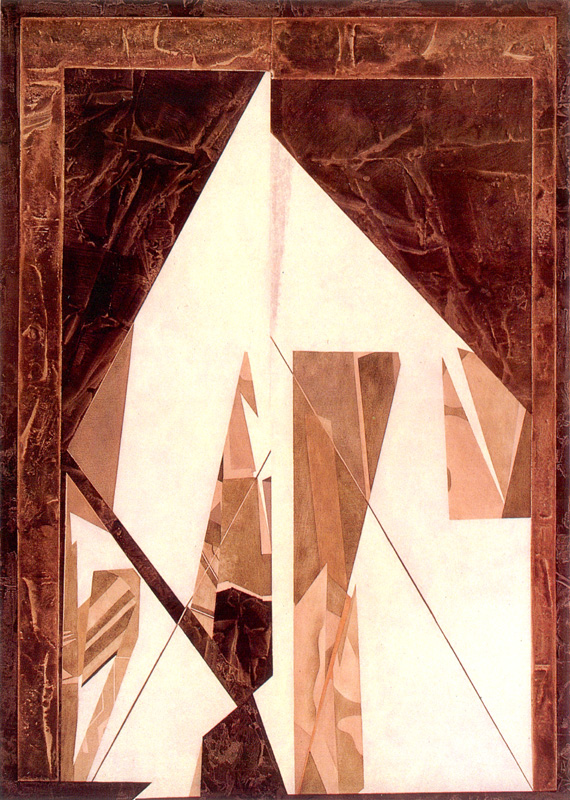
Ricardo Morin The Seventh Watch (Template Series, 5th panel) Watercolor over paper 22” x 30” 2005
Introductory Note
Ricardo Morin is a writer and researcher of the history of thought as a dynamic and evolving practice—a student of unspoken gestures, a language stronger than words, especially when interlocutors no longer listen to each other. Drawing on reflections on the cycles of life and a personal experience approaching the last, he invites readers to consider how quiet vigilance and tenderness can shape a meaningful existence. The Seventh Watch emerges from decades of living attentively, offering a humble testament to dignity through perseverance and care.
71 Years
I’ve lived seventy-one years. That alone still surprises me—not because I ever expected an early end, but because each year has asked more of me than the last. There was no dramatic fall, no single crisis to point to. Just a slow, constant shaping—of the body, of temperament, of the will.
Illness didn’t come in childhood. It arrived later, in my early twenties, during a snowbound winter in Buffalo. I was just beginning to live on my own, full of ambition and unfinished dreams. The diagnosis was mononucleosis—but it wasn’t the name that mattered. It was the way it interrupted momentum, slowed my pace, and revealed something deeper: the lifelong task of learning to live within my own limits.
That was the beginning—not of a medical history, but of a different kind of vigilance. Not directed outward, but inward. A quiet realization took root: that survival, if it was to be meaningful, required not just endurance, but restraint. A way of protecting myself from myself. That discipline wasn’t harsh—it became a kind of devotion. Not to self-denial, but to finding the clarity of a peaceful mind. To living with more care than urgency.
I don’t see illness as noble, but I do see in it a mirror—not for the pain, but for the truth it reflects. What can be tended, what must be relinquished, what deserves attention. I don’t claim wisdom from illness, but I recognize what it’s taught me to let go of: illusion, pride, and the frantic chase after things that do not last—such as the accumulation of wealth or power.
I’ve come to think of it simply as endurance—the kind illness teaches when you stop resisting and begin listening. There’s an ethical arc in this awareness—not born of dogma or belief, but shaped by experience. It bends not toward triumph, but toward tenderness.
This isn’t a story of pathology. It’s a story of attention—of refining the self without hardening it. Of discovering that maturity means knowing when to persist and when to pause. That the quiet act of sustaining one’s life—daily, attentively—is its own form of courage.
I never set out to write a testament. But seventy-one years in, I see the outlines more clearly. And in that, there is dignity.
Yet, dignity is not a reward. It arrives without announcement, without ceremony. It builds slowly—through the daily rituals of rising, of choosing what to carry and what to set down. It does not shield one from sorrow, nor make suffering easier to bear. But it gives the days a certain weight.
I’ve come to cherish that weight—not as a burden, but as proof. Proof that I’ve lived through each season not untouched, but intact. And that, even now, the task is not to escape life’s demands, but to meet them with steadiness.
What I’ve learned isn’t mine alone. Anyone who lives long enough will be asked to reckon with time—not as a thief, but as a sculptor. Illness, especially, teaches us how little control we truly have—yet how much presence we’re still capable of. It humbles and joins us. Not in sameness, but in mutual recognition.
Endurance, I’ve found, is not passive. It’s not about waiting for pain to pass. It is active, quiet, often unseen. It means choosing how to live when choice feels narrow. It means tending to life not with haste, but with attention.
There is no finish line to this work. Just the quiet act of continuing.
So I continue—not because I must, but because life, even in its reduced dimensions, still offers room for meaning. Some days that meaning is faint. Other days it is simply the act of rising, or writing a letter, or remembering the snow. But it is there. And as long as it is, I remain.
What follows does not simplify or announce itself. It moves inward—through observation, thought, and the tension between clarity and disappearance. The soliloquy keeps to its own course: neither performing nor explaining, but sustaining an interior gaze. To read it is not to be guided, but to remain with it—where thinking becomes presence, and language measures what endures.
Soliloquy
Once upon a time, there lived within the writer a creative energy—its force and passion for self-expression—that sustained him. It was not summoned; it simply endured. So arresting was this presence that he could not discipline it into routine or mold it into a pattern for physical endurance. He could not pause it for walks or for any activity not already part of the act of creation itself. He resorted to standing while writing, walking while reading, sleeping while thinking.
His experience was never an affliction to be named or cured, but a life to be lived on its own terms—a creative testament to the fullness of being, not a clinical footnote to someone else’s definition. Choosing not to be defined by it honored both its agency and his lifelong work. It was a condition to be understood alone, even if shared in writing—yet never in search of validation.
Within the boundaries of personal insight, it revealed itself as a form of devotional absorption, one that brought dignity even in moments of physical strain and aging.
His refusal of validation was not an opposition to authority, but a denial that any external pressure should exist.
Some said there was nothing unique in anyone, that all expression merely reflected what had been learned. The writer did not disagree, yet he knew there was more to being than what one received—even from experience itself. Perhaps no one was unique, but each voice was distinct—formed from the sum total of an existence that could not be equated. From a random mixture, an ineffable summation, something emerged: something irreplaceable and irreproducible—not because it exceeded others, but because it belonged only to the one who bore it.
He feared madness—not as spectacle, but as the slow drift of meaning into isolation. The force within him was real, yet not entirely satisfying unless it discovered truth—truth that resonated not only within his own logic but in the logic of others. How else could one know oneself if intelligence remained solitary? Without echo, thought became a sealed chamber: intricate, yes, but airless. He did not seek certainty; he sought correspondence. It was not solitude he feared, but becoming untranslatable.
Life now appeared transient, precarious—timeless in sensation, yet embedded in time. It moved furtively—through failings, disappointments, and sudden moments of radiant clarity. Nothing could be reproduced. But he had come to accept that—not because it was lost, but because even memory altered what it held. What repeated was not the moment, but the act of noticing—the deepening of attention. And so he did not live to preserve what was, but to remain present as it changed. There was no going back, only going further—more attentively, more awake.
During the last decade of his life, Michael’s health declined steadily, much as his father’s had in the years before him, burdened by a succession of illnesses that gradually narrowed the ordinary horizons of living. Yet he continued to embrace each day with quiet resolve, even as the growing uncertainty of his own body became impossible to ignore. His suffering was never his alone. It was shared by the husband who remained at his side and by those who loved him. His final years revealed a condition that ultimately belongs to every human life.
*
I. The Burden of Awareness
Sometimes suddenly, sometimes almost imperceptibly through the passing years, there comes a moment when mortality ceases to be an abstraction. It is no longer a distant eventuality, safely concealed beneath the routines of ordinary life or softened by the expectation of time still remaining. It becomes immediate, undeniable, and inseparable from the consciousness through which we experience the world.
For some, this awakening begins with the quiet betrayals of the body. A stiffness that no longer disappears with rest, a memory that hesitates before returning, a step taken with unexpected caution, each becomes a subtle reminder that permanence was always an illusion. For others, it begins with loss. The death of a friend, a sibling, a parent, or a spouse quietly reveals that what has happened to another now belongs, inevitably, to oneself.
Such awareness alters the measure of time. The future no longer appears boundless, nor does the past remain merely a record of what has been. Each assumes a different proportion. Without consciously intending it, we begin to measure life less by what has been accomplished than by what still remains possible.
The mind instinctively resists this recognition. It seeks refuge in plans, obligations, familiar routines, and the reassuring continuity of ordinary existence, as though attention itself might postpone what reason already knows. Mortality becomes something acknowledged intellectually while remaining emotionally distant.
This awakening is neither an achievement nor a failure. It is simply one of the conditions of being human. From the moment mortality is no longer imagined but personally recognized, every subsequent experience of decline, suffering, endurance, and acceptance acquires a meaning it could not previously possess.
~
*
II. The Decline: Mind and Body
Decline rarely announces itself through a single decisive event. More often, it advances quietly, measured by changes so gradual that they are first mistaken for passing inconveniences. The body no longer responds with its former certainty. Movements once performed without thought require intention. Strength diminishes, endurance shortens, and the senses begin, almost imperceptibly, to surrender their former clarity.
The mind follows a similar course. Memory hesitates where it once answered effortlessly. Thoughts arrive more slowly or dissolve before reaching completion. Attention becomes increasingly fragile, interrupted by moments of uncertainty that were once unknown. Yet awareness often remains sufficiently intact to perceive these changes with unsettling precision. There is a particular solitude in witnessing the gradual alteration of one’s own faculties while still possessing the clarity to understand what is being lost.
Medicine seeks, rightly, to preserve function, relieve suffering, and extend the years in which life may continue with purpose. Its achievements have transformed the experience of aging and illness beyond what earlier generations could have imagined. Yet no intervention alters the fundamental condition from which every life begins. The body remains finite, and every effort to preserve it ultimately encounters limits beyond which restoration is no longer possible.
The deepest transformation, however, is neither physical nor intellectual. It lies in the gradual recognition that decline is not an interruption of life, but one of its final expressions. What first appeared exceptional slowly reveals itself to be part of the same natural order through which every living being passes.
~
*
III. The Distractions That Delay Acceptance
To recognize mortality is not the same as to accept it. Awareness may arrive suddenly, yet acceptance often remains distant, deferred by the mind’s persistent inclination to continue living as though time were still without measure. We do not turn away because we are incapable of understanding death. We turn away because we remain deeply attached to life.
This attachment reveals itself in countless ways. We make plans, pursue ambitions, strengthen the body, cultivate the mind, and seek new remedies for the illnesses that accompany advancing age. We continue to build, repair, organize, and anticipate tomorrow, not merely because these activities possess value in themselves, but because they reaffirm our place within a future we instinctively presume will continue.
The reluctance to let go arises from more than fear alone. Lives remain unfinished. Promises have yet to be fulfilled, conversations remain incomplete, responsibilities endure, and those we love continue to depend upon us. Even after a long and abundant life, there persists the quiet conviction that something essential still awaits completion. What binds us to life is often less the fear of dying than the unwillingness to leave unfinished what we believe still belongs to our care.
These attachments are neither weaknesses nor illusions to be dismissed. They are expressions of love, responsibility, curiosity, and hope, the very qualities through which life acquires meaning. Yet they also postpone the inward stillness from which acceptance may eventually emerge. Before the end can be received with peace, the mind must gradually relinquish not only its fear of death, but also its expectation that life must always continue.
~
*
IV. The Weight of Suffering and Endurance
Suffering is among the few certainties shared by every sentient being. It is neither rare nor exceptional, but woven into the fabric of existence from its first breath to its last. Yet, for all its universality, suffering remains profoundly individual. No two lives experience it in precisely the same way, nor can its weight be fully measured by those who do not bear it.
Pain assumes many forms. It may arise from illness, injury, or the gradual weakening of the body. It may also emerge from quieter losses, the diminishing of memory, the erosion of independence, the loneliness of watching the world continue without us, or the grief that accompanies every meaningful attachment. Some burdens are visible and readily acknowledged. Others remain concealed, carried in silence and known only to the one who endures them.
Suffering, however, is not the same as endurance. Suffering is what life imposes. Endurance is the human response to what has been imposed. It is the quiet capacity to continue despite pain, uncertainty, or loss. It allows ordinary lives to bear extraordinary burdens without surrendering the desire to remain engaged with the world.
The measure of endurance cannot be determined from the outside. What one person carries with apparent ease may overwhelm another. A burden once thought unbearable may gradually become part of daily existence, while a seemingly lesser sorrow may exhaust reserves that have long been silently diminishing. Endurance follows no universal scale, for it reflects not only the magnitude of suffering but also the unique history, temperament, relationships, and inner resources of the individual who bears it.
For this reason, suffering should never be confused with weakness, nor endurance with invulnerability. To endure is not to deny pain, but to continue living in its presence. It is one of the quietest expressions of human dignity, requiring neither recognition nor admiration to possess its full measure.
Every life eventually encounters the limits of endurance, although those limits cannot be predicted or judged by others. They reveal themselves only within the silent experience of the individual who bears them. Before acceptance becomes possible, one must first come to understand not only the reality of suffering, but also the extraordinary capacity to endure it.
~
*
V. The Unseen Threshold
Life does not depart all at once. It recedes quietly at first, almost imperceptibly in its withdrawal. The breath grows shallower, not in gasps but in a gradual easing, as though the body has begun to ask less of the world. Weight diminishes, not only in flesh but also in presence. The self appears to loosen its attachment to the demands that once defined ordinary existence. A once restless mind drifts more freely, its thoughts lingering less upon the past, the future, or even the urgency of the present.
These changes need not be understood as signs of failure or defeat. They often resemble a gradual lessening of effort. The body begins to relinquish tasks it once performed without thought. Rest occupies more of the day than activity. Silence becomes more welcome than conversation. Even the struggle to remain gradually yields to intervals of quiet that seem neither forced nor resisted. The body often appears to recognize this transition before the mind fully understands it.
There also comes a moment of recognition that seldom announces itself dramatically. It is rarely defined by a diagnosis or measured by the calendar. Rather, it emerges through lived experience. Some continue to resist its approach and devote their remaining strength to extending each day. Others seem gradually to accommodate its presence, much as one yields to sleep after a long period of wakefulness.
Within this progression, control itself begins to assume a different meaning. The effort to command every remaining moment often gives way to a willingness to accompany the body’s own course. What earlier appeared to demand resistance may gradually invite release. The conclusion of life comes to resemble not an interruption of its order, but one of its final expressions.
Death remains neither something to be conquered nor something that can be indefinitely postponed. It stands as the final threshold of every life, unseen until it is approached and fully known only by the one who crosses it.
~
*
VI. The Quiet Acceptance
To think of death without fear, to sit with it unguarded and allow it to be what it is, may represent one of the last transformations of consciousness. For much of life the mind recoils from its certainty, surrounding it with distractions, explanations, ambitions, and unfinished obligations. Yet there often comes a time when these gradually lose their urgency, and death no longer appears as an interruption but as the natural conclusion of a life that has followed its own course.
As this change unfolds, fear itself may begin to assume a different character. The body has already entered the work of relinquishment. The mind, more slowly, begins releasing its attachment to unfinished meanings, unresolved questions, and the expectation that one more day might alter what has already become complete. Acceptance does not arise from certainty. It emerges gradually as resistance itself becomes less necessary.
No single course belongs to every life. Some meet mortality with acceptance, others with fear, resistance, or uncertainty. Illness, circumstance, or the limits of consciousness may leave little opportunity for reflection. The experience admits no universal progression. Yet where acceptance gradually emerges, it reveals not a victory over death, but one possible way of inhabiting its certainty.
Stillness differs from resignation. Resignation suggests defeat before an unwanted circumstance. Stillness suggests something quieter, an increasing harmony between the body’s condition and the mind’s understanding of it. The effort to negotiate with what cannot be altered slowly diminishes. What remains is neither triumph nor surrender, but a growing reconciliation with the course life has taken.
From within that reconciliation, life may be seen differently. Its value no longer depends upon its indefinite continuation, but upon having been lived. The quiet that once seemed empty gradually becomes sufficient in itself. Little remains to be defended. Little remains to be explained. What has been given begins to appear complete.
~
*
VII. The Living Memory
No life is lived in solitude, and no journey toward acceptance is completed alone. Along the way we are shaped, guided, and sustained by those whose lives become inseparable from our own. Even after they are gone, their presence continues in memory, affection, and the countless ways they have altered the lives they touched.
Michael’s final years offered such a presence. Those who remained beside him witnessed not only the gradual demands of illness, but also the quiet persistence with which he continued to inhabit each day. His life, no less than his death, reminds us that mortality is never experienced by one person alone. It is shared by families, by companions, and by all who accompany another through the final chapters of life.
Death strips away much that once appeared essential. What remains is often simpler than we had imagined. Affection endures. Gratitude remains. Memory continues its work long after physical presence has departed.
To those who have accompanied us through life, we owe more than remembrance. We owe the recognition that much of who we have become was formed through their companionship, their patience, and their love. Their absence does not erase that gift. It leaves it more clearly visible.
They are no longer present as they once were. Yet what they entrusted to those who loved them continues beyond their lives, carried quietly within the memory and affection of others. In that continuing presence, gratitude finds its most enduring expression.