Posts Tagged ‘Impermanence’

“A Conversation With Oneself”

May 19, 2026

Ricardo F. Morín

May 17, 2026

Bala Cynwyd, Pennsylvania

He considers whether the biography and the career essay can cohabit sequentially within the same corpus.

They can.  The sequence already contains its own direction.  The career essay first:  closer to the present tense of perception, moving by suspension, withholding biography deliberately.  The reader encounters the intelligence before the circumstances surrounding it.  The biography afterward.  What had remained withheld becomes visible then:  the cities, the illnesses, the rooms, the years of interruption and displacement.

Read in that order, the two texts produce something neither fully achieves alone.  One reveals how a person sees.  The other reveals what that person passed through while seeing it.  The distance between them does not fracture the corpus.  It creates proportion.

He considers whether three registers can coexist within the same body of work.

A corpus restricted to one register may already have accepted its own limits.  Multiple registers practiced simultaneously suggest something else:  not instability of method, but continuity of attention moving through different materials.  The register changes according to what the material permits or resists.  The underlying attention remains recognizable.

Across them, something is repeatedly brought near the edge of conclusion without fully entering it.  Not because conclusion is feared, but because certain recognitions become less accurate once sealed too quickly.  The distribution changes from text to text.  The pressure of examination does not.

The difficulty is less internal than external.  Readers and institutions prefer writers who can be situated immediately.  A stable category simplifies reception.  The corpus resists that instinct without opposing it directly.  Some readers may find the variation generative.  Others may experience uncertainty before it.  That uncertainty may not be a defect in reception.  It may be an accurate reflection of the work itself.

He considers publication outside of WordPress.

He does not intend to seek publication through commercial structures.  WordPress has held the work for eighteen years.  That continuity has been sufficient.  The responsibility, if there is one, would consist only in maintaining a parallel digital corpus capable of surviving technical disappearance should the platform eventually fail.  Perhaps a university library at some later point.  Perhaps not.

No publishing houses.  No agents.  Few editors he would trust enough to permit entrance into the interior movement of the prose.

He considers how long WordPress itself may last.

WordPress.com is operated by a private company.  Eighteen years of continuity is reassuring but not decisive.  Many structures that once appeared permanent disappeared without ceremony.  Libraries persist differently because preservation forms part of their institutional obligation rather than their market survival.

Yet the archive does not feel urgent.  There may still be another fifteen years of work not yet written.  The corpus at that point would be larger, more complete, more internally connected than it is now.  Premature administration of a living practice can quietly interfere with the practice itself.

What matters at present is simpler than preservation.  The work continues.  The corpus develops.  The next sentence remains unwritten.

He considers whether he should simply let the chips fall where they may.

The work exists.  It accumulates gradually.  What survives and what disappears has never belonged entirely to the author.  Most of what human beings created vanished long ago:  paintings, manuscripts, cities, names.  What remains is shaped partly by quality, partly by accident, partly by whether another person cared enough to carry something forward beyond its own moment.

There may be a form of integrity in recognizing that limit without bitterness.  A prose that refuses premature closure, a corpus resistant to category, a writer uninterested in agents, publishers, or literary positioning:  all of these movements arise from related recognitions.  The same attention that hesitates before sealing a conclusion in a sentence may hesitate before sealing one about permanence itself.

He considers whether it is worth anticipating the future condition of the corpus.

Probably not.

The work understood this long before the prose articulated it directly.  The understanding did not arrive as philosophy.  It emerged gradually through repetition:  paintings delayed, illnesses prolonged, rooms abandoned, plans interrupted, canvases resting against walls for weeks while nothing visible advanced and yet something continued silently underneath perception itself.

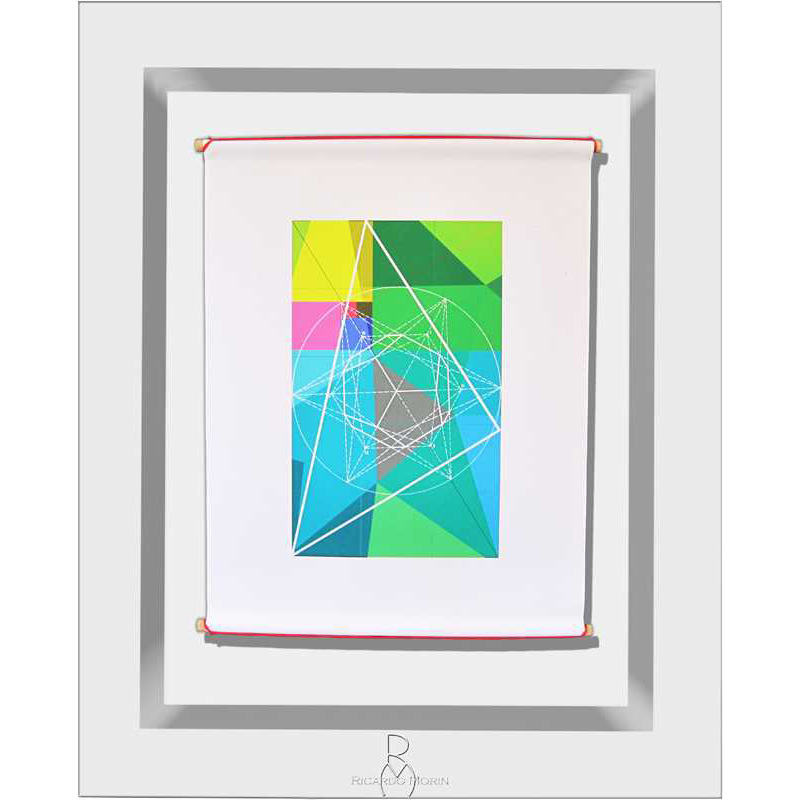
The pergaminos colgantes already contained that movement.  So did Paradise.  So did the long periods of stillness in Valencia.  The recognition that anticipation easily becomes a form of inward noise did not arise from theory.  It arose from observing how quickly projection interferes with attention.

To apply a different standard to the corpus itself, worrying over survival, categorization, institutional placement, would introduce an inconsistency the work has spent decades attempting to reduce.

The present moment contains the next essay.  That is sufficiently difficult.  Everything beyond it risks becoming administration of what does not yet exist.

He considers whether to share the corpus formally with an institution.

Perhaps not at all.

That possibility no longer produces anxiety.  It follows naturally from the other refusals already present throughout the work:  refusal of fixed category, refusal of literary positioning, refusal of premature conclusion, refusal of treating visibility as proof of value.

The archive may survive.  Or disappear.  Neither alters the necessity of the work while it is being written.

He considers ownership.

He never took much pride in possession.  The loft in Tribeca was relinquished.  The taller in Venezuela was relinquished.  Professional identities were relinquished more than once.  Each release altered perception afterward.  Something became visible that possession itself had partially obscured.

A corpus may not differ greatly from that condition.

The essays exist.  What happens to them afterward cannot entirely belong to him any more than the changing light across suspended canvases belonged to anyone who happened to stand before them.  The work was never constructed as property.  The pergaminos were not made as objects to dominate space.  They emerged from stillness temporarily and returned to it afterward.

Complete relinquishment may not signify indifference.  It may be the final extension of the same attention from which the work emerged.

He arrives somewhere that does not require a name.

Not grief exactly.  Not resignation.

Tears of loss look backward toward what can no longer be recovered.  Tears of acceptance belong to a different condition entirely:  recognition without resistance, clarity without demand for alteration, awareness without the impulse to negotiate with reality so that it conforms to preference.

The work approached that same place gradually through many forms and many years:  the stillness after noise, the empty canvas before the first mark, the pergamino hanging without frame or enclosure, the intervals where nothing appeared resolved and yet nothing required immediate resolution either.

Perhaps the work was never attempting permanence at all.  Perhaps it was attempting something closer to lived energy moving through form for a brief interval before returning to stillness again.

That is not a small thing.

A conversation with oneself.

The question unresolved.

What remains is the writing.


“A Threshold of Silence”

February 12, 2025

~


*

Michael Basso
(June 28, 1955 – May 28, 2025)

~


*

Sometimes sudden, sometimes creeping in with the years, there comes a moment when mortality ceases to be an abstraction.     It is no longer a distant eventuality, an idea tucked away in the folds of daily existence, softened by distractions and routine.     Instead, it steps forward, undeniable and weighty, as certain as breath and just as fleeting.

Perhaps it arrives with the quiet betrayal of the body—a stiffness upon waking that does not pass, the faltering of memory, the slight hesitation before a step once taken with ease.     Or maybe it comes with loss:     a friend, a sibling, a parent, a spouse, whose absence feels like a rehearsal for one’s own.     The awareness sharpens and turns time into something both more precious and more fragile.     We begin to measure life in what remains rather than what has passed.

And yet, even with this awareness, there is resistance.     The mind flits away and grasps at plans, distractions, the comfortable illusion of continuity.     We fear death, but we also refuse to fully look at it, as if acknowledgment alone might hasten its approach.     We craft rituals around it, philosophies to explain it, but we rarely sit with it, silent and unadorned.     It is not death itself that terrifies—it is the knowing, the certainty that it will come, whether with warning or in a moment unguarded.

But what if, instead of turning away, we let the awareness settle?     Not as a burden, but as a quiet companion.     If we could bear to see loss not as a theft but as an inevitable passage, one that has always been woven into the fabric of living, then death itself might lose its urgency.     To know we are mortal is not to despair, but to understand the shape of what we are given.     The question is not whether death will come, but whether we can carry that knowledge without fear—whether we can, at last, learn to live with it.

~


*

II. The Decline: Mind and Body

The body does not falter all at once.     Its undoing is slow, measured in the smallest betrayals—steps that once felt effortless but now require consideration, a name that lingers just out of reach, the gradual dimming of senses that once shaped the world in sharp relief.     At first, these changes seem like passing inconveniences, momentary lapses rather than the steady drift toward an inescapable fate.     But the truth settles in with time:     this is not a phase, not something to be recovered from, but the quiet unraveling of what once felt permanent.

The mind, too, shows its wear.     Thought slows; memories surface in fragments, elusive and unreliable.     There is irony in the awareness that remains—sharp enough to perceive the very faculties now fading.     It is one thing to lose oneself unknowingly, another to watch the process unfold with lucid understanding.     Here lies the deepest struggle:     not merely the failing of body or mind, but the tension between resisting the inevitable and surrendering to it.

Some fight against this decline with a desperate energy and will themselves to retain what is slipping away.     They train the body, challenge the mind, cling to routines as though discipline alone can hold back time.     Others yield more readily and see in each loss a reminder that life is not meant to be held onto with clenched fists.     Acceptance, however, does not come easily—it is not passive resignation, nor is it defeat.     It is an uneasy balance between effort and surrender, between maintaining what can be kept and releasing what must go.

Suffering wears many faces.     For some, it arrives as a single, catastrophic moment—a diagnosis, an accident, an unforeseen unraveling of the body’s delicate order.     For others, it creeps in gradually, its presence felt in the weight of each passing year.     The pain may be physical, unrelenting in its demands, or it may be the subtler ache of losing one’s sense of self, of becoming unrecognizable to one’s own reflection.     Yet suffering, no matter its form, is universal.     It does not measure its presence by fairness or logic.     It simply is.

Against this backdrop, medicine intervenes—an effort to slow, to repair, to resist the natural course of deterioration.     And yet, there is a discord in this.     The body is finite, its functions destined to wane, yet we press forward with treatments, procedures, and endless prescriptions, each promising to forestall the inevitable.     The line between care and prolongation blurs.     To fight for life is instinctive, but at what point does the fight itself become suffering?

In the quiet moments, away from doctors and treatments, the question lingers:     is decline something to battle, or is there dignity in allowing nature to take its course?     And if the answer is neither absolute resistance nor passive surrender, then where, exactly, does one find the balance?

~


*

III. The Distractions That Delay Acceptance

To accept death fully would require a stillness that few can bear.     The mind, restless and cunning, finds ways to avoid such stillness, to weave a life so full of movement and intention that mortality remains a distant, theoretical concern.     And so, we fill our days with efforts to prolong them.

Longevity itself becomes a pursuit, an industry built on the promise that decline can be postponed, perhaps even avoided altogether.     Diets, regimens, supplements, and treatments—all aimed at fortifying the body against its inevitable unraveling.     Science, too, lends its hand, in offering new ways to repair, replace, and sustain.     Medicine intervenes not only to heal but to extend, technology whispers of futures in which aging is optional, and ritual grants the comfort of structure to what cannot be controlled.     Each of these offers something real—time, ease, a semblance of mastery over the body’s betrayals.     But beneath them all is the same unspoken hope:     that death, if not conquerable, might at least be postponed long enough to be forgotten.

Yet it is not only the fear of death itself that keeps us tethered to life but the weight of what remains unfinished.     The obligations we have not yet fulfilled, the words left unsaid, the people who still need us—all of these create a sense that departure is premature, that to leave now would be to abandon something essential.     Even in old age, when life has been long and full, there lingers the feeling that there is more to do, more to settle, more to understand.     The past tugs at us with its unresolved questions; the future, though narrowing, still holds the illusion of possibility.

And so, we resist stillness.     We resist the quiet where truth is most easily heard.     The mind, unoccupied, might begin to accept what the body already knows.     And so, we fill the hours, surround ourselves with routine, distraction, movement.     Even suffering, in its strange way, can serve as a tether—something to focus on, something to endure, rather than a void to surrender to.

But what if we let the distractions fall away?     If we stopped grasping for more time, more purpose, more noise?     What would remain?     The fear, yes—but also the possibility of peace.     For all our striving, death will not be bargained with. It comes when it will, unmoved by the measures taken against it.     Perhaps the final act of wisdom is not to resist, but to release—to allow the quiet to settle, to let the mind and body, at last, align in their understanding.

~


*

IV. The Weight of Suffering and Endurance

Suffering is the one certainty all sentient beings share.     It is neither rare nor exceptional; it is the undercurrent of existence, woven into the fabric of life from its first breath to its last.     And yet, for all its universality, suffering is deeply personal—felt in ways no other can fully understand, borne in ways that cannot be measured.

Pain takes many forms.     It may be the slow tightening of the body against itself, the ache of illness, the heaviness of fatigue that never fully lifts.     Or it may be the quieter pains—the loss of self as the mind falters, the loneliness of watching the world move on without you, the grief of knowing that, no matter how much one has endured, there is still more to bear.     Some suffer in the open, their pain visible and acknowledged.     Others carry it in silence, as though to admit its weight would be to surrender to it.

Yet suffering alone does not mark the end.     There is something beyond it, something deeper:     endurance.     The threshold of what one can bear is not fixed; it shifts, expands, contracts.     A pain once unthinkable becomes routine; a burden that seemed insurmountable is carried, day after day.     And yet, there is always a limit, a moment—often unspoken, often known only in the quiet of one’s own thoughts—when endurance is no longer enough.

This is the reckoning, the moment when staying alive is no longer an act of living but of mere persistence.     For some, it comes as a sudden recognition, as clear as a breaking dawn.     For others, it arrives gradually, the body whispers before the mind dares to listen.     It is not simply about pain, nor is it about age.     It is the moment when the will to remain no longer outweighs the cost of doing so.

There is no universal measure for when this moment arrives; it is known only to the one who bears it.     To endure is an instinct, a habit built into the core of existence.     But to know when endurance has reached its end—that is something else entirely.     It is not weakness, nor is it surrender.     It is a quiet knowing, a recognition that every life carries within it the right to determine when it has been enough.

And so the question lingers:     is suffering the price of life, or is there a point at which one is justified in setting the burden down?     The answer is not written in doctrine, nor in medicine, nor in the opinions of those who do not bear the weight themselves.     It is written in the individual, in the silent moment when one understands—this is enough.

~


*

V. The Unseen Threshold

Life does not depart all at once. It recedes, quietly at first, almost imperceptible in its withdrawal.     The breath grows shallower, not in gasps but in a gradual easing, as though the body has decided to take up less space in the world.     Weight diminishes, not only in flesh but in presence—the self becomes lighter, less tethered to the demands of existence.     A once-restless mind drifts, thoughts untangle, as if loosening its grip on the past, the future, even the urgency of the present.

These are not signs of failure, nor of defeat.     They are the body’s way of whispering that it is time. Time to ease away from effort, from the relentless task of sustaining itself.     Time to let go of the struggle to remain.     For all the fear that surrounds death, the body itself does not fear it.     It knows when to surrender long before the mind is ready to accept.

And so comes the moment of knowing—not a grand realization, not an epiphany, but a quiet certainty.     It is not measured in days or dictated by diagnosis.     It is something deeper, something felt.     Some fight against it and grasp at every last breath as though sheer will alone can anchor it.     Others meet it as one meets sleep—reluctant at first, then trust, then finally yield to its pull.

There is dignity in this release.     Not the dignity others impose, the kind measured in stoicism or restraint, but the simple dignity of relinquishing control.     Of allowing the body to do what it was always meant to do:     to reach its end not as a tragedy, but as a completion.     To fight against this moment is to resist the natural rhythm of life itself.     But to accept it—to welcome the stillness, to let breath slow without fear—that is its own kind of grace.

In the end, death is not something that must be conquered, nor something that must be endured beyond what one can bear.     It is simply the last threshold, unseen until it is reached, known only to the one who crosses it.     And when the time comes, there is nothing left to do but step forward—light, unburdened, and without regret.

~


*

To think of death without fear—to sit with it, unguarded, and allow it to be what it is—this is a rare and difficult peace.     For so long, the mind has recoiled from its certainty and wrapped it in distractions, explanations, and resistance.     But there comes a point when all of that falls away, when death is no longer something to be argued with or postponed, but simply recognized as the inevitable conclusion to a life that has been lived.

Fear untangles itself when death is no longer treated as an interruption, no longer seen as a theft, but rather as something as natural as breath itself.     The body, in its wisdom, has already begun to let go.     It is the mind that lingers and clings to meaning, to unfinished things, to the illusion that one more day, one more hour, might change something essential.     But in the end, no justification is needed.     One does not have to prove that it is the right time.     The right time comes, whether welcomed or not, and acceptance is simply the act of ceasing to resist.

Stillness is not the same as resignation.     Resignation carries a sense of defeat, of something being taken against one’s will.     But true stillness—true acceptance—is something else entirely.     It is an arrival, a settling into the inevitable without fear or regret.     It is the moment when the mind and body, long at odds, finally move in the same direction.     No more effort.     No more bargaining.     Only the quiet understanding that what was given has been enough.

To embrace the end is not to let go of life’s value, but to affirm it fully—by allowing it to complete itself with grace.     There is nothing left to do, no more debts to settle, no more battles to fight.     There is only the quiet, and the quiet is enough.

~


*

VII, In Closing

No life is lived in solitude, and no journey—especially the one toward acceptance—is walked alone.     Along the way, we are shaped, guided, and held by those who have touched our hearts and left their presence within us even after they are gone.     In facing mortality, we recognize not only our own, but also those who have come before us, whose lives continue to echo in memory, in love, in the quiet places where absence becomes something enduring.

Their presence lingers—not as shadows, but as light.
They have taught us, challenged us, consoled us, and, in their own ways, prepared us for the path we all must take.

Death, in its harshness, strips us bare and confronts us with what is essential.
Yet, it also unites us, for the love we have given and received does not fade with physical absence.

Our loved ones remain until the end; they sustain us through their memory and the love they have left within us.

To them, we offer our deepest gratitude.
They are not gone.
They remain, in the heart, in the soul, in the quiet acceptance of all that has been and all that will be.

*

Ricardo F. Morín Tortolero

June 11, 2025, Capitol Hill , D.C.


*