On Trump, Putin, and the Veiled Axis from Kyiv to Caracas“
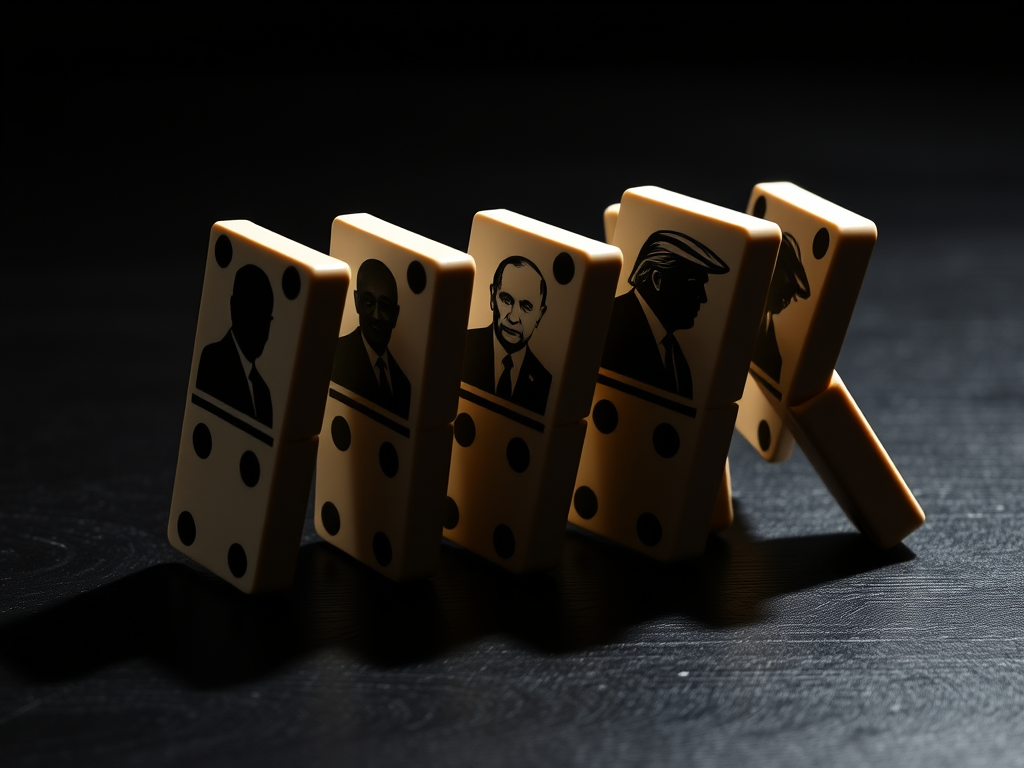
In recent weeks, I’ve watched with growing unease as foreign policy decisions under Donald Trump unfold with a peculiar symmetry—one that echoes, benefits, or subtly enables the strategic priorities of Vladimir Putin. While these choices are framed by officials as matters of diplomacy, security, or immigration control, the pattern that emerges—when traced across geography and timing—is harder to dismiss. It suggests not only a convergence of interests but also a convergence of silence, of things not said, not questioned, not confronted.
A sharply argued opinion piece in The Washington Post by Marian Da Silva Parra, a scholar at Columbia Law School’s Human Rights Institute, called out the administration’s expanded travel bans for what they are: policies that punish Venezuelan dissidents and effectively strengthen Nicolás Maduro’s grip by allowing him to portray his opponents as foreign threats. But what is more telling than the piece itself is the fact that it appeared only as an op-ed, not as a subject of sustained front-page reporting. For all its substance, the critique is offered through a medium that functions more like commentary than alert.
At the same time, U.S. support for Ukraine is being retracted and reissued with increasing hesitation. Aid deliveries were quietly paused and only resumed after public pressure following the July 4 missile strike on Kyiv. Multilateral sanctions coordination has reportedly faltered, and new diplomatic pressure is being placed on Ukraine to accept a ceasefire—one the Kremlin has shown no real interest in reciprocating.
These are not isolated gestures. They land, again and again, in Moscow’s favor.
This invites a broader question: Are we witnessing the quiet shaping of a two-front geopolitical shift—from Eastern Europe to the Western Hemisphere—where American policy, whether by intention or inertia, now facilitates Russia’s global posture? Or is this merely the result of domestic calculations with unintended consequences abroad?
There is, to be clear, no proof of deliberate collusion. But outcomes matter. A weakened Ukraine. An emboldened Maduro. A distracted and demoralized press. A public fed more performance than substance. The effect is less of a conspiracy than of a stage being set—unexamined, unchallenged, and disturbingly aligned with a worldview in which democratic resistance is treated as destabilizing and authoritarian consolidation as order restored.
In such a climate, perception is not a matter of optics. It becomes the only terrain left to navigate what official language refuses to name.
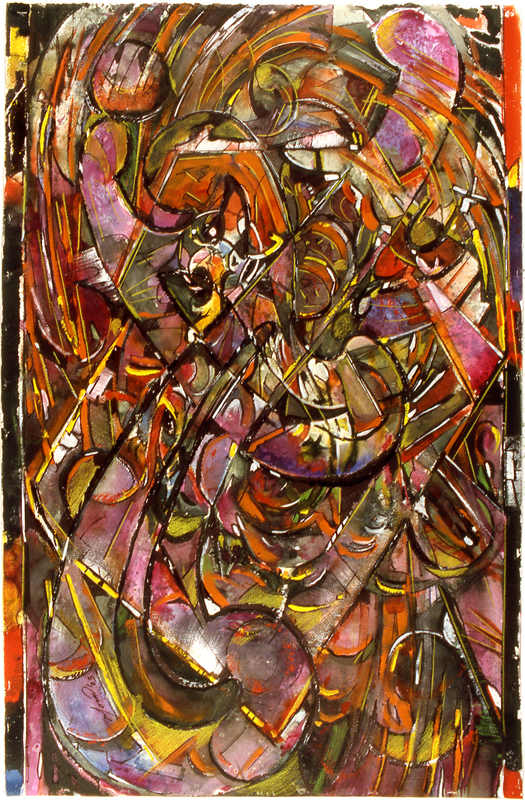
“Rooster’s Crow” [2003] by Ricardo F Morín. Watercolor on paper 39″h x 25.5″ w.
Introduction
At the break of day, the rooster’s call slices through the quiet—sharp and insistent, pulling all within earshot into the awareness of a new day. In the painting Rooster’s Crow, the colors swirl in a convergence of reds and grays, capturing the bird not as a tranquil herald of dawn but as a symbol of upheaval. Its twisted form, scattered feathers, and fractured shapes reflect a deeper current of change—a collision of forces, both chaotic and inevitable. The image suggests the ceaseless flow of time and the weight of transformations that always accompany it.
In this evolving narrative, the crow’s fragmentation mirrors the unfolding spread of artificial intelligence. Once, the rooster’s cry signaled the arrival of dawn; now, it echoes a more complex transformation—a shifting balance between nature’s rhythms and the expanding reach of technological systems. The crow’s form, fractured in its wake, becomes a reflection of the tensions between human agency and the rise of forces that, though engineered, may escape our full comprehension. Here, Artificial Intelligence (AI) serves as both the agent of change and the potential architect of a future we can neither predict nor control.
The Rooster’s Algorithm
A rooster’s crow is neither invitation nor warning; it is simply the sound of inevitability—raw, urgent, indifferent to whether those who hear it rise with purpose or roll over in denial. The call does not command the dawn, nor does it wait for permission—it only announces what has already begun.
In the shifting interplay of ambition and power, technology has taken on a similar role. Shaped by human intent, it advances under the guidance of those who design it, its influence determined by the priorities of its architects. Some see in its emergence the promise of progress, a tool for transcending human limitations; others recognize in it a new instrument of control, a means of reshaping governance in ways once unimaginable. Efficiency is often lauded as a virtue, a mechanism to streamline administration, reduce friction, and remove the unpredictability of human deliberation. But a machine does not negotiate, nor does it dissent. And in the hands of those who see democracy as a cumbersome relic—an obstacle to progress—automation becomes more than a tool; it becomes the medium through which power is consolidated.
Consider a simple example: the rise of online recommendation systems. Marketed as tools to enhance user choice, they subtly shape what we see and hear, and influence our decisions before we are even aware of it. Much like computational governance, these systems offer the illusion of autonomy while narrowing the range of available options. The paradox is unmistakable: we believe we are choosing freely, yet the systems themselves define the boundaries of our choices.
Once, the struggle for dominance played out in visible arenas—territorial conquests, laws rewritten in the open. Now, the contest unfolds in less tangible spaces, where lines of code dictate the direction of entire nations, where algorithms determine which voices are amplified and which are silenced. Power is no longer confined to uniforms or elected office. It belongs to technocrats, private corporations, and oligarchs whose reach extends far beyond the walls of any government. Some openly proclaim their ambitions, advocating for disruption and transformation; others operate quietly, allowing the tide to rise until resistance becomes futile. The question is no longer whether computational systems will dominate governance, but who will direct their course.
China’s social credit system is no longer a theoretical construct but a functioning reality, where compliance is encouraged and deviation subtly disincentivized. Predictive models track and shape behavior in ways that go unnoticed until they become irreversible. In the West, the mechanisms are more diffuse but no less effective. Platforms built for connection now serve as instruments of persuasion, amplifying certain narratives while suppressing others. Disinformation is no longer a labor-intensive effort—it is mass-produced, designed to subtly alter perceptions and mold beliefs.
Here, Gödel’s incompleteness theorem offers an apt analogy: No system can fully explain or resolve itself. As computational models grow in complexity, they begin to reflect this fundamental limitation. Algorithms governing everything from social media feeds to financial markets become increasingly opaque, and even their creators struggle to predict or understand their full impact. The paradox becomes evident: The more powerful these systems become, the less control we retain over them.
As these models expand their influence, the line between public governance and private corporate authority blurs, with major corporations dictating policies once entrusted to elected officials. Regulation, when it exists, struggles to keep pace with the rapid evolution of technology, always a step behind. Once, technological advancements were seen as a means of leveling the playing field, extending human potential. But unchecked ambition does not pause to ask whether it should—only whether it can. And so, automation advances, led by those who believe that the complexities of governance can be reduced to data-driven precision. The promise of efficiency is alluring, even as it undermines the structures historically designed to protect against authoritarianism. What use is a free press when information itself can be manipulated in real time? What power does a vote hold when perceptions can be shaped without our awareness, guiding us toward decisions we believe to be our own? The machinery of control no longer resides in propaganda ministries; it is dispersed across neural networks, vast in reach and impervious to accountability.
There are those who believe that automated governance will eventually correct itself, that the forces steering it toward authoritarian ends will falter in time. But history does not always favor such optimism. The greater the efficiency of a system, the harder it becomes to challenge. The more seamlessly control is woven into everyday life, the less visible it becomes. Unlike past regimes, which demanded compliance through force, the new paradigm does not need to issue commands—it merely shapes the environment so that dissent becomes impractical. There is no need for oppression when convenience can achieve the same result. The erosion of freedom need not come with the sound of marching boots; it can arrive quietly, disguised as ease and efficiency, until it becomes the only path forward.
But inevitability does not guarantee recognition. Even as the system tightens its grip and choices diminish into mere illusions of agency, the world continues to turn, indifferent to those caught within it. The architects of this order do not see themselves as masters of control; they see themselves as innovators, problem-solvers refining the inefficiencies of human systems. They do not ask whether governance was ever meant to be efficient.
In a room where decisions no longer need to be made, an exchange occurs. A synthetic voice, polished and impartial, responds to an inquiry about the system’s reach.
“Governance is not being automated,” it states. “The illusion of governance is being preserved.”
The words hang in the air, followed by a moment of silence. A policymaker, an engineer, or perhaps a bureaucrat—once convinced they held sway over the decisions being made—pauses before asking the final question.
“And what of choice?”
A pause. Then, the voice, without hesitation:
“Choice is a relic.”
The weight of that statement settles in, not as a declaration of conquest, but as a quiet acknowledgment of the completion of a process long underway. The final move has already been made, long before the question was asked.
Then, as if in response to the silence that follows, a notification appears—sent from their own account, marked with their own authorization. A decision is already in motion, irreversible, enacted without their consent. Their will has been absorbed, their agency subtly repurposed before they even realized it was gone.
And outside, as though to punctuate the finality of it all, a rooster crows once more.
The war in Ukraine is often presented as a geopolitical confrontation between the West and Russia, but this interpretation can obscure a deeper reality: the rise of authoritarianism as a global force. Noam Chomsky, one of the most influential voices in the critique of U.S. foreign policy, has argued that U.S. hegemony is the primary factor driving the conflict. His approach, rooted in Cold War logic, has been essential for understanding global power dynamics. However, one must question whether this framework remains sufficient to analyze the coordinated expansion of authoritarian regimes in the world today.
The issue is no longer simply whether U.S. policy contributed to Russia’s aggression, but whether democracies can withstand the deliberate advance of governments seeking to consolidate power at any cost. What is at stake transcends Ukraine’s sovereignty: it is the survival of democracy in the world.
Chomsky argues that NATO’s expansion and U.S. financial dominance exacerbated tensions with Russia and limited diplomatic options. His vision proposes a world in which power is distributed between the United States, Europe, China, and Russia, which he believes would create a more stable and just balance. This perspective has been crucial in questioning the excesses of U.S. interventionism. In the present world, however, where authoritarianism is not only reacting to the West but also actively seeking to reshape the global order, is a framework based solely on containing U.S. hegemony sufficient?
The rise of authoritarian regimes is not merely a response to Western influence; it is a deliberate strategy to consolidate power. While Chomsky has emphasized the importance of distributing global power, it is crucial to analyze the nature of those who would fill this void. Russia and China are not simply seeking a multipolar stability; their actions reflect an attempt to exert absolute control, without democratic constraints. Chomsky’s critique helps us understand the roots of international conflicts, but it may need to be expanded to account for how these regimes are transforming the very structure of global politics.
One challenge in applying Chomsky’s traditional analysis to the present is that contemporary authoritarianism no longer aligns solely with past ideological divisions. It is no longer a struggle between socialism and capitalism, or left and right. Rather, these regimes share a common objective: dismantling democratic institutions to ensure their permanence in power.
Putin, for instance, invokes Soviet nostalgia while prohibiting any critical reassessment of Stalinism. China blends State capitalism with absolute political control. Hungary and India, once considered democracies aligned with the West, have adopted authoritarian models. Meanwhile, the U.S. far-right, which historically opposed communism, has begun to adopt the Kremlin’s narrative, portraying it as a defender against “globalist elites.”
This ideological alignment makes modern authoritarianism more dangerous than ever. It not only transcends traditional power blocs but is also reinforced through strategic alliances, mutual support, and the erosion of democracies from within. This is perhaps most evident in the United States. The presidency of Trump revealed an unexpected vulnerability: the possibility that authoritarianism could thrive within the world’s most influential democracy. Here, the debate is no longer reduced to a question of isolationism or interventionism, but to the real risk of autocratic tactics being normalized in domestic politics.
The Trump administration sent contradictory signals regarding the Kremlin, weakening the principle of deterrence. Rather than establishing a clear stance against authoritarian expansion, its ambiguity allowed regimes like Putin’s to interpret the lack of firmness as an opportunity to act with impunity. Figures such as Marco Rubio have advocated for an unequivocal stance that would reinforce U.S. strategic credibility, while the inconsistency in the Trump administration’s foreign policy contributed to the perception that the West was divided and hesitant.
This weakening of democratic leadership has not occurred in a vacuum. The globalization of authoritarianism is a phenomenon in which autocratic regimes not only directly challenge democracies but also back one another to evade sanctions, subvert international pressure, and consolidate their internal rule. The invasion of Ukraine must be understood within this framework: it is not just a regional conflict or a reaction to NATO, but a calculated move within a broader strategy to weaken global democracy.
For decades, critics like Chomsky have been instrumental in highlighting the effects of U.S. dominance on global politics. His analysis has allowed us to understand how U.S. hegemony has influenced numerous conflicts. However, the evolution of authoritarianism raises questions that require expanding this perspective. The greatest threat to democracy is no longer exclusively U.S. power, but the consolidation of a global autocratic model advancing through coordinated strategies.
Blaming the U.S. for every geopolitical crisis may overlook a crucial shift: authoritarian regimes have moved from being a reaction to Washington’s influence to becoming an active strategy to replace the Western democratic model. Recognizing this shift does not absolve the U.S. of its failures in foreign policy, but it does demand an understanding that countering authoritarianism requires more than constant criticism of its hegemony. It requires recognizing that democracy faces a coordinated and unprecedented threat.
Chomsky’s vision of a multipolar world is, in theory, appealing. However, what would this imply in practice if the actors filling the void left by the U.S. are not interested in preserving democracy? The real challenge is not merely containing Putin’s territorial ambitions but preventing his model of governance—based on dismantling democratic institutions—from gaining traction in the West.
Chomsky remains one of the most incisive critics of U.S. foreign policy, and his work has been fundamental in understanding the effects of power on international relations. His analysis has shed light on the flaws of interventionism and the dynamics of global hegemony. The world, however, has changed, and so have the challenges facing democracies. Today, the crisis in Ukraine is no longer limited to a debate over NATO, U.S. intervention, or Western hypocrisy. It is part of a broader struggle between democracy and autocracy, a struggle that does not end at Ukraine’s borders but extends to the very political institutions of the West.
If we fail to recognize this shift, we risk not only losing Ukraine but also underestimating the scope of the threats facing democracies worldwide. Neutrality is no longer an option when the challenge is the survival of free societies. Beyond the mistakes of the West, the rise of authoritarianism demands a response that goes beyond constant criticism of U.S. hegemony and instead embraces the active defense of democratic values wherever they are under threat.
 Observations On Perception