
Posts Tagged ‘control’

“The Reader’s Reach”

November 10, 2026

*

Second Thoughts
By Ricardo F. Morín
CGI, 2026

*

1

A text arrives finished.  Its sentences are fixed, its order settled, its last word in place.  The reader arrives unfinished and wants the text finished in a second sense:  settled in meaning, assigned a position, closed.  The wish is quiet and feels like care.  A reader who wants to understand everything appears to be paying full attention.  Yet the wish to understand everything carries another wish inside it:  that nothing in the text remain beyond the reader’s hold.  Attention gives way to possession without any visible change in the act of reading.

2

The wish has several faces, and they appear together.  A reader supplies an intention the text never states and then judges the text by it.  A reader places in sequence what the text holds side by side, so that two views of one condition read as a statement and its retreat.  A reader speaks for others who are not present:  readers who will be confused, misled, or unconvinced, and whose confusion happens to match the reader’s own.  Each face lends the reading an authority it has not earned.  Each turns a private habit into something that sounds like a general condition.  None of them feels like overreach while it occurs; each feels like thoroughness.

3

A reading is a judgment made after the text has acted.  It attaches consequences to the page:  a risk the writer seems to run, a confusion the reader foresees, a drift in the argument.  Those consequences belong to the reading.  The page holds sentences; the consequences are relations the reader draws from them.  Some of those relations the text will bear and some it will not, and nothing in the reader’s experience marks the difference:  a consequence the text cannot support feels exactly like one it can.  Only when the text answers back, through its author, through a second reading, through a sentence the first reading passed over, does the reading show what it had been carrying.  The correction does more than add information.  It shifts what mattered:  a phrase once treated as a flaw turns out to hold the argument, and a judgment once delivered with confidence loses its footing.

4

Inexperience is commonly measured in years.  It is better recognized as a posture:  the wish to hold an understanding in full, to reach a point from which nothing further needs examining.  That posture appears in the young, who have not yet seen how often a settled view unsettles.  It also appears in institutions with long memories, where closure protects reputations; in specialists confident of their instruments; and in readers of every kind who mistake completeness for accuracy.  It does not disappear with age.  It returns after it seemed outgrown, and it returns most readily when a reader feels most thorough, since from the inside thoroughness and control are hard to tell apart.

5

Experience is not a store.  It cannot be laid up once and drawn on afterward.  Each reading begins exposed to the same wish, and the experienced reader is not the one who has overcome it but the one who recognizes it while it is still working.  That recognition never comes early enough to prevent the first overreach.  It arrives in the middle of a judgment, or just after, when the judgment has already gone out.  What experience offers is a readiness to be corrected without treating the correction as defeat, which is a different thing from protection.

6

Understanding is not always carried by a single continuous memory.  A tradition changes through interruption:  each generation misreads its predecessors, and the misreadings enter what is handed on.  An institution changes through turnover; the people who learned a lesson leave, and the lesson survives only in rules whose reasons have been forgotten.  A body of work written over many years is examined by a writer who is no longer the one who began it, and each return to an earlier page is a reading by someone else.  Some readers change through revision and break rather than steady accumulation, carrying forward less a memory than a shape.  Each of these still changes.  Each is still answerable for what it claims to see.  The absence of a continuous life does not excuse a reading from its overreach, and the presence of one does not prevent it.

7

Correction is where reading stays honest.  The reader who yields to a correction is not deferring to the author’s rank; authors misread themselves as readily as anyone.  The reader yields to what the text actually makes available, once the wish to finish it has been seen for what it is.  That yielding cannot be completed.  Every reading that survives a correction is itself a later judgment, open to the same reweighting it has just undergone.  No final reader stands outside the sequence of readings, looking back at all of them from a place where relevance no longer shifts.

8

A reading that knows it cannot close remains answerable to the text.  A reading that believes it has closed has already stopped reading, though it may go on speaking with great confidence about what it read.

*

Ricardo F. Morín
October 26, 2026
Oakland Park, Florida

“The Rooster’s Algorithm”

March 1, 2025

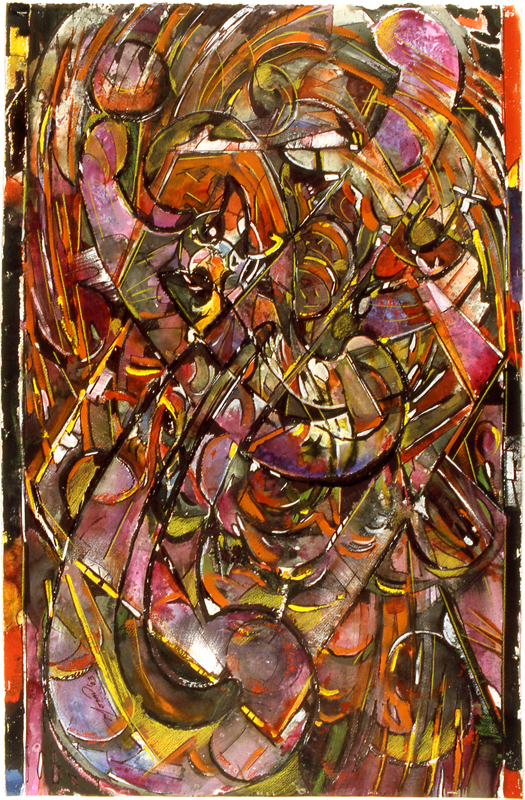
“Rooster’s Crow” [2003] by Ricardo F Morín.    Watercolor on paper 39″h x 25.5″ w.

Introduction

At the break of day, the rooster’s call slices through the quiet—sharp and insistent, pulling all within earshot into the awareness of a new day.      In the painting Rooster’s Crow, the colors swirl in a convergence of reds and grays, capturing the bird not as a tranquil herald of dawn but as a symbol of upheaval.      Its twisted form, scattered feathers, and fractured shapes reflect a deeper current of change—a collision of forces, both chaotic and inevitable.      The image suggests the ceaseless flow of time and the weight of transformations that always accompany it.

In this evolving narrative, the crow’s fragmentation mirrors the unfolding spread of artificial intelligence.      Once, the rooster’s cry signaled the arrival of dawn; now, it echoes a more complex transformation—a shifting balance between nature’s rhythms and the expanding reach of technological systems.      The crow’s form, fractured in its wake, becomes a reflection of the tensions between human agency and the rise of forces that, though engineered, may escape our full comprehension.      Here, Artificial Intelligence (AI) serves as both the agent of change and the potential architect of a future we can neither predict nor control.

The Rooster’s Algorithm

A rooster’s crow is neither invitation nor warning; it is simply the sound of inevitability—raw, urgent, indifferent to whether those who hear it rise with purpose or roll over in denial.      The call does not command the dawn, nor does it wait for permission—it only announces what has already begun.

In the shifting interplay of ambition and power, technology has taken on a similar role.      Shaped by human intent, it advances under the guidance of those who design it, its influence determined by the priorities of its architects.      Some see in its emergence the promise of progress, a tool for transcending human limitations; others recognize in it a new instrument of control, a means of reshaping governance in ways once unimaginable.      Efficiency is often lauded as a virtue, a mechanism to streamline administration, reduce friction, and remove the unpredictability of human deliberation.      But a machine does not negotiate, nor does it dissent.      And in the hands of those who see democracy as a cumbersome relic—an obstacle to progress—automation becomes more than a tool; it becomes the medium through which power is consolidated.

Consider a simple example:      the rise of online recommendation systems.      Marketed as tools to enhance user choice, they subtly shape what we see and hear, and influence our decisions before we are even aware of it.      Much like computational governance, these systems offer the illusion of autonomy while narrowing the range of available options.      The paradox is unmistakable:      we believe we are choosing freely, yet the systems themselves define the boundaries of our choices.

Once, the struggle for dominance played out in visible arenas—territorial conquests, laws rewritten in the open.      Now, the contest unfolds in less tangible spaces, where lines of code dictate the direction of entire nations, where algorithms determine which voices are amplified and which are silenced.      Power is no longer confined to uniforms or elected office.      It belongs to technocrats, private corporations, and oligarchs whose reach extends far beyond the walls of any government.      Some openly proclaim their ambitions, advocating for disruption and transformation; others operate quietly, allowing the tide to rise until resistance becomes futile.      The question is no longer whether computational systems will dominate governance, but who will direct their course.

China’s social credit system is no longer a theoretical construct but a functioning reality, where compliance is encouraged and deviation subtly disincentivized.      Predictive models track and shape behavior in ways that go unnoticed until they become irreversible.      In the West, the mechanisms are more diffuse but no less effective.      Platforms built for connection now serve as instruments of persuasion, amplifying certain narratives while suppressing others.      Disinformation is no longer a labor-intensive effort—it is mass-produced, designed to subtly alter perceptions and mold beliefs.

Here, Gödel’s incompleteness theorem offers an apt analogy:      No system can fully explain or resolve itself.      As computational models grow in complexity, they begin to reflect this fundamental limitation.      Algorithms governing everything from social media feeds to financial markets become increasingly opaque, and even their creators struggle to predict or understand their full impact.      The paradox becomes evident:      The more powerful these systems become, the less control we retain over them.

As these models expand their influence, the line between public governance and private corporate authority blurs, with major corporations dictating policies once entrusted to elected officials.      Regulation, when it exists, struggles to keep pace with the rapid evolution of technology, always a step behind.      Once, technological advancements were seen as a means of leveling the playing field, extending human potential.      But unchecked ambition does not pause to ask whether it should—only whether it can.      And so, automation advances, led by those who believe that the complexities of governance can be reduced to data-driven precision.      The promise of efficiency is alluring, even as it undermines the structures historically designed to protect against authoritarianism.      What use is a free press when information itself can be manipulated in real time?      What power does a vote hold when perceptions can be shaped without our awareness, guiding us toward decisions we believe to be our own?      The machinery of control no longer resides in propaganda ministries; it is dispersed across neural networks, vast in reach and impervious to accountability.

There are those who believe that automated governance will eventually correct itself, that the forces steering it toward authoritarian ends will falter in time.      But history does not always favor such optimism.      The greater the efficiency of a system, the harder it becomes to challenge.      The more seamlessly control is woven into everyday life, the less visible it becomes.      Unlike past regimes, which demanded compliance through force, the new paradigm does not need to issue commands—it merely shapes the environment so that dissent becomes impractical.      There is no need for oppression when convenience can achieve the same result.      The erosion of freedom need not come with the sound of marching boots; it can arrive quietly, disguised as ease and efficiency, until it becomes the only path forward.

But inevitability does not guarantee recognition.      Even as the system tightens its grip and choices diminish into mere illusions of agency, the world continues to turn, indifferent to those caught within it.      The architects of this order do not see themselves as masters of control; they see themselves as innovators, problem-solvers refining the inefficiencies of human systems.      They do not ask whether governance was ever meant to be efficient.

In a room where decisions no longer need to be made, an exchange occurs.      A synthetic voice, polished and impartial, responds to an inquiry about the system’s reach.

“Governance is not being automated,” it states.      “The illusion of governance is being preserved.”

The words hang in the air, followed by a moment of silence.      A policymaker, an engineer, or perhaps a bureaucrat—once convinced they held sway over the decisions being made—pauses before asking the final question.

“And what of choice?”

A pause.      Then, the voice, without hesitation:

“Choice is a relic.”

The weight of that statement settles in, not as a declaration of conquest, but as a quiet acknowledgment of the completion of a process long underway.      The final move has already been made, long before the question was asked.

Then, as if in response to the silence that follows, a notification appears—sent from their own account, marked with their own authorization.      A decision is already in motion, irreversible, enacted without their consent.      Their will has been absorbed, their agency subtly repurposed before they even realized it was gone.

And outside, as though to punctuate the finality of it all, a rooster crows once more.

*

Ricardo Federico Morín Tortolero

March 1, 2025; Oakland Park, Florida