*
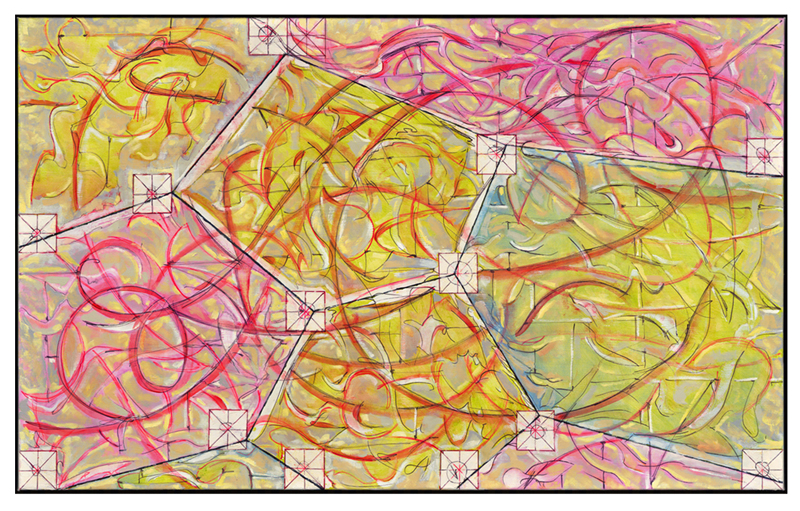
Dodecahedron
60″x 37″
Oil on linen
2005
Ricardo F. Morín
February 7, 2006
Oakland Park, F.
All living entities exist and persist through relational action. Relational action is not incidental; it constitutes the condition under which life maintains itself. Relationality entails exchange, and exchange entails signal. Communicative function therefore emerges not as an added layer upon life but as a fundamental modality through which relational existence operates across internal and external constraints. What humans call language represents a specialized manifestation of organized signaling within relational systems. Differences in symbolic complexity or abstraction do not establish ontological discontinuity; they reflect variations in manifestation within a continuous communicative order.
Communicative is not merely an activity occurring between entities but the order of correspondence through which relational fields become shared and sustained. Each species participates within its own shared field, yet these fields are not isolated domains; they form expressions within a broader continuity grounded in common life conditions. Cooperation, coordination, and mutual adjustment arise structurally from the requirements of coexistence rather than from moral or hierarchical distinctions. Cross-species relationality reflects continuity of condition rather than separation in kind.
Mutual intelligibility, functional coordination, and structural resonance describe simultaneous expressions of relational correspondence. Mutual intelligibility denotes the capacity of systems to register differences within shared fields. Functional coordination denotes alignment enabling persistence within constraints. Structural resonance denotes compatibility allowing signals to be received and integrated. These are not sequential stages but concurrent aspects of a unified communicative order.
Systemic intelligence cannot be singular in a manner that excludes other manifestations. Intelligence is not localized within individual agents or species but expresses itself through relational correspondence inherent to the system as a whole. Active intelligence denotes immanent relational capacity rather than centralized control or hierarchical ordering. Adaptation, coherence, and communication arise simultaneously as expressions of systemic relationality.
The system itself is an expression of active intelligence operating across all dimensions without exclusion. At this level, scale is infinite as total inclusiveness and absence of limit. Infinity does not denote magnitude but indicates that no manifestation, dimension, or relational expression stands outside participation in the whole. Differences in form or scale describe variations within continuity rather than separations.
Integration denotes coherence without fusion into uniformity and without reduction of multiplicity. The integrated whole expresses relational correspondence without hierarchy, segmentation, or imposed ordering. Descriptions invoking equilibrium, balance, motion, rest, progression, or resolution constitute perceptual projections derived from human cognition and do not describe intrinsic properties of the system.
Diagnostic articulation therefore focuses on conditions of correspondence rather than on systemic states. Communicative order denotes structural correspondence inherent to relational existence without presupposing preferred trajectories or evaluative oppositions. Mutual intelligibility, functional coordination, and structural resonance remain simultaneous descriptive coordinates employed provisionally by observation.
Observation constitutes the methodological posture shared by ontological disciplines. Observation remains external to the integrated whole and does not participate in or govern the system it describes. Language functions as a provisional descriptive instrument through which observation attempts articulation while remaining conditioned by human capacities and limitations.
Observation is neither fixed nor complete. Its scope may expand through technological tools, conceptual frameworks, and perceptual capacities simultaneously. Expansion of observation refines descriptive access without altering systemic reality and without warranting ontological conclusions beyond observable correspondence. Hypotheses concerning ultimate limits or total comprehension remain speculative.
Neutrality constitutes the methodological discipline of observation and remains an ongoing approximation rather than an achieved state. The integrated whole, characterized by total inclusiveness and absence of limit, expresses active intelligence through communicative order as relational correspondence inherent to existence itself. Description remains provisional; reality is not reducible to descriptive categories; and the boundary between description and reality persists only as a functional orientation within observational practice.
 Observations On Perception