Posts Tagged ‘observation’

“Ricardo F. Morín”

May 18, 2026

During those first years through 1976, Buffalo accumulated heavier snowfalls than usual, with blizzards exceeding those of previous winters.  In some neighborhoods the snow rose beyond the rooftops of houses.  The wind crossed the streets with an intensity unfamiliar to someone who had grown up in Valencia, Venezuela.  In the art studios of Bethune Hall, at the State University of New York at Buffalo, canvases leaned against one another while students worked for hours in silence or beneath scattered conversations.  The smell of oil, turpentine, and damp wood continuously permeated the interiors.

He had arrived in the United States in 1972 at seventeen years of age.  Displacement did not consist solely in leaving one country behind.  It also altered the daily perception of the simplest things:  the scent of cities, winter light entering through windows, the relation between the body and climate, the constant sound of a language still only partially familiar.

Before Buffalo there had been Valencia.  The Arturo Michelena School of Fine Arts.  The first hours of drawing during childhood.  Later, during adolescence, the summers studying painting in the private studio of the Hungarian painter Lazlo Lenyel.  Even then, however, painting seemed less a future profession than a form of attention.  Preparing the surface of a canvas produced an experience difficult to explain outside the act of painting itself.

During those years canvases began accumulating rapidly.  Some were destroyed.  Others remained leaning against walls for months before receiving another layer of paint.  The organization of the studio changed constantly.  Painting did not yet follow a precise theory.  There was instead a physical insistence:  returning each day to observe relations of color, spatial tension, surface, and rhythm.

In 1976 he returned briefly to Venezuela.  There he studied privately with the Málaga-born artist José Luis Montero before returning once again to Buffalo under the guidance of Herta Kane and James Jipson.  Gradually the first exhibitions began.  In May of that same year he presented “Works by Ricardo Morin” at the Villa Maria College Gallery.

Conversations about art during those years frequently revolved around movements, historical legitimacy, abstraction, expressionism, or formal theory.  Yet many of the most intense hours occurred far from any discourse.  Remaining alone in the studio, slowly shaping how certain surfaces retained or rejected light, seemed to contain an experience more concrete than many of the explanations later constructed around the work.

In 1977 the Venezuelan Ministry of Education awarded him a full scholarship to complete a B.F.A. at SUNY Buffalo.  The thesis exhibition, Buffalo Series 1979, was later curated by Seymour Drumlevitch at the Alamo Gallery of the State University of New York at Buffalo. [1]  Shortly afterward, Buffalo Series No. 1, 1980, received the Birge Wall Covering Award and the Reed Foundation Award at the 38th Western New York Show at the Albright Knox Art Gallery. [2]

Awards, exhibitions, and scholarships briefly made continuity seem attainable.  During certain periods it seemed possible to imagine a relatively stable professional trajectory.  Yet that stability coexisted with another sensation more difficult to name:  the persistent impression that the real work was taking place elsewhere, far from the forms through which it was publicly interpreted.

In 1979 he attended stage design seminars taught by Gunther Schneider-Siemsen at the Internationale Sommerakademie für Bildende Kunst Salzburg.  There he received the Förderungspreis Leistung der Stadt Salzburg award.  Shortly afterward Drumlevitch recommended that he apply to the M.F.A. program of the Yale School of Drama.

At Yale the theater workshops functioned on another scale of production.  Constructions, lighting, scenic architecture, models, and technical equipment occupied spaces inside buildings adapted for the stage.  Physical labor was continuous.  Stage design also offered a concrete possibility of economic survival within New York.

During the first years after Yale he worked as a set designer in New York’s Off-Off-Broadway circuit, collaborating with Irene Fornés and Max Ferrá at INTAR. [3]  At the same time he worked as principal assistant to established Broadway designers.  Workshops, constructions, and rehearsals occupied much of the days and nights.

By the late 1980s he obtained a loft in Tribeca devoted exclusively to painting.  Large-format canvases leaned against high walls while painting once again began occupying the center of daily life.  The studio was filled with accumulated materials:  stretchers, pigments, tools, fragments of canvas, and drawings tacked against the walls.

At certain moments it seemed possible to sustain both lives simultaneously:  theater and painting.  New York still retained industrial areas where some artists could work within relatively spacious environments.  Yet even during those years of greatest professional activity, a tension persisted between the public continuity of a career and the quieter experience of the work itself.

In 1993 interruption appeared.  Due to AIDS he was forced to abandon the loft, suspend professional activity, and return to Venezuela seeking refuge with his family.  The diagnosis rapidly altered the entire structure of daily life.  Many previous continuities disappeared within a few months:  work, economic stability, studio, city, professional rhythm.

Between 1993 and 1996 his health deteriorated considerably.  He spent long periods inside the family home with little physical energy and frequent medical interruptions.  It was then that the Aposentos series began.  The second painting of the series, Aposento No. 2, was selected for the “XIV Municipal Painting Salon: Homage to Carlos Cruz-Diez,” held in 1994 at the Municipal Art Gallery of Maracay. [4]

He painted slowly.  Canvases remained stacked against the walls for entire weeks before receiving another intervention.  The body fatigued quickly.  Light shifted inside the room while the paintings remained motionless for hours or entire days.  At times the work advanced only a few centimeters.

Painting then began acquiring another rhythm.  It no longer seemed to respond solely to the continuity of a career or to the possibility of exhibition.  Some works emerged more as accompaniment than affirmation.

During those same years he worked voluntarily at Fundación Metaguardia, created in Valencia as a center of information and support for people with terminal illnesses, many of them also living in conditions of indigence.  The foundation integrated emotional support, activities connected to the arts, and pro bono medical services.

Silent conversations, long periods of waiting, weakened bodies, and shared vulnerability slowly altered the perception of many previous categories.  Illness seemed to render secondary many differences that had previously organized much of daily attention.

In 1996 he finally returned to New York in order to access the new antiretroviral treatment.  His immunity was practically nonexistent.  Soon afterward he sought assistance from the Department of Human Resources because of his condition of destitution.  He first stayed at the transitional Paradise Hotel in the Bronx and later at the Common Ground program at the Hotel Times Square.

Paradise was a profoundly unstable place.  Narrow corridors, moldering rooms, and constant precariousness altered the perception of time.  Some people disappeared suddenly.  Others remained locked inside their rooms for entire days.  The noise of doors, televisions, and arguments continuously crossed through the walls of the building.

Even so he continued painting.  Small canvases rested against walls or on improvised furniture near the window.  The continuity of the work no longer depended upon ideal conditions.  It depended only upon continuing to work within whatever circumstances were available.

During those years an unexpected sensation of emptiness also appeared.  Not necessarily as absolute loss, but rather as a gradual reduction of the interior noise through which ambition, identity, or permanence had once been sustained.  Within that emptiness certain forms of attention slowly began acquiring greater intensity:  breathing, light upon surfaces, the rhythm of the body while walking through the city, the noise of certain rooms, the momentary presence of familiar faces.

In September 1998 he received support from the New York organization Visual AIDS, which organized a joint exhibition based on watercolor and oil portraits together with Nicolo Cataldi at St. Mark’s Church.  Later came other collective exhibitions and alternative platforms.  Some of the paintings from the early 1990s were later described by the artist Jo-ey Tang as “love letters to the city of New York”.

In 2000 he received a VESID rehabilitation grant that included specialized training in digital tools and computer equipment.  The computer then slowly became incorporated into the visual work.  Between 2000 and 2003 he used digital media combined with watercolor and hand drawing to reinterpret fifteenth-century Persian miniatures through geometric processes of reconstruction. [5]

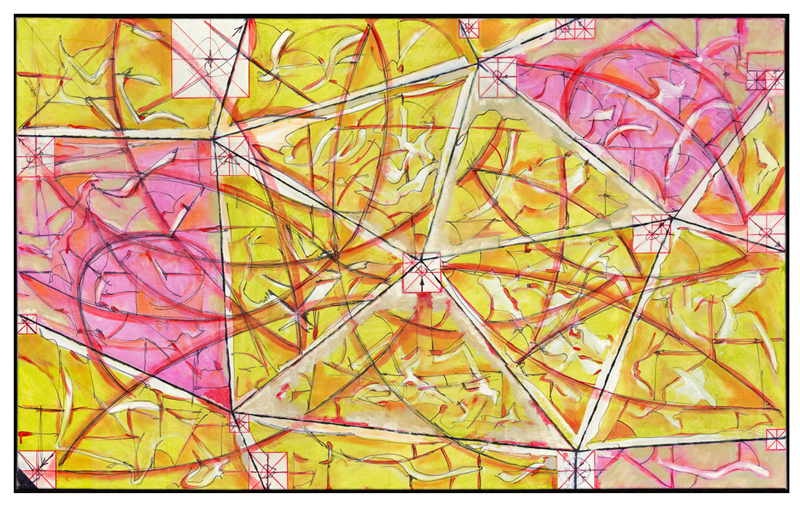
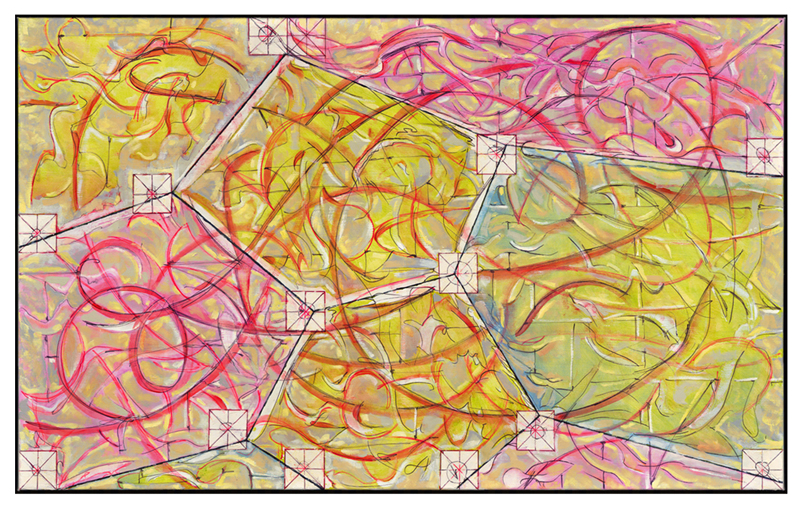
Later, between 2005 and 2012, he taught a course titled Pictorial Perspective at Pratt Institute.  Meanwhile he developed the Triangulation Series, working with suspended geometries, reduced spaces, and hanging formats. [6]

After completing chemotherapy in 2008 for an AIDS-related Non-Hodgkin lymphoma, systemic muscular disorders began preventing him from even stretching large canvases.  The hanging canvases then emerged also as a direct consequence of physical limitations.  The body slowly began imposing another relation to space, time, and work.

The canvases remained suspended for weeks while light varied across the surfaces.  Physical movements were slower.  Material reduction altered perception as well.  Silence ceased feeling like absence and began functioning as another form of attention.

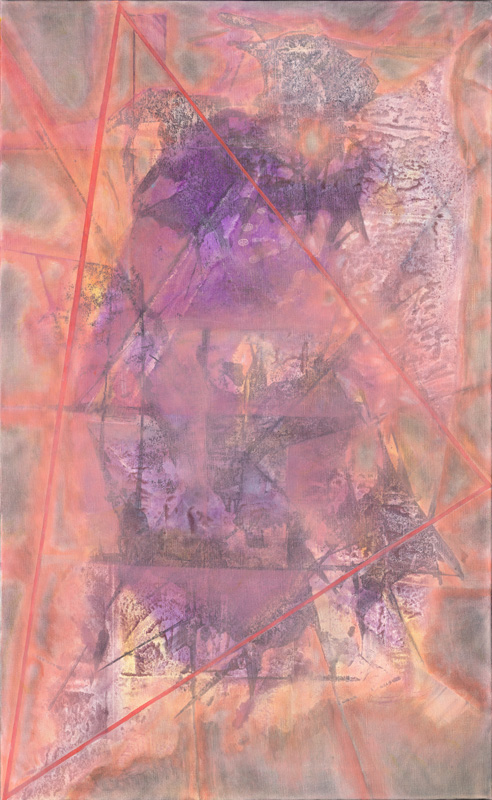
Between 2009 and 2010 he initiated the Metaphors of Silence series. [7]  Many of the works emerged slowly within prolonged periods of physical stillness.  The need to explain aesthetic experience intellectually gradually began losing intensity before the experience of observation itself.

During those same years he collaborated with Dr. Andrew Irving in an experimental project on art, anthropology, and human experience related to New York Stories.  Part of those dialogues were later incorporated into The Art of Life and Death: Radical Aesthetics and Ethnographic Practice. [8]

With the passing of years certain tensions slowly began losing sharpness.  Illness remained present, although it no longer organized each moment of the day in the same way.  Certain forms of ambition or anxiety surrounding continuity, recognition, or permanence seemed gradually to diminish without disappearing entirely.

Painting continued occupying a central place, though no longer necessarily as an exclusive affirmation of identity.  Other things also remained:  conversations, walks, reading, physical exercise, breathing finding rhythm again, the momentary attenuation of certain aches, light changing across the surfaces of the city, brief encounters throughout the day.

Some afternoons he continued walking slowly while breathing found rhythm and light descended across the buildings.  Aging, fragility, and the proximity of death did not disappear.  Neither did they remain completely separate from the movement of existence itself.

Ricardo F. Morín

May 17, 2026

Bala Cynwyd, Pennsylvania


Endnotes

[1] Buffalo Series 1979:
https://www.ricardomorin.com/l-series-html/62.html

[2] Buffalo Series No. 1, 1980:
https://www.ricardomorin.com/l-series-html/53.html

[3] Theater productions and press references:
https://www.nytimes.com/1986/04/17/theater/stage-lovers-at-intar.html

[4] Aposento No. 2:
https://www.ricardomorin.com/l-series-html/11.html

[5] Platonic Interactions Series and related works:
https://www.artmajeur.com/en/rfmorin/artworks?page=5

[6] Triangulation Series:
https://www.ricardomorin.com/Triangulation_Series.html

[7] Metaphors of Silence:
https://ricardomorin.wordpress.com/2010/11/24/metaforas-del-silencio/

[8] Andrew Irving, The Art of Life and Death: Radical Aesthetics and Ethnographic Practice:
https://www.academia.edu/53478128/The_Art_of_Life_and_Death_Radical_Aesthetics_and_Ethnographic_Practice_Andrew_Irving_Chicago_Hau_Books_2017_264_pp


“River Grass”

December 7, 2025

Ricardo Morin
Landscape II: River Grass
18” x 24”
Sepia on newsprint 
2003

Ricardo F Morin

Dec. 6, 2025

Naples. Florida

*

This diptych, “River Grass” and “Naples in the Morning,” brings together a reflection on continuity and a brief observation of everyday life.  Two scenes—one sustained, the other fleeting—register how experience, silence, and attention shape presence.  The first part, “River Grass,” does not present an argument, a confession, or a theory.  It offers an observation shaped over time by proximity rather than distance.   The focus is not on individual psychology or relational conflict, but on patterns that take form across generations and persist quietly within everyday life.

What follows avoids moral explanation and narrative resolution.   It attends instead to continuity—how restraint, generosity, and presence may be transmitted not through instruction or memory, but through posture, habit, and orientation.   The intention is to describe without adjudicating, and to clarify without assigning cause where cause cannot be cleanly isolated.   What is traced here represents one possible orientation among many, shaped by inheritance but not exhaustive of its effects—an invitation not to mistake the channel for the ocean.


Orientation of “River Grass”

What follows attends to what persists when lives are shaped by continuity rather than interruption.

Not all inheritance arrives as memory.   Some is conveyed without story, without date, without language.   It enters through atmosphere rather than narrative—through cadence, restraint, posture, and a preference for continuity over display.   In such cases, history is not recalled; it is carried.

This form of inheritance does not announce itself as trauma.   It leaves no single scene to revisit, no episode that can be isolated and explained.   Instead, it appears as a way of moving through the world:   measured, attentive, resistant to excess.   The past exerts influence not by instruction but by shaping what feels permissible, sustainable, or necessary.

Under these conditions, restraint is not experienced as loss.  It functions as orientation.  Accommodation does not signal submission but competence.   Stability reflects not the absence of desire but the quiet placement of desire among other priorities.   What is transmitted is not fear but caution—an ethic of endurance refined over time.

Because no event is foregrounded, little invites interpretation.   The absence of visible distress encourages the assumption of ease.   Life appears ordered, generous, and intact.   Yet the inheritance remains active and structures conduct without requiring acknowledgment.   It persists not as memory but as form.

Such inheritance often resists recognition precisely because it has succeeded.   The past has not repeated itself.   Continuity has been preserved.   What remains is a posture oriented toward sustaining that continuity—a vigilance so normalized that it passes as temperament rather than history.

Restraint, in this context, does not operate as inhibition or denial.   It functions as a stabilizing orientation—an internal calibration shaped over time.   Action is guided less by expression than by proportion and durability.   What governs choice is not moral judgment but coherence.

Such restraint often coexists with clarity and decisiveness.   Boundaries are maintained without conflict; decisions are made without excess emphasis.   What is avoided is not agency but surplus.   Expression is moderated not through fear of consequence, but through an internal sense of sufficiency.

Accommodation here is frequently misread.   It does not arise from compliance or uncertainty, but from an assessment of impact.   Space yielded to others reflects confidence in structure rather than retreat from position.   Presence remains intact even when it is not foregrounded.

This orientation produces a stability that can appear effortless.   Friction is minimized.   Demands are rare.   The absence of insistence is readily mistaken for ease or contentment.   Yet the restraint at work is active, not passive—and continuously shapes what is articulated, deferred, or left unspoken.

Over time, restraint becomes difficult to distinguish from identity.   It ceases to register as a choice among alternatives and hardens into posture.   The question of expression recedes, replaced by an emphasis on responsibility, proportion, and non-disruption.

Generosity shaped by inherited restraint rarely announces itself.   It does not seek recognition or reciprocation, nor does it depend on visibility for validation.   It appears instead as availability, as the quiet removal of obstacles, as the willingness to yield space without narrative or sacrifice.

In this form, giving is non-transactional.   No balance is tracked; no return anticipated.   What is offered is steadiness rather than favor.   Support unfolds without appeal, often unnoticed, absorbed into ordinary conduct.   The absence of demand is integral rather than incidental.

Because it imposes no weight, such generosity leaves little trace.   Others encounter freedom without sensing its source.   Autonomy is enabled without attribution.   The one who gives remains present yet unmarked.

Over time, the habit of making room for others becomes more practiced than the habit of entering it.   Attention turns outward and refines responsiveness while narrowing self-directed articulation.   What persists is not loss, but redirection.

This configuration resists conventional readings of imbalance.   No grievance emerges; no conflict announces asymmetry.   Generosity remains intact, even exemplary.   What shifts subtly is internal emphasis: presence exercised through allowance rather than assertion.

Desire, within this orientation, is neither denied nor suppressed.   It is repositioned.   Its legitimacy is not questioned, but its urgency is diminished.   What is set aside is not longing itself, but the expectation that longing must organize life.

Desire is acknowledged yet rarely centered.   Expression is permitted elsewhere more readily than inwardly claimed.   Attention gravitates toward what preserves stability rather than what intensifies experience.   Satisfaction arises from coherence rather than culmination.

This produces no vacancy.   Life remains engaged and responsive.   What diminishes is insistence.   Continuity comes to matter more than appetite; durability more than immediacy.

Because this arrangement is not framed as renunciation, it escapes notice.   No moral language surrounds it.   Nothing is named as sacrifice.   Desire persists at a distance—observed, managed, deferred without struggle.

Over time, identity becomes shaped less by pursuit than by maintenance.   Expression gives way to stewardship.   Meaning accrues not through arrival, but through the avoidance of rupture.

Patterns organized around restraint and continuity are often mistaken for moral attainment.   Composure is read as wisdom; accommodation as maturity; silence as depth.   Because no disturbance arises, the orientation escapes examination.   What functions smoothly is presumed complete.

This misreading is reinforced by social frameworks that reward stability over inquiry.   Absence of conflict is taken as evidence of balance.   Generosity without demand is praised rather than interrogated.   Its costs remain obscured precisely because they impose nothing on others.

Virtue, in this setting, becomes indistinguishable from habit.   Adaptive orientation solidifies into character, and character into expectation.   Reliability is affirmed repeatedly, deepening its hold.

The result is not deception but omission.   The steadiness is genuine.   What goes unrecognized is how fully such an arrangement organizes life around preservation rather than presence.   The question of displacement remains unasked, not refused.

Misreading occurs through success.   Relations endure.   Structures hold.   No obvious harm appears.   And so the deeper configuration—quiet, durable, historically shaped—continues beneath the language of virtue.

At a certain threshold, continuity shifts from supporting means to governing end.   Life becomes organized not around fulfillment, but around preservation.   What matters most is that nothing essential is exposed to rupture, whether through excess demand or through untested assertion.

Fulfillment is not rejected, but subordinated.   Satisfaction arises from duration rather than intensity.   Time is oriented toward extension, not culmination.   What is valued is the capacity to carry forward intact.

This proves effective.   The past does not recur.   Stability holds.   Loss is contained rather than amplified.   Inherited imperatives are honored not through recollection, but through conduct.

Yet when continuity occupies this position, the range of permissible movement narrows.   Change must justify itself in advance.   Desire must demonstrate durability before enactment.   Expression yields to maintenance.

The future is approached as responsibility rather than as open terrain.   Meaning accumulates through safeguarding what is essential rather than through the exploration of possibilities.   Success becomes synonymous with the preservation of continuity.

Presence, in its final form here, does not organize itself around position or priority.   It functions laterally and sustains structure without becoming its focus.   Life is held together through attentiveness rather than through claims to authority or justification.   The course of life proceeds without pressure to arrive at an explanation that secures its coherence.

This mode of presence resists visibility.  It does not seek recognition or assert precedence.   Its efficacy lies in what remains intact rather than in what is achieved.  Others move freely, often unaware of the support permitting such freedom.

To remain outside the center is not withdrawal.   Engagement continues—measured, responsive, intact.   What is avoided is domination, not participation.  Influence is exercised through stability rather than direction.

The image implied by the title takes form.   A river that advances without force, reshaping terrain through the sustained persistence of its course.  Motion without spectacle.  Endurance without inscription.  The course is maintained by flowing around obstruction rather than confronting it.

What remains is continuity itself—quietly sustained, seldom noticed, and difficult to name.


*

“Naples in the Morning”

I sat across from my husband at a breakfast place in Naples, Florida.  Diagonally behind him sat a young couple.  The woman was small—almost childlike in scale—next to her husband, who stood well over six feet.

None of us had ordered yet.  She carefully arranged her silverware and napkin, aligning them with deliberate precision, almost ritualistic.   Her hair fell forward, parted to either side of her face like curtains drawn closed.  When she lifted her chin, her facial features—Asian in appearance—came briefly into view.  Despite her slightness, her posture suggested control rather than fragility.

When our glances crossed, she held my gaze longer than expected, nearly staring.  She then lowered her head, hiding again behind her hair.   Moments later, she lifted it once more and made the sign of the cross—forehead, chest, shoulder to shoulder—before turning fully back toward her husband.   No words were exchanged.

When the food arrived, she resumed the same careful demeanor.   She sliced her omelet into small, uniform squares, placed the knife down, and paused.  Each piece was lifted individually, slowly, with unbroken repetition, as if rehearsed.  The sequence carried the quality of performance.   Though she remained oriented toward her husband, her torso shifted intermittently, angling slightly in my direction.

When they finished and moved toward the register, she rose first and walked ahead, chin lowered, hair once again masking her surroundings.  He followed—tall, broad, moving through the room with visible ease.  His stride was expansive, unguarded.

They left without speaking.