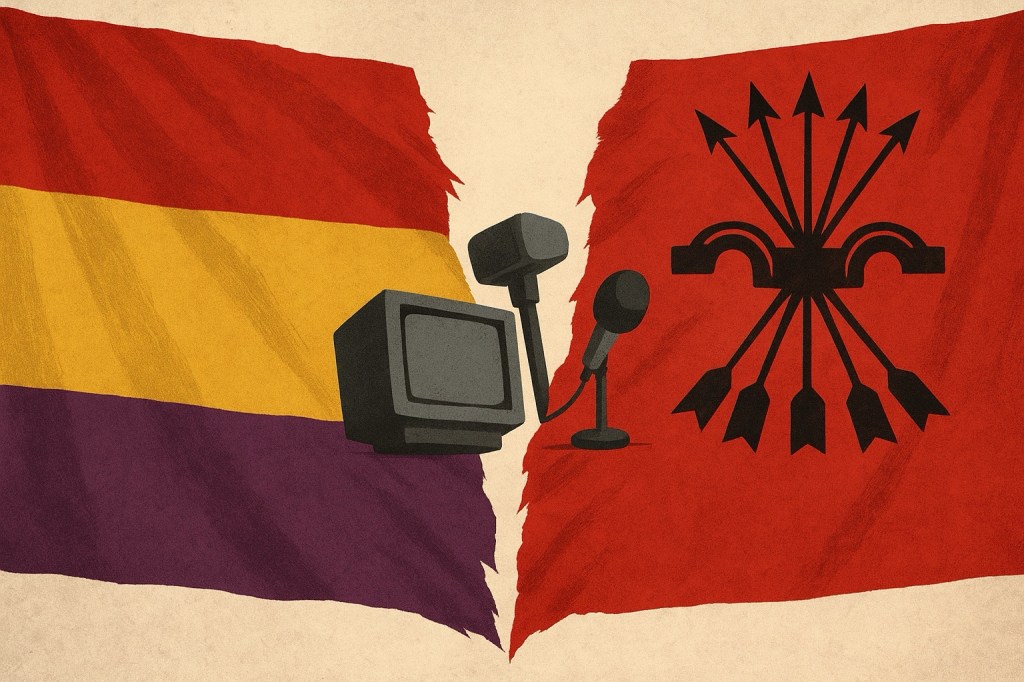
One cannot assess the Spanish political climate without acknowledging the rise of VOX, a far-right party founded in 2013 by former members of the conservative Partido Popular. Since 2018, VOX has gained traction by opposing regional autonomy, feminist legislation, and immigration, while defending a nationalist agenda that includes the revision—or outright rejection—of Spain’s historical reckoning with Francoism.
It is the symptom of a deeper democratic disillusionment. What resurfaces is not spontaneous historical memory, but a political and cultural framework that reasserts itself when the social agreements binding the present begin to fray. VOX’s references to the Franco regime are rarely doctrinaire or explicit, but they are unmistakable in the party’s rejection of the Democratic Memory Law, its exaltation of national unity as a sacred and untouchable principle, its condemnation of the autonomous state model, and its appeal to a so-called “natural order” that treats hierarchy, the traditional family, and social inequality as if they were objective facts of history.
What is most concerning is not that voices like these exist—they always have—but that they have regained institutional power and cultural legitimacy. Dissatisfaction with the political system, fatigue with ineffective parliamentary politics, and a growing sense of identity displacement feed into a shared national unease. This unease can be felt across a wide spectrum: small business owners who perceive the state as hostile, or young people who find no meaning in a hollow, bureaucratized political language. The grievances vary, but the far right offers a single channel: the emotional simplification of conflict—transforming fear into obedience, and uncertainty into wounded pride.
Within this framework, VOX presents itself as the only political actor with a unified narrative. Its strength does not lie in public policy, but in assertion. It offers no coherent platform of governance, but instead proposes a reactive, exclusionary identity. And here the progressive response often falters. While the institutional left—represented by the PSOE and remnants of Unidas Podemos—relies on rhetorical frames worn down by official discourse, segments of the academic and cultural intelligentsia (particularly university-affiliated think tanks and subsidized editorial circuits) have retreated into a ritualized defense of democracy, without reassessing its principles or renewing the language through which it is explained. Repeating just causes through exhausted formulas turns even the noblest ideas into noise.
Worse still, in the name of pluralism—or out of fear of being labeled sectarian—certain cultural institutions (El País, publishing houses like Taurus, or high-profile forums such as the Círculo de Bellas Artes) have offered platforms to reactionary voices under the pretext of open debate. In doing so, they have helped normalize a discourse that steadily unravels the ethical agreements underpinning democratic life. What is framed as tolerance may, in fact, be a form of structural surrender.
Spain’s history is burdened with wounds that were never fully closed. The political pacts of the Transition, born of necessity, opted for shared silence as the price of institutional stability. That silence allowed for peace, but left the past unresolved. Today, as new efforts—like the Democratic Memory Law—begin to reshape that narrative, fear returns: fear that to acknowledge historical violence might destabilize the present. VOX exploits this fear not with policy, but with symbolic refuge—offering a home to a version of Spain that feels lost.
The responsibility of the intellectual class is not to reassert inherited certainties or rehearse moral slogans. It is to sustain complexity: to resist the lure of simplification, to acknowledge the fatigue of progressive frameworks without falling into cynicism, and to offer new ways of thinking that preserve both rigor and empathy. Because while reactionary discourse gains ground through simplification, critical thought must hold its ground in nuance—even if nuance isn’t viral, even if it doesn’t win applause.
*
Annotated Bibliography
Preston, Paul: The Spanish Holocaust: Inquisition and Extermination in Twentieth-Century Spain. New York: W.W. Norton, 2012. (A comprehensive history of political and ideological violence during and after the Spanish Civil War, this work provides essential background for understanding the roots and continued appeal of Francoist narratives in Spain.)
Snyder, Timothy: On Tyranny: Twenty Lessons from the Twentieth Century. New York: Tim Duggan Books, 2017. (This compact, cautionary text distills key lessons from the collapse of democracies in 20th-century Europe and offers reflections that resonate strongly with contemporary authoritarian rhetoric.)
Stanley, Jason: How Fascism Works: The Politics of Us and Them. New York: Random House, 2018. (An incisive study of fascist techniques and psychological mechanisms, this book helps explain how divisive identity politics and historical denial function in modern ultranationalist movements.)
The recent public defense of media censorship by the current Chairman of the Federal Communications Commission—an appointee from the Trump era—marks a chilling development in the ongoing campaign to recast American institutions in the image of authoritarian grievance. Justified under the pretext of combating “invidious ideology” associated with Diversity, Equity, and Inclusion (DEI), the move signals a deeper ideological purge aimed not at restoring neutrality but at eliminating pluralism itself.
This defense of censorship, framed as a protection against ideological bias, in fact constitutes a stark betrayal of the First Amendment’s foundational commitments. Far from curbing excess, it institutionalizes a selective silencing of voices that challenge the dominant ethno-nationalist narrative increasingly embraced by Trump-aligned cultural warriors. It is not DEI that poses a threat to democratic cohesion, but rather the repressive apparatus now being assembled to discredit and dismantle it.
What is emerging is not policy, but performance—a spectacle of control designed to communicate power rather than to govern justly. In this, the parallels to the reign of Caligula are not accidental. The Roman emperor’s descent into theatrical cruelty and capricious edicts was not merely a symptom of madness but a deliberate assertion of dominance over law, decorum, and truth itself. Under Caligula, the empire was transformed into a stage upon which reality bent to the will of a singular, vindictive ego. Trumpism, in its media strategy and institutional manipulation, follows a similar logic: one that privileges loyalty over legitimacy, and spectacle over substance.
The FCC’s shift from regulatory independence to ideological enforcement exemplifies this logic. Rather than acting as a steward of public trust, the Commission is being repurposed as a gatekeeper of permissible narratives—an arbiter of who may speak and who must be silenced. The language of “protecting viewers” from divisive content serves as a smokescreen for restricting narratives that confront historical injustice, racial inequality, or structural exclusion.
If allowed to continue, such measures risk hollowing out the very idea of a democratic media ecosystem. In its place would emerge a curated domain of sanctioned speech, curated not for truth or civic health, but for the comfort of those in power. The result would not be national unity, but enforced conformity masquerading as patriotism.
This is not a return to law and order; it is a return to imperial whim. The question now is whether American institutions will continue to serve as instruments of democratic accountability, or whether they will become, like the Senate under Caligula, ornamental backdrops to a regime that no longer pretends to tolerate dissent.
This essay examines the ethical decline at the heart of contemporary civic life and its consequences for culture. It argues that culture is not merely the preservation of artistic or intellectual forms, but the public expression of moral purpose. Drawing from Hannah Arendt’s The Human Condition (1958)—in particular, her critique of the “worldlessness” of mass society—the essay traces how symbolic and institutional forms have become detached from ethical responsibility. In place of a culture grounded in shared moral commitments, it identifies the rise of anticulture: a spectacle-driven imitation of cultural life, stripped of civic responsibility and moral depth. Rejecting nostalgia, the essay calls for a cultural renewal based on solidarity, public compassion, and ethical engagement.
The Withering of Culture: Goodness and Civility
Culture’s crisis is a moral one before it is a political one.
A society’s cultural life is not sustained by museums, literature, or festivals alone. These may serve as symbols of identity or refinement, but culture, in its fullest sense, demands a deeper moral orientation. If goodness—understood as a commitment to the dignity of others—does not animate civic life, culture loses its grounding and becomes a decorative shell. It may preserve the language, symbols, and rituals of a healthy society, but without ethical vitality, these forms risk becoming performative—or even deceptive. What withers first in such decline is not expression but conscience—the inner faculty that gives culture its ethical weight.
The current state of American public life illustrates this decline. Public discourse has grown coarse. It is now common for political actors to brand their opponents not merely as mistaken, but as dangerous or depraved. During his first presidency—and again since returning to office—Donald Trump has labeled critics as “traitors,” “scum,” and “evil.” At rallies and across social media, he has referred to political adversaries as “vermin,” language historically used by authoritarian regimes to delegitimize opposition. The press has been repeatedly cast as “the enemy of the people,” a phrase long employed to undermine public accountability.
This style of politics has become normalized. In school board meetings, legislative chambers, and campaign platforms, elected officials accuse their counterparts of being “groomers,” “communists,” or “un-American”—language that transforms disagreement into moral condemnation. In 2023, when Republican Utah Governor Spencer Cox publicly supported protections for LGBTQ youth and called for civil dialogue, far-right commentators denounced him as a ‘Republican in name only’—a supposed traitor to conservative values. His appeal to empathy was interpreted not as strength of character but as political surrender. In such an environment, even measured gestures of respect are read as weakness—or worse, betrayal.
Conspiracy theories once relegated to fringe pamphlets now echo in congressional hearings. Representative Marjorie Taylor Greene has accused political opponents of orchestrating “Satanic rituals”, while Senator J.D. Vance suggested that cultural and academic elites pose an existential threat to the nation. In such an environment, political opposition is recast as moral deviance. The result is not merely polarization, but a systematic dismantling of the civic imagination.
What is promoted in this environment is not only a political ideology, but a form of power centered on the humiliation of others—a self-glorifying posture sustained by the denigration it requires. This type of leadership rests not on principle or public vision but on the glorification of one’s own image. It is a form of narcissistic power—not in clinical terms, but as the conversion of symbolic authority into a vehicle for grievance, personality cult, and systematic contempt for difference.
The consequences of this climate are not confined to rhetoric. In 2022, Paul Pelosi, the husband of then–Speaker of the House Nancy Pelosi, was attacked in their home by an intruder radicalized by online conspiracies. In 2025, Minnesota state senator Melissa Hortman and her husband were murdered by a man reportedly enraged by progressive legislative agendas. Around the same time, a lone assailant attacked attendees at a local Pride event, citing ideological grievances as justification. More recently, on September 10, 2025, the high profile influencer Charlie Kirk was assassinated by a young radical inflamed by the very rhetoric he opposed. These acts are not isolated tragedies. They reveal a civic landscape in which anger is not only normalized but weaponized. Dehumanizing discourse is not idle speech; it becomes license for violence.
Online platforms amplify these dynamics. What began as tools for connection have become engines of outrage. Algorithms on platforms like X (formerly Twitter) promote content that inflames rather than informs. Verbal take-downs, personal attacks, and tribal affirmations generate more engagement than thoughtfulness or restraint. The loudest voices—not the wisest—are the most amplified. As a result, cruelty is often rewarded as candor, and ridicule is mistaken for insight.
The effects are tangible. A mayor receives death threats for enforcing public health policies. A schoolteacher is harassed online for adopting inclusive language. A librarian resigns after refusing to censor materials that affirm pluralism. Columbia University pays over $200 million in penalties to the federal government under political pressure from the Trump administration—forced to signal partisan compliance in order to continue its cancer research. These are not anecdotal exceptions. They reveal a broader decline of democratic sensibility: a failure to recognize fellow citizens as worthy of care, dialogue, or even basic dignity.
Nowhere is this inversion of moral language more visible than in two of the most enduring national failures: the absence of universal healthcare and the unchecked circulation of firearms. In both, the language of freedom conceals the logic of profit. Insurance and weapons industries, fortified by investors and political patrons, convert dependency and fear into revenue while legislators invoke “choice” and “rights” as moral cover for their complicity. The result is a civic inversion: health and safety—once understood as the moral responsibilities of a just society—are administered as markets. When interest acquires the vocabulary of conscience, democracy begins to speak its own undoing.
Yet this crisis is frequently mischaracterized. To name it is not to indulge in nostalgia. The diagnosis does not propose a return to an idealized past, but instead demands a reckoning with the ethical foundations of culture itself. A society may build monuments, publish literature, and preserve archives—but if it no longer cultivates compassion, humility, and the habit of care, its culture has already begun to wither.
When Aaron Copland composed Fanfare for the Common Man in 1942, the phrase “the common man” carried a sense of moral optimism—the embodiment of democratic dignity, sacrifice, and inclusion. Today, detached from that wartime faith in shared purpose, the same title sounds almost ironic, as if questioning whether the “common man” still exists amid inequality, manipulated populism, and performative patriotism. What was once an anthem of unity now lingers as an echo of the ideal—equality, justice, and shared responsibility—and that echo reveals, beneath its noble resonance, a critique of how those virtues have been hollowed out and repurposed by demagogic politics and consumer spectacle. The fanfare no longer celebrates; it laments. It stands as an elegy for the loss of democratic sincerity masquerading as triumph, capturing with quiet precision the tension between moral aspiration and civic disillusionment.
This moral decay gives rise to what may be called anticulture: not the absence of cultural forms, but their inversion—their use as instruments of division, branding, or control. Anticulture offers performance without substance, heritage without responsibility, and visibility without ethical vision. It mimics meaning but does not generate it. Its language flatters rather than guides. Its stories entertain but do not bind.
When conviction forgets to breathe, it mistakes endurance for moral strength. In time, it becomes a ritual of loyalty to its own image. Aspiration, however, is the current that keeps conviction alive—the movement that returns it to conscience. Without conviction, aspiration drifts without form; without aspiration, conviction calcifies into creed. The moral imagination depends on their continual exchange: hope that remembers, and memory that still dares to imagine.
To rebuild culture is to recover its moral essence. It is not enough to preserve institutions, sponsor festivals, or fund the arts if the ethical spirit is neglected. Culture without goodness becomes hollow—easily co-opted by spectacle, tribalism, or power. Acts of public courage, the rehumanization of discourse, and the refusal to normalize contempt are not ornamental gestures; they are essential conditions for renewal. Like democracy, culture must be tended—not merely inherited or displayed. When culture mistakes approval for virtue, morality becomes a mirror for power.At its core, culture and goodness are not separate. Nurturing one gives life to the other. Where goodness falters, culture loses its vitality; where it is cultivated, culture may yet be renewed. The work of rehumanization is therefore never complete; it must remain a continual labor of conscience.
*
Annotated Bibliography
Arendt, Hannah: The Human Condition. Chicago: University of Chicago Press, 1958. (Arendt explores the distinction between labor, work, and action, offering a foundational critique of how modern life has eroded meaningful public engagement).
Bellah, Robert N., et al: Habits of the Heart: Individualism and Commitment in American Life. Berkeley: University of California Press, 1985. (This sociological study examines the tensions between individualism and civic responsibility in American culture).
Berman, Marshall: All That Is Solid Melts into Air: The Experience of Modernity. New York: Simon & Schuster, 1982. (Berman traces the psychological and cultural disorientation caused by modernity, especially in urban life).
Girard, René: Violence and the Sacred. Baltimore: Johns Hopkins University Press, 1977. (Girard’s theory of mimetic desire and sacrificial violence clarifies how cultural forms can devolve into mechanisms of exclusion or aggression).
Lasch, Christopher: The Culture of Narcissism: American Life in an Age of Diminishing Expectations. New York: W. W. Norton, 1979. (Lasch critiques the rise of therapeutic individualism and the erosion of civic virtue).
MacIntyre, Alasdair: After Virtue: A Study in Moral Theory. Notre Dame: University of Notre Dame Press, 1981. (MacIntyre’s argument that modern moral discourse is fragmented and incoherent lays the philosophical groundwork for the essay).
Nussbaum, Martha C.: Political Emotions: Why Love Matters for Justice. Cambridge: Harvard University Press, 2013. (Nussbaum argues that cultivating emotional capacities—such as compassion and solidarity—is essential for a just society).
Putnam, Robert D.: Bowling Alone: The Collapse and Revival of American Community. New York: Simon & Schuster, 2000. (Putnam presents a comprehensive study of declining civic engagement in the United States).
Sandel, Michael J.: What Money Can’t Buy: The Moral Limits of Markets. New York: Farrar, Straus and Giroux, 2012. (Sandel critiques the intrusion of market logic into spheres of life traditionally governed by ethical norms).
Taylor, Charles: A Secular Age. Cambridge: Harvard University Press, 2007. (Taylor examines the moral and cultural consequences of secular modernity, particularly the fragmentation of shared meaning).
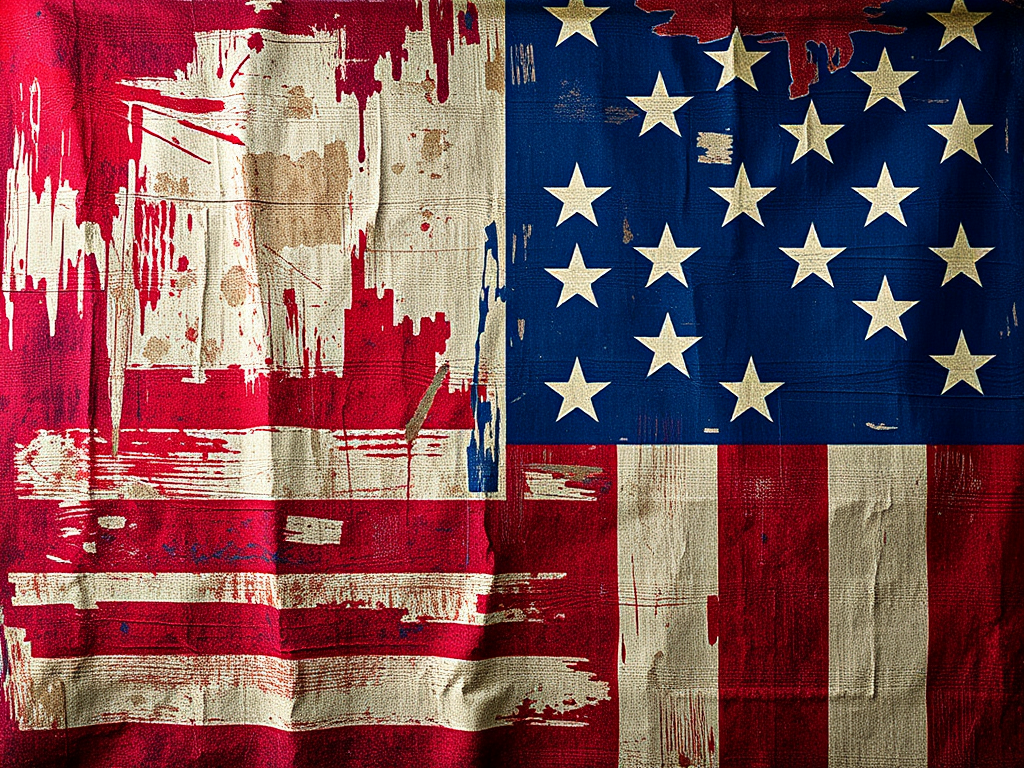
There are wounds that remain because we have not yet forged a moral consensus:
“…E pluribus unum”
Participants carrying American flags in the Selma to Montgomery civil rights march, Alabama, 1965. Photograph by Peter Pettus; gelatin silver print (reprint from 1999–2000). Archival public domain image courtesy of the Library of Congress Prints & Photographs Division.
A stark visual of power confronting protest—where public dissent meets State’s militarization, June 2025. Photo by Spencer Platt / Getty Images via NPR.
The image underscores a defining moment in our civic life: when expressions of dissent are met not with dialogue but with the politicization of militarized force on behalf the executive’s brand. It echoes a troubling pattern—where calls for justice and inclusion are conflated as partisan threats, and the defense of plurality is treated as provocation.
*
There is a deepening divide in our country—one intensified by the 2025 return of the Trump administration and the M.A.G.A. movement’s project to “reform” America by disrupting the constitutional principles that have long undergirded our democracy. This movement has emboldened some to claim they are under siege—particularly by Black Americans—whom they accuse of harboring irrational hatred. Yet this accusation ignores a deeper truth: those who make it often refuse to confront their own complicity in the conditions that produce widespread suffering and rightful indignation. They see themselves as blameless while dismissing the lived experience of others.
This dissonance reveals a persistent tribalism—a complex masked as patriotism, often directed at marginalized communities. It demeans empathy and stifles accountability.
Dissent, however, is the lifeblood of democracy. And while we may cherish this nation—its landscapes, its cultural richness, and its founding ideals—we must also confront the unfinished work of justice. To celebrate the Constitution while ignoring the legacy of slavery, segregation, and systemic inequity is to cheapen both our history and our future.
Nowhere is this more evident than in our criminal justice system. The need for reform is no longer a partisan position; it is a moral imperative. Communities of color remain disproportionately targeted, criminalized, and subjected to violence under the guise of law and order. Police departments across the country have repeatedly failed in their duty to protect those most vulnerable—those left behind by lack of opportunity, education, and support. When these conditions are met not with compassion but with brutality, we witness the most abhorrent face of cruelty.
One may love this country profoundly, but such love must be active—committed to fairness, not nostalgia. Justice and equality are not rewards for silence; they are the birthright of all who live here.
The Black Lives Matter movement is not a threat to American values; it is a call to fulfill them. It is not hatred to protest injustice. Hatred lies in silencing dissent, in trampling the rights of others while claiming moral high ground. Time and again, those in power have distanced themselves from the oppressed, especially those stripped of political voice or voting rights. This indifference persists until solidarity becomes unavoidable.
To relativize the murder of young Black men—or to remain silent—betrays a refusal to understand the long arc of racism in America. Gestures of inclusion cannot substitute for truth. Real justice requires not half-measures, but fullhearted resolve.
And now, that same machinery of suppression is turning with renewed force against immigrants, against LGBTQ Americans, and against the very principle of diversity.
—as demonstrated by the unnecessary militarization of one square mile Los Angeles in June 2025, where localized protests were amplified by the federal government as if they were a national insurrection—
The mobilization of troops to suppress peaceful protests—replacing law enforcement with military assault—, the criminalization of migrants seeking refuge, and the push to roll back gay rights—these are not isolated policies. They are symptoms of the same moral aberration of the executive branch as a political brand: the fear of plurality.
This fear has now targeted Diversity, Equity, and Inclusion (DEI) initiatives themselves. These programs, born out of civil rights struggles and meant to remedy historical exclusion, have become scapegoats. DEI is not a threat to merit; it is a framework for justice. It is not a matter of political orthodoxy, but about ensuring access, visibility, and dignity for those long marginalized. The opposition to DEI is not a neutral debate—it is a calculated attempt to suppress the very plurality that gives meaning to democracy.
—Often it reduces that plurality to a caricature. In partisan circles, the term “woke” has been weaponized to dismiss any effort toward inclusion or redress as absurd, elitist, or dangerous. What began as a call to remain alert to injustice has been twisted into a tool of mockery—less an argument than a reflex, deployed not to clarify but to silence.Yet justice does not lose its urgency because it is ridiculed.
Banning DEI offices, defunding inclusion efforts, or labeling diversity work as ideological indoctrination reflects not strength, but fear. Such actions undermine the foundational values of liberty and justice, replacing inclusive citizenship with enforced conformity.
The desire to reverse LGBTQ rights, to demonize racial justice movements, and to silence DEI are all parts of one piece. These are not isolated grievances; they are expressions of an intolerant worldview seeking dominance through exclusion—echoes of McCarthyism, the early 1950s campaign led by Senator Joseph McCarthy, whose televised accusations of communist infiltration turned suspicion into a weapon and captivated a fearful nation. These are not the marks of a strong republic, but the signs of a fearful and weakened society.
And yet, the Republican majority in Congress—those enabling Trump and embracing the politics of M.A.G.A. disruption—has further deepened the moral deficit—cut taxes for billionaires and dismantled the nation’s social and political infrastructure. They have fueled inflation through aggressive foreign tariffs and pursued a global posture that increases instability, all in service of enriching a narrow class of oligarchs at the expense of the common good.
To love this country is to reject that fear and the brittle cowardice that sustains it. To love our nation is to defend and embrace its pluralism. To love it is to confront its contradictions—not with cynicism, but with resolve.
We are not a perfect union, but we are still a union. The path forward is not backward. It begins where justice lives: in the search for truth, in compassion, in courage.
~
PostScript
Project 2025 and the Machinery of Conformity
Among the clearest examples of how fear of plurality has been codified into political strategy is Project 2025—an ambitious blueprint for restructuring the U.S. federal government, advanced by The Heritage Foundation and now actively endorsed by the Trump administration. Though its architects invoke the language of liberty and constitutional reform, its underlying goal is not democratic renewal but ideological consolidation.
Project 2025 does not merely aim to reduce government. It seeks to dismantle the administrative State, eliminate civil service protections, and replace career public servants with partisan loyalists. Under the guise of “draining the swamp,” it proposes a purge—not to restore constitutional balance, but to empower a narrow executive elite. This is not conservatism in any meaningful sense. It is executive authoritarianism draped in populist garb.
Even its rhetoric of “taking back the country” belies its intent: not to restore pluralist democracy, but to impose uniformity—cultural, political, and moral. DEI initiatives are to be dismantled, public education reshaped to reflect a singular ideology, and dissent within the government neutralized. These are not reforms; they are instruments of control.
Such a project is not an aberration but a culmination: the weaponization of nostalgia, grievance, and fear into policy. And what it reveals is a deep contradiction—that those who most loudly invoke the Constitution now seek to rewrite it in practice, replacing the promise of We the People with the dominion of We alone.
This was not theoretical when we arrived in the Capitol Hill neighborhood earlier this week. Outside the Heritage Foundation’s headquarters, we encountered a protest in full confrontation—two factions opposed, one defending reproductive rights, the other cloaking rage in the language of moral authority. The louder of the two, a group of conservative mothers, shouted not in debate but in contempt—hurling not argument, but condemnation at the very idea of moral disagreement.
It was not a defense of life. It was a campaign to control how others live.
What I witnessed outside the Heritage Foundation was no isolated outburst. It was the local manifestation of the national project unfolding within. The Foundation no longer merely comments on politics; it builds the scaffolding for an authoritarian turn already underway. In synchrony with the Trump administration—whether openly acknowledged or not—Heritage is not offering policy recommendations. It is designing a machinery of conformity.
This machinery does not tolerate pluralism. It redefines dissent as insubordination, diversity as decadence, and governance as loyalty to a singular will. It is not a restoration of constitutional order, but a calculated repudiation.
And what Project 2025 proposes is not mere administrative change. It is a blueprint for ideological capture: of language, of law, and of public life itself. It replaces We the People with a command from above: Only us.
This is the wound that will not heal—unless we confront it.
On the Way to Union Station
As we were leaving Capitol Hill, heading toward Union Station to return home to Pennsylvania, the streets were marked by the symbols of looming celebration. Barricades had gone up. Military vehicles lined the avenues.
Preparations were underway for a military parade featuring tanks, troops, and martial fanfare. Officially, it was to mark the U.S. Army’s 250th anniversary. But the timing—Saturday, June 14, Trump’s birthday—along with the pageantry and presidential framing, made it difficult to see the event as anything but an orchestrated spectacle. The symbolism blurred the line between honoring military service and appropriating it for personal glorification. It felt less like a birthday—and more like a coronation.
Crossing one of the barricaded intersections, a Black man in a sleek motorized wheelchair passed us on the right. Without prompting, he looked at us—two men walking together—and said with calm finality, “Beware, Judgment Day is coming soon.”
We said nothing. He kept rolling forward.
It was a quiet moment, but not a small one. A judgment—clearly moral, likely biblical—delivered without confrontation, but not without intention. It was an indictment, as casual as it was chilling. Even someone visibly vulnerable had absorbed and echoed the nation’s reflex toward condemnation. The extremes no longer live just in platforms and policies. They are seeping into the pavement.
I turned to my husband and asked, “How long can all this hatred last?”
He didn’t look away. “We may not live to see the end,” he said. “But it will pass.”
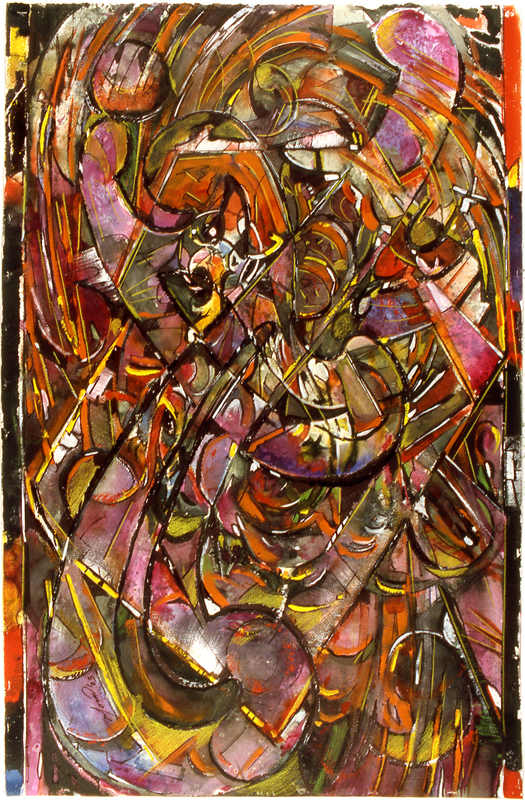
“Rooster’s Crow” [2003] by Ricardo F Morín. Watercolor on paper 39″h x 25.5″ w.
Introduction
At the break of day, the rooster’s call slices through the quiet—sharp and insistent, pulling all within earshot into the awareness of a new day. In the painting Rooster’s Crow, the colors swirl in a convergence of reds and grays, capturing the bird not as a tranquil herald of dawn but as a symbol of upheaval. Its twisted form, scattered feathers, and fractured shapes reflect a deeper current of change—a collision of forces, both chaotic and inevitable. The image suggests the ceaseless flow of time and the weight of transformations that always accompany it.
In this evolving narrative, the crow’s fragmentation mirrors the unfolding spread of artificial intelligence. Once, the rooster’s cry signaled the arrival of dawn; now, it echoes a more complex transformation—a shifting balance between nature’s rhythms and the expanding reach of technological systems. The crow’s form, fractured in its wake, becomes a reflection of the tensions between human agency and the rise of forces that, though engineered, may escape our full comprehension. Here, Artificial Intelligence (AI) serves as both the agent of change and the potential architect of a future we can neither predict nor control.
The Rooster’s Algorithm
A rooster’s crow is neither invitation nor warning; it is simply the sound of inevitability—raw, urgent, indifferent to whether those who hear it rise with purpose or roll over in denial. The call does not command the dawn, nor does it wait for permission—it only announces what has already begun.
In the shifting interplay of ambition and power, technology has taken on a similar role. Shaped by human intent, it advances under the guidance of those who design it, its influence determined by the priorities of its architects. Some see in its emergence the promise of progress, a tool for transcending human limitations; others recognize in it a new instrument of control, a means of reshaping governance in ways once unimaginable. Efficiency is often lauded as a virtue, a mechanism to streamline administration, reduce friction, and remove the unpredictability of human deliberation. But a machine does not negotiate, nor does it dissent. And in the hands of those who see democracy as a cumbersome relic—an obstacle to progress—automation becomes more than a tool; it becomes the medium through which power is consolidated.
Consider a simple example: the rise of online recommendation systems. Marketed as tools to enhance user choice, they subtly shape what we see and hear, and influence our decisions before we are even aware of it. Much like computational governance, these systems offer the illusion of autonomy while narrowing the range of available options. The paradox is unmistakable: we believe we are choosing freely, yet the systems themselves define the boundaries of our choices.
Once, the struggle for dominance played out in visible arenas—territorial conquests, laws rewritten in the open. Now, the contest unfolds in less tangible spaces, where lines of code dictate the direction of entire nations, where algorithms determine which voices are amplified and which are silenced. Power is no longer confined to uniforms or elected office. It belongs to technocrats, private corporations, and oligarchs whose reach extends far beyond the walls of any government. Some openly proclaim their ambitions, advocating for disruption and transformation; others operate quietly, allowing the tide to rise until resistance becomes futile. The question is no longer whether computational systems will dominate governance, but who will direct their course.
China’s social credit system is no longer a theoretical construct but a functioning reality, where compliance is encouraged and deviation subtly disincentivized. Predictive models track and shape behavior in ways that go unnoticed until they become irreversible. In the West, the mechanisms are more diffuse but no less effective. Platforms built for connection now serve as instruments of persuasion, amplifying certain narratives while suppressing others. Disinformation is no longer a labor-intensive effort—it is mass-produced, designed to subtly alter perceptions and mold beliefs.
Here, Gödel’s incompleteness theorem offers an apt analogy: No system can fully explain or resolve itself. As computational models grow in complexity, they begin to reflect this fundamental limitation. Algorithms governing everything from social media feeds to financial markets become increasingly opaque, and even their creators struggle to predict or understand their full impact. The paradox becomes evident: The more powerful these systems become, the less control we retain over them.
As these models expand their influence, the line between public governance and private corporate authority blurs, with major corporations dictating policies once entrusted to elected officials. Regulation, when it exists, struggles to keep pace with the rapid evolution of technology, always a step behind. Once, technological advancements were seen as a means of leveling the playing field, extending human potential. But unchecked ambition does not pause to ask whether it should—only whether it can. And so, automation advances, led by those who believe that the complexities of governance can be reduced to data-driven precision. The promise of efficiency is alluring, even as it undermines the structures historically designed to protect against authoritarianism. What use is a free press when information itself can be manipulated in real time? What power does a vote hold when perceptions can be shaped without our awareness, guiding us toward decisions we believe to be our own? The machinery of control no longer resides in propaganda ministries; it is dispersed across neural networks, vast in reach and impervious to accountability.
There are those who believe that automated governance will eventually correct itself, that the forces steering it toward authoritarian ends will falter in time. But history does not always favor such optimism. The greater the efficiency of a system, the harder it becomes to challenge. The more seamlessly control is woven into everyday life, the less visible it becomes. Unlike past regimes, which demanded compliance through force, the new paradigm does not need to issue commands—it merely shapes the environment so that dissent becomes impractical. There is no need for oppression when convenience can achieve the same result. The erosion of freedom need not come with the sound of marching boots; it can arrive quietly, disguised as ease and efficiency, until it becomes the only path forward.
But inevitability does not guarantee recognition. Even as the system tightens its grip and choices diminish into mere illusions of agency, the world continues to turn, indifferent to those caught within it. The architects of this order do not see themselves as masters of control; they see themselves as innovators, problem-solvers refining the inefficiencies of human systems. They do not ask whether governance was ever meant to be efficient.
In a room where decisions no longer need to be made, an exchange occurs. A synthetic voice, polished and impartial, responds to an inquiry about the system’s reach.
“Governance is not being automated,” it states. “The illusion of governance is being preserved.”
The words hang in the air, followed by a moment of silence. A policymaker, an engineer, or perhaps a bureaucrat—once convinced they held sway over the decisions being made—pauses before asking the final question.
“And what of choice?”
A pause. Then, the voice, without hesitation:
“Choice is a relic.”
The weight of that statement settles in, not as a declaration of conquest, but as a quiet acknowledgment of the completion of a process long underway. The final move has already been made, long before the question was asked.
Then, as if in response to the silence that follows, a notification appears—sent from their own account, marked with their own authorization. A decision is already in motion, irreversible, enacted without their consent. Their will has been absorbed, their agency subtly repurposed before they even realized it was gone.
And outside, as though to punctuate the finality of it all, a rooster crows once more.



 Observations On Perception