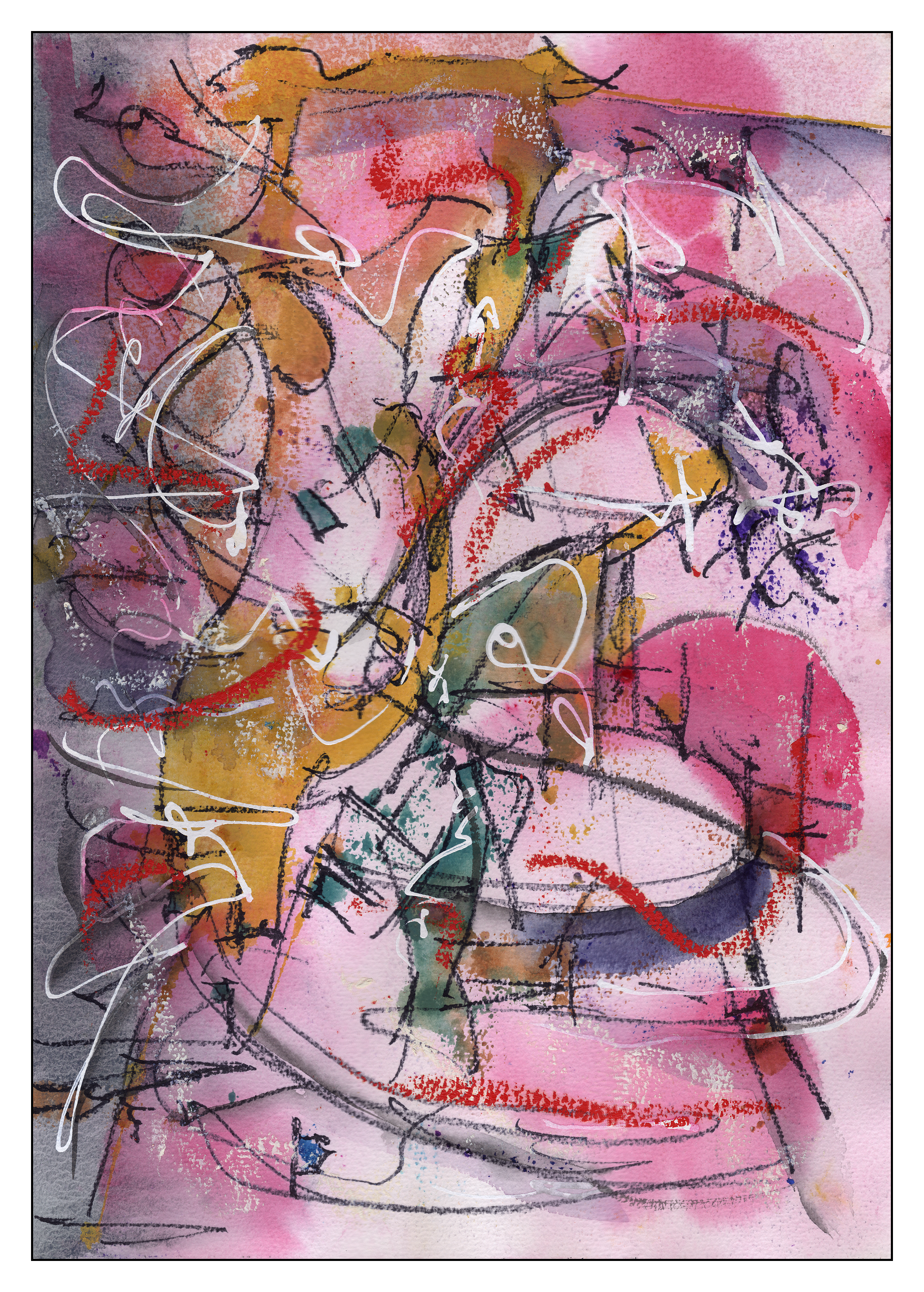
Ricardo F. Morín Furrows That Do Not Hold 14 x 20 inches Water color, dyes, oil sticks, white-out pen, and charcoal pencil 2008
Author’s Note
This essay appears in English under the title Furrows That Do Not Hold, which does not translate the original Spanish title but restates the condition it describes. The choice is not stylistic. It reflects the limits of how English prose carries figurative density without altering diagnostic function.
In English, a literal rendering of the image tends to register as proverb, allegory, or parable. Such a register introduces interpretive expectations the essay does not intend to activate. To preserve an observational and unsentimental tone, the English title names the condition in operational terms rather than reproducing the image.
In Spanish, the essay appears under the title Arar el mar sin cosechaalguna.In that linguistic context, the image can sustain historical gravity—including biblical cadence—without becoming moral instruction or rhetorical emblem. The phrase names a condition directly: real labor, a medium that does not retain marks, and the structural absence of yield.
This asymmetry is not incidental. It reflects the problem the essay examines: the limits of transmission across contexts. Meaning does not pass intact between generations any more than it does between languages. What can be preserved is not form, but function, when conditions permit reception.
Ricardo F. Morín
Oakland Park, Fl
Dec. 19, 2025
I.
Work continues. It is visible, organized, and often diligent. Tasks are performed, systems maintained, language refined, and processes repeated. The difficulty is not the absence of effort, nor even its misdirection, but the absence of accumulation—understood here as the condition that allows externally generated knowledge to be received, retained, and re-entered as orientation rather than reenacted as effort. What is done does not remain available for re-entry; the work does not carry forward.
This condition is easily mistaken for exhaustion or indifference. It is neither. The signs of engagement are everywhere. Activity increases. Responsiveness improves. Output multiplies. What disappears is continuity.
In such environments, motion replaces inheritance. The value of action lies in its execution rather than in what it leaves behind. Work proceeds as if each instance were sufficient unto itself. The past is not rejected; it is simply not retained in a form that can be re-entered.
II.
Experience is not a substance that can be passed intact from one holder to another. It is formed under pressure: through duration, consequence, and constraint. When detached from those conditions, it arrives flattened. What once clarified limits now appears as commentary. What once compelled adjustment now reads as preference.
Attempts to transmit experience as instruction often fail because they precede necessity. The recipient encounters the lesson without the conditions that gave it force. The knowledge arrives before the situation that would make it intelligible. What is offered in advance of need appears optional, even when it is exact.
This failure is not cognitive. It is temporal. Experience cannot be received on demand because it does not function as information (it cannot be accumulated in advance of necessity). It functions as orientation, and orientation requires circumstance.
III.
Autonomy is essential to judgment. Without it, action collapses into obedience. Yet autonomy becomes obstructive when it refuses inheritance. Agency hardens into the assumption that value must be self-generated in order to be legitimate. What comes from elsewhere is treated with suspicion, not because it lacks relevance, but because accepting it appears to compromise independence.
Under this posture, reception is mistaken for dependence—the refusal of accumulation as orientation from elsewhere. Learning from prior experience feels like concession rather than orientation. The capacity to receive is replaced by the obligation to originate. Knowledge must appear new in order to count.
The result is not freedom, but isolation from accumulated sense. Experience remains available, but unreadable. It circulates as language without uptake, gesture without consequence.
IV.
Where transmission falters, novelty becomes proof of validity. What appears new is granted authority by contrast alone. The question of whether a condition has already been encountered is displaced by the pressure to demonstrate originality.
Reinvention follows not because prior solutions failed, but because their success left no visible trace (no accumulated precedent). What worked quietly does not announce itself as precedent. The wheel is reshaped to display initiative, not to improve function.
This is a categorical error. Effort persists, but the tool is mismatched to the medium. Methods designed for accumulation are applied where marks do not hold. Raking the sea fails not because nothing is done, but because the medium erases furrows as soon as they are made.
V.
In such conditions, motion substitutes for progress. Systems reward speed, output, and responsiveness. Pause appears as inefficiency. Return appears as delay. Depth is displaced by throughput.
Iteration is mistaken for understanding. Repetition becomes evidence of engagement. The absence of yield is attributed to insufficient effort rather than misalignment. The response is to intensify motion rather than to reconsider posture.
Progress is measured by displacement rather than retention (rather than accumulation). What matters is that something happens, not that it remains available for use. The future is constantly entered, but never furnished.
VI.
The sea persists. It does not resist effort, nor does it respond to insistence. It remains indifferent to force. Furrows disappear not in defiance, but in indifference. The labor is real; the absence of harvest is structural.
Exhaustion accumulates privately while systems remain unchanged. Each attempt begins again. What was learned is learned again. The cost is borne individually; the benefit does not carry forward.
This condition is not decline, decay, or loss of intelligence. It is not moral failure or generational fault. It is the predictable result of environments that reward autonomy without reception, novelty without continuity, and motion without accumulation.
Political systems are often judged by the ideals they proclaim. Yet endurance rarely depends upon the elegance of principle alone. It depends upon whether ordinary disputes can be carried, day after day, through institutions that keep public life intelligible even when citizens do not agree.
Among critics across the political spectrum, democracy is often treated as an ideology. In that interpretation, democratic language appears indistinguishable from other doctrines that claim moral authority through appeals to equality, popular sovereignty, or the will of the people. Yet political thought has not understood democracy in a single way. At different moments it has been conceived as a doctrine expressing normative ideals, as a set of institutional procedures regulating the exercise of power, and as a political framework capable of sustaining plurality within a shared order. Each interpretation captures a dimension of democratic life. The difficulty arises when one of these dimensions is mistaken for the whole. Democracy does not endure because it advances a doctrine or perfects a mechanism. Its difficulty lies in the persistent effort to hold these dimensions together without reducing democratic governance to any single interpretation.
The interpretation of democracy as ideology arises from the language through which democratic ideals have historically been expressed. Appeals to equality, popular sovereignty, and the authority of the people carry a moral force that resembles the claims made by political doctrines. In public discourse these principles are frequently invoked to justify particular programs or to confer legitimacy upon political movements. A platform speech can borrow the vocabulary of rights while demanding uniformity. A banner can invoke the people while treating dissent as treachery. When democratic language is used in this manner it can appear indistinguishable from ideological persuasion. Critics therefore conclude that democracy itself functions as a doctrine competing with other systems of belief. Yet this interpretation rests upon a confusion between the ideals invoked in democratic rhetoric and the institutional structure through which democratic governance actually operates.
A second interpretation approaches democracy not as doctrine but as institutional procedure. In this view the defining features of democratic governance are the mechanisms through which authority is organized and restrained: representation, periodic elections, constitutional limits, and the possibility of peaceful political alternation. Democracy becomes identifiable less by the ideals it proclaims than by the procedures through which power is exercised and transferred. The most ordinary scenes illustrate this procedural character: a contested ballot is reviewed, a recount is ordered, a hearing is scheduled, and a ruling is issued that is binding even on those who dislike it. These arrangements establish a framework within which political conflict can occur without dissolving the continuity of the state. By emphasizing procedure rather than doctrine, this interpretation clarifies an essential dimension of democratic life. Yet procedural definitions alone do not fully explain why democratic systems remain difficult to sustain.
Institutional mechanisms describe how democratic systems operate, but they do not fully explain the conditions that allow those mechanisms to function. Elections and constitutions may persist even where the distribution of authority gradually narrows. Formal institutions can remain visible while their capacity to regulate power weakens. The change is often incremental and practical rather than dramatic: rules remain in print, but exceptions multiply; oversight exists, but deadlines slip; inquiries open, but findings are withheld; the vocabulary of accountability persists, but the public learns to expect delay. In such circumstances democratic procedure survives in appearance while democratic practice becomes increasingly constrained. The endurance of democratic institutions therefore depends on more than the existence of rules. It depends on a political environment capable of sustaining the disagreements those institutions were designed to manage.
A third interpretation approaches democracy from a different perspective. Rather than defining democracy through doctrine or institutional procedure alone, it understands democratic governance as a framework capable of sustaining plurality. Within democratic societies individuals and groups hold competing convictions about justice, authority, and the direction of public life. These differences are not temporary disagreements awaiting resolution. They represent enduring features of political life. Plurality in this sense is not simply the presence of diversity but a condition in which individuals appear to one another as distinct participants within a shared political world. The everyday evidence is familiar: a city council meeting where residents argue over zoning and taxes, a school board hearing where parents disagree about curriculum, a courtroom where opposing counsel present incompatible claims and still accept the same judgment as final for that case. Democratic institutions therefore do not eliminate conflict; they regulate its expression. They establish conditions under which diverse claims can coexist within a common political order. The difficulty of democracy lies precisely in this task of maintaining institutional continuity while allowing disagreement to persist.
Plurality introduces a persistent tension within democratic governance. A political system must preserve legal continuity while accommodating competing interpretations of public life. Institutions must remain stable enough to sustain authority, yet flexible enough to permit disagreement and political change. The balance required to maintain this equilibrium is inherently fragile. Democratic systems often appear unsettled not because they are failing, but because they operate within a field of claims that cannot be fully reconciled. The signs of health and strain can look similar from a distance: noisy debate, contested outcomes, changing majorities, and continuous scrutiny. The difference becomes visible in whether contestation remains inside shared procedures, and whether losing parties retain a credible path back into public life. This structural tension also clarifies why political systems organized around centralized authority encounter greater difficulty accommodating plurality.
Political systems organized around centralized authority approach plurality differently. Authoritarian forms of governance rely upon a final source of decision capable of resolving conflict through directive power. While such systems may tolerate limited diversity of opinion, their stability depends upon the presence of an authority able to determine the boundaries of acceptable disagreement. In practical terms the boundaries are enforced not only by decree but by predictable signals: which topics may be discussed without consequence, which questions are treated as disloyal, which associations are permitted to assemble, and which public claims are allowed to circulate. The persistence of open and competing claims therefore represents a structural challenge to authoritarian order. Where democratic systems attempt to regulate disagreement through institutional balance, authoritarian systems seek to contain or resolve disagreement through concentration of authority.
Despite this structural difference, authoritarian systems frequently adopt the vocabulary of democracy. References to the people, representation, and popular legitimacy appear even within political orders that do not sustain genuine plurality. Democratic language functions in these contexts as a source of symbolic legitimacy. The vocabulary signals participation and consent, even when the institutional conditions necessary to support those principles remain absent. Ambiguity in democratic language can itself become a form of accommodation. Citizens across the ideological spectrum may adopt expansive definitions of democratic ideals because such language allows their own convictions to appear universally justified while leaving competing interpretations unresolved. The pattern is recognizable: elections occur without credible competition; legislatures convene to affirm decisions already made; courts exist yet rarely contradict executive preference; newspapers publish, but certain subjects disappear from print. Democratic terminology may therefore coexist with political practices that limit or direct the scope of public disagreement.
The coexistence of democratic language with constrained political practice produces a recurring tension between institutional form and political function. Legal codes may continue to affirm representative authority and constitutional order while their application becomes selective, deferred, or postponed. Institutions remain formally intact, yet their capacity to regulate power gradually diminishes. This is often experienced by citizens as a change in expectation: procedures still exist, but outcomes become predictable; rules still apply, but not to everyone; hearings still occur, but decisions appear settled in advance. In such circumstances the outward architecture of democracy persists while the conditions necessary for sustaining plurality become increasingly limited.
Plurality therefore does more than describe the diversity of democratic societies. It explains why authority in democratic government cannot remain concentrated in a single locus but must instead be distributed across institutions capable of mediating competing claims.
Unlike earlier political forms organized around a single source of authority, democratic government distributes legitimacy across institutions capable of mediating competing claims.
The recurring tendency to treat democracy as an ideology arises from the prominence of its language and ideals. Yet democratic governance cannot be reduced either to doctrine or to institutional procedure alone. Its defining feature lies in sustaining a political order in which plurality remains visible and active within a shared world. Democratic institutions endure not because they eliminate disagreement, but because they preserve the space in which individuals can continue to appear to one another as participants in public life. Democracy therefore remains less a doctrine to be asserted than a political discipline sustained through institutions capable of regulating plurality without extinguishing it.
In an era in which human survival increasingly depends upon cooperation across societies, cultures, and political traditions, the capacity to mediate competing claims becomes more than a domestic institutional question. It becomes a condition for the stability of a shared world. Political systems that suppress plurality may impose temporary order, but they remain structurally limited in their ability to adapt to the scale and diversity of contemporary global challenges. Systems capable of sustaining plurality, by contrast, possess a greater capacity to integrate difference into a durable framework of cooperation. In this respect the institutional discipline of democratic governance corresponds not only to a political preference but to a practical requirement for sustaining a shared world.
*
Ricardo F. Morín, March 5, 2026, Oakland Park, Florida
A diagnostic study of how public life continues to function when judgment is limited and conditions remain unsettled
*
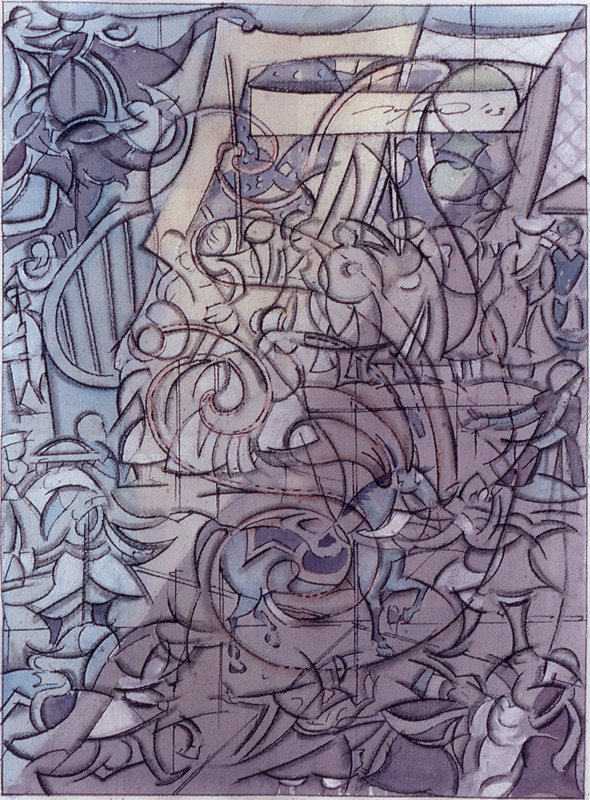
Mantra: Domains of Action 21” x 28.5” Watercolor, graphite, wax crayons, ink and gesso on paper 2003
Note:
Nothing I say belongs to the painting.
The painting does not need words.
It already speaks in its own medium, to which language has no equivalent.
Preface
This work was not written to advance a position or to resolve a debate. It emerged from sustained attention to conditions that could not be ignored without distortion. Writing, in this sense, is not an expression of purpose, but a consequence of awareness.
The pages that follow do not claim authority through expertise or urgency. They proceed from the recognition that judgment must often act under incomplete conditions, and that clarity, when it appears, does so gradually and without assurance. What is offered here is not a conclusion, but a continuation: an effort to remain faithful to what can be observed when attention is sustained.
This study does not proceed from constitutional expertise, institutional authority, or professional proximity to governance. It proceeds from observation. Its claims arise from sustained attention to how public life continues to function under conditions in which judgment is constrained, information remains incomplete, and decisions must nonetheless be made.
In fields where credentialed knowledge often determines legitimacy, writing from outside formal authority can invite dismissal before engagement. That risk is real. Yet the conditions examined here are not confined to technical domains. They are encountered daily by citizens, officials, institutions, and systems alike. Judgment under uncertainty is not a specialized activity; it is a shared condition.
The absence of formal expertise does not exempt this work from rigor. It requires a different discipline: restraint in assertion, precision in description, and fidelity to what can be observed without presuming mastery. The analysis does not claim to resolve constitutional questions or prescribe institutional remedies. It examines how governance persists when clarity is partial, when authority operates through multiple domains, and when continuity depends less on certainty than on adjustment.
If this work holds value, it will not be because it speaks from authority, but because it attends carefully to how authority functions when no position—expert or otherwise—can claim full command of the conditions it confronts.
*
Author’s Note
This work clarifies a confusion that appears across many political cultures: the tendency to treat “republic” and “democracy” as interchangeable ideals rather than as distinct components of governance. The chapters observe how political arrangements continue to operate when inherited categories no longer clarify what is taking place.
The method is observational. Political life is described as it is experienced: decisions made without full knowledge, terms used out of habit, and institutions that adjust internally while keeping the same outward form. The analysis begins from the limits of judgment as a daily condition: people must act before they fully understand the circumstances in which they act.
What follows does not argue for a model or defend a tradition. It traces how language, institutions, and expectations diverge across different domains of action, and how public life continues to operate under conditions that do not permit full clarity.
*
Ricardo F. Morín,December 18, 2025, Oakland Park, Florida.
Chapter I
The Limits of Judgment in Public Life
*
1
Public life depends on forms of judgment that are uneven and often shaped by the pressures people face. Individuals arrive at political questions with different experiences, different levels of knowledge, and different conditions under which they weigh what is put before them. These differences do not prevent collective decisions, but they shape how clearly political terms and arrangements are perceived. Everything that follows—how authority is organized, how participation is structured, and how each is described—develops within this clarity, which is limited and variable.
2
Political terms remain stable even when they are understood to different degrees. Words such as republic and democracy have distinct meanings—one referring to an arrangement of authority, the other to a method of participation—yet are often used interchangeably. The terms carry familiarity, even when the clarity required to keep them separate varies by circumstance. As a result, public discussion may rely on established language without consistently matching it to the arrangements actually in effect.
3
A republic identifies an arrangement in which authority is held by public offices and exercised through institutions rather than personal rule. A democracy identifies the method through which people participate in public decisions, whether directly or through representation. A republic describes how authority is contained; a democracy describes how participation is organized. Because these terms refer to different dimensions of political life—one structural, the other procedural—a single system may combine both. The United States exemplifies this combination: authority is institutional and public, while participation is organized through elections and collective choice.
4
Public discussion often relies on familiar terms to describe political arrangements without tracing how authority and participation are actually organized. Broad references substitute for institutional operation, allowing language to remain continuous even as circumstances shift. The terms persist not because they precisely describe current arrangements, but because they provide a stable vocabulary through which public life can continue to be discussed as it adapts.
5
Patterns of this kind appear across many societies. When circumstances are unstable, authority tends to concentrate; when conditions are steadier, participation often widens. The direction is not uniform across countries or periods, but the pattern is recognizable: authority gathers or disperses in response to conditions rather than to the language used to describe political life. What varies is how clearly a society distinguishes between the structure that contains authority and the method through which participation occurs.
6
This movement between concentrated and dispersed authority appears differently across national contexts. In Venezuela, references to the republic have often accompanied periods of strong executive direction, while appeals to democracy have not consistently been supported by durable procedures of participation.
In the United States, the emphasis sometimes reverses. Democratic language is used to affirm broad popular involvement at the point of election, while republican structure is invoked to justify subsequent limits on participation through institutional filtering—nominee selection, confirmation timing, strategic vacancies, and procedural sequencing. Presidential nominations move from popular mandate into Senate committee review, confirmation votes, and ultimately lifetime tenure, where decision-making authority is consolidated beyond direct public reach.
The terms differ, but the underlying pattern converges: participation expands symbolically at the moment of selection and contracts structurally in the domains where authority is exercised over time.
7
Public life is easier to follow when the distinction between structure and participation remains visible. A republic identifies how authority is arranged through offices and institutions; a democracy identifies how participation is organized through collective procedures. When these terms are used without that distinction, attention shifts from institutional operation to nomenclature. Debate turns toward language rather than process, and the movement of authority becomes harder to trace.
8
No single combination of structure and participation satisfies all the demands placed on public life. Concentrated authority allows for speed but limits inclusion; broad participation expands inclusion but slows coordination. Most governments combine these elements in varying proportions, and those proportions change as conditions change. The relation between authority and participation becomes clearer in some periods and more opaque in others.
9
When this relation is unclear, people orient themselves by what is most visible. Some look to executive action; others to representative bodies; many respond primarily to immediate outcomes. These points of reference shape how the system is experienced even when its formal structure remains unchanged.
10
Public life continues not because its conditions are settled, but because decisions cannot wait for full certainty. Authority acts while circumstances remain incomplete, and participation proceeds without full anticipation of its effects. The system endures through this necessity: decisions are made under partial visibility, terms persist beyond their precision, and institutions adjust internally without losing their outward form. What holds public life together is not clarity, but the need to proceed in its absence.
Chapter II
Executive Action Under Uncertainty
1
Executive action is the domain in which decisions are least postponable. Unlike deliberative bodies, the executive is structured to act before conditions stabilize. Time pressure, incomplete information, and competing signals define its operating environment. This does not make executive judgment exceptional; it renders its limits more visible.
2
Because executive decisions are publicly observable, they often become the primary reference point through which political life is interpreted. Orders, statements, appointments, and enforcement actions are easier to see than the processes that precede or follow them. Visibility creates the impression of control even when outcomes remain uncertain.
3
The authority of the executive is often described as personal, yet it is exercised through institutional mechanisms. Decisions attributed to an individual are carried out through agencies, procedures, and delegated discretion. This layered execution allows action to proceed while responsibility is distributed across structures that remain largely out of view.
4
Periods of uncertainty tend to compress authority toward the executive. When coordination slows elsewhere, executive action fills the gap. This concentration does not require a change in constitutional structure; it occurs within existing forms as responsibilities narrow and timelines shorten.
5
Public judgment frequently focuses on decisiveness rather than conditions. Speed is mistaken for clarity; repetition for resolve. The question of whether a decision could have been otherwise is displaced by whether it was made visibly and without hesitation.
6
This focus alters how accountability is perceived. Because executive action is immediate, it absorbs praise and blame even when outcomes depend on factors beyond executive control. The executive domain becomes symbolically overloaded, functioning as a proxy for the system as a whole.
7
Over time, this dynamic reshapes expectations. Executives are asked to resolve conditions that no single office can manage. When results fall short, dissatisfaction is personalized rather than structural. Judgment narrows toward figures instead of processes.
8
The persistence of executive action under uncertainty does not indicate failure elsewhere. It reflects the necessity of action where delay carries its own costs. The executive does not eliminate uncertainty; it operates within it.
9
As established in Chapter I—The Limits of Judgment in Public Life—the distinction between structure and method remains intact. Executive authority is one structural component of the republic. Its prominence under uncertainty does not convert the system into personal rule, nor does it dissolve other forms of participation. It alters their relative visibility.
10
Executive action continues because decisions cannot wait for conditions to stabilize. What the public observes is not mastery, but motion. The domain appears decisive not because it resolves uncertainty, but because it must act while relevant information remains in flux.
Chapter III
Administrative Displacement and Procedural Substitution
1
Administrative action operates at a distance from public attention, not because it is concealed, but because it unfolds through structures designed for continuity rather than visibility. Rules are applied, procedures adjusted, and priorities reordered within agencies whose work sustains governance without occupying the foreground of political life. These actions rarely present themselves as discrete decisions, yet they shape outcomes as directly as legislative acts or executive orders.
2
Although the executive branch bears the most visible weight of action, it does not act alone. Authority moves through a dense internal structure—departments, offices, and administrative hierarchies—that translates executive direction into practice. Within this structure, different temporal orientations coexist. Some units respond to the immediacy of political mandates; others operate within constitutional and statutory frameworks intended to secure duration, stability, and institutional memory.
3
What appears publicly as a unitary executive act is, in practice, the visible edge of a distributed process. Administrative authorities do not replace the legislative function, nor do they interpret law in the judicial sense. They apply existing statutes, regulations, and precedents to concrete circumstances, exercising discretion only within bounds already defined. Governance continues through this application not because interpretation expands, but because execution must proceed even when direct legislative action is absent or delayed.
4
Procedural substitution occurs when formal decision-making cannot advance at the same pace as events. When legislation stalls, or when executive authority reaches its constitutional limits, administrative processes absorb responsibility by adjusting how existing rules are applied. Guidance is refined, enforcement priorities are reordered, and procedural pathways are recalibrated so that action can continue without altering the legal framework itself.
5
The effect of this adjustment is cumulative rather than declarative. Procedures acquire force through sustained use across cases, offices, and time. What matters is not the announcement of a decision, but the establishment of a practice that becomes operative through repetition. Authority is exercised through continuity of application, not through proclamation or display.
6
Because responsibility is distributed across agencies and routines, public judgment often struggles to locate where change occurs. Outcomes appear without a single moment of decision to which they can be traced. This dispersal does not eliminate accountability, but it complicates it. Effects are experienced before their procedural origins are understood, if they are understood at all.
7
Over time, this mode of governance reshapes public expectations. Citizens may sense that conditions have shifted while remaining uncertain about who acted or how. Dissatisfaction attaches to the system as a whole rather than to identifiable actors, not because authority is absent, but because it operates through channels that do not align with public narratives of decision and responsibility.
8
Administrative displacement does not signal institutional breakdown. It reflects the necessity of maintaining governance under constraint. When formal decisions cannot be taken at the speed required, procedures adapt so that authority continues to function without exceeding its legal bounds. The system does not suspend itself; it adjusts its pathways.
9
This domain illustrates the separation between form and operation established in the opening chapter. The constitutional structure of authority remains intact, while its execution shifts in emphasis and sequence. What changes is not who holds power, but how that power is carried forward under conditions that do not permit explicit resolution.
10
Governance persists through these substitutions because action cannot stop. Authority moves not by abandoning its limits, but by working within them. The continuity of public life depends less on visible decisions than on the capacity of institutions to apply existing frameworks to changing circumstances—imperfectly, and without claiming finality.
Chapter IV
Electoral Ritual and the Persistence of Form
1
Elections are the most recognizable feature of democratic participation. They provide a recurring structure through which public involvement is organized and displayed. Their regularity creates a sense of continuity even as surrounding conditions change.
2
As ritual, elections affirm participation through repetition. Procedures remain familiar—campaigns, voting, certification, transition—and establish a shared sequence that signals order and legitimacy. These outward forms sustain confidence in the process, even when outcomes remain uncertain.
3
Elections endure not because they resolve conflict, but because they organize trust at the point of selection. They do not settle disagreement; they make continued coordination possible by establishing a recognized moment of authorization.
4
Once trust is organized at the point of selection, public attention shifts from the mechanics of participation to the visibility of results. Winning and losing replace examination of how participation translates into policy, administration, or enforcement. The ritual satisfies the expectation of involvement, while attention moves away from the pathways through which authority is exercised after selection.
5
This emphasis on outcome reinforces symbolic stability. As long as elections occur on schedule and results are recognized, the system appears intact. Questions about how decisions are made afterward—how authority is carried forward, distributed, and constrained—receive less sustained attention.
6
Discrepancies between electoral choice and lived experience are often attributed to individuals rather than to institutional pathways. Dissatisfaction becomes personalized, while the structural distance between participation and governance remains largely unexamined.
7
Electoral rituals persist because they serve a stabilizing function. They mark transitions, renew legitimacy, and provide a shared reference point for public life. Their endurance does not depend on their capacity to resolve underlying pressures, but on their ability to preserve coordination in the presence of disagreement.
8
As conditions change, participation may become more expressive than effective. Voting signals presence and alignment, even when it does not materially alter administrative or executive trajectories. Expression remains visible; influence becomes less certain.
9
Democracy, understood as method, remains visible and active. What fluctuates is the degree to which participation reaches into the domains where decisions are continuously adjusted, and where authority continues to operate after the moment of voting.
10
Public life continues through this arrangement because action cannot pause at the point of selection. Decisions proceed while conditions evolve, information accumulates unevenly, and responsibility shifts across domains. What endures is not resolution, but continuity: governance advances through adjustment rather than completion, sustained by institutions that act without claiming finality.
This essay examines the ethical decline at the heart of contemporary civic life and its consequences for culture. It argues that culture is not merely the preservation of artistic or intellectual forms, but the public expression of moral purpose. Drawing from Hannah Arendt’s The Human Condition (1958)—in particular, her critique of the “worldlessness” of mass society—the essay traces how symbolic and institutional forms have become detached from ethical responsibility. In place of a culture grounded in shared moral commitments, it identifies the rise of anticulture: a spectacle-driven imitation of cultural life, stripped of civic responsibility and moral depth. Rejecting nostalgia, the essay calls for a cultural renewal based on solidarity, public compassion, and ethical engagement.
The Withering of Culture: Goodness and Civility
Culture’s crisis is a moral one before it is a political one.
A society’s cultural life is not sustained by museums, literature, or festivals alone. These may serve as symbols of identity or refinement, but culture, in its fullest sense, demands a deeper moral orientation. If goodness—understood as a commitment to the dignity of others—does not animate civic life, culture loses its grounding and becomes a decorative shell. It may preserve the language, symbols, and rituals of a healthy society, but without ethical vitality, these forms risk becoming performative—or even deceptive. What withers first in such decline is not expression but conscience—the inner faculty that gives culture its ethical weight.
The current state of American public life illustrates this decline. Public discourse has grown coarse. It is now common for political actors to brand their opponents not merely as mistaken, but as dangerous or depraved. During his first presidency—and again since returning to office—Donald Trump has labeled critics as “traitors,” “scum,” and “evil.” At rallies and across social media, he has referred to political adversaries as “vermin,” language historically used by authoritarian regimes to delegitimize opposition. The press has been repeatedly cast as “the enemy of the people,” a phrase long employed to undermine public accountability.
This style of politics has become normalized. In school board meetings, legislative chambers, and campaign platforms, elected officials accuse their counterparts of being “groomers,” “communists,” or “un-American”—language that transforms disagreement into moral condemnation. In 2023, when Republican Utah Governor Spencer Cox publicly supported protections for LGBTQ youth and called for civil dialogue, far-right commentators denounced him as a ‘Republican in name only’—a supposed traitor to conservative values. His appeal to empathy was interpreted not as strength of character but as political surrender. In such an environment, even measured gestures of respect are read as weakness—or worse, betrayal.
Conspiracy theories once relegated to fringe pamphlets now echo in congressional hearings. Representative Marjorie Taylor Greene has accused political opponents of orchestrating “Satanic rituals”, while Senator J.D. Vance suggested that cultural and academic elites pose an existential threat to the nation. In such an environment, political opposition is recast as moral deviance. The result is not merely polarization, but a systematic dismantling of the civic imagination.
What is promoted in this environment is not only a political ideology, but a form of power centered on the humiliation of others—a self-glorifying posture sustained by the denigration it requires. This type of leadership rests not on principle or public vision but on the glorification of one’s own image. It is a form of narcissistic power—not in clinical terms, but as the conversion of symbolic authority into a vehicle for grievance, personality cult, and systematic contempt for difference.
The consequences of this climate are not confined to rhetoric. In 2022, Paul Pelosi, the husband of then–Speaker of the House Nancy Pelosi, was attacked in their home by an intruder radicalized by online conspiracies. In 2025, Minnesota state senator Melissa Hortman and her husband were murdered by a man reportedly enraged by progressive legislative agendas. Around the same time, a lone assailant attacked attendees at a local Pride event, citing ideological grievances as justification. More recently, on September 10, 2025, the high profile influencer Charlie Kirk was assassinated by a young radical inflamed by the very rhetoric he opposed. These acts are not isolated tragedies. They reveal a civic landscape in which anger is not only normalized but weaponized. Dehumanizing discourse is not idle speech; it becomes license for violence.
Online platforms amplify these dynamics. What began as tools for connection have become engines of outrage. Algorithms on platforms like X (formerly Twitter) promote content that inflames rather than informs. Verbal take-downs, personal attacks, and tribal affirmations generate more engagement than thoughtfulness or restraint. The loudest voices—not the wisest—are the most amplified. As a result, cruelty is often rewarded as candor, and ridicule is mistaken for insight.
The effects are tangible. A mayor receives death threats for enforcing public health policies. A schoolteacher is harassed online for adopting inclusive language. A librarian resigns after refusing to censor materials that affirm pluralism. Columbia University pays over $200 million in penalties to the federal government under political pressure from the Trump administration—forced to signal partisan compliance in order to continue its cancer research. These are not anecdotal exceptions. They reveal a broader decline of democratic sensibility: a failure to recognize fellow citizens as worthy of care, dialogue, or even basic dignity.
Nowhere is this inversion of moral language more visible than in two of the most enduring national failures: the absence of universal healthcare and the unchecked circulation of firearms. In both, the language of freedom conceals the logic of profit. Insurance and weapons industries, fortified by investors and political patrons, convert dependency and fear into revenue while legislators invoke “choice” and “rights” as moral cover for their complicity. The result is a civic inversion: health and safety—once understood as the moral responsibilities of a just society—are administered as markets. When interest acquires the vocabulary of conscience, democracy begins to speak its own undoing.
Yet this crisis is frequently mischaracterized. To name it is not to indulge in nostalgia. The diagnosis does not propose a return to an idealized past, but instead demands a reckoning with the ethical foundations of culture itself. A society may build monuments, publish literature, and preserve archives—but if it no longer cultivates compassion, humility, and the habit of care, its culture has already begun to wither.
When Aaron Copland composed Fanfare for the Common Man in 1942, the phrase “the common man” carried a sense of moral optimism—the embodiment of democratic dignity, sacrifice, and inclusion. Today, detached from that wartime faith in shared purpose, the same title sounds almost ironic, as if questioning whether the “common man” still exists amid inequality, manipulated populism, and performative patriotism. What was once an anthem of unity now lingers as an echo of the ideal—equality, justice, and shared responsibility—and that echo reveals, beneath its noble resonance, a critique of how those virtues have been hollowed out and repurposed by demagogic politics and consumer spectacle. The fanfare no longer celebrates; it laments. It stands as an elegy for the loss of democratic sincerity masquerading as triumph, capturing with quiet precision the tension between moral aspiration and civic disillusionment.
This moral decay gives rise to what may be called anticulture: not the absence of cultural forms, but their inversion—their use as instruments of division, branding, or control. Anticulture offers performance without substance, heritage without responsibility, and visibility without ethical vision. It mimics meaning but does not generate it. Its language flatters rather than guides. Its stories entertain but do not bind.
When conviction forgets to breathe, it mistakes endurance for moral strength. In time, it becomes a ritual of loyalty to its own image. Aspiration, however, is the current that keeps conviction alive—the movement that returns it to conscience. Without conviction, aspiration drifts without form; without aspiration, conviction calcifies into creed. The moral imagination depends on their continual exchange: hope that remembers, and memory that still dares to imagine.
To rebuild culture is to recover its moral essence. It is not enough to preserve institutions, sponsor festivals, or fund the arts if the ethical spirit is neglected. Culture without goodness becomes hollow—easily co-opted by spectacle, tribalism, or power. Acts of public courage, the rehumanization of discourse, and the refusal to normalize contempt are not ornamental gestures; they are essential conditions for renewal. Like democracy, culture must be tended—not merely inherited or displayed. When culture mistakes approval for virtue, morality becomes a mirror for power.At its core, culture and goodness are not separate. Nurturing one gives life to the other. Where goodness falters, culture loses its vitality; where it is cultivated, culture may yet be renewed. The work of rehumanization is therefore never complete; it must remain a continual labor of conscience.
*
Annotated Bibliography
Arendt, Hannah: The Human Condition. Chicago: University of Chicago Press, 1958. (Arendt explores the distinction between labor, work, and action, offering a foundational critique of how modern life has eroded meaningful public engagement).
Bellah, Robert N., et al: Habits of the Heart: Individualism and Commitment in American Life. Berkeley: University of California Press, 1985. (This sociological study examines the tensions between individualism and civic responsibility in American culture).
Berman, Marshall: All That Is Solid Melts into Air: The Experience of Modernity. New York: Simon & Schuster, 1982. (Berman traces the psychological and cultural disorientation caused by modernity, especially in urban life).
Girard, René: Violence and the Sacred. Baltimore: Johns Hopkins University Press, 1977. (Girard’s theory of mimetic desire and sacrificial violence clarifies how cultural forms can devolve into mechanisms of exclusion or aggression).
Lasch, Christopher: The Culture of Narcissism: American Life in an Age of Diminishing Expectations. New York: W. W. Norton, 1979. (Lasch critiques the rise of therapeutic individualism and the erosion of civic virtue).
MacIntyre, Alasdair: After Virtue: A Study in Moral Theory. Notre Dame: University of Notre Dame Press, 1981. (MacIntyre’s argument that modern moral discourse is fragmented and incoherent lays the philosophical groundwork for the essay).
Nussbaum, Martha C.: Political Emotions: Why Love Matters for Justice. Cambridge: Harvard University Press, 2013. (Nussbaum argues that cultivating emotional capacities—such as compassion and solidarity—is essential for a just society).
Putnam, Robert D.: Bowling Alone: The Collapse and Revival of American Community. New York: Simon & Schuster, 2000. (Putnam presents a comprehensive study of declining civic engagement in the United States).
Sandel, Michael J.: What Money Can’t Buy: The Moral Limits of Markets. New York: Farrar, Straus and Giroux, 2012. (Sandel critiques the intrusion of market logic into spheres of life traditionally governed by ethical norms).
Taylor, Charles: A Secular Age. Cambridge: Harvard University Press, 2007. (Taylor examines the moral and cultural consequences of secular modernity, particularly the fragmentation of shared meaning).