*
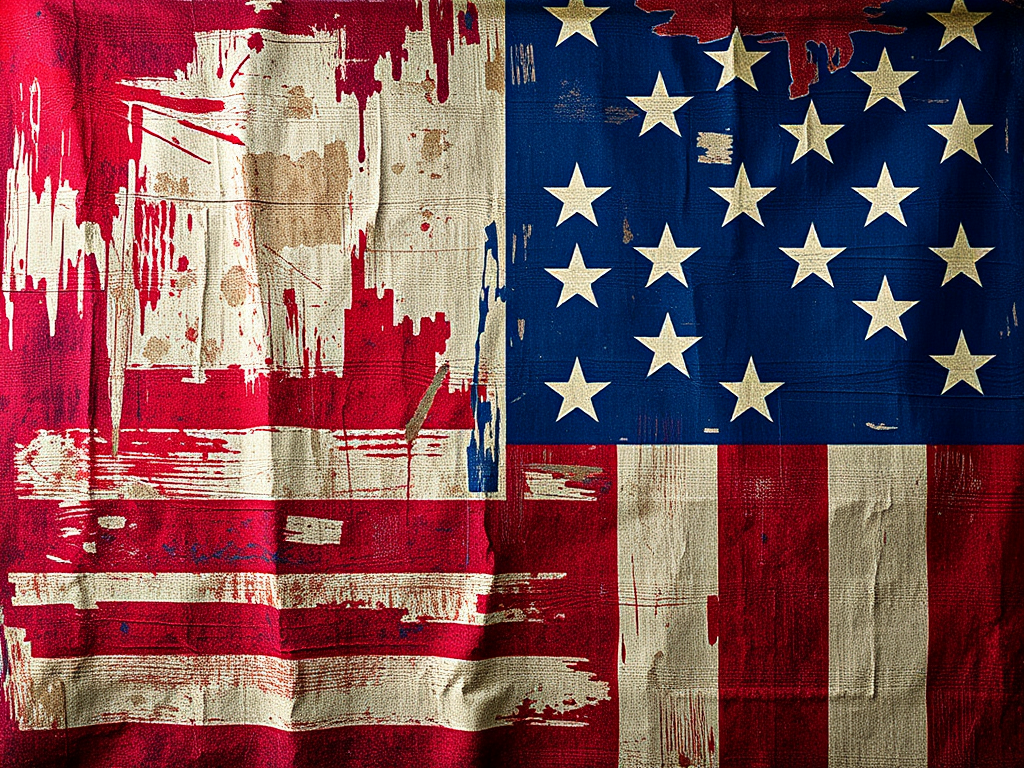
A Flag in Distress
CGI
2025
Ricardo F. Morin
July 31, 2025
*
Brendan Carr, whom Donald Trump designated Chairman of the Federal Communications Commission (FCC), recently defended the use of regulatory authority to induce a “course correction” within the media. This intervention marks a disturbing turn in the use of public institutions to advance a politics of grievance. Justified as an effort to combat diversity, equity, and inclusion (DEI) initiatives, portrayed as forms of discrimination contrary to the public interest, this position reveals a broader ideological purge directed not toward restoring any genuine neutrality but toward eliminating pluralism itself.
This form of censorship, presented as a defense against “ideological indoctrination,” constitutes an explicit repudiation of fundamental democratic commitments, particularly the principle of freedom of speech. Equity does not threaten democratic cohesion. The danger lies in the repressive apparatus now being consolidated to discredit its purposes and silence its defenders. This strategy follows not a normative but a theatrical logic: it is a spectacle of power, not a legitimate exercise of government.
In this respect, the comparison with Caligula’s reign is revealing. The Roman emperor turned politics into a theater of personal rule, in which caprice displaced law and punishment was staged as a demonstration of dominion. His purpose was not merely to govern but to subjugate: reducing law to mere scenery for his will. Under Trump, institutional manipulation, the fixation on personal loyalty, and the staging of conflict reproduce this same logic. Truth and legality are subordinated to the performance of an authority beyond challenge.
The FCC’s transformation into an organ of ideological enforcement, far from being an exception, forms part of a broader pattern. The supposed protection of the public from “divisive” content provides a pretext for suppressing narratives that confront structural inequality, racial exclusion, or historical privilege. Within this rhetoric, equity and social justice become threats, while censorship assumes the form of cultural protection.
Censorship does not exhaust the mechanism at work. When public authority not only discourages dissent but also determines what may count as balanced, factual, or patriotic speech, it pressures the media to adopt the terms by which that authority legitimates its conduct. Oversight thereby becomes propaganda. If this course continues, a plural media environment will be dismantled, along with the conditions that make democratic deliberation possible. In its place, public communication will be organized around a narrower principle: institutional recognition will be reserved for speech that ratifies the ruling power’s account of itself. Far from fostering national unity, this order imposes conformity under the guise of patriotism.
This is not a restoration of institutional order but a return to imperial arbitrariness. Its defining sign is not the abolition of institutions, but their preservation as a backdrop for power that no longer submits to their constraints. The parallel with the Roman Senate under Caligula requires no assertion of historical equivalence. It rests on a precise operation: preserving institutional forms after their effective capacity to restrain power has been removed.
*

