*
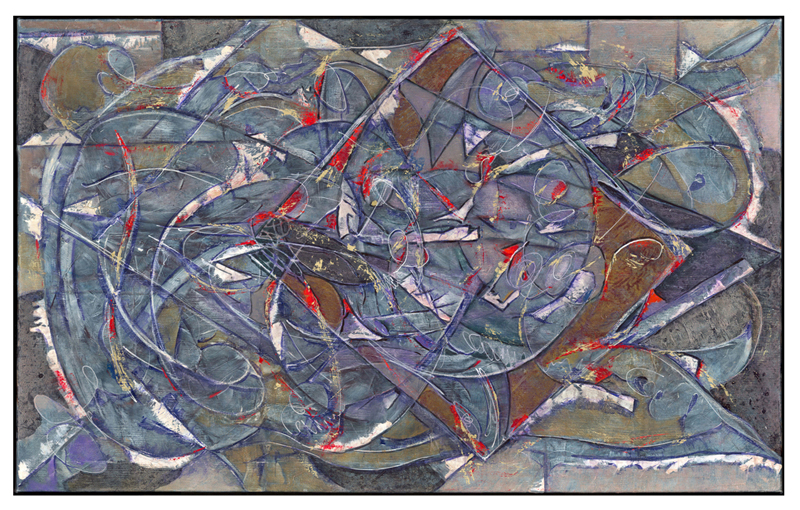
Infinity One: The Grammar of Emotional Mimicry
60″x 37″
Oil on linen
2005
*
Public life today is shaped less by ideas than by emotional cues. People respond not to the content of arguments but to the register in which those arguments are delivered. Tone becomes substance; affect becomes authority. The substitution of emotional cues for argument is not accidental. It reflects a deeper cultural grammar in which individuals learn to recognize themselves not through reasoning but through emotional likeness. The most resonant voice is not the most coherent one but the one that mirrors the emotional state of the crowd. I call this phenomenon the grammar of emotional mimicry.
The press plays a central role in reinforcing this grammar. Modern media does not function as a platform for the slow work of thought; it functions as a marketplace of sentiment. Editors select, frame, and circulate stories on the basis of emotional traction rather than intellectual clarity. A confession of anguish is treated as insight. A display of distress is treated as truth. The media’s primary currency is resonance, measured not by accuracy but by the intensity of feeling it can evoke. It simply reflects the incentives of an attention economy.
Prominent authors or celebrities are often given expansive platforms to articulate personal grievances that contain little conceptual grounding. A statement such as “there is no closure for innocent suffering unless the universe holds someone accountable” is presented as a courageous moral reflection. Yet the premise collapses at first contact: suffering is not distributed according to desert, and nature does not adjudicate innocence. Still, these are emotionally potent narratives because the marketplace rewards vulnerability, not reasoning.
This pattern of selection and reward parallels the emotional logic of populism. Followers of political figures often identify with leaders not because they share material circumstances or policy interests but because they recognize themselves in the emotional posture the leader performs. This is evident in the movement surrounding Donald Trump. His supporters do not mimic his ideas; they mimic his emotional volatility, his sense of grievance, and his theatrical defiance. He becomes a projection surface for the emotional life of the crowd. In return, he mirrors their turbulence. This is mimicry in both directions.
The convergence between media dynamics and populist dynamics is not accidental. Both rely on the same grammar: emotional resonance as a substitute for coherence. Trump’s appeal depends on this alignment between emotional expression and public response. The press amplifies his volatility because it generates spectacle; the public interprets the spectacle as authenticity; and authenticity is misread as truth. What appears most authentic is often least reliable as a guide to truth. The cycle continues because repetition and amplification do not depend on coherence. Indeed, incoherence strengthens the bond, because it signals freedom from the constraints of disciplined thought—constraints that many interpret as elitist or oppressive.
This grammar does not operate only in politics. It shapes cultural life more broadly. Cultural production increasingly privileges emotional exposure over disciplined expression. Works are evaluated on the basis of how effectively they simulate immediate sentiment, not on how clearly they illuminate experience. The result is a narrowing of public imagination: nuance becomes difficult to sustain, and reflection is displaced by emotive shorthand. This environment favors individuals who narrate their emotions vividly, regardless of whether their interpretations withstand scrutiny.
The consequences for civic life are considerable. When emotional mimicry becomes the dominant mode of engagement, disagreement becomes impossible to navigate. Individuals no longer encounter differences in judgment; they encounter differences in emotional identity. To critique an argument becomes an attack on the person’s emotional legitimacy. Public conversation becomes a contest of grievances rather than an exchange of ideas. The result is a brittle social sphere in which the loudest emotional frequency defines the terms of debate.
This shift also erodes the distinction between witness and participant. By seeking emotional stories, the press becomes a participant in the very dynamics it reports. It reinforces the emotional scripts people already inhabit. It privileges personal turmoil as evidence of moral depth. It treats spectacle as substance. In doing so, it trains the public to internalize emotional performance as the primary mode of communication. The media does not merely reflect emotional mimicry; it makes it a habitual form of expression.
Today’s emotional grammar differs in scale and function. Selection, repetition, and amplification now operate continuously, reducing complex experience to a narrow range of signals—grievance, resentment, and confession. As these signals circulate, attention is captured by intensity rather than guided by coherence. This is not a moral collapse; it is a failure in how attention is directed and sustained in public life.
The challenge is not to suppress emotion but to restore proportion. Emotional life is essential to human experience, but it cannot serve as a universal grammar for public reasoning. A culture that communicates primarily through emotional mimicry loses its ability to distinguish perception from projection. It becomes reactive rather than reflective. To recover clarity, we must once again separate the vividness of emotion from the validity of thought. Only then can public life recover the depth it has traded for resonance.
*
Ricardo F Morín, November, 2025, Oakland Park, Florida

