Posts Tagged ‘public discourse’

“Who Feeds Hatred?”

April 15, 2026

Ricardo F. Morín
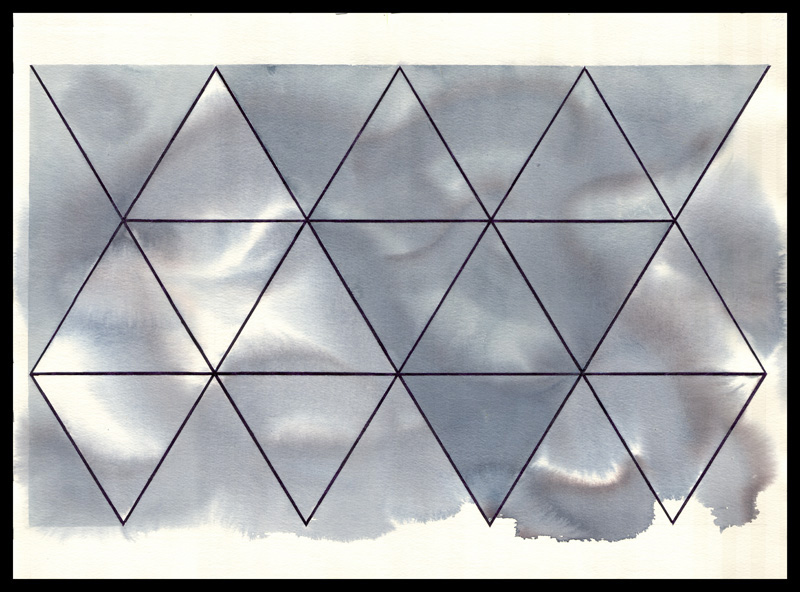
Triangulation II
22″ x 30″
Body color, sanguine, sepia, and white out on paper
2008


Societies rarely recognize when language begins to prepare the conditions for hatred.  Long before violence appears, speech has already changed how people see what is in front of them.  A group is no longer described by what it does, but by what it is made to stand for:  a “threat,” an “invasion,” a “corruption.”  Description yields to designation. 

In “Language, Judgment, and Freedom of Conscience:  On the Architecture of an Intellectual Position,” I examined how freedom of conscience depends on a steady link between what is seen, what is said, and how it is judged.  That link is not sustained by itself.  Seeing something does not ensure naming it precisely, and naming it does not ensure judging it clearly.  When that link breaks, language stops following experience and begins to direct it.  Words no longer come after what happens; they tell people in advance what they are supposed to see, think, or conclude.  In that shift, the ability to judge for oneself begins to weaken, long before courts are bypassed or rights are set aside.

 Once perception is shaped in advance, judgment no longer moves on its own.  Hostility no longer appears as a break but as something already contained in the way things are said.  A neighbor becomes “one of them.”  A disagreement becomes “an attack.”

Societies speak easily about hatred, yet rarely ask where it begins.  When violence becomes visible, the instinct is to find someone to blame.  The tyrant appears sufficient.  Yet this explanation soothes more than it explains.  It confines wrongdoing to individuals while leaving intact what made it possible:  repeated phrases, accepted labels, words no longer questioned.

A distinction is required.  To see clearly is not to hate.  To name brutality is not resentment but clarity.  To say “this act destroys a life” remains a description.  Hatred begins when the person is reduced to what must be removed.  Whoever speaks in that way adopts the same language he claims to reject.

Ideologies that organize hostility do not arise in isolation.  They differ in name but share a simple rule:  people define who they are by pushing others out.  Where this rule governs how people define themselves, human worth no longer serves as a shared measure.  Public life divides between those who belong and those who do not.  Nazism in Europe, Chavismo in Venezuela, the MAGA movement in the United States, and forms of theocracy show how entire populations come to speak of others as enemies and to treat that division as necessary for order or purity.

What appears in Trump is not new.  It is what no longer needs to disguise itself.

Once this way of speaking is taken up and repeated, it does not remain confined to leaders or doctrine.  It spreads.  Some repeat it because they believe it.  Others repeat it to avoid trouble, to fit in, or to protect themselves.  Language changes.  Words stop pointing to people and begin to assign them a place.  The adversary becomes a threat; the threat becomes someone to despise.  A person is no longer called by name but by a label:  “illegal,” “traitor,” “infidel,” “enemy.”

Another confusion follows.  In the name of understanding, some begin to describe those who defend such ideas as misunderstood or wounded.  This posture appears balanced, yet it shifts attention toward those who exercise power and away from those who live under it.

This confusion rests on a deeper habit of thought.  Violence is often explained by pointing to personal wounds or exclusion.  There is truth in this.  Yet when applied everywhere, it removes responsibility.  Everyone is vulnerable.  Not everyone participates in organized harm.  That requires decisions, repeated words, and people willing to act on them.

The difference between ethics and moralizing appears here.  Moralizing sorts people into good and bad.  Ethics looks at what allows certain actions to take place and spread.  It does not turn the adversary into a monster, but it does not excuse what is done.

Those who suffer the consequences rarely appear in these arguments.  They do not belong to factions or slogans.  They are those who must live with what others decide:  the family forced to move, the worker shut out, the person who learns to remain silent.

The question, then, cannot be answered by pointing to a tyrant.  Hatred is fed when people accept the lowering of language, treat humiliation as normal, and allow their judgment to be replaced by ready-made explanations.

At that point, hatred no longer appears exceptional.  It becomes a habit.  It repeats itself in ordinary speech:  “that is how things work,” “everyone does it,” “we have no choice,” “we were forced,” “it is for the nation.”  It appears in the language of order and protection:  “to restore order,” “for your safety,” and in the steady stirring of fear:  fear of losing place, fear of difference, fear of those seen as outsiders, even in societies shaped by mixture.

These expressions do not simply describe what is happening.  They shape how it is understood.  They make exclusion seem reasonable.  What once required justification begins to sound like common sense.

When this way of speaking settles in, hostility no longer needs to be defended.  It becomes expected, repeated, routine.  Responsibility does not vanish through denial; it fades through repetition:  through explanations that excuse and fears no one stops to question.

This is how hatred continues:  not only through those who declare it, but through those who repeat it, accept it, or let it pass without objection. 

The question remains. 

Who feeds hatred?

*

Ricardo F. Morín, March 16, 2026, Oakland Park, Florida.

“The Grammar of Emotional Mimicry”

April 15, 2026

Ricardo Morín
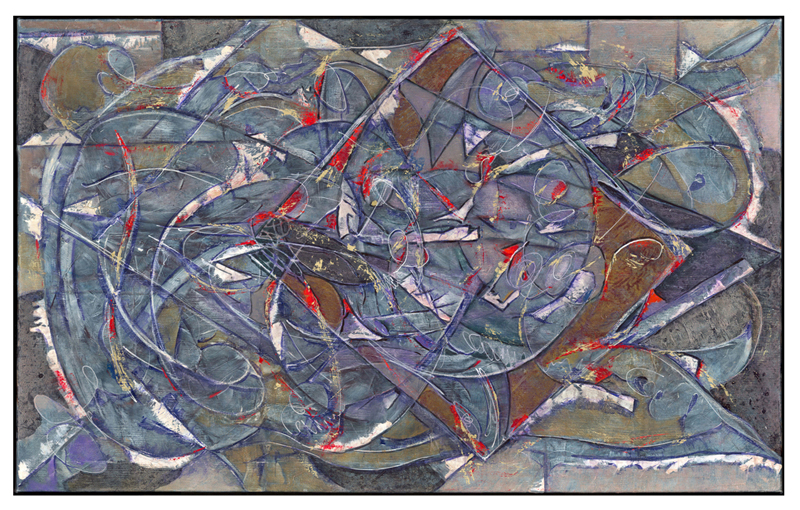
Infinity One: The Grammar of Emotional Mimicry
60″x 37″
Oil on linen
2005

Public life today is shaped less by ideas than by emotional cues.   People respond not to the content of arguments but to the register in which those arguments are delivered.   Tone becomes substance; affect becomes authority.   The substitution of emotional cues for argument is not accidental.   It reflects a deeper cultural grammar in which individuals learn to recognize themselves not through reasoning but through emotional likeness.   The most resonant voice is not the most coherent one but the one that mirrors the emotional state of the crowd.   I call this phenomenon the grammar of emotional mimicry.

The press plays a central role in reinforcing this grammar.   Modern media does not function as a platform for the slow work of thought; it functions as a marketplace of sentiment.   Editors select, frame, and circulate stories on the basis of emotional traction rather than intellectual clarity.   A confession of anguish is treated as insight.   A display of distress is treated as truth.   The media’s primary currency is resonance, measured not by accuracy but by the intensity of feeling it can evoke.   It simply reflects the incentives of an attention economy.

Prominent authors or celebrities are often given expansive platforms to articulate personal grievances that contain little conceptual grounding.   A statement such as “there is no closure for innocent suffering unless the universe holds someone accountable” is presented as a courageous moral reflection.   Yet the premise collapses at first contact:   suffering is not distributed according to desert, and nature does not adjudicate innocence.   Still, these are emotionally potent narratives because the marketplace rewards vulnerability, not reasoning.

This pattern of selection and reward parallels the emotional logic of populism.   Followers of political figures often identify with leaders not because they share material circumstances or policy interests but because they recognize themselves in the emotional posture the leader performs.   This is evident in the movement surrounding Donald Trump.   His supporters do not mimic his ideas; they mimic his emotional volatility, his sense of grievance, and his theatrical defiance.   He becomes a projection surface for the emotional life of the crowd.   In return, he mirrors their turbulence.   This is mimicry in both directions.

The convergence between media dynamics and populist dynamics is not accidental.   Both rely on the same grammar:   emotional resonance as a substitute for coherence.   Trump’s appeal depends on this alignment between emotional expression and public response.   The press amplifies his volatility because it generates spectacle; the public interprets the spectacle as authenticity; and authenticity is misread as truth.   What appears most authentic is often least reliable as a guide to truth.   The cycle continues because repetition and amplification do not depend on coherence.   Indeed, incoherence strengthens the bond, because it signals freedom from the constraints of disciplined thought—constraints that many interpret as elitist or oppressive.

This grammar does not operate only in politics.   It shapes cultural life more broadly.   Cultural production increasingly privileges emotional exposure over disciplined expression.   Works are evaluated on the basis of how effectively they simulate immediate sentiment, not on how clearly they illuminate experience.   The result is a narrowing of public imagination:   nuance becomes difficult to sustain, and reflection is displaced by emotive shorthand.   This environment favors individuals who narrate their emotions vividly, regardless of whether their interpretations withstand scrutiny.

The consequences for civic life are considerable.   When emotional mimicry becomes the dominant mode of engagement, disagreement becomes impossible to navigate.   Individuals no longer encounter differences in judgment; they encounter differences in emotional identity.   To critique an argument becomes an attack on the person’s emotional legitimacy.   Public conversation becomes a contest of grievances rather than an exchange of ideas.   The result is a brittle social sphere in which the loudest emotional frequency defines the terms of debate.

This shift also erodes the distinction between witness and participant.   By seeking emotional stories, the press becomes a participant in the very dynamics it reports.   It reinforces the emotional scripts people already inhabit.   It privileges personal turmoil as evidence of moral depth.   It treats spectacle as substance.   In doing so, it trains the public to internalize emotional performance as the primary mode of communication.   The media does not merely reflect emotional mimicry; it makes it a habitual form of expression.

Today’s emotional grammar differs in scale and function.   Selection, repetition, and amplification now operate continuously, reducing complex experience to a narrow range of signals—grievance, resentment, and confession.   As these signals circulate, attention is captured by intensity rather than guided by coherence. This is not a moral collapse; it is a failure in how attention is directed and sustained in public life.

The challenge is not to suppress emotion but to restore proportion.   Emotional life is essential to human experience, but it cannot serve as a universal grammar for public reasoning.   A culture that communicates primarily through emotional mimicry loses its ability to distinguish perception from projection.   It becomes reactive rather than reflective.   To recover clarity, we must once again separate the vividness of emotion from the validity of thought.   Only then can public life recover the depth it has traded for resonance.

*

Ricardo F Morín, November, 2025, Oakland Park, Florida


“Lines That Divide”

March 1, 2026
Ricardo Morin
Silence III
22’ x 30” 
Watercolor, graphite, gesso, acrylic on paper 
2010

  • Rethinking Identity and Entitlement in Civic Life


The phrase “my people” draws lines.  It signals allegiance before argument begins.  It may express familiarity, shared memory, or recognition.  Yet the same words separate one group from another.  A boundary forms, often without intention.  Those inside feel affirmed; those outside may feel unseen.

Such moments rarely begin as acts of exclusion.  They arise from ordinary human impulses:  the desire to protect what feels familiar, to defend what has been wounded, or to claim space where one has felt overlooked.  But when identity becomes the primary language through which claims are made, conversations change.  Disagreement becomes personal.  Listening becomes strategic.  The space where people meet as equals contracts.

Group identity has long provided people with strength and protection.  It helps individuals recover dignity when they feel ignored or misunderstood, and it offers language through which shared experiences can be recognized.  Yet the same force can also narrow perception.  When group identity becomes the main lens through which people judge one another, ideas are weighed less on their merit and more on the speaker’s affiliation.

When ideas begin to be judged primarily through identity rather than merit, the change is often subtle.  An exchange that begins openly can become defensive as participants look for signs of alignment or opposition.  Words are weighed for allegiance.  Questions are interpreted as challenges rather than invitations to examine ideas together.  Over time, dialogue shifts from exploration toward defense of positions. Judgment shifts from the merit of an idea to the standing of the speaker.

Many people carry an expectation into public life that they will be treated consistently.  Uneven rules are recognized quickly.  When identity determines whose voice counts before ideas are heard, trust weakens not only among those excluded, but also among those unsure whether they are seen as individuals or as representatives of a category.

Problems deepen when identity stops being one part of a person’s experience and begins to overshadow all others.  Public debate narrows.  Arguments are interpreted as attacks on identity rather than disagreements over ideas.  People feel compelled to defend positions not because they are persuaded by them, but because reconsidering publicly may be treated as betrayal.  The result is not stronger community, but increasing rigidity, where listening carries risk and reconsideration feels unsafe.

People turn toward simplification and absolutism to reduce uncertainty and relieve the strain of complexity.  This tendency does not permanently define human interaction; it marks moments when ambiguity feels intolerable and certainty appears easier to sustain.  Certainty offers relief, but it reduces the space in which plurality can endure.  The tension itself does not disappear; only the way people attempt to manage it changes.

Contemporary communication technologies accelerate the circulation and visibility of opinion.  Expressions that promise certainty or provoke fear travel farther and faster; expressions that sustain ambiguity move more slowly.  This circulation amplifies tendencies toward simplification, reinforcing what attracts attention rather than what withstands examination.

When identity becomes the basis for deciding who others are before dialogue takes shape, examination gives way to labeling.  Nuance is set aside.  Individuals become symbols of larger struggles, and ordinary encounters carry the weight of broader conflicts.  Under these conditions, disagreement resembles confrontation even when intentions remain sincere.

Public life rests on an expectation that the same rules apply to all.  Uneven application becomes visible when some voices are heard more readily than others or when identity determines credibility before ideas are considered.  Under these conditions, conversation shifts from exchange toward competition for recognition, and the possibility of shared judgment becomes more difficult to sustain.

The tension does not belong to one group alone; this situation affects everyone who participates in public life.  Each person seeks recognition while fearing misinterpretation.  Attempts to resolve disagreement through persuasion alone often reach limits beyond individual control.  Listening, under these conditions, does not erase distance but allows interaction to continue despite it.

Differences remain, and disagreement persists.  The lines that divide do not disappear; they shift, harden, or soften as people respond to one another in ordinary encounters.  Living together does not remove tension; living together reveals tension.  No shared answer resolves the matter.  Each person must decide how to respond and how to live alongside others within limits no one fully controls.

Ricardo F. Morín, February 15, 2026, Oakland Park, Florida.