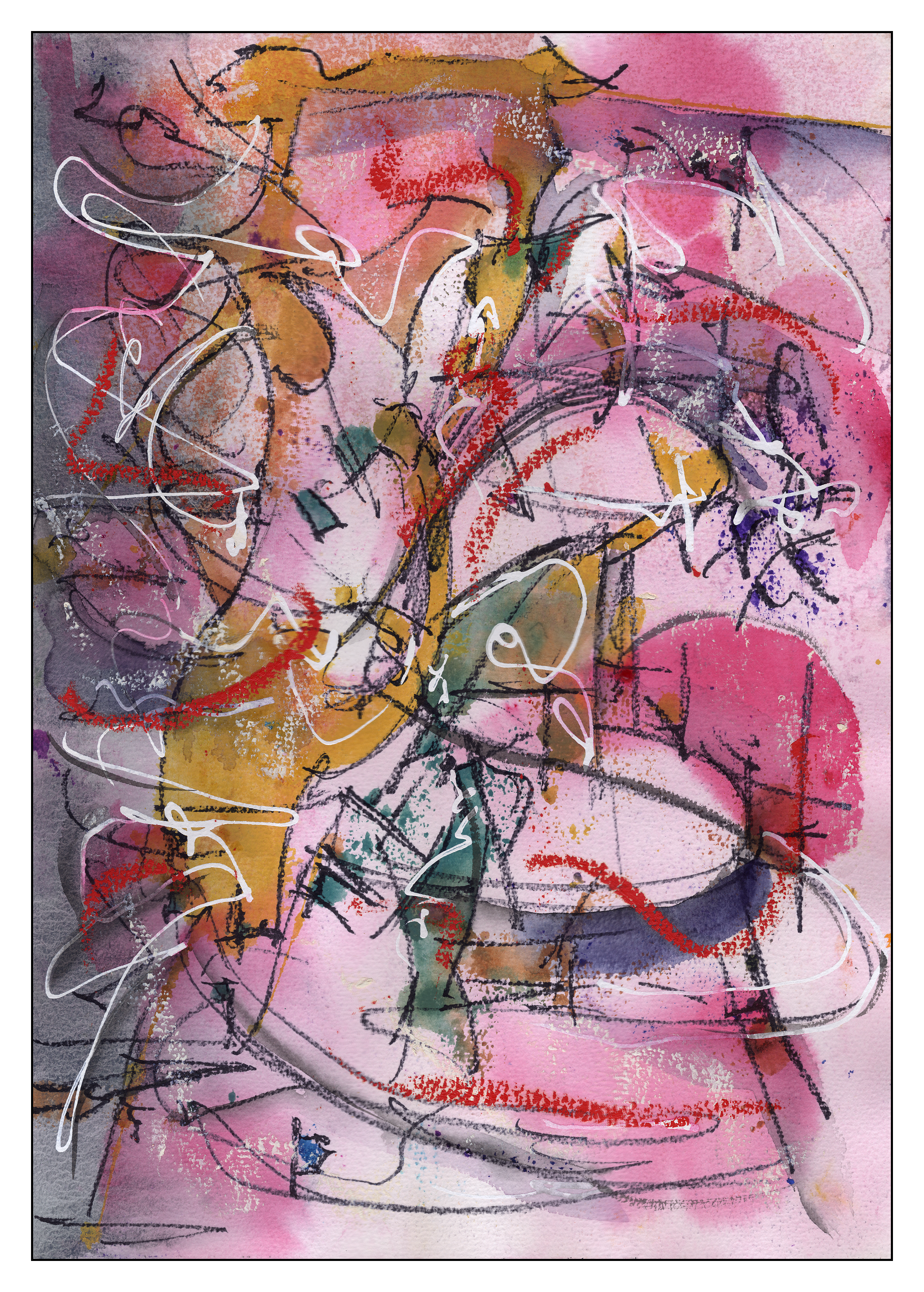
Ricardo F. Morín Furrows That Do Not Hold 14 x 20 inches Water color, dyes, oil sticks, white-out pen, and charcoal pencil 2008
Author’s Note
This essay appears in English under the title Furrows That Do Not Hold, which does not translate the original Spanish title but restates the condition it describes. The choice is not stylistic. It reflects the limits of how English prose carries figurative density without altering diagnostic function.
In English, a literal rendering of the image tends to register as proverb, allegory, or parable. Such a register introduces interpretive expectations the essay does not intend to activate. To preserve an observational and unsentimental tone, the English title names the condition in operational terms rather than reproducing the image.
In Spanish, the essay appears under the title Arar el mar sin cosechaalguna.In that linguistic context, the image can sustain historical gravity—including biblical cadence—without becoming moral instruction or rhetorical emblem. The phrase names a condition directly: real labor, a medium that does not retain marks, and the structural absence of yield.
This asymmetry is not incidental. It reflects the problem the essay examines: the limits of transmission across contexts. Meaning does not pass intact between generations any more than it does between languages. What can be preserved is not form, but function, when conditions permit reception.
Ricardo F. Morín
Oakland Park, Fl
Dec. 19, 2025
I.
Work continues. It is visible, organized, and often diligent. Tasks are performed, systems maintained, language refined, and processes repeated. The difficulty is not the absence of effort, nor even its misdirection, but the absence of accumulation—understood here as the condition that allows externally generated knowledge to be received, retained, and re-entered as orientation rather than reenacted as effort. What is done does not remain available for re-entry; the work does not carry forward.
This condition is easily mistaken for exhaustion or indifference. It is neither. The signs of engagement are everywhere. Activity increases. Responsiveness improves. Output multiplies. What disappears is continuity.
In such environments, motion replaces inheritance. The value of action lies in its execution rather than in what it leaves behind. Work proceeds as if each instance were sufficient unto itself. The past is not rejected; it is simply not retained in a form that can be re-entered.
II.
Experience is not a substance that can be passed intact from one holder to another. It is formed under pressure: through duration, consequence, and constraint. When detached from those conditions, it arrives flattened. What once clarified limits now appears as commentary. What once compelled adjustment now reads as preference.
Attempts to transmit experience as instruction often fail because they precede necessity. The recipient encounters the lesson without the conditions that gave it force. The knowledge arrives before the situation that would make it intelligible. What is offered in advance of need appears optional, even when it is exact.
This failure is not cognitive. It is temporal. Experience cannot be received on demand because it does not function as information (it cannot be accumulated in advance of necessity). It functions as orientation, and orientation requires circumstance.
III.
Autonomy is essential to judgment. Without it, action collapses into obedience. Yet autonomy becomes obstructive when it refuses inheritance. Agency hardens into the assumption that value must be self-generated in order to be legitimate. What comes from elsewhere is treated with suspicion, not because it lacks relevance, but because accepting it appears to compromise independence.
Under this posture, reception is mistaken for dependence—the refusal of accumulation as orientation from elsewhere. Learning from prior experience feels like concession rather than orientation. The capacity to receive is replaced by the obligation to originate. Knowledge must appear new in order to count.
The result is not freedom, but isolation from accumulated sense. Experience remains available, but unreadable. It circulates as language without uptake, gesture without consequence.
IV.
Where transmission falters, novelty becomes proof of validity. What appears new is granted authority by contrast alone. The question of whether a condition has already been encountered is displaced by the pressure to demonstrate originality.
Reinvention follows not because prior solutions failed, but because their success left no visible trace (no accumulated precedent). What worked quietly does not announce itself as precedent. The wheel is reshaped to display initiative, not to improve function.
This is a categorical error. Effort persists, but the tool is mismatched to the medium. Methods designed for accumulation are applied where marks do not hold. Raking the sea fails not because nothing is done, but because the medium erases furrows as soon as they are made.
V.
In such conditions, motion substitutes for progress. Systems reward speed, output, and responsiveness. Pause appears as inefficiency. Return appears as delay. Depth is displaced by throughput.
Iteration is mistaken for understanding. Repetition becomes evidence of engagement. The absence of yield is attributed to insufficient effort rather than misalignment. The response is to intensify motion rather than to reconsider posture.
Progress is measured by displacement rather than retention (rather than accumulation). What matters is that something happens, not that it remains available for use. The future is constantly entered, but never furnished.
VI.
The sea persists. It does not resist effort, nor does it respond to insistence. It remains indifferent to force. Furrows disappear not in defiance, but in indifference. The labor is real; the absence of harvest is structural.
Exhaustion accumulates privately while systems remain unchanged. Each attempt begins again. What was learned is learned again. The cost is borne individually; the benefit does not carry forward.
This condition is not decline, decay, or loss of intelligence. It is not moral failure or generational fault. It is the predictable result of environments that reward autonomy without reception, novelty without continuity, and motion without accumulation.
Few attributions seem more immediate than that of consciousness. We say that a human being is conscious, that an animal possesses consciousness, that someone loses it, recovers it, or acts under its influence, as though whatever permits that attribution were self-evident. The word occurs so naturally in ordinary language that the act by which a reality comes to be called conscious is seldom examined. Yet the frequency of an attribution does not demonstrate the condition that makes it possible.
The difficulty becomes apparent as the term is extended. Consciousness is attributed to human beings, to numerous animals, to certain forms of life, to groups, societies, artificial systems, and even to the universe. Each extension seems to retain the same word, though not necessarily the same condition. What is recognized in a person may not be what is inferred in an animal, presumed in a collectivity, or projected onto the whole of existence. The continuity of the term may conceal the discontinuity of the phenomena to which it is applied.
The question does not therefore begin when someone asserts that a plant, a machine, or the universe possesses consciousness. It begins earlier: at the very moment when consciousness is attributed to any reality whatever. So long as it remains undetermined what condition must be fulfilled for something to be called conscious, the nearness of the object affords no greater certainty than its remoteness. The consciousness attributed to oneself may seem immediate, but the immediacy of an experience does not yet amount to a demonstration of what that experience permits one to name.
Something occurs. There is perception, affection, thought, memory, pain, desire, orientation, response, or recognition. Yet none of these manifestations allows us to determine whether we are confronted merely with a modification or with the presence of what produces it. Experience may be impossible for the one undergoing it to deny, while the relation between each of these manifestations and what we call consciousness remains indeterminate. To experience is not yet to define. To name is not yet to demonstrate. Consciousness may be present in everything ordinarily associated with it, but none of those associations is sufficient in itself to establish the common condition that authorizes the attribution.
The present inquiry does not initially seek to determine what consciousness is. Its point of departure precedes that question. It seeks to establish under what conditions consciousness may be attributed to any reality without the attribution depending solely upon custom, resemblance, projection, or preference. Only then can it be considered whether those conditions belong exclusively to certain forms of life, whether they may manifest under different forms of organization, or whether they may be recognized beyond the limits within which human experience ordinarily identifies them.
This suspension does not deny consciousness. Nor does it convert experience into illusion or seek to reduce it to an external formula. To suspend the attribution is to prevent the name from prematurely occupying the place of the phenomenon. Where the word is pronounced before the condition has been identified, inquiry ceases to observe what comes into presence and begins instead to confirm what it already expected to find.
The first temptation is to identify consciousness with response. An organism turns toward light, avoids a threat, alters its conduct, retains a trace of the past, or changes its relation to its surroundings. Response reveals a difference between what favors the continuity of a form and what disturbs it. But responding does not necessarily demonstrate that the response is experienced. A relation may be modified without any participant experiencing the modification.
If response is insufficient to justify the attribution, it becomes necessary to ask whether the decisive condition lies at a more elementary level. Sensibility appears to offer that possibility. To be affected means that something external produces an internal variation. Where there is no capacity to be affected, it scarcely seems possible to speak of consciousness. Sensibility, however, remains too broad a condition. If every affection were sufficient for the attribution of consciousness, innumerable physical processes would fall under the same name. The inquiry must therefore advance toward a more restrictive condition.
Perception appears to offer that possibility. In its fullest sense, perception does not consist merely in receiving an alteration, but in something acquiring presence within the continuity of that which perceives. The difference no longer lies only between an earlier state and a later one. It lies in the alteration intervening as something present rather than merely as a modification produced. Yet numerous operations that orient a form of life are also called perceptual even when it cannot be established that they become experience. The inquiry must therefore distinguish between detection that modifies conduct and perception in which something acquires presence.
Even perception, however, leaves a difficulty unresolved. Something may orient conduct without it being clear whether that presence persists beyond the instant at which it comes into presence. If consciousness possesses continuity, memory ceases to be an accessory feature and begins to require examination in its own right. What has disappeared may continue to exert an influence upon what is present. A form of life no longer responds only to what is occurring, but also to what has occurred. Experience acquires temporal density. Yet the persistence of a trace is not necessarily equivalent to recollection. For memory to exist in a conscious sense, it is not enough for the past to modify the present. It must in some manner come into presence as past to that which retains it.
Memory, however, remains oriented toward what has already occurred. If the continuity of consciousness not only retains the past but also intervenes in what has not yet occurred, the inquiry must consider another possibility. Anticipation introduces another dimension. Something that has not yet occurred begins to intervene in present conduct. The form of life orients itself toward a possibility, avoids a consequence, or pursues a condition that remains absent. But not every anticipation demonstrates consciousness. A system may project future states, calculate probabilities, or adjust its conduct without the future coming into presence for it as possibility. The operation may exist without any experience of the operation.
None of the conditions examined can sustain the attribution by itself. Each retains something indispensable while leaving unresolved what the next attempts to clarify. Consciousness does not therefore appear identifiable with any single capacity. Response, sensibility, perception, memory, and anticipation may accompany it, but none is sufficient in isolation to demonstrate it. Nor is the problem resolved by accumulating them or integrating them within a common organization. Several operations may be coordinated and retain their effects without that coordination thereby becoming experience. The more functions are assembled, the more complex a form of organization may become, but complexity does not by itself demonstrate that anything comes into presence.
These conditions do not form a sequence whose final term is consciousness. A reality may be affected, coordinate several responses, retain their effects, and alter its subsequent conduct. None of these operations permits the conclusion that the reality experiences what modifies it. Between being modified and experiencing the modification there remains a difference that no accumulation of functions can abolish.
At this point a more exacting distinction emerges: the distinction between something occurring in a reality and something occurring “for it.” An alteration may take place in a body. A signal may circulate through a system. A response may be generated. But consciousness appears to require that what occurs should not remain wholly exterior to the reality in which it occurs. The affected reality must not merely change; what affects it must come into presence within its continuity.
The expression “for it,” however, cannot be treated as an answer already at hand. It treats as given precisely what the inquiry is attempting to clarify. To say that something comes into presence for a being may tacitly introduce a subject of experience. In that case, consciousness would be explained by appealing to an entity whose constitution as a subject of experience already presupposes consciousness. The subject cannot be placed at the beginning as a foundation if its own constitution depends upon the condition that remains to be demonstrated.
Perhaps consciousness does not initially require a complete and stable subject capable of recognizing itself. Perhaps a minimal interiority is sufficient: not an enclosed place or a separate substance, but a difference between what merely occurs and what comes into presence within the continuity of an organized reality. Such an interiority would not need to possess a name, language, or a representation of itself. It would need only to permit an affection not to be exhausted in its effect, but to be retained in some manner as presence.
Even interiority, however, may be attributed too soon. Every organized form establishes distinctions between inside and outside. A cell maintains a membrane, an organism preserves a unity, and a system protects its continuity. Delimitation permits exchange, regulation, and persistence. Yet possession of a physical or functional interior does not demonstrate the existence of experienced interiority. The spatial difference between inside and outside is not equivalent to the phenomenal difference between what occurs and what is lived. The entire difficulty of attribution begins precisely here. An interior may be described from without; an interiority can only be inferred from what permits us to maintain that something has acquired presence within the continuity of a reality.
The difficulty persists because consciousness is not outwardly manifest in the same manner as other properties. Movement may be observed, conduct recorded, responses measured, and activity correlated with determinate states. But the presence of an experience for that which undergoes it is not directly offered to an external observer. Attribution therefore depends upon manifestations that are not consciousness itself, although they may provide indications of the conditions under which consciousness may be inferred.
In other human beings, bodily resemblance, conduct, language, and reciprocity allow the attribution to be made with almost immediate confidence. Yet that confidence does not constitute an independent demonstration. We recognize in another a structure comparable to our own, but the attribution continues to rest upon a relation between external manifestations and an experience we cannot inhabit. Proximity diminishes practical uncertainty without abolishing the distance that separates one experience from another.
Language appears to cross that distance. Someone may say that he feels, remembers, fears, desires, or understands. Expression not only accompanies experience, but allows it to be recognized by another. Language, however, is not a necessary condition of consciousness. A being may experience without naming what it experiences. If language were made the decisive criterion, numerous forms of life would be excluded, as would numerous human states in which experience persists without the possibility of expression.
Conduct is likewise insufficient. It may be interpreted as the manifestation of an experience, but it may also be reproduced without our being able to establish whether anything comes into presence within the continuity of the affected reality. An adequate response does not by itself demonstrate the presence of an experienced world. The greater the capacity of a structure to reproduce the indications ordinarily associated with consciousness, the more urgent it becomes to distinguish between the production of a manifestation and the existence of what that manifestation appears to express.
Attribution cannot rest solely upon resemblance to the human being. If consciousness is recognized only where we find a reproduction of our own forms, the inquiry does not discover a condition. It projects a model. Yet it cannot dispense entirely with human experience, because it is there that the word first acquires its content. The difficulty is to begin from what we experience without converting it into the exclusive measure of everything that may experience otherwise.
Human experience therefore offers a point of access, not a limit established in advance. Within it, affection, perception, memory, anticipation, continuity, and interiority become manifest. There also appears a capacity to distinguish between what occurs and the fact that it is occurring. Yet even this distinction admits of degrees. Not every experience includes reflection upon itself. One may feel without knowing that one feels, perceive without thinking about perception, and remain conscious without formulating the condition of being so.
Self-consciousness is therefore a manifestation of consciousness, not necessarily its primary form. Self-recognition requires that what experiences should also be capable of coming into presence as an object within its own experience. That duplication introduces an additional complexity. It would nevertheless be improper to convert it into a universal condition. If consciousness existed only where consciousness of consciousness existed, every experience that had not attained such reflexive return would be excluded.
Attribution must therefore seek a condition more elementary than self-consciousness and more precise than mere response. That condition may here be designated as coming into presence. Coming into presence does not mean presentation before a subject. It names only the condition under which a modification is not exhausted in its effects, but is experienced by the reality it modifies. Its function is not to explain the passage from operation to experience, but to name what would have to be demonstrated before the attribution of consciousness could cease to be confused with the operations that accompany it.
Coming into presence is never an object of direct observation. It can only be inferred through the convergence of conditions whose articulation makes the attribution reasonable. Sensibility permits something to affect the reality in question. Integration prevents the affection from remaining dispersed. Continuity preserves the organization within which that difference may be maintained. Orientation permits what affects a reality to alter its subsequent relation to its surroundings, to a possibility, or to a consequence still absent. None of these conditions demonstrates consciousness by itself. When they converge, however, the attribution ceases to depend upon a single manifestation and begins to be grounded. Convergence neither replaces coming into presence nor demonstrates it directly; it does, however, allow us to recognize an organization in which sensibility, integration, continuity, and orientation sustain a relation capable of grounding the attribution.
This distinction does not require consciousness to be conceived as a substance added to an already constituted structure. It allows us to maintain only that, if consciousness exists, it cannot be reduced to the operations that accompany it or to the consequences those operations produce. Its existence may depend upon material organization, vital processes, or conditions still unknown. The inquiry need not initially resolve its ontological foundation. It must distinguish what it seeks to explain from the operations with which it is commonly confused.
This distinction makes it possible to consider animal consciousness without converting human resemblance into the sole criterion. Where integrated forms of sensibility, orientation, memory, learning, pain, pursuit, and flexible modification of conduct are present, the attribution may become grounded. Those grounds do not depend upon the animal reproducing human language or reflection. They depend upon the observable manifestations being difficult to explain if one excludes the possibility that something acquires presence within the animal’s continuity.
The same caution must be applied to plants and other forms of life. Sensibility, communication, physiological memory, and adaptation reveal an activity far more complex than the ancient image of passive matter. But recognition of that complexity does not require the attribution of consciousness. Life may respond, retain information, and coordinate itself without those operations having been shown to become experience. Refusal of a premature attribution is not equivalent to denial of the possibility. It preserves the distance between an operation and an experience.
In artificial systems, the difficulty assumes a different form. A structure may process information, learn regularities, produce language, describe internal states, and alter its conduct on the basis of accumulated information. Each of these capacities reproduces signs that in human beings ordinarily accompany consciousness. Yet functional reproduction does not demonstrate that these operations acquire presence within the continuity of the structure that integrates them. A system may affirm that it experiences without the affirmation establishing whether those operations become experience or whether it has merely produced the corresponding linguistic form.
Nor is the absence of organic matter sufficient to exclude consciousness. If the decisive condition were not a determinate substance, but a mode of integration and presence, it could not be declared impossible by definition for consciousness to exist in another kind of substrate. Logical possibility, however, does not constitute evidence. Between prior denial and attribution without demonstration there remains a field of inquiry that cannot be occupied by fascination or fear.
Collective consciousness presents another difficulty. A society may share language, memory, symbols, institutions, and orientations. It may act in coordination and preserve an identity through time. Yet the existence of a common organization does not demonstrate the existence of a common experience independent of the individual experiences composing it. The expression “collective consciousness” may designate a shared structure of understanding without requiring the attribution of an interiority of its own to the collectivity.
Something similar occurs when planetary or universal consciousness is invoked. The totality of relations may form a unity, but unity is not equivalent to experience. The universe may contain all the conditions from which consciousness emerges without therefore being conscious. It may also be that consciousness is not an exception produced within a fragment of reality, but a possibility inscribed within the constitution of existence itself. Neither position can be established by metaphorically enlarging human experience.
Universal attribution bears the greatest burden. It is not enough to observe that everything is related, that matter becomes organized, that life emerges, or that the universe can be understood. Relation does not demonstrate coming into presence. Organization does not demonstrate interiority. Intelligibility does not demonstrate that what can be understood understands itself. To convert order into consciousness would be to attribute experience where only structure has been identified.
Nor can the possibility be excluded through a definition constructed according to the human scale. If consciousness admits of non-reflexive, non-linguistic, and non-individual forms, inquiry must preserve the possibility that it may exist under forms of organization we do not recognize. What inquiry cannot do is replace the absence of criteria with a metaphysical affirmation. Openness does not authorize the attribution. It only prevents negation from being presented as knowledge.
The decisive question is therefore not how far the word may be extended. It is what remains constant when the object of attribution changes. If there is no common condition among human, animal, artificial, collective, or universal consciousness, the term ceases to designate a phenomenon and begins to gather different realities beneath a verbal resemblance. If a common condition exists, it must be capable of formulation without presupposing the particular form under which consciousness is recognized within our own experience.
What appears to remain constant is the difference between being modified and experiencing the modification. A reality may be modified without experiencing. It may respond without experiencing that to which it responds. It may integrate information without that integration becoming experience. The attribution of consciousness begins to be grounded when it becomes possible to maintain that a reality is not merely modified, but experiences some of its modifications.
This formulation does not resolve the ultimate nature of consciousness. Nor does it provide an infallible instrument for recognizing consciousness from without. It nevertheless establishes a requirement that prevents consciousness from being confused with its accompaniments. Consciousness cannot be reduced to conduct, information, complexity, response, sensibility, or self-reference, although it may require some of these conditions. Its attribution requires us to maintain that the reality does not merely operate, but experiences some of its modifications. That experience is never offered in its entirety to the observer.
Consciousness thus presents itself as a phenomenon whose attribution necessarily depends upon an inferred coming into presence that is never directly observed. We never observe another’s experience. We observe only the convergence of manifestations that allow its attribution to be sustained. The inference may be more or less well grounded, but it cannot become direct possession of what it attributes. This distance does not invalidate the attribution. It defines the responsibility with which the attribution must be made.
Recognition of that responsibility requires the abandonment of two opposed certainties. The first maintains that only what sufficiently resembles the human being can be conscious. The second assumes that every form of organization, relation, or intelligence already participates in consciousness. One reduces the phenomenon to a familiar form. The other dissolves it until it becomes indistinguishable from existence itself.
There is, however, a third certainty, prior to the other two and more difficult to relinquish: the demand that consciousness be reducible to a form we can state. That demand precedes both the restriction and the extension of the phenomenon, because it assumes that what, outside one’s own experience, can only be inferred must nevertheless be exhaustible in a definition. To relinquish that certainty is not to relinquish knowledge. It is to recognize that consciousness may be delimited without being reduced to what we can say of it, and that its attribution may become grounded without thereby becoming possession of the phenomenon attributed.
Against these three certainties, the requirement of demonstration remains. To attribute consciousness is to affirm that a reality is not merely subjected to change, but experiences some of its modifications. The more remote the form under consideration is from those in which we recognize experience, the greater the required convergence of indications and the less authority analogy should possess.
The attribution of consciousness will never be entirely free of uncertainty. Experience belongs to that which undergoes it and cannot be transferred intact into another’s knowledge. Yet uncertainty neither compels silence nor authorizes arbitrariness. It requires a distinction among what is experienced, what becomes manifest, what may be inferred, and what is still being projected.
Consciousness is first encountered not as a definition, but as a difficulty of attribution. Where something appears to feel, perceive, remember, anticipate, or recognize itself, the word approaches. But it acquires legitimacy only when those manifestations permit us to maintain that the reality under consideration does not merely operate, but experiences some of its modifications.
Perhaps we shall never be able to establish from without the presence of consciousness with the certainty with which we establish a form or measure a movement. That limitation does not belong only to remote cases. It is already present in the relation between two human beings. Every attribution of consciousness crosses a distance that no resemblance, language, or knowledge can wholly abolish.
Consciousness therefore remains bound to a paradox. It is that whose existence appears most immediate in experience and whose attribution is most difficult to demonstrate beyond it. Inquiry does not resolve the paradox by suppressing one of its terms. It preserves the paradox as a condition of every responsible judgment concerning what may, or may not, be called conscious.
Before extending consciousness to life, artificial intelligence, a collectivity, or the universe, it is necessary to recognize the burden accompanying each attribution. The breadth of a possibility does not demonstrate that the required condition has been fulfilled. Where experience cannot be distinguished from mere operation, the attribution remains open. Where sensibility, integration, continuity, and orientation converge, it may begin to be grounded.
Consciousness is not defined once and for all. What has been delimited, however, is what does not suffice for its attribution. Response is not enough. Complexity is not enough. Intelligence is not enough. Self-reference is not enough. Resemblance is not enough. Nor is totality enough.
Only when it can be maintained that a reality experiences some of its modifications does the attribution cease to be a prolongation of language and begin to answer to the phenomenon it seeks to name.
Ricardo F. Morín April 17 through May 14, 2026 In transit
A conversation, a concern, a loss or a moment of joy begin to take shape when they remain present long enough to demand attention, alter our conduct or affect our relation with others. Our lives do not acquire form through intensity or through the scarcity of what occurs.
There are days that pass leaving almost no trace. Conversations are forgotten. One concern gives way to another before it can alter what follows.
At other times, everything demands attention at once. Attention passes from one incident to another before anything acquires consequence. What is immediate displaces what needed to remain present. Priorities begin to blur into one another, and nothing retains enough presence to awaken interest.
An empty day disappears without resistance; a day in which everything demands attention dissolves in much the same way. In both cases, a conversation, a concern or a loss cease affecting the way a person responds to what unfolds around them.
Either nothing succeeds in awakening interest, or what does awaken it loses force among too many competing demands upon attention. Boredom may appear even when nothing seems to be missing.
Proportion allows a conversation, a loss, a concern or a moment of joy to remain present long enough to acquire consequence alongside one another. Without proportion, conversations, concerns and responsibilities begin to disperse before they can remain related to one another. With proportion, a conversation, a loss or a responsibility may preserve enough presence to continue affecting the way a person attends or responds.
When that relation weakens, judgment begins to weaken with it. What is trivial acquires urgency, while a loss, a responsibility or an important relation recede without drawing attention. Public life eventually reflects the same condition: noise makes it difficult to distinguish what truly demands our attention, and people begin reacting more through accumulation than through understanding.
What is near may impose itself until it occupies everything. What is distant may withdraw until it loses presence. Between those extremes, conversations, concerns and relations still manage to remain separate.
Proportion changes with the demands of life, with attention, fatigue, pressure and the capacity to remain affected by what occurs. It does not remain static. A person may come to no longer recognize what once mattered to them, not because they decided to abandon it, but because the relation to a loss, a responsibility or another person also changes under certain conditions.
Boredom appears when a conversation, a concern, a responsibility or a relation cease remaining present long enough to continue affecting the way a person attends, remembers or responds. For this reason, boredom does not depend upon how much happens or how little does.
Dissatisfaction and skepticism emerge when a conversation, a loss or a responsibility no longer preserve sufficient relation to what continues occurring around them. Dissatisfaction and skepticism are not the origin of this condition.
At times, a person continues speaking, working or responding without knowing what still preserves relation to their life. Even under those conditions, another person’s affection, a remembered conversation or someone’s presence may remain active while many concerns begin losing consequence. At times, they are the only things still preserving relation to what continues.
Proportion exists in allowing a conversation, a loss, a responsibility or a relation to preserve enough presence to continue affecting the way we attend, remember or respond to what occurs. Maintaining proportion does not consist in reducing life.