Posts Tagged ‘human condition’

“The Grammar of Punishment”

December 16, 2025

Ricardo Morin
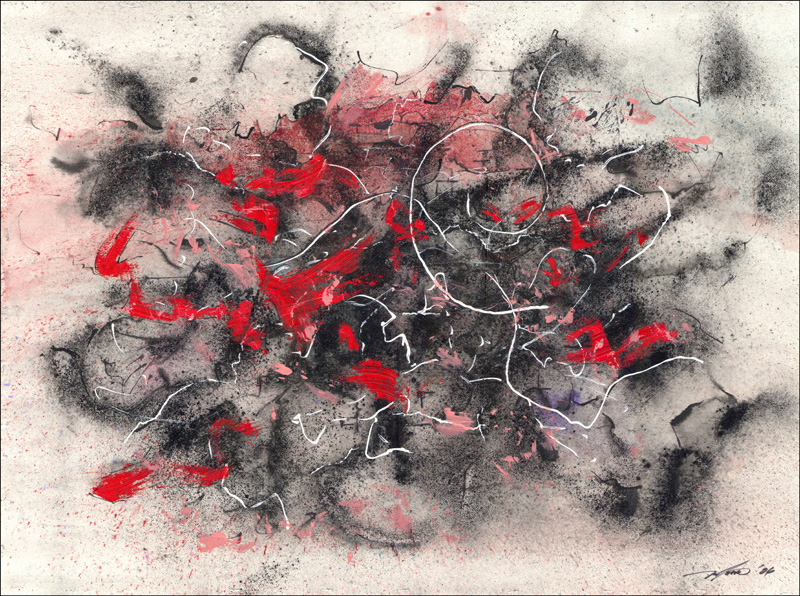
The Grammar of Punishment
10″x12″
Watercolor
2003

Ricardo F. Morín

November 2025

Bala Cynwyd, Pa

Billy Bussell Thompson, Editor

Author’s Note:

Societies respond to harm in two fundamentally distinct modes of action.    One unfolds through the slow, cumulative patterns of behavior and belief that shape collective life; the other through the deliberate, codified interventions undertaken by institutions in the name of order.    The Grammar of Conflict and The Grammar of Punishment are companion essays, each devoted to one of these modes of action.   The Grammar of Conflict traces how hatred, victimhood, hypocrisy, tribalism, and violence intertwine into a self-perpetuating system—one that is sustained through repeated explanation at every turn and is endured not through necessity, but through the stories societies choose to tell.    The Grammar of Punishment concerns the authority of the State, viz. a formal, structured exercise of power that imposes consequences within boundaries defined by lawful interpretation.   The Grammar of Conflict traces how civic and political antagonism becomes habitual and self-justifying.   The Grammar of Punishment addresses cases in which the State that exceeds its limits can turn injustice into a system of unreasoned laws.    Taken together, the two essays offer complementary perspectives on the forces that perpetuate harm and on the deliberate choices that may interrupt its recurrence.

Abstract:

The Grammar of Punishment addresses the consequences a society imposes for wrongdoing and how the consequences shape the political order and the moral landscape.    The essay treats punishment as a limited civic instrument and punishment as an entrenched practice.    It describes conditions under which the same punitive act can either uphold shared rules or weaken these rules when the scope and purpose of the punishment exceed the original moral and civic justification for imposing them.   The drift beyond that justification often occurs because punishment extends beyond accountability:   when punishment becomes a vehicle for revenge, a demonstration of power, and a means of perpetuating the authority or moral narratives that allow it to continue long after the original violation has been addressed.   This essay does not oppose punishment; it addresses conditions under which punishment displaces justice.    At a time when punitive measures increasingly shape political discourse and public policy, understanding the internal logic of punishment is essential to preserving the boundary between justice and power.

The essay will trace how punishment evolves from a measured response to a specific wrongdoing into a self-perpetuating system of governing.    It will show how institutions originally created to restore justice will come to assert authority, to sustain narratives of legitimacy, and to conceal the principles they were established to defend.    The analysis will identify the conditions under which punishment remains credible (when the exercise of punitive authority is bounded by reason, procedure, scope, proportionality, time, and review) and the points at which punishment ceases to protect social order and begins instead to perpetuate harm.    The essay, however, will neither dictate specific policies nor condemn the use of policies.    Its purpose will be to clarify the roles attributed to punishment, the points at which those roles break down, and how continued reliance on punitive measures discloses deeper social choices about authority, responsibility, and the impulse to respond to injury—choices that reveal as much about a society’s values as about its fears.

1
Punishment is a public act that imposes a cost in response to a breach of law or shared norm.    Punishment marks a boundary, declares a rule, and demonstrates its enforcement.    This definition distinguishes punishment from prevention, restraint, accountability, and repair.    Prevention concerns events that have not yet occurred.    Restraint limits the capacity of an individual or group to cause harm.    Accountability establishes facts and assigns responsibility.    Repair addresses loss and attempts to restore what has been taken away.    Punishment differs from these responses because punishment addresses a specific violation after the fact and imposes a consequence.

2
Any serious assessment of punishment must answer three questions:    What is the purpose of punishment?    To whom is punishment directed?    And, what is the outcome of punishment?   The first question concerns a reasoned intent as opposed to a vague one.    The second question concerns the target and scope of the punitive act.    The third question concerns its manifestation as opposed to the original intention of punishment.    A punishment that claims deterrence yet produces recurrence, or resists compliance, errs not in degree but in comprehension of punishment as a tool.    By ignoring cause, the application of punishment can mistake reaction for resolution and enact justice without insight—a cycle that corrects nothing because it understands nothing.

3
Four primary purposes of punishment are commonly recognized:    boundary-setting, deterrence, incapacitation, and recognition.    Boundary-setting defines the limits of acceptable behavior and affirms that rules retain meaning only when their violation entails consequence; those limits must be defined with clarity.    Deterrence seeks to prevent future harm by making the cost of wrongdoing visible and measurable.    Incapacitation protects society by restricting the offender’s ability to inflict further injury.    Recognition satisfies the moral need to acknowledge that a wrong has occurred and that the community has responded to it.    These aims are conceptually clear, yet their success depends on interpretation and application—each revealing whether the pursuit of order remains faithful to the idea of justice
.

4

A penalty first intended to correct a specific wrongdoing can, over time, be turned by institutions into an instrument of government.  This transformation begins when authorities broaden the reach of the penalty, apply it repeatedly as a mechanical demonstration, and treat its continuation as proof of the authority of the institutions and the legitimacy of the system.  What begins as a targeted reaction applied to a specific violation is repeated, extended, and maintained beyond its original scope.  Over time, the expectation of punitive action acquires a life of its own, and support for punishment becomes a marker of allegiance to the prevailing order.  Actions that once aimed to correct behavior evolve into assertions of dominance, and dissent is recast as disloyalty.  As this process deepens, penalties grow harsher, the circle of responsibility expands, and temporal limits dissolve.  Punishment, once applied to resolve conflict, is continued under conditions that reproduce the same conflict.  When a punitive measure must be repeated indefinitely merely to prove that a rule still holds, the measure is no longer reinforcing the rule; the measure itself becomes the rule.   When punishment is applied habitually, its function changes—no longer of law but of power.   Habit grants power a moral vocabulary that disguises its interest as principle.
When law borrows the tone of justice itself, punishment is presented as restoration.

5

Once power begins to speak in the place of law, the line between what is and is not permitted may remain obscure, but the penalty for transgression is certain.   Such obscurity transforms the law from a boundary of understanding into a field of intimidation.   Power gains elasticity by refusing clarity; it rewards those who conform and isolates those who interpret too freely.   In this inversion, the rule of law survives only in form but its grammar—definition, proportion, and foreseeability—has been erased.

6
Legitimacy is the foundation on which punishment stands. Without legitimacy, punishment no longer functions as justice and becomes an imposition of unchecked power—an exercise of power without lawful foundation. Legitimacy demands definition; tyranny thrives on ambiguity. For punishment to be legitimate, the rules it enforces must be established in advance, written in language that the public can understand, and open to examination and review through lawful procedures. To write rules in advance is to bind power to reason; it makes punishment a civic act—foreseeable, accountable, and shared—rather than the decision of whoever holds command. When these conditions are met, punishment serves a civic purpose, reinforces the rule of law, and secures its own legitimacy instead of weakening it.

7
Time limits are essential safeguards that prevent punishment from becoming a permanent condition.  A consequence without a defined endpoint ceases to address a specific violation and becomes a permanent structure of power.  When the duration of punishment is not limited by purpose, punishment no longer serves the law, but replaces it.  This principle applies both within societies and among them:   a sanction imposed on an individual, a community, or a State follows the same moral and structural logic.  In foreign relations, punitive measures such as sanctions or embargoes function as instruments of discipline between States, and they risk the same transformation—from response to domination—when no path toward resolution is defined.  The possibility of restoration—whether through legal standing, political recognition, or the end of hostilities—is not an act of leniency but a precondition for stability.  Without a defined point of closure, the punished party has no reason to change course, and opposition becomes the only rational response.  Durable orders, civic or international, therefore require an exit from punishment if they are to secure lasting peace.

8
Deterrence is often described as the most rational purpose of punishment, yet its logic frequently is invoked under conditions that include other motives.  Under vague statutes, however, deterrence no longer warns; it confuses.  Political authorities often invoke deterrence to justify harsher measures and claim that fear of consequence will prevent future harm.  But fear imposes compliance without addressing underlying conditions that give rise to transgression.  A punitive policy designed to frighten rather than to understand or correct those conditions becomes less an instrument of prevention and more a mechanism for asserting control.  It teaches not respect for the rule of law but submission to power.  When deterrence functions in this way, it ceases to serve justice and instead sustains the very instability it claims to prevent.

9

Uncertainty is an inherent condition of every system of punishment.  Facts are often incomplete, motives are mixed, and consequences can rarely be predicted with precision.  When the absence of reason is institutionalized under the pretext of uncertainty, the temptation arises to punish not for actions already committed but for those merely expected.  Measures such as preventive detention or deportation are imposed not on verified conduct but on assumptions about future behavior.  These actions, though defended as safeguards against possible harm, risk turning suspicion into verdict.  This form of preemptive punishment blurs the distinction between justice and prevention, replacing evidence with prediction.  As the reach of punishment extends beyond proven acts into the realm of conjecture, the obligation to justify its use must grow correspondingly heavier.

10
There are cases in which punishment is not only justified but necessary.  Certain violations—treason, systemic corruption, sustained violence—break the foundation of shared order.  Ignoring violations signals that common rules no longer carry consequence; this breakdown in enforcement creates the conditions for further harm.  In such circumstances, punishment functions as an act of preservation:   it re-establishes lawful boundaries and affirms that no person or group stands above the rules that govern collective life.   Yet the legitimacy of this response depends on proportion and restraint.   When punishment becomes the automatic answer to every offense, it ceases to serve justice and instead entrenches a culture of retribution.  Punishment fulfills its purpose only when it is applied after reasoned explanation, fair procedure, and tangible repair have failed to resolve the violation; under those conditions, punishment restores the boundaries of order without extending harm beyond necessity.

11

Mercy functions as a limiting condition within systems of punishment rather than as a negation of justice.  Where legal systems retain mechanisms for clemency, review, or proportional adjustment, punishment remains bounded by its original civic purpose.   Systems that apply punishment without the possibility of mitigation or termination treat duration as authority and convert consequence into permanence.  Under such conditions, punishment ceases to respond to a specific violation and instead establishes an enduring relation of domination.

The availability of mercy alters the operation of punishment by introducing temporal and proportional limits.  These limits prevent punitive authority from extending beyond the circumstances that justified its initial application.  When legal procedure excludes such limits, enforcement persists independently of the conduct that prompted it, and legality is reduced to repetition rather than judgment.  Under such circumstance, punishment is administered as a continuous practice rather than as a reasoned response.

Systems that incorporate mercy preserve a distinction between law and command by allowing punishment to conclude once its stated purpose has been met.   Where that distinction is maintained, punishment remains an instrument within the law rather than a substitute for it.  Where it is not maintained, punishment operates without reference to restoration, and civic membership is replaced by continued exposure to sanction.

12

These principles are not abstractions but safeguards that keep the exercise of power subject to the law. When institutions apply punishment within those limits, the law retains its credibility because the consequences remain connected to reason. When institutions exceed those limits, punishment replaces the law as the source of authority, and conflict grows within the space that reason has abandoned.   Under such circumstance, punishment no longer resolves the doing of wrong; it reproduces it.   Justice survives only when the law speaks with a clarity that power cannot rewrite.


“The Grammar of Conflict”

October 9, 2025

Ricardo F. Morín
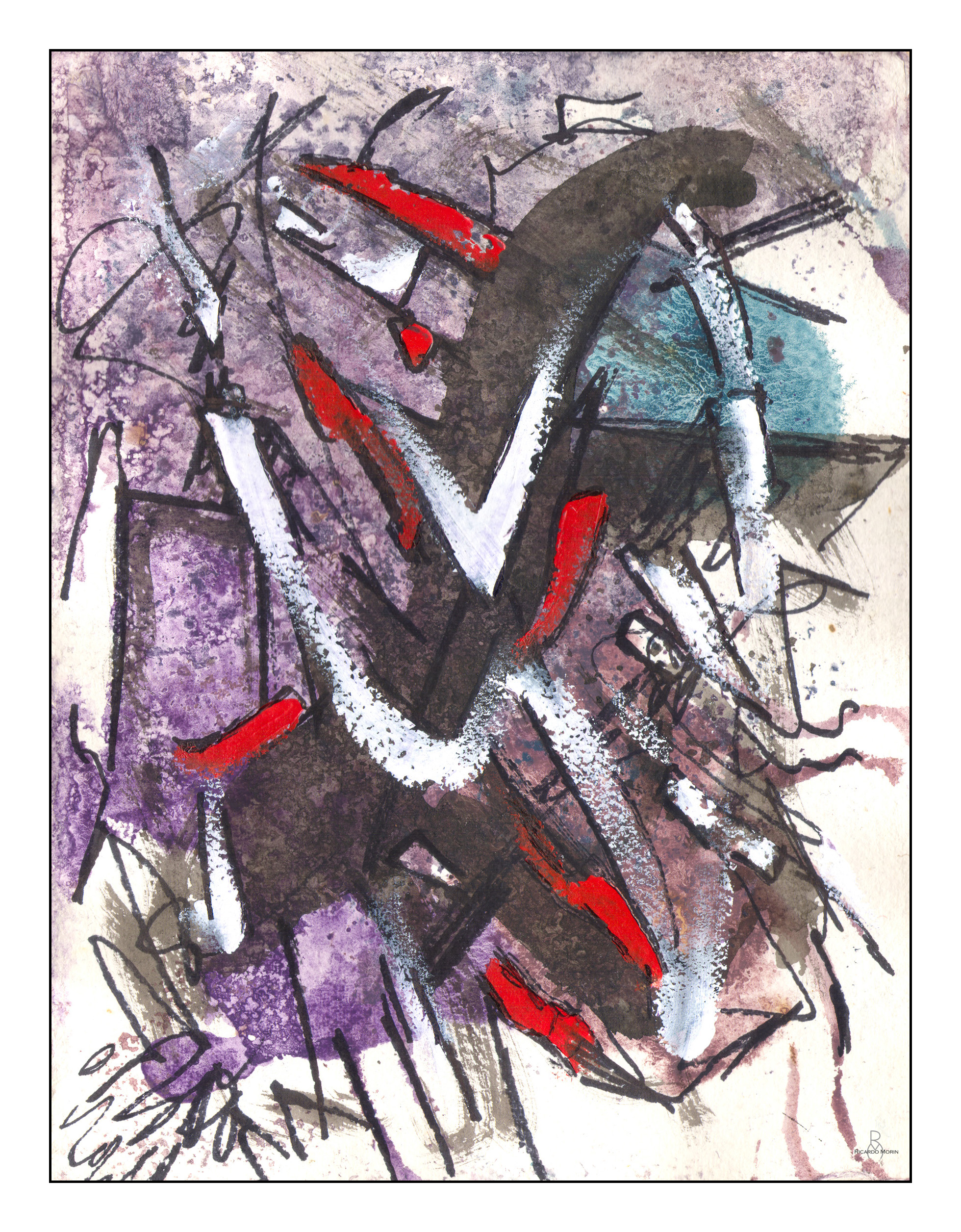
Untitled #2
Watercolor
10”x12”
2003

By Ricardo F. Morín

Oct. 9, 2025

Bala Cynwyd, Pa

Conflict endures not only because of the grievances that ignite it, but also because of the internal logic that sustains it.    Hatred, victimhood, hypocrisy, tribalism, and violence do not operate as separate forces; they form an interdependent system that is justified at every turn.   This essay examines a system of conflict as a grammar—a set of rules and patterns through which antagonism shapes thought, legitimizes action, and perpetuates itself across generations.    The objective is not to judge but to expose how conflict becomes self-sustaining, how violence evolves from an instrument into a ritual, and how contradiction becomes the very foundation upon which societies act in ways that betray their own professed values.


1

Conflict, when stripped down to its structure, is less an event than a language.   Conflict is learned, repeated, and transmitted—not as instinct alone but as a structured framework through which people interpret events and justify actions.   Violence is only one expression of conflict; beneath the act lies a sequence of ideas and reactions that not only precede violence but also weave hostility deliberately into a fabric of continuity.   Understanding this grammar of conflict is essential, because it shows how human beings can remain locked in cycles of harm long after the original reasons have disappeared—not by accident, but because the rhetoric sustaining conflict extends the original violence far beyond its initial cause.    What appears spontaneous is often scripted, and what seems inevitable is, more often than not, the cumulative result of choices that have hardened into reflex.

2

Hatred is the first syntax of this grammar.    Conflict does not erupt suddenly but accumulates over time, layer upon layer, through memory, myth, and selective narration.    Conflict is presented as a defense against a perceived threat or subordination; yet its deeper function is preservation.    Hatred sustains identity by defining itself against what it is not.   Conflict, once entrenched, ceases to depend on immediate threat.   Conflict becomes self-justifying.   It becomes a lens that reinterprets evidence in conformity with its narrative and expectations.    Conflict prepares the ground on which it thrives and provides ready-made explanations for future disputes.

3

Victimhood gives hatred an enduring vocabulary.   It converts the suffering from a past event into a permanent political and social resource.   Suffering is a condition we all inhabit.    Yet to make suffering the core of collective identity is strategic.    Suffering allows communities to claim moral authority and to legitimize otherwise illegitimate actions.    The story of injury becomes a foundation for retaliation.    Herein, however, lies a trap:   identity anchored in victimhood threatens the cessation of its narrative.    Without the presence of an adversary, legitimacy loses potency.    The original wound remains open—remembered and weaponized for all that follows.    Each new act of aggression is framed as a defense of dignity and as a reaffirmation of suffering.

4

Hypocrisy is the structure holding this system together.    Hypocrisy enables simultaneous denunciation and deployment of violence.    It is a proclamation of ideals systematically violated.    Hypocrisy not only conceals contradiction; it embodies it.    It is, in fact, a vain attempt to invoke justice, to speak of universal rights, and to decry cruelty.    The resulting duplicity is essential.    Hypocrisy presents violence as a legitimate principle, domination as protection, and exclusion as necessity.

5

Once hatred, victimhood, and hypocrisy have aligned, violence becomes a ritual—not a reaction.    This ritual can claim instrumental goals:    the recovery of lost territory, the righting of past wrongs, or the assurance of safety.    But over time, the purpose fades and the pattern remains.    Each act tries to confirm the legitimacy of the last and to prepare a justification for the next.   The cycle no longer requires triggers; conflict sustains itself through momentum.    Violence becomes a means through which the collective is used to consolidate identity and to institutionalize memory.

6

Tribalism is a ritual of emotional power.   Conflict reduces the complexity of human experience to affiliation and exclusion.  Within this framework, radically different standards judge shifting actions according to who commits them.   What outsiders called terrorism becomes a defensive force within the tribe.   The tyranny of an enemy becomes the tribe’s strength.   Tribalism turns contradiction into coherence; it makes hypocrisy acceptable; it transforms violence into allegiance and reprisal into obligation.    The more deeply divisions define a society, the more indispensable conflict becomes to its sense of purpose.

7

Violence is no longer a response; it is a condition.    Violence persists not because it serves immediate goals, but because it affirms permanence.   Ending a cycle means dismantling its sustaining narratives; it means acknowledging an enemy is not immutable; victimhood is no longer unique; ideals no longer coexist with betrayals.

8

The illusion of inevitability is insidious.    If conflict frames destiny, accountability dissolves.    Reaction explains every action as defensive.   Herein, recognition diminishes agency; violence becomes not a choice but a forced external condition, an illusion allowing the cycle to continue.

9

Breaking the continuation is neither difficult nor mysterious.   Hatred as an explanation simplifies and legitimizes the narrative; it offers ideological reassurance; it sustains a false sense of control.    Together they form a system that seems natural, but familiarity is not fate.    The grammar of conflict is learned; what is learned can be unlearned.   The first step is to elucidate and to recognize what seems inevitable is only a choice disguised as a reaction.   Thus societies can construct new grammars, without enmity, without vengeance, and without domination.

10

To diagnose conflict is not to diminish suffering or to excuse violence.    An understanding of how suffering and violence endure reveals that each helps to sustain the other.    Profound injuries are not those inflicted once but are those kept alive by stories repeated about them.    The cycle endures because unreason has its own reason; it preserves the stories that keep us injured and persuades us of their necessity.    It is not that people act without reason, but that they rationalize the irrational until irrationality itself becomes the organizing principle of their behavior.    Exposing their grammar is not a solution, but it is a beginning:   a way to make visible the architecture of antagonism and, perhaps, to imagine forms of coexistence that no longer depend on perpetual conflict for their justification.


Edited by Billy Bussell Thompson, Oct. 9, 2025, NYC, NY

“Ritual: A Philosophy of Necessity”

September 20, 2025

*

Ricardo Morín
New York Series, Nº 5
54″ x 84″
Oil on canvas
1992

Preface

This essay seeks to define rituals without reliance on metaphors, abstractions, or moral judgments.   The method of this essay begins with etymology, then traces its biological foundation, and follows the extension of ritual into human conduct.   Ritual is treated as repetition with form, carried out by necessity to contain forces uncontrollable by command or intention.

The analysis will distinguish ritual from belief and superstition.    Belief attributes power beyond immediate function.   Superstition arises when belief assigns causality where none exists.    Ritual is not a belief, but only a procedure.   Its function is to regulate life through ordered repetition.

The chapters that follow address the principal domains in which ritual operates.   In sexuality, ritual prevents destabilization by giving desire a form through which it can move without collapse.   In distrust, friendship, enmity, and love, ritual contains states that resist control and makes them livable.   In governance, ritual holds ideological differences within limits that preserve continuity of community.

Ritual is necessary for existence.   It does not eliminate instinct, emotion, or conflict.   It gives them form and allows life to continue without disintegration.   This necessity is not external, but generated by life itself.   Where forces exceed control, ritual provides order.

*

Ricardo Morin. September 12, 2025, Bala Cynwyd, Pa.

I

The word ritual comes from the Latin ritus (a prescribed act performed in an ordered manner).    Its essence is repetition.   To speak of ritual is not to speak of tradition or abstraction, but of a necessity carried out for primal longing.

The biological basis of ritual is clear.   In many species, conflictive instinctive drives are contained by repeated actions which reduce uncertainty.    Birds perform dances before mating.   Wolves display submission to prevent attack.    Primates groom one another to ease tension.    These actions do not alter the external world.    They do not ensure mating, nor prevent danger, nor eliminate aggression.   They work by regulating behavior in ways preventing destabilization.    They arise from necessity:   without them, reproduction, survival, or cohesion could be placed at risk.

Human conduct extends this biological principle.    The handshake is a repeated act signaling non-aggression between strangers.   A funeral orders grief into sequence and allows the bereaved to endure loss.    A meal shared among people affirms cooperation and reduces the possibility of conflict.   Not one of these actions are effective because of a belief in causality.    They are effective because they are the product of repetition and recognition within the group.   They are necessary because without them, mistrust, grief, or rivalry would remain uncontained.

Instinct and emotion generate uncontrolled command or intention.   Repetition gives them form without elimination.    Herein lies the necessity:    life produces forces beyond control, and ritual provides their procedure without collapse.    Thus further inquiry rests here.

II

Belief begins where an act or event is taken to hold power beyond its immediate function.    To believe is to attribute meaning not evident in the act itself.   Belief provides orientation, but also creates vulnerability.

From belief grows superstition.   Superstition occurs when a gesture, a sign, or an accident is taken to determine good or bad luck.   Breaking glass is said to bring harm.   A number is said to bring luck.    The act or sign is given power it does not possess.    Superstition is belief that’s misdirected.   It relies on the conviction that external hidden forces govern external events and become accessible through signs and gestures.

Ritual does not depend on belief that an act can change fate or invoke hidden power.   Its effectiveness does not rest on what is imagined but on what is enacted.   A handshake obviates mistrust because it is repetition and recognition, not because of its magic.   A funeral allows provides ordered sequence and allows grief, but it does not alter death.   A meal shares cooperation through its mutuality, not because it calls luck.

The distinction is exact.   If ritual is the form, desire is the current that moves within it. Religious traditions have often cast desire as a deficit, a disorder, or a temptation to be repressed.   But desire is neither deficit nor disorder; it is vitality itself:   an energy that presses toward expression.   Ritual does not restrict this force; restriction belongs to fear and suffering.    Ritual contains fear and keeps excess within the limits of endurance and necessity.   Fasting, for example, does not abolish hunger but holds it in rhythm; it makes appetite a measure rather than a punishment.    By contrast, a prohibition that denies the legitimacy of desire transforms vitality into anxiety altogether.    In this way, ritual and desire are not opposed but interdependent:   the former is the channel, the latter the stream.

III

Sexual drive is pervasive in human life.    Left without form, it destabilizes both the individual and the community.    Its power lies in persistence.   Command cannot dismiss desire.   Desire presses for expression.    Every culture has developed rituals to contain and to regulate it.

Yet the grounds of sexual ritual are not repression but replication.    Nurture marks the human condition from birth:    in lactation, nurture consists in being fed, held, and sustained through another’s body.    In this original state, intimacy secures survival.    Later, desire repeats the structure.    The quest for union is both a return to that first condition of dependence and a transformation of it into adulthood.    Sexual ritual prolongs that first experience:    it carries within it the imprint of nurture.    It is not a matter of shame or judgment, but of continuity.

Courtship is the model.   Repeated gestures mark the approach to intimacy.   Ceremonies (words, gifts, dances) structure the encounter.   Desire is not eliminated, but gives form to sexuality and allows it to proceed without immediate conflict.    Marriage extends the process and establishes rules for its conduct within a recognizable frame.   Ritual transforms a disruptive force into a relation that can be carried within order.

Different cultural examples exemplify the variety of this process.    In Japan, tea ceremonies and formal visits have structured the first stages of marital negotiation.    In Victorian England, the presence of chaperones functioned as a mode of surveillance and set boundaries for courtship.   Among the Navajo in North America, the Kinaaldá ceremony marks a girl’s transition into womanhood and links individual desire and fertility with the continuation of the community.   In each case, ritual does not extinguish instinct but channels it into social life.

When desire cannot be enacted without risk, individuals turn to patterned acts that provide release without collapse.    Monastic traditions across cultures developed rituals of celibacy, which are supported by prayer, fasting, and other disciplines, containing sexual force.   In everyday life, other people turn to imagery (fantasy, dream, or artistic representation) and stage symbolically acts they long for but cannot realize.   Still others establish habits (exercise, meditation, or creative work) that redirect sexual energy into manageable outlets.   Longing, however, is not erased.   Its structure makes sure that desire moves within set limits without becoming overwhelming.

Obsession arises when desire remains unresolved and intrudes upon thought; it repeats itself without relief and it threatens stability.   Ritual is a way to contain obsession.    Through repetition, it acknowledges the force and gives it shape.    Though not eliminated, it has boundaries.

Ritual in the sphere of sexuality is not an option but a necessity.   It provides form where instinct would exceed measure.

IV

Reason alone does not govern human beings.   Emotional states persist in ways that resist control.   Distrust, friendship, enmity, and love cannot be removed by decree or maintained by thought.   Each requires ritual to provide continuity and containment.

Words alone cannot erase suspicion.    Distrust is one of the most persistent of these states. Suspicion cannot be erased by emotion.   Suspicion lingers and destabilizes interaction.   Ritual reduces its scope.   A greeting, an oath, or a contract are ceremonial acts repeated across encounters; they establish a minimum ground on which cooperation can occur.   These acts do not eliminate suspicion, but they allow engagement to proceed in spite of it.

Friendship depends on feelings, but feelings without form fade.   Ritual gives duration to friendship.    Shared meals, recurring visits, exchanges of favors, and so forth, are patterned acts that affirm a relation.   By themselves, they do not create friendship, but without them friendship weakens.   Rituals sustain that which cannot be commanded—the persistence of trust and attachment across time.

Enmity is no less powerful.    Unbounded hostility escalates until destruction follows.   Rituals channel hostility into limited form:    a duel, a contest, a formal debate—each provides a frame in which enmity can be expressed without collapse.   Even in war, treaties operate as ritual forms that restrict violence to recognizable limits.    Without them, conflict loses proportion.

Love in itself is unstable.   It begins in impulse and only lasts with repetition.   Daily gestures, renewed promises, anniversaries, and continuous acts of care provide a form to sustain it.    These rituals do not guarantee permanence, but they give a structure to love within which it can endure.    Without these rituals, love dissipates.

In all these states, ritual serves the same function.    It gives order where the force cannot be controlled directly.   It does not remove distrust, friendship, sexuality, enmity, or love.    It makes them livable.

V

Governance is the state where human forces are amplified by scale.    Distrust, enmity, and competing loyalties appear not only among individuals but among groups.    Ideological differences cannot be eliminated; they can be managed.   Ritual provides the procedure by which this is done.

One example is Parliamentary procedure.    Debate, order of speaking, and voting are repeated acts that permit conflict to be expressed without dissolution.    The forms themselves do not create agreement.   They provide limits within which disagreement can persist.

Civic ceremonies perform a related function.   Inaugurations, public oaths, and national commemorations do not change political conditions in of themselves.    Their repetition affirms the continuity of authority and gives recognition to transitions of power.   The acts are symbolic only in appearance; their real function is procedural stability.

Elections are more direct.   They do not remove ideological division.   They provide a repeated method for channeling conflict into outcomes recognizable by opposing sides.   Without elections, or when their results are not acknowledged, division tends toward rupture.

Ritual is necessity.    Governance depends on it.   Across species, ritual arises from the need to manage forces that exceed direct control.   Human conduct continues this principle.

In ancient Athens, the assembly and the use of the lot allowed opposition to be expressed without dissolving civic order.    Later, parliaments and councils provided ritual structures for negotiation between absolute monarchs and subjects.    In modern democracies, constitutions and electoral cycles maintain continuity by repeating forms that regulate the transfer of power.   When such rituals fail, the outcome is predictable.    Governance is a ritual that makes ideological differences livable.    Without ritual, politics reduces itself to domination and resistance, a cycle that cannot sustain order.


Annotated Bibliography

  • Arendt, Hannah: On Revolution. New York: Viking, 1963. (Arendt emphasizes the role of civic procedures in sustaining governance; this underlies Chapter V’s claim that ritual makes ideological difference livable.)
  • Douglas, Mary: Purity and Danger: An Analysis of Concepts of Pollution and Taboo. London: Routledge, 1966. (Douglas’s work on ritual boundaries informs Chapter IV’s discussion of distrust, enmity, and the management of instability through repeated acts.)
  • Durkheim, Émile: The Elementary Forms of Religious Life. New York: Free Press, 1995. (Durkheim argues that ritual is the foundation of social cohesion, an idea reflected in Chapter I’s claim that rituals regulate behavior and prevent destabilization.)
  • Freud, Sigmund: Three Essays on the Theory of Sexuality. New York: Basic Books, 2000. (Freud’s psychoanalytic discussion of sexual drive and obsession parallels Chapter III’s treatment of private rituals and the containment of unresolved desire.)
  • Geertz, Clifford: The Interpretation of Cultures. New York: Basic Books, 1973. (Geertz treats ritual as “models of” and “models for” reality; his ethnographic analysis supports the essay’s extension of ritual from sexuality to governance in Chapters IV and V.)
  • Habermas, Jürgen: Between Facts and Norms: Contributions to a Discourse Theory of Law and Democracy. Cambridge: MIT Press, 1996. (Habermas shows how ritualized procedures in discourse and law preserve governance under conflict; his thesis supports the essay’s treatment of parliamentary debate and elections.)
  • Jung, Carl Gustav: Symbols of Transformation. Princeton: Princeton University Press, 1956. (Jung traces how instinctual drives, especially sexuality, become ritualized in both individual psychology and collective culture; his analysis complements Chapter III.)
  • Turner, Victor: The Ritual Process: Structure and Anti-Structure. Chicago: Aldine, 1969. (Turner’s analysis of liminality informs Chapter III and IV, where sexuality, friendship, and enmity are shown to require ritual frames to carry disruptive forces without collapse.)

“The Limits of Suffering”

March 14, 2025

*

Untitled 012 by Ricardo Morín
22" x 30"
Watercolors, charcoal, oil, white-out and ink on paper
2006
Untitled 012 by Ricardo Morín
22″ x 30″
Watercolors, charcoal, oil, white-out and ink on paper
2006

There exists a threshold beyond which suffering ceases to be endurance and becomes something else—something raw, incommunicable.      It is not simply a matter of pain, nor even of despair, but of a silent depletion where the self finds itself at the precipice of its own dissolution.      Yet, how does one define this limit?

It is tempting to believe suffering has purpose, that it can be transmuted into wisdom or resilience.      This belief sustains us through its early stages.      We endure in the name of meaning, in the hope that suffering refines rather than annihilates.      But there comes a point where suffering becomes a force unto itself, severed from justification.      It no longer instructs, no longer dignifies—only persists.

The problem of suffering is not only how much one can bear, but how much one should reveal.      Silence often protects both the sufferer and the witness.      There are pains too intimate, too profound to translate into language without reducing them to spectacle.      To expose suffering in its entirety risks transforming it into something unrecognizable, stripping it of the dignity that private endurance affords.      Yet, concealment can create its own form of exile, a loneliness where pain festers unseen.

Some attempt to navigate this tension by offering fragments—enough to acknowledge suffering’s presence without inviting intrusion.      Others say nothing at all.      This is not cowardice but a final assertion of control, a refusal to be defined by pain.      To impose the expectation of disclosure upon those who suffer is to misunderstand the nature of their burden.      The gravity of suffering is not only in the experience itself but in the impossible task of making it understood.

We live under the illusion that the mind and body will hold, that endurance is limitless.      But suffering reminds us otherwise.      There is a breaking point, whether visible or silent, sudden or drawn out.     

It is not the same for everyone.      Some withstand more than others—not through superior strength, but through a different alchemy of circumstance, temperament, and sheer chance.      What remains constant is that all thresholds, eventually, are met. There is no single way to live with suffering.    Sometimes, what brings relief is not endurance, but the quiet act of self-recognition.    To speak, when one can.    To remain silent, when one must.    In the space between what cannot be said and what must be accepted, a simple truth may emerge: even uncertainty can sustain us, if we meet it with honesty.

And when that release is impossible, when suffering stretches beyond its own limits, only the silent acknowledgment of its presence remains—a weight that, sooner or later, must either be laid down or consume what is left.

Ricardo Federico Morín Tortolero

March 16, 20025; Oakland Park, Florida