*
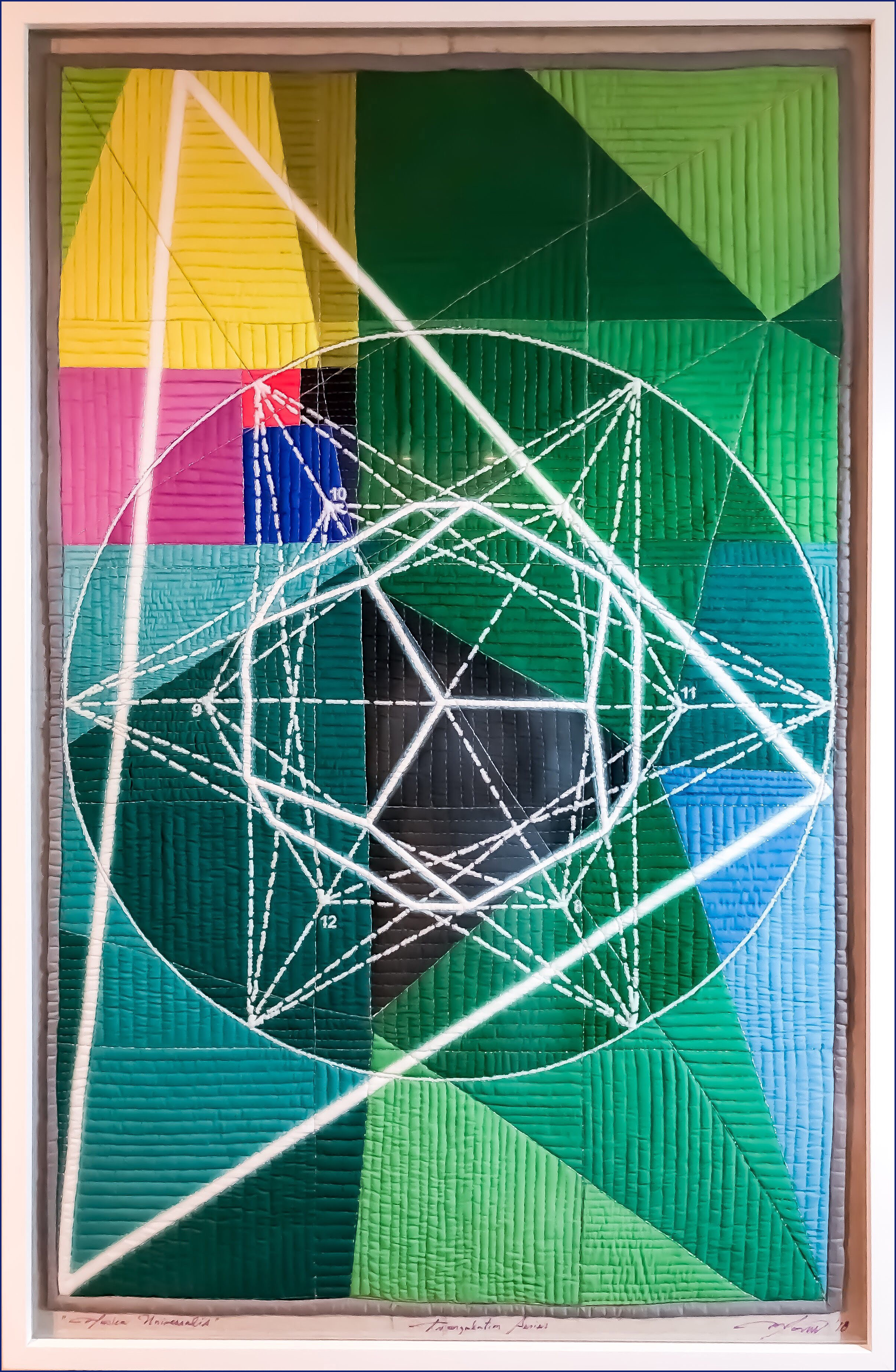
(Triangulation Series)
Musica Universalis
Silk quilt streched over linen
37″ x 60″
2013-18
A geometrical construction of a dodecahedron within a Fibonacci composition, reinforced by a right-angle triangle: A meditation on the harmony of the universe, where mathematics and language converge yet never fully enclose reality.
Ricardo Morin, August 20, 2025
Abstract
This essay examines the interdependence of language and mathematics as the twin pillars of knowledge, each indispensable yet incomplete without the other. While mathematics secures precision and abstraction, language renders reasoning intelligible and shareable; together they approximate, but never fully capture, a reality richer than any formulation. The discussion situates artificial intelligence as a vivid case study of this condition. Marketed at premium cost yet marked by deficiencies in coherence, AI dramatizes what happens when mathematical power is privileged over linguistic rigor. Far from replacing human thought, such systems test our capacity to impose meaning, resist vagueness, and refine ideas. By weaving philosophical reflection with contemporary critique, the essay argues that both mathematics and language must be continually cultivated if knowledge is to progress. Their partnership does not close the gap between comprehension and reality; it keeps it open, ensuring that truth remains an unending pursuit.
Language, Mathematics, and the Price of Artificial Intelligence
Every society advances by refining its tools of thought. Two stand above all others: mathematics, which distills patterns with precision, and language, which gives form and meaning to reasoning. Neither is sufficient alone. To privilege one at the expense of the other is to weaken the very architecture of knowledge.
Artificial intelligence dramatizes both their promise and their limitations. The announcement of a $200 monthly fee for access to ChatGPT-5 is revealing. Marketed as a luxury service “for those who can afford it,” it underscores the widening gap between technological privilege and cultural necessity. Those with resources can fine-tune their productivity; those without are left behind. Yet even for the well-equipped, the question persists: what exactly is being purchased?
The machine dazzles with speed and scale, but its deficiencies are equally striking. Engineers may be virtuosos of algorithms, but grammar is not their instrument. The results are too often colloquial, vague, or lacking in rigor. To extract coherence, the user must not be a passive consumer but an editor—capable of clarifying, restructuring, and imposing meaning. The paradox is unmistakable: the tool marketed as liberation demands from its operator the very discipline it cannot supply.
This paradox reflects the larger truth about knowledge itself. Mathematics and language are both indispensable and both incomplete. Mathematics achieves abstraction but leaves its results inert unless language renders them intelligible and shareable. Language conveys thought but falters without the rigor that mathematics provides. What one secures, the other interprets.
Yet both are bound by a deeper condition: reality exceeds every formulation. Our theories—whether mathematical models or linguistic descriptions—are approximations shaped by the observer. Language cannot exhaust meaning; mathematics cannot capture finality. Knowledge is never absolute: it is a negotiation with a reality richer than any model or phrase.
Artificial intelligence lays bare this condition. It can automate structure but cannot provide wisdom; it can reproduce language but cannot guarantee meaning. Its true value lies not in replacing the thinker but in testing our capacity to resist vagueness, impose coherence, and refine thought. What is marketed as freedom may, in truth, demand greater vigilance.
To dismiss language and the humanities as secondary, or to imagine mathematics and computation as sufficient unto themselves, is to misunderstand their interdependence. These disciplines are not rivals but partners, each refining the other. AI magnifies both their strengths and their deficiencies; they remind us that progress depends on the continual refinement of both—mathematics to model reality, language to preserve its meaning.
The path of knowledge remains open-ended. Language and mathematics do not close the gap between our finite comprehension and the inexhaustible richness of reality; they keep it open. They allow us to approach truth without presuming to possess it. Artificial intelligence, as every tool of thought, shows us not the end of knowledge but its unending condition: a dialogue between what can be measured, what can be spoken, and what forever exceeds us.
*
Annotated Bibliography
- Arendt, Hannah: The Life of the Mind. Vol. 1: Thinking. New York: Harcourt, Brace, Jovanovich, 1971. (Arendt examines the act of thinking and the limits of expression, which shows how thought requires language to become shareable while never able to exhaust reality. Her work reinforces the essay’s claim that reasoning without expression cannot advance knowledge.)
- Bender, Emily M., and Koller, Alexander: “Climbing towards NLU: On Meaning, Form, and Understanding in the Age of Data.” Proceedings of ACL, 2020. (Bender and Koller argue that large language models process form without true understanding; this highlights the gulf between mathematical pattern recognition and linguistic meaning—it supports the essay’s caution that AI dazzles with form but falters in coherence.)
- Chomsky, Noam: Language and Mind. 3rd ed. Cambridge: Cambridge University Press, 2006. (Chomsky explores the innate structures of language and their role in shaping cognition; this affirms that language conditions the possibility of thought while it still remains limited in capturing reality.)
- Devlin, Keith: Introduction to Mathematical Thinking. Stanford: Keith Devlin, 2012. (Devlin explains how mathematical reasoning distills structure and pattern while acknowledging abstraction as approximation; this reinforces the idea that mathematics, as a safeguard of precision, cannot exhaust the world it models.)
- Floridi, Luciano: The Fourth Revolution: How the Infosphere Is Reshaping Human Reality. Oxford: Oxford University Press, 2014. (Floridi situates digital technologies and AI within a broader history of self-understanding, which enriches the essay’s argument that mathematics and language—extended into computation—remain approximations of a reality beyond full control.)
- Lakoff, George, and Núñez, Rafael: Where Mathematics Comes From: How the Embodied Mind Brings Mathematics into Being. New York: Basic Books, 2000. (Lakoff and Núñez argue that mathematics arises from metaphor and embodied cognition, which reveals how dependence on human interpretation and the affirmation that mathematical theories, as linguistic ones, remain bound to the observer.)
- Mitchell, Melanie: Artificial Intelligence: A Guide for Thinking Humans. New York: Farrar, Straus and Giroux, 2019. (Mitchell provides a critical overview of AI’s capabilities and limits; it shows how the advancement of pattern recognition does not close fundamental gaps in understanding and parallels the essay’s critique of AI’s grammatical poverty.)
- Polanyi, Michael: Personal Knowledge: Towards a Post-Critical Philosophy. Chicago: University of Chicago Press, 1962. (Polanyi emphasizes tacit knowledge and the need for articulation in validation; it echoes the view that mathematics and language refine understanding but never achieve closure.)
- Snow, C. P.: The Two Cultures. Cambridge: Cambridge University Press, 1993 [1959]. (Snow diagnoses the divide between sciences and humanities; this undergirds the essay’s call to treat language and mathematics as complementary pillars of understanding.)
 Observations On Perception