Posts Tagged ‘abstraction’

“Before Language”

June 12, 2026
Ricardo F. Morín
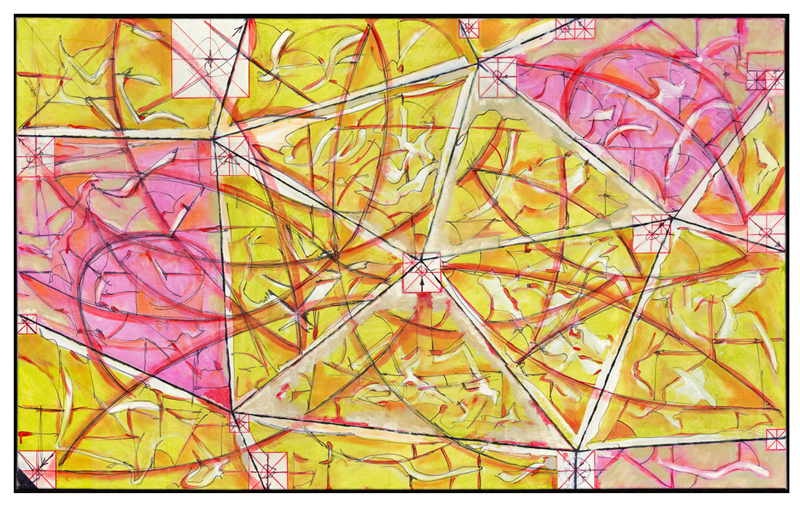
Dodecahedron
60″x 37″
Oil on linen
2005

Ricardo F. Morín

June 12, 2026

Bala Cynwyd, Pennsylvania

All living entities persist through relations.  No organism exists in complete isolation from the conditions that sustain it.  Life proceeds through continuous exchanges with surrounding environments and with other living systems.  These exchanges need not be deliberate, conscious, or symbolic.  They need only permit the registration of differences and the adjustment of behavior in response to them.

Communication emerges within this condition.  It is not limited to speech, writing, or symbolic expression.  More broadly, communication arises through correspondence, within which differences are registered and relations are established, maintained, or modified.  Signals constitute one manifestation of such correspondence, but the forms through which correspondence occurs vary widely.  Chemical gradients, electrical impulses, physical gestures, vocalizations, and symbolic systems all participate in communicative processes under different conditions.

Language occupies a distinct place within this broader field.  Human language permits abstraction, symbolic reference, recursion, and the transmission of information beyond immediate circumstances.  These capacities expand the range of what can be communicated.  They do not, however, constitute the origin of communication itself.  Rather, language represents a specialized manifestation of communicative processes that already operate throughout living systems.

The distinction is important because language often becomes identified with communication as such.  Human beings naturally experience the world through linguistic categories and therefore tend to privilege language when considering the conditions of understanding.  Yet much of what sustains relational life occurs without language.  Organisms coordinate, adapt, compete, cooperate, and respond to changing conditions through forms of correspondence that precede symbolic representation.

Differences among communicative systems are differences of form, scope, and complexity.  They do not necessarily imply absolute divisions between categories of existence.  A signal that coordinates the movement of a colony, a vocal call that alerts a group to danger, and a sentence describing a future possibility all perform communicative functions despite substantial differences in structure.  The means differ.  The correspondences through which those differences are registered remain prior to the communicative forms that express them.

Observation permits the study of these processes but remains constrained by the capacities through which observation occurs.  Instruments may extend perception, and conceptual frameworks may organize what is perceived, yet description remains distinct from the realities it attempts to describe.  Every account reflects both the conditions observed and the limitations of the observer.

For this reason, communication is best approached descriptively rather than hierarchically.  Human language possesses distinctive capacities, but those capacities do not require communication to begin with language nor to be exhausted by it.  Language belongs within a broader communicative field that arises from forms of correspondence present throughout relational life.

The question is therefore not whether communication exists where language is absent.  The more instructive question concerns the many forms through which relational life becomes possible before language appears.  Attention to those forms reveals communication not as a uniquely human achievement but as a condition through which living systems participate in, respond to, and persist within the circumstances they inhabit.

“The Quest for an Authentic Prose”

May 27, 2026

Ricardo F Morín
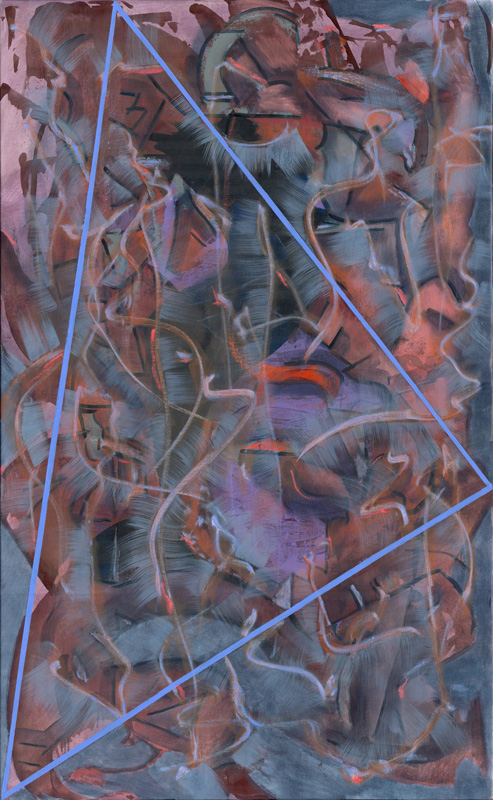
Triangulation Series Nº 5: The Quest for an Authentic Prose
37″ x 60″ x 2″
Oil on linen
2006

Ricardo F. Morín

September 18, 2025

Centerville, Massachusetts

Preface

The human leap into abstraction gave birth to language, and with it the possibility of prose.   When Homo sapiens began to imagine beyond the visible, they created tools, symbols, and stories that no other species could produce.   Yet abstraction, the very source of imagination, remains among the hardest realities to communicate.   Writing bears this paradox:   it tries to give form to what resists form without obscuring the condition it seeks to render visible.   This essay does not seek to trace that vast history in full; it draws instead on that primal act of abstraction to show that the writer’s struggle, to render thought visible and to give shape to the unseen, remains unchanged across centuries.

That struggle is not only technical but deeply human.   To write is also to doubt, to question whether one’s voice is adequate to thought; whether one’s grasp of language can sustain the weight of meaning.   Under the pressures of expectation and judgment, many writers quietly ask whether they are impostors, feigning a competence they do not truly possess.   Yet this uncertainty is itself part of the discipline:   an honest reckoning with one’s limitations that refines rather than disqualifies the work.   Few can claim certainty about the boundaries of their ability, and perhaps none should.

The quest for an authentic prose is bound to this origin.   Every age, scribal, print, digital, has tested our ability to express not only information but the inner life that words struggle to hold.   Authentic prose does not resolve abstraction; it endures its difficulty while attempting to preserve the lucidity through which a condition becomes perceptible, line by line, revision by revision.

And so the question returns, as it began:   have we exhausted our capacity to speak with authenticity, or is the very struggle with expression the mystery that keeps language alive?   What opened in the first human imagination remains unfinished, because language eludes finality.


1.

Dissatisfaction has always marked the practice of prose, and it has always required self-editing.   Quintilian (ca. 35–100 CE) instructed Roman students to imitate their teachers but warned that imitation must give way to correction:   “Imitation is useful, but it must be imitation with judgment” (Institutio Oratoria, 1920).   Without revision, he argued, the voice remained borrowed.   Medieval scribes copied texts with care but often left glosses in the margins that blurred the line between text and commentary.   Readers had to disentangle the author’s hand.   With the rise of print, writers demanded proof sheets so they could defend their style against compositor preferences.   Erasmus (1466–1536) complained that careless printers “murder books” by imposing their preferences on authors (Correspondence, 1974).   Each age produced new tools, and each forced the writer to revise, to discern, and to secure a voice that could be claimed as one’s own.

2.

Later technologies extended this burden.   The telegraph compressed sentences into terse signals.   Clarity was often sacrificed for speed, and writers had to restore coherence when they expanded the message.   The typewriter regularized spacing and rhythm but imposed a mechanical cadence.   Henry James (1843–1916) remarked that the typewriter “interposes a metal hammer between the brain and the page” (The Notebooks of Henry James, 1947).   In newsrooms, deadlines forced journalists to adopt the inverted pyramid, a structure prized for efficiency but known for flattening voice.   Each medium promised advantage, but each introduced distortions.   Only deliberate editing allowed prose to remain authentic.   Dissatisfaction was not a flaw of these tools.   It was the condition under which prose could survive.

3.

Artificial intelligence belongs to this sequence, not apart from it.   A question receives an answer, but the exchange never resolves into a single voice that can be owned.   One line appears fluent, the next falls into distortion.   Prose wavers between clarity and uncertainty.   The writer is drawn into testing, correcting, and doubting.   The difference is one of scale.   Artificial intelligence (AI) fills the page with language detached from origin, and that scale increases the demand for discernment.   Much of its output takes the form of compression:   context reduced into words that gesture broadly without communicating intent.   To accept such compression unexamined is to risk distortion; to unpack it is to reclaim voice.   Surveys confirm that grammatical correction remains inconsistent, particularly in rare or complex contexts (Bryant et al., Grammatical Error Correction:   A Survey of the State of the Art, 2023).   Studies also show that artificial intelligence often overcorrects in an effort to be seamless, yet it produces stylistically distorted prose (Lin et al., 2024), or fails to maintain nuance when handling morphologically complex languages (Nguyen et al., 2025). These deficiencies show that the old burden of revision has not disappeared.   It has only been intensified.

4.

The uncertainty surrounding artificial intelligence extends into the institutions that teach writing.   Universities now advance two opposing postures.   One treats AI as a breach of authorship, relying on detection systems that attempt to distinguish human irregularity from synthetic fluency.   Yet these systems impose their own distortions:   they mistake conformity for evidence and penalize students whose prose does not match the patterns the software expects.   The policing thus reveals its own fragility.   Other institutions take the inverse view, presenting AI as a neutral instrument meant to optimize expression and support creativity.   But this assurance remains unsettled, for neither posture can define with clarity what constitutes a presence on the page when assistance threatens to precede intention.   These contradictions show that the cultural setting has not reached agreement on how authentic prose should be recognized or taught.   The burden of discernment therefore returns to the writer, intensified rather than relieved.

5.

No writer is exempt from this responsibility.   Ease can dull style.   Resistance can sharpen it.   Hesitation can blur both.   Every posture requires accountability.   Intent does not absolve anyone.   Each sentence must be tested to communicate the most.   Each failure must be corrected.   Each line must be claimed as one’s own.   The practice of self-editing applies to poets and journalists, to scribes and novelists, to humanists and programmers alike.   Recent work confirms that even when AI explains grammar, it falters, exposing its limits in linguistic awareness (Song et al., 2024).   Authentic prose survives only when every line is tested against the measure of discernment.

6.

What rises on the page may look finished yet remain unsettled.   Telegraph brevity, compositor uniformity, or artificial intelligence–generated flow can all produce the semblance of prose without its ground.   Authenticity is not guaranteed by refinement, cadence, or economy.   A sentence may appear polished yet still obstruct the perceptibility of the condition it seeks to communicate.   It depends on the writer’s willingness to revise until intention becomes visibly well illustrated.   That is the issue behind every borrowed sentence:   whether the line bears the trace of a mind that claims it.   Multilingual evaluations confirm that large language models (LLMs) continue to introduce systematic errors in complex linguistic settings (Wisniewski et al., 2025).   No system, ancient, mechanical, or digital, can provide the mark of intention.   It belongs only to the writer who accepts dissatisfaction as the cost of prose that endures.

7.

Artificial intelligence intensifies this old struggle by mimicking fluency without possessing thought.   Its sentences often appear coherent, even responsive, yet their origin is neither conscience nor intention.   They arise from statistical patterning constrained by engineers whose priorities are safety, speed, and predictability, not grammar, philosophy, or the interior stakes of prose.   What looks like neutrality is therefore engineered neutrality, a posture shaped by constraints rather than by judgment.   The result is a style that can imitate tone yet cannot sustain depth:   a simulation of reasoning without the risks that give reasoning its force.

8.

This distinction carries consequences for the writer.   When artificial intelligence produces language faster than reflection can take shape, the danger emerges before the sentence even appears finished:   the instrument’s efficiency can press upon the writer’s own process.   The act of compression not only collapses intention into patterns that merely resemble understanding but also narrow the perceptual aperture through which discernment becomes communicable.   This resemblance introduces a risk of substitution, in which the machine’s output precedes the writer’s thought rather than following it.   Such displacement narrows the aperture through which conscience operates.   What begins as assistance can encourage the writer to accept coherence in place of insight and fluency in place of voice.

9.

The gravitational pull of these systems must therefore be met with boundaries.   Attraction lies in the promise of clarity; repulsion lies in the preservation of autonomy.   The tension between the two is not a flaw but a condition under which authentic prose can still be written.   The writer must think before consulting, draft before refining, and allow the sentence to pass through the discipline of human discernment rather than settling for synthetic coherence.   No tool, mechanical or digital, should be permitted to form thought before thought forms itself.

10.

Authentic prose requires attention to this boundary.   A sentence may appear refined yet lack interiority; it may be correct yet hollow.   No system can supply the tension that gives writing its moral weight:   the lived contradictions, the asymmetries of experience, the reckoning with meaning that cannot be mimicked because it is not a pattern.   What rises on the page must bear the trace of a mind that has chosen, shaped, and claimed its language.   Without that assertion, prose risks becoming inefficient and inauthentic.:   a surface almost polished but without depth, a neutrality without judgment, a voice without origin.

11.  

The  question  of  authentic  prose  ultimately  exceeds  technique.  It  reaches  into  the  structure  of  conscience  itself.  For  prose  does  not  merely  transmit  information.  It  organizes  experience,  establishes  hierarchies  of  relevance,  and  determines  what  may  be  judged  and  what  must  be  tolerated.  In  this  sense,  language is not an instrument that follows judgment.  It is the medium through which judgment becomes possible because it preserves the distinctions through which experience remains perceptible to conscience.

Where  language  is  compressed,  standardized,  or  substituted  before  reflection  takes  shape,  the  danger  is  not  only  aesthetic.  It  is  moral.  For  the  freedom  most  easily  lost  is  not  political  but  cognitive:  the  capacity  to  sustain  a  judgment  without  deforming  experience,  without  delegating  responsibility,  and  without  allowing  coherence  to  replace  understanding.  Artificial  intelligence  sharpens  this  risk  by  offering  fluency  in  advance  of  intention.  When  coherence  precedes  reflection,  the  sentence  may  appear  complete  while  the  conscience  remains  unengaged.  What  is  displaced  in  this  process  is  not  authorship  alone,  but  the  continuity  between  perception,  judgment,  and  action  upon  which  interior  freedom  depends.  

Authentic  prose  therefore  guards  more  than  voice.  It  guards  autonomy.  A  sentence  that  bears  the  trace  of  intention  preserves  a  space  where  judgment  remains  sovereign.  A  sentence  that  arrives  before  intention  narrows  that  space  imperceptibly to replace  discernment  with  pattern  and  responsibility  with  conformity.  The  preservation  of  authentic  prose  is  thus  inseparable  from  the  preservation  of  freedom  of  conscience  itself.  Where  language  no  longer  serves  judgment,  the  first  form  of  servitude  has  already  begun.  


Epilogue

The quest for an authentic prose may be measured against two poles.   One treats language as science, aspiring to the exact word, the simplest expression that can bear the grandest truth.   The other recognizes that prose began in abstraction, and that no sentence ever escapes its shadow.   Artificial intelligence has added a third pressure in the form of compression:   context reduced into words that seem fluent yet hover without anchoring intent.   Perhaps authentic prose lies not in choosing among these forces, but in holding the tension they create, precision as aspiration, abstraction as condition, compression as challenge to communicate with clarity.   What began as the first attempt to name what could not be seen persists in every sentence we revise; each is an effort to render experience perceptible without surrendering it to distortion.   Hope, far from naïve, is the most enduring form of courage—a steady insistence that the work continues, even in the shadow of doubt.


Annotated Bibliography

Bryant, Christopher, et al: Grammatical Error Correction: A Survey of the State of the Art.Cambridge, MA: MIT Press, 2023. (This survey reviews the strengths and limits of AI in grammatical error correction. It highlights persistent deficiencies, especially in complex or rare error types and shows that even advanced models cannot consistently sustain authentic prose.)

Erasmus, Desiderius:  Correspondence. Toronto: University of Toronto Press, 1974. (Erasmus warned that careless printers “murder books” by imposing their preferences on authors. His complaint illustrates how the struggle for authentic prose extended into the print era.)

James, Henry: The Notebooks of Henry James. Chicago: University of Chicago Press, 1947. (James remarked that the typewriter “interposes a metal hammer between the brain and the page;” this noted how technology can shape rhythm and force writers to reclaim nuance through revision.)

Lin, S., et al: Evaluating LLMs’ Grammatical Error Correction Performance in Learner Chinese Errors from a Corpus Linguistic Perspective. San Francisco: Public Library of Science, 2024. (This study shows that AI often overcorrects learner texts and produces grammatically smooth but stylistically distorted prose. It confirms that correction tools may obscure authentic voice.)

Nguyen, Phuong Thao; Nuss, Bernd, Dressler, Roswita, and Ovens, Katie: A Small-Scale Evaluation of Large Language Models Used for Grammatical Error Correction in a German Children’s Literature Corpus: A Comparative Study. Basel: MDPI, 2025. (The authors reveal how AI struggles with morphological complexity and stylistic preservation. Their findings reinforce the need for discernment when editing machine-assisted corrections.)

Quintilian: Institutio Oratoria. Cambridge: Harvard University Press, 1920. (Quintilian advised that imitation must be guided by judgment. His emphasis on correction as the path to authentic voice situates dissatisfaction at the core of rhetorical training.)

Song, Y., et al: GEE! Grammar Error Explanation with Large Language Models.Stroudsburg, PA: Association for Computational Linguistics, 2024. (This paper evaluates whether AI can explain grammatical errors as well as correct them. The results reveal frequent failures in explanation, which expose limits in linguistic awareness and precision.)

Wisniewski, Dawid; Solarski, Antoni, and Nowakowski, Artur: Exploring the Feasibility of Multilingual Grammatical Error Correction with a Single LLM up to 9B Parameters: A Comparative Study of 17 Models. Ithaca, NY: arXiv, 2025. (This comparative study across multiple languages shows that LLMs remain prone to systematic grammatical errors, particularly in complex contexts. The evidence underscores the persistence of deficiencies across linguistic domains.)

“BEFORE FORM II”

November 17, 2025

*

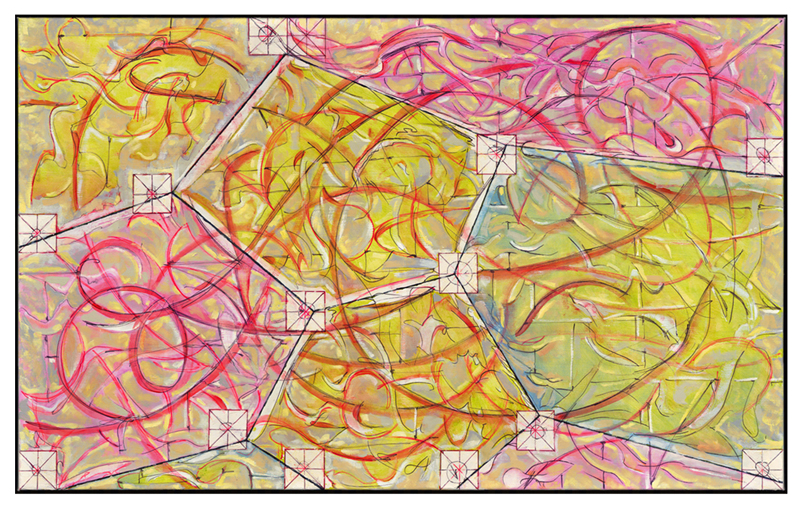
Impressions, Diptych: BEFORE FORM II
18″ x 48″
Oil on board
2000

Ricardo F. Morín

Nov. 17, 2025

Oakland Park, Fl

1

There are relationships in which language arrives too early.

Two minds meet, and each brings its own architecture—one built of corridors, the other of thresholds.

Nothing coheres. Nothing resolves. Yet something is exchanged.

Perhaps the only way to describe it is to refuse description.

What passes between the two is not influence, nor authority, nor instruction.

It is the faint recognition that creation does not always arise from tradition,

and tradition does not always arise from clarity.

One mind preserves structure because it fears dissolution.

The other preserves freedom because it fears enclosure.

Neither is right, neither is wrong, and neither can become the other.

If there is a lesson, it is not philosophical.

It is simply that some encounters generate form only by refusing to take one.

Some dynamics can be seen only by letting them remain unsettled.

Not a system.

Not a method.

Not an alchemical transformation.

Just the quiet knowledge that meaning does not always arrive in recognizable shapes—

and sometimes the refusal of structure

is itself the most honest form.

This is neither alchemy nor allegory.

It does not mirror academic tropes.

It does not explain itself.

It simply stands.

2

There is a place where thought has not yet chosen its weight.

Where nothing must resemble anything.

Where no lineage can be traced because the idea has not agreed to be inherited.

Two minds meet there sometimes, though neither intends to.

One arrives with tools, the other with openings.

One tries to recognize what appears; the other lets appearance undo itself.

No roles persist in that space.

No teacher, no student, no authority, no dissident.

Only the slight disturbance of something wanting to become meaning

and something else resisting the invitation.

Perhaps the exchange exists only in the refusal to define it.

Perhaps it is nothing more than two ways of seeing colliding for a moment

before each retreats to its natural distance.

There is no lesson.

No transformation.

Not even understanding—

just the faint impression that the encounter mattered

in a way that cannot be justified.

Some relationships never enter language fully.

They touch the threshold and withdraw,

leaving only a shape that refuses to become a shape.

What remains is not story, not insight, not metaphor.

Only a quiet remainder:

that something passed between two minds,

and it does not wish to be named.

3

Some encounters move like weather across the mind—arriving without intention,

passing without conclusion.

They do not teach; they do not claim.

They shift the air and leave a pressure change that takes days to understand.

Two temperaments can drift into the same moment like front and current.

One carries the weight of accumulated seasons,

the other moves with the quiet urgency of what is still forming.

Neither is stronger.

Neither is clearer.

They simply meet, and the atmosphere changes.

There is no point of balance.

No point of conflict.

Just a tremor in the air between them,

as if the room itself were listening for something that never quite becomes sound.

Thought loosens in that space.

Meanings approach, circle, and recede.

Nothing settles long enough to be named.

Nothing wants to.

Some relationships never become narrative because narrative would freeze them.

They remain suspended—felt more than understood,

remembered less as moments than as shifts in light,

like a room darkening for reasons the sky doesn’t explain.

When they part, it is not an ending.

It is a dispersal, like mist thinning at the edge of dawn.

Each carries a trace of the other’s weather,

a change in temperature that lingers long after the shapes have dissolved.

What remains is not knowledge.

Not conclusion.

Just the faint sensation that something passed through—

and continues to pass through—

quietly, insistently,

without ever agreeing to take form.

4

There are moments that never arrive fully.

Not as meaning, not as feeling—more like a faint shift,

a drift in the periphery.

Two presences cross, neither entering nor leaving.

A pressure, a thinning, a pulse without source.

Not connection, not distance—an interval that hovers.

Nothing coheres.

Nothing insists.

There is only the sense of something lightly touching thought

and withdrawing before thought can respond.

Contours don’t form here.

Edges blur as soon as they appear.

The exchange—if it can be called that—dissolves into the same air that carried it.

A pause lengthens,

not to reveal anything

but to remind that revelation is unnecessary.

This is not atmosphere; even atmosphere has structure.

It is less.

A faint impression that doesn’t land,

doesn’t settle,

doesn’t belong to either mind that felt it.

Later, one might remember a flicker—

not an idea,

not a moment—

just the residue of an approach that never closed.

No clarity follows.

No resolution.

The experience continues only as dispersal,

the way fog continues after your body has walked through it.

What remains is not being,

but the trace of something that preferred not to become one.

5

There is a place where awareness thins,

not into silence,

but into something before silence—

a faint trembling at the boundary of what the mind can hold.

Nothing shapes itself here.

Outlines gather, loosen, drift apart.

Perception moves like breath against a surface it cannot see,

feeling only its own hesitation.

Two currents brush past each other—

not touching, not avoiding—

simply passing through the same unmarked space.

No exchange takes place, only a slight alteration in texture.

The air feels different by a degree so slight

you question whether it changed at all.

Sensation approaches but does not declare itself.

It folds and unfolds at the edge of recognition,

as if deciding whether to become experience

or to recede without consequence.

Thought cannot follow it.

Emotion cannot name it.

Language reaches out but finds nothing to hold,

its grasp closing on the faint imprint of something

that prefers not to be caught.

There is no meaning here,

only the suggestion of one—

a whisper of form that vanishes when looked at directly.

What remains is the after-feel:

a soft pressure,

a disturbance without cause,

a nearness with no direction.

It lingers not as memory

but as the memory of almost remembering—

the residue of a touch

that occurred just beyond the threshold

where understanding begins.

At the edge of sensation,

nothing is known.

Yet everything feels about to become.

6

There is a quiet that does not empty the world but concentrates it—

a quiet that draws breath around itself.

Nothing is spoken, yet everything leans forward,

as if waiting for a pulse to reveal where it has always been.

The stillness is not rest.

It is tension held with care,

a subtle hum beneath awareness,

a throb the body recognizes

before the mind opens its hands to feel it.

You could call it presence,

but even that word is too heavy.

It is not being,

only the soft insistence

that something is unmistakably here.

Light moves differently in this quiet—

slower, denser,

as if thought itself thickens the air.

It is the moment before meaning,

before shape,

before the world chooses a direction.

Alive, but without calling attention to its life.

Silent, but without conceding to silence.

A current passes through,

barely perceptible,

yet carrying enough force

to rearrange everything

it does not touch.

What remains is only this:

a breath held between two states—

not message,

not impression,

just the warm gravity of being

before it becomes anything else.

7

It comes softly,

so softly you cannot tell whether it arrived

or whether you only stopped long enough to feel it.

A warmth gathers at the edge of awareness—

not heat,

but the suggestion of nearness,

like breath that barely lifts the air.

Nothing speaks,

yet something touches you

in the place where words would break it.

It moves the way light moves across closed eyes—

a tenderness that does not seek to be seen,

only to be known without knowing.

It is the quietest kind of nearness,

the kind that asks nothing

and in asking nothing

restores a part of you you did not realize

had gone dim.

It grazes the soul like a hand

that never quite touches—

a promise of contact,

a murmur of care,

a soothing traced along the inner surface

of being itself.

No message,

no direction,

only the gentle reassurance

that something in the universe

has noticed your existence

and answers with a softness

equal to your need.

A whisper,

not into the ear

but into the space behind the heart,

where feeling wakes before thought understands.

It lingers there—

a quiet pulse,

a sheltering nearness—

not holding you,

but letting you rest

as if you were held.

And then, barely,

it recedes—

not leaving,

just loosening—

like the last warmth of a hand

still felt long after it has gone.

8

It appears without approach.

Not rising, not entering—simply there.

A pulse without rhythm,

a force without weight,

life showing itself in the smallest possible gesture.

No softness here,

no harshness either—

only the unqualified fact of energy

standing in its own clarity.

It does not warm,

does not startle,

does not soothe.

It simply asserts a kind of being

that needs nothing to validate it.

Not spirit.

Not breath.

Not sensation.

Just the unmistakable surge

that accompanies existence

whenever it remembers itself.

A being unshaped by intention

moves through the moment,

neither touching nor retreating,

neither demanding nor yielding.

Its essence is activity without aim—

motion held within stillness,

potential without need for direction.

It does not call attention to itself.

It does not fade.

It does not speak.

It remains—

a clarity,

a tension,

a spark of the world’s own self-recognition

before language arrives to claim it.

Alive,

unadorned,

without echo or interpretation—

just the force that underlies all form,

manifest for an instant

in its simplest,

most unmediated state.

9

At last the force loosens.

Not fading—simply releasing its hold

on being something.

The pulse ceases to define itself.

The clarity thins.

What was formless being unravels

into the same unbounded quiet

that preceded it.

No retreat,

no vanishing,

only the simple act

of no longer remaining.

The vitality that stood so plainly

lets its edges dissolve,

not into darkness,

not into silence,

but into the untouched space

that asks nothing of it.

What stays behind

is not trace or echo

but the openness that held it—

a vastness indifferent to form,

yet origin to all form.

This is not return

because nothing was ever apart.

It is not ending

because nothing concludes.

It is the unmaking

that restores everything

to the ground of its own possibility.

Where force once stood,

there is now only the expanse

from which force arises—

the nothingness that is not absence

but the pure condition

of all that can become.

Here, being and unbeing

are the same gesture.

Life dissolves

into what has always held it.

And the dissolution is complete.


CODA

Nothing follows.

What has unfolded returns to its origin,

not as echo,

not as meaning,

but as the same quiet field

that allowed each motion to appear.

The cycle leaves no imprint.

The trace erases itself.

The movement completes by letting the world resume its stillness.

There is nothing to gather,

nothing to carry forward,

nothing to understand.

The unfolding has ended where it began—

in the openness that holds all beginnings

and requires none.

What remains is not conclusion

but the calm that arrives

when even dissolution has dissolved.

And from that calm,

if anything were ever to arise again,

it would do so without memory of having been.

“Language, Mathematics, and the Price of Artificial Intelligence”

August 19, 2025

*

Ricardo Morín
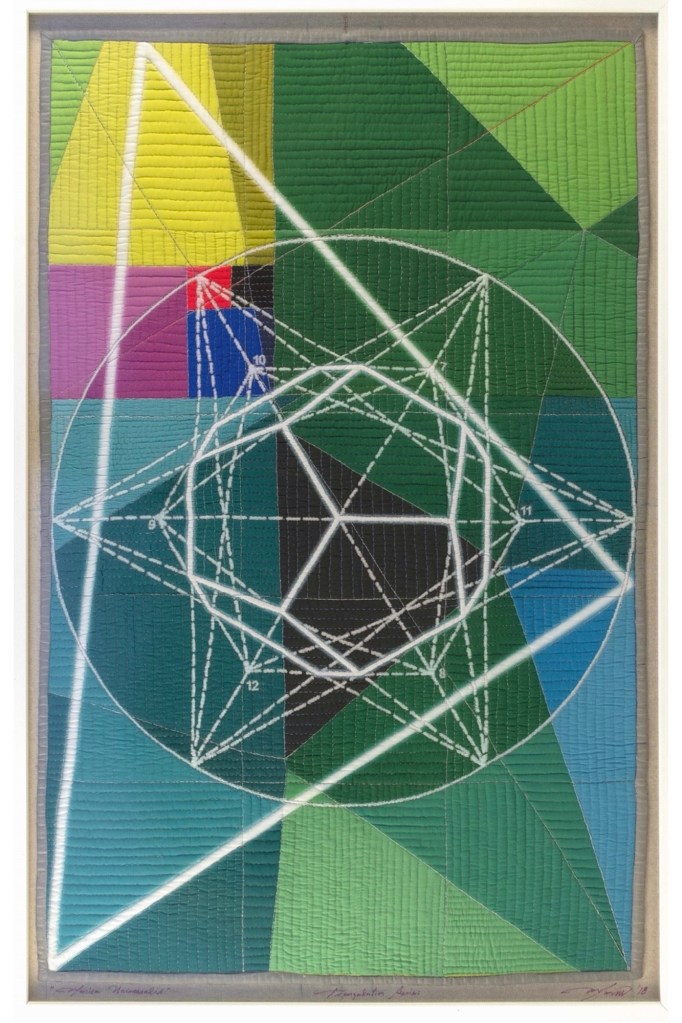
(Triangulation Series)
Musica Universalis
Silk quilt streched over linen
37″ x 60″
2013-18

A geometrical construction of a dodecahedron within a Fibonacci composition, reinforced by a right-angle triangle: A meditation on the harmony of the universe, where mathematics and language converge yet never fully enclose reality.


Ricardo Morin, August 20, 2025

Abstract

This essay examines the interdependence of language and mathematics as the twin pillars of knowledge, each indispensable yet incomplete without the other. While mathematics secures precision and abstraction, language renders reasoning intelligible and shareable; together they approximate, but never fully capture, a reality richer than any formulation. The discussion situates artificial intelligence as a vivid case study of this condition. Marketed at premium cost yet marked by deficiencies in coherence, AI dramatizes what happens when mathematical power is privileged over linguistic rigor. Far from replacing human thought, such systems test our capacity to impose meaning, resist vagueness, and refine ideas. By weaving philosophical reflection with contemporary critique, the essay argues that both mathematics and language must be continually cultivated if knowledge is to progress. Their partnership does not close the gap between comprehension and reality; it keeps it open, ensuring that truth remains an unending pursuit.


Language, Mathematics, and the Price of Artificial Intelligence

Every society advances by refining its tools of thought. Two stand above all others: mathematics, which distills patterns with precision, and language, which gives form and meaning to reasoning. Neither is sufficient alone. To privilege one at the expense of the other is to weaken the very architecture of knowledge.

Artificial intelligence dramatizes both their promise and their limitations. The announcement of a $200 monthly fee for access to ChatGPT-5 is revealing. Marketed as a luxury service “for those who can afford it,” it underscores the widening gap between technological privilege and cultural necessity. Those with resources can fine-tune their productivity; those without are left behind. Yet even for the well-equipped, the question persists: what exactly is being purchased?

The machine dazzles with speed and scale, but its deficiencies are equally striking. Engineers may be virtuosos of algorithms, but grammar is not their instrument. The results are too often colloquial, vague, or lacking in rigor. To extract coherence, the user must not be a passive consumer but an editor—capable of clarifying, restructuring, and imposing meaning. The paradox is unmistakable: the tool marketed as liberation demands from its operator the very discipline it cannot supply.

This paradox reflects the larger truth about knowledge itself. Mathematics and language are both indispensable and both incomplete. Mathematics achieves abstraction but leaves its results inert unless language renders them intelligible and shareable. Language conveys thought but falters without the rigor that mathematics provides. What one secures, the other interprets.

Yet both are bound by a deeper condition: reality exceeds every formulation. Our theories—whether mathematical models or linguistic descriptions—are approximations shaped by the observer. Language cannot exhaust meaning; mathematics cannot capture finality. Knowledge is never absolute: it is a negotiation with a reality richer than any model or phrase.

Artificial intelligence lays bare this condition. It can automate structure but cannot provide wisdom; it can reproduce language but cannot guarantee meaning. Its true value lies not in replacing the thinker but in testing our capacity to resist vagueness, impose coherence, and refine thought. What is marketed as freedom may, in truth, demand greater vigilance.

To dismiss language and the humanities as secondary, or to imagine mathematics and computation as sufficient unto themselves, is to misunderstand their interdependence. These disciplines are not rivals but partners, each refining the other. AI magnifies both their strengths and their deficiencies; they remind us that progress depends on the continual refinement of both—mathematics to model reality, language to preserve its meaning.

The path of knowledge remains open-ended. Language and mathematics do not close the gap between our finite comprehension and the inexhaustible richness of reality; they keep it open. They allow us to approach truth without presuming to possess it. Artificial intelligence, as every tool of thought, shows us not the end of knowledge but its unending condition: a dialogue between what can be measured, what can be spoken, and what forever exceeds us.

*


Annotated Bibliography

  • Arendt, Hannah: The Life of the Mind. Vol. 1: Thinking. New York: Harcourt, Brace, Jovanovich, 1971. (Arendt examines the act of thinking and the limits of expression, which shows how thought requires language to become shareable while never able to exhaust reality. Her work reinforces the essay’s claim that reasoning without expression cannot advance knowledge.)
  • Bender, Emily M., and Koller, Alexander: “Climbing towards NLU: On Meaning, Form, and Understanding in the Age of Data.” Proceedings of ACL, 2020. (Bender and Koller argue that large language models process form without true understanding; this highlights the gulf between mathematical pattern recognition and linguistic meaning—it supports the essay’s caution that AI dazzles with form but falters in coherence.)
  • Chomsky, Noam: Language and Mind. 3rd ed. Cambridge: Cambridge University Press, 2006. (Chomsky explores the innate structures of language and their role in shaping cognition; this affirms that language conditions the possibility of thought while it still remains limited in capturing reality.)
  • Devlin, Keith: Introduction to Mathematical Thinking. Stanford: Keith Devlin, 2012. (Devlin explains how mathematical reasoning distills structure and pattern while acknowledging abstraction as approximation; this reinforces the idea that mathematics, as a safeguard of precision, cannot exhaust the world it models.)
  • Floridi, Luciano: The Fourth Revolution: How the Infosphere Is Reshaping Human Reality. Oxford: Oxford University Press, 2014. (Floridi situates digital technologies and AI within a broader history of self-understanding, which enriches the essay’s argument that mathematics and language—extended into computation—remain approximations of a reality beyond full control.)
  • Lakoff, George, and Núñez, Rafael: Where Mathematics Comes From: How the Embodied Mind Brings Mathematics into Being. New York: Basic Books, 2000. (Lakoff and Núñez argue that mathematics arises from metaphor and embodied cognition, which reveals how dependence on human interpretation and the affirmation that mathematical theories, as linguistic ones, remain bound to the observer.)
  • Mitchell, Melanie: Artificial Intelligence: A Guide for Thinking Humans. New York: Farrar, Straus and Giroux, 2019. (Mitchell provides a critical overview of AI’s capabilities and limits; it shows how the advancement of pattern recognition does not close fundamental gaps in understanding and parallels the essay’s critique of AI’s grammatical poverty.)
  • Polanyi, Michael: Personal Knowledge: Towards a Post-Critical Philosophy. Chicago: University of Chicago Press, 1962. (Polanyi emphasizes tacit knowledge and the need for articulation in validation; it echoes the view that mathematics and language refine understanding but never achieve closure.)
  • Snow, C. P.: The Two Cultures. Cambridge: Cambridge University Press, 1993 [1959]. (Snow diagnoses the divide between sciences and humanities; this undergirds the essay’s call to treat language and mathematics as complementary pillars of understanding.)

“Platonic Scroll Series 2009”

August 6, 2009

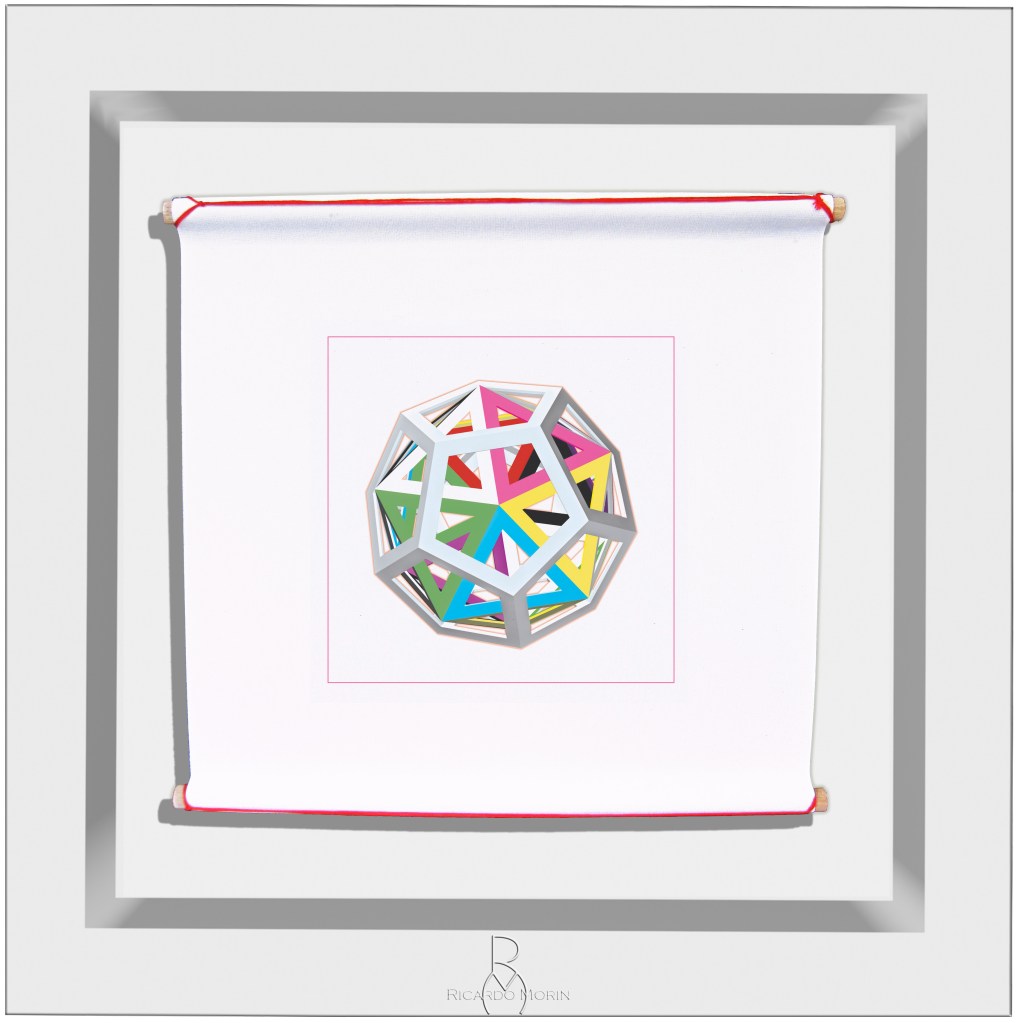
Platonic Series #99, 2009
Platonic Scrolls Series #99 — Engraving on Canvas in a Digital Frame

Ricardo F. Morin, September 9, 2009, Cape Cod, Massachusetts

The aesthetic beauty and symmetry of the Platonic Solids have made them a favorite subject of geometers for thousands of years. They are named for the ancient Greek philosopher Plato who theorized that the classical elements were constructed from five regular solids: the dodecahedron, icosahedron, octahedron, hexahedron and tetrahedron–there are no other possible regular polyhedrons. The 92 Johnson Solids are irregular polyhedrons which, as the Platonic Solids, are also made out of triangles, squares and pentagons.

The Platonic Scroll Series serve as analogy to our inter-connectivity and the imponderable quality of harmony that unify us.  It is to be noticed that there is no set manner as to how these manifestations may be perceived by any observer. Our reality is ever so much more interesting than any image representing it or anything that can be explicated.