Posts Tagged ‘censorship’

“The Politics of Erasure: Authoritarianism and Spectacle”

August 22, 2025

*


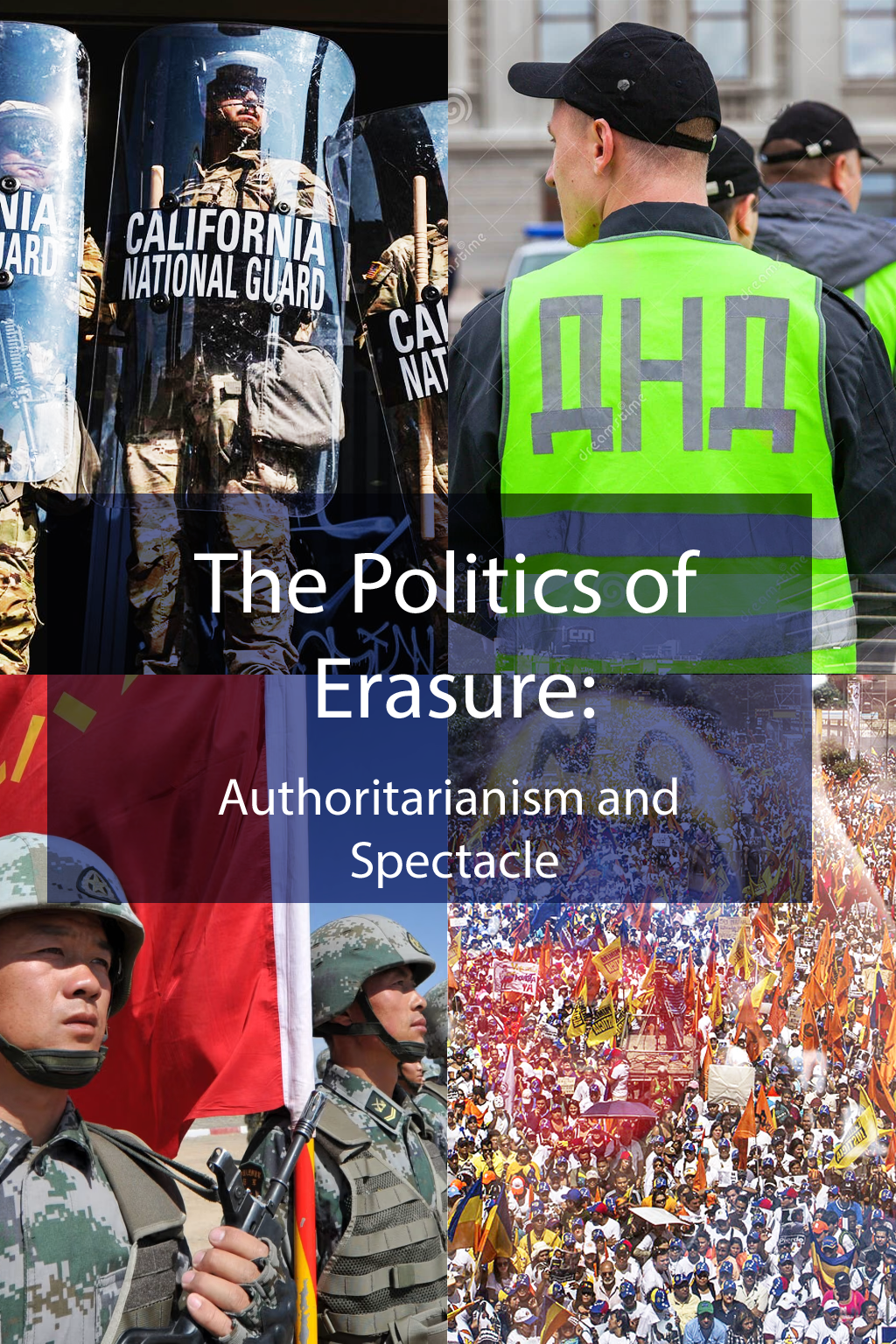
Cover design for the essay “The Politics of Erasure: Authoritarianism and Spectacle.” The composite image juxtaposes surveillance, militarization, propaganda, and mass spectacle to underscore how authoritarian regimes render lives expendable while legitimizing control through display.

By Ricardo Morín, In Transit to and from NJ, August 22, 2025

Authoritarianism in the present era does not present itself with uniform symbols. It emerges within democracies and one-party states alike, in countries with declining economies and in those boasting rapid growth. What unites these varied contexts is not the formal shape of government but the way power acts upon individuals: autonomy is curtailed, dignity denied, and dissent reclassified as threat. Control is maintained not only through coercion but also through the appropriation of universal values—peace, tolerance, harmony, security—emptied of their content and redeployed as instruments of supression. The result is a politics in which human beings are treated as expendable and spectacle serves as both distraction and justification.

In the United States, the Bill of Rights secures liberties, yet their practical force is weakened by structural inequality and concentrated control over communication. After the attacks of September 11, the USA PATRIOT Act authorized sweeping surveillance in the name of defending freedom, normalizing the monitoring of private communications (ACLU 2021). Protest movements such as the Black Lives Matter demonstrations of 2020 filled the streets, but their urgency was absorbed into the circuits of media coverage, partisan argument, and corporate monetization (New York Times 2020). What begins as protest often concludes as spectacle: filmed, replayed, and reframed until the original message is displaced by distractions. Meanwhile, the opioid epidemic, mass homelessness, and medical bankruptcy reveal how millions of lives are tolerated as expendable (CDC 2022). Their suffering is acknowledged in statistics but rarely addressed in policy, treated as collateral to an order that prizes visibility over remedy.

Venezuela offers a more direct case. The Ley contra el Odio (“Law against Hatred”), passed in 2017 by a constituent assembly lacking democratic legitimacy, was presented as a measure to protect tolerance and peace. In practice, it has been used to prosecute journalists, students, and citizens for expressions that in a democratic society would fall squarely within the realm of debate (Amnesty International 2019). More recently, the creation of the Consejo Nacional de Ciberseguridad has extended this logic to place fear and self-censorship among neighbors and colleagues (Transparencia Venezuela 2023). At the same time, deprivation functions as a tool of discipline: access to food and medicine is selectively distributed to turn scarcity into a means of control (Human Rights Watch 2021). The state’s televised rallies and plebiscites portray unity and loyalty, but the reality is a society fractured by exile, with over seven million citizens abroad and those who remain bound by necessity rather than consent (UNHCR 2023).

Russia combines repression with patriotic theater. The 2002 Law on Combating Extremist Activity and the 2012 “foreign agents” statute have systematically dismantled independent journalism and civil society (Human Rights Watch 2017), while the 2022 law against “discrediting the armed forces” criminalized even the description of war as war (BBC 2022). Citizens have been detained for carrying blank signs, which demonstrates how any act, however symbolic, can be punished if interpreted as dissent (Amnesty International 2022). The war in Ukraine has revealed the human cost of this system: conscripts drawn disproportionately from poorer regions and minority populations are sent to the frontlines, their lives consumed for national projection. At home, state television ridicules dissent as treason or foreign manipulation, while parades, commemorations, and managed elections transform coercion into duty. The official promise of security and unity is sustained not by coexistence but by the systematic silencing of plural voices, enforced equally through law, propaganda, and ritual display.

China illustrates the most technologically integrated model. The 2017 Cybersecurity Law and the 2021 Data Security Law require companies and individuals to submit to state control over digital information and extend surveillance across every layer of society (Creemers 2017; Kuo 2021). Social media platforms compel group administrators to monitor content and disperses the responsibility of conformity to citizens themselves (Freedom House 2022). At the same time, spectacle saturates the landscape: the Singles’ Day shopping festival in November generates billions in sales, broadcast as proof of prosperity and cohesion, while state media showcases technological triumphs as national achievements (Economist 2021). Entire communities, particularly in Xinjiang, are declared targets of re-education and surveillance. Mosques are closed, languages restricted, and traditions suppressed—all in the name of harmony (Amnesty International 2021). Stability is invoked, but the reality is the systematic denial of dignity: identity reduced to an administrative category, cultural life dismantled at will, and existence itself rendered conditional upon conformity to the designs of state power.

Taken together, these cases reveal a common logic. The United States commodifies dissent and normalizes abandonment as a permanent condition of public life. Venezuela uses deprivation to enforce discipline and the resulting compliance is publicly presented as loyalty to the state. Russia demands sacrifice and transforms coercion into patriotic duty. China fuses surveillance and prosperity and engineers conformity. Entire communities are suppressed in the name of harmony. The registers differ—commercial, ritualistic, militarized, digital—but the pattern is shared: dissent is stripped of legitimacy, lives are treated as expendable, and universal values are inverted to justify coercion.


References

  • ACLU: “Surveillance under the USA PATRIOT Act”. New York: American Civil Liberties Union, 2021. (This article documents how post-9/11 legislation expanded state surveillance in the United States and framed “security” as a justification for reducing privacy rights.)
  • Amnesty International: “Venezuela: Hunger for Justice. London: Amnesty International”, 2019. (Amnesty International reports on how Venezuela’s Ley contra el Odio has been used to prosecute citizens and silence dissent under the rhetoric of tolerance.)
  • Amnesty International: “Like We Were Enemies in a War: China’s Mass Internment, Torture and Persecution of Muslims in Xinjiang”. London: Amnesty International. 2021. (Amnesty International provides evidence of mass detention, surveillance, and cultural repression in Xinjiang carried out in the name of “harmony” and stability.)
  • Amnesty International: “Russia: Arrests for Anti-War Protests”. London: Amnesty International, 2022. (Amnesty International details the systematic arrest of Russian citizens, including those holding blank signs, under laws claiming to protect peace and order.)
  • BBC: “Russia Passes Law to Jail People Who Spread ‘Fake’ Information about Ukraine War.” March 4, 2022. (News coverage of Russia’s 2022 law criminalizing criticism of the war shows how “discrediting the armed forces” became a punishable offense.)
  • CDC.: “Opioid Overdose Deaths in the United States. Atlanta: Centers for Disease Control and Prevention”. 2022. (The CDC provides statistical evidence of widespread loss of life in the U.S. and underscores how entire populations are treated as expendable in public health.)
  • Creemers, Rogier: “Cybersecurity Law of the People’s Republic of China”: Translation with Annotations. Leiden University, 2017. (An authoritative translation and analysis of China’s 2017 Cybersecurity Law illustrate how digital oversight is institutionalized.)
  • UNHCR: “Refugee and Migrant Crisis in Venezuela: Regional Overview”. Geneva: United Nations High Commissioner for Refugees, 2023. (This report offers figures on the Venezuelan exodus and highlights the mass displacement caused by deprivation and repression.)
“The New Face of Old Tyranny: …

August 1, 2025

*

… The Persistence of Francoist Nostalgia and the Discomfort Beneath It”


Ricardo Morin
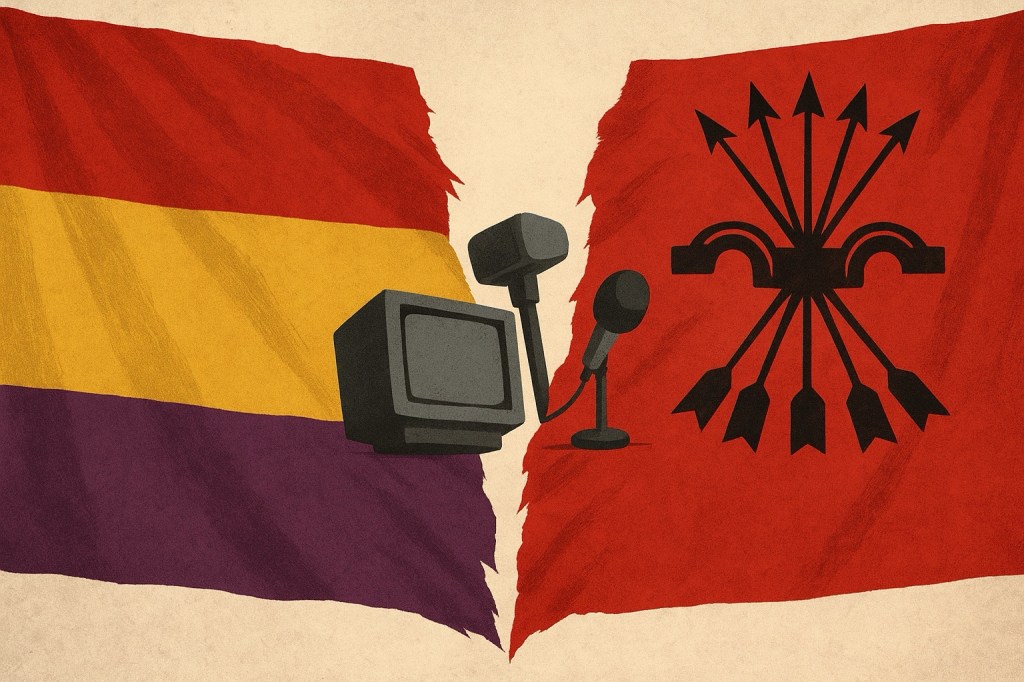
Half Republican, Half Falangist
CGI
2005

By Ricardo Morin

August 1, 2025

One cannot assess the Spanish political climate without acknowledging the rise of VOX, a far-right party founded in 2013 by former members of the conservative Partido Popular. Since 2018, VOX has gained traction by opposing regional autonomy, feminist legislation, and immigration, while defending a nationalist agenda that includes the revision—or outright rejection—of Spain’s historical reckoning with Francoism.

It is the symptom of a deeper democratic disillusionment. What resurfaces is not spontaneous historical memory, but a political and cultural framework that reasserts itself when the social agreements binding the present begin to fray. VOX’s references to the Franco regime are rarely doctrinaire or explicit, but they are unmistakable in the party’s rejection of the Democratic Memory Law, its exaltation of national unity as a sacred and untouchable principle, its condemnation of the autonomous state model, and its appeal to a so-called “natural order” that treats hierarchy, the traditional family, and social inequality as if they were objective facts of history.

What is most concerning is not that voices like these exist—they always have—but that they have regained institutional power and cultural legitimacy. Dissatisfaction with the political system, fatigue with ineffective parliamentary politics, and a growing sense of identity displacement feed into a shared national unease. This unease can be felt across a wide spectrum: small business owners who perceive the state as hostile, or young people who find no meaning in a hollow, bureaucratized political language. The grievances vary, but the far right offers a single channel: the emotional simplification of conflict—transforming fear into obedience, and uncertainty into wounded pride.

Within this framework, VOX presents itself as the only political actor with a unified narrative. Its strength does not lie in public policy, but in assertion. It offers no coherent platform of governance, but instead proposes a reactive, exclusionary identity. And here the progressive response often falters. While the institutional left—represented by the PSOE and remnants of Unidas Podemos—relies on rhetorical frames worn down by official discourse, segments of the academic and cultural intelligentsia (particularly university-affiliated think tanks and subsidized editorial circuits) have retreated into a ritualized defense of democracy, without reassessing its principles or renewing the language through which it is explained. Repeating just causes through exhausted formulas turns even the noblest ideas into noise.

Worse still, in the name of pluralism—or out of fear of being labeled sectarian—certain cultural institutions (El País, publishing houses like Taurus, or high-profile forums such as the Círculo de Bellas Artes) have offered platforms to reactionary voices under the pretext of open debate. In doing so, they have helped normalize a discourse that steadily unravels the ethical agreements underpinning democratic life. What is framed as tolerance may, in fact, be a form of structural surrender.

Spain’s history is burdened with wounds that were never fully closed. The political pacts of the Transition, born of necessity, opted for shared silence as the price of institutional stability. That silence allowed for peace, but left the past unresolved. Today, as new efforts—like the Democratic Memory Law—begin to reshape that narrative, fear returns: fear that to acknowledge historical violence might destabilize the present. VOX exploits this fear not with policy, but with symbolic refuge—offering a home to a version of Spain that feels lost.

The responsibility of the intellectual class is not to reassert inherited certainties or rehearse moral slogans. It is to sustain complexity: to resist the lure of simplification, to acknowledge the fatigue of progressive frameworks without falling into cynicism, and to offer new ways of thinking that preserve both rigor and empathy. Because while reactionary discourse gains ground through simplification, critical thought must hold its ground in nuance—even if nuance isn’t viral, even if it doesn’t win applause.

*


Annotated Bibliography

Preston, Paul: The Spanish Holocaust: Inquisition and Extermination in Twentieth-Century Spain. New York: W.W. Norton, 2012. (A comprehensive history of political and ideological violence during and after the Spanish Civil War, this work provides essential background for understanding the roots and continued appeal of Francoist narratives in Spain.)

Snyder, Timothy: On Tyranny: Twenty Lessons from the Twentieth Century. New York: Tim Duggan Books, 2017. (This compact, cautionary text distills key lessons from the collapse of democracies in 20th-century Europe and offers reflections that resonate strongly with contemporary authoritarian rhetoric.)

Stanley, Jason: How Fascism Works: The Politics of Us and Them. New York: Random House, 2018. (An incisive study of fascist techniques and psychological mechanisms, this book helps explain how divisive identity politics and historical denial function in modern ultranationalist movements.)

*


“Censorship, Caligula, and the Return of Imperial Propaganda”

July 31, 2025

*


Ricardo Morin
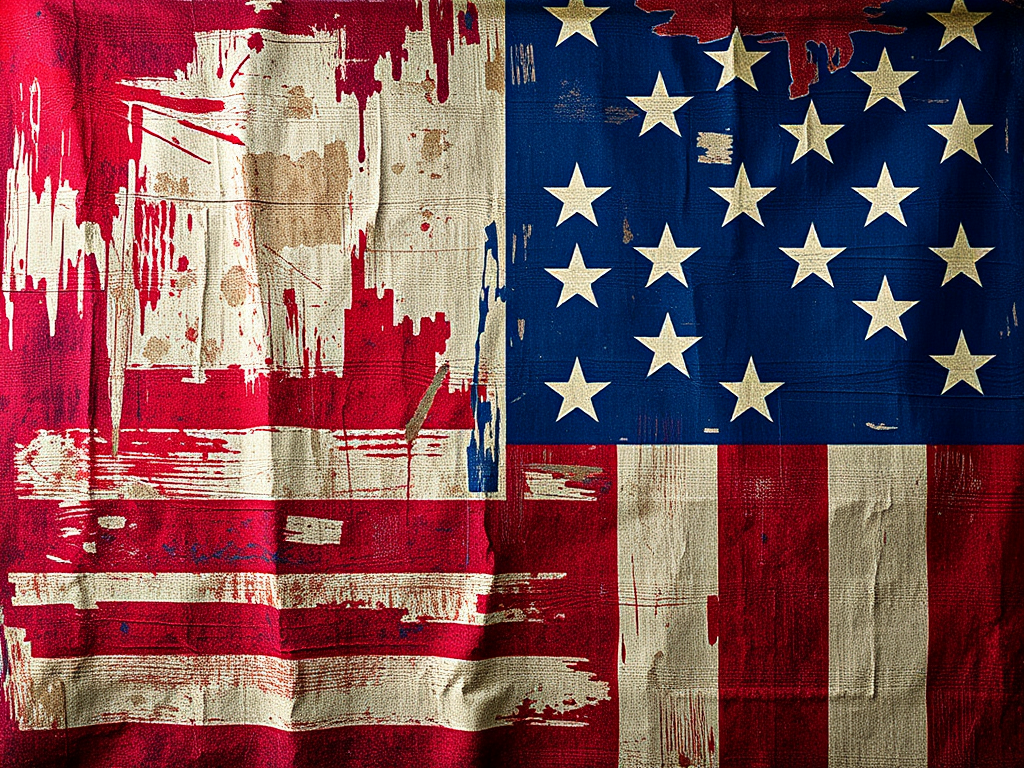
A Flag in Distress
CGI
2025


By Ricardo Morin

July 31, 2025

The recent public defense of media censorship by the current Chairman of the Federal Communications Commission—an appointee from the Trump era—marks a chilling development in the ongoing campaign to recast American institutions in the image of authoritarian grievance. Justified under the pretext of combating “invidious ideology” associated with Diversity, Equity, and Inclusion (DEI), the move signals a deeper ideological purge aimed not at restoring neutrality but at eliminating pluralism itself.

This defense of censorship, framed as a protection against ideological bias, in fact constitutes a stark betrayal of the First Amendment’s foundational commitments. Far from curbing excess, it institutionalizes a selective silencing of voices that challenge the dominant ethno-nationalist narrative increasingly embraced by Trump-aligned cultural warriors. It is not DEI that poses a threat to democratic cohesion, but rather the repressive apparatus now being assembled to discredit and dismantle it.

What is emerging is not policy, but performance—a spectacle of control designed to communicate power rather than to govern justly. In this, the parallels to the reign of Caligula are not accidental. The Roman emperor’s descent into theatrical cruelty and capricious edicts was not merely a symptom of madness but a deliberate assertion of dominance over law, decorum, and truth itself. Under Caligula, the empire was transformed into a stage upon which reality bent to the will of a singular, vindictive ego. Trumpism, in its media strategy and institutional manipulation, follows a similar logic: one that privileges loyalty over legitimacy, and spectacle over substance.

The FCC’s shift from regulatory independence to ideological enforcement exemplifies this logic. Rather than acting as a steward of public trust, the Commission is being repurposed as a gatekeeper of permissible narratives—an arbiter of who may speak and who must be silenced. The language of “protecting viewers” from divisive content serves as a smokescreen for restricting narratives that confront historical injustice, racial inequality, or structural exclusion.

If allowed to continue, such measures risk hollowing out the very idea of a democratic media ecosystem. In its place would emerge a curated domain of sanctioned speech, curated not for truth or civic health, but for the comfort of those in power. The result would not be national unity, but enforced conformity masquerading as patriotism.

This is not a return to law and order; it is a return to imperial whim. The question now is whether American institutions will continue to serve as instruments of democratic accountability, or whether they will become, like the Senate under Caligula, ornamental backdrops to a regime that no longer pretends to tolerate dissent.

*