Posts Tagged ‘spectacle’

“The Politics of Erasure: Authoritarianism and Spectacle”

August 22, 2025

*


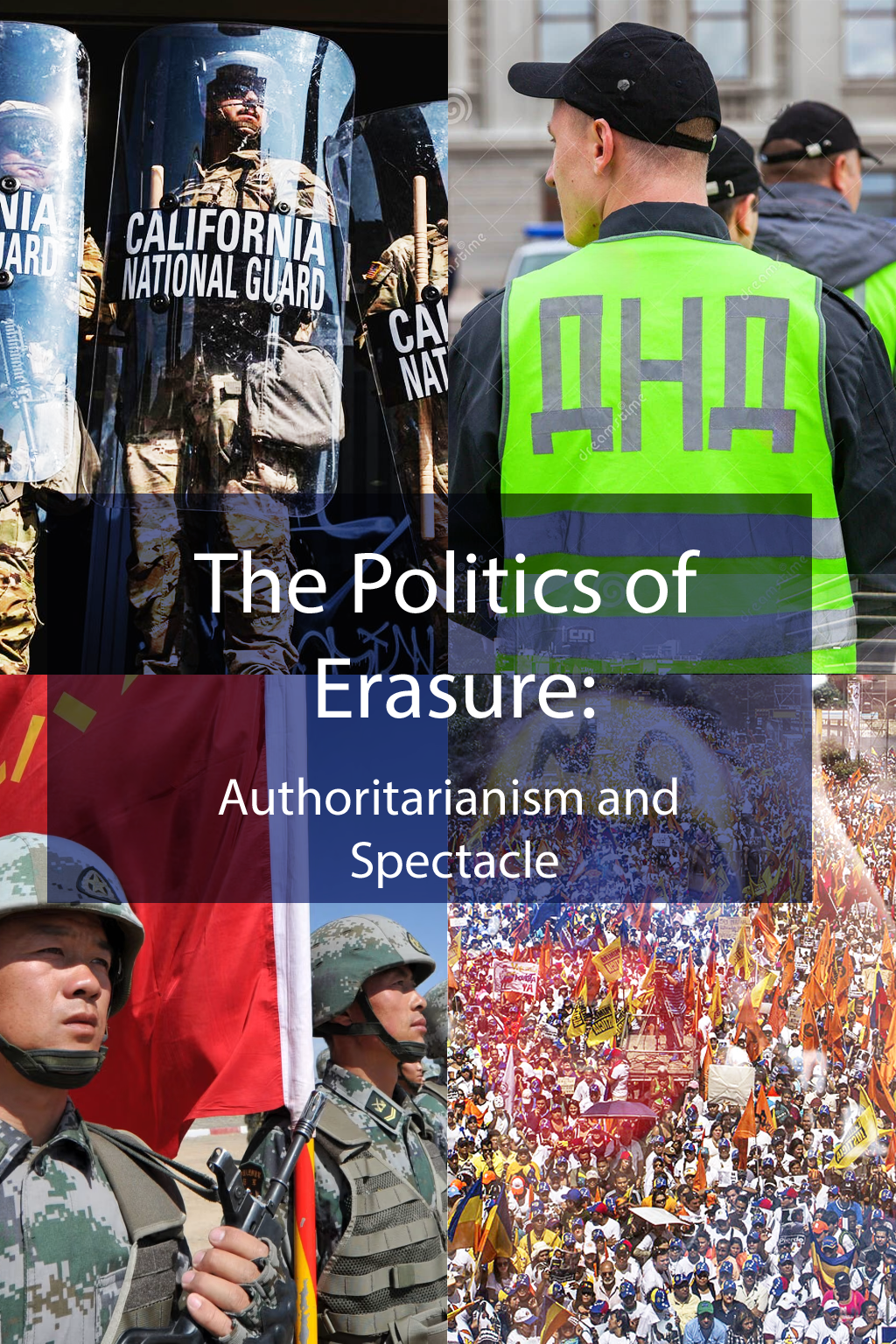
Cover design for the essay “The Politics of Erasure: Authoritarianism and Spectacle.” The composite image juxtaposes surveillance, militarization, propaganda, and mass spectacle to underscore how authoritarian regimes render lives expendable while legitimizing control through display.

By Ricardo Morín, In Transit to and from NJ, August 22, 2025

Authoritarianism in the present era does not present itself with uniform symbols. It emerges within democracies and one-party states alike, in countries with declining economies and in those boasting rapid growth. What unites these varied contexts is not the formal shape of government but the way power acts upon individuals: autonomy is curtailed, dignity denied, and dissent reclassified as threat. Control is maintained not only through coercion but also through the appropriation of universal values—peace, tolerance, harmony, security—emptied of their content and redeployed as instruments of supression. The result is a politics in which human beings are treated as expendable and spectacle serves as both distraction and justification.

In the United States, the Bill of Rights secures liberties, yet their practical force is weakened by structural inequality and concentrated control over communication. After the attacks of September 11, the USA PATRIOT Act authorized sweeping surveillance in the name of defending freedom, normalizing the monitoring of private communications (ACLU 2021). Protest movements such as the Black Lives Matter demonstrations of 2020 filled the streets, but their urgency was absorbed into the circuits of media coverage, partisan argument, and corporate monetization (New York Times 2020). What begins as protest often concludes as spectacle: filmed, replayed, and reframed until the original message is displaced by distractions. Meanwhile, the opioid epidemic, mass homelessness, and medical bankruptcy reveal how millions of lives are tolerated as expendable (CDC 2022). Their suffering is acknowledged in statistics but rarely addressed in policy, treated as collateral to an order that prizes visibility over remedy.

Venezuela offers a more direct case. The Ley contra el Odio (“Law against Hatred”), passed in 2017 by a constituent assembly lacking democratic legitimacy, was presented as a measure to protect tolerance and peace. In practice, it has been used to prosecute journalists, students, and citizens for expressions that in a democratic society would fall squarely within the realm of debate (Amnesty International 2019). More recently, the creation of the Consejo Nacional de Ciberseguridad has extended this logic to place fear and self-censorship among neighbors and colleagues (Transparencia Venezuela 2023). At the same time, deprivation functions as a tool of discipline: access to food and medicine is selectively distributed to turn scarcity into a means of control (Human Rights Watch 2021). The state’s televised rallies and plebiscites portray unity and loyalty, but the reality is a society fractured by exile, with over seven million citizens abroad and those who remain bound by necessity rather than consent (UNHCR 2023).

Russia combines repression with patriotic theater. The 2002 Law on Combating Extremist Activity and the 2012 “foreign agents” statute have systematically dismantled independent journalism and civil society (Human Rights Watch 2017), while the 2022 law against “discrediting the armed forces” criminalized even the description of war as war (BBC 2022). Citizens have been detained for carrying blank signs, which demonstrates how any act, however symbolic, can be punished if interpreted as dissent (Amnesty International 2022). The war in Ukraine has revealed the human cost of this system: conscripts drawn disproportionately from poorer regions and minority populations are sent to the frontlines, their lives consumed for national projection. At home, state television ridicules dissent as treason or foreign manipulation, while parades, commemorations, and managed elections transform coercion into duty. The official promise of security and unity is sustained not by coexistence but by the systematic silencing of plural voices, enforced equally through law, propaganda, and ritual display.

China illustrates the most technologically integrated model. The 2017 Cybersecurity Law and the 2021 Data Security Law require companies and individuals to submit to state control over digital information and extend surveillance across every layer of society (Creemers 2017; Kuo 2021). Social media platforms compel group administrators to monitor content and disperses the responsibility of conformity to citizens themselves (Freedom House 2022). At the same time, spectacle saturates the landscape: the Singles’ Day shopping festival in November generates billions in sales, broadcast as proof of prosperity and cohesion, while state media showcases technological triumphs as national achievements (Economist 2021). Entire communities, particularly in Xinjiang, are declared targets of re-education and surveillance. Mosques are closed, languages restricted, and traditions suppressed—all in the name of harmony (Amnesty International 2021). Stability is invoked, but the reality is the systematic denial of dignity: identity reduced to an administrative category, cultural life dismantled at will, and existence itself rendered conditional upon conformity to the designs of state power.

Taken together, these cases reveal a common logic. The United States commodifies dissent and normalizes abandonment as a permanent condition of public life. Venezuela uses deprivation to enforce discipline and the resulting compliance is publicly presented as loyalty to the state. Russia demands sacrifice and transforms coercion into patriotic duty. China fuses surveillance and prosperity and engineers conformity. Entire communities are suppressed in the name of harmony. The registers differ—commercial, ritualistic, militarized, digital—but the pattern is shared: dissent is stripped of legitimacy, lives are treated as expendable, and universal values are inverted to justify coercion.


References

  • ACLU: “Surveillance under the USA PATRIOT Act”. New York: American Civil Liberties Union, 2021. (This article documents how post-9/11 legislation expanded state surveillance in the United States and framed “security” as a justification for reducing privacy rights.)
  • Amnesty International: “Venezuela: Hunger for Justice. London: Amnesty International”, 2019. (Amnesty International reports on how Venezuela’s Ley contra el Odio has been used to prosecute citizens and silence dissent under the rhetoric of tolerance.)
  • Amnesty International: “Like We Were Enemies in a War: China’s Mass Internment, Torture and Persecution of Muslims in Xinjiang”. London: Amnesty International. 2021. (Amnesty International provides evidence of mass detention, surveillance, and cultural repression in Xinjiang carried out in the name of “harmony” and stability.)
  • Amnesty International: “Russia: Arrests for Anti-War Protests”. London: Amnesty International, 2022. (Amnesty International details the systematic arrest of Russian citizens, including those holding blank signs, under laws claiming to protect peace and order.)
  • BBC: “Russia Passes Law to Jail People Who Spread ‘Fake’ Information about Ukraine War.” March 4, 2022. (News coverage of Russia’s 2022 law criminalizing criticism of the war shows how “discrediting the armed forces” became a punishable offense.)
  • CDC.: “Opioid Overdose Deaths in the United States. Atlanta: Centers for Disease Control and Prevention”. 2022. (The CDC provides statistical evidence of widespread loss of life in the U.S. and underscores how entire populations are treated as expendable in public health.)
  • Creemers, Rogier: “Cybersecurity Law of the People’s Republic of China”: Translation with Annotations. Leiden University, 2017. (An authoritative translation and analysis of China’s 2017 Cybersecurity Law illustrate how digital oversight is institutionalized.)
  • UNHCR: “Refugee and Migrant Crisis in Venezuela: Regional Overview”. Geneva: United Nations High Commissioner for Refugees, 2023. (This report offers figures on the Venezuelan exodus and highlights the mass displacement caused by deprivation and repression.)

“The Ritual of Belonging”

July 16, 2025

*


Prefatory Note

The image that opens this essay was taken inside the Philadelphia Masonic Temple, a structure conceived as a civic interior of symbolic order.  Along one of its grand corridors, the Latin phrase fide et fiducia:  “by faith and trust” appears inscribed in gold within patterned walls and vaulted symmetry.  

Such inscriptions are not decorative.  They compress a worldview into phrase and placement.  The words are not presented for examination.  They are encountered as part of an already arranged environment.  The setting does not argue for belief.  It organizes the conditions under which belief appears appropriate.   

In this way, the space becomes more than a container.  It becomes a guide.  It establishes rhythm, posture, and expectation.  It suggests what is to be affirmed and how that affirmation is to be expressed.   

This essay examines how such forms persist beyond architecture.  It traces how belonging is cultivated through repetition, how virtue is performed through alignment, and how the appearance of shared meaning can displace the work required to sustain it.   

*

The Ritual of Belonging

Group virtue rarely begins as doctrine.  It begins as gesture.   

A room rises when a signal is given.  A phrase is recited in unison.  A participant repeats words only partially considered, yet already familiar in cadence.  Nothing appears coercive.  Each act is small and easily justified.  Yet repetition binds them.  What is first performed becomes expected.  What is expected becomes difficult to refuse.   

Within such sequences, belonging precedes understanding.  The individual does not first examine and then join.  He joins and learns how to respond.  The distinction between loyalty and obedience does not disappear.  It is displaced as affirmation becomes easier than hesitation and faster than inquiry.   

This structure is sustained not by force, but by arrangement.  Organizations built on continuity rely on repeated forms to stabilize identity.  Meetings open with familiar phrases.  Gestures follow a fixed order.  A participant who interrupts the sequence introduces delay.  That delay is immediately visible.  The cost of interruption becomes clear, while the cost of conformity remains diffuse.  Under these conditions, agreement does not need to be imposed.  It is selected.   

Ritual serves a purpose.  It binds individuals into shared time and recognition.  Without it, no lasting association could persist.  Yet the same mechanism that sustains cohesion also limits examination.  What allows a group to hold together can also prevent it from asking what holds it.   

The transition is gradual.  A statement repeated for coordination becomes a statement repeated for reassurance.  A value once examined becomes a value that no longer requires examination.  The language remains intact.  Terms such as duty, service, and honor continue to circulate.  What changes is their relation to experience.  They are no longer tested in use.  They are confirmed in repetition.   

At that point, belief no longer depends on recognition.  It depends on alignment.  

This pattern appears wherever the need for coherence exceeds the tolerance for uncertainty.  In contemporary political life, it has taken a visible form in the rise of Trumpism.  Large gatherings provide a clear sequence.  A phrase is introduced from a stage.  It is repeated immediately and without alteration.  Repetition does not test the phrase.  It confirms participation.  A participant who withholds repetition marks himself at once, not through argument, but through absence.   

Here, belonging is demonstrated through response.   

The mechanism does not depend on content.  It depends on sequence:  signal, repetition, confirmation, exclusion.  What matters is not what is said, but how quickly it is taken up and how visibly it is shared.  Under these conditions, language shifts function.  It ceases to describe and begins to designate.  A person or group is named as a threat, an invasion, a corruption.  Once designated, no further description is required.  The designation organizes perception in advance.   

The same sequence extends into digital systems.  Language produced under conditions of speed, reward, and amplification becomes the material from which models are trained.  Systems developed by entities such as OpenAI and Google do not originate these patterns.  They inherit them.  When the material on which they are trained is saturated with repetition, assertion, and emotional charge, the resulting systems reproduce those patterns with increasing fluency.  The output appears coherent because it reflects what has already circulated.   

In this feedback loop, expression is reinforced independently of verification.   

The machine does not introduce distortion.  It stabilizes what is already present and returns it in a more consistent form.  

Under these conditions, identity is offered as resolution.  The individual is placed within a narrative that assigns meaning and opposition in advance.  Agreement produces recognition.  Hesitation produces distance.  Applause becomes a measurable signal.  Silence becomes a visible deviation.  The individual no longer asks whether a claim corresponds to experience.  He registers whether it corresponds to the group.   

Few of these changes are noticed while they occur.  A statement that aligns with expectation is processed quickly.  A statement that interrupts expectation requires time.  Repetition produces familiarity.  Familiarity produces confidence.  Confidence is then taken as evidence.   

This is not reducible to ignorance.  It reflects a contraction in the willingness to remain uncertain.  In many environments, to hesitate is to risk separation.  To question is to delay the sequence.  Under these conditions, the space in which judgment might form is reduced before it can be exercised.  

A sequence can be traced.  A phrase is repeated without examination.  A participant receives approval.  Another hesitates and is met with silence.  The hesitation is registered.  The next participant repeats the phrase without pause.  The sequence continues.  No rule has been stated.  No command has been issued.  Yet a boundary has been established.  Over time, the boundary holds.   

From such sequences, larger structures are assembled.  Control does not begin as an external imposition.  It emerges through the accumulation of ordinary acts that favor affirmation and discourage interruption.  Each act remains defensible in isolation.  Together, they produce a condition in which deviation carries a cost that affirmation does not.  

For this reason, authoritarian forms can resemble their opposites.  They borrow the language of continuity, the symbols of tradition, and the forms of collective pride.  What distinguishes them is not their appearance, but the narrowing of permissible response.  When only one form of affirmation remains viable, participation is no longer voluntary in substance, even if it appears voluntary in form.   

Resistance cannot proceed by substitution.  To replace one set of repeated phrases with another is to preserve the sequence.  The interruption must occur before repetition.  A phrase must be examined before it is spoken.  A gesture must be understood before it is performed.  This introduces delay.  Delay introduces friction.  Friction restores the conditions under which judgment can take place.   

Such interruption carries a cost.  It separates the individual from the immediate rewards of alignment.  It exposes him to uncertainty without the assurance of agreement.  Yet without this interruption, no distinction between belief and performance can be sustained.   

No system organized around reflex can withstand sustained attention.  Its continuity depends on the speed with which responses are produced and confirmed.  When that speed is reduced, the sequence becomes visible.  When the sequence becomes visible, it can no longer proceed without recognition.   

Clarity does not arrive as declaration.  It appears when repetition no longer satisfies, when approval no longer substitutes for recognition, and when the individual distinguishes between what is said and what is seen.  At that point, belonging does not disappear.  It changes condition.  It no longer precedes understanding.  It follows it.

*