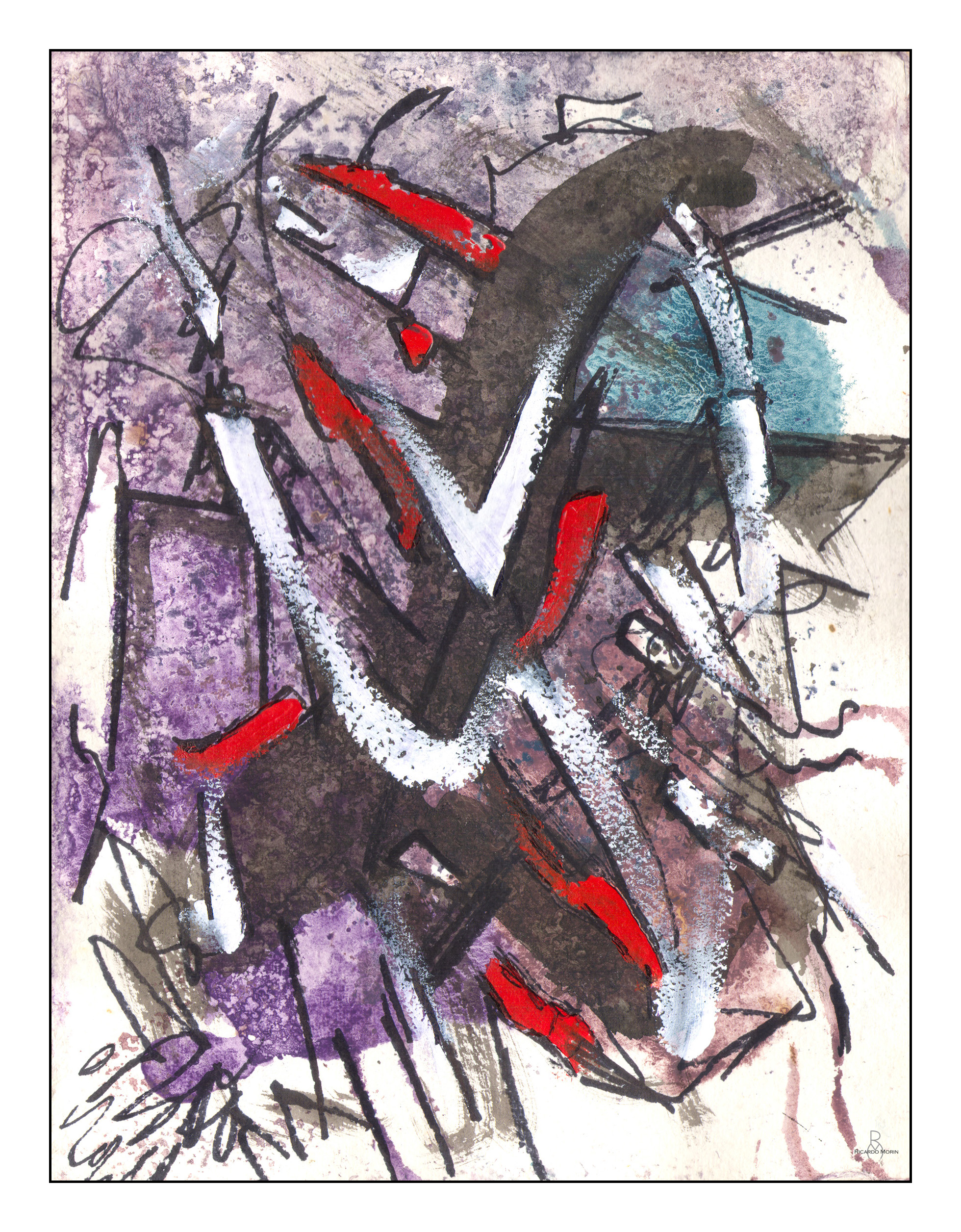
The Grammar of Punishment
10″x12″
Watercolor
2003
Ricardo F. Morín
November 2025
Bala Cynwyd, Pa
Billy Bussell Thompson, Editor
Author’s Note:
Societies respond to harm in two fundamentally distinct modes of action. One unfolds through the slow, cumulative patterns of behavior and belief that shape collective life; the other through the deliberate, codified interventions undertaken by institutions in the name of order. The Grammar of Conflict and The Grammar of Punishment are companion essays, each devoted to one of these modes of action. The Grammar of Conflict traces how hatred, victimhood, hypocrisy, tribalism, and violence intertwine into a self-perpetuating system—one that is sustained through repeated explanation at every turn and is endured not through necessity, but through the stories societies choose to tell. The Grammar of Punishment concerns the authority of the State, viz. a formal, structured exercise of power that imposes consequences within boundaries defined by lawful interpretation. The Grammar of Conflict traces how civic and political antagonism becomes habitual and self-justifying. The Grammar of Punishment addresses cases in which the State that exceeds its limits can turn injustice into a system of unreasoned laws. Taken together, the two essays offer complementary perspectives on the forces that perpetuate harm and on the deliberate choices that may interrupt its recurrence.
Abstract:
The Grammar of Punishment addresses the consequences a society imposes for wrongdoing and how the consequences shape the political order and the moral landscape. The essay treats punishment as a limited civic instrument and punishment as an entrenched practice. It describes conditions under which the same punitive act can either uphold shared rules or weaken these rules when the scope and purpose of the punishment exceed the original moral and civic justification for imposing them. The drift beyond that justification often occurs because punishment extends beyond accountability: when punishment becomes a vehicle for revenge, a demonstration of power, and a means of perpetuating the authority or moral narratives that allow it to continue long after the original violation has been addressed. This essay does not oppose punishment; it addresses conditions under which punishment displaces justice. At a time when punitive measures increasingly shape political discourse and public policy, understanding the internal logic of punishment is essential to preserving the boundary between justice and power.
The essay will trace how punishment evolves from a measured response to a specific wrongdoing into a self-perpetuating system of governing. It will show how institutions originally created to restore justice will come to assert authority, to sustain narratives of legitimacy, and to conceal the principles they were established to defend. The analysis will identify the conditions under which punishment remains credible (when the exercise of punitive authority is bounded by reason, procedure, scope, proportionality, time, and review) and the points at which punishment ceases to protect social order and begins instead to perpetuate harm. The essay, however, will neither dictate specific policies nor condemn the use of policies. Its purpose will be to clarify the roles attributed to punishment, the points at which those roles break down, and how continued reliance on punitive measures discloses deeper social choices about authority, responsibility, and the impulse to respond to injury—choices that reveal as much about a society’s values as about its fears.
1
Punishment is a public act that imposes a cost in response to a breach of law or shared norm. Punishment marks a boundary, declares a rule, and demonstrates its enforcement. This definition distinguishes punishment from prevention, restraint, accountability, and repair. Prevention concerns events that have not yet occurred. Restraint limits the capacity of an individual or group to cause harm. Accountability establishes facts and assigns responsibility. Repair addresses loss and attempts to restore what has been taken away. Punishment differs from these responses because punishment addresses a specific violation after the fact and imposes a consequence.
2
Any serious assessment of punishment must answer three questions: What is the purpose of punishment? To whom is punishment directed? And, what is the outcome of punishment? The first question concerns a reasoned intent as opposed to a vague one. The second question concerns the target and scope of the punitive act. The third question concerns its manifestation as opposed to the original intention of punishment. A punishment that claims deterrence yet produces recurrence, or resists compliance, errs not in degree but in comprehension of punishment as a tool. By ignoring cause, the application of punishment can mistake reaction for resolution and enact justice without insight—a cycle that corrects nothing because it understands nothing.
3
Four primary purposes of punishment are commonly recognized: boundary-setting, deterrence, incapacitation, and recognition. Boundary-setting defines the limits of acceptable behavior and affirms that rules retain meaning only when their violation entails consequence; those limits must be defined with clarity. Deterrence seeks to prevent future harm by making the cost of wrongdoing visible and measurable. Incapacitation protects society by restricting the offender’s ability to inflict further injury. Recognition satisfies the moral need to acknowledge that a wrong has occurred and that the community has responded to it. These aims are conceptually clear, yet their success depends on interpretation and application—each revealing whether the pursuit of order remains faithful to the idea of justice.
4
A penalty first intended to correct a specific wrongdoing can, over time, be turned by institutions into an instrument of government. This transformation begins when authorities broaden the reach of the penalty, apply it repeatedly as a mechanical demonstration, and treat its continuation as proof of the authority of the institutions and the legitimacy of the system. What begins as a targeted reaction applied to a specific violation is repeated, extended, and maintained beyond its original scope. Over time, the expectation of punitive action acquires a life of its own, and support for punishment becomes a marker of allegiance to the prevailing order. Actions that once aimed to correct behavior evolve into assertions of dominance, and dissent is recast as disloyalty. As this process deepens, penalties grow harsher, the circle of responsibility expands, and temporal limits dissolve. Punishment, once applied to resolve conflict, is continued under conditions that reproduce the same conflict. When a punitive measure must be repeated indefinitely merely to prove that a rule still holds, the measure is no longer reinforcing the rule; the measure itself becomes the rule. When punishment is applied habitually, its function changes—no longer of law but of power. Habit grants power a moral vocabulary that disguises its interest as principle.
When law borrows the tone of justice itself, punishment is presented as restoration.
5
Once power begins to speak in the place of law, the line between what is and is not permitted may remain obscure, but the penalty for transgression is certain. Such obscurity transforms the law from a boundary of understanding into a field of intimidation. Power gains elasticity by refusing clarity; it rewards those who conform and isolates those who interpret too freely. In this inversion, the rule of law survives only in form but its grammar—definition, proportion, and foreseeability—has been erased.
6
Legitimacy is the foundation on which punishment stands. Without legitimacy, punishment no longer functions as justice and becomes an imposition of unchecked power—an exercise of power without lawful foundation. Legitimacy demands definition; tyranny thrives on ambiguity. For punishment to be legitimate, the rules it enforces must be established in advance, written in language that the public can understand, and open to examination and review through lawful procedures. To write rules in advance is to bind power to reason; it makes punishment a civic act—foreseeable, accountable, and shared—rather than the decision of whoever holds command. When these conditions are met, punishment serves a civic purpose, reinforces the rule of law, and secures its own legitimacy instead of weakening it.
7
Time limits are essential safeguards that prevent punishment from becoming a permanent condition. A consequence without a defined endpoint ceases to address a specific violation and becomes a permanent structure of power. When the duration of punishment is not limited by purpose, punishment no longer serves the law, but replaces it. This principle applies both within societies and among them: a sanction imposed on an individual, a community, or a State follows the same moral and structural logic. In foreign relations, punitive measures such as sanctions or embargoes function as instruments of discipline between States, and they risk the same transformation—from response to domination—when no path toward resolution is defined. The possibility of restoration—whether through legal standing, political recognition, or the end of hostilities—is not an act of leniency but a precondition for stability. Without a defined point of closure, the punished party has no reason to change course, and opposition becomes the only rational response. Durable orders, civic or international, therefore require an exit from punishment if they are to secure lasting peace.
8
Deterrence is often described as the most rational purpose of punishment, yet its logic frequently is invoked under conditions that include other motives. Under vague statutes, however, deterrence no longer warns; it confuses. Political authorities often invoke deterrence to justify harsher measures and claim that fear of consequence will prevent future harm. But fear imposes compliance without addressing underlying conditions that give rise to transgression. A punitive policy designed to frighten rather than to understand or correct those conditions becomes less an instrument of prevention and more a mechanism for asserting control. It teaches not respect for the rule of law but submission to power. When deterrence functions in this way, it ceases to serve justice and instead sustains the very instability it claims to prevent.
9
Uncertainty is an inherent condition of every system of punishment. Facts are often incomplete, motives are mixed, and consequences can rarely be predicted with precision. When the absence of reason is institutionalized under the pretext of uncertainty, the temptation arises to punish not for actions already committed but for those merely expected. Measures such as preventive detention or deportation are imposed not on verified conduct but on assumptions about future behavior. These actions, though defended as safeguards against possible harm, risk turning suspicion into verdict. This form of preemptive punishment blurs the distinction between justice and prevention, replacing evidence with prediction. As the reach of punishment extends beyond proven acts into the realm of conjecture, the obligation to justify its use must grow correspondingly heavier.
10
There are cases in which punishment is not only justified but necessary. Certain violations—treason, systemic corruption, sustained violence—break the foundation of shared order. Ignoring violations signals that common rules no longer carry consequence; this breakdown in enforcement creates the conditions for further harm. In such circumstances, punishment functions as an act of preservation: it re-establishes lawful boundaries and affirms that no person or group stands above the rules that govern collective life. Yet the legitimacy of this response depends on proportion and restraint. When punishment becomes the automatic answer to every offense, it ceases to serve justice and instead entrenches a culture of retribution. Punishment fulfills its purpose only when it is applied after reasoned explanation, fair procedure, and tangible repair have failed to resolve the violation; under those conditions, punishment restores the boundaries of order without extending harm beyond necessity.
11
Mercy functions as a limiting condition within systems of punishment rather than as a negation of justice. Where legal systems retain mechanisms for clemency, review, or proportional adjustment, punishment remains bounded by its original civic purpose. Systems that apply punishment without the possibility of mitigation or termination treat duration as authority and convert consequence into permanence. Under such conditions, punishment ceases to respond to a specific violation and instead establishes an enduring relation of domination.
The availability of mercy alters the operation of punishment by introducing temporal and proportional limits. These limits prevent punitive authority from extending beyond the circumstances that justified its initial application. When legal procedure excludes such limits, enforcement persists independently of the conduct that prompted it, and legality is reduced to repetition rather than judgment. Under such circumstance, punishment is administered as a continuous practice rather than as a reasoned response.
Systems that incorporate mercy preserve a distinction between law and command by allowing punishment to conclude once its stated purpose has been met. Where that distinction is maintained, punishment remains an instrument within the law rather than a substitute for it. Where it is not maintained, punishment operates without reference to restoration, and civic membership is replaced by continued exposure to sanction.
12
These principles are not abstractions but safeguards that keep the exercise of power subject to the law. When institutions apply punishment within those limits, the law retains its credibility because the consequences remain connected to reason. When institutions exceed those limits, punishment replaces the law as the source of authority, and conflict grows within the space that reason has abandoned. Under such circumstance, punishment no longer resolves the doing of wrong; it reproduces it. Justice survives only when the law speaks with a clarity that power cannot rewrite.


 Observations On Perception