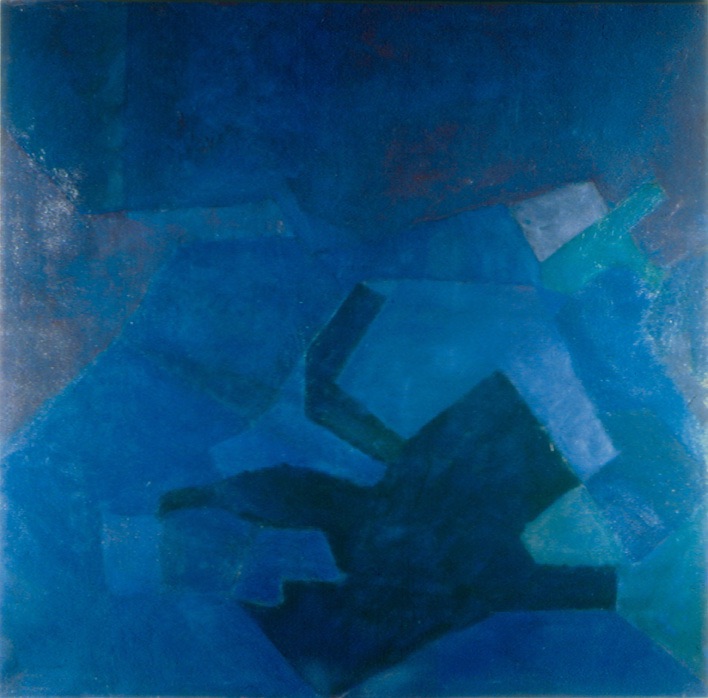
Buffalo Series, Nº 2
48″ x 48″
Oil on canvas
1978
At a town hall, one participant says, “They just don’t share our values.” Another replies at once, “That’s freedom of speech.” No one asks who “they” refers to. No one asks which values are meant. The discussion shifts. The reply becomes the center of the discussion.
A participant to the left says, “He can say it.” Across the table, another answers, “He shouldn’t say it.” A third repeats, “It’s freedom of speech.” No one restates the sentence in full. No one asks the speaker to name the values or to identify who is included in “they.” The words that gave rise to the discussion no longer guide it.
Someone tries to return to the sentence. “What do you mean by ‘they’?” The speaker does not answer. Another voice cuts in: “That’s freedom of speech.” The question does not hold. The discussion resumes from the reply.
Then one participant restates the earlier sentence: “They just don’t share our values.” Another replies: “That’s freedom of speech.” For a moment, the sentence and the reply are held together. No one determines whether the reply addresses what is said. No one asks whether the claim can be examined. The moment passes.
From that point on, each response addresses only that same reply. One insists on the right to speak. Another rejects the defense. No one asks the speaker to define “our values.” No one tests the claim that “they” do not share them. The sentence no longer directs the discussion. Those referred to as “they” are not named. They are set apart without being identified. The sentence rejects them without stating who they are.
The phrase is used to defend the speaker and to reject its use as justification. It does not return to the sentence. It allows each participant to take a position without clarifying what was said. Expression itself is treated as evidence of allegiance rather than as an invitation to examination.
At the end, the sentence remains unresolved: it is not examined, it is not sustained, it is not withdrawn. It is left behind. The rejection holds. The phrase remains in use, and the discussion continues from it.
Ricardo F. Morín
April 2026
In transit