
Posts Tagged ‘recognition’

“The Measure of Self”

March 28, 2026

Ascension-2
CGI 2005

by Ricardo F. Morín

March 12, 2036

Kissimmee, Florida

*

Young people grow up hearing a language of promise.  School principals, teachers, and commencement speakers present the civic language of freedom, equal worth, and opportunity in classrooms, school assemblies, and commencement ceremonies.  Young people enter life expecting that dignity belongs to them not by achievement but by right.

The world in which adolescents grow up reveals another measure of value.  Universities select applicants.  Employers choose candidates.  Newspapers, screens, and social media present visible distinction as a standard of value.  In this environment value becomes linked less to the fact of being alive than to results obtained: grades, admission, income, recognition.  Public language affirms equal dignity and opportunity, while everyday life rewards distinction.

The consequences of this tension in adolescence cannot be reduced to a single cause.  Yet the statistics describing adolescent suicide provide an observable point from which to examine the pressures affecting young lives.  In the United States, suicide ranks among the leading causes of death for those between fifteen and nineteen years of age.  Thousands of adolescents take their own lives each year.  Similar figures appear in other countries whose laws and public speech affirm freedom and dignity.  These figures do not reveal the thoughts of any single adolescent, yet they show that many young people reach a point at which life appears closed to them.

Each suicide carries its own history.  Parents search for reasons in school pressure, humiliation, loneliness, or despair that no one recognized in time.  Physicians prescribe medicine.  Counselors offer guidance.  These efforts help some adolescents and fail to reach others.  The continued rise of these deaths directs attention to the world in which adolescents grow up.

From early childhood many students learn that recognition follows visible success.  Teachers and schools praise the highest scores and celebrate the strongest performers.  Young people watch classmates receive awards and admission letters while others receive neither.  Under such conditions adolescents begin to measure their own lives against the success of others.

The acquisitive and ostentatious character of contemporary life becomes visible on screens, in the media, and across social networks.  In them, mastery and social status predominate.  Young people learn to present themselves as exceptional before they come to know themselves, and they learn not only to observe these images but also to reproduce them.  The surrounding culture celebrates achievement while leaving little room for hesitation or failure, even though both belong to the passage into adulthood.

Failure forms part of learning, and discovery begins with uncertainty.  That understanding arises from repeated observation across history and from the process of discovery itself.  Within that process, error is gradually set aside until what is intelligible and comprehensible comes into view.  Yet the surrounding environment continues to place visible honor on success.  The young therefore encounter two messages at once: encouragement to endure failure and a public display that celebrates achievement.

Within this environment the work of forming human relations grows difficult.  Friendships break.  Intimate relations begin with uncertainty.  Sexual experience rarely matches the images that circulate in public view.  These difficulties belong to the slow formation of adult life.  Yet the contrast between public images of fulfillment and the experience of life can lead some adolescents to judge themselves as failures.

The judgment of value does not remain external.  It becomes shame.  Shame seeks concealment.  An adolescent who carries shame may continue to appear among friends, classmates, and family while inwardly withdrawing.  Recognition promises to confirm value, yet it awakens a need for worth that cannot be founded by recognition itself.  Beneath that shame lies another absence: the absence of self-love.  Without some measure of regard for one’s own existence, recognition from others becomes the only source of worth, and failure becomes a verdict upon the self.

Family expectations may deepen this burden.  Parents often transmit hopes formed by their own experience.  They may believe that success will protect their children from the difficulties they themselves encountered.  When the achievements of the young appear to confirm the sacrifices or aspirations of earlier generations, the pressure can grow heavier than a simple wish for well-being.

Communication surrounds young people with images and activity.  An adolescent may sit among many signals and still face distress alone.  Social encounters become occasions for display rather than opportunities for trust to form through time. The adolescent appears present in social life while carrying a sense of emptiness.  When the language of dignity no longer corresponds to the experience of life, the public words themselves begin to lose their meaning.

Adolescence does not create this condition; adolescence reveals it.  Many adults live under the same pressure to prove worth through success and recognition.  Work, family, and routine allow life to continue, yet the sense of insufficiency does not always disappear.  Some carry it for decades.  Adolescents encounter the condition before such supports take hold.  Some confront it before they possess the strength required to bear it.

This condition does not belong to the present alone.  Records from earlier centuries describe the same despair, the same shame, and the same act of self-destruction among the young.  The forms surrounding life have changed across time.  Religious authority once imposed its judgments.  Family honor and inherited status placed other burdens on the young.  Human vulnerability has remained constant even as the surrounding environment has changed.

The question does not lie in whether despair among the young is new.  The question lies in how the conditions of the present shape that vulnerability within a society that speaks often of dignity and opportunity yet still produces circumstances in which some young people come to believe that life offers no place for them.

A society may create conditions that intensify despair, shame, and pressure.  Those conditions deserve examination and criticism.  Yet the act of ending one’s life cannot be assigned to others in the same way that those conditions can be examined collectively.

Over time many people come to recognize a difficult distinction:  to feel another person’s pain deeply is not the same as bearing responsibility for their choice.  One may carry empathy, grief, and even a lingering sense of connection to that suffering without having been the agent of the act itself.

When deaths accumulate in this way, observers turn to specialized language in search of explanation.  Academic terms attempt to describe the problem through categories and theories.  Such language may organize discussion, yet the words themselves do not remove the fact that thousands of adolescents take their own lives each year.  The numbers remain visible without the help of technical vocabulary.

*
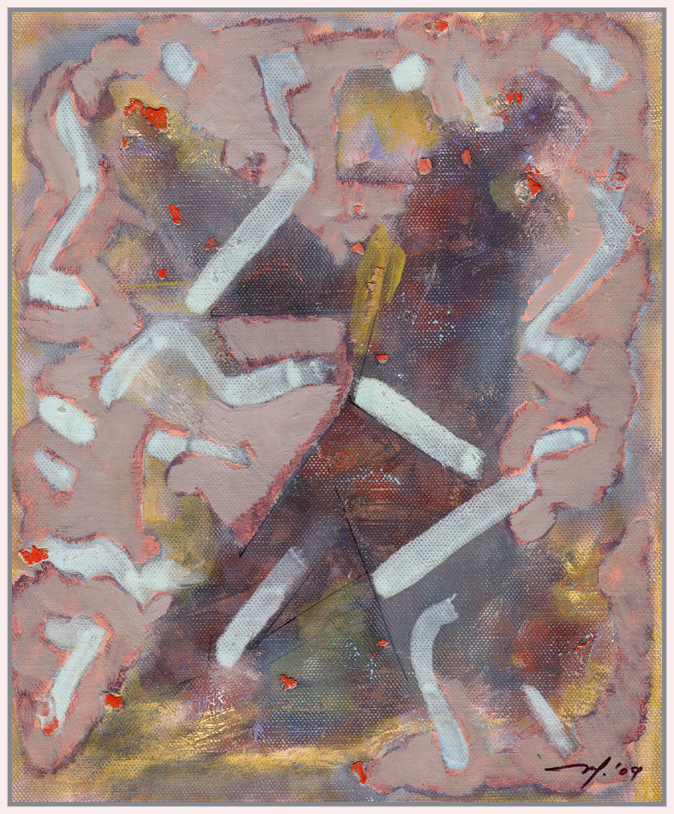

“Admitting and Denying Otherness in Religious and Democratic Life”

March 1, 2026
Ricardo F. Morín
Infinity 32
13 “ x 15 ¾”
Oil on linen
2009

Ricardo F. Morín

February 16, 2026

Oakland Park, Fl.

Religious belief and democratic life often meet within diverse societies where traditions, rituals, and outward identities differ, even as individuals share deeper ethical concerns.  People turn to religion for meaning and conscience, while democratic life asks them to live alongside others whose practices and expressions vary.  Tension becomes visible when superficial distinctions shape perception more than shared ethical ground, and when claims of moral authority seek to govern the shared civic space of others.

Plurality is a constant feature of democratic life.  Individuals speak, listen, and respond in public meetings, civic gatherings, online exchanges, and everyday encounters where limits and freedom of expression meet.  Expression that invites response, allows disagreement, or makes room for reconsideration can sustain coexistence, while expression framed as accusation, exclusion, or moral finality can narrow it.  Political life adjusts to shifting advantage and immediate circumstance, while religious conscience often draws individuals toward standards held to endure across conflicts.  Individuals move between these two demands, rarely able to resolve the tension between them.  Religious and political judgment can align while remaining open to disagreement, even as individuals draw from moral frameworks that shape their conduct and traditions.

Religious expression often appears in public life through appeals to fairness, responsibility, and the dignity of persons.  Such expressions shape how individuals frame their claims without requiring agreement on doctrine.  When religious language enters public conversation as part of a shared ethical vocabulary, it can widen recognition without demanding uniform belief.  People may not agree on belief, yet they may recognize common ground in the use of moral language.  At times, religious communities identify ethical similarities across traditions, allowing plurality to remain workable within that recognition.  When partisan pressures reframe difference as threat, markers such as creed, race, or culture become dividing lines, and shared ground recedes from view.

Difficulty emerges when religious identity becomes inseparable from partisan alignment and when public language becomes structured around accusation rather than mutual examination of ideas.  Under such conditions, freedom of expression is interpreted less as civic difference and more as personal rejection.  Expression itself is treated as evidence of allegiance rather than as an invitation to examination.

Another condition appears when citizens continue to recognize one another as legitimate participants despite differences that remain unresolved.  Religious conviction shapes conscience, while democratic life maintains a space in which competing claims can exist without coercion.  Individuals move between these spheres, sometimes comfortably and sometimes with strain, as they adjust boundaries, widen or narrow participation, and renegotiate coexistence over time.

People continue to move between religious conviction and democratic participation without resolving the tension between them.  Some draw boundaries more firmly; others widen the space for coexistence, and many shift between both over time.  The tension remains visible not as a problem to eliminate, but as part of how individuals understand themselves, claim authority, and live alongside others within a shared civic world.


“Lines That Divide”

March 1, 2026
Ricardo Morin
Silence III
22’ x 30” 
Watercolor, graphite, gesso, acrylic on paper 
2010

Ricardo F. Morín

February 15, 2026

Oakland Park, Fl

  • Rethinking Identity and Entitlement in Civic Life


The phrase “my people” draws lines.  It signals allegiance before argument begins.  It may express familiarity, shared memory, or recognition.  Yet the same words separate one group from another.  A boundary forms, often without intention.  Those inside feel affirmed; those outside may feel unseen.

Such moments rarely begin as acts of exclusion.  They arise from ordinary human impulses:  the desire to protect what feels familiar, to defend what has been wounded, or to claim space where one has felt overlooked.  But when identity becomes the primary language through which claims are made, conversations change.  Disagreement becomes personal.  Listening becomes strategic.  The space where people meet as equals contracts.

Group identity has long provided people with strength and protection.  It helps individuals recover dignity when they feel ignored or misunderstood, and it offers language through which shared experiences can be recognized.  Yet the same force can also narrow perception.  When group identity becomes the main lens through which people judge one another, ideas are weighed less on their merit and more on the speaker’s affiliation.

When ideas begin to be judged primarily through identity rather than merit, the change is often subtle.  An exchange that begins openly can become defensive as participants look for signs of alignment or opposition.  Words are weighed for allegiance.  Questions are interpreted as challenges rather than invitations to examine ideas together.  Over time, dialogue shifts from exploration toward defense of positions. Judgment shifts from the merit of an idea to the standing of the speaker.

Many people carry an expectation into public life that they will be treated consistently.  Uneven rules are recognized quickly.  When identity determines whose voice counts before ideas are heard, trust weakens not only among those excluded, but also among those unsure whether they are seen as individuals or as representatives of a category.

Problems deepen when identity stops being one part of a person’s experience and begins to overshadow all others.  Public debate narrows.  Arguments are interpreted as attacks on identity rather than disagreements over ideas.  People feel compelled to defend positions not because they are persuaded by them, but because reconsidering publicly may be treated as betrayal.  The result is not stronger community, but increasing rigidity, where listening carries risk and reconsideration feels unsafe.

People turn toward simplification and absolutism to reduce uncertainty and relieve the strain of complexity.  This tendency does not permanently define human interaction; it marks moments when ambiguity feels intolerable and certainty appears easier to sustain.  Certainty offers relief, but it reduces the space in which plurality can endure.  The tension itself does not disappear; only the way people attempt to manage it changes.

Contemporary communication technologies accelerate the circulation and visibility of opinion.  Expressions that promise certainty or provoke fear travel farther and faster; expressions that sustain ambiguity move more slowly.  This circulation amplifies tendencies toward simplification, reinforcing what attracts attention rather than what withstands examination.

When identity becomes the basis for deciding who others are before dialogue takes shape, examination gives way to labeling.  Nuance is set aside.  Individuals become symbols of larger struggles, and ordinary encounters carry the weight of broader conflicts.  Under these conditions, disagreement resembles confrontation even when intentions remain sincere.

Public life rests on an expectation that the same rules apply to all.  Uneven application becomes visible when some voices are heard more readily than others or when identity determines credibility before ideas are considered.  Under these conditions, conversation shifts from exchange toward competition for recognition, and the possibility of shared judgment becomes more difficult to sustain.

The tension does not belong to one group alone; this situation affects everyone who participates in public life.  Each person seeks recognition while fearing misinterpretation.  Attempts to resolve disagreement through persuasion alone often reach limits beyond individual control.  Listening, under these conditions, does not erase distance but allows interaction to continue despite it.

Differences remain, and disagreement persists.  The lines that divide do not disappear; they shift, harden, or soften as people respond to one another in ordinary encounters.  Living together does not remove tension; living together reveals tension.  No shared answer resolves the matter.  Each person must decide how to respond and how to live alongside others within limits no one fully controls.