Posts Tagged ‘spectacle’

“The Politics of Erasure: Authoritarianism and Spectacle”

August 22, 2025

*


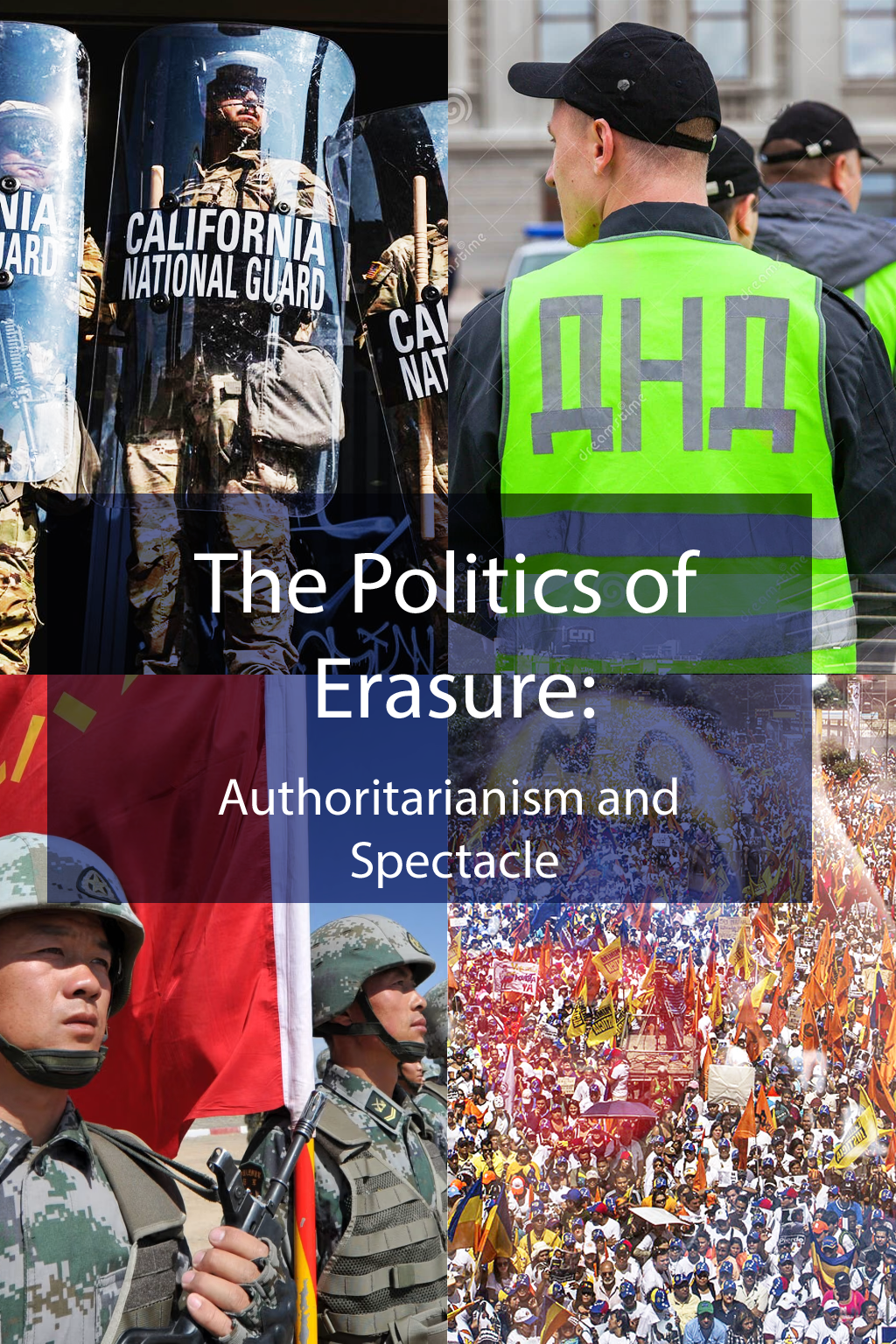
Cover design for the essay “The Politics of Erasure: Authoritarianism and Spectacle.” The composite image juxtaposes surveillance, militarization, propaganda, and mass spectacle to underscore how authoritarian regimes render lives expendable while legitimizing control through display.

By Ricardo Morín, In Transit to and from NJ, August 22, 2025

Authoritarianism in the present era does not present itself with uniform symbols. It emerges within democracies and one-party states alike, in countries with declining economies and in those boasting rapid growth. What unites these varied contexts is not the formal shape of government but the way power acts upon individuals: autonomy is curtailed, dignity denied, and dissent reclassified as threat. Control is maintained not only through coercion but also through the appropriation of universal values—peace, tolerance, harmony, security—emptied of their content and redeployed as instruments of supression. The result is a politics in which human beings are treated as expendable and spectacle serves as both distraction and justification.

In the United States, the Bill of Rights secures liberties, yet their practical force is weakened by structural inequality and concentrated control over communication. After the attacks of September 11, the USA PATRIOT Act authorized sweeping surveillance in the name of defending freedom, normalizing the monitoring of private communications (ACLU 2021). Protest movements such as the Black Lives Matter demonstrations of 2020 filled the streets, but their urgency was absorbed into the circuits of media coverage, partisan argument, and corporate monetization (New York Times 2020). What begins as protest often concludes as spectacle: filmed, replayed, and reframed until the original message is displaced by distractions. Meanwhile, the opioid epidemic, mass homelessness, and medical bankruptcy reveal how millions of lives are tolerated as expendable (CDC 2022). Their suffering is acknowledged in statistics but rarely addressed in policy, treated as collateral to an order that prizes visibility over remedy.

Venezuela offers a more direct case. The Ley contra el Odio (“Law against Hatred”), passed in 2017 by a constituent assembly lacking democratic legitimacy, was presented as a measure to protect tolerance and peace. In practice, it has been used to prosecute journalists, students, and citizens for expressions that in a democratic society would fall squarely within the realm of debate (Amnesty International 2019). More recently, the creation of the Consejo Nacional de Ciberseguridad has extended this logic to place fear and self-censorship among neighbors and colleagues (Transparencia Venezuela 2023). At the same time, deprivation functions as a tool of discipline: access to food and medicine is selectively distributed to turn scarcity into a means of control (Human Rights Watch 2021). The state’s televised rallies and plebiscites portray unity and loyalty, but the reality is a society fractured by exile, with over seven million citizens abroad and those who remain bound by necessity rather than consent (UNHCR 2023).

Russia combines repression with patriotic theater. The 2002 Law on Combating Extremist Activity and the 2012 “foreign agents” statute have systematically dismantled independent journalism and civil society (Human Rights Watch 2017), while the 2022 law against “discrediting the armed forces” criminalized even the description of war as war (BBC 2022). Citizens have been detained for carrying blank signs, which demonstrates how any act, however symbolic, can be punished if interpreted as dissent (Amnesty International 2022). The war in Ukraine has revealed the human cost of this system: conscripts drawn disproportionately from poorer regions and minority populations are sent to the frontlines, their lives consumed for national projection. At home, state television ridicules dissent as treason or foreign manipulation, while parades, commemorations, and managed elections transform coercion into duty. The official promise of security and unity is sustained not by coexistence but by the systematic silencing of plural voices, enforced equally through law, propaganda, and ritual display.

China illustrates the most technologically integrated model. The 2017 Cybersecurity Law and the 2021 Data Security Law require companies and individuals to submit to state control over digital information and extend surveillance across every layer of society (Creemers 2017; Kuo 2021). Social media platforms compel group administrators to monitor content and disperses the responsibility of conformity to citizens themselves (Freedom House 2022). At the same time, spectacle saturates the landscape: the Singles’ Day shopping festival in November generates billions in sales, broadcast as proof of prosperity and cohesion, while state media showcases technological triumphs as national achievements (Economist 2021). Entire communities, particularly in Xinjiang, are declared targets of re-education and surveillance. Mosques are closed, languages restricted, and traditions suppressed—all in the name of harmony (Amnesty International 2021). Stability is invoked, but the reality is the systematic denial of dignity: identity reduced to an administrative category, cultural life dismantled at will, and existence itself rendered conditional upon conformity to the designs of state power.

Taken together, these cases reveal a common logic. The United States commodifies dissent and normalizes abandonment as a permanent condition of public life. Venezuela uses deprivation to enforce discipline and the resulting compliance is publicly presented as loyalty to the state. Russia demands sacrifice and transforms coercion into patriotic duty. China fuses surveillance and prosperity and engineers conformity. Entire communities are suppressed in the name of harmony. The registers differ—commercial, ritualistic, militarized, digital—but the pattern is shared: dissent is stripped of legitimacy, lives are treated as expendable, and universal values are inverted to justify coercion.


References

  • ACLU: “Surveillance under the USA PATRIOT Act”. New York: American Civil Liberties Union, 2021. (This article documents how post-9/11 legislation expanded state surveillance in the United States and framed “security” as a justification for reducing privacy rights.)
  • Amnesty International: “Venezuela: Hunger for Justice. London: Amnesty International”, 2019. (Amnesty International reports on how Venezuela’s Ley contra el Odio has been used to prosecute citizens and silence dissent under the rhetoric of tolerance.)
  • Amnesty International: “Like We Were Enemies in a War: China’s Mass Internment, Torture and Persecution of Muslims in Xinjiang”. London: Amnesty International. 2021. (Amnesty International provides evidence of mass detention, surveillance, and cultural repression in Xinjiang carried out in the name of “harmony” and stability.)
  • Amnesty International: “Russia: Arrests for Anti-War Protests”. London: Amnesty International, 2022. (Amnesty International details the systematic arrest of Russian citizens, including those holding blank signs, under laws claiming to protect peace and order.)
  • BBC: “Russia Passes Law to Jail People Who Spread ‘Fake’ Information about Ukraine War.” March 4, 2022. (News coverage of Russia’s 2022 law criminalizing criticism of the war shows how “discrediting the armed forces” became a punishable offense.)
  • CDC.: “Opioid Overdose Deaths in the United States. Atlanta: Centers for Disease Control and Prevention”. 2022. (The CDC provides statistical evidence of widespread loss of life in the U.S. and underscores how entire populations are treated as expendable in public health.)
  • Creemers, Rogier: “Cybersecurity Law of the People’s Republic of China”: Translation with Annotations. Leiden University, 2017. (An authoritative translation and analysis of China’s 2017 Cybersecurity Law illustrate how digital oversight is institutionalized.)
  • UNHCR: “Refugee and Migrant Crisis in Venezuela: Regional Overview”. Geneva: United Nations High Commissioner for Refugees, 2023. (This report offers figures on the Venezuelan exodus and highlights the mass displacement caused by deprivation and repression.)
“The Ritual of Belonging”

July 16, 2025

*


Prefatory Note

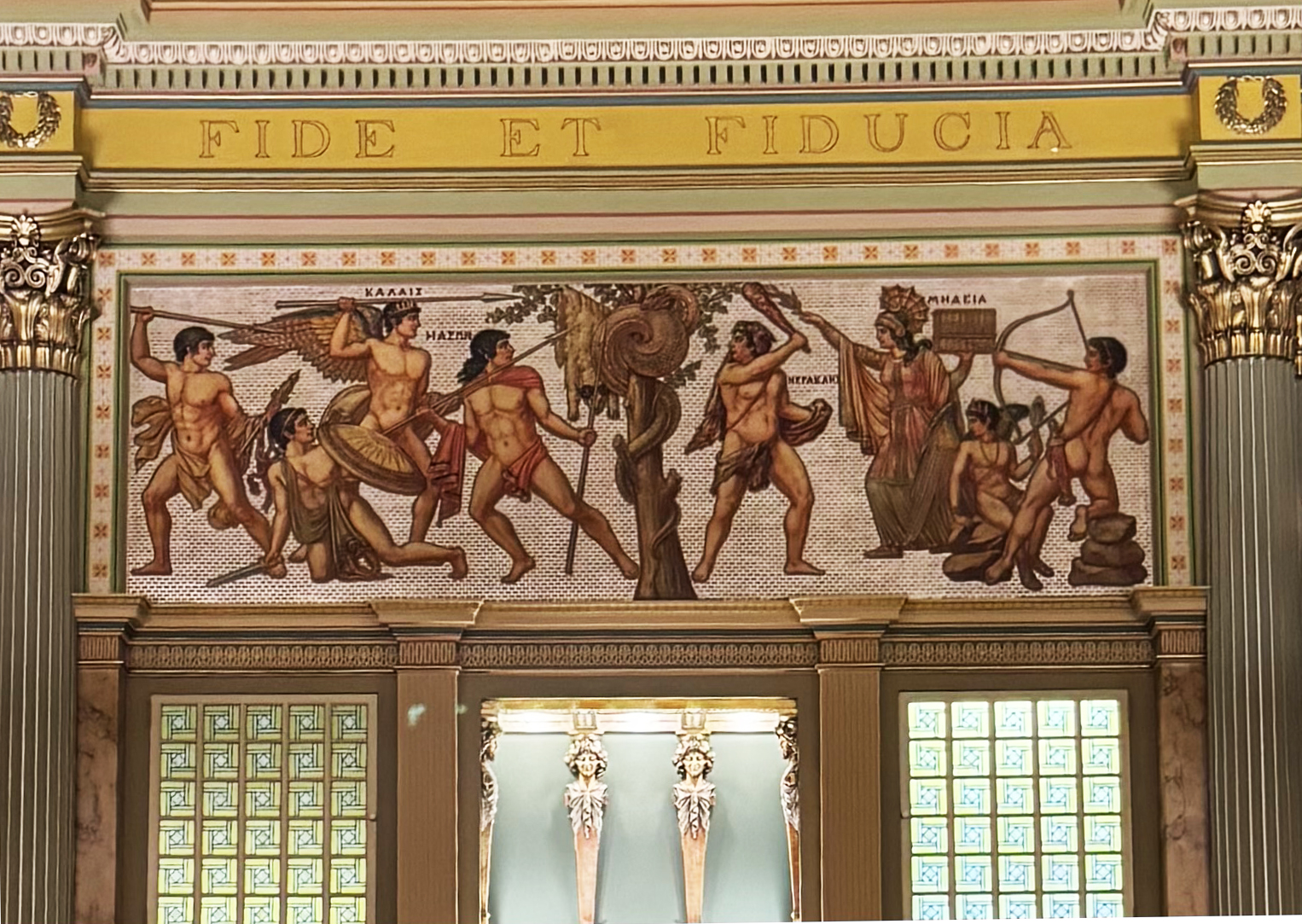
The image that opens this essay was taken inside the Masonic Temple of Philadelphia, a structure conceived by architect John Mary Gibson and interior designer George Herzog as a civic sanctum of symbolic order.   Along one of its grand corridors, the Latin phrase fide et fiducia—“by faith and trust”—appears inscribed in gold, presiding over patterned walls, vaulted symmetry, and ritual space.

Such inscriptions, embedded in the design of institutions, are not incidental.    They distill a worldview into mottos, gestures, and emblems, inviting belief without question.   In this architecture of conviction, the ideals of trust, honor, and fidelity are codified through repetition and reverence.   The physical setting becomes a moral template.

This essay explores the persistence of such forms—how belonging is cultivated through ritual, how virtue is performed through alignment, and how, in modern life, the aesthetics of tradition may obscure the labor of thought.    The photograph does not explain itself, but its symbols remain present—unmoving, persistent, and open to interpretation.

*

The Ritual of Belonging

Group virtue often operates without scrutiny.    Once symbols are introduced—flags, mottos, salutes—values begin to resemble formulas:    repeatable, ceremonial, unexamined.    Belonging takes precedence over understanding.    Within such frameworks, the line between loyalty and obedience fades, and systems of moral performance begin to replace systems of moral reasoning.

The structure is familiar.    Organizations built on tradition—be they civic, fraternal, or political—adopt postures of unity and discipline, cultivating a sense of shared purpose while discouraging internal dissent.    Ceremonies do not welcome contradiction.    In many such settings, affirmation becomes a form of sublimation, and ritual a substitute for thought.

This cultural pattern predates contemporary politics.   Its persistence depends not on any one ideology, but on a readiness to exchange reflection for reassurance.    When belief is inherited through performance rather than inquiry, it becomes indistinguishable from superstition.    The language remains uplifting—duty, service, honor—but the content thins out.    Over time, what is repeated becomes what is revered, and what is revered becomes untouchable.

This imitation has become increasingly visible in the political sphere.   No more so than in the visible rise of Trumpism, which distilled belonging into spectacle and allegiance into repetition.    It weaponized affirmation, turned performance into principle, and recoded belonging as opposition.    Its slogans thrived on exclusion, its truths on applause.    But what emerged was not only a political movement—it was a ritual template:    highly transferable, affect-driven, and structurally indifferent to fact.    That template now echoes far beyond politics, seeping into how reality itself is being filtered, including through artificial intelligence.    Trained on language steeped in polarized emotion and viral certainty, AI systems are learning to mimic a world shaped by fervor, not reflection.    The same pressures that hollow out discourse in human arenas—speed, spectacle, certainty—now shape the machine’s mirror of us. In this feedback loop, the aesthetics of belief are reinforced, while the conditions for nuance erode. 

Identity is offered as redemption.    The individual is folded into a collective story with a ready-made meaning and a designated enemy.    Applause becomes evidence.    Slogans become arguments.    Conviction replaces clarity.   Political movements, once shaped by ideals, begin to mirror the emotional architecture of clubs, congregations, and lodges.

Few notice the shift while it happens.    Emotional coherence is mistaken for truth.   Dissent sounds like betrayal.   The invocation of tradition appears more trustworthy than the disruption of contradiction.   Repetition creates comfort.   Symbols produce confidence.   Under such conditions, facts are less persuasive than feelings that seem familiar.

This is not the result of ignorance alone.   It is the outcome of cultural habits that discourage ambiguity.    In many environments, uncertainty is mistaken for weakness.    Questioning is mistaken for disloyalty.    The space for moral hesitation—the place where ethical clarity might grow—is quietly removed.

Authoritarianism does not begin with violence.    It begins with ritual.    Its strength lies not in force, but in emotional choreography:    the right gesture at the right time, the practiced cadence of certainty, the reward of approval.   It borrows the tone of heritage to advance the mechanisms of control.    In its early forms, it is nearly indistinguishable from patriotism, from tradition, from pride.

Resistance, if it is to mean anything, cannot rely on counter-slogans or louder voices.   It must begin with the restoration of difficulty—with the refusal to accept that belonging is more important than understanding.    Reflection must interrupt ritual.   Doubt must interrupt repetition.   The goal is not to replace one set of unexamined beliefs with another, but to slow the machinery long enough to remember what thought feels like when it is not performed.

No movement built on emotional choreography can long withstand honest attention.   It thrives on reflex, not recognition.   And when the symbols lose their spell—when applause no longer passes for argument; then clarity, long exiled, returns—not quietly, but with the gravity of attention.

*

Ricardo F. Morin, Bala Cynwyd, Pa., July 16, 2025


Annotated Bibliography

  • Arendt, Hannah:   Eichmann in Jerusalem:    A Report on the Banality of Evil.    New York:   Viking Press, 1963.   (A foundational analysis of how ordinary people participate in systemic harm by following rules and routines without moral reflection).
  • Arendt, Hannah:   The Origins of Totalitarianism.   New York:   Harcourt, 1973.   (A sweeping historical account of the conditions that enable authoritarian regimes, with emphasis on ideological myth-making and political isolation).
  • Berger, Peter L., and Luckmann, Thomas:   The Social Construction of Reality:   A Treatise in the Sociology of Knowledge.   New York:   Anchor Books, 1967.   (Explores how collective belief systems take on the force of reality through habitual social practices and institutional reinforcement).
  • Bermeo, Nancy:   “On Democratic Backsliding”. Journal of Democracy 27 (1): 5–19, 2016.   (An analysis of how modern authoritarianism emerges gradually within democratic frameworks, often through rituals of legitimacy).
  • Brown, Wendy:   Regulating Aversion:   Tolerance in the Age of Identity and Empire.   Princeton, NJ:   Princeton University Press, 2006.   (Critiques how liberal ideals of tolerance and diversity can paradoxically serve exclusionary and imperial power structures).
  • Eco, Umberto:   “Ur-Fascism”. The New York Review of Books, June 22, 1995.   (A compact essay identifying recurring features of fascist ideology, particularly its emotional appeal and use of cultural nostalgia).
  • Elias, Norbert:   The Civilizing Process.   Oxford: Blackwell. Revised Edition, 2000.   (Traces the historical evolution of self-regulation and public behavior, revealing how ritual and hierarchy shape social norms).
  • Frankfurt, Harry G.:   On Bullshit.   Princeton:   Princeton University Press, 2005.   (A concise philosophical inquiry into the nature of insincere speech and the erosion of truth in public language).
  • Fromm, Erich:   Escape from Freedom.   New York:   Farrar & Rinehart, 1941.   (Describes the psychological mechanisms by which individuals relinquish freedom in exchange for belonging under authoritarian rule).
  • Girard, René:   Violence and the Sacred.   Baltimore: Johns Hopkins University Press, 1977.   (Examines how ritualized violence and scapegoating function as stabilizing myths in collective identity and moral systems).
  • Graeber, David:   The Utopia of Rules:   On Technology, Stupidity, and the Secret Joys of Bureaucracy.   Brooklyn, NY:   Melville House, 2015.   (A critique of how bureaucratic systems—both state and civic—sustain irrational authority through ritual and deference).
  • Hedges, Chris:   American Fascists:   The Christian Right and the War on America.   New York:   Free Press, 2007.   (Investigates how religious and civic ritual are used to normalize authoritarian tendencies in American political life).
  • Hofstadter, Richard:   The Paranoid Style in American Politics and Other Essays.   Cambridge, MA:   Harvard University Press, 1964.   (A seminal exploration of conspiratorial thinking and performative virtue in American political rhetoric.
  • Illouz, Eva:   The End of Love:   A Sociology of Negative Relations.   Oxford:   Oxford University Press, 2020.   (Analyzes how emotional life is structured by political and economic forces, with attention to how identities are manipulated by affect).
  • Milgram, Stanley:   Obedience to Authority: An Experimental View.   New York:   Harper & Row, 1974.   (Details the famous psychological experiments on obedience, showing how institutional framing can suppress ethical responsibility).
  • Orwell, George:   “Politics and the English Language”.   Horizon, April 1946.   (A classic essay on how political language obscures meaning and enables ideological deception).
  • Putnam, Robert D.:   Bowling Alone:   The Collapse and Revival of American Community.   New York:   Simon & Schuster, 2000.   (Documents the decline of civic engagement and the transformation of group belonging in American culture).
  • Scott, James C.:   Seeing Like a State:   How Certain Schemes to Improve the Human Condition Have Failed.   New Haven:   Yale University Press, 1998.   (Explores how centralized systems impose simplified models of society that disregard lived experience, often with destructive effects).
  • Sennett, Richard:   The Fall of Public Man.   New York: Knopf, 1977.   (Argues that modern life has hollowed out the space for reflective public discourse, replacing it with scripted social roles).
  • Turner, Victor:   The Ritual Process:   Structure and Anti-Structure.   Chicago:   Aldine Publishing, 1969.   (Foundational in the study of ritual, this book explores how symbolic acts create social cohesion while suppressing ambiguity).
  • Weber, Max:   The Protestant Ethic and the Spirit of Capitalism.   New York:   Scribner, 1958.   (Connects religious discipline and capitalist rationality, illuminating how ethics become institutionalized through habit and belief).
  • Weil, Simone:   The Need for Roots:   Prelude to a Declaration of Duties Toward Mankind.   New York: Harper & Row, 1952.   (A moral meditation on the need for justice, belonging, and resistance to ideological coercion).
  • Zuboff, Shoshana:   The Age of Surveillance Capitalism:   The Fight for a Human Future at the New Frontier of Power.   New York:   PublicAffairs, 2019.   (Details how digital platforms convert personal behavior into economic control, blending corporate power with rituals of personalization).

*