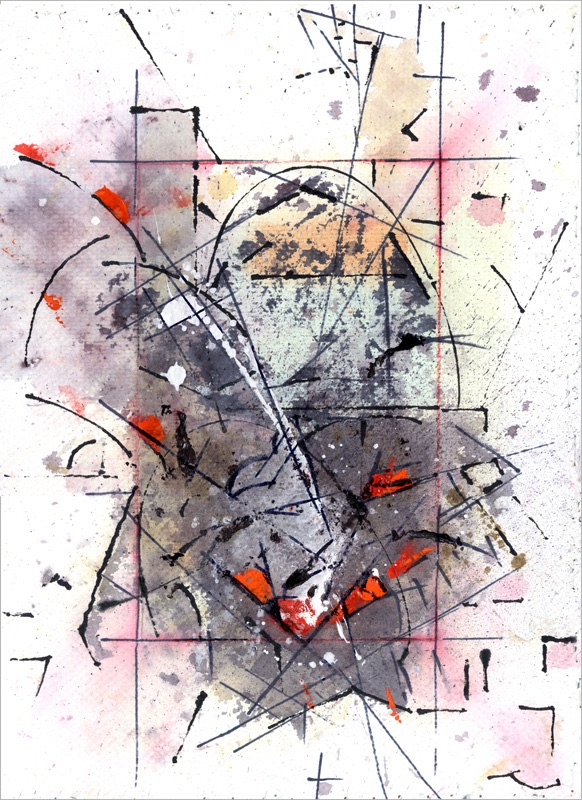
Ricardo F Morín Window I 8” x 10” Watercolor and ink on paper 2003
Ricardo F. Morín
February 18, 2026
Oakland Park, Fl
1 Most people first recognize vulnerability not through abstract reflection but when ordinary functions change. Sleep becomes fragmented. Movement requires calculation. Attention shifts toward signals that once remained unnoticed. Human life begins not from stability but from exposure. The body exists within conditions it does not fully control and must continuously adapt to forces that exceed intention. Vulnerability is not an exception. It is a structural condition of being alive. Wellbeing does not remove this condition. It reorganizes how one lives within it.
2 Attempts to explain healing often rely on simplified narratives of control, positivity, or emotional purification. Such narratives overlook the complexity through which biological systems regulate themselves. Hormones, neural pathways, immune responses, and behavioral patterns operate through feedback rather than command. The organism adjusts through interaction, not through absolute mastery. Understanding this distinction allows healing to be viewed less as conquest over illness and more as participation in an ongoing process of regulation.
3 Mental practices such as meditation, visualization, or structured breathing may influence physiological states. Their value lies not in eliminating difficulty but in altering how perception interacts with bodily response. Attention can change tension, breathing patterns can modify autonomic responses, and emotional framing can influence how stress signals are interpreted. These practices do not replace biological realities. They operate within existing physiological processes.
4 Many discussions of emotional life rely on familiar language about resentment or anger without examining how such patterns function in practice. Emotional fixation narrows perception because it reduces the range of possible interpretations available to the mind. When attention becomes rigid, the body often reflects that rigidity through muscular contraction, altered breathing, or disrupted sleep. Recognizing this does not deny legitimate grievances. It clarifies how sustained cognitive patterns shape physiological experience. What appears biologically as regulation appears conceptually as participation.
5 Healing must also acknowledge limits. Not all illness can be traced to emotional origin, and not all suffering yields explanation. Biological variability, environmental exposure, and genetic inheritance create outcomes that cannot be reduced to intention or belief. Humility recognizes that the absence of explanation neither invalidates the search for meaning nor guarantees it.
6 Contemporary medical technology introduces a further dimension into this landscape. Adaptive systems capable of measuring neural activity and adjusting stimulation in real time demonstrate that regulation is inherently dynamic. The nervous system functions through continuous feedback loops. Closed loop neuromodulation technologies reveal this principle by making adjustment visible and measurable. Rather than blocking pain entirely, such systems alter how signals are transmitted and interpreted, and allow the body to reorganize patterns that have become fixed through chronic strain.
7 Technology in this context does not replace the organism. It participates alongside it. The device measures electrical responses, modifies stimulation within clinical parameters, and supports gradual adaptation rather than immediate elimination of discomfort. This reflects a shift in how regulation is understood. Healing increasingly involves collaboration between biological systems and external adaptive tools. The boundary between internal regulation and technological assistance becomes relational rather than oppositional.
8 Because of this shift, improvement may appear indirectly. Functional changes such as more consistent sleep, increased movement, or reduced hesitation in daily tasks often emerge before subjective perception of pain changes significantly. The nervous system learns through repetition across time rather than through instant resolution. Observing patterns over days or weeks becomes more meaningful than evaluating isolated moments.
9 The language of self healing therefore requires revision. Healing does not imply independence from vulnerability. It involves learning to inhabit vulnerability with greater precision, supported by practices, relationships, and technologies that expand the range of possible responses. Faith, meditation, medical science, and personal discipline may each contribute, not as competing explanations but as complementary modes of engagement with the unknown.
10 Experience itself does not provide ultimate meaning. Meaning arises from how experience is integrated into awareness. When experience is treated as proof of certainty, rigidity follows. When experience is held as information rather than identity, adaptation remains possible. The aim is not to silence the mind or eliminate difficulty, but to allow perception to remain flexible enough to respond to change.
11 Healing, then, is neither purely psychological nor purely technological. It is the ongoing negotiation between organism and environment, perception and physiology, vulnerability and adaptation. Modern tools may refine this negotiation by providing new forms of feedback, yet the underlying condition remains unchanged. Human beings continue to live within limits while developing new ways to respond to them. The task is not to escape vulnerability but to regulate within it.
Pragmatism is often introduced as realism. It presents itself as sobriety, maturity, and an aversion to illusion. It speaks in the language of what is workable rather than what is desirable. In doing so, pragmatism claims distance from ideology while it reproduces those outcomes.
Over time, pragmatism ceases to describe a method and begins to function as a posture. It becomes a way of signaling seriousness. Principles are reframed as luxuries, and conviction is recoded as rigidity. Ethical limits are not rejected outright. They are treated as impractical.
Following resilience, pragmatism completes the turn from endurance to acceptance. Where resilience asks subjects to adapt, pragmatism asks them to agree that adaptation is reasonable. Acceptance is praised as intelligence rather than surrender. To object is to misunderstand how the world works.
As pragmatism takes hold, alternatives begin to narrow. Choices are reduced to what can be implemented immediately. The possible gives way to the manageable. What cannot be implemented within existing constraints is dismissed as irrelevant.
Pragmatism does not deny ethics. It postpones them. At the level of justification, it becomes a way of saying not now. Delay substitutes for refusal. Deferral replaces judgment. Both shift limits from decision into timing.
The consequences of this posture are unevenly distributed. Those insulated from outcomes are most often positioned to define what counts as pragmatic. Those exposed to the effects are asked to live with the decision. Pragmatism travels downward, while consequence does not travel upward.
Pragmatism governs by tone rather than by argument. It favors calm over urgency and composure over insistence. Passion is treated as disqualifying, while restraint is taken as evidence of reason. In this way, pragmatism closes debate without explicitly doing so.
What pragmatism is, then, is a method for choosing among constrained options. It is a response to limitation. It is a tool.
What pragmatism is not is an ethic. It is not a justification for abandoning limits. It is not evidence that what is available is sufficient.
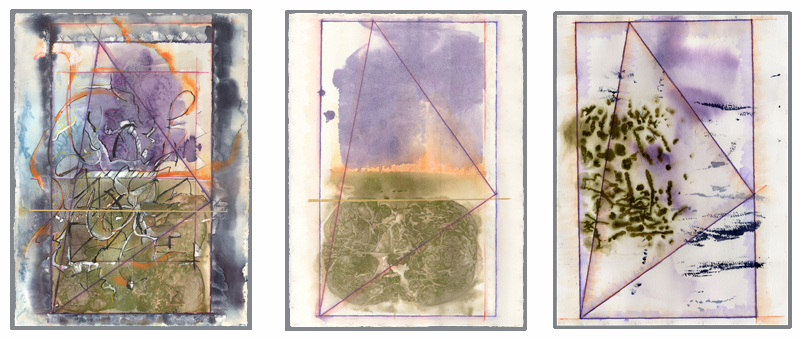
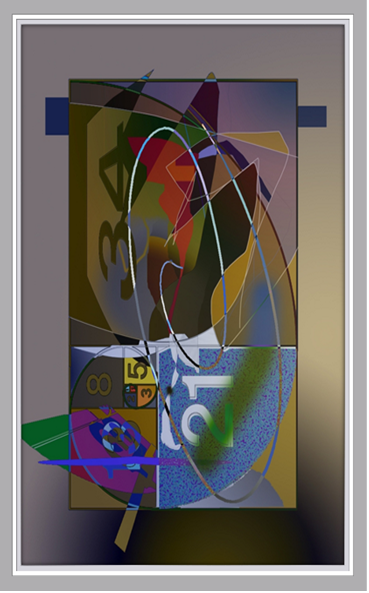
Ricardo F. Morín Golden Ratios Each 22″x30″= 66″h x 30″w overall Watercolor on paper 2005
Ricardo F. Morín
February 9, 20026
Oakland Park, Fl
Contemporary financial structures increasingly present themselves in ways that are difficult to follow in clear terms. Mechanisms grow more layered. Explanations become more technical. Yet the basic logic governing value, risk, and consequence becomes harder to see. Confidence continues to be expected even as intelligibility diminishes.
A financial system remains intelligible when certain realities stay visible. These include how value is produced, how money moves, where risk accumulates, and under what conditions failure occurs. When these elements require specialized decoding, explanation loses grounding. Language multiplies detail without reducing uncertainty. Distance replaces understanding.
Appearance and substance begin to separate. Elaborate vocabulary, institutional endorsement, and technological framing signal sophistication without necessarily clarifying outcomes. Terms such as “innovation,” “efficiency,” or “algorithmic design” circulate widely while underlying mechanisms remain indistinct. Repetition of familiar language gradually replaces demonstration. Recognition begins to replace examination.
Opacity aligns with structural incentives. Systems that are difficult to interpret shift decision-making power toward those who design, structure, or mediate them. As clarity diminishes, authority migrates toward interpretation rather than transparency. The process does not require explicit coordination. It emerges through incentives that reinforce one another. Complexity generates fees. Early positioning captures advantage. Intermediaries profit from activity regardless of long-term result. Institutions convert technical difficulty into legitimacy. Political actors attach themselves to systems framed as progress. Reducing opacity would redistribute power and reward, so opacity persists.
Regulatory structures and deregulation cycles play a central role in enabling this condition. Periods of financial liberalization encourage innovation in securitization, transferability of debt, and layered ownership structures. Oversight frameworks often lag behind new instruments. Documentation practices adapt to speed and scale instead of clarity. Legal enforceability remains intact even when transparency weakens. Over time, financial rights become separated from the original lending relationship, allowing obligations to survive in fragmented or redistributed forms.
Within this environment, financial artifacts may continue to circulate long after their original context appears settled. Mortgage debt provides a clear example. Loans may be bundled, transferred, securitized, or reassigned many times. Documentation fragments across institutions. Legal rights remain active even when practical awareness fades. In some cases, dormant liens or secondary loans re-enter enforcement through resale or reassignment. These are sometimes described as “zombie mortgages.” The mechanism itself operates within legal frameworks, yet its effects can remain largely invisible to property owners who believed obligations were resolved or inactive. As market values shift, investors may revive these claims to extract value embedded in historical contracts. Financial stability becomes vulnerable to instruments rooted in past transactions that are difficult to trace or reconstruct.
This pattern reflects a broader dynamic. Financial markets explore value through instruments that can outlive the clarity of their origin. Securitization and repeated transfer chains allow ownership and enforcement rights to separate from direct relationships between borrower and lender. When opacity governs the movement of such instruments, consequences may appear disconnected from visible cause. Security becomes contingent not only on present circumstances but also on layers of financial history that re-emerge when incentives align.
This pattern recurs across periods of financial expansion. New instruments appear. Language expands around them. Legitimacy forms before comprehension stabilizes. Technologies change. The structural rhythm remains. Explanation grows while clarity recedes.
Certain signals accompany this shift. The source of value becomes difficult to trace to tangible activity. Profit aligns more closely with expansion than with endurance. Compensation rewards timing or position rather than sustained outcome. Reputation substitutes for explanation. Risk disperses into technical language, making consequence harder to locate.
Authority increasingly rests on prestige rather than clear explanation. Definitions shift when questioned. Simplicity is treated as misunderstanding. Explanation becomes something that must be accepted rather than understood. Confidence remains even when clarity is missing.
The effects are visible. Profit gathers where control over structure exists. Those who design or manage complex financial systems capture most of the gains. Others experience the system through its consequences rather than through direct participation in its design. Extraordinary wealth accumulates among a small number of actors while financial insecurity spreads more widely. This concentration is often defended by the belief that gains at the top will eventually benefit everyone else.
Some structures are intentionally built as pyramids, relying directly on new inflows to sustain earlier gains. Others arrive at similar dynamics without explicit design. Incentives reward expansion, early positioning, and continual growth. Over time the system begins to depend on upward concentration and continued inflow to maintain stability. The result resembles pyramidal logic even when it was not formally constructed as a pyramid.
This resemblance rarely appears openly. It adopts familiar language. It presents itself through accepted financial forms, technical explanations, or narratives of innovation and progress. Repetition of these forms makes the structure appear natural. Recognition replaces scrutiny. The underlying dependence on continued expansion becomes harder to see because it looks like what has come before.
Opacity and scale reinforce this movement. As financial instruments move across institutions and markets, the connection between cause and outcome becomes harder to trace. Old obligations reappear. New risks emerge from past transactions. Gains concentrate. Losses disperse.
The gap between explanation and understanding remains. Confidence continues to be expected even when clarity is uneven. The structure continues to operate within that gap.
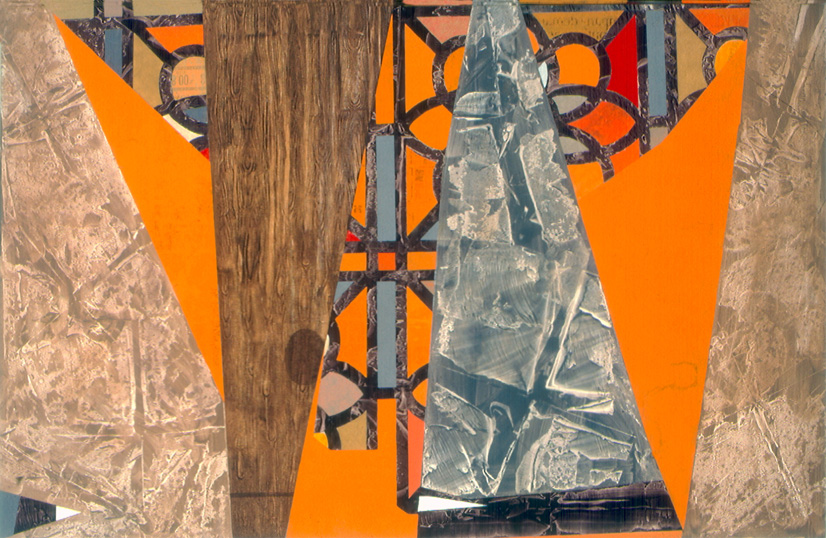
Ricardo F. Morín New York Series, Nº 11 54″ x 84″ Oil on canvas 1989
Ricardo F Morín
January 1, 2026
Oakland Park, Fl
The work began within a relationship marked by companionship and solidarity. Attention to language, discipline, and restraint developed through shared effort rather than assertion of authority. Standards were learned through proximity, conversation, and time. Whatever shape the writing later assumed did not arise in isolation; it took form within sustained exchange oriented toward craft.
For a time, that arrangement held. Growth moved in a common direction. Guidance clarified rather than constrained. Correction sharpened rather than narrowed. At that stage, there was no reason to imagine that continuation would require anything other than more work.
As the writing developed, friction appeared without a clear source. Questions emerged that did not settle easily. Revisions accumulated without resolving what they were meant to address. What had once felt like refinement began to feel like adjustment, though the difference was not immediately clear. The work continued, but with more hesitation.
Gratitude complicated recognition. What had been received was evident and could not be denied. To question the present form of the relation felt premature, even ungrateful. Endurance seemed preferable to interruption, especially while uncertainty could still be explained as part of growth.
Over time, small signs accumulated. Decisions were postponed. Directions shifted after agreement. Suggestions were acknowledged but returned unchanged. The writing slowed. Nothing dramatic occurred, but progress no longer felt proportionate to effort.
Attempts were made to restore balance. Clarifications were offered. Adjustments were accepted. The hope was that refinement of terms might recover the earlier ease of movement. Instead, the same tension reappeared, differently framed, without resolving what had prompted it.
At a certain point, the difficulty could no longer be treated as temporary. Continuing began to require forms of accommodation that altered how judgment operated while writing. Choices were made to preserve the relation rather than the work. What was being protected became harder to name.
Recognition did not arrive as certainty. It arrived as a limit. There were things the work could no longer do without distortion. There were directions it could no longer take without resistance that did not diminish over time.
Rupture followed hesitation, delay, and resistance. It did not resolve anything cleanly. It ended a form of continuity that had once been formative. What was relinquished was not gratitude, but dependence. What remained was the work itself, now proceeding without mediation.
The cost of rupture was not conflict, but exposure. Standards had to be held without reinforcement. Decisions could no longer be deferred. Failure, if it came, would no longer be shared.
Nothing in the rupture erased what had been learned. It marked the point at which learning could no longer continue in the same form. What followed was not freedom in the abstract, but authorship in the strict sense: judgment carried without shelter.
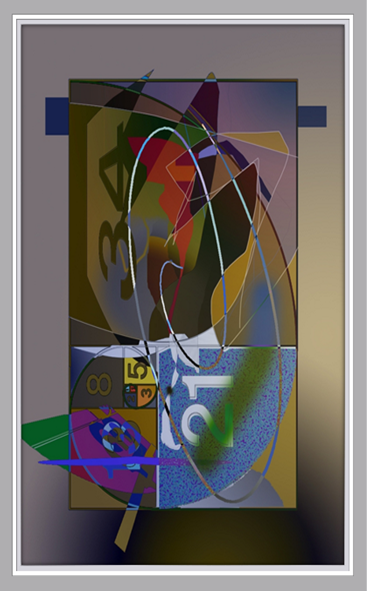
“Geometric Allegory” digital painting 2023 by Ricardo Morin (American visual artist born in Venezuela–1954)
*
Ricardo F. Morín
Oakland Park, F.
December 12, 2025
Author’s Note:
The preceding chapters established a standard by which political life may be assessed. They did not propose an ideal government as a program, nor did they advance virtue as a moral aspiration detached from circumstance. They articulated, instead, a set of constraints—justice, restraint, and judgment—without which governance loses proportion and language loses meaning.
The chapters that follow examine how those constraints were displaced. They do not proceed from intention or ideology, but from accumulation. Political resentment, once mobilized as a source of legitimacy, became a governing instrument rather than a condition to be addressed. Military authority, long embedded in Venezuela’s institutional history, ceased to function as a stabilizing force and assumed a constitutive role in political identity. Party structures, rather than mediating between society and the State, hardened into asymmetries that neutralized opposition and converted pluralism into fragmentation.
These developments did not arise in isolation, nor were they the product of a single figure or moment. They emerged through a convergence of affect, coercion, and institutional design. The disappointment examined here is not emotional in nature. It is structural: a consequence of ideals retained as symbols after their operative limits had been removed.
“Part II” traces these mechanisms in sequence. What appears is not a rupture from the ethical geometry outlined earlier, but its progressive distortion. Virtue persists in language while constraint disappears in practice. Governance continues to speak in universal terms even as power concentrates and accountability dissolves. The result is not merely authoritarianism, but a political order in which disappointment becomes systemic—produced, sustained, and normalized.
*
Chapter IX
~
The First Sign
*
On Political and Social Resentment
1
From the ashes of Venezuela’s fractured democracy arose a bitter sentiment:a resentment that reshaped the political and social fabric of the nation. Political and social resentment, born of inequality, historical grievances, and unfulfilled promises, became the primary currency of Hugo Chávez’s rhetoric and policies. This undercurrent of discontent allowed Chávez to rally the dispossessed under the banner of his Bolivarian Revolution, which reframed a nation’s despair as the foundation of his movement.
2
Chávez’s speeches evoked the memories of colonial exploitation and 20th-century corruption; they cast the elite as Venezuela’s oppressors. The enduring inequality between rural and urban areas, the oil-rich elite, and impoverished communities was central to this narrative. Through fiery oratory, Chávez positioned himself as the voice of the marginalized, promising economic justice and empowerment. [1]
3
Yet, behind the veneer of inclusion and equity lay policies that ultimately betrayed these ideals. The social programs known as Misiones, though impactful in the short term, were not sustainable. Funded by volatile oil revenues, these initiatives addressed symptoms rather than structural causes and ultimately deepened Venezuela’s dependency on oil wealth and the state’s centralized control. [2]
4
Despite their initial popularity, these policies created new inequalities. Access to state benefits became contingent on political loyalty and fostered division and mistrust among the very populations Chávez had vowed to uplift. Corruption and inefficiency plagued these programs, leaving many promises unfulfilled and further polarized Venezuelan society.
5
The Cult of Personality
*
Chávez’s charisma played a critical role in channeling resentment into political capital. His larger-than-life persona blurred the boundary between leader and nation; he transformed dissent into perceived betrayal of patriotism. This cult of personality, portraying critics as enemies of progress, allowed him to centralize power with little resistance.
6
As Chapter VI, Chronicles of Hugo Chávez, demonstrated, Chávez presented himself as the champion of the people, while his approach undermined pluralism and fostered a climate of fear and conformity. This dynamic cemented his control but weakened democratic institutions. His frequent invocation of historical grievances acted as a smokescreen for growing authoritarianism.
7
Exploiting Division
*
The Bolivarian Revolution thrived on cultural division, deliberately stoking class, racial, and regional tensions to consolidate power. Amplifying resentment and ensuring loyalty among his base, Chávez’s rhetoric of “us versus them” weaponized existing fractures in Venezuelan society. By cultivating distrust, his regime inhibited collective action across class or political lines and fractured the potential for broad-based scrutiny by a legitimate opposition.
8
This strategy also extended to the private sector. Expropriations, price controls, and the vilification of business leaders dismantled private enterprise and reinforced dependence on the State. These actions exacerbated economic decline, displaced blame onto perceived enemies of the revolution, and perpetuated cycles of resentment. [3]
9
Its Allure
*
Chávez’s manipulation of resentment was not simply a response to inequality but an exploitation of it. By harnessing historical and contemporary grievances, he galvanized a movement that promised to heal Venezuela’s wounds while simultaneously deepening its divisions. The promise of unity and progress became a pretext for authoritarianism; it left behind a legacy of mistrust, unmet expectations, and fractured institutions.[4]
10
When resentment is allowed to govern a nation, it may consume the very structures meant to protect it. Although Chávez offered hope to the disillusioned, his revolution ultimately amplified the very injustices it claimed to address.
~
Endnotes—Chapter IX
[1]Luis Vicente León,Chávez: La Revolución No Será Televisada (Caracas: Editorial Planeta, 2008) 112-127.
[2]Luis Vicente León, Misiones Sociales: Un Gobierno de Dependencia? (Caracas: Editorial Alfa, 2011) 45-59.
[3]Michael F. A. Sargeant,The Venezuelan Military Under Chávez: Political Influence and Militarization(New York: Columbia University Press, 2013) 150-165.
[4]Gustavo Coronel, Venezuela: The Collapse of a Democracy (Miami: Editorial Santillana, 2015) 203-220.
~
*
Chapter X
*
The Second Sign
~
Emblem of the Bolivarian Army.
The Solid Pillar of Power: The Military Force
1
The dynamics outlined in earlier chapters reveal how the military functioned not merely as an institution but as an axis of political identity. Military rule has shaped Venezuela’s identity since its independence in 1811—see Appendix: 19th and 20th-century Constitutions. This endurance stems not only from political necessity but from a deeply ingrained belief in military dominance—a force that has long stifled Venezuela’s progress. For nearly two centuries, from the early republic to the present, the military has been the backbone of Venezuela’s governance, shaped by a succession of caudillos—each with distinct ambitions yet bound by reliance on military authority. Long cast as the steady hand in political turbulence, the military remains a rigid scaffold encasing Venezuela’s political landscape. Chávez’s rise and his reconfiguration of military influence must be understood within this context. As his predecessors had done, Chávez sought to harness military power within a new vision of State control and to intertwine military and political authority in ways that reinforced Venezuela’s autocratic rule.
2
In the wake of independence, Venezuela grappled with instability as military leaders—at times disciplined and at times opportunistic—imposed order in a fractured State. The first decades were marked by struggles between competing factions, from the rivalry between Simón Bolívar and José Antonio Páez to later military-led conflicts, including the struggles of the Blue Federalists in the 1860s and Cipriano Castro’s rise at the turn of the 20th century. Yet, the military’s rigid hierarchy and capacity for decisive action secured its position as the nation’s dominant force. Soldiers dictated national policies and shaped Venezuela’s fate from barracks and battlefields, not from parliamentary halls. Civilian governance, fragmented and short-lived, repeatedly failed to unify the country amid ongoing strife.
3
This legacy endures in General en Jefe Vladimir Padrino López and General en Jefe Diosdado Cabello, who embody the military’s entrenched presence in Venezuela’s political structure. Padrino López, as Minister of Defense, represents the continuity of military influence within the State. His strategic alliance with Nicolás Maduro, grounded in unwavering loyalty and ideological alignment with Hugo Chávez’s Bolivarian revolution, cements his role as a linchpin of the regime’s survival. Diosdado Cabello, who straddles both military and civilian power, leverages his military background to reinforce the government’s authority. Together, they embody the enduring fusion of discipline, ambition, and coercive power.
4
Vladimir Padrino López is widely regarded as a highly disciplined and pragmatic individual. He combines the traits of a loyal military officer with the political acumen necessary to navigate Venezuela’s volatile political landscape. He presents himself as a defender of institutional order and frequently emphasizes the military’s role as a stabilizing force in Venezuela. However, beneath this outward professionalism lies a figure integral to the Maduro regime’s political survival. Padrino López’s loyalty to Maduro has been central to the regime’s endurance. His calculated diplomacy, unlike the confrontational style of other officials, positions him as a pragmatic actor, particularly in dealing with international actors. He balances his public military role with behind-the-scenes influence and leverages his position to navigate internal power struggles. His emphasis on anti-imperialism and nationalism solidifies his standing within the military and political elite.
5
Padrino’s alleged role in the regime’s repression has made him controversial. He has been accused of involvement in systemic military corruption and illicit activities, including drug trafficking and illegal mining. These allegations raise concerns about his complicity in the regime’s criminal activities. His actions reflect calculated pragmatism: he presents himself as a pillar of stability, yet his actual influence remains ambiguous. Some analysts suggest that he could emerge as a power broker in times of crisis.
6
As we analyze the present power structures and their ties to Chávez’s legacy, we must examine the broader historical forces at play. Though often regarded as the architect of Venezuela’s autocratic system, Chávez both emerged from and reinforced the country’s longstanding traditions of militarism and populism. His rise was not an isolated event but the culmination of nearly two centuries of political and social currents. To focus solely on him is to overlook the historical forces that enabled and shaped his rule. Understanding Venezuela’s path to autocracy requires recognizing its political evolution—see Appendix: Constitutional Evolution in the 19th to 20th Centuries.
~
*
Chapter XI
*
The Third Sign
~
The Asymmetry of Political Parties
1
Since the late 20th century, Venezuela’s political landscape has undergone significant transformation, driven by persistent socio-economic instability that disproportionately affected the middle and lower classes. The democratic system established in 1958 was initially defined by a two-party duopoly—Acción Democrática (AD) and Partido Social Cristiano (COPEI)—instituted under the Pacto de Punto Fijo to stabilize democratic governance through alternating power-sharing (see item 26—Constitution of 1961—Appendix, A-1). [1][2][3] Over time, however, this duopoly increasingly monopolized the political arena and marginalized other voices, especially those of socialist and leftist groups. This exclusion not only suppressed pluralistic participation but also deepened discontent among Venezuela’s disadvantaged populations—a factor that ultimately contributed to the system’s collapse. [4]
2
Economic mismanagement, inequality, and political corruption during the 1980s and 1990s further discredited the two-party system. A widening debt crisis, coupled with falling oil prices, exacerbated social inequalities.[5][6] The Caracazo riots of 1989 marked a decisive rupture by exposing the growing gulf between the ruling elite and the general population and signaling the end of the old political order.[7] These riots, which erupted in response to austerity measures imposed by the International Monetary Fund, revealed deep political and social fractures in Venezuelan society. [8]
3
In the aftermath of these systemic failures and societal fractures, Hugo Chávez’s Movimiento V República (MVR) emerged in 1999 as a dominant force, offering populist rhetoric and pledges of wealth redistribution fueled by oil revenues. The Movimiento V República eventually transformed into the Partido Socialista Unido de Venezuela (PSUV) in 2007. This transition not only solidified the political left’s dominance but also reduced internal factionalism that could more effectively enforce its policies. [9][10][11]
4
Chávez’s death in 2013 left a power vacuum, and Nicolás Maduro’s rise to power was contested within the Partido Socialista Unido de Venezuela. Factionalism, particularly between military and civilian wings, complicated governance. Maduro’s consolidation of power relied on autocratic legalism—a practice involving the manipulation of the constitution, judicial subversion, and the exploitation of elections to sustain a democratic façade. Extralegal tactics, however, (such as repression, media censorship, and the co-optation of all branches of government) became essential means by which the regime maintained control. [12][13][14]
5
Though new opposition parties emerged, the Partido Socialista Unido de Venezuela continued to dominate the political landscape. Fragmentation became a defining obstacle for opposition parties, with internal disagreements over strategy and competing visions for engagement with the regime. The Partido Socialista Unido de Venezuela‘s strategy for weakening opposition parties persisted through judicial and electoral manipulation and the promotion of splinter groups, which led to a continued weakening of democratic resistance.
6
The opposition parties struggled to present a united front: a vulnerability that both Chávez and Maduro’s governments actively exploited. This partly explains the opposition’s failure in presenting itself as an effective alternative. Pivotal moments in Venezuela’s political crises were the 2004 recall referendum (when Chávez narrowly survived his recall) and the Ruling 156 by the Tribunal Supremo de Justicia in 2017 (which stripped the opposition-controlled Asamblea Nacional of its powers)—events that further deepened political tensions.[15][16][17]
7
As the political landscape became increasingly fragmented, opposition leaders attempted to develop alternative strategies, and new opposition parties emerged. Altogether, at one point, there were 49 parties (see Appendix: Item B). Despite this expansion, the ruling party has maintained its dominance, while the opposition is still in disarray. Political splintering has become a defining barrier for the opposition in mounting a challenge against the Partido Socialista Unido de Venezuela and has led to repeated failures in electoral and non-electoral arenas: internal divisions over strategy mean that some factions advocate dialogue while others push for more confrontational approaches. The Partido Socialista Unido de Venezuela has played a role through its policy of “divide and rule.” By co-opting certain opposition leaders, creating splinter groups, and using judicial and electoral mechanisms to weaken opposition parties, the regime has effectively neutralized potential threats to its dominance.
~
Endnotes—Chapter XI
[1] Martz, John D., Acción Democrática. Evolution of a Modern Political Party in Venezuela, (Princeton: Princeton University Press, 1966). Provides a detailed history of the Democratic Action (AD) party in a PhD thesis on Venezuela. https://doi.org/10.1215/00182168-46.4.468 .
[2] Ellner, Steve, “Venezuelan Revisionist Political History, 1908-1958: New Motives and Criteria for Analyzing the Past” (Latin American ResearchReview: The Latin American Studies Association, 30, no. 2, 1995), 91-121. This article offers critical context for the history of the Social Christian COPEI Party. https://www.jstor.org/stable/2503835 .
[3] Handlin, Samuel Paltiel, “The Politics of Polarization: Legitimacy Crises, Left Political Mobilization, and Party System Divergence in South America” (PhD diss., Political Science: University of California, Berkeley, Fall 2011), 8, 39-48, 54, 59, 73, 79, 81-86, 91-93, 95, 116, 168, 172.
[4] Myers, David J. “The Struggle to Legitimate Political Regimes in Venezuela: From Pérez Jiménez to Maduro” (Latin American Research Review: Cambridge University Press, October 23, 2017). DOI: https://doi.org/10.25222/larr.240 .
[6] Corrales, Javier, Fixing Democracy: The Venezuela Crisis and Global Lessons (Cambridge: Cambridge University Press, 2021), 99-133.
[7] López Maya, Margarita “The Venezuelan Caracazo of 1989: Popular Protest and Institutional Weakness,” Journal of Latin American Studies, 2003), 35, 117–137. DOI: 10.1017/S0022216X02006673
[10] Marta Harnecker, Understanding the Venezuelan Revolution: Hugo Chávez Talks to Marta Harnecker (New York: Monthly Review Press, 2005), 45-7.
[11] Barry Cannon, Hugo Chávez and the Bolivarian Revolution: Populism and Democracy in a Globalised Age (Manchester: Manchester University Press, 2009), 101-3.
[12] Gregory Wilpert, Changing Venezuela by Taking Power: The History and Policies of the Chávez Government (London: Verso Books, 2007), 102-04.
[13] Javier Corrales, and MIchael Penfold, Dragon in the Tropics: Hugo Chávez and the Political Economy of Revolution in Venezuela (Washington: Brookings Institution Press, 2011), 19-24, 30-34.
[15] Gustavo Delfino and Guillermo Salas, “Analysis of the 2004 Venezuela Referendum: The Official Results Versus the Petition Signatures,” (Project Euclid, November 2011). DOI: 10.1214/08-STS263
Consensus is often introduced as agreement freely reached. It appears as the resolution of conflict and the suspension of dispute. It signals stability where division was visible and closure where uncertainty remained. In this sense, consensus presents itself as a collective achievement.
Over time, however, consensus ceases to describe an outcome and begins to function as a presumption. Agreement is no longer demonstrated but asserted. Unity is declared before dissent has been addressed. The appearance of accord replaces the work of deliberation.
Once consensus is presumed, disagreement changes status. It is no longer part of the process but an interruption of it. Objection is reframed as obstruction, and hesitation is treated as irresponsibility. Participation becomes conditional on alignment.
Consensus narrows the field of acceptable speech without issuing prohibitions. Positions are not banned, but they are rendered procedurally untimely. Questions are not silenced, but they are judged to have arrived too late. The space for dissent contracts without visible force.
This contraction carries a temporal logic. Consensus is framed as something already achieved, even when its effects are still unfolding. Time is invoked to justify closure. What remains unresolved is deferred in the name of moving forward.
The ethical weight of consensus is unevenly distributed. Those empowered to declare agreement are least exposed to its consequences. Those who bear the effects are asked to accept that the matter is settled. Closure travels downward, while authorship does not travel upward.
Consensus governs by atmosphere rather than argument. It relies on tone, repetition, and the appearance of unanimity. To dissent is not forbidden, but it is marked as unnecessary. Silence is mistaken for assent.
What consensus is, then, is a condition in which disagreement is treated as already resolved. It names closure rather than understanding. It stabilizes outcomes by limiting further inquiry.
What consensus is not is unanimity freely reached. It is not evidence that competing claims have been reconciled. It is not proof that dissent has lost relevance.
Ricardo F. Morín My Nest 24′”x30″ Oil on linen 1999
Ricardo F. Morín
January 1, 2026
Oakland Park, Fl
*
Help was not offered casually. It was offered over time, shaped by history, familiarity, and a belief that loyalty required staying present when circumstances were unsettled. Unclear commitments were accepted with the expectation that steadiness might compensate for instability, and that patience would allow clarity to arrive where it had not yet appeared.
As time passed, those commitments became harder to anticipate. Plans shifted after they were accepted. Expectations changed without being stated. What had been agreed to one week was revised the next. Each adjustment was absorbed rather than challenged. Meetings no longer produced decisions. Agreements no longer survived the week. The effort to remain fair became an effort to remain adaptable. What was not confronted was carried.
There was hesitation in naming what was occurring. Doing so felt severe. It risked appearing uncharitable or impatient. Silence often seemed preferable to objection, not because nothing was seen, but because what was seen resisted easy articulation. Silence, once a form of restraint, had ceased to clarify anything. Endurance appeared safer than judgment.
Gradually, the effects of that endurance became visible. Loyalty did not stabilize the situation. It prolonged it. The more uncertainty was accommodated, the more it became the organizing condition. Commitments lost their edges. Responsibility dispersed. Care, extended without limit, ceased to correct anything and instead made instability easier to sustain.
At one point, a friend chose a different posture. He remained attentive, but at a distance. He did not intervene repeatedly or attempt to steady what showed no sign of holding. At the time, that distance was easy to misread. Commitment, as it was then understood, appeared to require proximity. Restraint looked like withdrawal.
Only later did the significance of that posture become clear. What had appeared passive was a form of orientation. Limits had been recognized earlier, and conduct adjusted accordingly. Distance had not signaled indifference, but an understanding that presence, under unstable conditions, does not always improve outcomes. The difference lay not in intention, but in timing.
This recognition unsettled earlier assumptions. Proximity had been mistaken for responsibility. Endurance had been treated as virtue without asking whether it was sustaining anything beyond the appearance of care. What felt like loyalty had, in part, become permission. The most difficult admission was not about the actions of others, but about the role played in allowing those actions to continue without consequence.
Distance did not follow immediately. It came after repeated attempts to restore proportion, after explanations failed to hold, and after silence ceased to clarify anything. Withdrawing was not a rejection of concern. It was the only remaining way to prevent concern from being consumed by unpredictability. It was a way of preserving judgment, preventing concern from being consumed by unpredictability, and leaving open the possibility that conditions might yet change
Refusal, understood in this way, is not dramatic. It does not accuse or announce itself. It does not seek recognition. It withdraws consent quietly and allows arrangements either to stabilize or to reveal their own limits. What ends is not care, but participation in conditions that require self-deception to endure.
This form of refusal is not moral superiority. It is responsibility turned inward. It begins when remaining present requires abandoning one’s own judgment, and when loyalty, left unchecked, undermines what it was meant to protect. Silence, at that point, does not evade obligation. It restores coherence.
The act is restrained. Its consequences are durable. By stepping back, one ceases to supply the energy on which instability depends. What remains intact is judgment without foreclosing the possibility of renewal should proportion be restored. What is relinquished is the belief that endurance is always ethical—and refusal becomes the means by which clarity, rather than rupture, is maintained.
“Geometric Allegory” digital painting 2023 by Ricardo Morin (American visual artist born in Venezuela–1954)
Author’s Note:
This installment marks a transition in the Unmasking Disappointment series. The chapters that follow move from symbolic orientation to institutional diagnosis—from the ethical measures by which governance may be assessed to the historical mechanisms through which those measures were steadily displaced.
The opening chapters do not propose an ideal government as a program, nor do they advance allegory as metaphysical instruction. They establish, instead, a standard of measure. Without some articulation of justice, restraint, and judgment as relational constraints, disappointment risks collapsing into mere grievance or retrospective outrage. Allegory appears here not as escape from political reality, but as a means of identifying when political language has been emptied of substance.
The chapters that follow trace how resentment, military authority, and party asymmetry gradually supplanted those constraints in Venezuela. What emerges is not a singular rupture but an accumulation: ideals invoked without limit, institutions mobilized without restraint, and power exercised without symmetry. Disappointment, in this sense, is not an emotional response but a structural outcome—one produced when virtue survives only as symbol, no longer as practice.
*
On ethical geometry before political distortion
Chapter VII
The Allegorical Mode
Resistance to authority often makes use of symbolism that requires interpretation and thereby detaches meaning from responsibility. In the spirit of Plato, I propose that the true philosopher is an inverted allegorist. Rather than merely deciphering symbols, the philosopher distinguishes between what signifies and what governs.
Symbols and allegories are not mere reflections of the material world but serve as gateways to something beyond it. Allegory functions as recognition only where symbols have ceased to orient conduct—an orientation toward that with which the philosopher strives to align.
~
*
Chapter VIII
*
The Ideal Government and the Power of Virtue
~
Allégorie de la Géométrie by French Baroque artist Laurent de La Hyre [1606-56], oil painting circa 1649 (40 7/8 x 86 1/8 in.) – Fine Arts Museums of San Francisco. Museum purchase, Roscoe and Margaret Oakes Income Fund.
~
Allégorie de la Géométrie, by Laurent de La Hyre (1649), evokes a conception of ideal government understood as a geometry of virtues, in which balance depends on proportion rather than invocation. Justice, temperance, and wisdom form a triad whose significance lies not in their enumeration but in the relations they establish. As in geometry, stability is maintained only so long as those proportions hold.
Just as the philosopher moves beyond symbols toward discernment, so too must governance be assessed by standards not governed by the whims of power. In the spirit of Plato’s Forms, an ideal government reflects justice, temperance, and wisdom—principles that do not fluctuate with circumstance. Such a government stands in contrast to politics organized around power alone.
The concept of virtue in governance transcends moral abstraction; it operates as a relational condition between rulers and the governed. Virtue does not belong exclusively to either, but emerges in the form that relation takes and the limits it sustains. Where virtue operates, governance is not organized around the accumulation of power but around constraints that regulate its exercise—justice to restrict arbitrariness, temperance to contain excess, and wisdom to discipline decision.
Government understood as a form structured by virtue exposes abuses of power not as exceptional deviations but as structural failures. When symbols such as equity or plurality are detached from their regulating functions, they become available for use as instruments of control. Where virtue retains an operative role, such symbols cease to obscure power and resume their function as limits on its exercise.
Chavismo, as it emerged under Hugo Chávez and continued under Nicolás Maduro, stands in direct contrast to these conditions. Although the regime relied extensively on the language of justice and equity, those references ceased to function as constraints on power. Symbols associated with virtue were detached from their regulating roles and redeployed as mechanisms of legitimization. Governance thus persisted in the vocabulary of virtue while operating without its limiting functions.
Virtuous governance assumes the form of a balanced structure: one not governed by the current of power but constrained by justice. Such a system does not privilege the will of the ruler over the common good, nor does it rely on appeals that fluctuate with circumstance. Where these constraints hold, order becomes possible—not as aspiration, but as condition.
Ricardo F. Morín Landscape II 18″ x 24″ Oil on board 2000
Ricardo F. Morín
February 1, 2026
Oakland Park, Fl.
*
The word activism now functions in public language as a device for disqualification rather than description. It appears when someone protests, reports, or questions how power is being exercised. The word does not explain what occurred or whether rules were followed. It assigns suspicion to the person who speaks. Once the word enters a sentence, attention shifts from facts to motive, and inquiry is halted before it can proceed.
This linguistic use of activism depends on presenting the existing order as beyond legitimate question. What already exists is described as normal, lawful, and necessary. What challenges it is labeled activism. The structure of the sentence assumes that authority does not need to justify itself, while those affected by authority do. Language thus distributes legitimacy in advance and shields power from explanation.
Recent executive orders on immigration make this mechanism concrete and visible. Policies once described as border enforcement have been extended deep into the interior of the country. Federal agents now operate in cities, towns, workplaces, and private homes far from any border. This shift is not merely about location. It changes who is exposed to the power of the State and under what assumptions.
Interior immigration enforcement now treats distinct categories of people as interchangeable in practice. The stated objective is to arrest people with criminal records and to take custody of those already detained. At the same time, operations are designed to collect anyone present, nearby, or loosely associated. Non-criminal residents are taken alongside those accused of crimes. Long-term residents, elderly people, workers with families, and even citizens are drawn into the same encounters. Legal distinctions remain on paper but collapse in execution.
This operational blending is presented by authorities as coherent, but its coherence is asserted rather than demonstrated. Arresting a person convicted of a violent offense and detaining a neighbor with no criminal history are described as parts of a single mission. The language suggests unity and purpose. In reality, different objectives are combined for scale, not clarity. The result is that no one can know where enforcement ends, and uncertainty itself becomes the governing condition.
Profiling supplies the practical method by which interior enforcement sustains itself. Away from the border, agents cannot rely on crossings or documented violations. They rely instead on appearance, accent, location, or association. People are stopped not because of what they have done, but because of what they are assumed to be. Citizenship, residency, and legality cease to function as reliable protections at the moment of encounter.
Community response emerges when these practices become visible in daily life. In places such as Montana, residents have watched neighbors taken from their homes in early hours, elderly people removed while barely dressed, children detained alongside adults, and towns unsettled by large federal deployments. In other parts of the country, citizens have died during enforcement operations. As such events repeat, they cease to appear exceptional and begin to register as conditions people are expected to endure.
Public protest arises from this recognition of harm rather than from ideological performance. People gather, speak, and demand answers because something familiar has been crossed. Their response is rooted in what they have seen and experienced. Yet this response is often dismissed as activism, a term that avoids addressing the conduct that provoked it and instead questions whether reaction itself was permissible.
The label activism redirects responsibility away from state action and toward civic response. The word does not ask whether enforcement was lawful, proportionate, or humane. It asks whether people should have objected. In doing so, the conduct of authority recedes from scrutiny while dissent becomes the subject of judgment. Accountability is reversed.
The same linguistic device is applied to journalism that documents these events. When reporters record raids, publish testimony, or show images of arrests, the work is sometimes dismissed as activist reporting. The accusation is not that the facts are false, but that they were assembled with improper intent. Accuracy is displaced by suspicion, and the act of documentation itself is treated as a breach.
This pattern of language gradually alters how democracy is understood. Democratic life depends on questioning authority, reviewing decisions, and objecting when harm occurs. Under the grammar of activism, these actions are treated as disruptions. Quiet acceptance is praised. Scrutiny is framed as excess. Stability is elevated above fairness.
The ethical consequence of this shift is the denial of ordinary civic agency. When workers, parents, and neighbors are told that speaking up makes them activists, they are no longer addressed as reasoning citizens. They are treated as obstacles to be managed. Authority ceases to explain itself and instead asserts continuity as its own justification.
A narrowing definition of national belonging advances alongside this linguistic shift. Belonging is measured by silence. Loyalty is measured by compliance. Difference is treated as threat. Supremacy enters not through open declaration, but through repetition, as people are asked again and again to accept what they are no longer permitted to question.
A plural society cannot endure under a grammar that treats challenge as deviance. Such a society does not depend on shared origin, culture, or uniform belief. It depends on the recognition that no single group owns the meaning of the nation. When language is used to dismiss those who expose harm or demand explanation, democracy is not defended. It is quietly redefined against the people it exists to serve.



 Observations On Perception