*
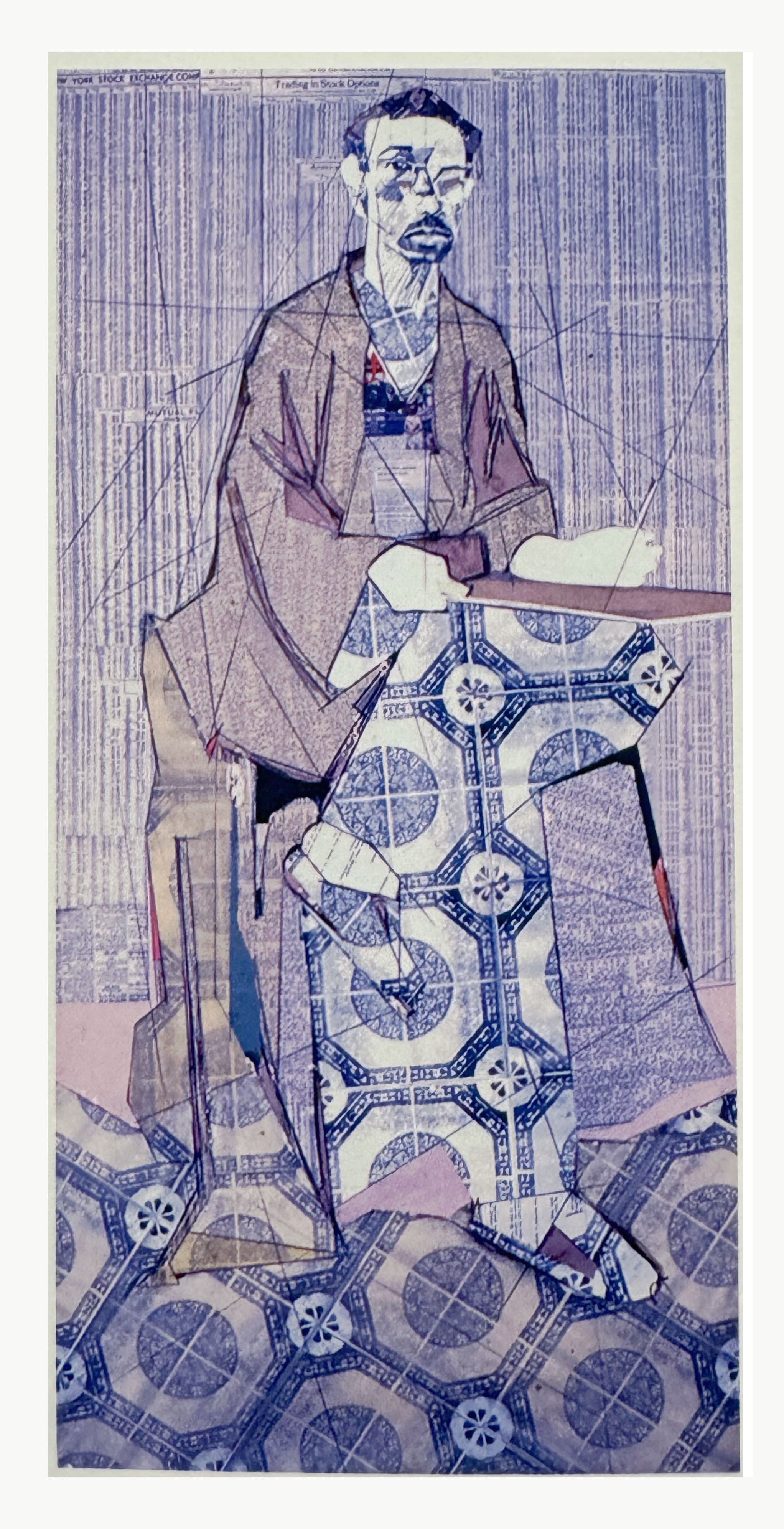
Self Portrait: Stock Market
New York City
36” x 74”
Collage with charcoal pencil
1987
He did not go into other artists’ studios unless invited. If he recognized something in the work, he said it.
At that time, education consisted in finding a means of expression that suited him. It was a way to refine what he saw and felt and to bring it into the work. The subject was his own, but it moved within the traditions of painting and other arts. What mattered was finding his voice as a painter, in the use of color and the depth it could sustain pictorially. On the surface, his gestures remained inscribed.
Within that, he would stand before the work and look, asking what it could contain or where it might resolve. If he recognized something, he stayed with it, not to explain or to correct it, but to register it mentally or to shift it within its structure. There would be a pause, and he would look again, as if something already present had just come into view.
Other artists entered his space with legitimate differences. They did not alter what took place between them.
One moment remains with him.
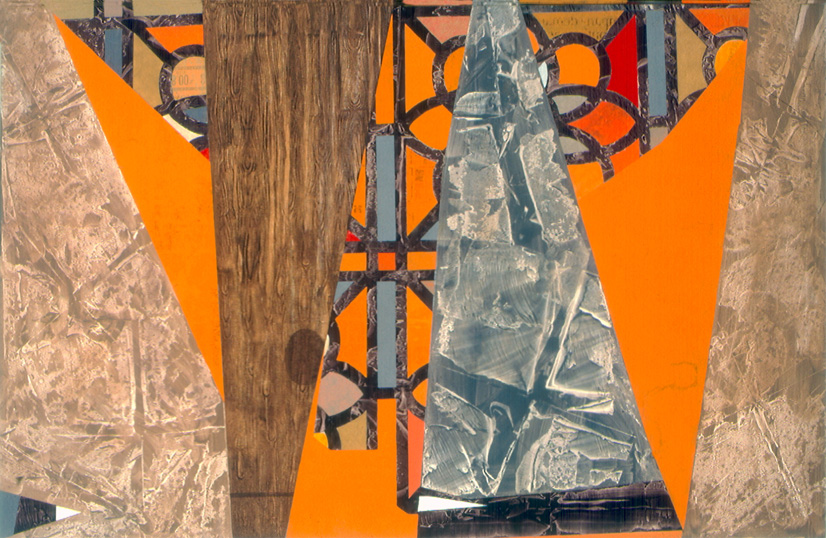
A graduate student was working on a piece, a structure rising like a tapering tower, bright, near red, perhaps fuchsia, with broken glass along its edges. It was not finished. It was evident that she was still working through it.
He stood beside her and said what came to him. It recalled what he had seen growing up: glass placed on top of walls, not as decoration, but to keep people out, to cut anyone who tried to enter.
She stopped, looked at the piece, then at him. Nothing more was said.
He left.
Later, he saw the piece again when she opened her show at an alternative gallery after graduating. There was a recording, a voice repeating that there is a violent world outside, and the piece and the voice remained together without resolution.
Their advisor in the art department told him that what he had said in her studio did not leave her and passed into the work.
He had not thought of it that way. He said it and moved on.
That is what remains with him, not recognition, but that something one sees can be taken up and continue elsewhere.
Around that time, his mentor said something to him in private. He told him not to take at face value what other faculty members said about his work, nor what he himself might say.
He heard it, and it did not leave him.
During that period, he traveled to Salzburg, Austria, for a seminar in stage design. He had not planned it. It just happened.
The work there required interpretation, and he found himself imposing his own way of seeing so that it would hold. It was not just something one looked at. It generated a mood that people entered and responded to.
He worked from what he saw, though it did not work as expected.
He continued with it.
After that, he entered a selective graduate program. It followed from what he had already started.
There, things took shape within a director’s limits of interpretation. He finished the program, but the way he had been working before did not continue in the same way.
Outside academia, he was received as an outsider; it did not extend beyond distrust. The work remained within that frame. He could see where the attention was directed; it did not include him, whatever he did. In New York City, visibility opened to the same names, not to him.
While he worked in stage design to support himself, he continued to produce paintings.
Opportunities did not present themselves for either.
He worked on what others would present, and it advanced without him.
The hours and the demands occupied the day and extended into the night, and when they ended, nothing was left for his own work. What had advanced before ceased to advance and it was no longer received in the same way. Expectations were in place, ways of doing things, and he saw them clearly enough to know where he stood.
Nothing came of that situation, but he persisted.
He kept working.
When he writes, he perceives what he has just thought and observes it once more without turning it into an answer.
At times, a thought comes with more weight than the rest. Where facts do not admit of equivalence and distinctions become inconvenient, they tend to be blurred; and where they are blurred, judgment loses its basis.
He leaves it there.
He asks whether anything is missing, not that something is missing, but whether.
Almost immediately, what he says begins to take form as an answer.
He stops.
Because that is not what he is asking.
He asked whether anything is missing, not what is missing, and left it there.
It occurs again. What he sees begins to take form as something he could think through.
He suspends that as well.
In the act of working, what he sees and thinks begins to take form as an answer. At times, what appears is not his, yet it comes as if it were. He sees it and does not complete it. It remains and returns without resolving. His attention does not leave him.
He remains within the situation as it presents itself.
There are relations in his life, some close, some not, and they arrive as they arrive. In those moments he responds, not because he decides to, but because the situation calls for it. He responds and confronts what derives from it.
He does not go beyond that act.
That stays there, not as something to return to, but as something that does not dissolve.
He sees himself acting and, at the same time, sees the movement that follows that action.
He does not resolve that movement.
He notices the inclination to fix a conclusion and does not follow it.
What appears presents itself with the weight of certainty for a moment and then recedes.
He does not accept it.
That movement loses force.
He remains intact.
The question is unresolved.
Is anything missing?
He does not answer.
*
Ricardo F. Morín
May 5, 2026
Bala Cynwyd, Pennsylvania