Herta Lager Kane (1928-2021) was born in Vienna. With her family, she came to New York City in 1941–via Switzerland–fleeing Nazi persecution.
Herta began her education at the Fashion Institute of Technology and the Cooper Union for the Advancement of Science and Art, School of Art and Architecture, before obtaining a B.F.A. in Graphic Design and an M.F.A. in Painting from the University at Buffalo.
Photo provided by Herta’s daughter Vivien Kane
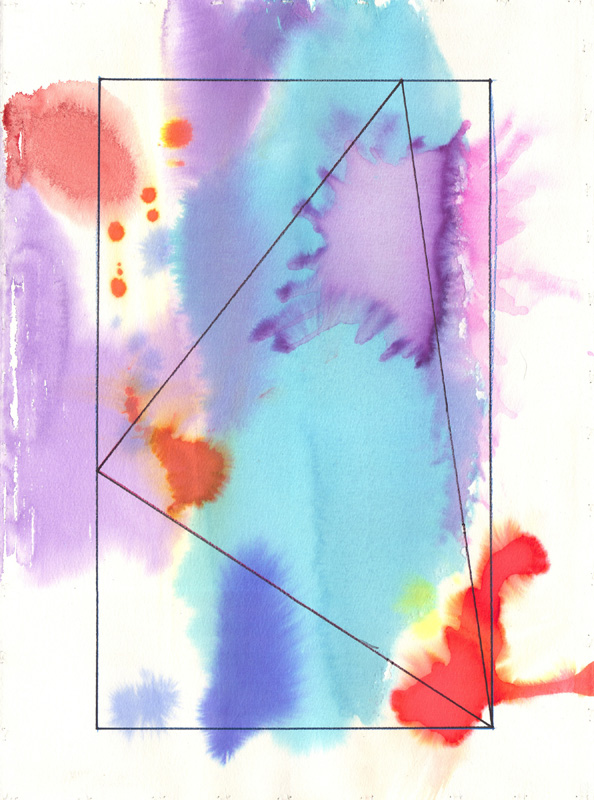
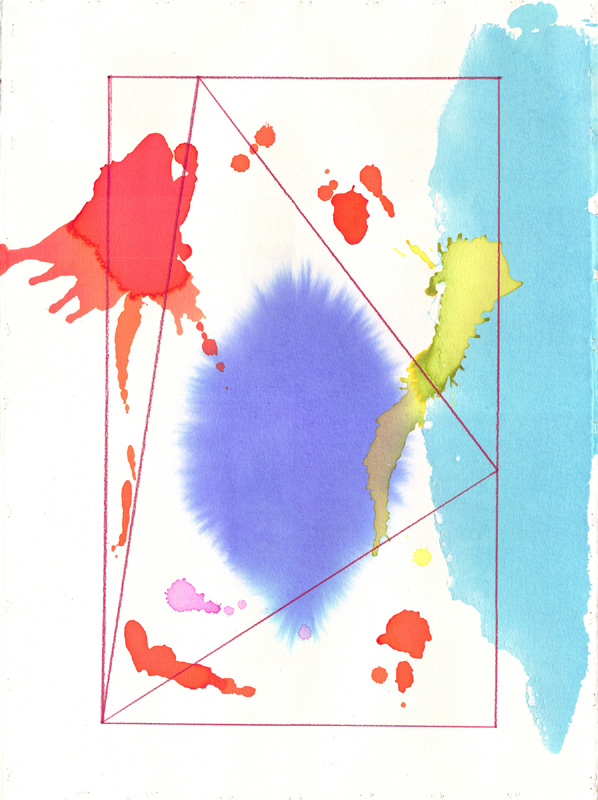
Herta began her career as an adjunct professor of Painting in the University at Buffalo, and then spent most of her life as an associate professor of graphic design in the State University College at Buffalo. Herta’s paintings on the plasticity of geometric abstractions as well as her refined constructivist drawings have been exhibited at Buffalo’s Albright Knox Art Gallery, the Burchfield Penney Art Center, the Hallwalls Contemporary Arts Center, and various alternative local cooperatives dedicated to video research and development for theater and television.
In her work Herta searched for a new direction in the depiction of pictorial space, resulting from the great legacy of our mentor Seymour Drumlevitch. In her own words, Herta aspired to arrive at the power “… of a mystical ambiguity and elusiveness.”
________________________________________
***
An Elegy
*
Herta always had a generous warmth for and a profound insight into humanity. Even when we were most fragile, in our moments of trouble, we did not have to say much to assure each other that everything would be fine; even in silence, we supported one another with a sense of wonderment, at times even with great humor.
From the time when I first met Herta in 1975, as a painting instructor in the University at Buffalo, she shared her wealth of knowledge and always provided encouragement. She looked after my well-being until she was no longer able. Our friendship attested to the fact that no one has control over his destiny, though our love persisted beyond such boundaries.
Herta’s confidence—in the labors of becoming a visual artist and surviving the myriad uncertainties of a professional career—enabled my finding answers to managing whatever fate provided.
Her humanity, dignity, and intelligence were a fountain of inspiration for all of us, who had the good fortune of knowing her. More than a mentor Herta became a loving and loyal friend. No one else could fill her place in my heart.
Herta and I had strong bonds. I owe her my standing, not only emotional maturity but also my intellectual development. Without her, I would be different; to her I owe the inspiration of authenticity and thoughtfulness.
R.F.M.
*
___________________________________________
*
In Memoriam Herta Lager Kane
***
Destiny
*
Fate and chance drew out of our tears a smile
and brought solace to our failures;
then we looked up after we'd sunk
with the confidence
of climbing back.
In loneliness
we found for ourselves company,
and in helping others, we were helped.
In our pursuit of the impossible good,
we came to know our failures.
In the brevity of each moment,
nothing seemed to fit for being possessed;
when we marveled at the great arc of time,
this never died,
even in the absence of hope.
The ups and downs from the goddesses, the three Moirai and Tyche,
in their dispensation of favors and troubles,
couldn’t keep us from moving on,
even if we met each other and were
hopelessly aware of our imperfections.
***
Ricardo F Morin, December 29, 2021, coauthored by Billy Bussell Thompson
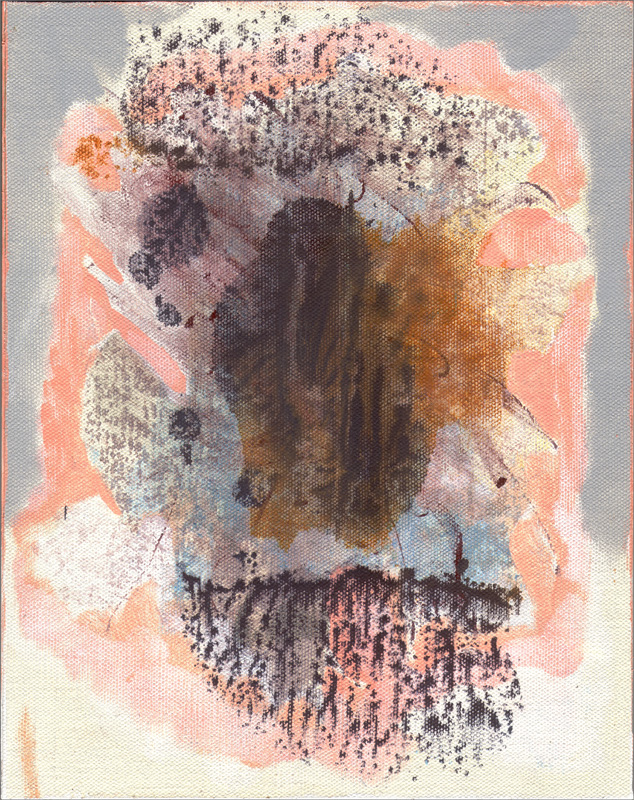
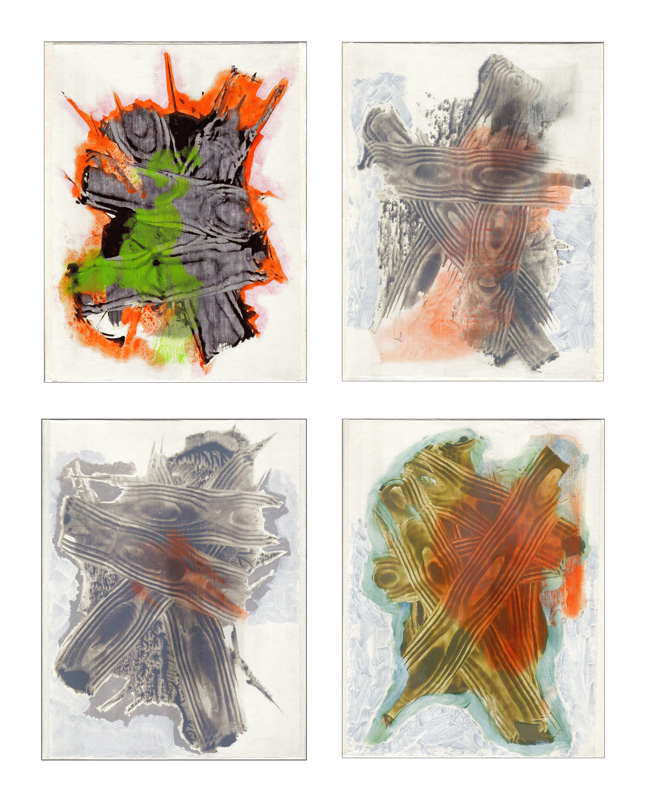
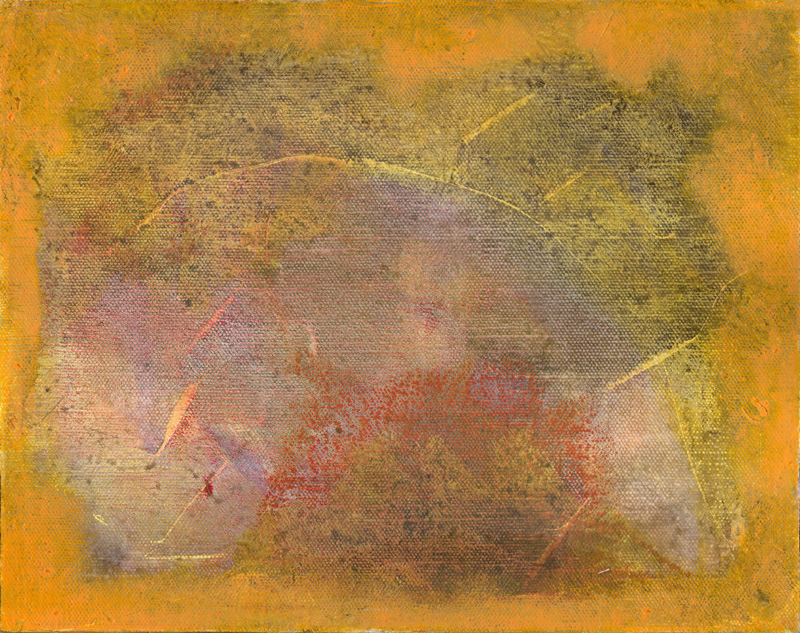
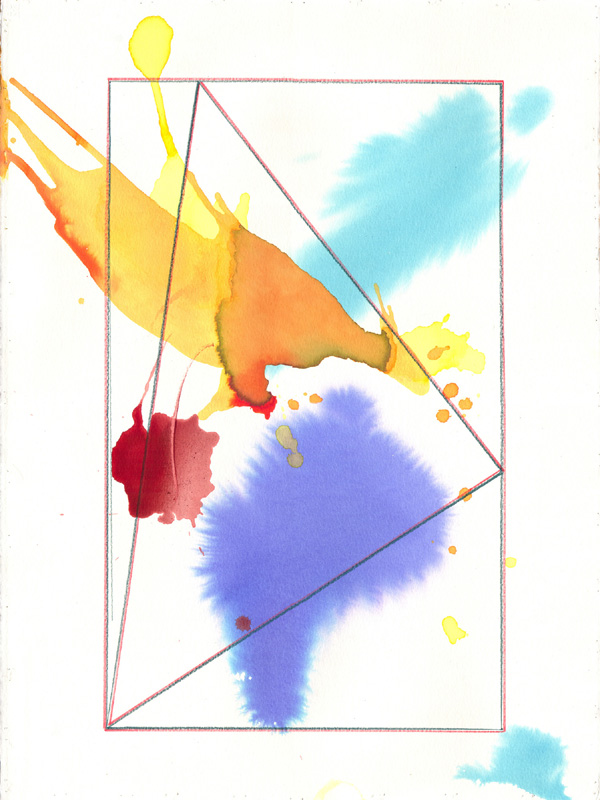
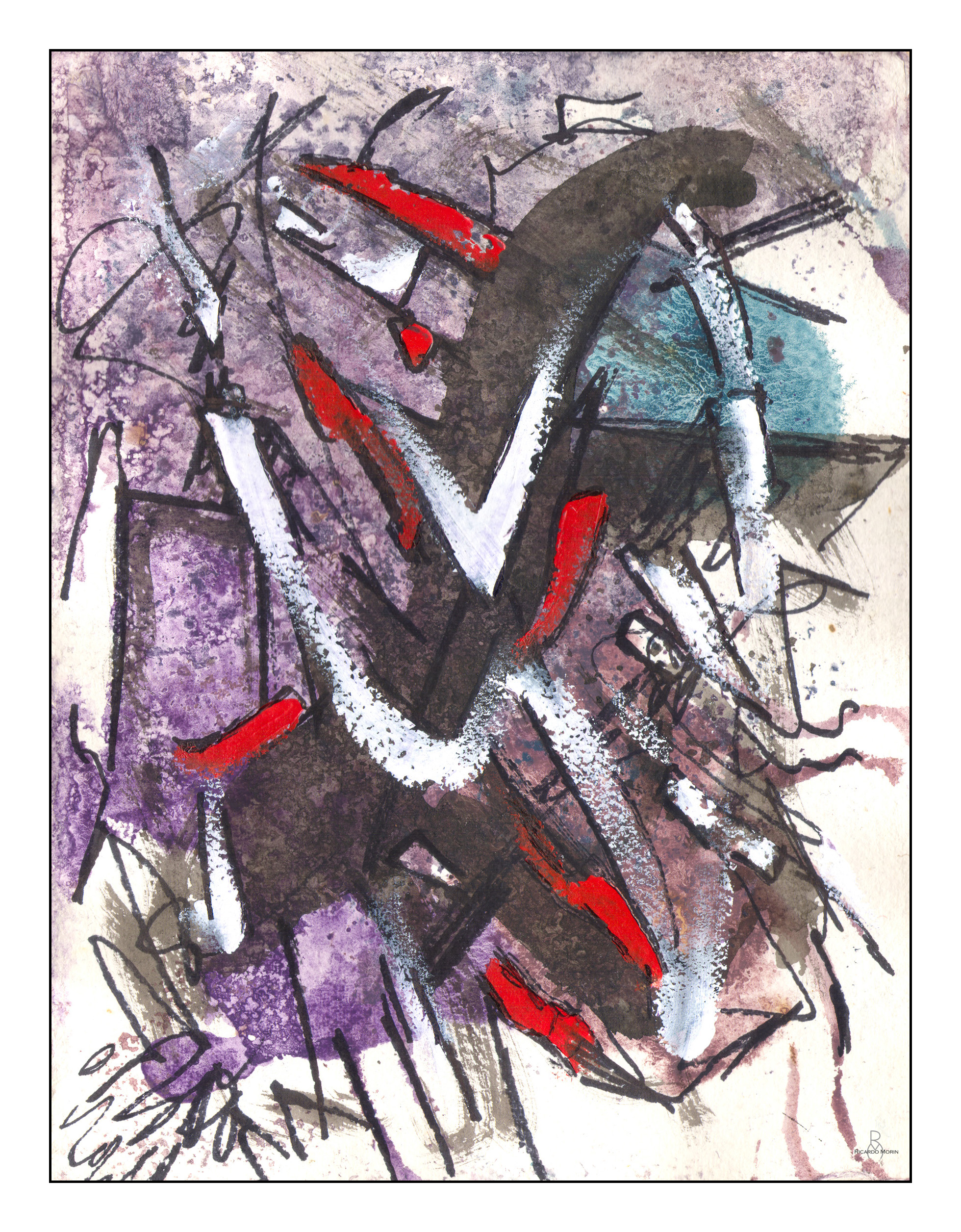
Herta Kane, American artist born in Austria (1928-2021), work on paper entitled “Untitled”, Acrylic and collage on paper, 10 1/2″ x 10 1/2″. Gift of the Arts Development Services, Inc., 1978 to the Burchfield Penny Arts Center Collection, 1978. https://burchfieldpenney.org/art-and-artists/people/profile:herta-kane/
Words are symbols not necessarily truthful. We endow them with meaning in order to appease our bewilderment before aspects of reality we cannot fully comprehend. Perhaps writing is found in an effort for our conscience to overcome its fragility.
Anonymous
Wisława Szymborska was born July 2, 1923 in Bnin [now part of Kórnik], Poland; died February 1, 2012 in Krakow. She was a poet, whose intelligent and empathetic explorations of philosophical, moral, and ethical questions earned her the Nobel Prize in Literature in 1996.
https://press.princeton.edu/our-authors/szymborska-wislawa
We have a soul from time to time.
Nobody has her all the time,
nor possesses her forever.
Day after day,
year after year,
may go by without her.
Sometimes she nests in us for a while,
in the fears and raptures of childhood,
and sometimes at our surprise of being old.
Rarely does she lend us a hand
with routine tasks,
moving furniture,
or baggage,
or walking miles in shoes that don't fit.
She runs away
when meat is to be ground,
and hopes are to be met.
Out of every thousand talks
she'll take part in one,
if at that.
She likes silence.
When one’s entrails go from dull to intense pain
she gives up.
She is choosy:
she doesn't like us in crowds.
Our desires to get ahead and
hustling for advantage make her sick.
For her, joy and sorrow
are not opposites.
She is within us
in the union of both.
We count on her
when we're sure of nothing
and curious about everything.
The things she likes are
mirrored clocks with pendulums
working all the while,
even when no one looks at them.
She doesn't say whence she comes
nor when she'll leave again,
even tough she is waiting for these questions.
For some reason
we need her,
and she needs us just as well.
Footnote:
1: Poem written by Wislawa Szymborska: published July 1, 2000, original translation from the Polish by Stanislaw Baranczak and Claire Cavanagh in 2006, transposed into Spanish and English by Ricardo Morin and Billy Bussell Thompson, December 2021.
Book of Changes is a new departure from my life as a visual artist into a recent collaboration with Billy Bussell Thompson, who is a Ph.D. in Linguistics, Professor Emeritus at Hofstra University. Our relation is unlike that of an independent author and an editor. As friends with a shared history of experiences and distinctly different influences, our relation defines us beyond simply one providing feedback and constructive advice to the other.
I see myself without any pretense of wanting to become a professional writer, or of emulating a particular literary style, just as I have never considered myself a professional artist of any particular tendency. Yet I am a life long inquirer of these two distinctly different disciplines. As I have mentioned it to Billy, “I come to be who I am in writing because of him”: in learning how to order my perceptions into concrete events, which is a difficult task for a visual artist without a full ownership of the English language. Billy’s specialty and his particular knowledge of Romance languages enable him to bridge the differences between their semantic fields. Without presumption, I believe our relation defines us both in unique ways, not possible if we were fully independent of one another. I am as much a work in progress for him, as I am for myself.
As with any given artistic expression, the process itself of Book of Changes arose from exorcizing a variety of memories in the act of writing. The writing process informed the direction and nature of the story as an object of artistic pursuit.
Real memories as well as random, and chance events were combined, including the daily changes of every emerging moment. The effort that Billy and I made was to find unity in all these events, despite their multiple possibilities. All of it was brought to bear in a complex collage, stripped away of superficiality, and into its own realism.
Inauthenticity was as easily dismissed, just as excessive information had to be eliminated, and in the process we discovered how the story had to be directed. Yet, I am aware of the absence of what was cancelled, which left an indelible mark on the nature of the story.
For me, it was the same as creating an abstract painting, except that in working together, Billy and I channeled each other to arrive at the piece itself. The process felt different from the ways in which a painting takes place in the intimacy of one’s studio, constructing and deconstructing, building and rebuilding, what may have turned into a fluid geometric abstraction. In our story, every word, as a brushstroke or a line in a painting, became essential to the harmony of the narrative: as the illusive depth of spatial relations in visual art, language and feeling, undifferentiated and congruent, came about like the regenerative portrayal of an abstract painting.
Book of Changes strives to formulate my memories and the changes in perception, which occur from time to time. The nuances of this particular book of histories attempt to illustrate the character of personal truth, of what is imponderable and evanescent in one’s sense of humanity. Though the story is based on real life experiences, the personal and particular, however, do not constitute the principal objective, rather it is the constantly evolving character of one’s truth.
Ignis Fatuus: the whole world could collapse; to live we need false hopes.
Chapter 2
Your paternal grandfather hardly ever spoke; lying next to him, you suffered his snores. One Sunday morning you sat quietly on the bench with him; he was playing the organ at the Church of Bella Vista in Caracas. One Sunday afternoon, he took you to feed pigeons at the “plaza mayor” in Puerto La Guaira. One early Monday, he sat at a carved desk and sipped hot coffee from a demitasse’s saucer. For a time, he twiddled his thumbs and whistled a tune. Suddenly he chased you from the house in belief that you had broken something of his. Fearfully you ran across the street and were almost hit by a car. You joined older eight-year-olds playing marbles.
Chapter 3
There is so much that we ignore that humility becomes a necessity, not a choice. Nothing can be conclusive at any time.
Chapter 4
Your maternal grandmother never engaged in small talk. To dissuade you from sucking your thumb, before bedtime, she applied hot sauce to your left hand. You simply switched to your right thumb.
Chapter 5
Man does not control who he is, nor how he thinks, or even how he perceives himself. You do not control who you are, how you think, or how you perceive yourself. Asking why one exists or observing how one changes from time to time, only appears to suggest lack of control.
Chapter 6
In his cell, Father Manuel, the math teacher, talked to himself. His murmurs were barely audible. Often he chastised us on the differences between a big man and the little man. The principal Father Lisandro replied there’s no explanation for evil in the world.
Chapter 7
One cannot debunk fears about the existence of God and the devil. It is a wild goose chase. Culture, similar to tradition and belief, comes from the imagination.
Chapter 8
As a friend, Rogelio was considerate and attentive. Your mother heeded not to grow too close to him: he was poor, black. Angrily you countered: poverty was not shameful and, besides, your father’s skin was only slightly lighter.
Chapter 9
Do you find meaning in imaginative worlds and daydreams?
Chapter 10
During lunch, Uncle Calixto sat across at the end of the table. Casually he announced the suicide of a couple he’d introduced you to, only a month before. Your consternation was obvious; Uncle Calixto insisted you were to inquire no further. Years later, with the same tone of anger he accused you of evil thoughts: you have the devil in you, for being gay.
Chapter 11
You asked how moral can a person be: someone who believes in the devil, hell, and eternal damnation! For you this morality was defective. For you, religion is no different from astrology.
Chapter 12
Fifteen years ago Francis died of cancer. His brother grieved as if a limb had been amputated. He set his home ablaze before drinking antifreeze. The family was not surprised. Neighbors blamed you for not having expunged his pain. The building’s manager called the next day alarmed that you had exposed 45 stories to conflagration.
Chapter 13
Suicide is no different from murder. Killing yourself is no less moral than killing another. Both are cowardly. Consciousness pertains just to the living. Killing oneself is to defile one’s nature. Accounting for madness cannot absolve agony. Memory of love is the only consolation.
Chapter 14
Just before first Communion, your father brought up death. You replied it was inevitable. Later you heard him telling your mother that your answer was quite unexpected. At Christmas time, you announced to your father you knew all about Santa. He answered “what do you plan to do about it?” You just shrugged your shoulders and asked for his blessings before going off to bed.
Chapter 15
Are you suffering for not being an innocent?
Chapter 16
The grocer said he knew your family, so you asked him for a ride home on the back of his pick-up. Arriving there you found your father in a state of panic. You had disappeared to him, and you thought he had forgotten you. Thereafter, you did not go to your art classes for ten years. Then, as a teenager, you wandered around your neighborhood. One day, in the early evening you found an older boy studying. He was memorizing something when you interrupted him. He asked why you were offering him candy, and you said: “why not? Aren’t we neighbors?” When you got home late, your parents were leaving to report you missing.
Chapter 17
Can anyone measure consciousness?
Chapter 18
Each time you came through the gate to your friend’s house, his German Shepard would lurch forward until he recognized your voice and scent. Your friend had stayed out of school that day, not feeling well. Without preamble, he volunteered he was being sent off to military school. Then he said he was terribly upset and had to get rid off his stress. You sat quietly at the foot of his bed. The two of you exchanged monosyllables, while he masturbated beneath the blanket. He told you he had to beat and to come. These words were meaningless to you. With a friendly glance you left, never to see him again.
Chapter 19
You did not ward off fears, so much as you needed to reckon with their fleeting existence, just like when waking up from a dream.
Chapter 20
Vacationing with a classmate, your attentions were on his older brother Francisco. Each time your bodies touched you trembled. You feared becoming overwhelmed. Long after his death, his appeal rushes after you.
Chapter 21
From early childhood innocence had already been lost to ache. You had long been fair game.
Chapter 22
At 18 years you met Ennio Lombana, after having crossed to the neighbors’ house. You became his sexual victim. Perhaps this explains going to university four thousand miles away.
Chapter 23
You tried never to think of fear, yet it became an obsession.
Charter 24
Your father and your art tutor both encouraged education in North America, yet fearing its implications. Their memories stand in silence.
Chapter 25
Ignorance is the essential condition of our existence, despite one’s arrogance to aspire knowledge or its authority. For you that is the real obstruction preventing a clear perception of anxiety, the pain of loneliness, fear, and lack of love. You cannot achieve rationality in your life with the rigidity of belief or the absurdity of dogma. In vain you may try to reject doubt, fearing uncertainty and thus denying the very depth of your ignorance.
Chapter 26
La Nena Pérez was a golden rebel for José Luis. Her beauty bewitched all who saw her. For his wife Antonieta, however, she was an interloper. Decades later, a letter of his arrived from Andalucía. In it Antonieta was praised as toda una señora. Self deprecatingly, he lauded your father. You had mentioned that La Nena did not recognize you at a chance encounter in Caracas. He was beside himself learning your voice was no longer familiar to her. Seemingly, she had forgotten canoeing across the Tucacas Bay.
Chapter 27
How can there be love, if one is empty? Ennui uncovers it. Self importance aspires to enlightenment just as yearning does to sanctity and humility. It is luck to find pure love.
Chapter 28
Before entering the university you enrolled in a course in English as a second language. The professor made learning exciting. His patience disarmed you. At mealtime, you spoke on and on, forgetting to eat, and he would smile tenderly.
Chapter 29
Desperation cannot assuage sufferance.
Chapter 30
Three Marys flew from South America to Niagara Falls for a visit. They rode the Ferris Wheel at the amusement park on the shores of Lake Ontario. Their visit was a complete mystery, except they believed they were in contact with extraterrestrials. One of them realized she wasn’t the object of Ennio Lombana’s affections. Your mother’s resulting breakdown was immediate.
Chapter 31
In 1977, hungry and destitute, you came close to dying. You distracted yourself in discos. You met Donald Bossak and Paul Barret: the former insecure and the latter suicidal. You moved into the university dorms to face a group of rioters, who had been egged on by a room-mate. Away with the foreigner, they shouted, setting fire to your door. At graduation you found out the university had assigned you a bodyguard. By then you had come to know a student. This Polish dissident, Jurek Pystrak comforted your misery. The summer before graduation you studied together in Austria, and after graduation he went on to continue his studies at the University of Pennsylvania and you went on to Yale for the MFA. Jurek died in the mid 80’s in Berlin. Only later did you hear it was AIDS.
Chapter 32
Technology has extended our lives into preconceived worlds. Algorithmic archetypes impose an order over bias, by which it controls, sells, and manipulates you.
Chapter 33
Every weekend, you and Jurek traveled between New Haven and Philadelphia. Before taking his Fulbright, he suggested it was okay dating another during his absence. You took this to be a lack of loyalty. From Berlin he wrote he had met a film historian. After Jurek’s death, Karl visited your art studio. He found your geometrical canvases oddly formal. Was his conversation an echo of his own influence on Jurek and, of his own vision of the freedom of artistic expression? He later wrote from Berlin he was dying. In his letter he said your quests regarding treatments were futile missionary pretenses.
Chapter 34
But it was not a mission, it was compassion for him as it could have been for Jurek. Karl was filled with his own memories; you begged him to keep up hope.
Chapter 35
Never have you cried for someone as when you did when Benjamin Ivry left to work in Paris in 1984. After he left, your old friend Carol Magar helped you negotiate the pass to the American Citizenship. Eighteen years later, she died of cervical cancer, and five years earlier, Benjamin had returned from France. Was it his stance of irony that broke you apart as friends? You last spoke to him at a bookstore on Park Avenue and 57th Street. There, on the occasion of promoting his book “Maurice Ravel: His Life,” you introduced him to your husband David. Benjamin excused himself and left abruptly to meet his agent. Later that year, Benjamin moved to Thailand. He became a biographer and translator of well-known 20th-century figures in the arts. Only thanks to the World Wide Web can you see his image, and his prose continues to provide you with his particular métier. He remains your provocateur.
Chapter 36
In 1987 you were diagnosed with AIDS. Before the diagnosis you came to know an Episcopal clergyman and a TV-soap’s actor. Both fought for your attention. For years one disapproved of the other. The actor was ironic and the clergyman was a libertine. The clergyman died of a heart attack in 2008. The actor is in his late 80’s. His husband derided you.
Chapter 37
During the years of AIDS’s hysteria, your friends Philip Jung and Tom Bunny were not scared of death. You comforted them when they lay quietly on your lap.
Chapter 38
Nearly blind, Lyda saw herself as a patron of Latino culture in the United States. She enjoyed curating art shows in Midtown Manhattan. A provincial teacher, turned diplomat, enforced the idea in her they had the opportunity to open up the American art establishment. Then a pseudo progressive revolution strengthened them as potential populists.
Chapter 39
You listened to grand stories. Their aspirations, akin to religious fervor, never materialized. They seemed like grafters unable to give up their desires to dominate.
Chapter 40
Painting kept you sane, said a friend, who had come to your loft. Your paintings were developing an abstract vocabulary. You painted at night and worked as a commercial designer during the day. When your health failed you renounced everything and chose refuge with your family in South America.
Chapter 41
One learns to live with fear.
Chapter 42
You became a seesaw in your native land. You ran into repugnance both from the medical establishment as well as from family.
Chapter 43
In 1994 the Venezuelan medical institutions were collapsing. A few doctors and several thousand businesses asked you to write a mission statement for Fundación Metaguardia. It had been registered as a program for people with terminal diseases, The proposal went to the Venezuelan commissions of Health, Education and Culture, and to the United Nations. It failed. The Venezuelan Ministry of the Family tried to turn the program into activities for the feebleminded. Nothing happened.
Chapter 44
In November 1995, you flew from Caracas to Los Angeles. You had been nominated for an Emmy for your work on In Search of Dr. Seuss. The morning after you awoke to a fever of 108 degrees, from a hospital bed, you hallucinated making love to an angel descending upon you. To your nurse, you explained that death was an illusion. In your mind you spoke of Egyptian gods and goddesses, of Germans meandering inside your room, of Zapata fighting for Mexico’s freedom, and even of an intergalactic journey on a spaceship hovering over the hospital. A nurse asked you to open your eyes. Your body had begun to slow down; your eyesight had become magnified. Pulling the intravenous line out of your arm, you wanted to flee. You could not walk but somehow, you danced to music played by the nurses’ radio. You felt yourself in a different time. You saw your home in Venezuela as you crawled on its floor. The grouts were like rivers. Then you opened your eyes to an ocean. Your heart pulsated. You climbed to your home’s roof and stared at the cloudless sky. Fractals of light pulsated like thousands of rainbows. Now you were awake; your ankles were weak. You stood up. You turned to the doctor and said: “What does dignity mean to you? Are you a human being?”
Chapter 45
Nine months later, you were in your mother’s house. Your father came every week to visit. As you become stronger, he says you should return to the U.S.
Chapter 46
In November 1996, you fly from Caracas to New York. Your nine months stay in Venezuela violated your residence’s status. “I believe I was dying and unable to return” you answered. Sir, you may proceed“, the agent finally said.
Chapter 47
Some weeks later, your father falls at home and suffers a concoction. After surgery, he dies in the hospital. Your stepmother had locked him away as if he were a wild beast. In grief you paint again. With no more success than before, rejections from galleries continued to abound. With your mother you traveled to Europe. She talks incessantly and then nine years later she loses her voice to Alzheimer’s. Without parents, you had no bridge to your brothers and sisters. Throughout the years of Chavez and Maduro you have helped the family.
Chapter 48
In 2012, you stopped painting at your art-studio in Jersey City, only to return to art through digital technologies … By chance you have regained your confidence.
Chapter 49
In 1997 you met Nelson. Together you hiked the Amazonian Rainforest all the way to Angel Falls. You swam together in Los Roques. With you he showed himself vulnerable. Was his suicide the venting of his dejection over his brother’s death?
Chapter 50
In August of 1999, you confessed to a Nicaraguan priest in the Vatican. He tells you to measure your responsibilities. You sobbed inconsolably over Nelson’s death. The priest’s response, ” this is not the place.” From the Vatican you returned to the hotel, where you locked yourself up. Upon returning to the United states you seek therapy. There you discussed a relationship with a married English teacher with children, who tells you, “you have killed me as well.” Then you fell into a relationship with an alcoholic. It too was unsuccessful.
Chapter 51
Therapy became a crutch and strangled freedom. Leaving it, the therapist was disappointed. He had become accustomed to directing your thinking and actions. It was his empowerment and, much to his chagrin, you left him.
Chapter 52
When you and David meet, he fills a void in you and you in him. Respite in an imperfect world is found.
Chapter 53
He awoke to an itching jaw with stubble. You rubbed your cheeks carelessly against his face and musky scent. His eyes had the expression of a loving child.
Chapter 54
His glowing eyes evince a timid sense of wonder.
Chapter 55
Together you have traveled the world: the Atlantic, the Pacific, the South China Sea, the Mediterranean, and the NorthSea.
Chapter 56
On December 27, 2000, police reported that a 39-year-old man apparently jumped to his death from a Manhattan apartment building on Sunday morning. The suspected suicide leap occurred in Hell’s Kitchen, a short distance away from your home. He was your primary doctor, who had plummeted from the sixth floor. The week before, you had explained to him that the medication he last prescribed had caused you to be sleep deprived for eight consecutive days.
Chapter 57
A few friends from my childhood remain in touch today. At 94, Herta is my oldest friend. I have known her for 46 years. She was my mentor and Platonic friend since college. She lost her memories to Alzheimer’s. From Yale graduate school, there is Angiolina Melchiori , who is now an Italian News Director at RAI TV in Rome; Ariel Fernández, who is an American-Argentinian physical chemist and pharmaceutical researcher; and Maider Dravasa, who is a French Basque with Ph.D. in Linguistics living in Paris. All three have been my friends for the past forty years. As with all of my friends, we have traversed life’s forests through thicket and thin. Then there is my good friend Billy Bussell Thompson, who has a Ph.D. in Linguistics, Professor Emeritus at Hofstra University. I believe Billy has suffered what Job did not. I have known Billy for 34 years since 1987. My true education began when I met him. Over the years, we have coauthored in many occasions, and nearly in every one of my WordPress blogs. When I wrote other short stories in Spanish, Italian, or French, Billy was there to guide me ordering my thoughts into the Romance languages. Book of Changes evolved from a collage of reflections coming from memoirs, my interest and aversion to social sciences, my love of history, an interest in meter, its rise and fall in American poetry, suicide prevention, and self healing. Billy brings to my prose a desire to be precise and to unburden those nagging, vague, and scattered allusions of mine, and overcoming my limitations of fluency as a bilingual writer. Most importantly, there is my husband of over 20 years: David Lowenberger, who has exerted perhaps the most significant influence over who I am. His friends and relatives have also been major contributors. Much to my good fortune, his mother, my mother-in-law, Eva, gifted me 20 years of memorable friendship. Dignified in every respect, she was an inspiration as a mother and a friend. She recently died nearly five weeks before turning 98.I dedicate these short stories in her memory.
I share with the reader my utmost sincere gratitude to Billy Bussell Thompson, PhD in Linguistics, Professor Emeritus at Hofstra University, who has been a lifelong mentor, editor, and closest friend. I also express my deep appreciation for the nuance of sensitive and perceptive editing contributed by both, my perspicacious sister Bonnie Morín, playwright, producer and director of the Madrid Method Workshop in Spain (https://www.metodomadrid.es/), and by her daughter, the talented niece Natalia Velarde (@nix.conbotas), graphic artist and fanzine author who has earned many acolytes. I also give thanks for a much awaited reunion with her other daughter, the unequaled niece Camila Velarde, Lic. in philosophy and choreography. Last, I thank my dear husband David Lowenberger, whom I consider to be the most influential in every aspect of my life. Their perception and wisdom served as inspiration and guide for the realization of this short story.
Ricardo F. Morin T., 21 February 2021
_________________________________________________
PREFACE:
Choking On One’s Own Saliva
My father once said how dismal his life would be were his identity lost to the orthodoxy of religion. It was no coincidence that, in reaction to the pieties of five generations, my father was to become a criminologist. For most of his life, he thought that the traditional stories about complementary retribution, binary belief in reward and condemnation, were fantasies, harmless until they became radicalized as replacements for inquiry. As a young man he based his own doctoral dissertation on such principles. Unfortunately, those convictions he deemed delusional were ultimately his own at the end of his life.
I think that, except for the instigation of violence through the search for meaning and its attachment to fiction, whether the violence arises from retribution or self-preservation, a person has no reason to become fearful or destructive. The only remedy to violence is knowing the difference between fantasy and reality.
As I reflected on my own father’s contradictions, I remembered what he had told me when I was a child, that lying was a survival skill. It enabled a person to hide himself in secrecy, not necessarily out of moral incompetence. It arose either from charity or from the fear of being judged. For him lying was part of becoming a competent adult. It was a way to hide imperfections and vulnerabilities. However, if sincerity or honesty were to threaten my father’s survival, it would be because he wanted rather to invent a story instead of looking into his ignorance and diminished understanding of his own importance. Was it natural for him to hide behind lies, or was it his own hubris? Perhaps he was choking on his own saliva during his entire life. He suffered from the delusion that he could avoid truth, or that he could control not facing up to it. Was this a fear of loosing control? Was that a reason why he could not find self-understanding? The mystery was centered not in his self-questioning, but in his fictionalizing his own life, no differently from our forebears.
__________________________
Gangs of West Harlem
1
The Process
For the third time I was serving on jury duty. As on previous occasions, I introduced myself as a visual artist during the voir dire. This time the defense lawyer inquired if I was a portraitist. I reasoned to myself the question was intended to probe the degrees of observation a painter aspired to. I replied that my interest as a visual artist was in the conceptual processes of abstract art, no different from that of a portraitist or any other representational painter, seeking to observe and interpret the essence of a subject. What I chose to represent through abstraction or conception was just as concrete as that of a sitter for a portraitist.
2
The Rules
The trial concerned the murder of a fourteen-year-old boy, and I was selected juror number 12. Previously, I served in civil cases. In civil cases, the preponderance of the evidence is the determining principle. In a criminal trial, the ruling principle is the measure of reasonable doubt. The rules were cautionary and aimed to avoid bias on the part of the jury. In their deliberations jurors were to concentrate on the evidence presented and not on background. Also, jurors were not to share information with other people outside of their own forum. I did not know how my participation in a murder trial would affect me. The day after the trial began, juror number 11 was replaced by an alternate.
Testimony lasted 17 days. During that time our electronic devices, cell phones, laptops, and tablets were allowed. On the 18th day, when jury’s deliberations started, these devices were taken away from us. Before this, we had been permitted to speak on matters not related to the trial. We were a diverse group and had very little in common. During court hearings, we had been allowed to take notes while we sat in the jury box. After the days’ proceedings, our note pads were left on our respective seats. When deliberations began, we could take our pads back and forth between the jury box and the jury room. Only then, were we able to study our notes and refer to our observations. Only then could we begin to talk about the case with each other.
3
The Jurors
The foreman of the jury was an office manager, who felt comfortable in his role as moderator. His communication skills were excellent; even when he disagreed, his manner never expressed condescension. Some jurors were reticent and never voiced a judgment one way or the other. The youngest member of the jury did not find the witness of the crime unreliable. Other jurors were open minded. A teacher remained calm throughout; she listened to others before expressing her own views. Another juror was impatient about the length of the trial. She complained that she had a toddler to care for at home. Aside from myself, there were two other retirees, one of whom was a corporate lawyer, who reminded us of the distinction between civil and criminal cases. Reasonable doubt existed in varying degrees for every member of the jury, save for the youngest one.
4
The Defendant: In dubio pro reo
The defense lawyer had her client plead the fifth amendment. The accused gazed solicitously, with a kind of clawing eagerness. He looked seven years younger in his freshly starched white shirt and tie. His hair was a cropped Afro, and he had across his upper lip a straight mustache. His dress was conceived obviously to attest to his wholesomeness. Since the time of the murder, he has been a detainee at Rikers Island. Sitting barely 30 feet away from the jury, the accused bore a grin across his face whenever he looked towards the jurors. Some members of the jury interpreted his countenance as gloating. Others saw his expression as self-pity or abjection, even an attempt at winning us over. His grin, a kind of twisted grimace, was unflappable and even disturbing to us. By the end, however, we dismissed our apprehensions. It was impossible to know whether the accused was remorseful or just trying to beguile us. More important was the question of consistency. If doubt was to play a part in the case, it had to arise from the evidence. Key was whether the accused was a lone assailant or whether there might have been others involved. Certainty had to come from the assessment of facts, and not be based on appearances.
5
The Prosecution
The prosecution charged the defendant with “first degree” murder. This implied premeditation with malice aforethought. The prosecution added two other charges: murder in the “second degree,” suggesting lack of premeditation. The third charge was for felony murder: death caused during the commission of a felony using an illegal weapon and with extreme indifference to human life. Rendering judgment on these charges rested on intent. Each member of the jury would have to reach an approximation of the truth, and no other reasonable explanation could explain the evidence presented at the trial. The verdict, of course, would have to be unanimous. Proof of the direct involvement of the accused was paramount. The evidence had to show the accused had committed the crime. Was the victim’s death the result of self-defense or was it deliberate? The question before the jury was whether there were circumstances outside the control of the accused. How did his instincts and fears come into play with his own actions. Could the jurors differentiate all of these aspects?
6
Testimonies
I
July’s weather was overbearingly hot. The air conditioning in the jury room was old and as inefficient as it was in the court room; the jury room was even more stifling than the courtroom, particularly between the long intervals of each day’s proceedings. The room was barely large enough for the long table and its 12 uncomfortable chairs. In this tight space it was almost impossible for the jurors to walk around, to go to the water-fountain, or even to the single restroom available. Lunch breaks were much appreciated. On the few days when there was a breeze, we could open the windows, but had to put up with street noise. In the court room, no such liberties were permitted
II
By the third week of the proceedings, the judge began standing with his arms folded against his hips. With a baffled face, he would turn around and stand behind his chair, his black robe half unfurled, and his necktie loosened. At times, he assumed what seemed to be a meditative expression with both arms folded over the back of the chair. Other times, he supported himself with one of his elbows over the back of the chair. One of his hands was placed against his chin, giving him a certain look of abandon. For me, this informality broke up the monotony of the case, as if it were helping him stay awake, and mollified the stultifying heat.
III
The aspects of this case had been under investigation for seven years. We, the jurors, were astonished at the lack of cohesion to the accusations. The statements by the witnesses in no way corresponded to the arguments made by the prosecutor. In fact, the prosecution’s case was stale. One wondered if there was any justification for this trial. The only merit to the case seemingly was using the authority of a jury trial to render a verdict, either for exoneration or conviction.
IV
According to testimony given by the police, the crime resulted from two rival gangs. The gang members’ ages ranged from 12 to 40. The defendant’s lawyer provided their pictures to the jury. The pictures showed them in expensive clothing. Both groups seemed to be showing off, as if they were the source of the neighborhood’s pride. Each group had its own hand signs as mottoes. According to the police, on the night of the murder the two gangs fought over their territory for the peddling of drugs. The defendant became the prime suspect two years into the investigation. According to one of the detectives, the defendant sought to intimidate younger members of the opposing gang, as a means of establishing his own authority over them. The defendant’s motive was said to be an attempt to sooth his own anger for being “dissed.” The jury found these to be speculative. For us the only facts credible were those of the struggle between them.
V
The first eyewitness, aged 13 years at the time of the murder, was the centerpin of the prosecution’s defense. He had been a close friend of the victim, and his proximity to the deed made him valuable. During the course of several days of testimony, two officers escorted him in dressed in an orange jumpsuit, both hands and ankles shackled. They removed only his handcuffs when he sat down on the stand. From the defendant’s attorney, we learned that he had been in custody for two years on a different murder charge. The defendant’s attorney asked him: Are you here today in exchange for lenience for the indictment you face? He thrust his arms and shoulders forward. His answers seemed evasive while the prosecution objected. The question was withdrawn, but the jury would not forget it. His hand partly covered his face, especially his eyes and nose. His head shifted from side to side. He pointed to the defendant, rubbed his chin, and accused him of being the killer. Yet, his deportment was indiscernible and seemed manipulative. Obviously, he had not seen from where the bullet had come. His allegations sounded implausible, as if they had been rehearsed. He had an air of entitlement, exuding hatred. During the prosecution’s examination, he revealed his conversion to Islam, and stated he had become a better person by the teachings of the Prophet. For the jury, however, his demeanor was that of an unrepentant malefactor. His lack of doubt hinted at a life of crime, without a sense of any morality.
VI
The prosecutor’s second witness spoke softly, yet his testimony seemed tentative. By his own account, he had been at the edges of the riotous horde. A circle had formed around the hooded individual and the victim. When questioned by the defense, he hesitated before admitting having seeing another armed buddy. But at the end, he relented. He recalled that other gang members had shot into the sky. He acknowledged that other guns had been used, thus accounting for multiple shells found by the police. The bullet, however, that pierced the victim’s heart was a mystery. The jury was at a loss as to what had gone on. Was it retaliation? Was it the shooter egging on accomplices? No answer was forthcoming, neither from this witness nor from the previous one.
VII
Even though the defense attorney tried to unravel the credibility of the prosecutor’s two eyewitnesses, she tripped over her own words. Not unnoticed was her assertion that the gunman might have carried a gun inside the pocket of his hoodie. Since no one had yet claimed to having seen him draw a gun, her attention to this matter seemed out of place. Was she trying to negate the hooded man’s innocence, while at the same time admitting to her client’s involvement? Jurors never understood her purpose, since the identity of the person in the hood had never been made clear. For the defendant her digression was inconsequential. But not for the jury because it augmented our doubts. Nevertheless, the defense attorney rebutted the evidence gathered by the police.
VIII
On the night of the murder, a pedestrian called the neighborhood foot patrol’s attention to a commotion on the street. The patrol did nothing until the police arrived in their cars and found the body of someone killed. The crowd around the victim had already dispersed and none of the neighbors willingly spoke of what they had seen. The jury was dismayed that the arrest warrant was issued two years after the event. The defense lawyer emphasized that, in the course of those two years, any witnesses’ recollection surely must have faded. She argued: “… just to be pointing a finger at an alleged culprit, out of a desire to seek closure, should not be deemed evidentiary in and of itself.”
7
The Evidence
We asked to see the video evidence before and after the shooting. Witnesses had stated that the defendant on the night of the murder had gone to a tenement looking for a gun, which was shared by all members of his gang. There were two cameras, both of which had restrictive angles of vision. The video was grainy: the product of low resolution security cameras. There was no sound and the imagery was choppy. The lobby camera showed someone descending the stairs to exit, wearing a baseball cap underneath a hoodie. Only his lips and chin were visible. The jury’s dilemma was how to identify the person. The woman with the child at home emphasized “…those features could have been any member of either gang.”
The crime took place at midnight. There was no traffic and the street was poorly lighted. For a second time, we examined the tape from the outside camera. We concentrated on the footage just before the shooting. It was murky and it showed the person in the hoodie stepping outside the building. The victim’s back was visible and his friend was behind him. There were several flashes of gun fire with one of them coming from next to the victim. A person in the hoodie faced the camera wielding a gun.
Ballistic evidence showed that the trajectory of the bullet came from a short distance before it entered the body of the victim. Maybe the shot came from the position of the hooded man but this was only a guess. More importantly, no guns were ever recovered and we still did not know who the gunman was. In summary, the testimonies, the analysis, and the written accounts were all useless to us.
8
The Community
Jurors were in agreement that the accounts given by the two gangs and the community were not to be trusted. The two gangs lived in two adjacent blocks. Drug infested, the community had become their victim. Solidarity showed itself as hostility. Assault not only on the street but at home was rife. Mothers, brothers, and sisters were commonly attacked. The death rate was high, which, in and of itself, was evidence that this community was sowing the seeds of its own destruction. Teenagers commonly stole and murdered. Only the rare adolescent was exempt. No social program could help. We, as jurors, were we only agents of retribution?
9
Blindness
From the first days of deliberation, the jurors were uncertain if the accused had taken any part at all. On our fourth day, the young woman who had been most adamant about the guilt of the accused began to waver. Most jurors still thought him to be innocent, but four remained unconvinced. The more jurors accepted their own limitations, the more difficult it became to form an opinion. The phrase blind justice turned piercingly poignant.
10
Unanimity
The majority argued with the four hold outs. Tensions rose with the thermometer. The heat of midday, the humidity, and the noise from the street became increasingly unbearable. With the windows closed, we turned on the anemic air conditioner and became more fearful than ever of not measuring up to the task. Our disagreements put us on edge and were nerve racking. Slowly we moved towards common ground. One by one, concessions were made. By the time of the third vote, the foreman hesitantly voted against conviction. There were still three jurors holding strongly for conviction. We gave ourselves a minute of silence before voting again. The decision was unanimous innocent. Surprisingly, had we presented a wrongful conviction, or had we derailed the case?
11
Announcing the Verdict
Jurors summoned the guard and handed him a yellow manila envelope with the verdict. After we had returned to the court room, the judge polled us individually. Indelibly imprinted on us was the murdered child’s mother’s face. From the start she had sat alone on the back left corner of the court room. Her sorrow contrasted sharply with the defendant’s family. I felt wary of these families’ reactions. I was deflated, even felt inadequate, indeed insignificant. Knowledge here was slippery.
An uproar reigned in the courtroom. The cries of the murdered child’s mother collided with the joy of the defendant’s family. Repeatedly, the judge admonished the room to be silent. He closed by thanking the jurors for their service, who were in a state of shock. Were we right or were we wrong?, I asked myself.
12
The Randomness of Truth
Chance dominated the jury’s participation. I recalled with fear my father’s imperative about hiding behind fiction as an instrument of self reliance.
The jury broke up. The judge stared at us with a smile as we climbed down to the exit. We walked to where we had deliberated and collected our belongings. We moved to an elevator at the opposite end of the courthouse. Below, the family of the acquitted man awaited us and, as we approached, they shouted their deafening thanks. The corruption was now complete.
________________________________________________
Epilogue
Ended the theater of misalliance, jurors, the lawyers, and witnesses became actors in the absurd. Our verdict was uncertain: Loss of life and life was foremost. Society seems predetermined: Advantage and disadvantage are in confrontation. What a role do abandonment and darkness play in the human condition? I pondered. It just seems as if indifference inflicts itself on destiny.
Series F Medium: Oil On Linen Size: 14 by 18 by 3/4 inches 2009
*
Acknowledgments:
David Lowenberger,
Jiddu Krishnamurti (1895–1986),
Carlo Giuseppe Soarés (1892–1976).
*
Introduction
An artist’s Manifesto by Ricardo Morin: Viewing of his Jersey City art-studio where he engages with his paintings [2005-10]; some artworks are in progress and some are part of a recently finished hanging scroll series, entitled Metaphors of Silence. http://www.ricardomorin.com/
*
Metaphors of Silence (2005–2010)
Studio Videography Transcript (Edited in Prose)
From 2005 to 2010, the work expands on questions dealing with perspective, synthesizing concepts of pictorial space and infinity that have been present over the years. Painterly abstraction and plasticity are allowed to express, both in form and in content, a kind of art that moves beyond a material world of signs.
The paintings reach toward the infinite, toward mystery, and toward the poetry present in each individual drama. Although situated within twentieth-century aesthetics, the work does not align itself with a specific historical movement or with a postmodernist agenda. Making art is approached as a fleshy product of human experiencing, a result of the maker’s own passion.
The idiosyncrasy of the individual, indivisible in nature and blind to causality, is held within an aesthetic frame that embraces all essences. The image appears as a residue: non-objective, timeless, and at times existential. It does not seek to explain experience. Rather, it manifests itself and invites interpretation from the observer.
The finished work stands on its own. The viewer may come away with the sense of a generative completeness, as if a universe were making and remaking itself.
“Metaphors of Silence” suggests that the verbalization of aesthetic reality implies its own ending. No matter how precise, words resist the magnitude of that reality. The actuality of art may remain unseen if it arises within a fragmented spirit, shaped by formulas, gratification, or condemnation.
Art is not sustained by the prejudices of the observer, nor by the need to attract attention through eccentric stimuli. It is found instead in the open space of silence, in the stillness of meditative contemplation, and in the freedom to observe without the control of the observer.
In that state of heightened attention, questions become unnecessary and responses diminish the act of observation. This aesthetic is not derived from accumulated experience, from association with the past, from the search for an audience, or from the demands of a prevailing market.
These currents are not governed by awareness or unawareness. They do not pursue fulfillment, nor do they arise from vanity or choice. They are manifestations common to all, defining what exists beyond ideas and words. They operate creatively without dependence on the noise of knowledge and remain outside measurement and classification.
Within that obscurity, a vital energy unfolds, moving beyond limitation and isolation. Creation appears as a process of awakening and renewal within every relation. To participate in the movement of life requires a continuous release from conditioning.
The creative act is not an accumulation of knowledge. The figure of the “creative genius” marks only a stage within the process of deconditioning, and it cannot become knowledge if confined to individuality. The eye, bound to duration, may seek moments of inspiration, but those moments do not constitute creation itself.
Creation occurs in that which reaches beyond the moment toward continuity.
In this relation to art, the aim is not self-fulfillment, but the expression of an underlying interconnectedness.
*
Metaphors of Silence (2005–2010) by Ricardo F. Morín
Studio Videography Raw Transcript
0:07
From 2005 to 2010, my work expands on questions dealing with perspective,
0:14
synthesizing concepts of pictorial space and infinity, something I have worked on over the years.
0:23
I have allowed painterly abstraction and plasticity to express, both in form and in content,
0:29
a kind of art that goes beyond a material world of signs.
0:38
My paintings reach for the infinite, the mystery, and the poetry in every man’s individual drama.
0:44
Though immersed in twentieth-century aesthetics,
0:52
I neither strive for a specific historical movement nor for the postmodernist agenda.
1:01
Simply, I look at making art as a fleshy product of human experiencing,
1:08
a resultant of the maker’s own passion.
1:15
Just as the idiosyncrasy of an individual, indivisible in nature, is blind to causality,
1:25
an aesthetic frame embraces all essences,
1:32
and the image is only the result or residue non-objective, timeless, or even existential.
1:40
In this sense, the image seeks not to explain what the meaning of experience is;
1:48
rather, the image manifests itself, provoking interpretation from the observer.
1:56
The finished work stands on its own.
2:06
The viewer comes away, I hope, with the sense of the work’s generative completeness,
2:15
of a universe making and remaking itself.
2:23
Metaphors of Silence.
2:31
The verbalization of an aesthetic reality implies its own death.
2:38
No matter how precise, the very accuracy of words resists the magnitude of that reality.
2:46
Seeing the actuality of art may never take place
2:53
if born in a spirit fragmented by the illusion of formulas,
3:01
immured by gratification or condemnation.
3:08
Art is not sustained by the avarice of a prejudiced observer,
3:16
nor is it derived from eccentric stimuli meant to draw attention to itself.
3:23
It is found in the open space of silence,
3:32
in the stillness of meditative contemplation,
3:40
in the freedom to observe without the control of the observer.
3:48
With heightened attention, questions become unnecessary,
3:56
and responses trivialize the act of observation.
4:03
This aesthetic is not the product of experience,
4:11
nor the association with the past,
4:19
nor the search for an audience,
4:27
nor the product of a prevailing market.
4:34
These currents are not aware or unaware;
4:43
they do not propagate fulfillment,
4:50
nor are they the product of egotistic or vain ritual.
4:57
They are manifestations common to all of us,
5:06
that which defines us beyond ideas and words,
5:14
that which operates creatively without dependence on the noise of knowledge,
5:23
that which is not suited to measurement or labels.
5:45
Within obscurity, a vital energy unfolds beyond isolation.
Creation is the awakening and renewal present in every relation.
If we are to join in the movement of life,
freeing ourselves from conditioning is a continuous creative process.
The creative genius is only a stage in the deconditioning of the self,
which cannot become true knowledge if confined within individuality.
The eye, bound to duration, may seek moments of inspiration,
but such moments are not part of the act of creation.
Creation belongs to that which reaches beyond the moment toward continuity.
In this relation to art, I do not seek self-fulfillment,
Triangulation Scroll Series Nº 225, 49 x 68 inches; oil on canvas; 2008
Origins of Modern Western Aesthetics
The concept of Aesthetics comes to us out of a wide variety of different traditions: from those of the West, the Chinese, the Japanese, the African, the Polynesian, and so forth. The Western traditions, of course, have different qualities from the others with regards to origins, to evaluative criteria, either in opposing or defending approaches to the making of art.
From its beginnings Western aesthetic theory has developed in parallel with art criticism. The concept, however, of Aesthetics, but not the word, was first talked about by Joseph Addison (1672–1719), in a series of essays in The Spectator in 1712, as a “pleasure that is derived from the imagination.” Thus, pleasure forms the basis that will serve as the foundation of modern aesthetics. Alexander Gottlieb Baumgarten (1714–62) most likely read Addison, and he sought to define Aesthetics as a science of that which is sensed or imagined in his master’s thesis Aesthetica, 2 Vol. (1750-58) at the Royal Prussian University in Halle. He coined the word for the German language; Aesthetics is derived from the New Latin aesthetica (the feminine adjective), and it is related to the Greek aesthetikos/aestheta (perceptible things) and related to the verb aesthetai (to perceive). Immanuel Kant (1724–1804), however, took issue with aesthetics as a science. [1] Nonetheless, the term remained controversial, and it was not until much later in the 19th century when it was finally accepted in academic circles.
Aesthetics is a specific valuation theory, or a distinct convention of what beauty is. It is an individualizing characteristic or a particular taste for, or an approach to, what is of interest to the intellect or pleasing to the senses: both visual or auditory (as in literature, the plastic arts, architecture, and music). By extension, the term Aesthetics may be applied to many varieties of human behavior—toilette, cosmetology, interior design, and so forth.
For the avant-garde Aesthetics and Originality can be at odds with established social or political norms. Aesthetics, as valuation, is normative. Art criticism is the way in which the norms are established. Art criticism is transmitted both to collectors and to institutions (e.g., museums, in the case of the plastic arts and the marketplace, in the case of music and architecture).
Although art criticism dates from antiquity, analyses of visual aesthetics or the plastic arts began as a journalistic effort. The art critic and the artist became mutually dependent, and what had once been new and refreshing by the closing of the 20th century, became academic, routine, and repetitive. Contemporarily, Harold Bloom (1930–2019) expressed that art criticism had become confused with questions of social justice and politics, and was no longer about the art product itself.[2]
Nothing, however, is really new; the concept of Aesthetics itself, as a means of expression, may be said to be a dominant force dating as far back to the origins of human cave paintings. At the turn of the 21st century, there no longer seems to exist an adherence to one current aesthetic or approach; art criticism now appears to evoke a wide variety of tendencies of the formal, moral, social, and spiritual.
In the following excerpt, “Confessions of an ever emerging visual artist” from a YouTube and WordPress-audio-visual Manifesto entitled “Metaphors of Silence” (2010), I have given my own point of view:
The usage which the visual arts serve is a complex demonstration of varying dimensions whose expression seeks not to explain meaning but to express its intent; to bring about a clearly independent act of interpretation, over which the artist exerts no control as creator. From this, arises the sublimity of the psychological condition that is partly visual delight and partly passion that renews and nourishes a spirit of partnership with the medium. The intent expresses one is what one perceives: i.e., it is a quality of energy and a temperament independent of the intellect, separate from the craft itself, and apart from the residue of the images.[3][4]
Endnotes
[1] Immanuel Kant, Critique of Judgment, trans. Werner S. Pluhar (Indianapolis: Hackett, 1987), Introduction, §§1–5.(Kant does not reject “aesthetics” outright; rather, he rejects Baumgarten’s project of establishing aesthetics as a science: scientia).
[2] Harold Bloom, The Western Canon: The Books and School of the Ages (New York: Harcourt Brace, 1994), 17–35.(Bloom argues that literary—and by extension artistic—criticism has shifted toward ideological frameworks—Marxism, feminism, historicism, etc—and that these approaches prioritize social and political concerns over aesthetic value; as a result, the evaluation of the work itself is displaced.)
A harmful but enticing, state of affairs develops in the visual arts when the ethnocentric-artists align themselves with the adjuncts to commerce and their proxies (commercial institutions and art dealers on the one hand, and foundations and curators on the other), all of whom serve as instruments of indoctrination and publicity for the dictation of style, theme, and content, and in giving markets: The entertaining ‘circus’ of mass culture.
The Zeitgeist of multidisciplinarity and the crossing of frontiers seek to justify the relevance of the visual arts—in its sales and resales—through their contortions of its contextualization and validation of its avant-gardism. The study of the methodological principles of aesthetic interpretation gauges the importance of the arts and its place in the world of gimmickry and fashion, which are far removed from the dynamics of its origins. As such the visual arts find themselves in approximation with the modalities of narrative but expressed in the language of commerce. The artist now is succumbing to an ethos of expanding academic sophistry (the parcels-for-sale of commercial art history and the critics from the mass media). The result is not so much a lack of insight but a desperate impulse to cultivate greed and to strive for status; this indication of a bourgeois, sentimental enlightenment and authority avert any negation notions of a therapeutic or hobby genre: as anything other than menial and disenfranchised dilettantism for dabblers of artistic pursuit.
And so it is that the ensuing adaptation of analytic discourses into politics, philosophies, semiotics, linguistics, psychologies, and mathematics outline the obvious while absorbing the seeds of self-destruction. In other words, the universal urge of a visual necessity finds itself transmogrified into commercial success. Self-expression compares to commodification: Personal fulfillment is to be equated with making money. Can we suppose this mercantilism arises out of the Genre paintings of the 17th century (petit genre: still-life, flora and fauna, landscape, and scenes from the lives of the middle-class) with the emerging power of the bourgeoisie being able to decorate their homes with this style of painting? With a still bleaker legacy, these merchants of taste and consumerism seem to have missed the point that one’s perception of an image cannot be replaced by its description. To do so is to replace a jargon—piece of gossip with the visual intent. As visual meaning derives from internal intent, an encoded tag for a work of art can never replace the joy of experiencing it. Art is a manifestation of observation; as such, it is basically immeasurable. Passion and quality of energy need not require explanation, or, in particular, its manifestation should not be interpreted either for its worth or for its valuation—or enrichment—of a given elite. [1]
Ultimately, there is a tendency on the part of any artist in his/her approach to consolidate the supremacy of their egos and minds, with the verbal and the visual in a hieratic creative process; at this very moment this rationalization extinguishes both probability and logic (in other words, it becomes dead!). The lame allusions to the Conceptual, self-aggrandizing conceits, or to the simplistic Kitsch of popular iconographies—biases turned into cliché—to the orientation of Gender or Identity—affirmations of self-discovery—, or to the flaunting of Geo-Environmental Installations—with their fixed dimensional constants, all fall short of their promise to deliver something new or important: Declarations of approval, however, abound.
Many of today’s mainstream artists mythologize uprooted specimens derived from the trivial and the prosaic. Coming from a world we know about and live in, instead of a world we don’t know yet; these agents celebrate derivatives of tyrannical forms of erudition. Rather than enhancing our sense of perception, they extend an alienation that comes out of ambition and ownership, and make ubiquitous the desire for the object, which surrounds our ordinary lives. This gregariousness and massive consumerism disconnects and puts us to sleep in a technological era of purveyors of everything except sensitivity and human interconnectivity.
Collectors, museums, and galleries—today’s greedy usurpers of culture—welcome the glitz by which they turn art into a commodity and their power as plutocrats to satisfy the ignorance created by their Circensian parade of market indices. By definition the mythomania of stardom promotes only the few; every selection of one is a rejection of many [The Rise of the Meritocracy]. [2] The result of complacency fuels the alienation of 90% of active artists and creates therein an artificial shortage of resources, thus giving value to those market indices which ultimately result in the excessive struggle for survival. Rather than art giving strength to the collective unity, a sense of sectarianism separates everyone into a race of competing ideologies over commerce. The truth of art is left to search among competing opinions over what is relevant. These unstable times of ours, of victimizers and victims, of plunderers and the exploited repeat themselves in the annals of history.
Conformity, indifference, defining ourselves by the supremacy of personal success obscure inquiry on the disadvantaged. It is an empty gesture for one to defend the free market progress in the arts of today, or of any other given period. There have been innumerable artists whose accomplishments did not depend on a resplendent financial support or an irrefutable explication of competing narratives; sometimes, their ultimate measure of accomplishment came about despite the obstacles they had to endure—as well as the mores and instability of cultural vanities which opposed them. Their works may have come to have a great deal of recognition either towards the end of their lives (as in the case of a Paul Cézanne, who preempted 20th-century Modernity throughout his first forty years of obscure labor before landing a first one-man-show); or after their deaths (as in the case of Vincent Van Gogh, recognized for his sublimely “outsider” creations): When the capricious dictates of fashion made them relevant. And then, there are those who lose or regain their relevance, as in the case of François Boucher during the French Revolution, whose reformulation waited 100 years later until the end of the 19th century. In the same way, we have the banal chasing after the new in the late 20th century. And finally, there are those in 21st century who are first praised only to be soon forgotten.
The answer could be found by the rejection of a collector’s system of greed, or by the recognition that the quality of artistic creations cannot be pursued as a commodity. The answer cannot be found by their taxonomy. The answer is to be found in the recognition that any form of exploitation is undesirable and destructive to our collective being. The answer is to be found in the cultivation of all the arts, not as a commercial testimony of our sense of humanity.
If support for the arts were to be sought after, would we not need to assess the irrationality of our system of valuation, perhaps even our own cultural rationality?
[1] Steven Pinker, The Blank Slate: The Modern Denial of Human Nature (New York: Viking, 2002). Extract: It is hard to recognize nascent art forms when they are on the rise, and by the time they are widely appreciated their best days are behind them—pp 400-410
[2] Michael Young, Rise of the Meritocracy, 1870-2033: The New Elite of Our Social Revolution (New York: Random House, 1959), p.12 [London: Thames & Hudson, 1958]. Young’s pejorative conception, set in a dehumanized [dystopian] future is based on the existence of a meritocratic class that monopolizes access to merit and the symbols and markers of merit, and thereby perpetuates its own power, social status, and privilege.
Triangulation Scroll Series Nº 555; 49 x 33 inches, oil on canvas, 2008
Picture of myself taken by my husband at Beechwood Point, Santuit Pond State, in Mashpee, Mass
To my beloved
On a bright sunny day with temperatures in the mid-seventies, we rambled along the trails surrounding the delta-like shape of Long Pond. From there we continued on to the much larger adjoining Mashpee and Wakeby Ponds—first in the morning sun, before lunch, and later in the cooler light of the afternoon after three. Along the shores, we saw men and women with their pets playing at the water’s edge.
The clearings, unforgettable amid the surrounding forest, were bathed in clean sunlight. Their green patterns seemed to rival the timid Gothic forms that human hands have built in an effort to imitate nature.
Roots covered in emerald moss rose in steps toward translucent tunnels, leading us through a chance arrangement of natural colonnades and buttresses beneath open canopies. The fresh, aromatic air revived the errant heart as we walked through gullies and groves, at ease with the rhythm of the soul beside me.
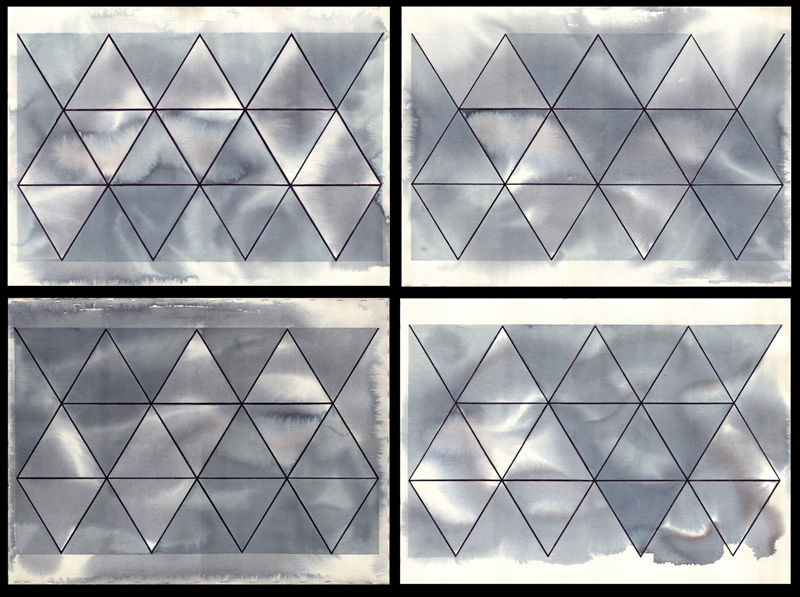
The aesthetic beauty and symmetry of the Platonic Solids have made them a favorite subject of geometers for thousands of years. They are named for the ancient Greek philosopher Plato who theorized that the classical elements were constructed from five regular solids: the dodecahedron, icosahedron, octahedron, hexahedron and tetrahedron–there are no other possible regular polyhedrons. The 92 Johnson Solids are irregular polyhedrons which, as the Platonic Solids, are also made out of triangles, squares and pentagons.
The Platonic Scroll Series serve as analogy to our inter-connectivity and the imponderable quality of harmony that unify us. It is to be noticed that there is no set manner as to how these manifestations may be perceived by any observer. Our reality is ever so much more interesting than any image representing it or anything that can be explicated.
MN> The film My Dinner with Andre was recently canceled in Caracas.
RM> This is coincidentally one of my favorite movies of all times.
MN> There is also “Wings of Desire” (Der Himmel über Berlin), one may see them apart but with some connection…
RM> Having a profound impact during the Eighties, I came to own DVD’s for both of these films; you have just reminded me to view them again, like re-reading a good book. These days I seek a better understanding by reading J. Krishnamurti’s innumerable publications [Krishnamurti Foundation of America].
MN> Have you read through Osho Rajneesh? or traditional G.I. Gurdjieff? There is another movie kind of interesting Meeting with Remarkable Men by Peter Brook…
RM> I understand that in either instance leadership and methodology overshadow search for truth.
MN> That is right but the info is all about the same methods for increasing your consciousness…Sufi and new Indian…Interesting comments found on Powels book Gurdjieff. Also a very interesting approach to the knowledge in Ouspensky’s Fragments of an Unknown Teaching…
RM> I am mostly leery of anyone who pretends the attainment of truth through a technique, a method or a system, a belief or a dogma, for in doing so he/she succumbs to divisiveness. As much as I admire Krishnamurti, I don’t follow anyone’s authority: neither Jesus’, nor Muhammad’s, nor Buddha’s and much less any ashram’s or famous guru’s. I find it useful to recall a quote from J.K. which is very much apropos: “Beauty (truth) is in experiencing, not in experience. Reality has no resting place.” The understanding I take is that our collective past does not belong to anyone, though knowledge of it may be useful to establish its limits.
MN>Yes, the path is the one taken by a mind alone; I do share the same perspective about freedom. I used to say to my friends that I was a man of no land and no heroes.. or maybe not only was I mentally ill but, perhaps, socially disabled. It is very pleasant to communicate with you. In rare occasions does one truly have a dialogue.
RM> You meant not inclined to gregariousness, as opposed to socially disabled or unsociable. Though disability in terms of sociability is tantamount to the inability of compassion, I do see you as a most compassionate human being.