Posts Tagged ‘aging’

“Memories”

September 16, 2025

Author’s Note

Written years apart, Intervals and Memories reflect different moments of reckoning. Each stands on its own.

Ricardo Morín

September 14, 2016

New York City.

Memories

We are mirrors of the people in our lives, and through them we come to know ourselves. When I see you, I see myself also. To be vulnerable is to admit our fears and limitations. To grow is to accept them and other things as well—even that we are moving to the rhythm of a diverse and chaotic universe. Infinity is vast and varying time loses its hold.

Aging is part of the cycle that gives us birth and death. These are expressions of life. At every moment we end and begin anew. We let go of our ambitions so that we can live in the present. Our mind resists this and clings to the idea of independence, that it can re-create even itself.

Yet, the universe is a whole and we are part of it. We are free as persons, but never apart from that around us. Loneliness may be built into us and the mind may be in exile, but no barrier separates from the whole.


“The Seventh Watch”

August 6, 2025

*


Ricardo Morin
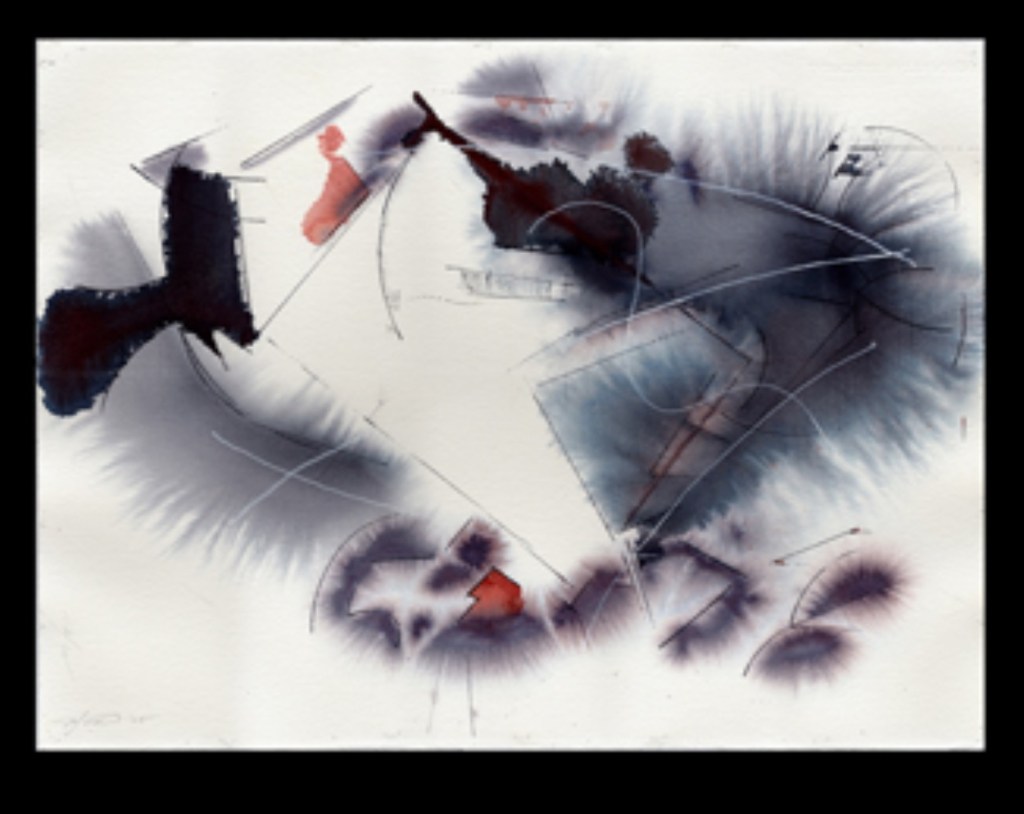
The Seventh Watch
(Template Series, 5th panel)
Watercolor over paper
22” x 30”
2005

Introductory Note

Ricardo Morin is a writer and researcher of the history of thought as a dynamic and evolving practice—a student of unspoken gestures, a language stronger than words, especially when interlocutors no longer listen to each other. Drawing on reflections on the cycles of life and a personal experience approaching the last, he invites readers to consider how quiet vigilance and tenderness can shape a meaningful existence. The Seventh Watch emerges from decades of living attentively, offering a humble testament to dignity through perseverance and care.

71 Years

I’ve lived seventy-one years. That alone still surprises me—not because I ever expected an early end, but because each year has asked more of me than the last. There was no dramatic fall, no single crisis to point to. Just a slow, constant shaping—of the body, of temperament, of the will.

Illness didn’t come in childhood. It arrived later, in my early twenties, during a snowbound winter in Buffalo. I was just beginning to live on my own, full of ambition and unfinished dreams. The diagnosis was mononucleosis—but it wasn’t the name that mattered. It was the way it interrupted momentum, slowed my pace, and revealed something deeper: the lifelong task of learning to live within my own limits.

That was the beginning—not of a medical history, but of a different kind of vigilance. Not directed outward, but inward. A quiet realization took root: that survival, if it was to be meaningful, required not just endurance, but restraint. A way of protecting myself from myself. That discipline wasn’t harsh—it became a kind of devotion. Not to self-denial, but to finding the clarity of a peaceful mind. To living with more care than urgency.

I don’t see illness as noble, but I do see in it a mirror—not for the pain, but for the truth it reflects. What can be tended, what must be relinquished, what deserves attention. I don’t claim wisdom from illness, but I recognize what it’s taught me to let go of: illusion, pride, and the frantic chase after things that do not last—such as the accumulation of wealth or power.

I’ve come to think of it simply as endurance—the kind illness teaches when you stop resisting and begin listening. There’s an ethical arc in this awareness—not born of dogma or belief, but shaped by experience. It bends not toward triumph, but toward tenderness.

This isn’t a story of pathology. It’s a story of attention—of refining the self without hardening it. Of discovering that maturity means knowing when to persist and when to pause. That the quiet act of sustaining one’s life—daily, attentively—is its own form of courage.

I never set out to write a testament. But seventy-one years in, I see the outlines more clearly. And in that, there is dignity.

Yet, dignity is not a reward. It arrives without announcement, without ceremony. It builds slowly—through the daily rituals of rising, of choosing what to carry and what to set down. It does not shield one from sorrow, nor make suffering easier to bear. But it gives the days a certain weight.

I’ve come to cherish that weight—not as a burden, but as proof. Proof that I’ve lived through each season not untouched, but intact. And that, even now, the task is not to escape life’s demands, but to meet them with steadiness.

What I’ve learned isn’t mine alone. Anyone who lives long enough will be asked to reckon with time—not as a thief, but as a sculptor. Illness, especially, teaches us how little control we truly have—yet how much presence we’re still capable of. It humbles and joins us. Not in sameness, but in mutual recognition.

Endurance, I’ve found, is not passive. It’s not about waiting for pain to pass. It is active, quiet, often unseen. It means choosing how to live when choice feels narrow. It means tending to life not with haste, but with attention.

There is no finish line to this work. Just the quiet act of continuing.

So I continue—not because I must, but because life, even in its reduced dimensions, still offers room for meaning. Some days that meaning is faint. Other days it is simply the act of rising, or writing a letter, or remembering the snow. But it is there. And as long as it is, I remain.

*


“Listening Beyond the Trance: …

July 21, 2025

… Reassessing Krishnamurti in Later Life”

by Ricardo Morín
July 2025

Ricardo Morin
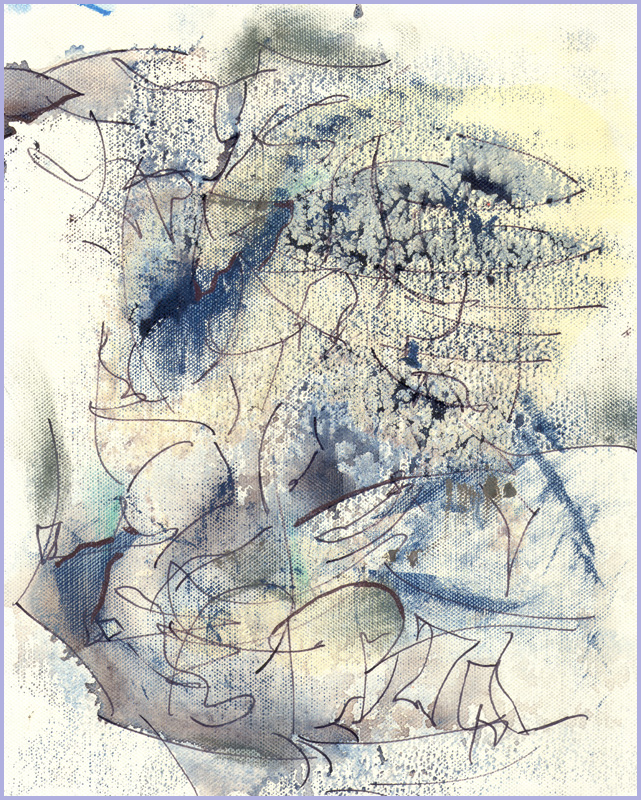
Infinity 6
12” x 15”
Oil and ink on linen
2005

*

Abstract

This reflective essay reconsiders the thought of Jiddu Krishnamurti through the lens of aging and evolving philosophical expectations. While Krishnamurti’s teachings once offered inspiration and a path toward inner freedom, they now appear to dissolve into rhetorical mysticism and incoherence. The essay critiques his rejection of “intellectual understanding” and analyzes the contradictions inherent in his style of spiritual discourse. It argues for the necessity of rational clarity, especially in later stages of life when discernment becomes more valuable than inspiration alone. This shift is presented not as a betrayal of earlier insight, but as its maturation.

“Listening Beyond the Trance: Reassessing Krishnamurti in Later Life”

In my forties and fifties, I found great inspiration in the thought of Jiddu Krishnamurti. His emphasis on freedom from authority, his critique of systems, and his call to radical self-awareness spoke directly to a part of me that sought liberation from inherited dogmas and psychological conditioning. He offered, or seemed to offer, a clarity beyond tradition—a voice that felt both universal and personal.

But now, in my seventies, I find myself rereading his words with a different ear. What once felt revelatory now strikes me as elusive, at times incoherent. A recent passage shared by the Krishnamurti Foundation, drawn from a 1962 public talk in New Delhi, crystallized this shift for me:

“There is no such thing as intellectual understanding; you really only mean that you hear the words, and the words have some meaning similar to your own, and that similarity you call understanding, intellectual agreement. There is no such thing as intellectual agreement – either you understand or do not understand. To understand deeply, with all your being, you have to listen”.

This line of thinking—expressed in varied forms across his oeuvre—once felt like an invitation to presence. Now, I hear it differently: as a kind of rhetorical mysticism that dismisses the very faculties we depend on to make meaning. The claim that “there is no such thing as intellectual understanding” is not merely provocative; it is self-undermining. If words cannot convey meaning through reason, then why speak? Why write? Why gather an audience at all?

Krishnamurti’s sharp dichotomy between “intellectual” and “real” understanding collapses under scrutiny. Intellectual reflection is not merely passive recognition of familiar ideas. It is the groundwork of discernment—of logic, dialogue, and ethical clarity. To discard it is to unravel the very possibility of communication. What he seems to offer instead is a kind of pure, undefinable receptivity—“listening with all your being”—a state left vague, idealized, and unexamined.

This tendency is not unique to Krishnamurti. It is a feature of a broader strand of Indian and global spiritual discourse that wraps itself in the aura of wisdom while resisting the discipline of logic. It blurs the line between paradox and nonsense, invoking transcendence but offering no clear ground. What results is not insight but opacity.

None of this erases what Krishnamurti once offered me. His call to question, to observe without prejudice, helped me unlearn many habits of thought. But inspiration and clarity are not the same. The mind that once needed liberation may later need precision.

We change. What moves us at one stage of life may lose its grip as our questions evolve. That does not make earlier experiences false—it simply means that our standards grow. In listening now, I want something more than the echo of profundity. I want coherence. I want meaning that can stand up to thought.

Krishnamurti taught me to listen. That lesson remains. But now, I listen not only with receptivity—but with reason, with discernment, and with the quiet courage to call abstraction what it is.

*


Annotated Bibliography:

  • Krishnamurti, Jiddu: The First and Last Freedom. San Francisco: Harper & Row, 1954. (A collection of early talks that established Krishnamurti’s core ideas; includes his foundational argument against psychological authority and tradition.)
  • ———: Commentaries on Living, First Series. Madras: Krishnamurti Foundation India, 1956. (Brief philosophical dialogues drawn from real encounters; written in prose that oscillates between clarity and metaphysical opacity.)
  • ———: The Awakening of Intelligence. New York: Harper & Row, 1973. (A comprehensive transcript of public discussions and interviews where Krishnamurti expands his rejection of intellectual systems and explores “pure observation.”)
  • ———: The Wholeness of Life. London: Victor Gollancz, 1978. (A late-career synthesis that juxtaposes technological anxiety with inward freedom; his critique of organized thought becomes more abstract here.)
  • ———: Krishnamurti to Himself: His Last Journal. San Francisco: Harper San Francisco, 1987. (Dictated reflections shortly before his death; his rejection of analysis deepens and borders on mysticism, with lyrical but imprecise language.)
  • ———: The Ending of Time: Where Philosophy and Physics Meet. San Francisco: Harper & Row, 1985. (Conversations with physicist David Bohm; illustrative of Krishnamurti’s dismissal of conventional logic even when in dialogue with a scientist.)
  • Murti, T. R. V.: The Central Philosophy of Buddhism: A Study of the Mādhyamika System. London: George Allen & Unwin, 1955. (A key work in Buddhist philosophical reasoning; useful contrast to Krishnamurti in that it pursues dialectical rigor rather than mystical generality.)
  • Ganeri, Jonardon: Philosophy in Classical India: The Proper Work of Reason. London: Routledge, 2001. (Challenges the stereotype that Indian thought is mystical or anti-rational; highlights traditions that value analysis and inference over insight alone.)
  • Nussbaum, Martha C.: Cultivating Humanity: A Classical Defense of Reform in Liberal Education Cambridge, MA: Harvard University Press, 1997. (Advocates for clarity, rational argument, and intellectual pluralism; offers a counterpoint to Krishnamurti’s anti-intellectualism.)
  • McGinn, Colin: The Making of a Philosopher: My Journey Through Twentieth-Century Philosophy. New York: HarperCollins, 2002. (A memoir that models the philosophical maturation process; echoes the author’s own shift from inspiration to the pursuit of clarity.)

*


“Unattainable Gestures”

June 14, 2025

“Echoes of a life devoted to the elusive”

*


Ricardo F Morin
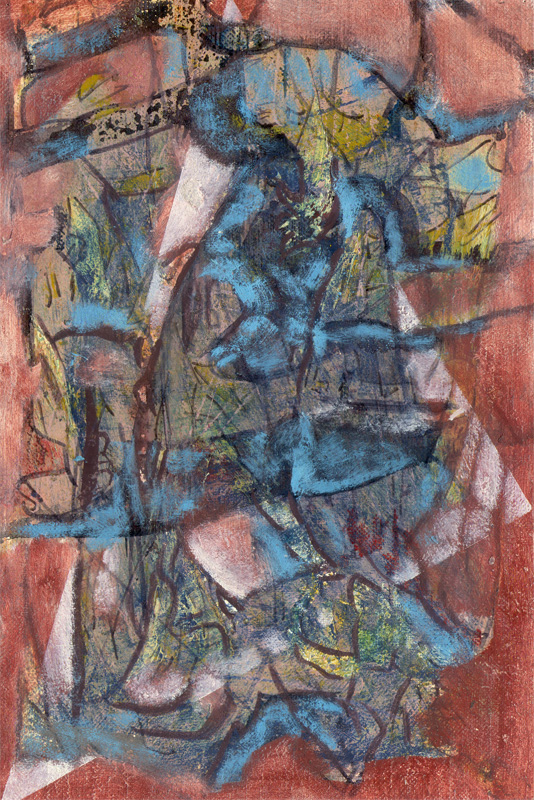
Triangulation Series Nº 38
9” x 13”
Oil on linen
2009

*

In memoriam José Luis Montero


For him, inspiration didn’t strikeit settled.    It arrived not with answers, but with permission to begin.

There was no ritual.    No dramatic turning point.    Only the canvas, the scent of oil, the shifting light across the floor.    One day folding into the next, until the work became its own weather—sometimes clear, sometimes stormy, but always present.

He believed in attention, not mastery.

What moved him wasn’t how the painting was achieved at any given moment, but when deconstructed he had to reclaim it, not out of skill, but out of necessity—when the hand moved before thought, and something more honest than intention began to lead.    And when it happened, it asked everything of him.

Any one watching—anyone but him—would have seen very little.    A trace.    A pause.    A slight adjustment.    But inside, something in him was listening—not to himself, but to the world, the material, the echo of a form not yet known.

He didn’t make work to be remembered, though he carried each piece like a child of his.    He made it to stay alive.    And when he encountered a finished painting years later, it stirred him physically.    It wasn’t nostalgia.    It was the smell of pigment, the sound of bristles, the grief of something nearly realized—lost, then found again.

Some days, the work moved with a kind of ease.    Other days, it refused.    He learned not to chase either.

He always began without knowing what he was after.    A shade.    A flicker of transparency.    A stroke that unsettled the surface.    Often the brush would stop midair, suspended while he waited for the next move to reveal itself.    Sometimes nothing came.    Those pieces sat untouched for weeks—a quiet unease in the corner of the room.

He lived alongside their silence.

The studio was never clean, but always ordered.    Rags folded.    Jars fogged with old turpentine.    Walls bearing soft outlines of past canvases.    The mess wasn’t careless.    It was lived-in—not careless, just lived-in.    Notes of Goethe’s pyramidal harmony hung besides mineral samples, sketches, color wheels, torn letters from art dealers.    Not for revelation—but for proximity.

Not every piece held.    Some failed completely.    Others, losing urgency layer by layer, failed gradually,    He kept those too—not as records, but as reminders.    Where the hand had gone quiet.    Where the work had ceased to ask.    Yet they became platforms—spaces for later returns, for deeper entry.

His days had no fixed schedule, though a rhythm formed over the years—a long devotion, interrupted, resumed, endured.

Now, he arrived late morning from the City.    The studio held the faint scent of wax and turpentine, laced with something older—dust, fabric, memory.    He opened a window if weather allowed.    Not for light but for air.    For movement.    For the slow turning of the fans like breath.

He made tea.    Sometimes he played Bach, or a pianist, whose fingers pressed deeper into the keys than others.    Other mornings:    National Public Radio.    A poet, a scientist, someone trying to say the impossible in ordinary words.    He liked the trying more than the saying.

He painted standing—rarely seated.    Some days he moved constantly between easel, sink, and mixing table.    Other days he barely moved at all.    Just watched.

Lunch was simple.    Bread.    Fruit.    A little cheese.    Sometimes eggs, lentils, soup across several days.    He didn’t eat out much—not out principle, but because it broke the thread.

If tired, he would lie on the couch at the back wall.    Twenty, thirty minutes.    No more.    And when he woke, the light had shifted again—slanted, softened, more forgiving.    The canvas looked changed.    As if it had waited for his absence.

Late afternoons were often the best.    A second wind, free of pressure.    There was a looseness in the air, born from knowing no one would knock or call.    He spoke to the work then—not aloud, but inwardly.    This tint?    Too warm.    This stroke?    Too sure.    Let it break.    Let it breathe.    Let it speak without saying.

Sometimes the medium resisted.    A brush faltered.    A gesture collapsed.    He didn’t fight.    He gave it space.    If he stayed patient, it found its rhythm again.

Not everything reached completion.    Some works remained opennot abandoned, simply finished enough.    Others came suddenly, like music that plays without lifting the fingers.

By evening, he cleaned his tools.    Never rushed.    He wiped the palette.    Rinsed the jars.    Hung the rags to dry.    It was a kind of thanks.    Not to the painting.    To the day.

Then lights out.    Door closed.    Nothing declared.    Nothing completed.    Yet something always moved forward.

Grief, too, remained.    It lived in the room like dust—settled in corners, clinging to stretchers still bare, woven into old white sheets.

His sister’s illness came slowly, then all at once—while Adagio in G Minor played low across the studio.    He painted through it.    Not to escape, but because stopping would have undone him.    In the silence between strokes, he could feel her breath weakening.    Sometimes he imagined she could see the work from wherever she was.    That each finished piece carried a word he hadn’t dared to say aloud.    She would have understood.    She always had.

Later, when his former lover died—alone, unexpectedly, in Berlin—he stopped painting altogether.    The studio felt still in a way he couldn’t enter.    Even the canvas turned away from him.    When he returned, it was with a muted palette.    Dry.    Indifferent.    The first brush stroke broke in two.    He left it.    And continued.

Desire, too, had quieted.    Not vanished.    Just softened.    In youth it had been urgent, irrepressible.    Now it hovered—an echo that came and went.    He didn’t shame it or perform it.    He lived beside it, the way one lives beside a field once burned, now slowly greening.

Grief didn’t interrupt the work.    It deepened it.    Not in theme—but in texture.    Some of those paintings seemed familiar to others.    But he knew what they held—the weight of holding steady while coming apart inside.

Even now, some colors recalled a bedside.    A winter walk.    The sound of someone no longer breathing.    A flat grey.    A blue once brilliant, now tempered between longing and restraint.

He wondered sometimes about that tension.

But when he painted, stillness returned.

Seventeen years ago, when chemotherapy ended, the days grew quieter.

There was no triumph. Just a slow return to rhythm—different now.    The body had changed.    So had the mind.    He couldn’t paint for hours without fatigue.    The gestures once fluid were heavier, more tentative.

He didn’t resist it.

The studio remained, but the center of gravity shifted.    Where once he reached for a brush, now he reached for a pen.    At first, just notes.    Fragments.    A way to hold the day together.    Then came sentences.    Paragraphs.    Not about himself, not directly.    About time.    Memory.    Presence.    Writing became a solace.    A way to shape what the body could no longer carry. A place to move, still, with care.

It wasn’t the end of painting.    Just a pause.    A migration.    Writing required its own attention, its own patience.    And he recognized in that a familiar devotion.

Sometimes, the canvas still called.    It would rest untouched for weeks.    Then one day, without announcement, he would begin again.

The two practices lived side by side.    Some days the brush.    Some days the page.    No hierarchy.    No regret.    Only the quiet persistence of a life still unfolding.

There is no final piece.    No last word.

He understands now:    a life is not made of things finished, but of gestures continued—marks made in good faith, even when no one is watching.    A sentence begun.    A color mixed.    A canvas turned to the wall—not in shame, but because it had said enough.

He no longer asks what comes next.    That question no longer troubles him.

If anything remains, it will not be the name, or the archive, or even the objects themselves.    It will be the integrity of attention—the way he returned, again and again, to meet the moment as it was.

Not to make something lasting.
But to live, briefly, in truth.

*

Ricardo F Morin Tortolero

Bala Cynwyd, Pa., June 14, 2025

Editor:    Billy Bussell Thompson


Author’s Note

This piece, like much of what I’ve made in recent years, exists because of those who have sustained me.

To David Lowenberger—whose love and steadfastness give my life its rhythm.    Without him, continuity itself would falter.

To José Luis Montero, my first art teacher, whose presence early on became a compass I’ve never stopped following.

To my parents, whose quiet influence shaped my regard for form, devotion, and care.

And always, to my friend and editor, Billy Bussell Thompson, whose voice lives quietly in mine.