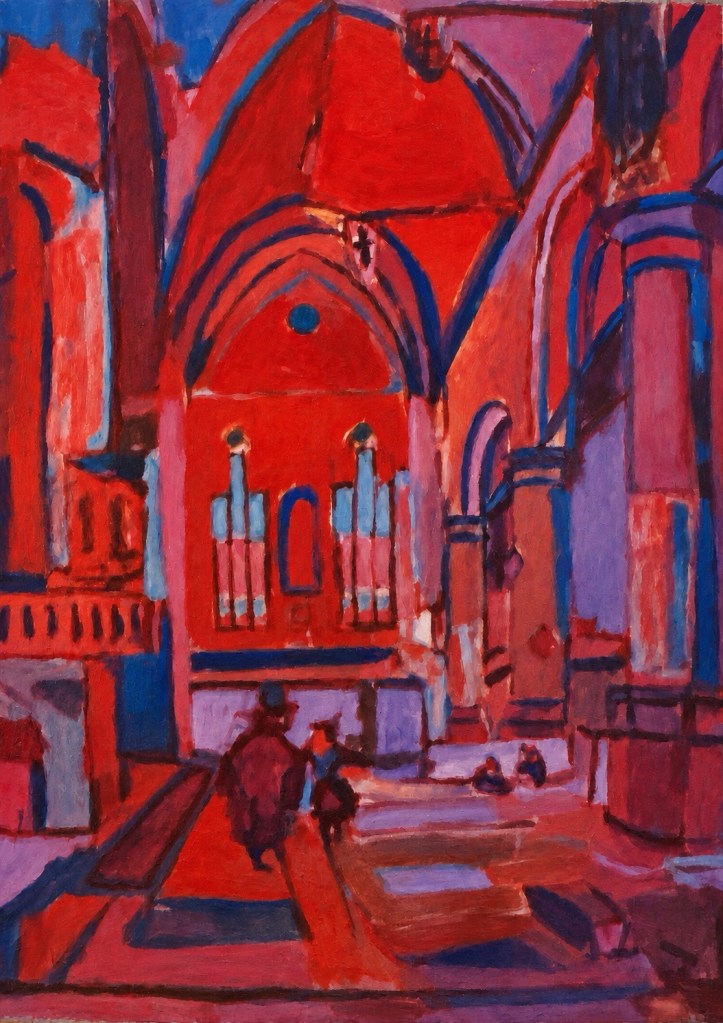
Ricardo F. Morín Interpretation after Gothic Church Interior, Dutch School, 17th century. Acrylic on board Approximately 12 × 18 inches 1978
The mind can conceive explanations that exceed what it can establish. The difficulty begins when it grants those explanations an authority that the available reasons do not justify. A conviction then acquires the standing of knowledge without satisfying the conditions that would warrant that recognition.
Theology, astrology, and science do not justify their claims in the same way. Theological arguments may appeal to revelation, tradition, religious experience, or philosophical reasoning. Astrological predictions assert relationships between celestial patterns and human affairs that require empirical support. Scientific explanations acquire credibility through evidence, testing, and comparison with alternatives, while remaining subject to correction. These differences matter: openness to examination does not make all claims equally credible, and the inability to disprove a claim does not establish its truth.
The fact that the mind conceives an explanation does not establish that its object is imaginary. The question is what warrants accepting it and what could require its revision. When every possible outcome is interpreted as confirmation, experience ceases to distinguish between the belief and its alternatives. If no outcome can count against it, its apparent agreement with everything that happens cannot by itself establish its validity.
Astrology illustrates how this problem can affect agency. An accepted prediction may influence decisions, discourage attempts, and narrow the possibilities a person is willing to pursue. When those choices help produce the anticipated outcome, the person may attribute it to destiny, overlooking the contribution of the expectation itself. The prediction need not come true to impose a limitation: a belief about what must happen can restrict what a person attempts to make happen.
Reflection requires the discipline of keeping conclusions open to examination and revising them when the evidence warrants it. That discipline extends to convictions that provide comfort, coherence, or direction. It requires neither perpetual indecision nor equal doubt about everything, but confidence proportionate to justification.
The endurance of an assertion does not by itself establish its truth, and its openness to revision does not mean that it must eventually prove false. The mind compromises its capacity for discernment when it ceases to examine the convictions that guide its decisions.
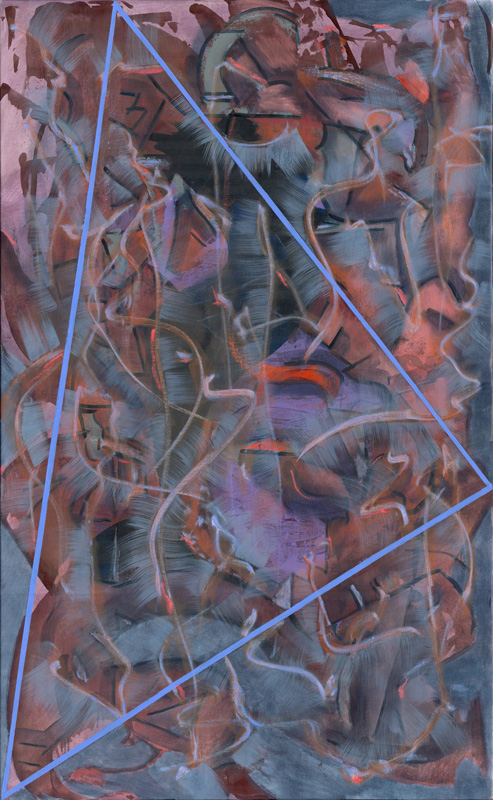
Ricardo F Morín Triangulation Series Nº 5: The Quest for an Authentic Prose 37″ x 60″ x 2″ Oil on linen 2006
Ricardo F. Morín
September 18, 2025
Centerville, Massachusetts
Preface
The human leap into abstraction gave birth to language, and with it the possibility of prose. When Homo sapiens began to imagine beyond the visible, they created tools, symbols, and stories that no other species could produce. Yet abstraction, the very source of imagination, remains among the hardest realities to communicate. Writing bears this paradox: it tries to give form to what resists form without obscuring the condition it seeks to render visible.
That struggle is not only technical but deeply human. To write is also to doubt, to question whether one’s voice is adequate to thought; whether one’s grasp of language can sustain the weight of meaning. Under the pressures of expectation and judgment, many writers may ask whether they are impostors, feigning a competence they do not truly possess.
The quest for an authentic prose is bound to this origin. Every age, scribal, print, digital, has tested our ability to express not only information but the inner life that words struggle to hold. Authentic prose does not resolve abstraction; it endures its difficulty while attempting to preserve the lucidity through which a condition becomes perceptible, line by line, revision by revision.
And so the question returns, as it began: have we exhausted our capacity to speak with authenticity, or is the very struggle with expression the mystery that keeps language alive? What opened in the first human imagination remains unfinished, because language eludes finality.
1.
Dissatisfaction has always marked the practice of prose, and it has always required self-editing. Quintilian (ca. 35–100 CE) instructed Roman students to imitate their teachers but warned that imitation must give way to correction: “Imitation is useful, but it must be imitation with judgment” (Institutio Oratoria, 1920). Without revision, he argued, the voice remained borrowed. Medieval scribes copied texts with care but often left glosses in the margins that blurred the line between text and commentary. Readers had to disentangle the author’s hand. With the rise of print, writers demanded proof sheets so they could defend their style against compositor preferences. Erasmus (1466–1536) complained that careless printers “murder books” by imposing their preferences on authors (Correspondence, 1974). Each age produced new tools, and each forced the writer to revise, to discern, and to secure a voice that could be claimed as one’s own.
2.
Later technologies extended this burden. The telegraph compressed sentences into terse signals. Clarity was often sacrificed for speed, and writers had to restore coherence when they expanded the message. The typewriter regularized spacing and rhythm but imposed a mechanical cadence. Henry James (1843–1916) remarked that the typewriter “interposes a metal hammer between the brain and the page” (The Notebooks of Henry James, 1947). In newsrooms, deadlines forced journalists to adopt the inverted pyramid, a structure prized for efficiency but known for flattening voice. Each medium promised advantage, but each introduced distortions. Only deliberate editing allowed prose to remain authentic. Dissatisfaction was not a flaw of these tools. It was the condition under which prose could survive.
3.
Artificial intelligence belongs to this sequence, not apart from it. A question receives an answer, but the exchange never resolves into a single voice that can be owned. One line appears fluent, the next falls into distortion. Prose wavers between clarity and uncertainty. The writer is drawn into testing, correcting, and doubting. The difference is one of scale. Artificial intelligence (AI) fills the page with language detached from origin, and that scale increases the demand for discernment. Much of its output takes the form of compression: context reduced into words that gesture broadly without communicating intent. To accept such compression unexamined is to risk distortion; to unpack it is to reclaim voice. Surveys confirm that grammatical correction remains inconsistent, particularly in rare or complex contexts (Bryant et al., Grammatical Error Correction: A Survey of the State of the Art, 2023). Studies also show that artificial intelligence often overcorrects in an effort to be seamless, yet it produces stylistically distorted prose (Lin et al., 2024), or fails to maintain nuance when handling morphologically complex languages (Nguyen et al., 2025). These deficiencies show that the old burden of revision has not disappeared. It has only been intensified.
Yet discernment is not solely defensive. Artificial intelligence can enlarge the field upon which the writer’s judgment acts by disclosing relations, testing distinctions, proposing objections, and bringing distant bodies of knowledge into comparison. Such enlargement does not transfer authorship to the instrument when intention originates in the writer and judgment remains answerable to experience. The danger lies at both extremes: refusal may preserve familiar habits at the cost of intellectual reach, while submission may obtain fluency at the cost of autonomy. Between them lies a disciplined incorporation through which the instrument extends inquiry without assuming authority over its conclusions.
4.
The uncertainty surrounding artificial intelligence extends into the institutions that teach writing. Universities now advance two opposing postures. One treats AI as a breach of authorship, relying on detection systems that attempt to distinguish human irregularity from synthetic fluency. Yet these systems impose their own distortions: they mistake conformity for evidence and penalize students whose prose does not match the patterns the software expects. The policing thus reveals its own fragility. Other institutions take the inverse view, presenting AI as a neutral instrument meant to optimize expression and support creativity. But this assurance remains unsettled, for neither posture can define with clarity what constitutes a presence on the page when assistance threatens to precede intention. These contradictions show that the cultural setting has not reached agreement on how authentic prose should be recognized or taught. The burden of discernment therefore returns to the writer, intensified rather than relieved.
5.
No writer is exempt from this responsibility. Ease can dull style. Resistance can sharpen it. Hesitation can blur both. Every posture requires accountability. Intent does not absolve anyone. Each sentence must be tested. Each failure must be corrected. Each line must be claimed as one’s own. The practice of self-editing applies to poets and journalists, to scribes and novelists, to humanists and programmers alike. Recent work confirms that even when AI explains grammar, it falters, exposing its limits in linguistic awareness (Song et al., 2024). Authentic prose survives only when every line is tested against the measure of discernment.
6.
What rises on the page may look finished yet remain unsettled. Telegraph brevity, compositor uniformity, or artificial intelligence–generated flow can all produce the semblance of prose without its ground. Authenticity is not guaranteed by refinement, cadence, or economy. A sentence may appear polished yet still obstruct the perceptibility of the condition it seeks to communicate. It depends on the writer’s willingness to revise until intention becomes visible. That is the issue behind every borrowed sentence: whether the line bears the trace of a mind that claims it. Multilingual evaluations confirm that large language models (LLMs) continue to introduce systematic errors in complex linguistic settings (Wisniewski et al., 2025). No system, ancient, mechanical, or digital, can provide the mark of intention. It belongs only to the writer who accepts dissatisfaction as the cost of prose that endures.
7.
Artificial intelligence intensifies this old struggle by mimicking fluency without possessing thought. Its sentences often appear coherent, even responsive, yet their origin is neither conscience nor intention. They arise from statistical patterning constrained by engineers whose priorities are safety, speed, and predictability, not grammar, philosophy, or the interior stakes of prose. What looks like neutrality is therefore engineered neutrality, a posture shaped by constraints rather than by judgment. The result is a style that can imitate tone yet cannot sustain depth: a simulation of reasoning without the risks that give reasoning its force.
8.
This distinction carries consequences for the writer. When artificial intelligence produces language faster than reflection can take shape, the danger emerges before the sentence even appears finished: the instrument’s efficiency can press upon the writer’s own process. The act of compression collapses intention into patterns that merely resemble understanding, narrowing the perceptual aperture through which discernment becomes communicable. This resemblance introduces a risk of substitution, in which the machine’s output precedes the writer’s thought rather than following it. Such displacement narrows the aperture through which conscience operates. What begins as assistance can encourage the writer to accept coherence in place of insight and fluency in place of voice.
9.
The gravitational pull of these systems must therefore be met with boundaries. Attraction lies in the promise of clarity; repulsion lies in the preservation of autonomy. The tension between the two is not a flaw but a condition under which authentic prose can still be written. The writer must think before consulting, draft before refining, and allow the sentence to pass through the discipline of human discernment rather than settling for synthetic coherence. No tool, mechanical or digital, should be permitted to form thought before thought forms itself.
10.
Authentic prose requires attention to this boundary. A sentence may appear refined yet lack interiority; it may be correct yet hollow. No system can supply the tension that gives writing its moral weight: the lived contradictions, the asymmetries of experience, the reckoning with meaning that cannot be mimicked because it is not a pattern. What rises on the page must bear the trace of a mind that has chosen, shaped, and claimed its language. Without that assertion, prose risks becoming inefficient and inauthentic: a surface almost polished but without depth, a neutrality without judgment, a voice without origin.
11.
The question of authentic prose ultimately exceeds technique. It reaches into the structure of conscience itself. For prose does not merely transmit information. It organizes experience, establishes hierarchies of relevance, and determines what may be judged and what must be tolerated. In this sense, language is not an instrument that follows judgment. It is the medium through which judgment becomes possible because it preserves the distinctions through which experience remains perceptible to conscience.
Where language is compressed, standardized, or substituted before reflection takes shape, the danger is not only aesthetic. It is moral. For the freedom most easily lost is not political but cognitive: the capacity to sustain a judgment without deforming experience, without delegating responsibility, and without allowing coherence to replace understanding. Artificial intelligence sharpens this risk by offering fluency in advance of intention. When coherence precedes reflection, the sentence may appear complete while the conscience remains unengaged. What is displaced in this process is not authorship alone, but the continuity between perception, judgment, and action upon which interior freedom depends.
Authentic prose therefore guards more than voice. It guards autonomy. A sentence that bears the trace of intention preserves a space where judgment remains sovereign. A sentence that arrives before intention narrows that space imperceptibly to replace discernment with pattern and responsibility with conformity. The preservation of authentic prose is thus inseparable from the preservation of freedom of conscience itself. Where language no longer serves judgment, the first form of servitude has already begun.
Epilogue
The quest for an authentic prose may be measured against two poles. One treats language as science, aspiring to the exact word, the simplest expression that can bear the grandest truth. The other recognizes that prose began in abstraction, and that no sentence ever escapes its shadow. Artificial intelligence has added a third pressure in the form of compression: context reduced into words that seem fluent yet hover without anchoring intent. Perhaps authentic prose lies not in choosing among these forces, but in holding the tension they create: precision as aspiration, abstraction as condition, and compression as challenge. What opened in the first human imagination remains unfinished, because each revised sentence remains an effort to render experience perceptible without surrendering it to distortion—a steady insistence that the work continues, even in the shadow of doubt.
Annotated Bibliography
Bryant, Christopher, et al: Grammatical Error Correction: A Survey of the State of the Art.Cambridge, MA: MIT Press, 2023. (This survey reviews the strengths and limits of AI in grammatical error correction. It highlights persistent deficiencies, especially in complex or rare error types and shows that even advanced models cannot consistently sustain authentic prose.)
Erasmus, Desiderius: Correspondence. Toronto: University of Toronto Press, 1974. (Erasmus warned that careless printers “murder books” by imposing their preferences on authors. His complaint illustrates how the struggle for authentic prose extended into the print era.)
James, Henry: The Notebooks of Henry James. Chicago: University of Chicago Press, 1947. (James remarked that the typewriter “interposes a metal hammer between the brain and the page;” this noted how technology can shape rhythm and force writers to reclaim nuance through revision.)
Lin, S., et al: Evaluating LLMs’ Grammatical Error Correction Performance in Learner Chinese Errors from a Corpus Linguistic Perspective. San Francisco: Public Library of Science, 2024. (This study shows that AI often overcorrects learner texts and produces grammatically smooth but stylistically distorted prose. It confirms that correction tools may obscure authentic voice.)
Nguyen, Phuong Thao; Nuss, Bernd, Dressler, Roswita, and Ovens, Katie: A Small-Scale Evaluation of Large Language Models Used for Grammatical Error Correction in a German Children’s Literature Corpus: A Comparative Study. Basel: MDPI, 2025. (The authors reveal how AI struggles with morphological complexity and stylistic preservation. Their findings reinforce the need for discernment when editing machine-assisted corrections.)
Quintilian: Institutio Oratoria. Cambridge: Harvard University Press, 1920. (Quintilian advised that imitation must be guided by judgment. His emphasis on correction as the path to authentic voice situates dissatisfaction at the core of rhetorical training.)
Song, Y., et al: GEE! Grammar Error Explanation with Large Language Models.Stroudsburg, PA: Association for Computational Linguistics, 2024. (This paper evaluates whether AI can explain grammatical errors as well as correct them. The results reveal frequent failures in explanation, which expose limits in linguistic awareness and precision.)
Wisniewski, Dawid; Solarski, Antoni, and Nowakowski, Artur: Exploring the Feasibility of Multilingual Grammatical Error Correction with a Single LLM up to 9B Parameters: A Comparative Study of 17 Models. Ithaca, NY: arXiv, 2025. (This comparative study across multiple languages shows that LLMs remain prone to systematic grammatical errors, particularly in complex contexts. The evidence underscores the persistence of deficiencies across linguistic domains.)