*
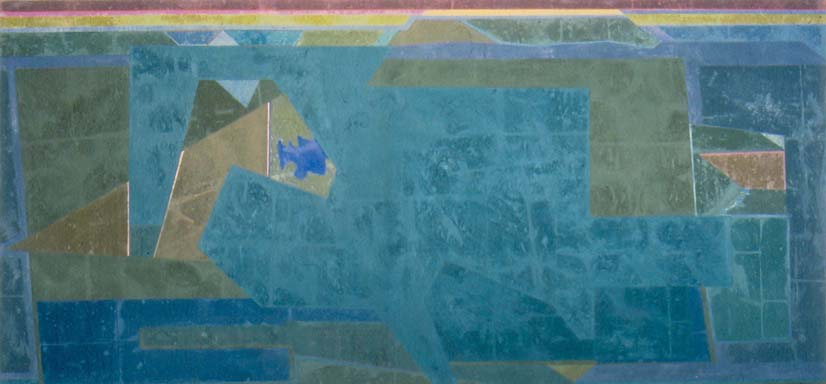
Buffalo Series, Nº 6
36″ x 78″
Oil on canvas
1979
Preface
People often discover that events far beyond their immediate surroundings affect their lives in ways they neither anticipated nor controlled. A shortage appears in a local store because production has been interrupted elsewhere. A disease emerges in one region and reaches another. A decision taken in a distant capital alters conditions for people who had no part in making it. Weather patterns shift, prices change, technologies spread, and consequences arrive from places most people will never see.
Such experiences belong to a world in which many of the processes shaping daily life extend beyond local communities. Families, neighborhoods, towns, and nations remain affected by forces that originate beyond them.
The circumstances in which human societies live have repeatedly encountered conditions that exceeded the reach of existing practices and expectations. Trade connected distant regions. Political territories expanded beyond local communities. Industrialization linked livelihoods to economic processes operating far from where those livelihoods were sustained. In each case, people confronted realities larger than those for which many inherited arrangements had originally been developed.
Historical responses varied. Some commercial and governmental institutions adapted gradually. Others resisted change until circumstances imposed it. Some expanded their reach while preserving older assumptions. Others generated new practices and new forms of organization. No single pattern governed these transitions. What remained constant was the encounter between inherited arrangements and conditions that had outgrown them.
Whether contemporary conditions belong to this historical pattern, or whether they represent something different, remains uncertain. At issue is not a preferred outcome, but the extent to which the reach of circumstance continues to exceed the assumptions, expectations, and arrangements through which societies understand and respond to it.
The puzzling question matters because familiar ways of organizing collective life often persist after the circumstances that gave rise to them have changed. Practices that once addressed the conditions people faced may continue long after those conditions have been altered by new technologies, new forms of exchange, new patterns of movement, and new forms of interdependence. Whether inherited arrangements can still comprehend circumstances whose reach has changed is not merely an abstract question. It bears on how societies understand the challenges before them and the range of responses available to them.
Ricardo F. Morin
June 3rd, 2026
Bala Cynwyd, Pennsylvania
I. Routes: Circumstances in Motion
Circumstances do not remain where they originate. The conditions shaping a community’s life rarely arise entirely within that community. They arrive through paths established for other purposes, across distances no single traveler encompasses, and over periods no single generation witnesses in full. Movement extends the reach of circumstance beyond the boundaries of any local setting and carries with it more than those who first set it in motion anticipated or intended. Goods travel, but so do the conditions that produce them, the diseases that accompany them, and the beliefs that give them meaning. People move, but so do the arrangements they carry within them and the circumstances they encounter along the way. Ideas cross boundaries that armies cannot always cross, and diseases pass through barriers that neither commerce nor diplomacy can fully seal. The significance of routes lies not in motion alone but in what motion makes possible: the entry of one circumstance into a setting where it had not previously been present. The reach of circumstance begins with motion.
Long before large states, industrial systems, or modern means of communication existed, overland routes connected communities separated by vast distances. The network of paths crossing Central Asia, known in later centuries as the Silk Road, consisted not of a single road but of multiple corridors traversing deserts, mountain passes, and steppe grasslands across Eurasia. Caravans moved between regions whose languages, religions, political arrangements, and ecological conditions differed profoundly from one another. No merchant occupied the entire network, and no political authority administered it in its entirety. Yet circumstances originating in one region entered the lives of populations living far beyond it. Silk moved westward. Horses moved eastward. Spices, glassware, and precious metals followed routes whose combined length exceeded the administrative reach of any empire that sought to govern them. Alongside merchandise traveled religious traditions, technical knowledge, artistic forms, and linguistic practices. The overland routes of Eurasia revealed that the reach of circumstance could extend across vast distances through the cumulative movement of many participants, none of whom controlled the whole.
Maritime routes extended that reach across different terrain. The Indian Ocean connected societies ranging from East Africa and the Arabian Peninsula to the western coast of India, the ports of Southeast Asia, and the southern coast of China. What made this network distinctive was not merely its geographic extent but the regularity of its operation. Seasonal monsoon winds established recurring patterns of movement, carrying vessels outward during one part of the year and returning them during another. Merchants, sailors, pilgrims, migrants, and travelers moved through the same maritime network across centuries, sustaining relationships among distant societies whose encounters gradually became part of the ordinary conditions of life in each of them. Goods traveled in large quantities, but so did languages, religious traditions, technologies, and commercial practices. Circumstances originating in one region entered others not through isolated contact but through recurring circulation that accumulated across generations. The maritime routes of the Indian Ocean revealed that the reach of circumstance could be sustained through continuity as much as through distance.
Oceanic routes carried the reach of circumstance further still. The Atlantic world that developed after the fifteenth century connected populations that had previously evolved in separation from one another across an ocean neither had previously crossed. Plants, animals, pathogens, technologies, and people crossed in both directions, but the consequences were distributed unequally across the societies involved. Environments were altered. Diets changed. Demographic patterns shifted on a scale that no previous exchange had produced. Labor systems were reorganized to serve production systems operating across oceanic distances. The oceanic routes of the Atlantic laid bare that the reach of circumstance could alter not only what communities possessed but the fundamental conditions under which they sustained themselves: their populations, their ecologies, and their arrangements for organizing work and distributing its products.
Certain routes acquire significance not merely because they connect distant regions but because multiple circumstances depend upon them simultaneously. Western Asia has functioned across many centuries as a crossroads through which routes linking Africa, Europe, Central Asia, and South Asia have repeatedly passed. Trade, migration, imperial expansion, religious transmission, and resource flows have converged upon the same corridors across successive periods. The Strait of Hormuz illustrates the enduring significance of such passages: a narrow body of water connecting the Persian Gulf to the Arabian Sea, has served for centuries as a point where the movement of goods, the projection of political authority, and the conduct of trade have repeatedly intersected. Circumstances affecting a single passage may alter conditions extending far beyond it. The importance of a strategic corridor lies not only in its location but in the range of relationships that depend upon its continued accessibility. The reach of circumstance becomes concentrated at such points in ways that render its dependence upon particular geographic conditions intelligible.
Information has always traveled through routes as surely as goods and people. Postal systems carried correspondence across empires and commercial networks centuries before modern communications existed. Telegraph networks in the nineteenth century altered the speed at which commercial, political, and military circumstances could be transmitted across distances that had previously required weeks or months to traverse. Broadcasting systems extended the reach of information further still, into settings that earlier communications had not penetrated. Digital networks have extended the movement of circumstance through informational pathways whose speed and scale differ from all previous systems. Circumstances travel through informational routes as they travel through physical ones: they enter settings where they had not previously been present and carry with them more than those who first transmitted them intended or anticipated. The speed of transmission changes. The reach of circumstance through routes of communication remains a constant of historical experience.
II. Entanglements: Circumstances in Relation
Circumstances rarely arrive alone. A disease follows commercial exchange. Migration follows conflict. Religious traditions accompany merchants, pilgrims, settlers, and conquerors. Crops alter diets, populations, labor systems, and patterns of settlement. Resources attract political authority, commercial investment, military protection, and competition. Movement, as the preceding inquiry has established, extends the reach of circumstance beyond its point of origin. But movement alone does not explain what happens when circumstances that originated separately enter the same field of experience. Once they intersect, they often become difficult to separate from one another. What began as distinct conditions becomes part of a single, if not always coherent, field. The reach of circumstance extends not only through movement but through relation. Circumstances become part of one another.
Disease seldom remains a medical circumstance alone. The Black Death, which followed commercial routes across Eurasia during the fourteenth century, did not arrive as a purely biological event. It traveled through a network of exchange already shaped by commercial, political, and demographic circumstances that determined where it spread, how quickly it moved, and what populations it encountered. Its effects accumulated through those relations. Labor arrangements changed because populations declined. Theological interpretations shifted because existing explanations proved inadequate to the scale of mortality. Political arrangements were destabilized in regions where administrative capacity depended upon populations that no longer existed in their previous numbers. Later epidemics revealed the same condition. Cholera moved through nineteenth-century commercial and imperial networks. Influenza followed the movement of populations during and after the First World War. HIV spread through patterns of migration and commerce across continents. Ebola exposed relations among ecological disruption, institutional capacity, and international response. COVID-19 revealed the entanglement of global supply chains, public health systems, political authority, and information circulation. Pathogens travel through circumstances already shaped by other circumstances. Their effects emerge through those relations as much as through the biology of the disease itself. The reach of a disease is inseparable from the reach of the circumstances through which it moves.
Migration alters populations, labor systems, languages, religious practices, cultural forms, and political arrangements in ways that no single cause produces and no single authority fully controls. Conditions at places of origin remain connected to conditions at destinations long after the movement itself has occurred. Remittances flow back along paths that migrants have traveled forward. Languages spoken in communities of arrival carry traces of the regions from which their speakers came. Religious practices transplanted into new settings encounter existing traditions and produce forms that neither setting would have generated alone.
The circumstances that produce migration are rarely singular. Environmental deterioration, economic displacement, political violence, demographic pressure, and military conflict often operate simultaneously, making the isolation of any one cause an analytical convenience rather than a historical reality. The circumstances that migration produces at its destinations are similarly varied. Labor market changes, institutional adaptations, cultural encounters, and political responses frequently emerge together and resist reduction to a single origin.
Migration makes it possible to recognize relationships that span multiple places and generations that outlast the original movement. The reach of circumstance through migration is measured not only in distance but in the duration of its effects upon the communities through which it passes.
Religious traditions do not travel alone. The spread of Islam across the Indian Ocean world, Central Asia, sub-Saharan Africa, and Southeast Asia was not a movement of belief in isolation from other circumstances. Languages accompanied it. Legal traditions developed alongside it. Educational institutions followed it. Commercial networks bore the tradition and were extended by its spread. Artistic forms, architectural practices, and systems of social organization traveled through the same pathways.
The spread of Christianity through the Atlantic world similarly carried languages, institutional forms, educational practices, legal concepts, and political arrangements into settings where those circumstances had not previously been present. Neither Islam nor Christianity arrived as a pure system of belief separable from the material and institutional circumstances with which each had become entangled in the course of its transmission. The circumstances accompanying religious traditions often outlasted the intensity of the original transmission and persisted in institutional forms, legal practices, and social arrangements long after the initial encounter had receded from immediate experience.
The reach of circumstance through religious transmission makes it possible to recognize that belief and institution, faith and organization, cannot always be separated from the wider field of relations through which they travel.
Food systems reveal the reach of circumstance through the most immediate conditions of daily life. Agriculture depends simultaneously upon climate, water, labor, transportation, trade, finance, and technology. No harvest is produced by a single circumstance. The voyages of Christopher Columbus altered diets, populations, environments, and economic arrangements across continents through the movement of plants, animals, and agricultural practices between hemispheres that had previously developed in separation. Maize, potatoes, tomatoes, and other American crops entered European, African, and Asian agricultural systems and altered not only what people ate but how populations grew, how labor was organized, and how land was used. Sugar production in the Americas reorganized labor systems across the Atlantic world, connecting the agriculture of one region to the commerce and consumption of others through relations that no participant in any single part of the system fully surveyed.
Food insecurity and famine frequently lay bare relations among environmental conditions, commercial arrangements, political decisions, and demographic pressures that resist attribution to a single cause. The Irish famine of the nineteenth century, the famines accompanying disruptions of colonial administration in South Asia, and the food crises of the twentieth century each demonstrated that the conditions shaping whether populations could sustain themselves were entangled with circumstances extending far beyond the fields in which crops were grown or failed.
The reach of circumstance through food systems makes clear how closely the necessities of daily life depend upon relations extending beyond the settings in which food is produced, exchanged, and consumed.
Energy systems reveal the reach of entanglement into the infrastructures upon which modern life depends. Coal altered the conditions of manufacturing, transportation, and urban life during the nineteenth century, concentrating populations, reorganizing labor, and producing consequences for health, the environment, and political organization that no single decision had anticipated. Oil extended those relations further, connecting the conditions of daily life in industrial societies to regions whose populations had no necessary relation to the consumption occurring elsewhere.
The dependence of transportation, manufacturing, agriculture, commerce, communication, and household life upon energy systems whose sources lie far from their points of use has made the entanglement of energy with other circumstances a persistent feature of modern historical experience. Disruptions in production, shifts in price, and conflicts over access to energy resources have repeatedly altered conditions well beyond the settings in which those disruptions originated. Production disruptions, price fluctuations, and conflicts over access to energy resources have repeatedly altered conditions far beyond the locations where those disturbances originated. The concentration of transport along a limited number of corridors renders distant economies dependent on geographical and political conditions beyond their control.
The reach of circumstance through energy systems makes clear how deeply the conditions of ordinary life depend upon relations extending across great distances.
Information systems alter the circulation of knowledge, belief, commerce, and political authority in ways that become entangled with the broader circumstances through which societies organize collective life. The introduction of printing in fifteenth-century Europe altered the conditions under which religious authority, commercial communication, legal practice, and political organization operated, not by replacing those circumstances but by entering into relation with them and altering the field in which they functioned. Telegraphy in the nineteenth century changed the speed at which commercial and political circumstances could interact across distances, producing relations between markets that had previously been separated by the time required for information to travel between them. Broadcasting extended the reach of information into domestic settings, entangling the circulation of belief, political authority, and commercial persuasion with the conditions of private life.
Digital networks and algorithmic platforms have extended those relations further, connecting identity, governance, markets, and social interaction through systems whose operations frequently exceed the awareness of those participating in them. Circumstances increasingly interact through systems of communication as well as through physical movement, producing relations whose origins and effects cannot always be confined to a single domain.
The reach of circumstance through information systems reveals that communication does more than transmit conditions. It becomes one of the conditions through which other circumstances interact.
Commercial exchange links production, transportation, labor, finance, consumption, and governance through relations extending beyond the awareness of individual participants. A garment produced in one region, from materials extracted in another, transported through systems organized in a third, sold in a fourth, and financed through arrangements originating in a fifth, concentrates within a single object the reach of circumstances distributed across multiple settings and multiple scales.
The supply chains through which contemporary commercial systems operate render visible relations extending far beyond the visibility of those who participate in any single part of them. Commercial circumstances intersect with migration, energy, disease, environmental change, and political authority in ways that make the effects of a disruption in one part of the system felt in settings with no immediately apparent connection to it. The financial arrangements through which commercial exchange is organized similarly distribute the effects of instability across populations that had no direct part in producing the conditions from which that instability emerged.
Exchange becomes part of a wider field of interconnected circumstances whose reach extends beyond the intentions of those who participate in it and beyond the arrangements any single authority has established to govern it. What the preceding sections allow us to recognize retrospectively through the lens of historical distance, artificial intelligence allows us to observe from a different vantage point in time.
III. Duration: Circumstance through Permutation
Some circumstances disappear. The conditions that produced them dissolve, the routes through which they traveled close, and the settings in which they operated transform beyond recognition. What remains may be little more than a trace in language, an architectural form, or a practice whose original context has become unrecoverable.
Others endure. They persist across centuries, surviving the political orders that first gave them institutional form, the commercial systems through which they first spread, the populations that first carried them, and the technologies through which they first operated. Those that endure rarely remain unchanged. A circumstance that persists across several centuries does not persist by remaining identical to what it was at its origin. It survives through successive transformations, assuming forms that its originators would not always recognize, operating through arrangements that differ substantially from those through which it first appeared, and producing effects in settings its first carriers never encountered.
Duration is not permanence. It is the capacity of a circumstance to remain identifiable across transformations that would, taken individually, appear to have altered it beyond continuity. The reach of circumstance extends not only through motion and relation but through time: through the ability of a condition to outlast the particular arrangements through which it first became visible.
Christianity emerged within the eastern Mediterranean world of the Roman Empire, among populations whose languages, political circumstances, and cultural forms were shaped by that specific historical setting. Its earliest institutions developed in relation to those conditions: the administrative structures of the empire, the philosophical traditions of the Hellenistic world, the legal practices of Roman governance, and the religious landscape of a region in which multiple traditions coexisted and competed.
Those conditions changed. The empire through whose administrative framework the tradition first spread eventually divided, contracted, and in its western portions dissolved into successor arrangements that differed substantially from what had preceded them. Christianity survived that dissolution and continued through the political arrangements that replaced it, adapting its institutional forms, its languages of worship and administration, and its relations to political authority as the conditions surrounding it changed.
Schisms altered its internal organization. Reformations challenged existing institutional arrangements and produced new expressions that contested the authority of older ones. Missionary expansion carried the tradition into settings whose populations, languages, and cultural forms differed profoundly from those in which it had first developed. Colonization entangled it with political and commercial circumstances unlike those accompanying its earlier expansion. Secularization altered the institutional position it occupied within societies where it had long been established.
Across these transformations, the circumstance remained recognizable, not because it was unchanged, but because continuity persisted through permutation rather than stasis. The reach of circumstance through duration reveals itself in the capacity to remain identifiable across conditions that would have made its original form unsustainable.
Islam emerged within the Arabian Peninsula during the seventh century and expanded across regions whose existing circumstances differed profoundly from those of its origin. Persian administrative traditions, African political arrangements, Central Asian steppe cultures, South Asian philosophical and religious systems, Southeast Asian commercial networks, and European intellectual and political formations each encountered the expanding tradition under different conditions and produced outcomes that varied accordingly.
Legal traditions diversified into schools of interpretation whose differences reflected the circumstances of the societies in which they developed. Political arrangements through which the tradition related to governance changed across regions and centuries, producing forms that differed substantially from one another while remaining recognizable as expressions of the same circumstance. Cultural expressions in architecture, literature, music, and visual art assumed forms specific to the settings in which they appeared, carrying the tradition into domains shaped by local conditions.
Islam persisted not through uniformity but through adaptation and differentiation. The circumstance remained identifiable across settings whose conditions differed as substantially from one another as the societies of West Africa, Central Asia, and Southeast Asia differed from the Arabian Peninsula in which it originated. Duration occurred through permutation rather than through the preservation of a fixed original form.
Commercial exchange long predates the institutional arrangements through which it has been organized in any particular period. The circumstance of organized exchange, the movement of goods between producers and consumers through systems that establish value, facilitate transaction, and distribute proceeds, has persisted across the full range of historical settings in which human societies have organized collective life, while the forms through which it has operated have changed repeatedly and substantially.
Markets, merchant houses, trading companies, joint-stock corporations, multinational enterprises, and the financial systems accompanying them differ in their organization, legal foundations, geographic reach, and relations to political authority. The methods through which exchange has been conducted have likewise changed. Barter gave way to coinage. Credit expanded the reach of transaction. Paper instruments, electronic transfer, and digital transactions altered the speed and scale at which exchange could occur. Accounting practices, ownership arrangements, investment structures, and the legal frameworks governing commercial claims underwent transformations that, taken individually, represented substantial departures from what preceded them.
Yet the circumstance of organized exchange endured through those transformations. It remained identifiable across settings that differ as substantially from one another as medieval merchant networks differ from contemporary commercial systems. Duration occurred through institutional transformation rather than through the preservation of any particular form.
Political authority has assumed forms across historical time that differ substantially in scale, organization, justification, and relation to the populations over which they exercised governance. City-states organized political life around concentrated urban communities. Kingdoms extended authority across territories defined by dynastic claims and military capacity. Empires incorporated diverse populations, languages, legal traditions, and administrative arrangements within structures whose geographic extent exceeded anything earlier forms had achieved. Federations distributed authority among constituent units through arrangements intended to balance local autonomy with the requirements of collective action. Colonial administrations extended political authority across oceanic distances, governing populations through arrangements designed to serve distant metropolitan centers. Nation-states organized authority around claims of shared cultural, linguistic, or historical identity whose relation to the diversity of the populations they governed was often more assumed than demonstrated.
Across these successive forms, administrative practices frequently survived the political orders that first developed them. Bureaucratic procedures, legal frameworks, taxation systems, and methods of record-keeping persisted through transitions between political forms, carrying arrangements developed under one order into the operations of its successor.
States endure less through permanence than through continual reconfiguration. The reach of circumstance through political authority reveals itself in the persistence of administrative practice across the transformations of political form.
Financial systems have evolved across centuries through transformations that repeatedly altered the mechanisms through which credit, debt, investment, and exchange are organized, while the circumstance of financial interdependence continued to expand. Coinage established systems of exchange whose operation depended upon the political authority that issued and guaranteed it. Banking institutions developed methods of credit and transfer that extended commercial activity beyond what the physical movement of coin could sustain. Securities markets created arrangements through which investment could be organized across distances and among participants with no direct relation to the enterprises their capital supported.
Central banking introduced mechanisms through which political authority sought to regulate the conditions of credit and monetary circulation across national economies. Electronic finance altered the speed and scale at which transactions could occur, connecting markets across continents through systems operating faster than any participant could fully observe. Digital assets and algorithmic trading introduced mechanisms whose operation exceeds the immediate comprehension of many of the institutional participants responsible for overseeing them.
The mechanisms through which financial interdependence operates have changed repeatedly and substantially. The circumstance itself has continued to expand, drawing an increasing range of economic activity into relations of mutual dependence extending across settings that earlier financial systems did not connect. Duration occurred through technological and organizational transformation while the underlying circumstance continued to extend its reach.
Digital infrastructures emerged from specific scientific, military, and administrative contexts during the mid-twentieth century. They developed through research programs whose participants did not anticipate the eventual scale of what they were creating and expanded from specialized systems serving limited institutional purposes into global infrastructures upon which communication, commerce, governance, research, and social interaction have become extensively dependent.
The circumstance did not remain stable across that expansion. Advances in processing capacity, network architecture, software design, the miniaturization of devices, and the integration of computational systems into everyday objects altered the conditions under which digital infrastructures operated while extending their reach into domains earlier stages of development had not penetrated. Communication became dependent upon digital infrastructures before commerce did. Commerce became dependent before governance did. Governance became dependent before social interaction at the scale of ordinary daily life did.
The circumstance continued to change even as dependence upon it deepened, producing a condition in which transformation and dependence proceeded simultaneously, each altering the conditions of the other. Duration occurred through successive technological permutations whose cumulative effect was to make digital infrastructures increasingly difficult to separate from the conditions of modern social life.
Artificial intelligence emerged from earlier developments in computation, mathematics, statistics, and information theory, carrying within it traces of the circumstances through which those antecedent fields developed. Its forms have already changed repeatedly within a comparatively short period. Early symbolic systems designed to replicate specific forms of reasoning gave way to statistical approaches that altered how patterns could be identified in large collections of data. More recently, neural network architectures have produced capabilities that their designers did not always anticipate and that existing frameworks of understanding have not always adequately characterized.
Research systems developed for specialized scientific purposes have been adapted into commercial applications serving populations that had no part in the original research programs. Governmental uses have developed alongside commercial ones, extending the reach of the circumstance into domains of administration, surveillance, and political authority. Public interaction with systems of artificial intelligence has become part of ordinary experience across multiple societies, integrating the circumstance into daily life in ways earlier stages of its development did not foresee.
The circumstance remains unstable. Its methods, capabilities, and social reach continue to change even as it becomes increasingly integrated into other circumstances whose own operations are thereby altered. What the preceding sections allow us to recognize retrospectively through the lens of historical distance, artificial intelligence reveals from a different vantage point in time. Transformations are already underway. Complex structures are already accumulating. And yet, the arc of this situation cannot yet be grasped as a completed sequence.
Duration observed from within rather than from a distance appears as precisely this condition: a circumstance already altering the settings through which it passes without having assumed the stable form that would make its persistence fully legible in retrospect. The reach of circumstance continues through permutation rather than completion, and a circumstance need not have assumed a stable form to have already altered the conditions of the settings through which it passes.
IV. Scale: Circumstances in Coexistence
Circumstances do not operate at a single scale. The conditions shaping a household differ in their immediate character from those shaping a city, a region, a nation, or a system of relations extending across continents. Yet those conditions are not sealed from one another. A circumstance operating at the scale of a continental system enters the conditions of a household through the price of food, the availability of labor, the presence or absence of disease, and the stability or disruption of the arrangements through which ordinary life is sustained. A circumstance originating within a single household may extend its effects through commercial, familial, political, or institutional connections into settings far beyond the one in which it arose.
Circumstances of different origins, different durations, and different geographic reach coexist within the same historical moment without dissolving into one another. The local does not disappear into the global. The global does not exhaust itself in any particular local expression. No single circumstance occupies the entire field in which it operates, and no single field is occupied by only one circumstance.
Coexistence renders legible the scope of the circumstance of the emergent and the inherited. New circumstances enter settings already shaped by older ones, and both remain present even when neither governs the field entirely.
Some of these coexistences become legible only in retrospect. Others are encountered while they are still forming, before their duration, effects, or final relation to older circumstances can be known.
Industrial communities of the nineteenth and twentieth centuries illustrate the coexistence of scales with particular clarity. A mill town in Lancashire, a mining community in the Ruhr Valley, or a factory district in New England organized its working life, institutions, and patterns of settlement around a specific productive activity whose conditions were determined by circumstances extending far beyond the community itself. The price of cotton, the demand for coal, the decisions of distant investors and commercial houses, the fluctuations of international commodity markets, and the policies of national governments each shaped the conditions of communities whose daily experience was immediate and local while the determinants of that experience were not.
Workers whose lives were organized around the rhythms of the mill or the mine encountered, through wages, employment, and the availability of goods, the circumstances of commercial and financial systems whose operations they did not govern and whose extent they did not survey. The community remained a particular place, with its own social arrangements, institutions, and culture of labor and association, while the conditions of its existence were shaped by scales of organization that differed substantially from those at which its members lived and worked.
Different scales coexisted without dissolving into one another. The conditions of life in any particular industrial community were shaped by their simultaneous presence rather than by any single scale operating independently.
Communities respond to the circumstances immediately before them while remaining subject to decisions made elsewhere. The conditions under which a provincial city in the Roman Empire organized its public life were shaped in part by administrative decisions made in Rome, by military commitments whose theaters of operation lay beyond the horizon of local experience, and by commercial circumstances whose origins lay in regions many of its inhabitants would never see.
The conditions under which a colonial settlement in the Atlantic World organized its economic life were shaped by commercial regulations, tariff systems, and political decisions made in distant metropolitan capitals. The distance separating those who made such decisions from those who lived within their consequences was measured not only in miles but also in differences of circumstance.
Communities in the contemporary world continue to experience the effects of decisions made beyond the settings in which those effects are felt. Financial decisions made in distant centers, commercial arrangements governed at larger scales, and political decisions affecting populations that had no part in making them all become part of local experience.
Different scales of circumstance occupy the same field without being reducible to one another. The conditions of local life are shaped by their coexistence rather than by any single scale operating independently.
Wars remain geographically situated. The territory across which armed conflict is conducted has boundaries, however contested and shifting those boundaries may become during the conflict itself. Yet the effects of armed conflict extend through circumstances that are not geographically bounded in the same way.
Migration follows armed conflict, carrying populations across distances that the conflict itself does not traverse. Commerce is disrupted across supply chains whose extent exceeds the geographic scope of the fighting. Energy systems are altered when conflicts involve regions through which vital resources pass. Diplomatic arrangements are reorganized through the broader network of relationships maintained by the parties to the conflict. Communication systems carry the circumstances of war into settings far beyond its location, making its conditions part of the experience of populations who encounter it through information rather than direct proximity.
Circumstances originating within a particular region coexist with circumstances operating at scales far beyond that region, and the reach of conflict extends through those coexisting circumstances into settings its geographic boundaries would not suggest. The reach of a circumstance is not limited to its location. What occurs within one scale is rarely confined to it.
Droughts, floods, storms, and other ecological disruptions occur within particular places. The conditions that produce them operate across scales that do not correspond to the boundaries of human political or commercial organization. A drought affecting an agricultural region alters food production in ways that extend through commercial systems far beyond the affected area, reaching consumers in distant markets through changes in price and availability. A flood disrupting transportation infrastructure in one region alters conditions across commercial networks that depend upon that infrastructure without being located within the affected area. A storm damaging energy infrastructure produces effects that extend through the systems dependent upon it into settings the storm itself does not reach.
The consequences of ecological disruptions travel through food systems, transportation networks, commercial arrangements, and migration patterns, reaching scales of impact that their immediate geographic scope would not suggest. Environmental and social circumstances coexist at different scales, and the effects of disruption in one scale pass through connections into settings operating at different geographic and institutional levels. The difference between where a disturbance occurs and where its consequences are experienced makes it possible to gauge the scope of the situation.
Strategic corridors render the coexistence of circumstances across scales with particular clarity. The Strait of Hormuz is a geographic feature of limited physical extent, a body of water measuring roughly thirty miles at its narrowest point. Yet the circumstances that depend upon its accessibility extend across scales of commercial, political, and domestic life that differ as substantially from one another as the operations of an international energy market differ from the heating of a household in a distant country.
Maritime passages, transportation networks, and energy systems similarly concentrate within specific geographic features the dependencies of circumstances operating at vastly different scales. A disruption at a strategic corridor does not remain at the scale of the corridor. It travels through the systems that depend upon it into the conditions of household economies, industrial operations, commercial arrangements, and political relations whose geographic location bears no immediate relation to the passage whose disruption altered their conditions.
Circumstances separated by scale remain connected through coexistence. The significance of a strategic corridor lies in its capacity to reveal those connections by making visible what the uninterrupted operation of wider systems ordinarily conceals.
New circumstances enter fields already occupied by established arrangements, and their coexistence produces conditions that neither would generate in isolation. The arrival of a new disease in a population with no prior exposure encounters not an empty field but one already shaped by institutions, patterns of settlement, commercial and transportation networks, and political arrangements developed under earlier conditions. The effects of the new circumstance are shaped by those coexisting conditions as much as by its own characteristics.
New technologies enter similarly structured fields. The introduction of printing encountered a world already organized by manuscript culture, ecclesiastical authority, and existing commercial networks for the distribution of written materials. Digital networks entered settings already organized by communications infrastructure, commercial arrangements, and political frameworks governing communication. Artificial intelligence is entering fields already shaped by systems of governance, commerce, education, and social organization, and its effects will be shaped in part by those preexisting conditions.
Circumstances of different duration coexist within the same historical moment. New circumstances do not arrive in empty settings. They encounter arrangements formed by earlier circumstances whose presence continues to shape the field into which the new circumstance enters.
The reach of circumstance becomes intelligible through the coexistence of the emerging and the inherited, neither of which fully determines the conditions produced by their encounter.
Armed conflict, migration, disease, food insecurity, financial instability, energy dependence, and technological transformation have repeatedly coexisted within the same historical moments without sharing a common origin, duration, or geographic reach. The fourteenth century in Eurasia witnessed the simultaneous presence of plague, commercial disruption, political instability, and agricultural crisis across a field of circumstances differing in origin, duration, and reach.
The period of Atlantic expansion witnessed the simultaneous presence of ecological transformation, demographic collapse, labor reorganization, commercial development, and religious transmission across a field of circumstances operating at different scales and through different mechanisms. The nineteenth century witnessed the simultaneous presence of industrialization, imperial expansion, mass migration, epidemic disease, and financial integration across a field of circumstances whose geographic reach and temporal duration varied substantially from one another.
No single circumstance exhausted the field in which it operated. No single field was occupied by only one circumstance. Historical experience repeatedly unfolded through the coexistence of circumstances differing in origin, duration, reach, and scale.
The reach of circumstance becomes intelligible through this simultaneous presence. Different circumstances occupy the same moment without becoming the same circumstance, and the settings through which they pass are shaped by all of them at once.
V. Passage: Circumstances in Concrete Settings
Circumstances do not operate in abstraction. The reach established through motion, extended through relation, sustained through permutation, and encountered in coexistence does not become actual until it enters a particular setting: a place with its own prior conditions, its own inherited arrangements, and its own population already engaged in the work of sustaining daily life within the circumstances present to it. A circumstance whose reach extends across continents must still pass through a port, a market, a household, an institution, or a border before its reach becomes a condition that particular people inhabit.
The setting does not contain the circumstance. It is not large enough, permanent enough, or sufficiently in control of its own conditions to contain what passes through it. Yet the circumstance does not abolish the setting. The port remains a port. The household remains a household. The institution continues to operate through inherited arrangements even as the circumstances passing through it alter what those arrangements must address.
The reach of circumstance becomes visible not in the abstract field through which it extends but in the particular places where it takes effect. There the wide and the local meet without dissolving into one another. Inherited arrangements encounter conditions that have arrived from beyond them, and the ordinary work of life continues within circumstances that no one in that setting fully originated and no one there fully controls.
Ports have long served as settings through which circumstances originating elsewhere enter the conditions of particular places with unusual concentration and visibility. A port is, by definition, a point of entry: a place organized around the movement of what arrives from beyond it and what departs toward destinations it does not control. Commerce arrives through a port, but so do diseases traveling alongside commerce, migrants following established routes of movement, religious traditions accompanying populations in transit, and political authorities seeking to regulate, tax, and administer what passes through.
Alexandria in the ancient Mediterranean world concentrated within a single urban setting the commercial, intellectual, religious, and political circumstances of a region extending from the western Mediterranean to the Indian Ocean. Calicut on the Malabar Coast received the circumstances of Arab, Chinese, African, and eventually European commercial networks within a setting that remained distinctively its own while participating in systems of exchange whose reach extended far beyond it. Lisbon in the fifteenth and sixteenth centuries became a point through which the circumstances of Atlantic expansion passed into and out of a European setting already shaped by its own prior conditions. Goods, populations, diseases, commercial arrangements, and political ambitions moved through the city without originating there.
In each case, the port remained a particular place with its own geography, population, and institutional arrangements. Yet the circumstances passing through it connected it to fields whose reach far exceeded its own. The reach of circumstance becomes visible through such locations because they concentrate within a concrete setting conditions that would otherwise remain distributed across a wider and less legible field.
Cities gather within a single setting the full range of circumstances that routes carry, entanglements multiply, duration preserves, and scale distributes across different levels of organization. The density of urban life, its concentration of populations, institutions, markets, infrastructures, and systems of communication, makes cities the settings through which wider circumstances often assume their most visible and consequential form.
Constantinople occupied for centuries a geographic position through which the circumstances of Europe, Asia, and the Mediterranean world passed. Within a single urban setting it concentrated commercial, religious, political, and military circumstances originating across a vast geographic field. The city, its walls, institutions, accumulated wealth, and position astride major routes of movement, shaped and was shaped by the circumstances passing through it. Successive political orders transformed its governance while leaving traces of earlier arrangements embedded within its institutions and urban fabric.
London in the nineteenth century concentrated within its streets, financial institutions, port facilities, administrative apparatus, and population the circumstances of an imperial system extending across multiple continents. Commercial exchange, migration, industrial production, political administration, and financial activity converged within a setting whose immediate geography was limited but whose connections extended across much of the world.
The city becomes a setting through which wider circumstances take concrete form not because it contains them but because it provides the density of arrangement through which their effects become operative and their relations become visible. The reach of circumstance becomes legible in cities because circumstances that remain dispersed elsewhere are encountered there within the same field of daily life.
Borders serve as settings through which the reach of circumstance encounters arrangements established to regulate movement. They seek to determine what may pass, at what rate, under what conditions, and with what consequences for those whose movement is governed by them. A border is not merely a line. It is a setting organized around the encounter between the reach of circumstance and the claims of political authority. Migration meets regulation there. Commerce meets inspection and taxation. The movement of people encounters the categories through which political systems classify and respond to that movement.
The borders of the Roman Empire were not fixed lines but zones through which populations, goods, military forces, and political authority moved under conditions that changed as the circumstances of the empire and of neighboring populations changed. The borders established through the colonial reorganization of territories in Africa, Asia, and the Americas created settings through which imperial authority encountered populations whose own arrangements for organizing territorial relations differed substantially from those being imposed upon them.
The effects of those encounters often persisted beyond the circumstances that first produced them. Institutional arrangements, territorial disputes, and political relationships continued to shape successor states long after direct colonial administration had ended. The circumstances that had passed through the border remained present in the settings shaped by that passage.
Borders make manifest the relation between wider circumstances and particular jurisdictions not by resolving the tensions between them but by making those tensions visible through the conditions they produce where the encounter occurs. The reach of circumstance becomes intelligible at borders because movement and regulation meet there without fully containing one another.
Markets translate the reach of distant circumstances into the local conditions that participants encounter through prices, the availability of goods, opportunities for labor, and the financial conditions under which exchange occurs. The market is a setting through which circumstances originating in harvests, military conflicts, transportation disruptions, financial decisions, and technological changes become part of daily experience, often without those participating possessing direct knowledge of their origins.
The grain markets of ancient Rome translated the agricultural circumstances of Egypt, Sicily, and North Africa into the food conditions of an urban population whose size depended upon the continued operation of supply systems extending far beyond the city. A disruption in the harvest of a distant province became a condition of urban life through exchange, connecting the agricultural circumstances of one region to the subsistence conditions of another through arrangements neither region fully controlled.
The commodity markets of the nineteenth century translated the agricultural, extractive, and manufacturing circumstances of multiple continents into the prices encountered by participants whose geographic location bore no immediate relation to the origins of what they were exchanging. Contemporary financial markets similarly translate the circumstances of commercial production, political decision, environmental disruption, and technological change into conditions of investment, credit, and exchange that affect populations across settings the originating circumstances do not directly touch.
The market becomes a setting through which wider circumstances become operative in particular lives because its mechanisms of price and exchange make distant conditions present within immediate experience. The reach of circumstance becomes visible in markets through the conversion of remote conditions into local realities.
The institutions through which societies organize their capacity to respond to the circumstances confronting them include schools, hospitals, religious organizations, governments, courts, laboratories, and commercial establishments. They are also the sites through which the scope of broader circumstances enters the organized arrangements of collective life. An institution embodies within its procedures, personnel, physical infrastructure, and accumulated practices the responses that earlier circumstances produced. The arrangements through which it operates were developed to address conditions that existed when the institution was formed or reformed, conditions that may differ substantially from those it later encounters.
The hospitals of medieval European cities were developed within particular circumstances of medical understanding, religious organization, and urban life. When epidemic disease arrived through the commercial routes connecting those cities to wider systems of exchange, it encountered institutions organized around assumptions that had been formed under different conditions. The circumstances of plague passed through institutions whose understandings of disease, care, and social obligation had not been developed in response to the conditions they were now required to confront. The encounter was shaped by both the arriving circumstance and the inherited arrangements through which it was received.
Governmental institutions developed under colonial administration provide another illustration. Many were created to govern circumstances associated with imperial rule and were later required, often with limited modification, to address the circumstances of independent statehood. The inherited arrangements remained present even as the conditions confronting them changed.
Institutions are not passive recipients of circumstance. Their accumulated practices influence how arriving conditions are interpreted, organized, and addressed. Yet neither do they fully determine the outcomes of the circumstances passing through them. The reach of circumstance becomes visible in institutions through the encounter between inherited arrangements and conditions for which those arrangements were not originally developed. What emerges from that encounter belongs fully to neither.
Families encounter the reach of circumstance through the most immediate conditions of daily existence: food, labor, health, education, transportation, communication, and the economic arrangements through which households sustain themselves across time. The circumstances that determine whether a family can support itself, educate its children, maintain the health of its members, and participate in the wider society are not produced within the household. They arrive through the systems connecting the household to broader fields of circumstance: through prices established by commercial exchange, labor conditions shaped by economic arrangements, health conditions influenced by disease and public health systems, political decisions made elsewhere, and information distributed through networks of communication.
A household engaged in agricultural production encounters distant circumstances through the prices it receives for what it produces and the prices it pays for what it must purchase. A household dependent upon wage labor encounters the circumstances of commercial production, financial organization, and political regulation through the conditions of employment available to it. A household navigating migration encounters the circumstances of political authority, economic organization, and social arrangement through the conditions of reception established by the society into which it enters.
The household does not stand outside the wider reach of circumstance. It is one of the settings through which that reach becomes visible in its most immediate and consequential form. Conditions produced by systems extending across great distances become the circumstances within which particular people make the decisions of daily life.
Families respond to the conditions immediately before them while remaining connected to circumstances extending far beyond them. The reach of circumstance becomes visible in households because it is there that distant conditions become immediate realities, and where circumstances of great reach are encountered through particular lives.
Epilogue
Circumstances do not remain where they begin.
A river rising beyond a mountain range may determine the harvest of distant settlements. A disease emerging in one locality may appear months later in another. A discovery made in a workshop, laboratory, or observatory may alter habits far beyond the place in which it originated. Commercial exchange, migration, transportation, communication, and conflict have repeatedly carried the effects of one circumstance into the lives of people who neither initiated nor anticipated it.
This condition is neither unique to the present nor confined to any particular society. The pattern recurs across historical time even though its particular forms are never fully identical and may not be fully legible while they are still unfolding. Circumstances intersect. They accumulate. They alter one another. What appears at first to belong to a single household, community, region, or nation often becomes part of a wider field of relations extending beyond it.
Yet people continue to encounter the world through particular places and particular lives. They work, travel, exchange goods, conduct commerce, establish institutions, raise families, cultivate land, and respond to the conditions immediately before them. The wider reach of circumstance does not abolish these settings. It passes through them.
The history of human societies may be read, in part, as a history of encounters between circumstances originating in different places, operating at different scales, and unfolding across different spans of time. Some were accommodated. Some were resisted. Some transformed the settings into which they entered. None remained entirely isolated from the conditions surrounding it.
The reach of circumstance lies not only in its origin or in its effects, but also in the connections through which one circumstance becomes part of another.

