*
Ricardo F. Morín
July 3, 2026
Toronto, Canada
*
Scientific inquiry does not begin with certainty. It begins by identifying the boundaries of what is known, what remains unknown, and why the distinction matters. The absence of sufficient evidence neither confirms nor disproves a hypothesis; it defines the limits of present knowledge and establishes the necessity for further investigation. Nowhere is this principle more consequential than in environmental policy, where decisions made under conditions of uncertainty may shape the integrity of entire ecosystems for generations.
The first obligation of responsible governance is therefore not to defend a predetermined conclusion, but to ensure that the scientific conditions necessary to reach one exist. Where those conditions are absent, the appropriate response is neither affirmation nor dismissal, but verification.
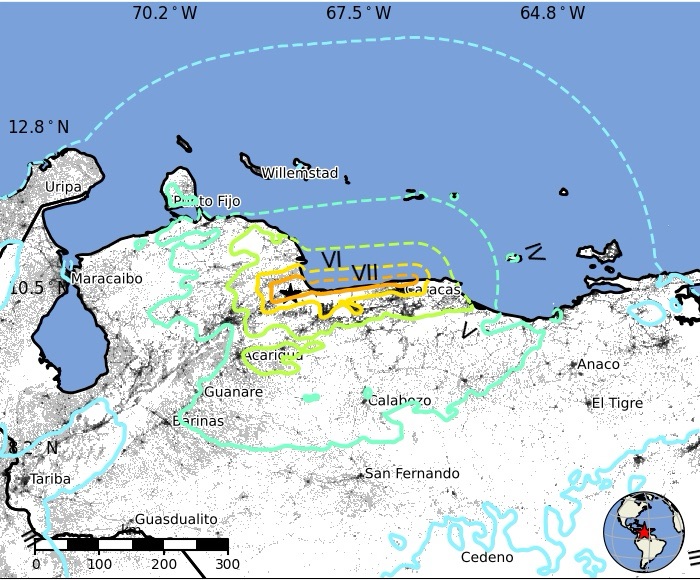
Venezuela presents a circumstance that calls for independent scientific inquiry. The earthquakes of Wednesday, June 24, 2026, brought renewed attention to a question whose importance reaches far beyond those seismic events. They underscore the need to determine whether the scientific knowledge presently available is adequate to evaluate any interaction that may exist between intensive subsurface carbon extraction and the geological dynamics of one of the most tectonically complex regions in the Western Hemisphere. The country contains some of the world’s largest hydrocarbon reserves while also being traversed by active fault systems whose behavior demands continuous observation, precise measurement, and independent scientific verification.
Whether recent seismic activity bears any relationship to large-scale subsurface carbon extraction cannot presently be determined without transparent access to operational records, geological mapping, high-resolution seismic observations, and independent scientific analysis. The necessary evidence must first be established, verified, and subjected to rigorous scrutiny before any responsible conclusion—affirmative or negative—can be sustained.
This absence of verified knowledge is not a procedural inconvenience. It is itself an environmental concern. Carbon extraction necessarily alters the subsurface environment through drilling, reservoir depletion, fluid movement, pressure redistribution, and other engineering interventions. The degree to which those alterations interact with naturally stressed geological systems cannot be assumed. It must be measured. Where extensive extraction occurs within tectonically active regions, uncertainty becomes the principal reason for scientific investigation rather than an excuse to postpone it.
The question therefore extends well beyond the explanation of any individual seismic event. It concerns whether present scientific understanding adequately characterizes the cumulative interaction between industrial intervention and the geological systems upon which entire populations depend. Resolving that question requires continuous seismic monitoring, comprehensive geological characterization, transparent operational reporting, independent verification, and the willingness to revise conclusions as new evidence emerges.
The implications are not confined to Venezuela. They concern the broader governance of carbon extraction throughout the world. Every nation possessing significant hydrocarbon resources situated within geologically sensitive environments confronts the same responsibility: to ensure that economic activity proceeds within the limits established by demonstrable scientific understanding rather than by commercial urgency or geopolitical expediency.
Under conditions of institutional weakness, diminished regulatory independence, or limited transparency, this responsibility becomes even more critical. Scientific uncertainty should never become a refuge for either complacency or speculation. Instead, it imposes a higher standard of public accountability. The legitimacy of environmental regulation depends not upon confidence in predetermined outcomes, but upon confidence in the integrity of the investigative process itself.
This principle transcends the identity of any particular government, corporation, or foreign investor. Whether extraction is undertaken by domestic enterprises, multinational corporations, or state-owned entities, the obligation remains identical. Every operator should be subject to the same independent scientific oversight, the same environmental scrutiny, and the same public disclosure of information necessary to evaluate geological and ecological consequences. Responsible stewardship cannot depend upon the nationality of capital. It depends upon the universality of scientific standards.
When those standards are weakened or subordinated to political or economic priorities, the consequences extend far beyond the extraction site. The risks are borne by landscapes, watersheds, ecosystems, infrastructure, and communities whose stability depends upon geological conditions that cannot be negotiated once altered. Economic benefit may be immediate; environmental consequences may endure for generations.
The responsible extraction of carbon resources therefore demands more than technological capability or financial investment. It requires institutions capable of recognizing that uncertainty is not the absence of responsibility but its beginning. Scientific knowledge is not merely one consideration among many in environmental governance. It is the foundation upon which every legitimate regulatory decision must rest.
The Earth records every intervention with complete fidelity. Whether humanity possesses the wisdom to understand those records before they become irreversible consequences remains one of the defining environmental questions of our time.
[1]. https://earthquake.usgs.gov/data/shakemap/?utm_source=chatgpt.com

