Posts Tagged ‘inevitability’

“Notes From Within” 

May 28, 2025
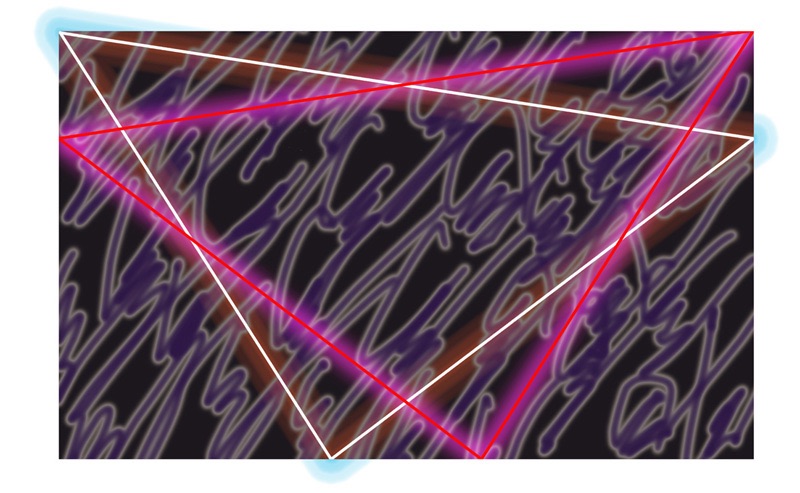
Triangulation Series M
C-Print
2007

“On Vulnerability”

*

Dedicated to my siblings

There’s a certain kind of person the world seems to admire—sharp-tongued, composed, deliberate.    He moves through life as if he’s never doubted the sound of his own voice.    His gestures are practiced, his opinions unshakable.    It’s a performance of authority, and to many, it’s compelling.

But I’ve never fit that mold.    I don’t hold myself like someone bracing for a fight with the world.    I don’t presume to master a room.    And more and more, I’ve come to believe that what makes a person is not how forcefully he presents himself, but how honestly he shows up.

Vulnerability has never been fashionable.    It doesn’t draw applause or dominate the stage. But it’s where I’ve found the most truth.    Not in being right, or revered, or untouchable—but in admitting how little I know, how often I’ve failed, and how much of life resists explanation.

We’re taught to act as if we’ve earned our place—through effort, through cleverness, through some innate worth.    But I’ve lived long enough to see how much is assumed, how much is favored, how many doors open not because of merit but because of circumstance, appearance, proximity to power.    The world flatters performance.    It often mistakes loudness for depth, certainty for wisdom.

But beneath all that, we’re fallible—achingly so.    We get things wrong.    We hurt people.    We retreat when we should have stayed, and speak when silence would have been kinder.    We tell ourselves stories to survive, not always to understand.

And yet, that fallibility isn’t shameful.    It’s not a flaw to be punished—it’s the most human part of us.    The mistake is not in being wrong; it’s in pretending we’re not.    Intimacy begins where performance ends—when we stop curating ourselves and let others see what is:    our confusion, our fear, our imperfect love.

I’ve stopped wanting to impress.    I want to be known.    I want to know others—not through their accomplishments or their poses, but through the quiet truths they carry.    I don’t need anyone to be flawless.    I need them to be present, to meet me somewhere beneath the surface.

That, to me, is strength.    Not the kind that commands a crowd, but the kind that sits across from others, unguarded, and says, “Me too. I don’t have it either.”

The world may never reward dishonesty with applause.    But it will reward it with connection—with moments that feel real, human, and lasting.    And in the end, I think that’s the only recognition that ever matters.    Not the illusion of certainty or the performance of strength, but the willingness to return, again and again, to the quiet inside us—the one where we are fallible, open, and fully alive.

*

Ricardo F Morin

Bala Cynwyd, Pa; May 28, 2025

Editor:    Billy Bussell Thompson


“Echoes of a Decanter”

March 5, 2025

*

This image has an empty alt attribute; its file name is 0005.jpg
Decantation [2003], CGI by Ricardo Morín

*


The air inside the old factory was thick with dust and conviction.      They had scrubbed the floors, repainted the walls, and reclaimed the space from its past, but the scent of rust and oil still lingered.      It smelled like work—like history.

Emil stood on a makeshift stage, elevated by wooden pallets stacked two high.      His voice carried across the room, each word striking with certainty.

“This is not another failed experiment.      This is not a return to old mistakes.      We are forging a new path—beyond capitalism, beyond the betrayals of so-called socialism.      This time, we get it right.”

Applause.      Nods of approval.      They had heard these words before, but this time, they believed them.

Isolde sat at the back, arms crossed, expression unreadable.      She had stood in this same room decades ago, listening to a different voice, hearing the same promise.      The factory, reborn each time, looked different, yet the space was always the same—a decanter of sorts, enclosing the same history, slowly pouring out its essence, again and again.

After the speech, as people gathered in small circles of animated discussion, Emil approached her.

“You don’t look convinced.”

“I don’t mistake passion for direction,” she said.

Emil smiled, as if indulging an elder.      “This time is different, Isolde.      We’ve studied history.      We won’t repeat their mistakes.”

She exhaled, looking past him to the crowd.      The factory hummed quietly behind them, a machine just starting to remember its old rhythms.      “You misunderstand history.      It’s not something you repeat.      It’s something that returns to you, whether you invite it or not.”

He shook his head.      He didn’t believe in ghosts.      But the air, thick with the weight of their past, seemed to hum with the same unspoken inevitability.      It reminded Isolde of something trapped within glass—preserved, yet futile in its attempts to remain unbroken. . .


The first weeks were golden.

Decisions were made by assembly.      Every worker had an equal say, an equal share, an equal stake.      The old machinery roared to life under new hands.      They printed new posters, declaring the rebirth of labor, the death of the boss.

For the first time, they worked for themselves.

But cracks, barely visible at first, began to form.

Meetings dragged for hours, circular debates with no resolution.      Some tasks were more desirable than others—some avoided the heavy lifting, citing ideological objections.      “Why should one person labor while another coordinates?”

“Because someone must,” Isolde murmured to herself.      Unheard.

Then came the first real crisis: a large order, a deadline, a need for efficiency.      The factory moved too slowly.      The assembly stalled.      Arguments flared.

“We need someone to oversee production,” Emil admitted.      “Just temporarily.”

A vote was cast.      A mediator was appointed.      He wasn’t a manager, they told themselves, just a guide.      But the balance had shifted.      The factory, like a vessel caught in an unrelenting tide, began to carry more than it could manage.

Isolde watched, saying nothing.


The mediator, needing to keep things moving, made quick decisions.      The assembly approved them after the fact.      The difference was subtle, but it grew.

Some workers were better at certain tasks, so roles solidified.      Someone had to negotiate with suppliers.      Someone had to ensure deadlines were met.      The mediator took on these roles, because it was easier.

“We need structure,” he explained.      “Not hierarchy, just order.”

Emil, exhausted, nodded.      The structure, which had once felt so free, began to settle into something heavier.      Something permanent.      Like the decanter that holds liquid—only to release it back into the world, though it never truly escapes its confines.

One evening, alone in his office—the office that wasn’t supposed to exist—he flipped through old books.      The words were familiar, but they read differently now.      He found a passage from an old revolutionary text, underlined by his own hand years ago:

“The first illusion of power is that it does not exist.”

He closed the book.      His fingers lingered on the edge of the paper, as though searching for something that had slipped away, like water escaping through a crack.


The next crisis arrived without warning.      A strike—among themselves.      Some demanded higher pay.      “Shouldn’t work be compensated by effort?”      They were equals, but some were more equal in labor than others.

Emil tried to reason with them.      “That’s not how this works.      We’re breaking that cycle.”

“Then why do you sit in the office while we sweat on the floor?”

He had no answer.

Another vote.      A restructuring.      A new proposal:      an oversight committee.      The committee became a board.      Outside investors offered financial stability.      A small compromise.      A necessary evil.

By the end of the year, the factory had become what it swore it never would.

Emil found Isolde in the break room, sipping tea.

“We tried,” he said.      “So did we,” she replied.

Silence.

“Why does it always end this way?” he asked.

Isolde set her cup down.      Her eyes met his, trapped in exhaustion, as though each glance carried the gravity of countless broken promises, like a fractured decanter.

“Because we are human.”


Years later, Emil walked past the factory.      It was thriving.      Not revolutionary.      Not a failure.      Just another business.

Inside, a new group of young activists had gathered.      Their leader, no older than he had been, stood on stacked wooden pallets, speaking with fire.

“We are not repeating the past.      We are forging a new path.      This time, we get it right.”

Emil did not stop to listen.

From the distance, Isolde watched.

“And so it begins again,” she whispered.

~

Ricardo Federico Morín Tortolero

March 5, 2025; Oakland Park, Florida


“The Rooster’s Algorithm”

March 1, 2025

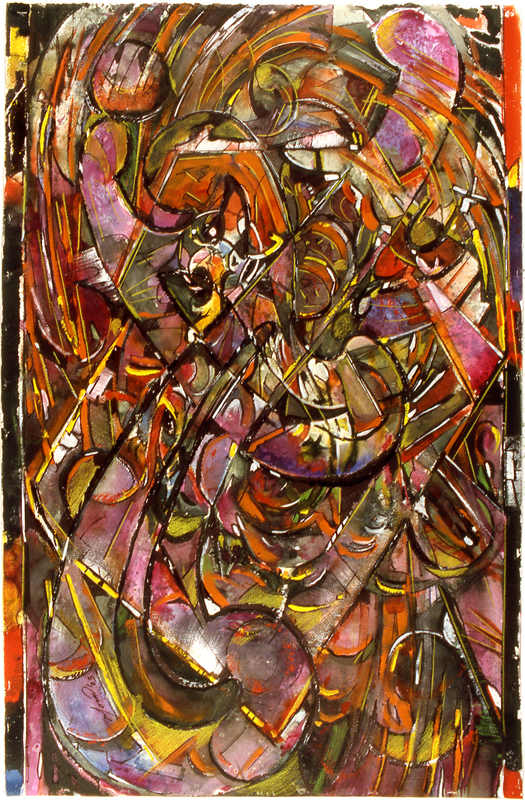
Rooster’s Crow” [2003] by Ricardo F Morín.    Watercolor on paper 39″h x 25.5″ w.

Introduction

At the break of day, the rooster’s call slices through the quiet—sharp and insistent, pulling all within earshot into the awareness of a new day.      In the painting Rooster’s Crow, the colors swirl in a convergence of reds and grays, capturing the bird not as a tranquil herald of dawn but as a symbol of upheaval.      Its twisted form, scattered feathers, and fractured shapes reflect a deeper current of change—a collision of forces, both chaotic and inevitable.      The image suggests the ceaseless flow of time and the weight of transformations that always accompany it.

In this evolving narrative, the crow’s fragmentation mirrors the unfolding spread of artificial intelligence.      Once, the rooster’s cry signaled the arrival of dawn; now, it echoes a more complex transformation—a shifting balance between nature’s rhythms and the expanding reach of technological systems.      The crow’s form, fractured in its wake, becomes a reflection of the tensions between human agency and the rise of forces that, though engineered, may escape our full comprehension.      Here, Artificial Intelligence (AI) serves as both the agent of change and the potential architect of a future we can neither predict nor control.

The Rooster’s Algorithm

A rooster’s crow is neither invitation nor warning; it is simply the sound of inevitability—raw, urgent, indifferent to whether those who hear it rise with purpose or roll over in denial.      The call does not command the dawn, nor does it wait for permission—it only announces what has already begun.

In the shifting interplay of ambition and power, technology has taken on a similar role.      Shaped by human intent, it advances under the guidance of those who design it, its influence determined by the priorities of its architects.      Some see in its emergence the promise of progress, a tool for transcending human limitations; others recognize in it a new instrument of control, a means of reshaping governance in ways once unimaginable.      Efficiency is often lauded as a virtue, a mechanism to streamline administration, reduce friction, and remove the unpredictability of human deliberation.      But a machine does not negotiate, nor does it dissent.      And in the hands of those who see democracy as a cumbersome relic—an obstacle to progress—automation becomes more than a tool; it becomes the medium through which power is consolidated.

Consider a simple example:      the rise of online recommendation systems.      Marketed as tools to enhance user choice, they subtly shape what we see and hear, and influence our decisions before we are even aware of it.      Much like computational governance, these systems offer the illusion of autonomy while narrowing the range of available options.      The paradox is unmistakable:      we believe we are choosing freely, yet the systems themselves define the boundaries of our choices.

Once, the struggle for dominance played out in visible arenas—territorial conquests, laws rewritten in the open.      Now, the contest unfolds in less tangible spaces, where lines of code dictate the direction of entire nations, where algorithms determine which voices are amplified and which are silenced.      Power is no longer confined to uniforms or elected office.      It belongs to technocrats, private corporations, and oligarchs whose reach extends far beyond the walls of any government.      Some openly proclaim their ambitions, advocating for disruption and transformation; others operate quietly, allowing the tide to rise until resistance becomes futile.      The question is no longer whether computational systems will dominate governance, but who will direct their course.

China’s social credit system is no longer a theoretical construct but a functioning reality, where compliance is encouraged and deviation subtly disincentivized.      Predictive models track and shape behavior in ways that go unnoticed until they become irreversible.      In the West, the mechanisms are more diffuse but no less effective.      Platforms built for connection now serve as instruments of persuasion, amplifying certain narratives while suppressing others.      Disinformation is no longer a labor-intensive effort—it is mass-produced, designed to subtly alter perceptions and mold beliefs.

Here, Gödel’s incompleteness theorem offers an apt analogy:      No system can fully explain or resolve itself.      As computational models grow in complexity, they begin to reflect this fundamental limitation.      Algorithms governing everything from social media feeds to financial markets become increasingly opaque, and even their creators struggle to predict or understand their full impact.      The paradox becomes evident:      The more powerful these systems become, the less control we retain over them.

As these models expand their influence, the line between public governance and private corporate authority blurs, with major corporations dictating policies once entrusted to elected officials.      Regulation, when it exists, struggles to keep pace with the rapid evolution of technology, always a step behind.      Once, technological advancements were seen as a means of leveling the playing field, extending human potential.      But unchecked ambition does not pause to ask whether it should—only whether it can.      And so, automation advances, led by those who believe that the complexities of governance can be reduced to data-driven precision.      The promise of efficiency is alluring, even as it undermines the structures historically designed to protect against authoritarianism.      What use is a free press when information itself can be manipulated in real time?      What power does a vote hold when perceptions can be shaped without our awareness, guiding us toward decisions we believe to be our own?      The machinery of control no longer resides in propaganda ministries; it is dispersed across neural networks, vast in reach and impervious to accountability.

There are those who believe that automated governance will eventually correct itself, that the forces steering it toward authoritarian ends will falter in time.      But history does not always favor such optimism.      The greater the efficiency of a system, the harder it becomes to challenge.      The more seamlessly control is woven into everyday life, the less visible it becomes.      Unlike past regimes, which demanded compliance through force, the new paradigm does not need to issue commands—it merely shapes the environment so that dissent becomes impractical.      There is no need for oppression when convenience can achieve the same result.      The erosion of freedom need not come with the sound of marching boots; it can arrive quietly, disguised as ease and efficiency, until it becomes the only path forward.

But inevitability does not guarantee recognition.      Even as the system tightens its grip and choices diminish into mere illusions of agency, the world continues to turn, indifferent to those caught within it.      The architects of this order do not see themselves as masters of control; they see themselves as innovators, problem-solvers refining the inefficiencies of human systems.      They do not ask whether governance was ever meant to be efficient.

In a room where decisions no longer need to be made, an exchange occurs.      A synthetic voice, polished and impartial, responds to an inquiry about the system’s reach.

“Governance is not being automated,” it states.      “The illusion of governance is being preserved.”

The words hang in the air, followed by a moment of silence.      A policymaker, an engineer, or perhaps a bureaucrat—once convinced they held sway over the decisions being made—pauses before asking the final question.

“And what of choice?”

A pause.      Then, the voice, without hesitation:

“Choice is a relic.”

The weight of that statement settles in, not as a declaration of conquest, but as a quiet acknowledgment of the completion of a process long underway.      The final move has already been made, long before the question was asked.

Then, as if in response to the silence that follows, a notification appears—sent from their own account, marked with their own authorization.      A decision is already in motion, irreversible, enacted without their consent.      Their will has been absorbed, their agency subtly repurposed before they even realized it was gone.

And outside, as though to punctuate the finality of it all, a rooster crows once more.

*

Ricardo Federico Morín Tortolero

March 1, 2025; Oakland Park, Florida