Posts Tagged ‘United States’

“Governing by Exception: The American Executive”

November 18, 2025

*

Ricardo Morín
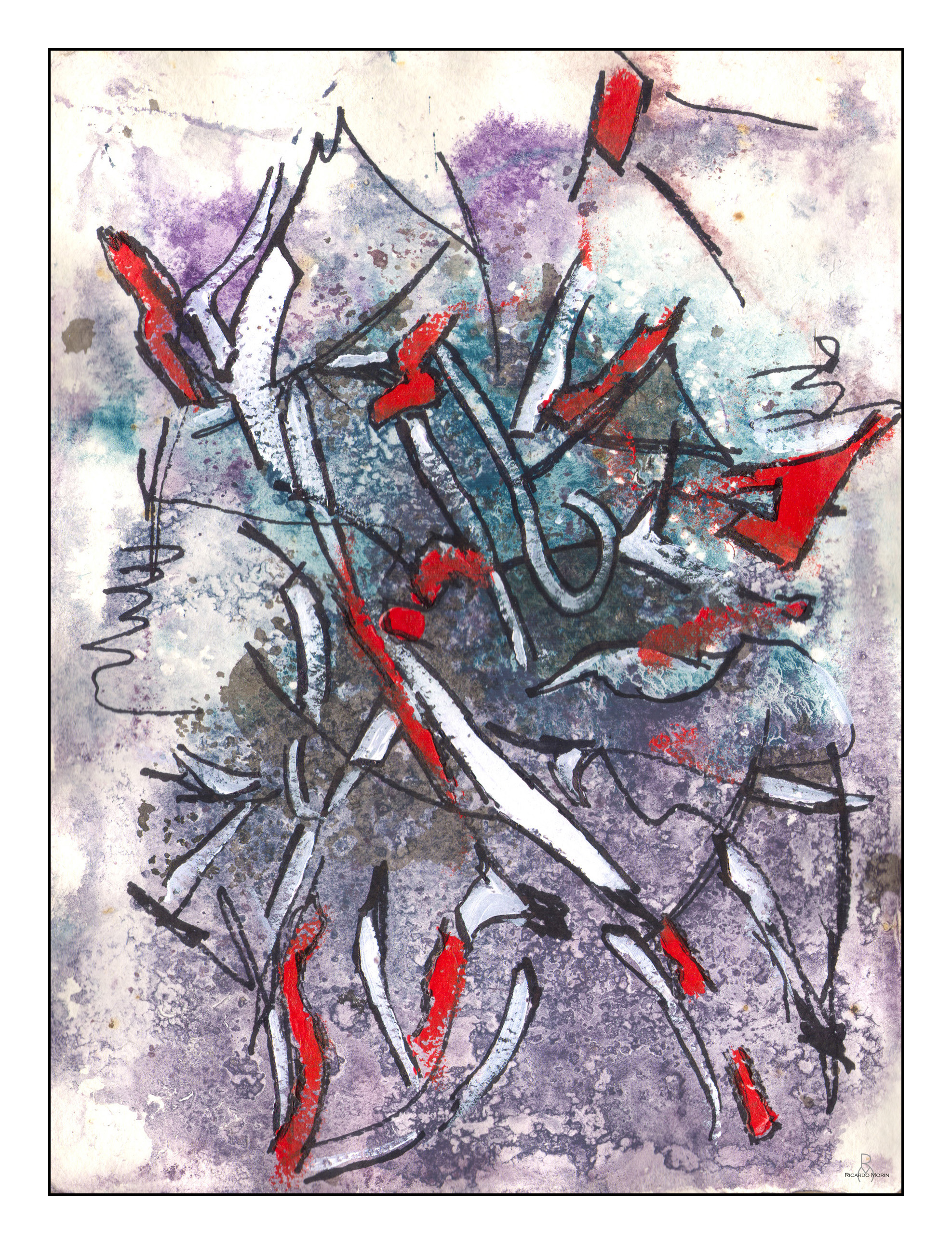
Untitled #3: Governing by Exception
10″x12″
Watercolor
2003

By Ricardo F. Morín

October 10, 2025

Bala Cynwyd, Pa

Power unexamined becomes its own justification—Anonymous civic maxim.

Prologue

Governance is the moral discipline of order—the effort to keep authority aligned with conscience so that power remains a function of justice, not an instrument of self-interest.  Government enacts that discipline:   necessary, fallible, and ever in danger of mistaking permanence for legitimacy.


1

Political history rarely unfolds as a straight line.  It accumulates as a palimpsest in which new regimes—imperial, republican, authoritarian, and democratic—write their doctrines over the residues of previous orders.   Institutions and laws rarely vanish; they survive as layers of precedent and practice that later governments reinterpret to serve new purposes.   The present political moment in the United States should be examined within that structure of accumulation.  What appears to be a radical break with constitutional tradition is, in fact, the latest rewriting of an existing template.   The mechanisms that once safeguarded the republic now expand the reach of executive power; these mechanisms reveal how continuity and rupture coexist in the same act.

2

During the first half year of the Trump administration’s return to office, the political system of the United States has entered a state of controlled dislocation.  Executive directives have overridden congressional appropriations, suspended statutory programs, and reorganized entire departments under provisional authority.   A government shutdown, declared an administrative necessity, has become a method for restructuring the State.   Mass dismissals, selective funding freezes, and the redefinition of agency mandates have become coordinated tools for concentrating authority in the executive branch.  These are not isolated disputes between branches of government.  These actions reveal a coherent strategy of reconfiguration, executed through administrative acts that appear lawful but are designed to disfigure the balance of powers from within.

3

The guiding principle of this transformation is the normalization of exception.   Powers that earlier generations considered temporary—emergency measures to be used only under extreme threat—have become ordinary instruments of governance.  The invocation of the Insurrection Act, intended for rebellion or lawless obstruction, now functions as justification for domestic military deployment in states governed by political opposition.  The use of this authority is framed as a response to rising crime, even when verified data show a national decline.   In this inversion of logic, the declaration of emergency precedes its necessity.   The government generates the crisis it claims to confront and allows coercive measures to appear both inevitable and legitimate. What dissolves in this process is not only institutional restraint but the moral discipline of order—the very principle that once bound authority to conscience: i.e. the active faculty of perception through which recognition becomes responsibility and seeing acquires ethical weight.

4

This redefinition of authority as authoritarianism is reinforced by judicial doctrine.   The Supreme Court’s 2024 decision in Trump v. United States established that a president enjoys absolute immunity for “core official acts” and presumptive immunity for all other actions undertaken in an official capacity.  This ruling altered the meaning of accountability.  It placed the office of the president above ordinary legal scrutiny by presuming legality wherever official duty could be claimed.   The decision inverted the constitutional order that once defined the presidency as a position constrained by law.  Under this new interpretation, legality flows from function rather than from statute.   The Court did not invent executive supremacy; it legalized its evolution.   By insulating the executive office from the consequences of its acts, the judiciary, perhaps unintentionally, became an instrument of the very transformation it was designed to prevent.

5

Measured against the triad of government powers—legislative, executive, and judicial—the present equilibrium reveals a pronounced distortion.   Each branch retains its formal outline, yet its interior authority has thinned. Congress’s control of the purse has been undermined by impoundment and selective disbursement.   Administrative agencies have been hollowed out through abrupt firings and structural reorganizations.   The judiciary, bound by its own doctrines of deference and immunity, finds itself unable to intervene effectively.   What remains of institutional balance depends less on constitutional principle than on administrative inertia.  The machinery of government continues to function, but its continuity now rests on habit rather than on law.

6

This condition does not yet constitute overt dictatorship.  It represents a subtler phenomenon—a system that operates through legal forms but concentrates power in practice.   Authority remains constitutional in appearance while using those same procedures to entrench unilateral control.  The pattern can be recognized not through proclamations but through measurable actions:   decrees replacing legislation, “temporary” orders renewed without expiration, funds withheld from political adversaries, and federal troops dispatched to jurisdictions where disorder has not been empirically established.   Each measure, taken alone, seems limited and justified.   Together they form an architecture of exception—an invisible framework that reorganizes power without declaring revolution. Beneath this architecture lies the decline of the moral discipline of order, where legality endures but conscience recedes.

7

A forensic approach must therefore focus not on accusation but on diagnosis.  The purpose is to identify where practice diverges from principle, and where legal continuity conceals political mutation.  The question is not whether democracy has vanished, but how far the republic has drifted from its own operational norms.   This drift can be measured empirically through ordinary data:  the number of appropriations ignored or delayed, the duration and scope of emergency declarations, the ratio of confirmed officials to acting appointees, and the frequency with which presidential immunity is invoked to block review.   Each indicator marks a step away from the rule of shared power that defines constitutional democracy.

8

The concept of the republic, in its classical and Enlightenment sense, presupposed a balance between power and virtue:   the rule of law safeguarded by citizens free from dependence.   In contemporary practice, that idea has been reduced to a partisan label.   The republicanism that once demanded civic responsibility now coexists with mechanisms—PAC financing (Political Action Committee: An organization that raises and spends money to elect political candidates), factional loyalty, corporate influence—that transform governance into an instrument of private interest.   Thus the very word that once signified restraint now conceals its opposite:   a system where representation serves its sponsors more faithfully than its citizens.

9

History suggests that constitutional systems rarely collapse through open defiance.  They decline through adaptation.   The Roman Republic did not abolish its institutions; it gradually converted them into imperial offices.   Modern democracies follow similar paths when crisis is used to justify the consolidation of power.  Executive authority expands, legislative restraint weakens, and judicial caution hardens into complicity.  The American case fits this pattern.   The existing framework of the Constitution remains in place, yet its meaning shifts incrementally through interpretation, precedent, and administrative habit.  The transformation proceeds without formal amendment because each deviation is defended as continuity.

10

The metrics of decline are structural rather than moral.   When legality depends on will—the self-legitimating impulse of power once detached from moral accountability—and will is shielded from scrutiny, the architecture of restraint loses coherence.   Here the moral discipline of governance yields to the self-justifying logic of power.   What follows is not anarchy but organized dislocation—a condition in which institutions operate as before yet serve opposite purposes; in truth it is anarchy disguised as its own absence.   Procedures are observed; substance is inverted.   The outward appearance of democracy persists, while its inner logic is replaced by a system that governs through perpetual exception.

11

The task for observers and citizens alike is not to forecast collapse but to recognize mutation.  Political systems rarely announce their turning points; they disguise themselves as routine.  The test of civic intelligence is the capacity to detect when law becomes vocabulary, when oversight becomes performance, and when the state of exception ceases to be temporary.   The republic continues to function, but it functions under altered premises.   The preservation of legality therefore depends not only on the design of institutions but also on the vigilance of those who interpret them. Justice endures only where institutions remember that they exist to limit power, defend the vulnerable, and preserve the moral foundation from which authority derives its right to act.

12

The endurance of the republic will therefore depend not on the spectacle of its elections but on the recovery of its first obligation:   to keep authority answerable to the moral idea from which it draws its right to act.   Justice endures only where institutions remember that they exist to limit power, defend the vulnerable, and preserve the moral discipline of order through which freedom remains lawful and law remains human.   When that memory fades, what remains is administration without soul—a government still standing, but no longer governing.
“The Politics of Erasure: Authoritarianism and Spectacle”

August 22, 2025

*


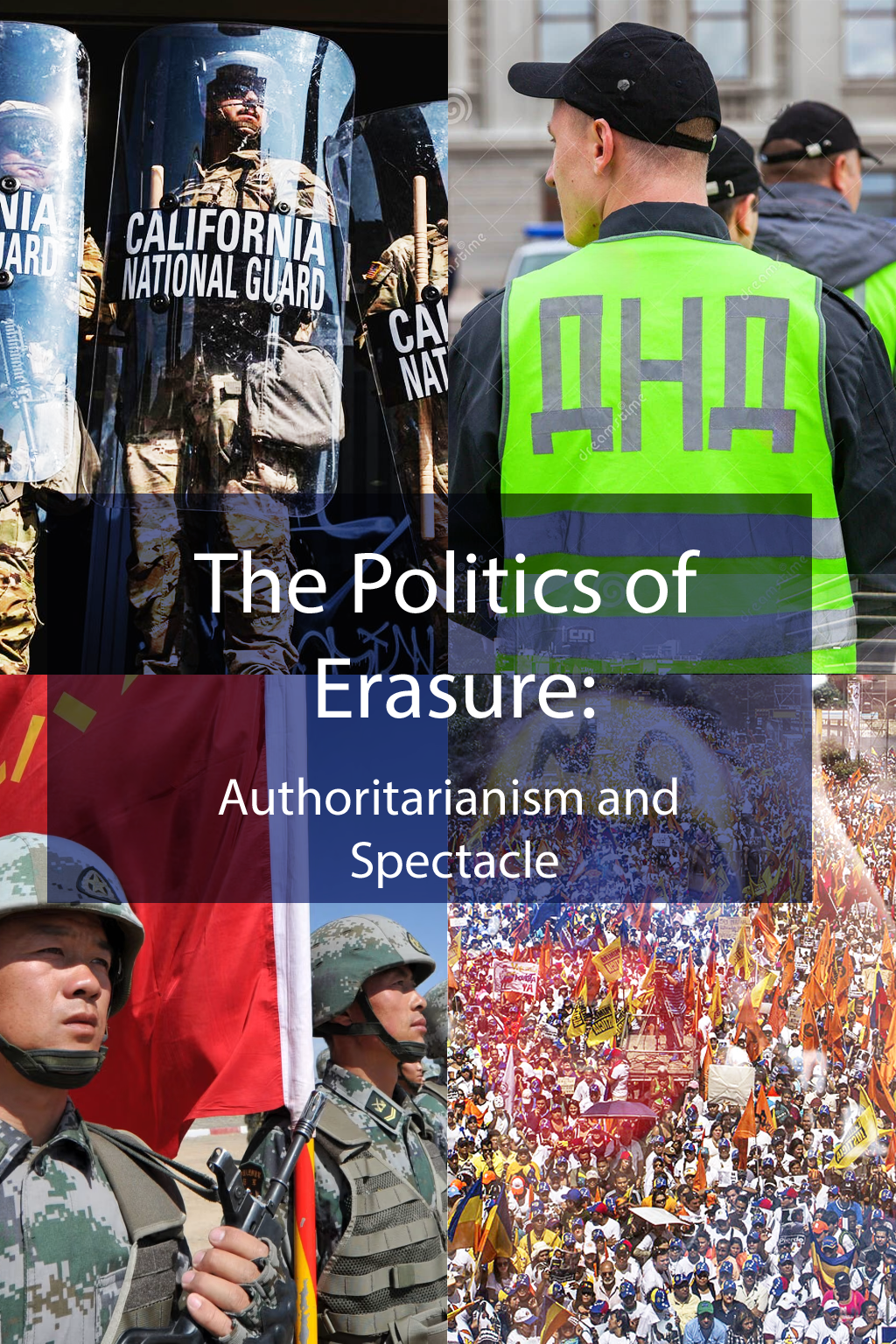
Cover design for the essay “The Politics of Erasure: Authoritarianism and Spectacle.” The composite image juxtaposes surveillance, militarization, propaganda, and mass spectacle to underscore how authoritarian regimes render lives expendable while legitimizing control through display.

By Ricardo Morín, In Transit to and from NJ, August 22, 2025

Authoritarianism in the present era does not present itself with uniform symbols. It emerges within democracies and one-party states alike, in countries with declining economies and in those boasting rapid growth. What unites these varied contexts is not the formal shape of government but the way power acts upon individuals: autonomy is curtailed, dignity denied, and dissent reclassified as threat. Control is maintained not only through coercion but also through the appropriation of universal values—peace, tolerance, harmony, security—emptied of their content and redeployed as instruments of supression. The result is a politics in which human beings are treated as expendable and spectacle serves as both distraction and justification.

In the United States, the Bill of Rights secures liberties, yet their practical force is weakened by structural inequality and concentrated control over communication. After the attacks of September 11, the USA PATRIOT Act authorized sweeping surveillance in the name of defending freedom, normalizing the monitoring of private communications (ACLU 2021). Protest movements such as the Black Lives Matter demonstrations of 2020 filled the streets, but their urgency was absorbed into the circuits of media coverage, partisan argument, and corporate monetization (New York Times 2020). What begins as protest often concludes as spectacle: filmed, replayed, and reframed until the original message is displaced by distractions. Meanwhile, the opioid epidemic, mass homelessness, and medical bankruptcy reveal how millions of lives are tolerated as expendable (CDC 2022). Their suffering is acknowledged in statistics but rarely addressed in policy, treated as collateral to an order that prizes visibility over remedy.

Venezuela offers a more direct case. The Ley contra el Odio (“Law against Hatred”), passed in 2017 by a constituent assembly lacking democratic legitimacy, was presented as a measure to protect tolerance and peace. In practice, it has been used to prosecute journalists, students, and citizens for expressions that in a democratic society would fall squarely within the realm of debate (Amnesty International 2019). More recently, the creation of the Consejo Nacional de Ciberseguridad has extended this logic to place fear and self-censorship among neighbors and colleagues (Transparencia Venezuela 2023). At the same time, deprivation functions as a tool of discipline: access to food and medicine is selectively distributed to turn scarcity into a means of control (Human Rights Watch 2021). The state’s televised rallies and plebiscites portray unity and loyalty, but the reality is a society fractured by exile, with over seven million citizens abroad and those who remain bound by necessity rather than consent (UNHCR 2023).

Russia combines repression with patriotic theater. The 2002 Law on Combating Extremist Activity and the 2012 “foreign agents” statute have systematically dismantled independent journalism and civil society (Human Rights Watch 2017), while the 2022 law against “discrediting the armed forces” criminalized even the description of war as war (BBC 2022). Citizens have been detained for carrying blank signs, which demonstrates how any act, however symbolic, can be punished if interpreted as dissent (Amnesty International 2022). The war in Ukraine has revealed the human cost of this system: conscripts drawn disproportionately from poorer regions and minority populations are sent to the frontlines, their lives consumed for national projection. At home, state television ridicules dissent as treason or foreign manipulation, while parades, commemorations, and managed elections transform coercion into duty. The official promise of security and unity is sustained not by coexistence but by the systematic silencing of plural voices, enforced equally through law, propaganda, and ritual display.

China illustrates the most technologically integrated model. The 2017 Cybersecurity Law and the 2021 Data Security Law require companies and individuals to submit to state control over digital information and extend surveillance across every layer of society (Creemers 2017; Kuo 2021). Social media platforms compel group administrators to monitor content and disperses the responsibility of conformity to citizens themselves (Freedom House 2022). At the same time, spectacle saturates the landscape: the Singles’ Day shopping festival in November generates billions in sales, broadcast as proof of prosperity and cohesion, while state media showcases technological triumphs as national achievements (Economist 2021). Entire communities, particularly in Xinjiang, are declared targets of re-education and surveillance. Mosques are closed, languages restricted, and traditions suppressed—all in the name of harmony (Amnesty International 2021). Stability is invoked, but the reality is the systematic denial of dignity: identity reduced to an administrative category, cultural life dismantled at will, and existence itself rendered conditional upon conformity to the designs of state power.

Taken together, these cases reveal a common logic. The United States commodifies dissent and normalizes abandonment as a permanent condition of public life. Venezuela uses deprivation to enforce discipline and the resulting compliance is publicly presented as loyalty to the state. Russia demands sacrifice and transforms coercion into patriotic duty. China fuses surveillance and prosperity and engineers conformity. Entire communities are suppressed in the name of harmony. The registers differ—commercial, ritualistic, militarized, digital—but the pattern is shared: dissent is stripped of legitimacy, lives are treated as expendable, and universal values are inverted to justify coercion.


References

  • ACLU: “Surveillance under the USA PATRIOT Act”. New York: American Civil Liberties Union, 2021. (This article documents how post-9/11 legislation expanded state surveillance in the United States and framed “security” as a justification for reducing privacy rights.)
  • Amnesty International: “Venezuela: Hunger for Justice. London: Amnesty International”, 2019. (Amnesty International reports on how Venezuela’s Ley contra el Odio has been used to prosecute citizens and silence dissent under the rhetoric of tolerance.)
  • Amnesty International: “Like We Were Enemies in a War: China’s Mass Internment, Torture and Persecution of Muslims in Xinjiang”. London: Amnesty International. 2021. (Amnesty International provides evidence of mass detention, surveillance, and cultural repression in Xinjiang carried out in the name of “harmony” and stability.)
  • Amnesty International: “Russia: Arrests for Anti-War Protests”. London: Amnesty International, 2022. (Amnesty International details the systematic arrest of Russian citizens, including those holding blank signs, under laws claiming to protect peace and order.)
  • BBC: “Russia Passes Law to Jail People Who Spread ‘Fake’ Information about Ukraine War.” March 4, 2022. (News coverage of Russia’s 2022 law criminalizing criticism of the war shows how “discrediting the armed forces” became a punishable offense.)
  • CDC.: “Opioid Overdose Deaths in the United States. Atlanta: Centers for Disease Control and Prevention”. 2022. (The CDC provides statistical evidence of widespread loss of life in the U.S. and underscores how entire populations are treated as expendable in public health.)
  • Creemers, Rogier: “Cybersecurity Law of the People’s Republic of China”: Translation with Annotations. Leiden University, 2017. (An authoritative translation and analysis of China’s 2017 Cybersecurity Law illustrate how digital oversight is institutionalized.)
  • UNHCR: “Refugee and Migrant Crisis in Venezuela: Regional Overview”. Geneva: United Nations High Commissioner for Refugees, 2023. (This report offers figures on the Venezuelan exodus and highlights the mass displacement caused by deprivation and repression.)

“Global Authoritarianism and the Limits of Traditional Analysis”

February 28, 2025

*

*


~

The war in Ukraine is often presented as a geopolitical confrontation between the West and Russia, but this interpretation can obscure a deeper reality:     the rise of authoritarianism as a global force.     Noam Chomsky, one of the most influential voices in the critique of U.S. foreign policy, has argued that U.S. hegemony is the primary factor driving the conflict.     His approach, rooted in Cold War logic, has been essential for understanding global power dynamics.     However, one must question whether this framework remains sufficient to analyze the coordinated expansion of authoritarian regimes in the world today.

The issue is no longer simply whether U.S. policy contributed to Russia’s aggression, but whether democracies can withstand the deliberate advance of governments seeking to consolidate power at any cost.     What is at stake transcends Ukraine’s sovereignty:     it is the survival of democracy in the world.

Chomsky argues that NATO’s expansion and U.S. financial dominance exacerbated tensions with Russia and limited diplomatic options.     His vision proposes a world in which power is distributed between the United States, Europe, China, and Russia, which he believes would create a more stable and just balance.     This perspective has been crucial in questioning the excesses of U.S. interventionism.     In the present world, however, where authoritarianism is not only reacting to the West but also actively seeking to reshape the global order, is a framework based solely on containing U.S. hegemony sufficient?

The rise of authoritarian regimes is not merely a response to Western influence; it is a deliberate strategy to consolidate power.     While Chomsky has emphasized the importance of distributing global power, it is crucial to analyze the nature of those who would fill this void.     Russia and China are not simply seeking a multipolar stability; their actions reflect an attempt to exert absolute control, without democratic constraints.     Chomsky’s critique helps us understand the roots of international conflicts, but it may need to be expanded to account for how these regimes are transforming the very structure of global politics.

One challenge in applying Chomsky’s traditional analysis to the present is that contemporary authoritarianism no longer aligns solely with past ideological divisions.     It is no longer a struggle between socialism and capitalism, or left and right.     Rather, these regimes share a common objective:     dismantling democratic institutions to ensure their permanence in power.

Putin, for instance, invokes Soviet nostalgia while prohibiting any critical reassessment of Stalinism.     China blends State capitalism with absolute political control.     Hungary and India, once considered democracies aligned with the West, have adopted authoritarian models.     Meanwhile, the U.S. far-right, which historically opposed communism, has begun to adopt the Kremlin’s narrative, portraying it as a defender against “globalist elites.”

This ideological alignment makes modern authoritarianism more dangerous than ever.     It not only transcends traditional power blocs but is also reinforced through strategic alliances, mutual support, and the erosion of democracies from within.     This is perhaps most evident in the United States.     The presidency of Trump revealed an unexpected vulnerability:     the possibility that authoritarianism could thrive within the world’s most influential democracy.     Here, the debate is no longer reduced to a question of isolationism or interventionism, but to the real risk of autocratic tactics being normalized in domestic politics.

The Trump administration sent contradictory signals regarding the Kremlin, weakening the principle of deterrence.     Rather than establishing a clear stance against authoritarian expansion, its ambiguity allowed regimes like Putin’s to interpret the lack of firmness as an opportunity to act with impunity.     Figures such as Marco Rubio have advocated for an unequivocal stance that would reinforce U.S. strategic credibility, while the inconsistency in the Trump administration’s foreign policy contributed to the perception that the West was divided and hesitant.

This weakening of democratic leadership has not occurred in a vacuum.     The globalization of authoritarianism is a phenomenon in which autocratic regimes not only directly challenge democracies but also back one another to evade sanctions, subvert international pressure, and consolidate their internal rule.     The invasion of Ukraine must be understood within this framework:     it is not just a regional conflict or a reaction to NATO, but a calculated move within a broader strategy to weaken global democracy.

For decades, critics like Chomsky have been instrumental in highlighting the effects of U.S. dominance on global politics.     His analysis has allowed us to understand how U.S. hegemony has influenced numerous conflicts.     However, the evolution of authoritarianism raises questions that require expanding this perspective.     The greatest threat to democracy is no longer exclusively U.S. power, but the consolidation of a global autocratic model advancing through coordinated strategies.

Blaming the U.S. for every geopolitical crisis may overlook a crucial shift:     authoritarian regimes have moved from being a reaction to Washington’s influence to becoming an active strategy to replace the Western democratic model.     Recognizing this shift does not absolve the U.S. of its failures in foreign policy, but it does demand an understanding that countering authoritarianism requires more than constant criticism of its hegemony.     It requires recognizing that democracy faces a coordinated and unprecedented threat.

Chomsky’s vision of a multipolar world is, in theory, appealing.     However, what would this imply in practice if the actors filling the void left by the U.S. are not interested in preserving democracy?     The real challenge is not merely containing Putin’s territorial ambitions but preventing his model of governance—based on dismantling democratic institutions—from gaining traction in the West.

Chomsky remains one of the most incisive critics of U.S. foreign policy, and his work has been fundamental in understanding the effects of power on international relations.     His analysis has shed light on the flaws of interventionism and the dynamics of global hegemony.     The world, however, has changed, and so have the challenges facing democracies.     Today, the crisis in Ukraine is no longer limited to a debate over NATO, U.S. intervention, or Western hypocrisy.     It is part of a broader struggle between democracy and autocracy, a struggle that does not end at Ukraine’s borders but extends to the very political institutions of the West.

If we fail to recognize this shift, we risk not only losing Ukraine but also underestimating the scope of the threats facing democracies worldwide.     Neutrality is no longer an option when the challenge is the survival of free societies.     Beyond the mistakes of the West, the rise of authoritarianism demands a response that goes beyond constant criticism of U.S. hegemony and instead embraces the active defense of democratic values wherever they are under threat.

*

Ricardo Federico Morín Tortolero

February 28, 2025; Oakland Park, Florida