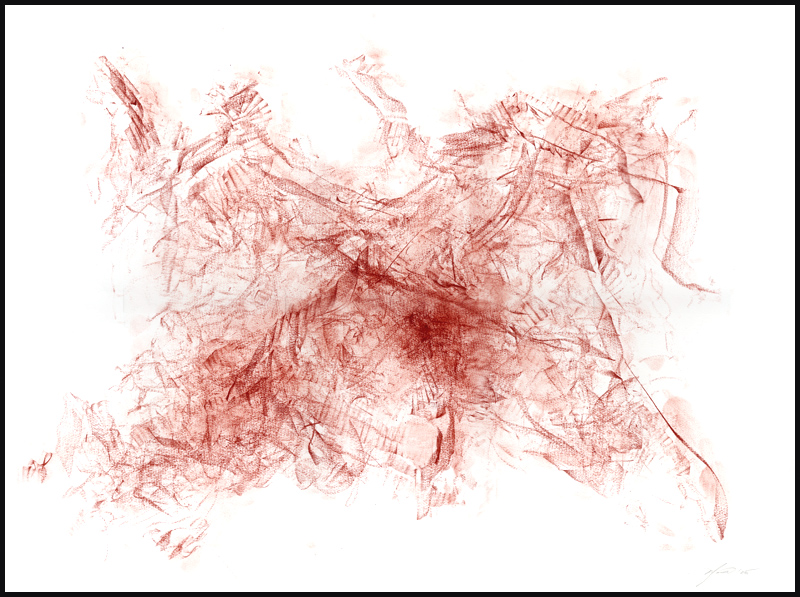
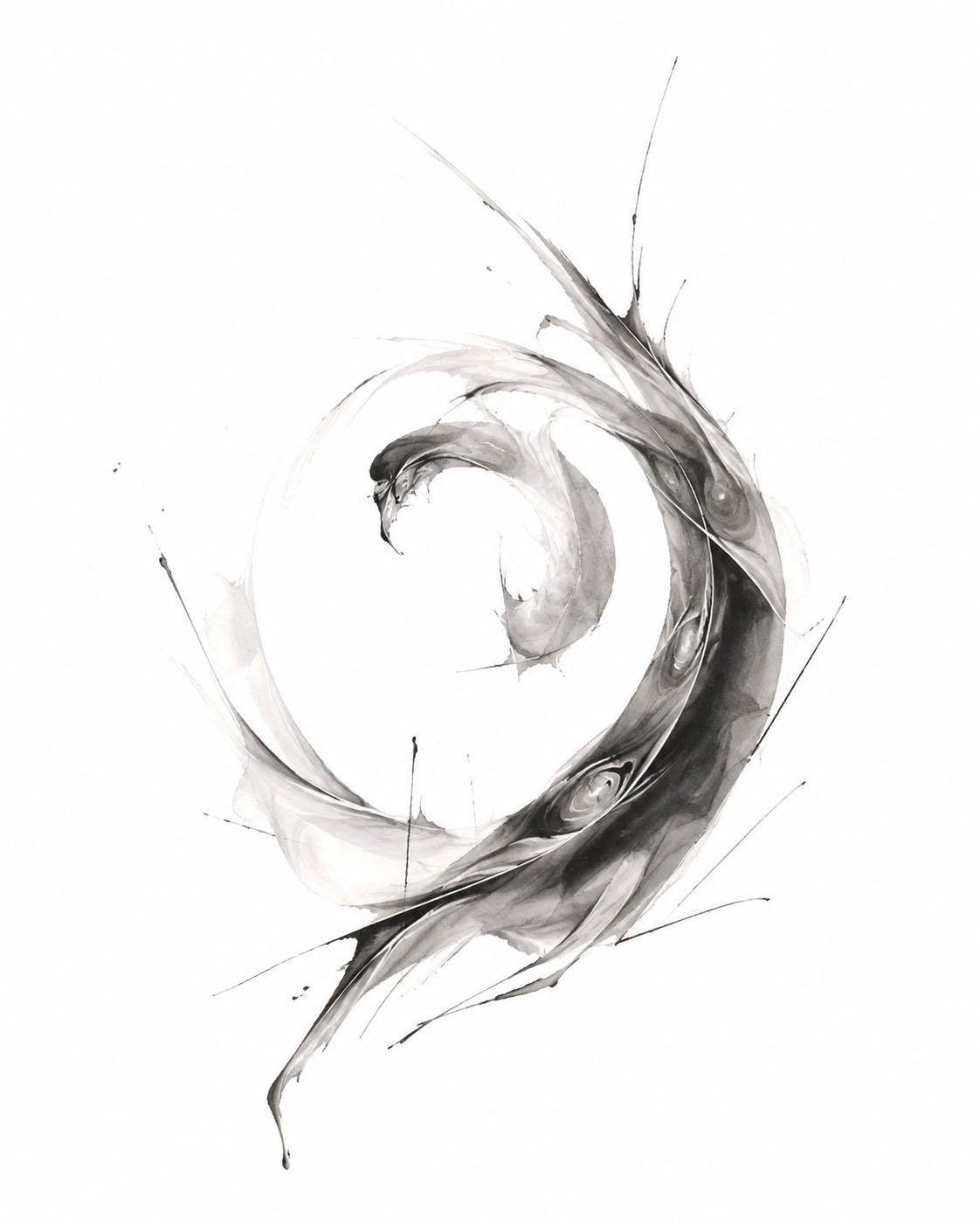
Ricardo F. Morín Infinity 3 30″x 22″ Sanguine on paper 2005
Two forms may be distinguished by their construction: an open curve, continuous along its course and capable of extension without closure, and a Möbius strip, formed by joining the ends of a band after a half-turn. The curve admits extension without return; the strip sustains a single continuous side through its return upon itself. Both are continuous. What differs is how continuity is held.
The open curve admits passage without requiring completion. It holds at each point without reference to return. The strip, received through its self-return, presents its course as already complete. Its coherence is apprehended through the relation that binds it to itself.
The curve may be followed without asking where it ends. A path along the strip’s interior may return indefinitely without meeting its single edge. The strip’s finite extent does not impose a final circuit. In both cases, continuity suffices.
The difference appears when attention shifts from what is given to how it is maintained. Along the curve, continuity is enacted in following. The path holds only insofar as no interruption occurs. The strip, received as a whole, appears to contain that continuity without requiring its course to be traced.
The strip’s return can thus sustain the invocation of infinity. An inexhaustible passage is received as already given within a finite form. The continuity that sustains this appearance remains implicit. The open curve offers no comparable assurance of completion. Its further extension must be followed, and its coherence depends on the unbroken relation along its course.
So long as the strip is received as given, the distinction holds. Infinity appears as already in place, and continuity remains absorbed within that appearance. The curve, by contrast, makes continuity operative without naming it.
The shift begins when what is given can no longer hold on its own. The strip’s apparent completeness no longer suffices. What appeared as a field without end must now be traced through the relation that sustains it.
The curve always depended on continuity, though it did not name it. Tracing the strip discloses the same dependence. What appeared as infinity is no longer primary. Its appearance depends on the continuity that had remained implicit.
The curve remains open, and the strip retains its return. Continuity is not confined to extension or return. It is what allows either to hold.
The appearance of infinity depends on continuity, but continuity does not require that appearance. It holds wherever relation is unbroken, including along a finite course.
Receiving accepts what appears without first requiring an explanation of what sustains it. Tracing follows the relations that sustain what appears and examines whether its coherence holds. Each entails a distinct discipline. Neither excludes the other.
The two modes remain distinct, yet not separate. The continuity that sustains the appearance in one is examined in the other. Their common ground does not make their requirements interchangeable.
In the invoking mode, virtue lies in receiving without imposing closure, in allowing what appears to remain unforced by premature explanation. The task is not to verify, but to receive without distortion.
In the diagnostic mode, virtue lies in sustaining relation without allowing coherence to be assumed. What appears must be traced, not to reduce it, but to prevent it from holding without what sustains it. Here the task is not merely to remain open, but to maintain relation.
Neither mode dispenses with the relation that sustains what appears. In receiving, that relation may remain implicit. In tracing, it must be maintained without substituting an imposed order for what was given.
The modes do not resolve into one another. Receptivity does not establish coherence, and tracing does not by itself prevent distortion. Passage between them requires attention to what each preserves and what each may alter.
Virtue does not belong to one mode alone. It appears wherever the proper condition of each is maintained without excess. In one, by not forcing completion. In the other, by not allowing what appears to hold without relation.
What differs is not what is given, but how it is held.
Ricardo F. Morin, October 6, 2026, Bala Cynwyd, Pennsylvania
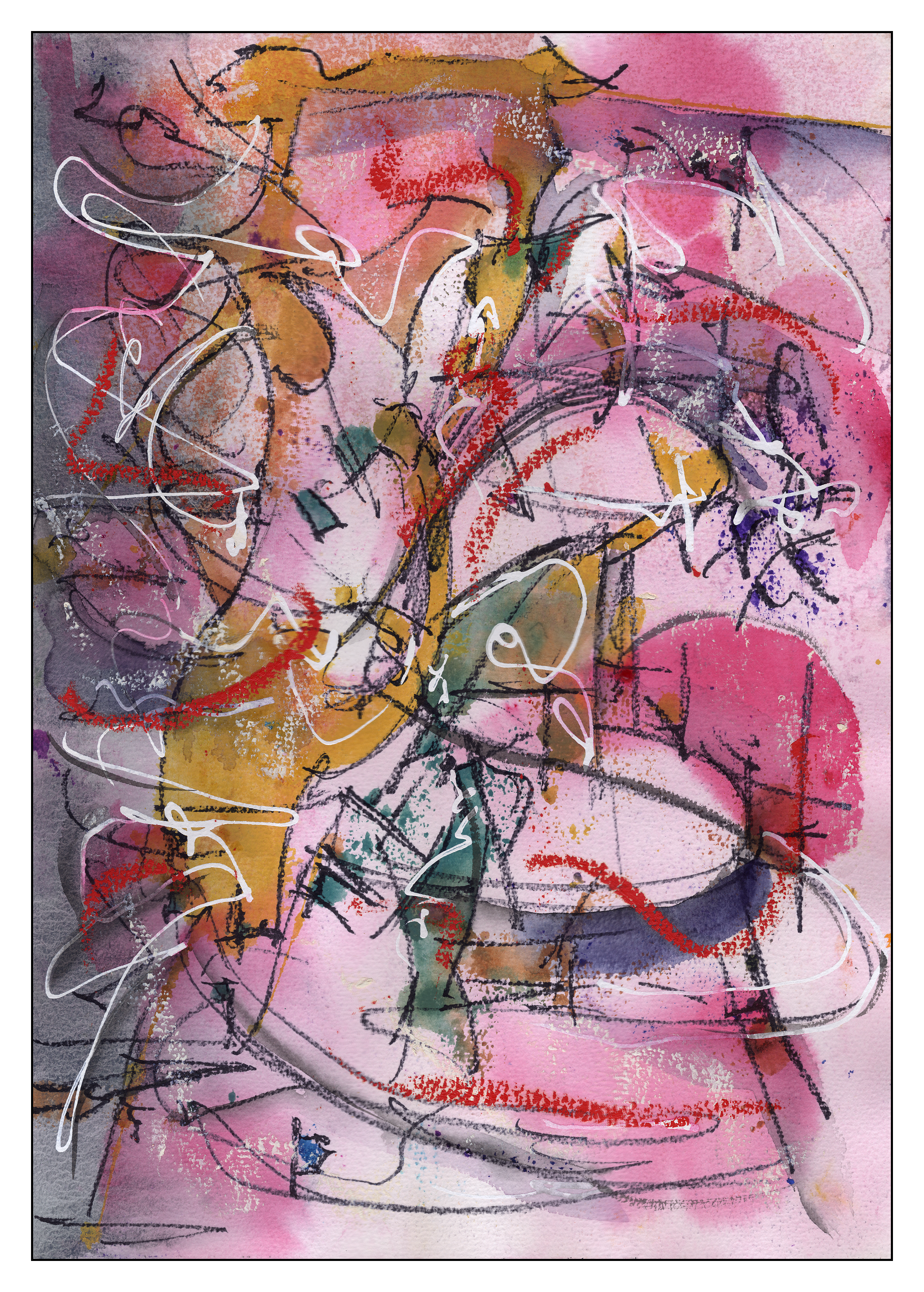
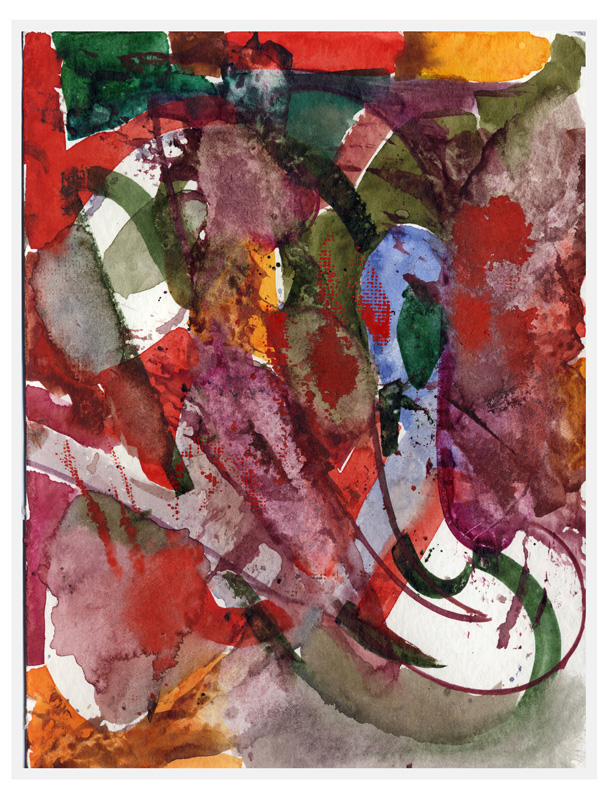
Ricardo F. Morín Furrows That Do Not Hold 14 x 20 inches Water color, dyes, oil sticks, white-out pen, and charcoal pencil 2008
Author’s Note
This essay appears in English under the title Furrows That Do Not Hold, which does not translate the original Spanish title but restates the condition it describes. The choice is not stylistic. It reflects the limits of how English prose carries figurative density without altering diagnostic function.
In English, a literal rendering of the image tends to register as proverb, allegory, or parable. Such a register introduces interpretive expectations the essay does not intend to activate. To preserve an observational and unsentimental tone, the English title names the condition in operational terms rather than reproducing the image.
In Spanish, the essay appears under the title Arar el mar sin cosechaalguna.In that linguistic context, the image can sustain historical gravity—including biblical cadence—without becoming moral instruction or rhetorical emblem. The phrase names a condition directly: real labor, a medium that does not retain marks, and the structural absence of yield.
This asymmetry is not incidental. It reflects the problem the essay examines: the limits of transmission across contexts. Meaning does not pass intact between generations any more than it does between languages. What can be preserved is not form, but function, when conditions permit reception.
Ricardo F. Morín
Oakland Park, Fl
Dec. 19, 2025
I.
Work continues. It is visible, organized, and often diligent. Tasks are performed, systems maintained, language refined, and processes repeated. The difficulty is not the absence of effort, nor even its misdirection, but the absence of accumulation—understood here as the condition that allows externally generated knowledge to be received, retained, and re-entered as orientation rather than reenacted as effort. What is done does not remain available for re-entry; the work does not carry forward.
This condition is easily mistaken for exhaustion or indifference. It is neither. The signs of engagement are everywhere. Activity increases. Responsiveness improves. Output multiplies. What disappears is continuity.
In such environments, motion replaces inheritance. The value of action lies in its execution rather than in what it leaves behind. Work proceeds as if each instance were sufficient unto itself. The past is not rejected; it is simply not retained in a form that can be re-entered.
II.
Experience is not a substance that can be passed intact from one holder to another. It is formed under pressure: through duration, consequence, and constraint. When detached from those conditions, it arrives flattened. What once clarified limits now appears as commentary. What once compelled adjustment now reads as preference.
Attempts to transmit experience as instruction often fail because they precede necessity. The recipient encounters the lesson without the conditions that gave it force. The knowledge arrives before the situation that would make it intelligible. What is offered in advance of need appears optional, even when it is exact.
This failure is not cognitive. It is temporal. Experience cannot be received on demand because it does not function as information (it cannot be accumulated in advance of necessity). It functions as orientation, and orientation requires circumstance.
III.
Autonomy is essential to judgment. Without it, action collapses into obedience. Yet autonomy becomes obstructive when it refuses inheritance. Agency hardens into the assumption that value must be self-generated in order to be legitimate. What comes from elsewhere is treated with suspicion, not because it lacks relevance, but because accepting it appears to compromise independence.
Under this posture, reception is mistaken for dependence—the refusal of accumulation as orientation from elsewhere. Learning from prior experience feels like concession rather than orientation. The capacity to receive is replaced by the obligation to originate. Knowledge must appear new in order to count.
The result is not freedom, but isolation from accumulated sense. Experience remains available, but unreadable. It circulates as language without uptake, gesture without consequence.
IV.
Where transmission falters, novelty becomes proof of validity. What appears new is granted authority by contrast alone. The question of whether a condition has already been encountered is displaced by the pressure to demonstrate originality.
Reinvention follows not because prior solutions failed, but because their success left no visible trace (no accumulated precedent). What worked quietly does not announce itself as precedent. The wheel is reshaped to display initiative, not to improve function.
This is a categorical error. Effort persists, but the tool is mismatched to the medium. Methods designed for accumulation are applied where marks do not hold. Raking the sea fails not because nothing is done, but because the medium erases furrows as soon as they are made.
V.
In such conditions, motion substitutes for progress. Systems reward speed, output, and responsiveness. Pause appears as inefficiency. Return appears as delay. Depth is displaced by throughput.
Iteration is mistaken for understanding. Repetition becomes evidence of engagement. The absence of yield is attributed to insufficient effort rather than misalignment. The response is to intensify motion rather than to reconsider posture.
Progress is measured by displacement rather than retention (rather than accumulation). What matters is that something happens, not that it remains available for use. The future is constantly entered, but never furnished.
VI.
The sea persists. It does not resist effort, nor does it respond to insistence. It remains indifferent to force. Furrows disappear not in defiance, but in indifference. The labor is real; the absence of harvest is structural.
Exhaustion accumulates privately while systems remain unchanged. Each attempt begins again. What was learned is learned again. The cost is borne individually; the benefit does not carry forward.
This condition is not decline, decay, or loss of intelligence. It is not moral failure or generational fault. It is the predictable result of environments that reward autonomy without reception, novelty without continuity, and motion without accumulation.
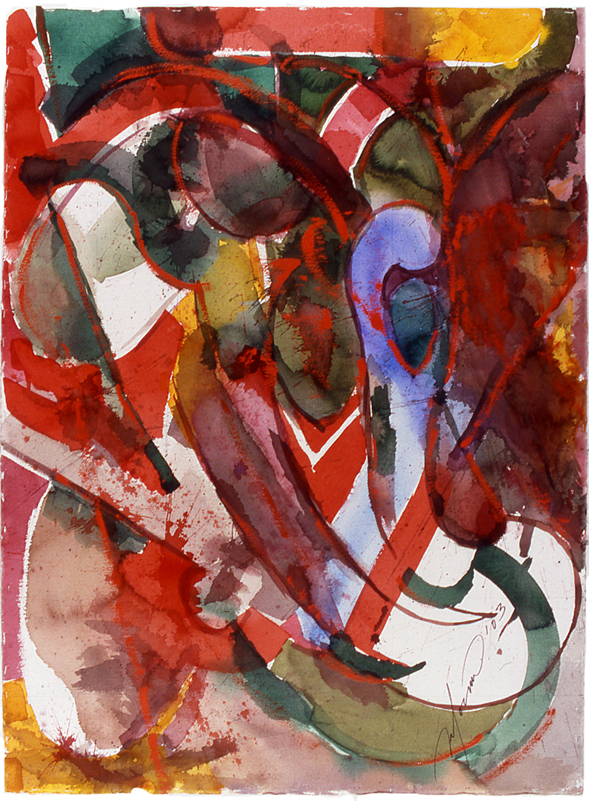
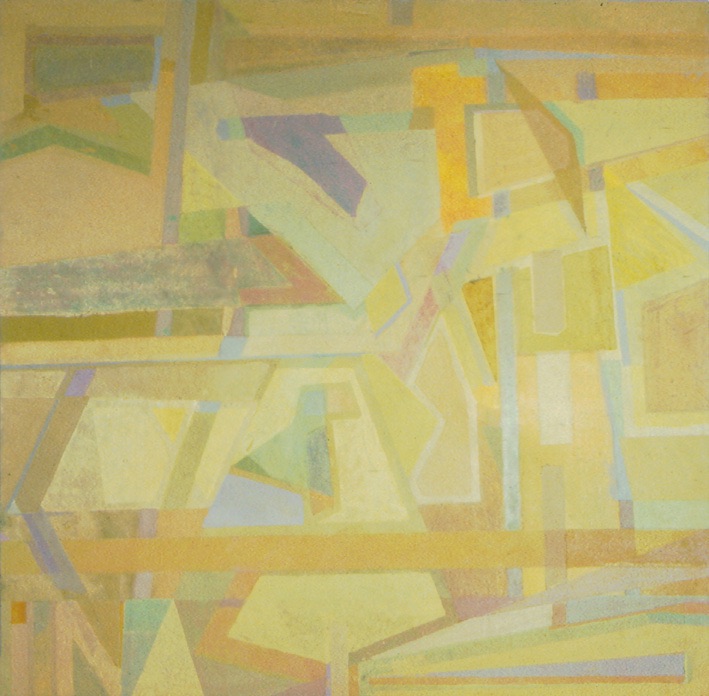
Ricardo F. Morín Templates II 40″h. x 30″w. Watercolor on paper 2003
People come to know who they are over time rather than all at once. A person recognizes themselves through earlier actions, remembered choices, and past commitments, even though the conditions under which those moments occurred no longer remain the same. What feels continuous is not encountered directly, but pieced together through recollection and interpretation as circumstances change. Because of this, uncertainty enters any effort to maintain a stable sense of self, not through confusion or deceit, but through the simple passage of time.
A person’s relation to themselves is therefore never fixed at its origin. It is mediated by memory, revision, and reassessment as life unfolds. What once made sense as a response to a particular moment must be understood again under different conditions. Identity does not remain secured by intention alone, because continuity can only be reconstructed after the fact rather than preserved intact.
Once identity must be reconstructed instead of taken as given, expectations of consistency begin to exert pressure. Past actions, statements, and commitments are treated as benchmarks against which the present self is measured, even when the circumstances that produced them no longer exist. Continuity is demanded where only relation is possible. What once functioned as a response to a specific situation is asked to stand as proof of an enduring self.
Because people encounter identity through memory and interpretation rather than direct access, identity becomes subject to demands for legibility. Others rely on familiar patterns of speech, behavior, and commitment to orient their expectations. When those patterns persist, continuity is assumed. When they shift, uncertainty arises. What cannot be readily recognized is often treated as absence rather than transformation.
Under these conditions, adjustment is frequently misread as violation. Changes made in response to altered circumstances are interpreted as departures from an assumed core rather than as necessary recalibrations. Earlier expressions of self are treated as binding commitments even when the conditions that produced them have changed. What is experienced internally as adaptation is therefore received externally as betrayal, not because trust has been broken, but because the expectation of fixity has remained in place.
After reconstruction is complete, identity offers no fixed origin. It offers only a coherence that must be maintained under changing conditions of recognition. Efforts to settle distress about identity fail when they ignore a simple fact: people change before others adjust their expectations. The difficulty does not arise from change itself, but from being required to remain readable according to standards that no longer apply.
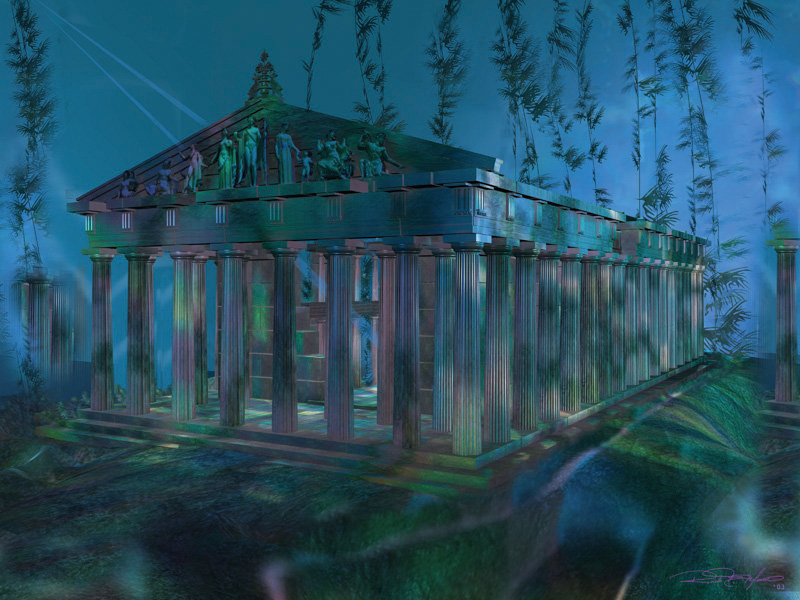
Ricardo F. Morín Temple of Zeus Underwater CGI 2003
The siblings had spent many years trying to conclude matters that had survived both of their parents. Their father had died nearly three decades earlier. Their mother died years after him, and even then the responsibilities did not end. Properties remained unsold. Before those matters were completed, another loss entered the family. The middle sister died the year before. Her own property and affairs now had to be incorporated into responsibilities that had already extended across many years.
Old registries and chains of title extending into the nineteenth century carried certifications, seals, and annotations from different decades and governments.
The country itself had changed during the last three decades. Currency and property lost value before transactions could be completed. Offices closed and reopened under different regulations, sometimes even under different names.
To release properties, formalize transfers, and liquidate assets, it became necessary to gather records, certifications, and documentary chains that different offices and fiscal authorities required for review. Procedures stalled among administrative demands, fiscal obligations, and intermediaries capable of accelerating processes that otherwise could remain paralyzed for months. Files accumulated beside seals, signatures, and annotations originating from different decades.
The matters had already extended across months and years. Meanwhile the siblings aged separately on opposite sides of the Atlantic. The oldest, still practicing law in Venezuela, continued moving between courts, registries, and offices in pursuit of unresolved claims and transfers.
At the same time, land previously belonging to the family remained tied to a legal dispute after having been illegally expropriated by the State years earlier. Defending the claim required certifications, archival records, legal filings, authorizations, appeals, and countersuits. Municipal fees, taxes, and procedural costs continued accumulating while the responsibilities themselves remained unfinished.
From outside the country, it was possible to perceive only partially how procedures there changed from month to month and sometimes from day to day. Some introduced further demands. Others became unavailable altogether. Another day had already been spent moving between offices, registries, and courts.
Messages moved constantly between them through calls, forwarded emails, receipts, scanned documents, explanations, and reminders. One sibling asked whether a payment could still be completed before another increase in tax fees made the transfer even more burdensome. The reply listed offices already visited that week and certifications still missing. Before the question returned again, the exchange had shifted toward an earlier disagreement others believed had already been resolved.
The second oldest, who had left Venezuela many years earlier, explained to one sibling that reminders concerning powers of attorney were meant to prevent delays. To another, he explained that unanswered messages were beginning to be understood differently. One sibling wrote late into the night to avoid misunderstanding. Another answered briefly the next morning before returning to the offices.
A signature believed to be sufficient was later rejected for lacking an additional authentication no one had mentioned before. One office requested papers already sent weeks earlier. Another confirmed receipt but could not say when the matter would be reviewed. A delayed response no longer remained only a delay.
Some questions received partial replies. Others were acknowledged and left unanswered. A message asking whether the funds could still be sent before the end of the month received only this reply: “We are doing what we can from here.” Another asking whether the property sale documents had already been submitted received a response about summer travel plans and whether the necessary signature would still be available in time.
He remembered a childhood game in which a sentence passed from one person to another until it returned altered, sometimes accidentally and sometimes not. At the time, the changes were part of the amusement.
When he attempted to describe some of this, one sibling told him that he was philosophizing again. The remark was mild enough to avoid argument, yet the explanation did not continue after that.
A requirement completed one week returned the next with another condition attached to it.
A message revised several times before being sent remained unanswered for days. Another received only a brief acknowledgment that did not refer to what had actually been written. By the time the next reply arrived, what had gone unanswered in the earlier message had already begun shaping the exchange that followed.
Later, a message arrived saying that one of the unresolved matters had finally been completed. No one referred to what had preceded the resolution. The exchanges resumed in a calmer tone, and attention moved toward whatever remained pending.
Ricardo F. Morín Templates 8” x 10” Watercolors on paper 2003
Ricardo F. Morín
January 31, 2026
Oakland Park, Fl.
People rely on memory because past experience cannot be returned to directly. What has already happened can only be approached again through recollection. Over time, memories are revisited under conditions that differ from those in which the original experience occurred. What once made sense in one moment must be made sense of again in another, and the standards used to judge it shift with present circumstances. As this happens, uncertainty enters the effort to rely on memory, not because people are careless, but because time alters the conditions under which understanding takes place.
In this respect, memory does not function differently from truth. Both remain exposed to time. What once appeared settled must be reconsidered as circumstances change, and neither memory nor truth remains fully governable by intention. What resists control is not honesty, but the displacement that time introduces between experience and its recall.
Memory as Justification
When direct access to experience is no longer possible, memory often takes its place as a source of explanation. People account for their decisions by referring to what they remember rather than to what can still be examined. Recollection is treated as evidence of continuity even when the conditions that produced it no longer exist. In this way, memory is asked to stabilize choices whose original context cannot be recovered.
As experiences recede further into the past, they are often invoked with greater confidence. This confidence does not arise because the memory has remained intact, but because distance shields it from challenge. What memory provides in such cases is not access to what happened, but a narrative sufficient to support judgment in the present.
Memory and Certainty
As experience becomes less accessible, certainty often increases rather than declines. Events that can no longer be tested against their original conditions become insulated from correction. Recollection hardens into conviction because comparison is no longer possible. Memory appears stable not because it is accurate, but because its sources cannot be revisited.
In this way, confidence attaches not to fidelity, but to distance. The past feels settled because it cannot be reentered. Certainty arises not from closeness to what occurred, but from the absence of any remaining means to contest what is remembered.
Memory and Repetition
As memories are repeated, they gain durability without preserving experience itself. Retelling does not restore original conditions; it refines what can be easily conveyed. Details that resist articulation fall away, while elements that can be narrated coherently are retained and reinforced. Through repetition, memory becomes less a trace of what occurred and more a stable account of what can be said.
What endures is not the experience itself, but a version shaped by its ability to be repeated without friction. After mediation is complete, the past yields no new facts, only new arrangements of what is already known.
We seldom think about gravity until something falls. A glass slips from a hand, rain descends through the air, our knees remind us that climbing stairs is not the same as coming down. Most of the time we simply accept weight as one of the conditions of being here. We stand because there is ground beneath us. We walk because our bodies remain attached to the surface of the Earth. We grow tired because carrying ourselves requires effort. Gravity seems so familiar that we hardly consider what it means.
We may know how to live within a condition without understanding what that condition reveals about us.
For centuries it was possible to imagine gravity as an attraction between bodies. A stone falls toward the Earth because the Earth pulls it downward. The image works well enough for ordinary purposes, and Newton gave that intuition mathematical power of extraordinary precision. Einstein did not simply improve the calculation.He altered the picture. In general relativity, gravity is expressed in the geometry of spacetime itself.Matter and energy affect that geometry, and a body in free fall follows the path determined by it.
When we stand motionless on the floor, we say that gravity is pressing us downward. But the pressure we actually feel comes from the floor pressing upward against us. If the floor disappeared and we began to fall freely, the sensation of weight would disappear as well, even though gravity had not gone away. What we call weight is the sensation produced when the floor prevents our body from following the path it would take in free fall.
We ask what time it is as though the question had a single answer.A call between London and Sydney gives the question different answers at the same moment.Morning in one place is already evening in another.We accept the discrepancy without difficulty because each clock names the hour from a different position on a rotating Earth.The clocks do not announce different realities.They reveal that even our most familiar account of time depends upon where we are.
Relativity carries that dependence further than ordinary experience suggests. The time accumulated by clocks depends not only upon the conventions by which we name the hour, but upon motion and gravity. Two perfectly accurate clocks separated by height do not accumulate exactly the same amount of time. A clock farther from the surface of the Earth runs imperceptibly faster than one below it. The difference within the height of a human body is extraordinarily small, yet it is real.
We do not feel it. Nothing in our nervous system announces that time accumulates at a slightly different rate near our head than near our feet. Our senses give us a practical world, not an exhaustive one.
The clock does more than organize appointments. Where we are enters into what we measure, first through the conventions of daily life and, at a deeper level, through the physical conditions in which the clock itself exists.
What suffices for living is not always enough for understanding.
We wake each morning within the apparent boundary of a body. We remember what happened yesterday. We anticipate what may happen tomorrow. We identify a continuous person who has survived changes of place, age, opinion, health, desire and circumstance. That continuity is indispensable. Without it we could scarcely conduct a life. But continuity does not mean immobility.
The body whose persistence we call ourselves is continually exchanging matter with its surroundings. We breathe, eat, excrete, shed cells, repair tissue, alter proteins, replace molecules and reorganize connections. The apparent solidity of the organism depends upon activity. What persists is not an untouched collection of material preserved from birth, but an organization maintained through change.
We distinguish the tree from the soil, rain, atmosphere and sunlight because the distinction is useful and because the tree possesses an organization unmistakably its own. Yet remove those exchanges and there is no tree. Its individuality does not require isolation. The boundary is real, but what it encloses remains dependent upon what crosses it.
We are no exception.
The elements in our bones, blood and nervous tissue did not begin with us. The carbon, calcium, oxygen, phosphorus and iron assembled into our bodies preceded every memory we possess. They entered a temporary organization capable of metabolism, sensation and thought. Eventually that organization will cease to maintain itself, and the materials that composed it will continue under other arrangements.
Nothing mystical needs to be added to this fact. Its difficulty comes from how directly it contradicts the scale at which we normally conduct our lives.
We naturally experience ourselves as centers. Vision opens from here. Pain occurs here. Memory gathers around this history. Desire points outward from this body. Every conscious life therefore begins from a perspective it cannot abandon. We cannot see without seeing from somewhere.
The mistake begins only when perspective becomes rank.
Because experience is centered upon us, we can begin to imagine that reality is centered upon us as well. What begins as an unavoidable condition of perception becomes an assumption about significance. Our plans acquire urgency because they are ours. Our losses appear uniquely intolerable because we undergo them. Our victories expand in importance because we remember the effort required to obtain them. The world gradually takes the form of a field across which we measure advantage, recognition, possession and control.
Much of human life must operate at this scale. We need homes, work, protection, institutions, agreements and some capacity to shape circumstances rather than merely submit to them. There is nothing inherently misguided in agency. The confusion occurs when the capacity to act becomes evidence of independence, or when the ability to control a portion of our circumstances is mistaken for mastery over the conditions that make control possible.
We may command a room, own a building, govern a company, direct an institution or exercise authority over millions of people, yet none of these distinctions alters the geometry in which our bodies exist. The most powerful person and the least visible pedestrian remain equally unable to suspend the passage of their own time. No title arrests metabolism. No possession negotiates with gravity. No reputation follows matter as an intrinsic property when the organization that sustained a person comes to an end.
This does not make human distinctions unreal. It places them.
A contract matters within human relations. An injustice matters to the person subjected to it. A work of art may alter perceptions long after the artist dies. A decision taken in an office can change a river, destroy a forest, preserve a neighborhood or determine whether strangers live under security or fear. Scale does not abolish consequence.
But consequence and cosmic importance are not the same thing.
We often seem caught between two unsatisfactory possibilities. Either we exaggerate ourselves until human desire becomes the measure of reality, or we look at the immensity of the universe and conclude that nothing we do can matter. Both responses preserve the same assumption. Both imagine that significance must be proportional to size or duration.
It need not be.
A brief event can alter everything that follows from it. A mutation occurs within a microscopic structure. A seed germinates in a crack. A sentence changes a judgment. A decision made in minutes affects people who were never present when it was made. Duration does not determine consequence any more than physical size determines complexity.
Our lives can therefore be transient without being negligible.
Much of human culture has been built around resistance to transience. We preserve names on buildings. We accumulate objects beyond use. We construct genealogies, monuments, archives and institutions. We seek recognition from people we do not know and sometimes from generations that will never meet us. Even power often carries beneath its practical advantages an obscure promise that importance might somehow protect us against disappearance.
Yet permanence is not what continuity means.
A wave continues through water without preserving the same water. A forest persists while individual trees germinate, mature, fall and decompose. A language survives because speakers who did not invent it alter it while using it. Continuity can depend upon transformation rather than resist it.
We usually speak of beginnings and endings as though they marked opposite conditions of reality. Something begins when a form appears and ends when that form can no longer sustain itself. The distinction remains real at the scale of the form, yet becomes less absolute when we ask what, precisely, has begun or ended. The wave subsides while the water continues in motion. The tree dies while its matter enters other exchanges. A body ceases to maintain the organization by which we recognized a person, while its materials continue under conditions the person no longer inhabits.
The same uncertainty widens with the scale. Roger Penrose has proposed, through conformal cyclic cosmology, that the remote future of one cosmic era may be conformally continuous with what appears as the beginning of another. Whether that proposal survives observation remains unresolved. Its relevance here lies less in asking us to accept a cyclic universe than in exposing how readily we treat beginning and ending as absolute properties of reality when they may also describe transitions between forms whose continuity exceeds the scale from which we observe them.
Every beginning we encounter already depends upon conditions that preceded it, and every ending alters the conditions that follow. A beginning can therefore be genuine without being an emergence from nothing, just as an ending can be final for a particular organization without becoming the disappearance of the reality from which that organization arose.
Continuity does not abolish beginning or ending. It places both within transformation.
We participate in such continuities everywhere, although our attention gravitates toward the individual form.
Birth gathers matter into an organization capable of sustaining a particular history. Death ends that organization. Between them something genuinely singular occurs. There is perception. There is memory. There is the astonishing capacity not merely to undergo events but to recognize relations among them.
Consciousness occurs within that same continuity.
We still do not possess an agreed physical account of how subjective experience arises. Penrose has also suggested that the problem may expose limits in our present understanding of quantum mechanics and perhaps connect consciousness with processes deeper than ordinary computation. Those proposals remain disputed.The more elementary point does not depend upon them:whatever consciousness ultimately proves to be, it does not occur outside nature.
Our thoughts are not spectators admitted into the universe from another realm.
They happen here.
The brain that distinguishes a star against surrounding darkness was assembled from the same physical world it observes. The eye that receives the light belongs to an organism formed on a planet orbiting one star among hundreds of billions in a galaxy that is itself one among an immense number of galaxies. The mathematical symbols with which we describe curvature, time and matter arise within nervous systems subject to the very conditions those symbols attempt to understand.
We are therefore in a peculiar position. We cannot step outside the universe to inspect it, yet within the universe a form has arisen capable of asking what the universe is.
This need not mean that the cosmos is conscious. The claim would exceed what we know. A more modest claim is already extraordinary enough: portions of matter can become organized in such a way that the resulting organism acquires sensation, memory, inference and the ability to examine its own conditions of existence.
For a while, matter can ask what matter is.
For a while, a temporal organism can investigate time.
For a while, beings held to the Earth by a geometry they cannot perceive directly can discover that geometry and revise an intuition that had seemed obvious.
Consciousness also allows consequences to be imagined before they occur.
A stone changes what it strikes. A river reshapes its banks. A storm destroys without intending destruction. We also alter what surrounds us, but sometimes we can foresee the alteration.
That difference is small in cosmic scale and enormous in human consequence.
The ability to anticipate does not guarantee wisdom. It also permits calculation, exploitation and forms of domination unavailable to creatures incapable of abstraction. We can organize resources on scales no individual could command alone. We can convert forests into numbers, populations into categories and distant consequences into tolerable abstractions. The same intelligence that discovers our dependence upon intricate systems can devise increasingly efficient ways of extracting from them.
Our problem may therefore be less a shortage of intelligence than a disorder in the scale at which intelligence is applied.
We become extraordinarily attentive to what enlarges immediate agency and strangely inattentive to the conditions that make agency possible. We learn how to increase production before asking what its continuation requires. We perfect means of influence without examining what influence is for. We celebrate the enlargement of personal power while rarely asking whether the self being enlarged has been understood.
We are temporary organizations of matter attempting to secure permanence by accumulating temporary arrangements of matter. We seek independence through systems of dependence. We pursue control while inhabiting bodies whose most elementary processes remain beyond voluntary command. We measure ourselves against one another while all of us participate in conditions none of us established.
Perhaps this is why cosmic perspective can become sentimental so easily. We look at photographs of galaxies, pronounce ourselves small and then return unchanged to the same hierarchies of importance. Smallness alone teaches very little.
The more consequential recognition is not that we are small. It is that we are situated.
We exist here, under conditions.
The word here contains more than location. It includes a particular planet, atmosphere, gravitational field, evolutionary history, network of organisms, inherited language and moment in time. None was chosen by us. Yet through them we acquired the capacity to choose other things.
We often speak of freedom as though it required independence from conditions, although nothing we observe possesses that kind of independence. What we call freedom therefore takes place within circumstances we did not choose and cannot entirely command.
Use is not identical with entitlement, nor ambition with domination. Individuality does not require separation from what sustains it, just as singularity does not by itself confer supremacy.
None of this diminishes human achievement. The ability to understand even a fragment of the cosmos is itself one of those achievements. What changes is the meaning of achievement when it no longer serves as evidence that we stand above the reality from which it arose.
Gravity remains an ordinary condition of the body.
We may speculate about consciousness, argue about the origin of the universe and construct theories extending billions of years into the past and future, but while doing so we remain seated in chairs, standing on floors, carrying the weight of bodies whose organization must continuously be maintained. The cosmic does not begin somewhere beyond ordinary life. It is already present in the conditions that make ordinary life possible.
The distance between our feet and the ground is enough.
The interval between one heartbeat and the next is enough.
The fact that we are changing while calling ourselves the same is enough.
The universe becomes less an enormous object surrounding us than the continuity within which our distinctions arise. We do not disappear into that continuity. We become more precisely located within it.
And perhaps location is a better beginning for human significance than grandeur.
We do not need to imagine ourselves as the purpose of the universe. We do not need the universe to certify our importance. We need only recognize that, during the brief organization we call a life, we can become aware of relations that extend beyond our immediate interests and sometimes choose our actions in light of them.
Gravity gives us weight without telling us what deserves weight.
Consciousness cannot release us from the conditions of existence, but it allows us to examine the measures by which we assign importance within them.
Between those two facts, a human life takes place.
We tend to think we know where a tree comes from. We place a seed in the ground, water it, wait, and eventually a green shoot breaks through the surface. The explanation seems almost too simple to deserve a question. The tree comes from the earth.
Yet a mature tree can weigh thousands of pounds, and almost none of the increase in its dry mass comes from the soil. The minerals absorbed by its roots are indispensable, but they account for only a small fraction of the matter that eventually becomes trunk, bark, branches, and roots. Much of the carbon incorporated into the body of the tree entered through its leaves as carbon dioxide, an invisible gas dispersed throughout the atmosphere. With water and the energy of sunlight, the tree incorporates that carbon into sugars, cellulose, lignin, and the extraordinary architecture we call wood.
That much of a tree’s dry mass originates in the atmosphere is elementary biology. Its implications are anything but elementary.
A tree appears solid, independent, and bounded. We can touch its bark and walk around its trunk. We can distinguish precisely where the tree ends and the air begins. Yet the history of the matter that constitutes the tree contradicts the apparent simplicity of that boundary. The matter that now forms a trunk was once dispersed through the atmosphere. Water entered the tree from the soil and will leave it again. Minerals passed from rock into soil and from soil into roots. Energy arriving from a star made possible the chemical transformations that sustain living structure.
The tree, then, is better understood as an organized continuity than as an isolated object.
And so are we.
The contrast between our ordinary perception and this material exchange can be unsettling because perception encourages us to picture the body as a closed unit. We experience ourselves as contained within the outlines of our bodies and conceive of the world as a reality beginning beyond the skin. We speak naturally of what occurs within the body and what lies beyond its limits. These distinctions are useful and biologically necessary, but their usefulness does not make them absolute.
Every breath contradicts the idea of an entirely closed bodily boundary.
Matter that a moment ago was outside our bodies subsequently participates in the body’s internal chemistry. Oxygen enters the bloodstream. Carbon dioxide leaves it. Water passes through us. Food supplies matter for tissue and chemical energy for vital processes, while tissues are continually broken down and rebuilt. The substances that compose us have histories immensely older than our own appearance and will continue to enter other processes once our present organization has ceased.
We are not, therefore, substances that permanently possess a fixed collection of matter. We are organized processes that maintain a recognizable form through continuous exchange.
Individuality does not become unreal merely because our bodies depend upon continuous exchange. A tree remains a tree, and we remain ourselves. The continuous exchange of matter and energy, together with the relationships that sustain life, does not erase the difference between the tree and us. It is more fruitful to understand individuality precisely as differentiation within continuity.
We do not have to choose between absolute separation and indistinction.
The tree is not the same as us, yet the tree and we do not belong to entirely separate orders of existence. We arise within the same material world, depend upon intersecting cycles, and participate in exchanges that precede each of our individual forms. Our difference is real, but our separation is never complete.
We habitually imagine the subject as an inner realm set apart from an external object. We look at the tree. But our experience never arises from an isolated consciousness contemplating a reality wholly external to itself. We see because we possess bodies capable of sight, because light travels between the world and our eyes, because the nervous system transforms physical events into perception, and because our bodies already belong to the same world that appears before us.
We do not exist first and enter into relation with the world afterward. Our relation to the world is part of the very condition of our existence.
The separation between the perceiving subject and the perceived world therefore ceases to constitute an absolute opposition. The perceiving subject and the perceived world belong to the same sensible field. We may say that our individuality is a conscious differentiation occurring within a continuity that has never ceased to contain us.
The idea of differentiation within continuity acquires a different gravity when we lose someone.
When someone we love dies, absence imposes itself with a gravity that seems absolute. A voice no longer answers. A body is no longer available to touch. The consciousness with which we once shared words, gestures, and attention no longer responds to our own. We confront a rupture that no philosophical subtlety should attempt to erase.
Yet death may compel us to reconsider what it has actually interrupted and what it has not.
We often speak as though the person had been removed entirely from existence, as though an individual life were an isolated portion of the world that death could simply annul. Material processes do not conform to such absolute cancellation. Matter does not fall into nothingness. Energy does not simply disappear. Structures dissolve, bonds break, and substances enter new cycles.
Matter continues to undergo transformation, but that continuity is not enough to preserve the person. The continued circulation of atoms does not mean that the singular consciousness we knew and loved continues with them. With death, the living form that made that singular consciousness possible comes to an end.
We never existed as isolated substances confronting an external reality. Our bodily, perceptual, and relational experience has always arisen within the same sensible reality to which we still belong.
A life also remains inscribed in other lives. It leaves memories, alters decisions, awakens affections, and produces consequences within a shared world. Death may bring the consciousness of that person to an end, but it cannot remove from reality the events that life made possible or the transformations it produced in those who remain.
We cannot infer from the conservation of matter or energy that personal consciousness survives death. Science provides no basis for such a conclusion. Nor does the continuity of physical processes constitute evidence that an individual mind persists after death.
But neither are we required to imagine death as an expulsion from existence.
The person who has died no longer persists as the conscious organism through which we knew and loved that person. Yet nothing requires us to imagine that the life itself has somehow fallen outside the world from which it arose. The individual organization has ceased. Material continuity, belonging to the sensible world, and the consequences of that life have not been annulled.
Once we recognize that physical continuity does not demonstrate personal survival, it becomes understandable that the ancient idea of reincarnation might enter our thoughts. Nothing we have recognized, however, implies the migration of an individual consciousness from one body to another.
Perhaps we can reformulate the intuition that the word reincarnation attempts to name.
The continuity of existence need not mean the repetition of the individual. The matter and energy that made a life possible enter new configurations, while the relationships and consequences produced by that life remain inscribed in the lives of those it affected. The person does not reappear in those new configurations or in the lives transformed by that person’s own, but the end of a singular form does not therefore amount to an absolute fall into nothingness.
The carbon in our bodies belonged before us to other organisms and material processes and will later become part of others. The elements that compose our bodies have histories reaching back to earlier generations of stars. The living world continually incorporates, transforms, releases, and reincorporates matter.
Our life begins within that ceaseless exchange and retains a form for an interval.
Transience does not make our lives insignificant. On the contrary, perhaps it is precisely the transient character of form that gives a life significance. A melody does not become unreal because its notes do not continue sounding forever. The identity of a melody resides in an organization that unfolds through time. We do not require music to become permanent matter before granting it reality.
Why should we require permanence of ourselves?
Perhaps we resemble a melody more than a monument.
Our existence does not consist in the permanence of a substance exclusively our own, but in an organized continuity of matter and energy within processes that exceed every individual. For a time, that continuity takes the form of a particular body, a particular perception, and a particular voice. That individual acquires a history and a name. Loves particular people. Remembers particular rooms. Looks at a tree and recognizes a presence distinct from itself.
When we look again at the tree, we discover unexpectedly that the separation between our bodies and the world was never as absolute as we had imagined.
We discover that matter which appears solid may once have been dispersed through the air. Matter that appears motionless participates in constant exchange. An organism that appears self-sufficient depends upon innumerable relationships. Forms we perceive as separate can retain genuine differences without ever having been absolutely severed from one another.
We need not deny that death has occurred. We need not invent certainties about what happens to consciousness when the body can no longer sustain it. We can acknowledge the full gravity of absence while also examining the assumption that absence amounts to absolute separation.
Death brings a singular form of presence to an end, but it cannot turn into absolute separation a life that was never absolutely separate from the world or from other lives. Those we have loved do not remain as consciousnesses demonstrably accessible to us, but neither can their lives be excluded from the shared reality in which they occurred and of which our own lives remain a part.
The singular form of each person cannot be replaced. That person’s consciousness cannot simply be reconstructed from the matter of the organism that once sustained it. Yet that life created relationships, left memories, and generated consequences that now belong to the actual history of the world and to the lives of those transformed by its presence.
We continue within the same reality that once held us together, not because death has preserved an intact personal identity, but because separation was never the original condition of our existence.
The tree thus becomes a way of understanding that extends beyond the example of photosynthesis. The existence of the tree invites us to reconsider the categories by which we divide reality. Air and wood, self and world, presence and absence, permanence and transformation may not stand on opposite sides of the absolute boundaries we habitually draw.
Perhaps existence does not consist primarily of separate things that occasionally enter into relation with one another.
Perhaps relationships are constitutive, and individual forms arise within them.
We can therefore say, without giving the phrase a literal biological meaning, that the tree is also us. Not because our differences disappear, but because every difference occurs within a continuity that no individual form originates and no individual ending can abolish.
We do not stand outside existence looking in from the exterior.
We are among the transient forms capable of recognizing the continuity of the existence to which we belong.
During those first years through 1976, Buffalo accumulated heavier snowfalls than usual, with blizzards exceeding those of previous winters. In some neighborhoods the snow rose beyond the rooftops of houses. The wind crossed the streets with an intensity unfamiliar to someone who had grown up in Valencia, Venezuela. In the art studios of Bethune Hall, at the State University of New York at Buffalo, canvases leaned against one another while students worked for hours in silence or beneath scattered conversations. The smell of oil, turpentine, and damp wood continuously permeated the interiors.
He had arrived in the United States in 1972 at seventeen years of age. Displacement did not consist solely in leaving one country behind. It also altered the daily perception of the simplest things: the scent of cities, winter light entering through windows, the relation between the body and climate, the constant sound of a language still only partially familiar.
Before Buffalo there had been Valencia. The Arturo Michelena School of Fine Arts. The first hours of drawing during childhood. Later, during adolescence, the summers studying painting in the private studio of the Hungarian painter Lazlo Lenyel. Even then, however, painting seemed less a future profession than a form of attention. Preparing the surface of a canvas produced an experience difficult to explain outside the act of painting itself.
During those years canvases began accumulating rapidly. Some were destroyed. Others remained leaning against walls for months before receiving another layer of paint. The organization of the studio changed constantly. Painting did not yet follow a precise theory. There was instead a physical insistence: returning each day to observe relations of color, spatial tension, surface, and rhythm.
In 1976 he returned briefly to Venezuela. There he studied privately with the Málaga-born artist José Luis Montero before returning once again to Buffalo under the guidance of Herta Kane and James Jipson. Gradually the first exhibitions began. In May of that same year he presented “Works by Ricardo Morin” at the Villa Maria College Gallery.
Conversations about art during those years frequently revolved around movements, historical legitimacy, abstraction, expressionism, or formal theory. Yet many of the most intense hours occurred far from any discourse. Remaining alone in the studio, slowly shaping how certain surfaces retained or rejected light, seemed to contain an experience more concrete than many of the explanations later constructed around the work.
In 1977 the Venezuelan Ministry of Education awarded him a full scholarship to complete a B.F.A. at SUNY Buffalo. The thesis exhibition, Buffalo Series 1979, was later curated by Seymour Drumlevitch at the Alamo Gallery of the State University of New York at Buffalo. [1] Shortly afterward, Buffalo Series No. 1, 1980, received the Birge Wall Covering Award and the Reed Foundation Award at the 38th Western New York Show at the Albright Knox Art Gallery. [2]
Awards, exhibitions, and scholarships briefly made continuity seem attainable. During certain periods it seemed possible to imagine a relatively stable professional trajectory. Yet that stability coexisted with another sensation more difficult to name: the persistent impression that the real work was taking place elsewhere, far from the forms through which it was publicly interpreted.
In 1979 he attended stage design seminars taught by Gunther Schneider-Siemsen at the Internationale Sommerakademie für Bildende Kunst Salzburg. There he received the Förderungspreis Leistung der Stadt Salzburg award. Shortly afterward Drumlevitch recommended that he apply to the M.F.A. program of the Yale School of Drama.
At Yale the theater workshops functioned on another scale of production. Constructions, lighting, scenic architecture, models, and technical equipment occupied spaces inside buildings adapted for the stage. Physical labor was continuous. Stage design also offered a concrete possibility of economic survival within New York.
During the first years after Yale he worked as a set designer in New York’s Off-Off-Broadway circuit, collaborating with Irene Fornés and Max Ferrá at INTAR. [3] At the same time he worked as principal assistant to established Broadway designers. Workshops, constructions, and rehearsals occupied much of the days and nights.
By the late 1980s he obtained a loft in Tribeca devoted exclusively to painting. Large-format canvases leaned against high walls while painting once again began occupying the center of daily life. The studio was filled with accumulated materials: stretchers, pigments, tools, fragments of canvas, and drawings tacked against the walls.
At certain moments it seemed possible to sustain both lives simultaneously: theater and painting. New York still retained industrial areas where some artists could work within relatively spacious environments. Yet even during those years of greatest professional activity, a tension persisted between the public continuity of a career and the quieter experience of the work itself.
In 1993 interruption appeared. Due to AIDS he was forced to abandon the loft, suspend professional activity, and return to Venezuela seeking refuge with his family. The diagnosis rapidly altered the entire structure of daily life. Many previous continuities disappeared within a few months: work, economic stability, studio, city, professional rhythm.
Between 1993 and 1996 his health deteriorated considerably. He spent long periods inside the family home with little physical energy and frequent medical interruptions. It was then that the Aposentos series began. The second painting of the series, Aposento No. 2, was selected for the “XIV Municipal Painting Salon: Homage to Carlos Cruz-Diez,” held in 1994 at the Municipal Art Gallery of Maracay. [4]
He painted slowly. Canvases remained stacked against the walls for entire weeks before receiving another intervention. The body fatigued quickly. Light shifted inside the room while the paintings remained motionless for hours or entire days. At times the work advanced only a few centimeters.
Painting then began acquiring another rhythm. It no longer seemed to respond solely to the continuity of a career or to the possibility of exhibition. Some works emerged more as accompaniment than affirmation.
During those same years he worked voluntarily at Fundación Metaguardia, created in Valencia as a center of information and support for people with terminal illnesses, many of them also living in conditions of indigence. The foundation integrated emotional support, activities connected to the arts, and pro bono medical services.
Silent conversations, long periods of waiting, weakened bodies, and shared vulnerability slowly altered the perception of many previous categories. Illness seemed to render secondary many differences that had previously organized much of daily attention.
In 1996 he finally returned to New York in order to access the new antiretroviral treatment. His immunity was practically nonexistent. Soon afterward he sought assistance from the Department of Human Resources because of his condition of destitution. He first stayed at the transitional Paradise Hotel in the Bronx and later at the Common Ground program at the Hotel Times Square.
Paradise was a profoundly unstable place. Narrow corridors, moldering rooms, and constant precariousness altered the perception of time. Some people disappeared suddenly. Others remained locked inside their rooms for entire days. The noise of doors, televisions, and arguments continuously crossed through the walls of the building.
Even so he continued painting. Small canvases rested against walls or on improvised furniture near the window. The continuity of the work no longer depended upon ideal conditions. It depended only upon continuing to work within whatever circumstances were available.
During those years an unexpected sensation of emptiness also appeared. Not necessarily as absolute loss, but rather as a gradual reduction of the interior noise through which ambition, identity, or permanence had once been sustained. Within that emptiness certain forms of attention slowly began acquiring greater intensity: breathing, light upon surfaces, the rhythm of the body while walking through the city, the noise of certain rooms, the momentary presence of familiar faces.
In September 1998 he received support from the New York organization Visual AIDS, which organized a joint exhibition based on watercolor and oil portraits together with Nicolo Cataldi at St. Mark’s Church. Later came other collective exhibitions and alternative platforms. Some of the paintings from the early 1990s were later described by the artist Jo-ey Tang as “love letters to the city of New York”.
In 2000 he received a VESID rehabilitation grant that included specialized training in digital tools and computer equipment. The computer then slowly became incorporated into the visual work. Between 2000 and 2003 he used digital media combined with watercolor and hand drawing to reinterpret fifteenth-century Persian miniatures through geometric processes of reconstruction. [5]
Later, between 2005 and 2012, he taught a course titled Pictorial Perspective at Pratt Institute. Meanwhile he developed the Triangulation Series, working with suspended geometries, reduced spaces, and hanging formats. [6]
After completing chemotherapy in 2008 for an AIDS-related Non-Hodgkin lymphoma, systemic muscular disorders began preventing him from even stretching large canvases. The hanging canvases then emerged also as a direct consequence of physical limitations. The body slowly began imposing another relation to space, time, and work.
The canvases remained suspended for weeks while light varied across the surfaces. Physical movements were slower. Material reduction altered perception as well. Silence ceased feeling like absence and began functioning as another form of attention.
Between 2009 and 2010 he initiated the Metaphors of Silence series. [7] Many of the works emerged slowly within prolonged periods of physical stillness. The need to explain aesthetic experience intellectually gradually began losing intensity before the experience of observation itself.
During those same years he collaborated with Dr. Andrew Irving in an experimental project on art, anthropology, and human experience related to New York Stories. Part of those dialogues were later incorporated into The Art of Life and Death: Radical Aesthetics and Ethnographic Practice. [8]
With the passing of years certain tensions slowly began losing sharpness. Illness remained present, although it no longer organized each moment of the day in the same way. Certain forms of ambition or anxiety surrounding continuity, recognition, or permanence seemed gradually to diminish without disappearing entirely.
Painting continued occupying a central place, though no longer necessarily as an exclusive affirmation of identity. Other things also remained: conversations, walks, reading, physical exercise, breathing finding rhythm again, the momentary attenuation of certain aches, light changing across the surfaces of the city, brief encounters throughout the day.
Some afternoons he continued walking slowly while breathing found rhythm and light descended across the buildings. Aging, fragility, and the proximity of death did not disappear. Neither did they remain completely separate from the movement of existence itself.
Ricardo F Morin April 17 through May 14, 2026 In transit
A thank you may be spoken and still leave little behind it. The words are said, the gesture acknowledged, yet what follows continues almost unchanged.
What resolves a necessity that could not otherwise have been resolved leaves more than a momentary obligation behind it. It alters conduct. The difficulty is not always in recognizing what has been received, but in remaining openly shaped by it afterward.
At times, what is received passes nearly unnoticed. It is recognized in the moment, then absorbed into ordinary expectation. Nothing changes.
At other times, acknowledgment is followed almost immediately by the resumption of guarded conduct, as though nothing had passed between them requiring either person to remain changed by what is owed to them.
Something similar occurs when acknowledgment becomes routine. The words remain intact while their force weakens. What once carried weight becomes part of ordinary exchange.
Resentment may emerge from the same movement. Withdrawal does not always arise because nothing was received, but because remaining openly affected by it becomes difficult to sustain over time.
The change does not announce itself directly. Replies shorten. Warmth recedes into formality. Attention weakens without disappearing. Continuity remains while something within it becomes less available.
Part of the difficulty lies in the human capacity to narrow perception around self-preservation while remaining partially aware of what is being diminished, avoided, or abandoned.
None of this proves that recognition was false. Yet when guardedness repeatedly restores itself before acknowledgment can continue altering conduct, relations gradually persist more through form than through the openness that once gave them force.
What remains active through form alone may continue outwardly for long periods while gradually losing the openness that first allowed recognition to alter conduct.
To remain capable of recognition is not to magnify what is given, but to allow what has been received to continue altering conduct without immediately reducing it to balance, habit, irritation, or distance.
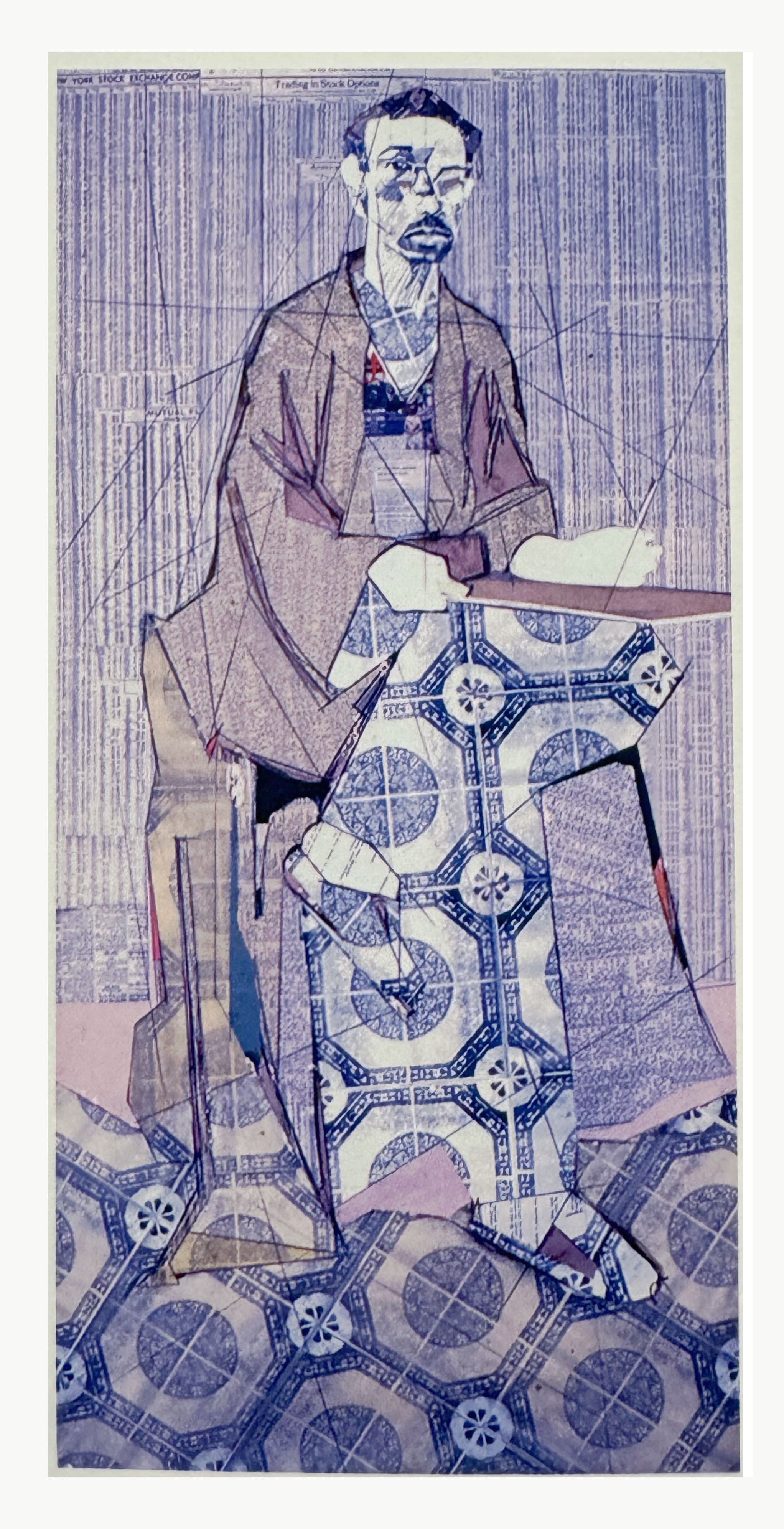
Ricardo F. Morín Self Portrait:Stock Market New York City 36” x 74” Collage with charcoal pencil 1987
He did not go into other artists’ studios unless invited. If he recognized something in the work, he said it.
At that time, education consisted in finding a means of expression that suited him. It was a way to refine what he saw and felt and to bring it into the work. The subject was his own, but it moved within the traditions of painting and other arts. What mattered was finding his voice as a painter, in the use of color and the depth it could sustain pictorially. On the surface, his gestures remained inscribed.
Within that, he would stand before the work and look, asking what it could contain or where it might resolve. If he recognized something, he stayed with it, not to explain or to correct it, but to register it mentally or to shift it within its structure. There would be a pause, and he would look again, as if something already present had just come into view.
Other artists entered his space with legitimate differences. They did not alter what took place between them.
One moment remains with him.
A graduate student was working on a piece, a structure rising like a tapering tower, bright, near red, perhaps fuchsia, with broken glass along its edges. It was not finished. It was evident that she was still working through it.
He stood beside her and said what came to him. It recalled what he had seen growing up: glass placed on top of walls, not as decoration, but to keep people out, to cut anyone who tried to enter.
She stopped, looked at the piece, then at him. Nothing more was said.
He left.
Later, he saw the piece again when she opened her show at an alternative gallery after graduating. There was a recording, a voice repeating that there is a violent world outside, and the piece and the voice remained together without resolution.
Their advisor in the art department told him that what he had said in her studio did not leave her and passed into the work.
He had not thought of it that way. He said it and moved on.
That is what remains with him, not recognition, but that something one sees can be taken up and continue elsewhere.
Around that time, his mentor said something to him in private. He told him not to take at face value what other faculty members said about his work, nor what he himself might say.
He heard it, and it did not leave him.
During that period, he traveled to Salzburg, Austria, for a seminar in stage design. He had not planned it. It just happened.
The work there required interpretation, and he found himself imposing his own way of seeing so that it would hold. It was not just something one looked at. It generated a mood that people entered and responded to.
He worked from what he saw, though it did not work as expected.
He continued with it.
After that, he entered a selective graduate program. It followed from what he had already started.
There, things took shape within a director’s limits of interpretation. He finished the program, but the way he had been working before did not continue in the same way.
Outside academia, he was received as an outsider; it did not extend beyond distrust. The work remained within that frame. He could see where the attention was directed; it did not include him, whatever he did. In New York City, visibility opened to the same names, not to him.
While he worked in stage design to support himself, he continued to produce paintings.
Opportunities did not present themselves for either.
He worked on what others would present, and it advanced without him.
The hours and the demands occupied the day and extended into the night, and when they ended, nothing was left for his own work. What had advanced before ceased to advance and it was no longer received in the same way. Expectations were in place, ways of doing things, and he saw them clearly enough to know where he stood.
Nothing came of that situation, but he persisted.
He kept working.
When he writes, he perceives what he has just thought and observes it once more without turning it into an answer.
At times, a thought comes with more weight than the rest. Where facts do not admit of equivalence and distinctions become inconvenient, they tend to be blurred; and where they are blurred, judgment loses its basis.
He leaves it there.
He asks whether anything is missing, not that something is missing, but whether.
Almost immediately, what he says begins to take form as an answer.
He stops.
Because that is not what he is asking.
He asked whether anything is missing, not what is missing, and left it there.
It occurs again. What he sees begins to take form as something he could think through.
He suspends that as well.
In the act of working, what he sees and thinks begins to take form as an answer. At times, what appears is not his, yet it comes as if it were. He sees it and does not complete it. It remains and returns without resolving. His attention does not leave him.
He remains within the situation as it presents itself.
There are relations in his life, some close, some not, and they arrive as they arrive. In those moments he responds, not because he decides to, but because the situation calls for it. He responds and confronts what derives from it.
He does not go beyond that act.
That stays there, not as something to return to, but as something that does not dissolve.
He sees himself acting and, at the same time, sees the movement that follows that action.
He does not resolve that movement.
He notices the inclination to fix a conclusion and does not follow it.
What appears presents itself with the weight of certainty for a moment and then recedes.