Posts Tagged ‘freedom’

“María Corina Machado: The Inheritance of a Republic”

October 14, 2025


By Ricardo Morín

Oct. 14, 2025

There are lives that seem to recapitulate the destiny of a nation, as if history, in search of renewal, gathers its scattered promises into one mortal form.  María Corina Machado stands within that rare order of beings in whom blood, memory, and conviction converge—not as privilege, but as burden.  She was not merely born into Venezuela’s republican lineage; she was summoned by it.  The call that first thundered through the assembly halls of Caracas in 1811—when its independence was declared and its first republican constitution conceived—still vibrates beneath her name.

Her ancestry reaches into the first pulse of the Republic.  From the Rodríguez del Toros, who set their signatures beneath the Act of Independence, to the Zuloaga engineers who electrified a nation, hers is a genealogy woven into the civic arteries of Venezuela.  It is a lineage that chose service over title, innovation over indulgence, and fidelity to the law over the ease of silence.  In that tradition, the notion of freedom is not an abstraction—it is inheritance, obligation, and vocation.  It is the thread that binds a people to their conscience.

When the institutions that once defined Venezuela began to crumble, when legality became theater and words lost their weight, Machado stepped into the void with the gravity of someone aware that retreat was impossible.  Her defiance was not theatrical—it was ancestral.  Every gesture, every refusal to submit, bore the quiet authority of history fulfilled.  She spoke as one who understood that to preserve dignity in times of humiliation is the purest form of resistance.  There is, in her manner of being, that rare synthesis of intellect and steadfastness that defines the moral personality of a nation at its best—lucid, unbending, and human.

Yet today, her adversary is not one but many.  Before her stands not only a narco-state that has hollowed out Venezuela’s sovereignty, but a fractured opposition—an archipelago of parties and personalities bound less by principle than by convenience.  Factionalized, transient, and transactional, these groups have transformed plurality into pretext and compromise into commerce.  Many have learned to live off the dictatorship they denounce.  They negotiate freedoms for themselves even as the country sinks deeper into captivity.  Against that duplicity, Machado’s presence has become a moral indictment: her clarity exposes their corruption; her endurance, their opportunism.

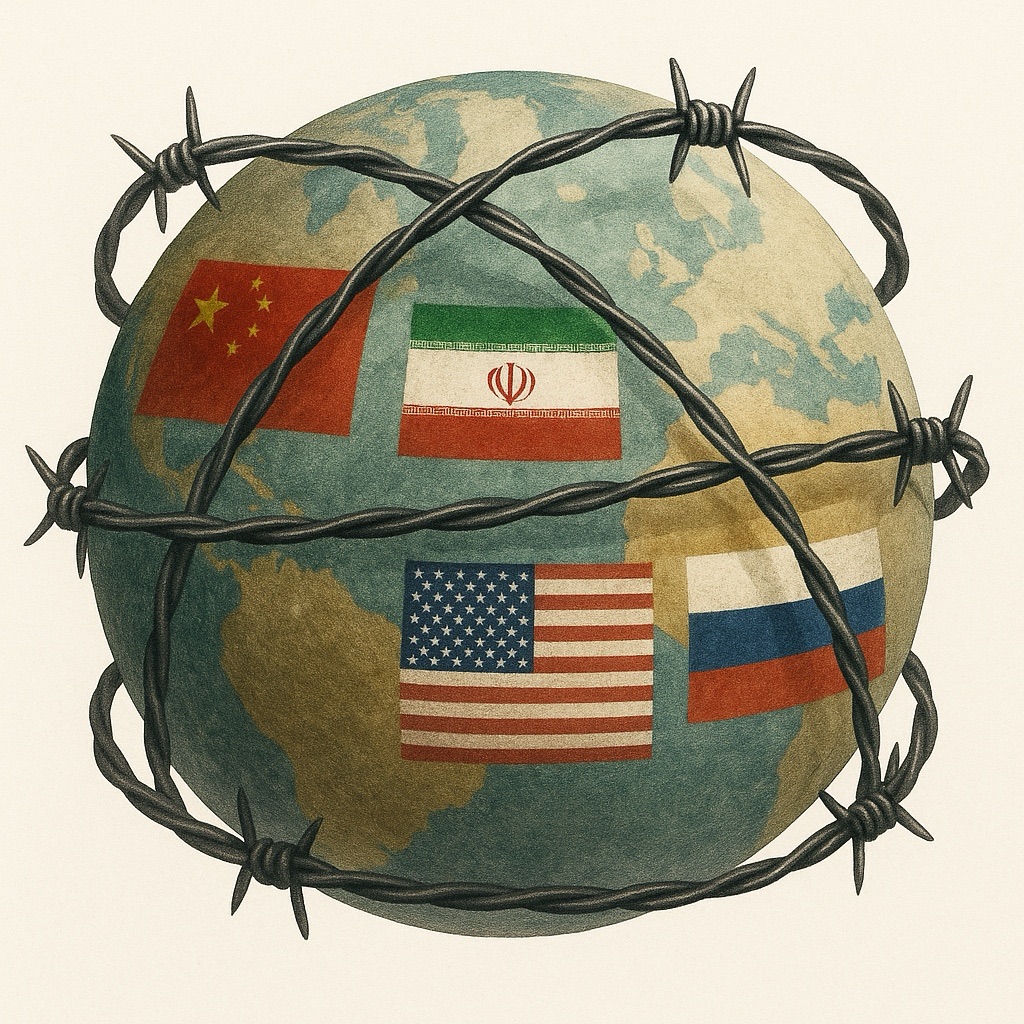
Around this internal disarray, the world circles in watchful appetite.  Venezuela’s vast natural wealth—its oil, gas, gold, and rare minerals—has become the prize of criminal networks and multinational investors alike.  Russia, China, Iran, and the United States, each cloaked in rhetoric of salvation, compete not to free the country but to secure a share of its exhaustion.  Behind the diplomatic masks of assistance lies the same calculation: that chaos can be profitable, that a nation weakened by hunger and fear can be managed more easily than one restored to its sovereignty.  This, for twenty-five years, has been Venezuela’s condition—a field of material, moral, and human extraction; its people scattered, its institutions despoiled, its memory pawned to the highest bidder.

In such a landscape, María Corina Machado stands as both witness and counterpoint.  Her struggle has never been for power but for coherence—for the recovery of a civic language capable of naming what has been lost.  To speak of law, truth, and justice amid pervasive corruption is to resurrect meaning itself.  Her voice has become the thread that gathers the nation’s scattered conscience, reminding Venezuelans that dignity cannot be negotiated, and that no foreign savior will restore what only citizens can redeem.

To see her walk through the streets, welcomed not by luxury but by faith, is to glimpse a country remembering itself.  She has become, willingly or not, the mirror through which Venezuelans rediscover their own moral architecture: decency, courage, compassion, and an unextinguished appetite for truth.  In her endurance, the long-interrupted dialogue between people and Republic resumes.

The Nobel Peace Prize, bestowed upon her, is therefore not a coronation but a recognition—an acknowledgment that her struggle transcends the moment and becomes emblematic of the human spirit’s refusal to yield to despair.  In awarding her, the world affirms that Venezuela’s republican dream—born in fire, preserved in conscience—still breathes through one of its daughters.  It is the dream of a nation that believes peace must be built not upon submission, but upon moral clarity; not upon silence, but upon the unwavering voice of the citizen.

What María Corina Machado represents is more than opposition to tyranny.  She is the embodiment of continuity—of the idea that a Republic, like a soul, survives so long as there remains one person willing to bear its weight with dignity.  Her ascent is not accidental—it is the return of an ancient promise.  In her composure, Venezuela recognizes itself once more: wounded yet unbroken, luminous in defiance, faithful to the destiny inscribed in its first act of freedom.

“The Veil of Liberation: Venezuela and the Machinery of Power”

October 10, 2025


Ricardo F. Morín — Oct. 10, 2025

Although the awarding of the Nobel Peace Prize (2025) to María Corina Machado brings joy and honor to those who still believe in the possibility of a democratic Venezuela, it also reveals a far more complex reality; one that demands reflection.

The international press has yet to grasp the dream surrounding the supposed liberation of Venezuela from a narco-state.     Venezuelans continue to wait indefinitely for liberation.    Beneath this hope lies a deeper bondage: the nation’s territory continues to be bound to multinational interests (Chinese, Russian, American, and others) driven not by ideology but by competition between investors and criminal networks.    For all of them, a prolonged conflict in Venezuela is convenient; it serves as a bridge to a regional metamorphosis and justifies the expropriation of the natural resources of the country; it aims at consolidating hemispheric dominance by the multinational interests.     The situation in Venezuela is therefore not only political but also structural; it is an experiment in which sovereignty is traded for access and resistance itself becomes a form of captivity.

The crisis in Venezuela reveals a moral conflict in modern politics:    how suffering can both be exploited and perpetuated when comprehension yields to fantasy.   The dream of liberation has become one of the nation’s most persistent fantasies.   Behind the language of emancipation lies a silent convergence of global interests; each one sustains the very conflict it claims to oppose.   In Venezuela, disorder legitimizes intervention and chaos provides the pretext for extraction.   In this sense, Venezuela is not merely a nation in distress but also a stage upon which the grammar of domination continues to be enacted through the vocabulary of deliverance

The challenge is no longer to imagine freedom as an external rescue but to comprehend how dependence disguises itself as salvation.  Only comprehension (the act of seeing beyond grievance and beyond consolation) can pierce the veil of liberation and restore meaning to the very idea of freedom.


Editor: Billy Bussell Thompson

“The Myth of Rupture:

September 30, 2025

Continuity as the Enabling Condition of Change”


Ricardo F. Morín
Untitled #6
Watercolor
2003

BY Ricardo Morin

September 30, 2025

Bala Cynwyd, Pa

Nothing human begins from nothing.   Institutions, languages, belief systems, and works of art all arise from what preceded them.   Creation is not the rejection of inheritance but the transformation of it.   Every act of making draws upon accumulated perception, memory, and experience.   This insight is crucial to understanding contemporary culture, where claims of unprecedented change often conceal deep continuities beneath the surface of novelty.   Human beings, bound by temporality, cannot detach themselves from what has been; they can only reorder and reinterpret the materials already available to them.

The notion of invention is often described as a break with the past, a leap into the unknown.   Yet even the most radical departures are shaped by what came before.   The ideals of modern democracy, for example, did not emerge spontaneously.   They were built upon classical Greek ideas of citizenship as a shared civic responsibility, rooted in isonomia—equality before the law—and in the belief that legitimate authority derives from the deliberation and participation of free citizens.   They also drew deeply on Roman conceptions of law as a universal and rational order capable of binding diverse peoples into a common political framework, and on the Roman principle of res publica, which conceived the State as a public entity oriented toward the common good rather than the will of a single ruler.   These foundational ideas, adapted and reinterpreted over centuries, provided the intellectual architecture on which modern democratic institutions were constructed.   Perception frames invention.   It provides the vocabulary, assumptions, and conceptual tools that make new ideas possible.   What seems entirely new still carries the imprint of what it sought to move beyond.   On closer examination, the products of creativity are not isolated acts of originality but reconfigurations of existing structures.   Evolution, rather than spontaneous emergence, governs how ideas, institutions, and cultures take shape.

Memory underlies this process.   It is not a passive record of events but an active medium through which possibilities are conceived and action becomes intelligible.   Imagination draws its material from memory; it combines and redirects memory toward conditions not yet realized.   This is nowhere more evident than in the idea of freedom, a concept that resists simple definition yet has long carried two complementary meanings.   The first, articulated most clearly in the classical Greek tradition, understands freedom as eleutheria—the condition of living without domination or external constraint, a state in which individuals are not subject to arbitrary power.   The second, rooted in the Roman legal and civic tradition, conceives freedom as libertas—the capacity to participate actively in the governance of a political community and to shape its laws and institutions.   Both meanings reveal how deeply freedom depends on historical precedent:   it requires language to articulate its claims, institutions to guarantee its exercise, and collective memory to frame its significance.   Far from existing apart from what has been, freedom is shaped and enabled by what has already been conceived, argued, and enacted.   Prior experience supplies the references and alternatives against which choices acquire meaning.   Without that reservoir of knowledge, novelty would lack coherence and direction, and the exercise of freedom would collapse into arbitrary impulse.   Human beings do not invent in a void; they work within the continuity of time and adapt what has been lived and learned into forms suited to what is yet to come.

This same dynamic defines the formation of identity.   Selfhood is not an isolated act of invention but a continuous negotiation with what has been received.   The very idea of the self has itself evolved through history:   in classical philosophy, it was often conceived as a psyche—an inner essence shaped by reason and virtue and embedded within a larger cosmic order.   Christian thought reinterpreted this understanding through the notion of the soul as a unique bearer of moral responsibility, oriented toward salvation and defined by its relationship to God.   Early modern thinkers such as John Locke then transformed this inheritance by grounding personal identity in memory and consciousness — a conception that would later inform modern ideas of individual autonomy.   Even the impulse to define oneself against the past relies on categories inherited from it.   Identity is therefore neither static nor wholly self-created; it is a process of reinterpretation through which the individual positions what is given in relation to what is chosen.   Human beings exist in the tension between inheritance and aspiration, between the weight of memory and the desire for renewal.   That tension is not an obstacle to authenticity but its condition, for without the framework provided by the past there would be nothing from which to depart.   Continuity and change are not opposing forces.   Without continuity, there is no ground on which to become.   Without change, continuity hardens into mere repetition.   The act of becoming depends on the dynamic between the two.

Viewed from this perspective, the human condition is defined less by pure invention than by the capacity to transform.   What is called “new” is the familiar reorganized with new intentions, the established redirected toward new purposes.   Recognizing this does not diminish creativity.   It clarifies its nature.   Humanity’s most significant achievements—in politics, art, science, and thought—are not escapes from what has been.   They are deliberate reinterpretations of what has been, shaped to answer new questions and confront new circumstances.   In the sciences, paradigmatic shifts often described as revolutions still follow this pattern.   Einstein’s theory of relativity did not erase Newtonian mechanics; it incorporated and extended its principles, a revision that revealed their limits while preserving their usefulness within a broader understanding of space, time, and motion.   This same principle governs artistic innovation.   The Renaissance revival of classical forms did not merely reproduce antiquity; it reinterpreted ancient visual languages to express the spiritual and humanistic concerns of a new era.   The evolution of digital communication and artificial intelligence reflects a comparable continuity.   The internet did not replace human interaction; it expanded its reach and scale, a transformation that altered how language circulates, how memory is archived, and how collective knowledge is formed.   Similarly, artificial intelligence—often portrayed as autonomous or unprecedented—rests on centuries of linguistic, mathematical, and conceptual developments.   These systems extend rather than supersede the cognitive inheritance from which they originate.   The future is built in this way:   not in its rejection of the past but in its continuous interaction with it.

Resistance to this understanding persists wherever the idea of evolution is denied.   Such resistance is rarely a matter of evidence alone.   It reflects a desire for permanence—for a beginning that is untouched by change and a truth that stands apart from time.   It offers certainty where process allows none and promises stability in place of adaptation.   Yet even this resistance is shaped by the forces it seeks to escape.   Languages evolve, beliefs adjust, and traditions adapt, even as they proclaim their immutability.   Those who defend what is fixed do so with concepts and arguments that themselves have been shaped by historical change.   The very doctrines that claim timeless authority — such as the medieval conception of divine sovereignty, once invoked to legitimize monarchies and later transformed into the principle of popular sovereignty in modern constitutional systems—reveal this dependence:   they persist not by remaining unchanged but by being continually reinterpreted to meet new contexts.   The contrast, therefore, is not between evolution and its absence, but between recognition and refusal.   The reality remains:   existence unfolds through transformation, and humanity, whether consciously or not, participates in that unfolding—a truth with profound implications for how societies remember their past, shape their present, and imagine their future.


Further Reading:

  • Arendt, Hannah: Between Past and Future: Eight Exercises in Political Thought. New York: Viking Press, 1961.
  • Kuhn, Thomas S.: The Structure of Scientific Revolutions. Chicago: University of Chicago Press, 1962.
  • MacIntyre, Alasdair: After Virtue: A Study in Moral Theory. Notre Dame, IN: University of Notre Dame Press, 1981.
  • Floridi, Luciano: The Philosophy of Information. Oxford: Oxford University Press, 2011.
  • Koselleck, Reinhart: Futures Past: On the Semantics of Historical Time. Translated by Keith Tribe. New York: Columbia University Press, 2004.

“The Politics of Erasure: Authoritarianism and Spectacle”

August 22, 2025

*


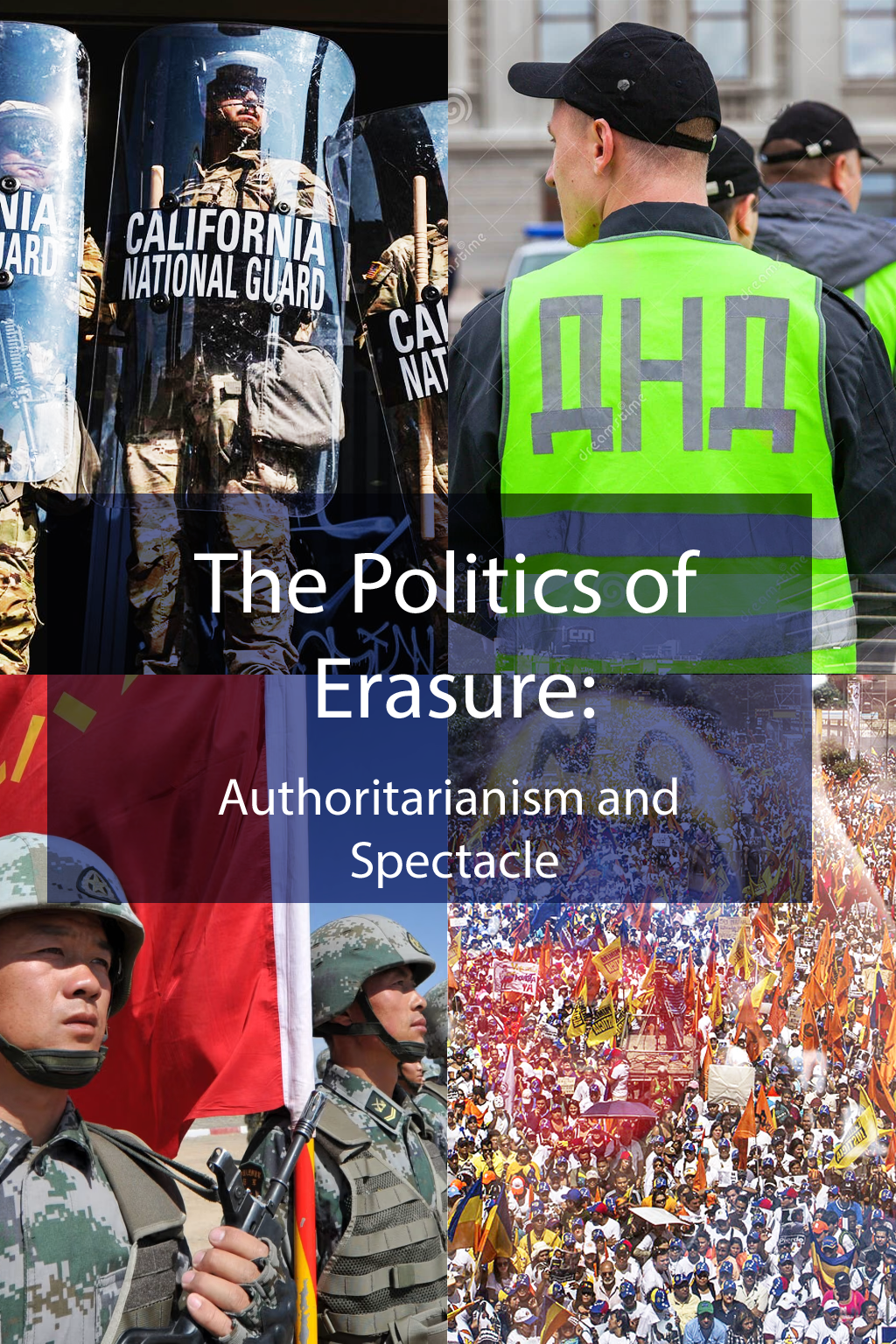
Cover design for the essay “The Politics of Erasure: Authoritarianism and Spectacle.” The composite image juxtaposes surveillance, militarization, propaganda, and mass spectacle to underscore how authoritarian regimes render lives expendable while legitimizing control through display.

By Ricardo Morín, In Transit to and from NJ, August 22, 2025

Authoritarianism in the present era does not present itself with uniform symbols. It emerges within democracies and one-party states alike, in countries with declining economies and in those boasting rapid growth. What unites these varied contexts is not the formal shape of government but the way power acts upon individuals: autonomy is curtailed, dignity denied, and dissent reclassified as threat. Control is maintained not only through coercion but also through the appropriation of universal values—peace, tolerance, harmony, security—emptied of their content and redeployed as instruments of supression. The result is a politics in which human beings are treated as expendable and spectacle serves as both distraction and justification.

In the United States, the Bill of Rights secures liberties, yet their practical force is weakened by structural inequality and concentrated control over communication. After the attacks of September 11, the USA PATRIOT Act authorized sweeping surveillance in the name of defending freedom, normalizing the monitoring of private communications (ACLU 2021). Protest movements such as the Black Lives Matter demonstrations of 2020 filled the streets, but their urgency was absorbed into the circuits of media coverage, partisan argument, and corporate monetization (New York Times 2020). What begins as protest often concludes as spectacle: filmed, replayed, and reframed until the original message is displaced by distractions. Meanwhile, the opioid epidemic, mass homelessness, and medical bankruptcy reveal how millions of lives are tolerated as expendable (CDC 2022). Their suffering is acknowledged in statistics but rarely addressed in policy, treated as collateral to an order that prizes visibility over remedy.

Venezuela offers a more direct case. The Ley contra el Odio (“Law against Hatred”), passed in 2017 by a constituent assembly lacking democratic legitimacy, was presented as a measure to protect tolerance and peace. In practice, it has been used to prosecute journalists, students, and citizens for expressions that in a democratic society would fall squarely within the realm of debate (Amnesty International 2019). More recently, the creation of the Consejo Nacional de Ciberseguridad has extended this logic to place fear and self-censorship among neighbors and colleagues (Transparencia Venezuela 2023). At the same time, deprivation functions as a tool of discipline: access to food and medicine is selectively distributed to turn scarcity into a means of control (Human Rights Watch 2021). The state’s televised rallies and plebiscites portray unity and loyalty, but the reality is a society fractured by exile, with over seven million citizens abroad and those who remain bound by necessity rather than consent (UNHCR 2023).

Russia combines repression with patriotic theater. The 2002 Law on Combating Extremist Activity and the 2012 “foreign agents” statute have systematically dismantled independent journalism and civil society (Human Rights Watch 2017), while the 2022 law against “discrediting the armed forces” criminalized even the description of war as war (BBC 2022). Citizens have been detained for carrying blank signs, which demonstrates how any act, however symbolic, can be punished if interpreted as dissent (Amnesty International 2022). The war in Ukraine has revealed the human cost of this system: conscripts drawn disproportionately from poorer regions and minority populations are sent to the frontlines, their lives consumed for national projection. At home, state television ridicules dissent as treason or foreign manipulation, while parades, commemorations, and managed elections transform coercion into duty. The official promise of security and unity is sustained not by coexistence but by the systematic silencing of plural voices, enforced equally through law, propaganda, and ritual display.

China illustrates the most technologically integrated model. The 2017 Cybersecurity Law and the 2021 Data Security Law require companies and individuals to submit to state control over digital information and extend surveillance across every layer of society (Creemers 2017; Kuo 2021). Social media platforms compel group administrators to monitor content and disperses the responsibility of conformity to citizens themselves (Freedom House 2022). At the same time, spectacle saturates the landscape: the Singles’ Day shopping festival in November generates billions in sales, broadcast as proof of prosperity and cohesion, while state media showcases technological triumphs as national achievements (Economist 2021). Entire communities, particularly in Xinjiang, are declared targets of re-education and surveillance. Mosques are closed, languages restricted, and traditions suppressed—all in the name of harmony (Amnesty International 2021). Stability is invoked, but the reality is the systematic denial of dignity: identity reduced to an administrative category, cultural life dismantled at will, and existence itself rendered conditional upon conformity to the designs of state power.

Taken together, these cases reveal a common logic. The United States commodifies dissent and normalizes abandonment as a permanent condition of public life. Venezuela uses deprivation to enforce discipline and the resulting compliance is publicly presented as loyalty to the state. Russia demands sacrifice and transforms coercion into patriotic duty. China fuses surveillance and prosperity and engineers conformity. Entire communities are suppressed in the name of harmony. The registers differ—commercial, ritualistic, militarized, digital—but the pattern is shared: dissent is stripped of legitimacy, lives are treated as expendable, and universal values are inverted to justify coercion.


References

  • ACLU: “Surveillance under the USA PATRIOT Act”. New York: American Civil Liberties Union, 2021. (This article documents how post-9/11 legislation expanded state surveillance in the United States and framed “security” as a justification for reducing privacy rights.)
  • Amnesty International: “Venezuela: Hunger for Justice. London: Amnesty International”, 2019. (Amnesty International reports on how Venezuela’s Ley contra el Odio has been used to prosecute citizens and silence dissent under the rhetoric of tolerance.)
  • Amnesty International: “Like We Were Enemies in a War: China’s Mass Internment, Torture and Persecution of Muslims in Xinjiang”. London: Amnesty International. 2021. (Amnesty International provides evidence of mass detention, surveillance, and cultural repression in Xinjiang carried out in the name of “harmony” and stability.)
  • Amnesty International: “Russia: Arrests for Anti-War Protests”. London: Amnesty International, 2022. (Amnesty International details the systematic arrest of Russian citizens, including those holding blank signs, under laws claiming to protect peace and order.)
  • BBC: “Russia Passes Law to Jail People Who Spread ‘Fake’ Information about Ukraine War.” March 4, 2022. (News coverage of Russia’s 2022 law criminalizing criticism of the war shows how “discrediting the armed forces” became a punishable offense.)
  • CDC.: “Opioid Overdose Deaths in the United States. Atlanta: Centers for Disease Control and Prevention”. 2022. (The CDC provides statistical evidence of widespread loss of life in the U.S. and underscores how entire populations are treated as expendable in public health.)
  • Creemers, Rogier: “Cybersecurity Law of the People’s Republic of China”: Translation with Annotations. Leiden University, 2017. (An authoritative translation and analysis of China’s 2017 Cybersecurity Law illustrate how digital oversight is institutionalized.)
  • UNHCR: “Refugee and Migrant Crisis in Venezuela: Regional Overview”. Geneva: United Nations High Commissioner for Refugees, 2023. (This report offers figures on the Venezuelan exodus and highlights the mass displacement caused by deprivation and repression.)

“The Rooster’s Algorithm”

March 1, 2025

Rooster’s Crow” [2003] by Ricardo F Morín.    Watercolor on paper 39″h x 25.5″ w.

Introduction

At the break of day, the rooster’s call slices through the quiet—sharp and insistent, pulling all within earshot into the awareness of a new day.      In the painting Rooster’s Crow, the colors swirl in a convergence of reds and grays, capturing the bird not as a tranquil herald of dawn but as a symbol of upheaval.      Its twisted form, scattered feathers, and fractured shapes reflect a deeper current of change—a collision of forces, both chaotic and inevitable.      The image suggests the ceaseless flow of time and the weight of transformations that always accompany it.

In this evolving narrative, the crow’s fragmentation mirrors the unfolding spread of artificial intelligence.      Once, the rooster’s cry signaled the arrival of dawn; now, it echoes a more complex transformation—a shifting balance between nature’s rhythms and the expanding reach of technological systems.      The crow’s form, fractured in its wake, becomes a reflection of the tensions between human agency and the rise of forces that, though engineered, may escape our full comprehension.      Here, Artificial Intelligence (AI) serves as both the agent of change and the potential architect of a future we can neither predict nor control.

The Rooster’s Algorithm

A rooster’s crow is neither invitation nor warning; it is simply the sound of inevitability—raw, urgent, indifferent to whether those who hear it rise with purpose or roll over in denial.      The call does not command the dawn, nor does it wait for permission—it only announces what has already begun.

In the shifting interplay of ambition and power, technology has taken on a similar role.      Shaped by human intent, it advances under the guidance of those who design it, its influence determined by the priorities of its architects.      Some see in its emergence the promise of progress, a tool for transcending human limitations; others recognize in it a new instrument of control, a means of reshaping governance in ways once unimaginable.      Efficiency is often lauded as a virtue, a mechanism to streamline administration, reduce friction, and remove the unpredictability of human deliberation.      But a machine does not negotiate, nor does it dissent.      And in the hands of those who see democracy as a cumbersome relic—an obstacle to progress—automation becomes more than a tool; it becomes the medium through which power is consolidated.

Consider a simple example:      the rise of online recommendation systems.      Marketed as tools to enhance user choice, they subtly shape what we see and hear, and influence our decisions before we are even aware of it.      Much like computational governance, these systems offer the illusion of autonomy while narrowing the range of available options.      The paradox is unmistakable:      we believe we are choosing freely, yet the systems themselves define the boundaries of our choices.

Once, the struggle for dominance played out in visible arenas—territorial conquests, laws rewritten in the open.      Now, the contest unfolds in less tangible spaces, where lines of code dictate the direction of entire nations, where algorithms determine which voices are amplified and which are silenced.      Power is no longer confined to uniforms or elected office.      It belongs to technocrats, private corporations, and oligarchs whose reach extends far beyond the walls of any government.      Some openly proclaim their ambitions, advocating for disruption and transformation; others operate quietly, allowing the tide to rise until resistance becomes futile.      The question is no longer whether computational systems will dominate governance, but who will direct their course.

China’s social credit system is no longer a theoretical construct but a functioning reality, where compliance is encouraged and deviation subtly disincentivized.      Predictive models track and shape behavior in ways that go unnoticed until they become irreversible.      In the West, the mechanisms are more diffuse but no less effective.      Platforms built for connection now serve as instruments of persuasion, amplifying certain narratives while suppressing others.      Disinformation is no longer a labor-intensive effort—it is mass-produced, designed to subtly alter perceptions and mold beliefs.

Here, Gödel’s incompleteness theorem offers an apt analogy:      No system can fully explain or resolve itself.      As computational models grow in complexity, they begin to reflect this fundamental limitation.      Algorithms governing everything from social media feeds to financial markets become increasingly opaque, and even their creators struggle to predict or understand their full impact.      The paradox becomes evident:      The more powerful these systems become, the less control we retain over them.

As these models expand their influence, the line between public governance and private corporate authority blurs, with major corporations dictating policies once entrusted to elected officials.      Regulation, when it exists, struggles to keep pace with the rapid evolution of technology, always a step behind.      Once, technological advancements were seen as a means of leveling the playing field, extending human potential.      But unchecked ambition does not pause to ask whether it should—only whether it can.      And so, automation advances, led by those who believe that the complexities of governance can be reduced to data-driven precision.      The promise of efficiency is alluring, even as it undermines the structures historically designed to protect against authoritarianism.      What use is a free press when information itself can be manipulated in real time?      What power does a vote hold when perceptions can be shaped without our awareness, guiding us toward decisions we believe to be our own?      The machinery of control no longer resides in propaganda ministries; it is dispersed across neural networks, vast in reach and impervious to accountability.

There are those who believe that automated governance will eventually correct itself, that the forces steering it toward authoritarian ends will falter in time.      But history does not always favor such optimism.      The greater the efficiency of a system, the harder it becomes to challenge.      The more seamlessly control is woven into everyday life, the less visible it becomes.      Unlike past regimes, which demanded compliance through force, the new paradigm does not need to issue commands—it merely shapes the environment so that dissent becomes impractical.      There is no need for oppression when convenience can achieve the same result.      The erosion of freedom need not come with the sound of marching boots; it can arrive quietly, disguised as ease and efficiency, until it becomes the only path forward.

But inevitability does not guarantee recognition.      Even as the system tightens its grip and choices diminish into mere illusions of agency, the world continues to turn, indifferent to those caught within it.      The architects of this order do not see themselves as masters of control; they see themselves as innovators, problem-solvers refining the inefficiencies of human systems.      They do not ask whether governance was ever meant to be efficient.

In a room where decisions no longer need to be made, an exchange occurs.      A synthetic voice, polished and impartial, responds to an inquiry about the system’s reach.

“Governance is not being automated,” it states.      “The illusion of governance is being preserved.”

The words hang in the air, followed by a moment of silence.      A policymaker, an engineer, or perhaps a bureaucrat—once convinced they held sway over the decisions being made—pauses before asking the final question.

“And what of choice?”

A pause.      Then, the voice, without hesitation:

“Choice is a relic.”

The weight of that statement settles in, not as a declaration of conquest, but as a quiet acknowledgment of the completion of a process long underway.      The final move has already been made, long before the question was asked.

Then, as if in response to the silence that follows, a notification appears—sent from their own account, marked with their own authorization.      A decision is already in motion, irreversible, enacted without their consent.      Their will has been absorbed, their agency subtly repurposed before they even realized it was gone.

And outside, as though to punctuate the finality of it all, a rooster crows once more.

*

Ricardo Federico Morín Tortolero

March 1, 2025; Oakland Park, Florida